感谢 造园建筑(联系邮箱:info@gardeningarchitects.com)予gooood分享以下内容。更多关于他们:Gardening Architects on gooood
Appreciation towards Gardening Architects (contact: info@gardeningarchitects.com) for providing the following description:
2018年,沈烈毅老师着手策划第三届杭州湾国际公共艺术邀请展,沈老师找到我,邀请我做一个不一样的“雕塑”作品。沈老师与我有着“建筑学缘分”,他的雕塑有着强烈的建筑学式的思考,我们以各自的方式探索“园林”的当代可能。二十个受邀艺术家里,我是唯一一位建筑师,沈老师一直想知道建筑师如何回应“公共艺术”?我脑子里从不乏想法,但总喜欢现状能给我一个“先手”,或者是“残局”。杭州湾新城海港湖公园的湖边,有个废弃的码头,基础做了一半,正好能借此复活,一个曾经公用设施的残局将重生为一个“公共艺术”。
In 2018, Shen Lieyi began curating the 3rd Hangzhou Bay International Public Art Invitational Exhibition. He approached me and invited me to create an unconventional “sculpture.” Shen and I share a certain “architectural affinity”—his sculptures are marked by a distinctly architectural mode of thinking, and we each explore the contemporary possibilities of the “garden” in our own ways. Among the twenty invited artists, I was the only architect. Shen was always curious to know how an architect would respond to “public art.” I never lack ideas, but I have always preferred that the site present me with an “opening move” or a “residual endgame.” By the lake in the Port Lake Park of Hangzhou Bay New Town, there lay an abandoned pier whose foundation had been only half-built. This offered a perfect opportunity for revival—a remnant of a former public facility would be reborn as a “public artwork.”
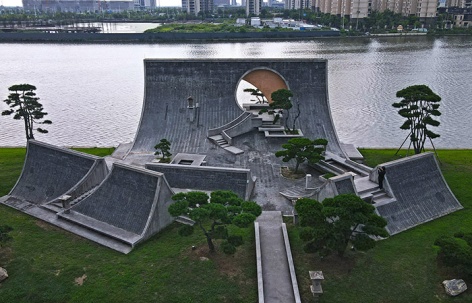
▼项目鸟瞰,aerial view of the project © 造园建筑
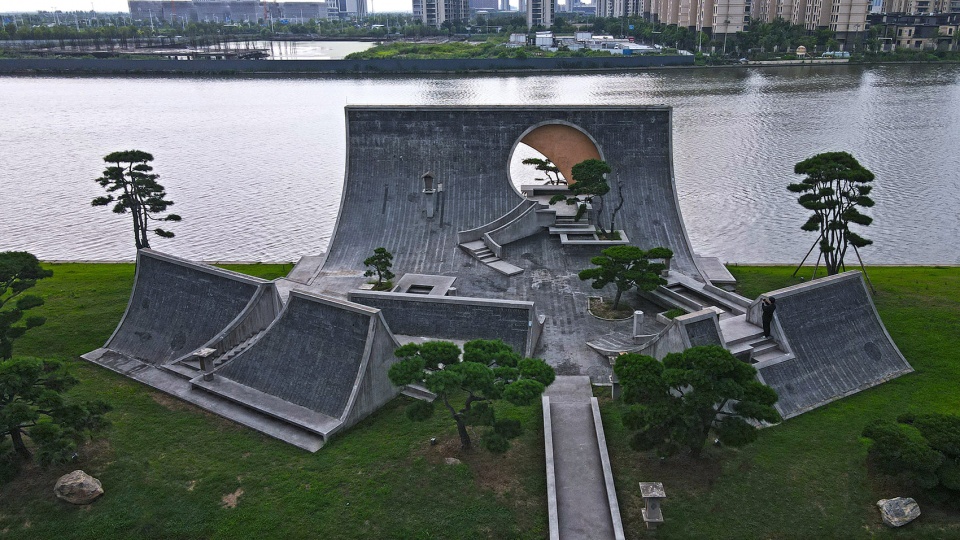
▼历史境遇与新城的撞见,An Encounter Between Historical Circumstances and the New City © 造园建筑
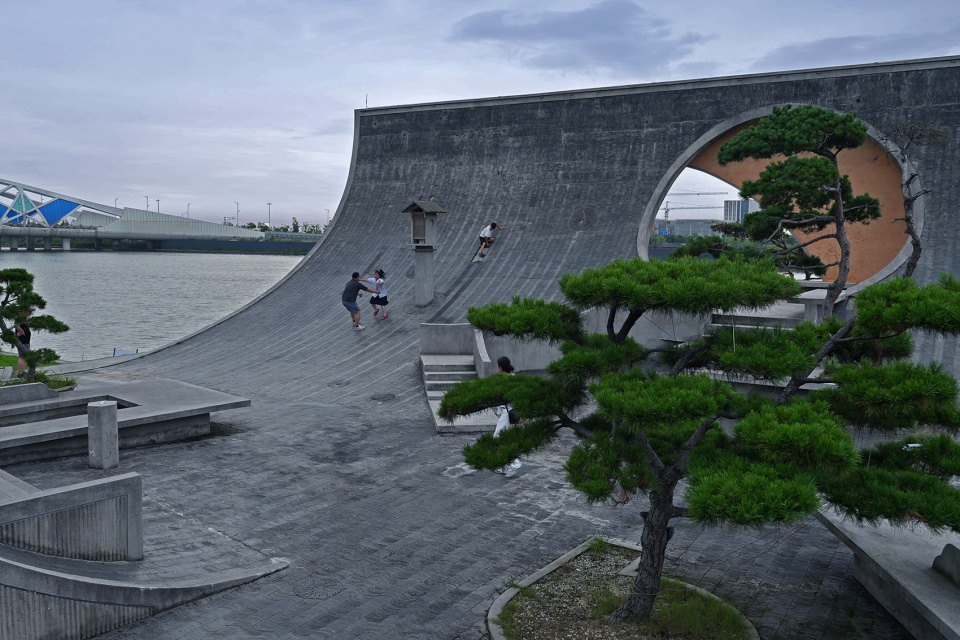
▼等待海月中人,Waiting for the One in the Sea Moon © 造园建筑
转译自然的几何
The Geometry of Transmuted Nature
王澍老师《自然形态的叙事与几何》一文,其核心旨在寻找一种“非欧几里得”的建筑几何,探寻属于中国本土的自然几何。他谈到中国山水画中的“陌生化”与“视差”,这是一种让人重新看见自然的机制,我们太需要打破惯常的思路来重新观看了,建筑师需要用一种决定性的观看来唤醒知觉,需要寻找一种“自然意味”的尺度自由来承载别样的情趣。特殊意图的表达,则需要强大的空间虚构能力,哪怕它看上去不甚合理,因为这个几何并非为了审美,而是为了一种“寻理”与“演理”的叙事。
Professor Wang Shu’s essay “The Narration and Geometry of Natural Form” centres on the search for a “non-Euclidean” architectural geometry—one that belongs to China’s indigenous natural geometry. He speaks of “defamiliarisation” and “parallax” in Chinese landscape painting, a mechanism that enables us to see nature anew. We are in dire need of breaking free from habitual ways of seeing; architects require a decisive act of looking to awaken perception, and a freedom of scale imbued with “natural sense” to carry alternative sentiments. The expression of a special intention demands a powerful capacity for spatial fiction—even if it appears somewhat unreasonable—because this geometry is not for the sake of aesthetics, but for a narrative of “seeking principle” and “enacting principle.”
▼建成初期植松,Pine trees were planted in the early days of the development © 造园建筑
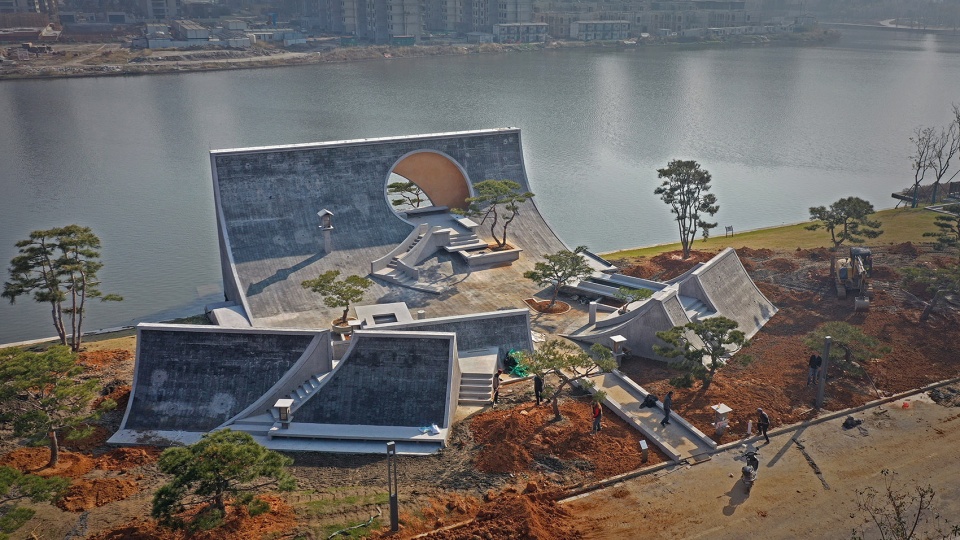
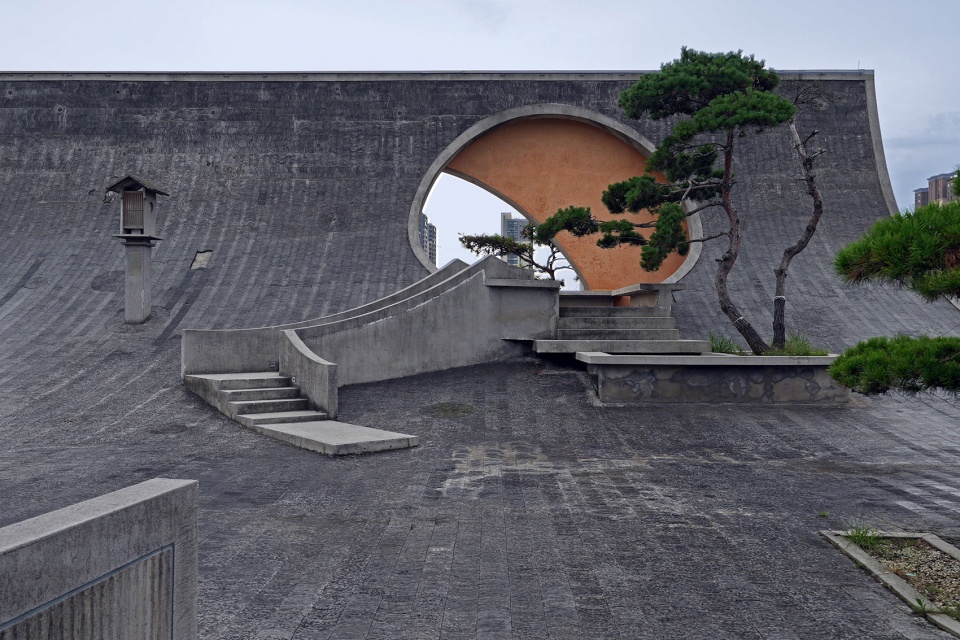
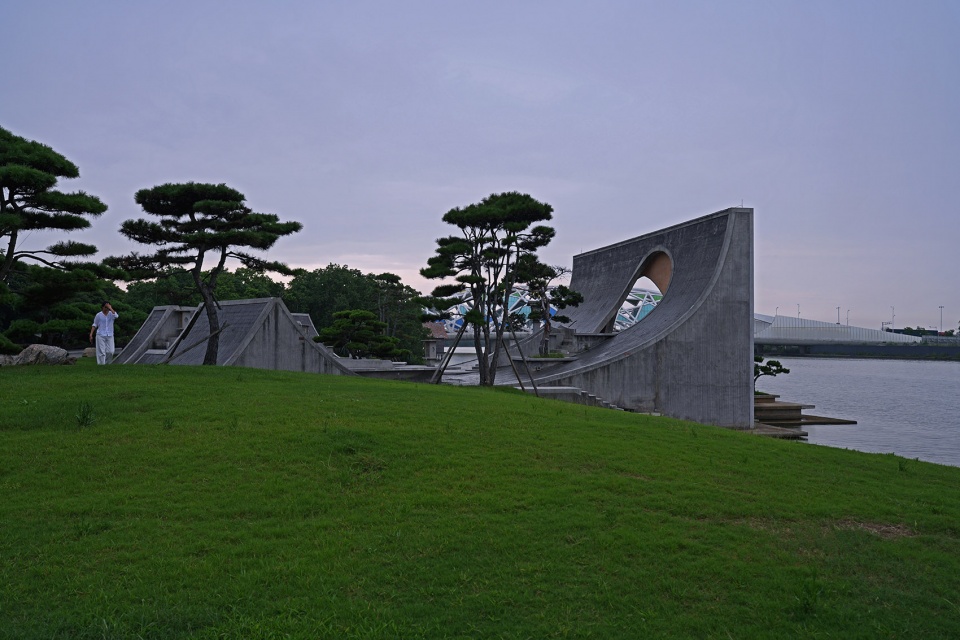
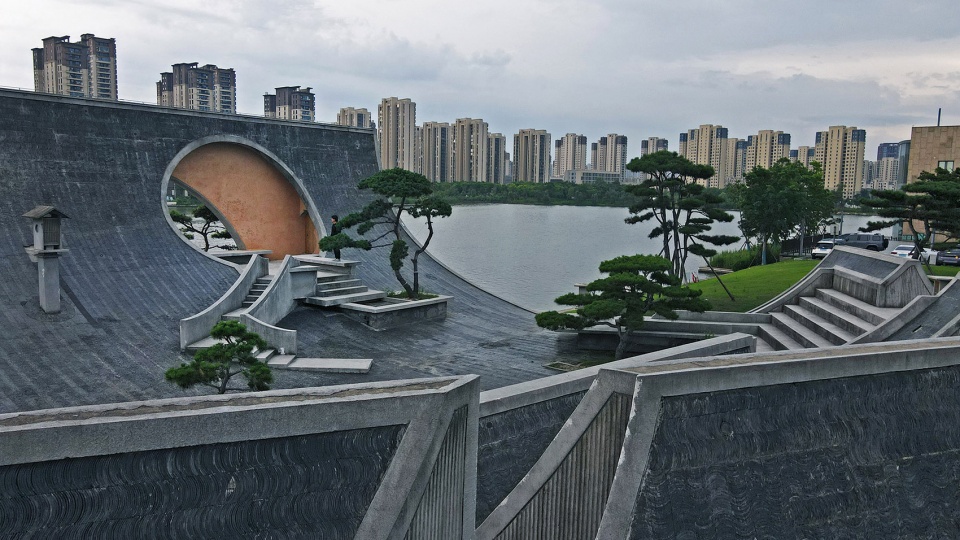
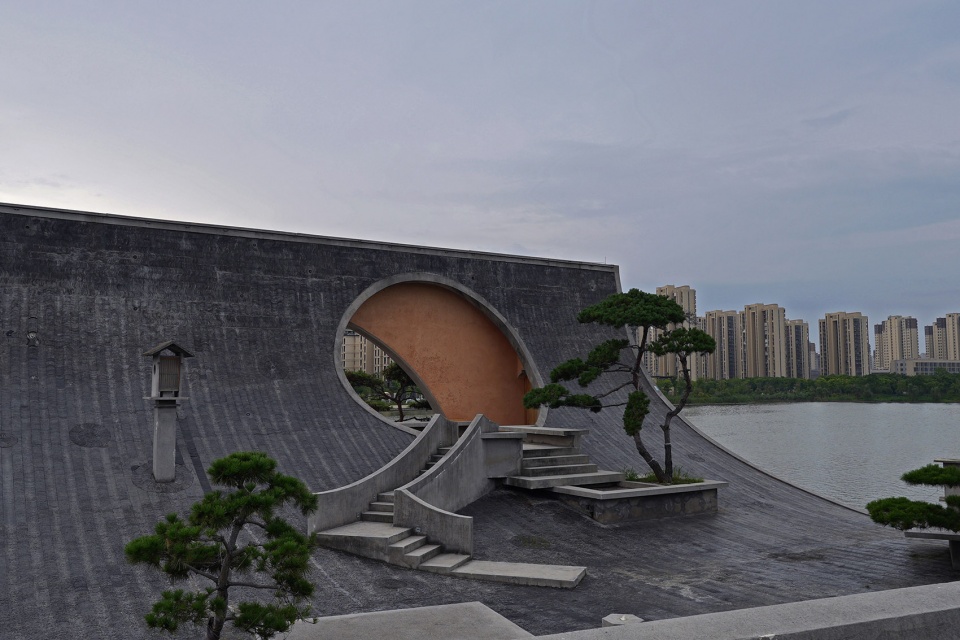
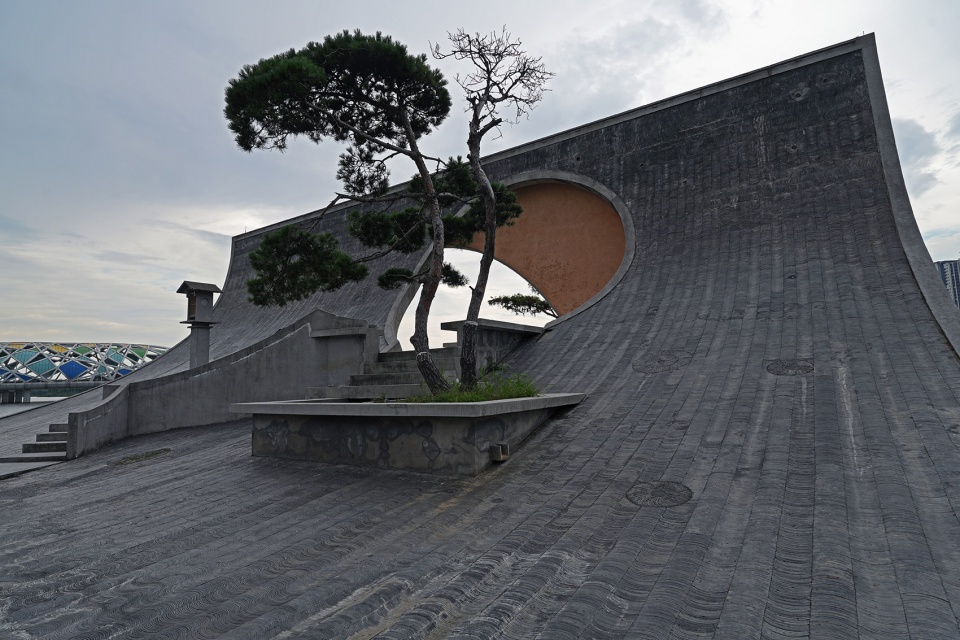
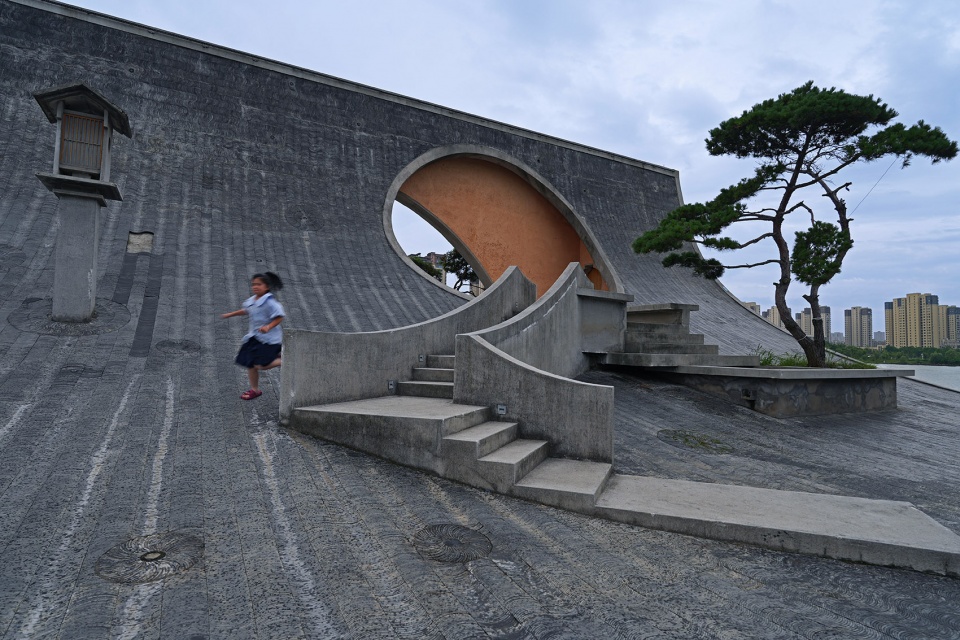
2008年树石论坛,陆文宇老师带着我爬上中国美院象山校区的建筑学院14号楼屋顶,因为屋顶的巨大曲面,几乎没有多大的平面可供正常站立,感觉就是踏在滔天巨浪之上。14号楼在外的形象,是一种山形,而走上屋顶的经验却换做了踏浪。海月剧场的取法,源自这次上屋顶的经验。山形屋顶落下地面,成为踏浪之场,即是一种尺度自由的挪用,也是超越样式的换看。明代有一本文集《鲸背集》,文集主要是记录作者跟随商船在海上航行日常见闻。但就看文集名《鲸背集》,顿时遐思无限,骑鲸捉月,遨游四海,这种神话般想象的境遇,召唤出一组“非常”的几何载体,产生极大的陌生感,用一个又一个的意外来唤醒人们的感知力。一组交叠的“巨浪”,自东向西推进,与杭州湾潮水方向一致。巨浪由一片大浪与三片小浪交叠构成,小浪在前,面向路口,大浪随后,大浪掀起一座屏山,完全了遮蔽了眼前视域,唯有一个月洞穿透浪体,指向远方。小浪在西,有台座随浪升起,坐满人的时候,即是人浪。大浪是舞台,小浪是观众席,小浪前伸出两艘板舫,是船型的贵宾席。演员出入海上明月,观众倚坐浪脊观戏。这是一座自然态的剧场,月洞出入,浪的舞台,浪的观众席,船的坐榻,岛型松池,破浪台阶……这是视觉的自然形态,更重要的是,观演共处在一种涌动之中,处在一种潮汐的呼吸之中,这只是一个瞬间的凝聚,下一个浪涌的周期,是否还能共座,是否还能相遇,是否观演互换了?“巨浪几何”告诉你,这个不静止,不永恒,是人与万物的共沉浮。建筑与园林,就是一个小天体,借此感受自然的演化。
In 2008, during the Shushi Forum, Professor Lu Wenyu took me up to the roof of Building 14 at the School of Architecture of the China Academy of Art’s Xiangshan Campus. The roof’s immense curved surface left barely any level ground to stand on; it felt as if one were stepping onto towering waves. From the outside, Building 14 presents a mountainous form, yet the experience atop the roof transformed it into wave-treading. The Sea-Moon Amphitheater takes its cue from that rooftop experience. A mountain-shaped roof, brought down to the ground, becomes a field for treading waves—a free appropriation of scale and a shift in viewing that transcends stylistic imitation. The Ming dynasty contained a literary collection titled *Jing Bei Ji* ( *On the Back of a Whale* ), which records the author’s daily observations while voyaging at sea on merchant ships. The very title *Jing Bei Ji* instantly evokes boundless reverie—riding whales to catch the moon, roaming the four seas. This mythical imaginary conjures a set of “extraordinary” geometric carriers, producing a profound sense of estrangement that awakens perception through one surprise after another. A cluster of overlapping “giant waves” advances from east to west, in alignment with the tidal direction of Hangzhou Bay. The waves consist of one large wave and three smaller ones overlapping—the small ones in front facing the road, the large one following behind, rising to form a screen-like mountain that completely obscures the view ahead, with only a moon gate piercing through the wave body, pointing into the distance. The small waves to the west have pedestal-like seats rising with the swell; when filled with people, they become a “human wave.” The large wave is the stage, the small waves the auditorium; extending from the small waves are two plank barges, serving as boat-shaped VIP seats. Performers emerge from the bright moon over the sea; spectators recline along the wave ridges to watch the drama. This is a natural-form theatre: entry and exit through the moon gate, a stage of waves, an auditorium of waves, boat-shaped daybeds, an island of pine and pond, steps that break through the waves… It is a visual semblance of nature, but more importantly, the audience and performers share in a state of surging motion, in the very breath of the tide. This is but a frozen moment; in the next tidal cycle, will they still share the same seats, will they meet again, will audience and performer have exchanged places? The “geometry of giant waves” tells you that this is not static, not eternal—it is the rising and sinking of humans and all things together. Architecture and garden are like a small celestial body, through which we sense the evolution of nature.
▼一座自然态的剧场,A theatre in its natural state © 造园建筑
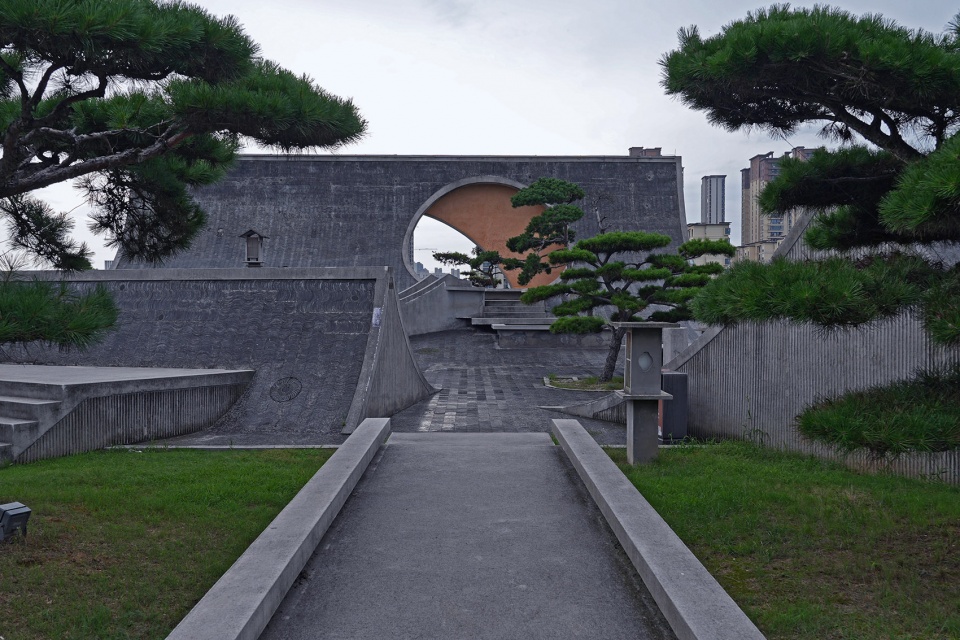
对“巨浪几何”的实验,绝非第一次,一共大大小小做了5个版本。形式探索不是“尝鲜”,而是要反复去试,在不同的功能需求与建造条件下,发现它的潜力。
This experiment in the “geometry of giant waves” was by no means a first; we produced five versions of varying scales. Formal exploration is not about “novelty-seeking” but about repeated trials—testing its potential under different functional requirements and construction conditions.
▼《东方竹》展览序幕空间,Oriental Bamboo Exhibition space © 造园建筑
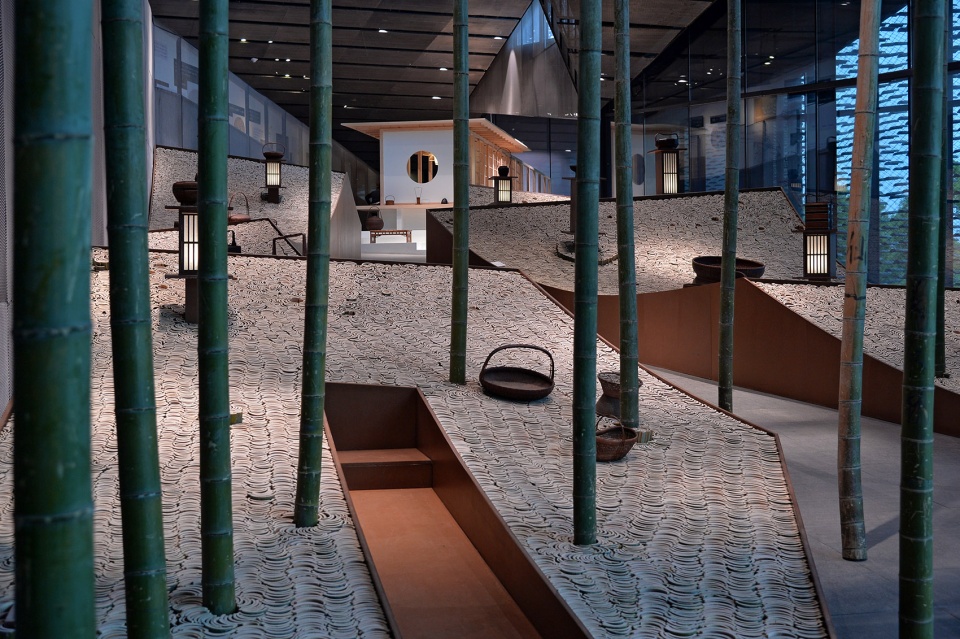
当然,几何的“非常”,亦来自它的不完整,有时候近乎一个“剖面”。我们看郭熙的《早春图》,是一种比较奇幻的视野组织,令人不安的山体涌动与划分,一种剖面的方式,分出了四个象限,指向了四个“安宁祥远”的类型:春游眺溪,渔人晚归,旅船靠岸,城阁山隐。一个近乎十字形的结构,建立了一种理想人间的秩序,特殊几何的运用,在于特殊的意图,这是对宋神宗变法时代的一种图像化的肯定。《早春图》的伟大之处,在于它成功地将一个时代的政治理想和对自然的精微表达融为一体。
▼郭熙《早春图》,Guo Xi’s Early Spring © 郭熙
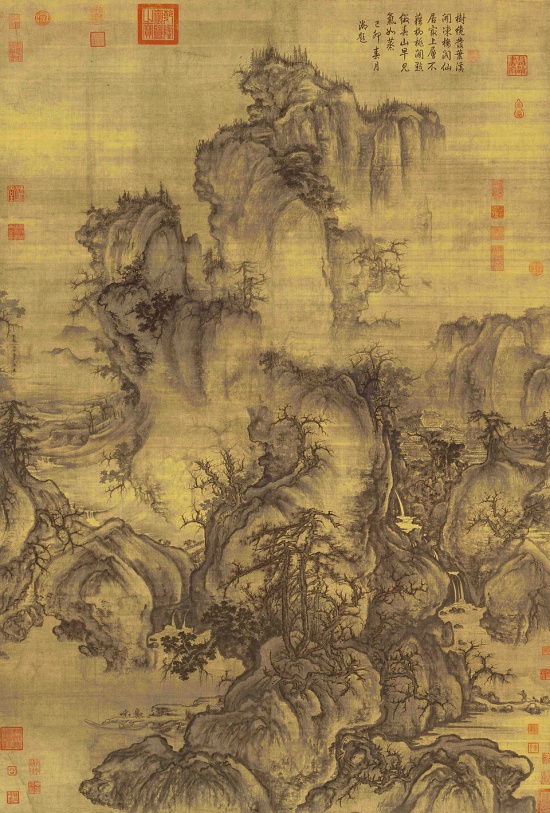
Of course, the “extraordinariness” of the geometry also derives from its incompleteness, at times bordering on a “section.” Looking at Guo Xi’s *Early Spring* , we encounter a rather fantastical organisation of vision—disquieting mountain surges and divisions, a sectional approach that demarcates four quadrants, each pointing to a type of “tranquil and distant serenity”: spring outings by the stream, fishermen returning at dusk, traveller’s boats docking, and city towers hidden among mountains. A near-cruciform structure establishes an ideal human order. The use of a special geometry serves a special intention—this is a pictorial affirmation of the reform era of Emperor Shenzong of Song. The greatness of *Early Spring* lies in its successful fusion of a dynasty’s political ideal with the subtle expression of nature.
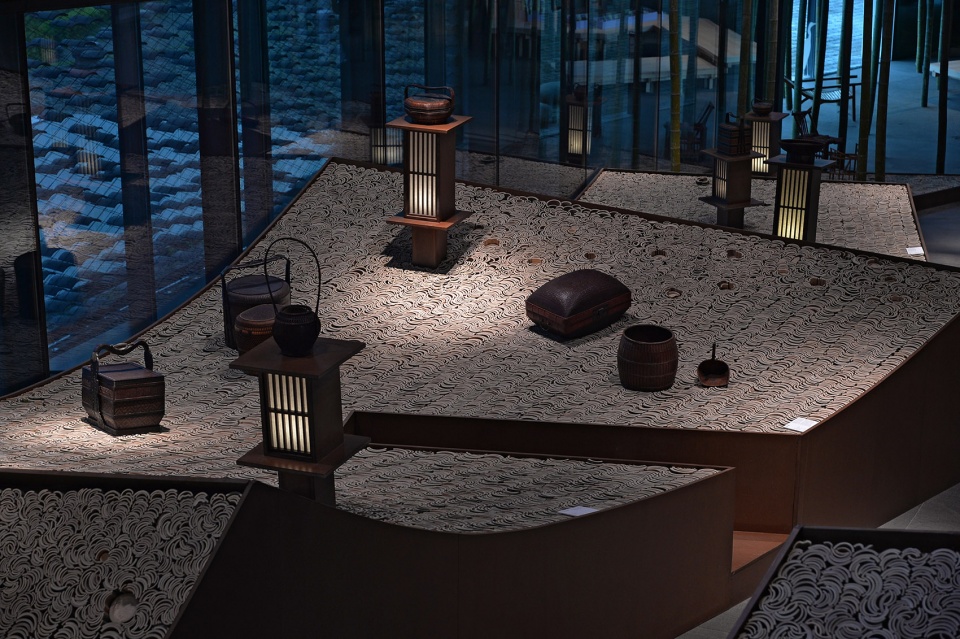
▼《竹海勾沉》园林装置,‘Recalling the Bamboo Sea’ – a landscape installation © 造园建筑
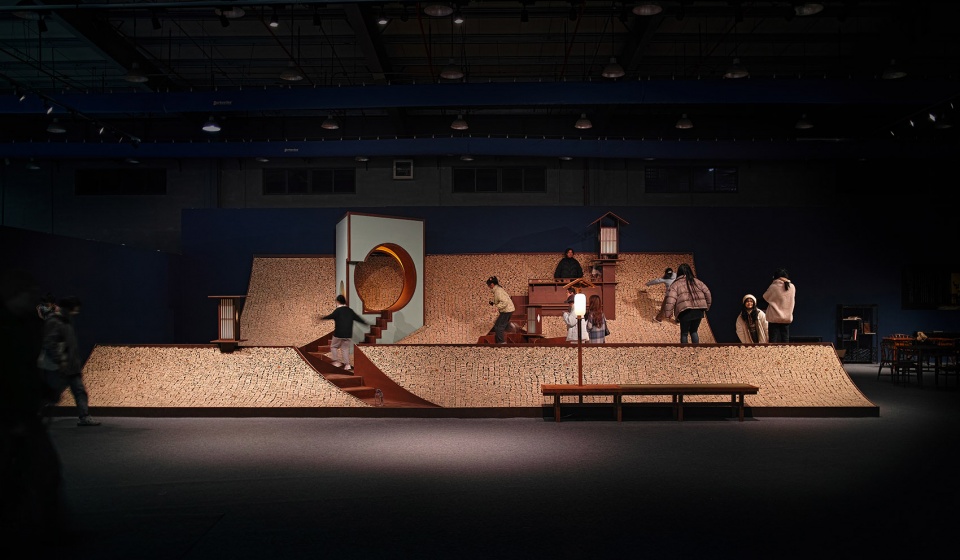
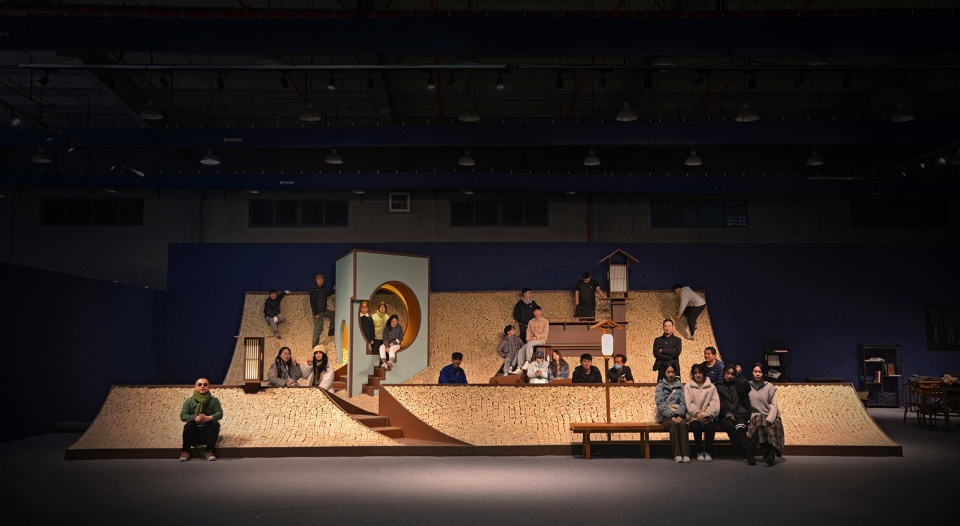
海月剧场里存在两个剖面:
Within the Sea-Moon Amphitheater, two sections exist:
第一个剖面,即浪的侧面,形成一个浪谷,一个巨大的洼地。对内聚合,形成一个能量的发生场;对外,是一个巨大的马鞍形的视野谷地。东面与西面视野皆阻隔,在这个侧面(南北)是一个时空的断面,是两个世界的对峙,让人世间突然撞见了神话的世界。惊艳,都是发生在两种世界的临界之处,而并非绝对意义上的尺度巨大。这个巨大的剖面与周围的草坪仅仅是一两步的高差,路人随意便可闯入这场异时空的聚会,产生天人际会的诧异与惊喜。
The first section is the side view of the waves, forming a wave trough—a vast hollow. Inwardly, it gathers energy, creating a field of generative force; outwardly, it presents a huge saddle-shaped valley of vision. Views to the east and west are both obstructed; from this side (north-south), it is a spatio-temporal cross-section, a confrontation between two worlds—suddenly crashing the human world into the mythical. Moments of astonishment always occur at the threshold between worlds, not merely in absolute magnitude. This immense section is only a step or two above the surrounding lawn; passers-by can casually wander into this encounter with an alien time-space, experiencing the wonder and surprise of a meeting between heaven and man.
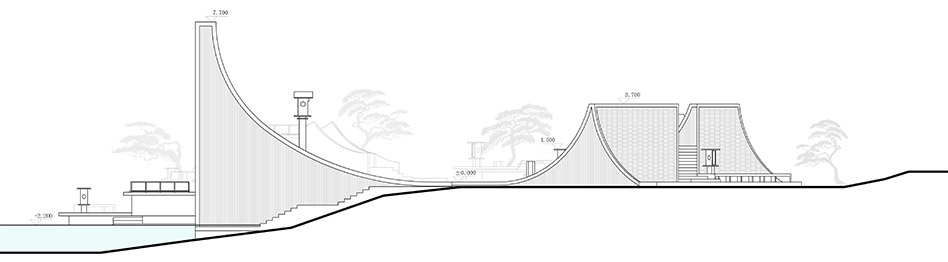
▼剧场北侧面,North elevation of the theatre © 造园建筑
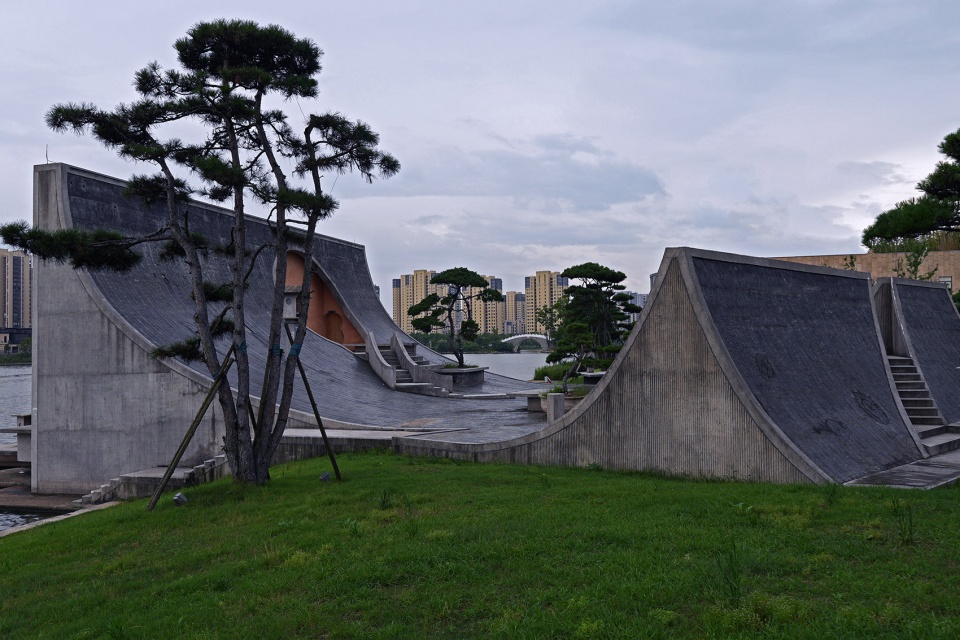
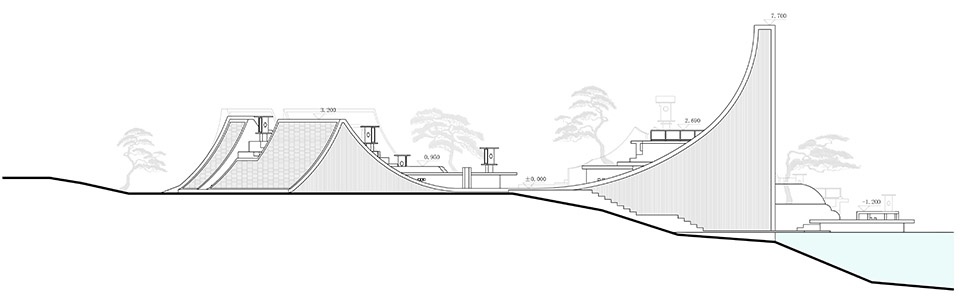
▼剧场南侧面,South elevation of the theatre © 造园建筑
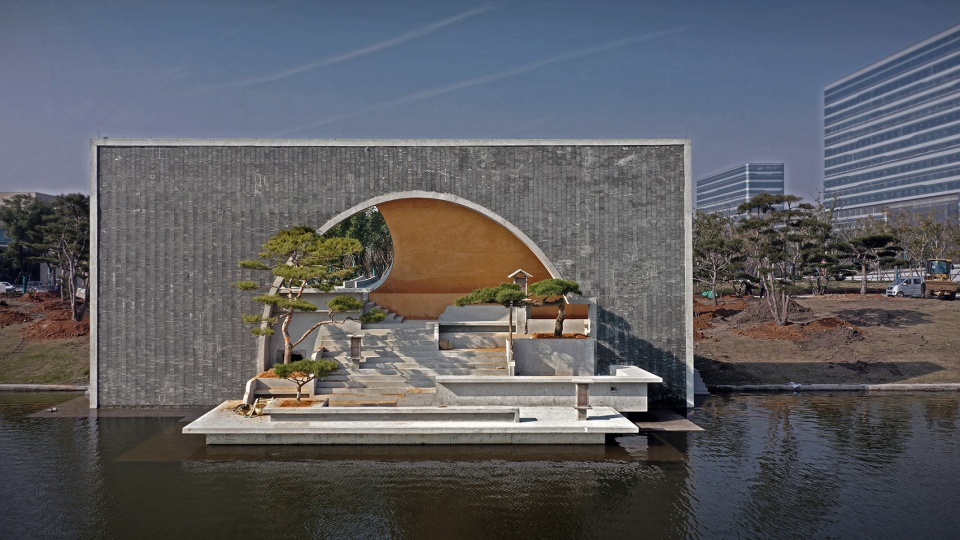
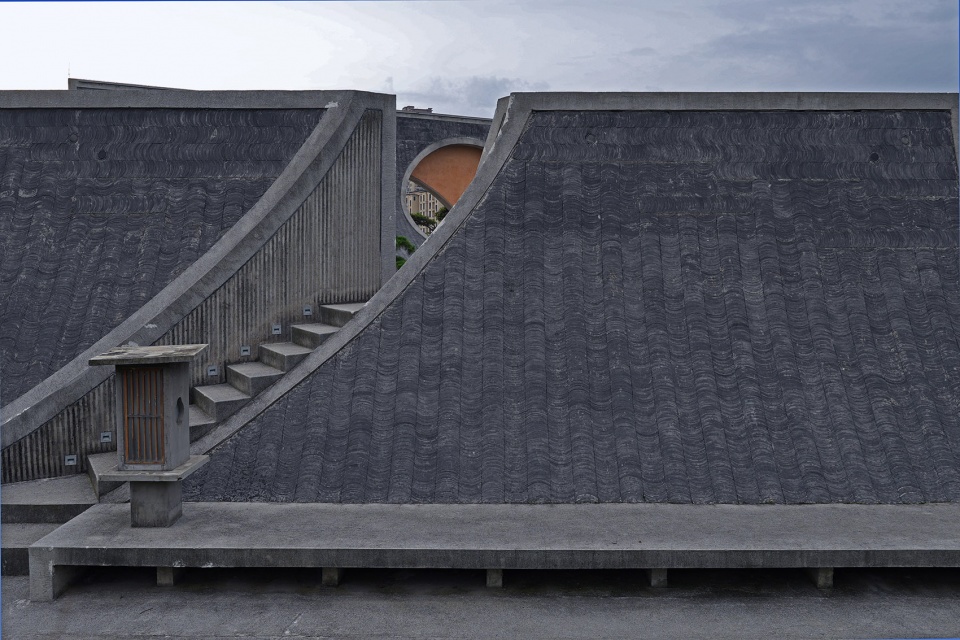
第二个剖面,在大浪的后面。视野陡然旋转了90度,大浪被横向的剖切了。造园,总是要遇到边界,边界是世界结束的地方,也应该是另一个世界开始的界面。传统园林叠山有“截溪断谷”之法,即是一种以局部指代无尽的幻术,用地有限,做一种完型,还是一种不完整型?山水画是囊括不尽山水的,所以山水画皆是“节点”,“转折点”,“关键的局部”等的表达,山水画总是要剖切与换界。最大的那片浪掀起之后,戛然而止,不再做外形的连续,而是将视野直接转换成为巨浪内部的世界,是蒙太奇,陡然切换了一个镜头。镜头变了,观众也变了,观看方式也变了,是水底,还是另一世界的叙事?浪作为一种界面,成就三个世界的穿梭。浪中是“骑鲸捉月”,浪的侧面是与人世间的邀约加入,而浪的反面打开了一场隔世隔岸的远观。戛然而止,是一种推远,《溪岸图》中,群山以茅亭作为结束,一角的湖水,是新的世界的开始,那个茅亭是结束,也是一个开始。大浪的后面,是后场,也是另外一个舞台。我一直有个顽皮的设计概念,叫做《永不谢幕的舞台》一场演不完的戏,下场即是另一个舞台的上台。
▼董源 《溪岸图》,Dong Yuan, View of the Riverbank © 董源
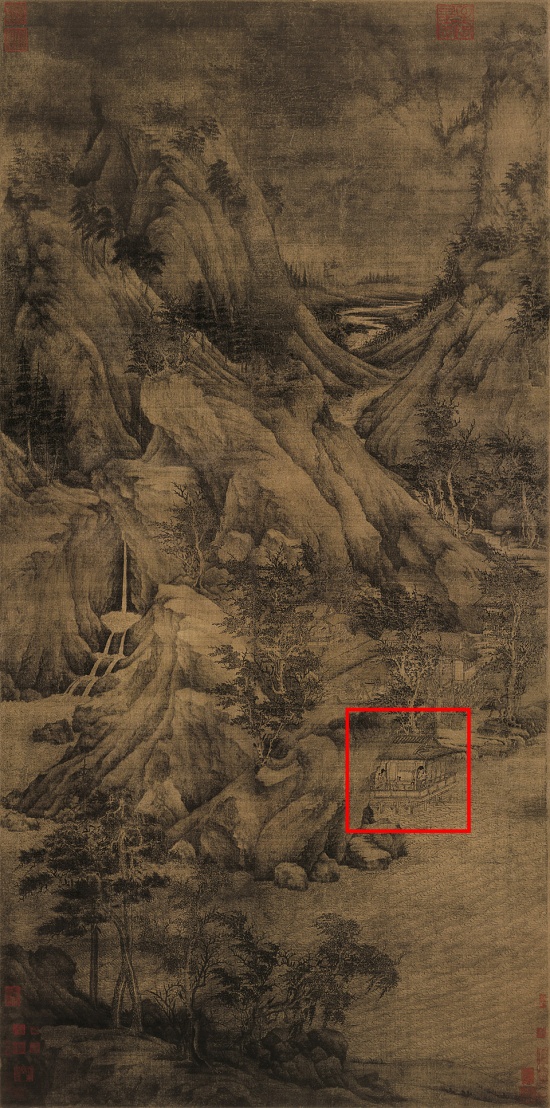
The second section lies behind the large wave. The view abruptly rotates by 90 degrees; the large wave is sliced horizontally. In garden-making, one always encounters boundaries—the boundary is where one world ends, and should also be the interface where another begins. Traditional rockery piling has the technique of “cutting streams and breaking valleys”—a kind of illusion that uses a part to imply the infinite. With limited land, do we create a Gestalt or an incompletion? Landscape paintings never exhaust the mountains and waters; they are all “nodes,” “turning points,” and “crucial fragments.” Landscape painting always involves sectioning and boundary-shifting. After the largest wave surges up, it comes to an abrupt halt—no longer continuing its external form, but instead switching the view directly into the interior world of the giant wave. It is montage, a sudden cut to another shot. The shot has changed, the spectator has changed, the mode of viewing has changed—is it underwater, or the narrative of another world? The wave, as an interface, enables traversal among three worlds. Within the wave is “riding the whale to catch the moon”; at its side is an invitation extended to the human world; while the reverse side opens up a distant viewing from across the shore and across time. The abrupt halt is a pushing-away. In *Streams and Mountains Without End*, the mountain mass ends with a thatched pavilion; a corner of lake water marks the beginning of a new world—that pavilion is both an ending and a beginning. Behind the large wave is the backstage, and also another stage. I have long harboured a playful design concept called “The Stage That Never Curtains”—a play that never ends; exiting the stage is merely entering another.
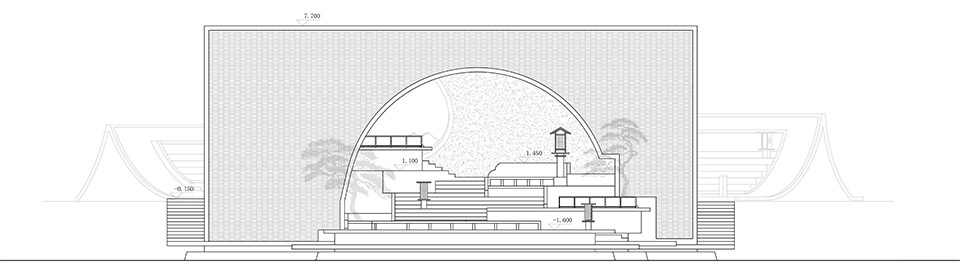
▼大浪的剖面,Cross-section of a large wave© 造园建筑
▼骑鲸背捉月,Riding a Whale to Catch the Moon © 造园建筑
园林的方法
The Garden Method
有人会用“像不像园林”来质疑“海月剧场”,我们先来说说园林中最重要的“假山”,假山,为何为“假”山,而不是“小”山,或者是“代”山?假山的一个基因,就是仙山或者洞天,就是那个假想出来的彼岸世界,甚至是一种实体化的图腾,这个“假”首先是“假想”。真山从来不是假山营造的唯一标准,苏州狮子林的假山是道家做法的地方,于是形态云蒸霞蔚;织帘老屋的前假山,是一个时间周回的转换轴,它的作用就是建立几个象限世界和时间转换,是一团“蒙太奇”;五峰园的假山是五老峰,寓意“五老聚会”,指向仙人与圣贤;苏州西园寺的假山,是大鼋形态的模拟;天一阁的主假山“九师一象”,作为正常的山水景之外 ,更是将“防火、读书、求仕、吉祥”融为一体的精神图腾,凝结了一个中国文人对文化与家族传承的强烈愿景。这个“假”,是“假借”。
Some may question whether the Sea-Moon Amphitheater “resembles a garden.” Let us first consider the most important element in gardens: the “*jiashan*” (artificial mountain). Why is it called a “*jia*” (false/imagined) mountain, rather than a “small” mountain or a “substitute” mountain? One of the genes of *jiashan* is the immortal mountain or grotto-heaven—that imagined other shore, even a kind of embodied totem. This “*jia*” is first and foremost “imaginary.” Real mountains have never been the sole standard for *jiashan* construction. The rockery of the Lion Grove Garden in Suzhou follows Daoist principles, hence its forms are vaporous and mist-veiled. The front rockery at Zhilian Laowu functions as an axis for cyclical time-transformation; its role is to establish several quadrant worlds and temporal transitions—a cluster of “montage.” The rockery of Wufeng Garden represents the Five Elders Peaks, signifying the gathering of immortals and sages. The rockery at Suzhou’s West Garden Temple mimics the form of a giant soft-shelled turtle. The main rockery at Tianyi Pavilion, “Nine Masters and One Elephant,” stands beyond the ordinary landscape view, integrating “fire prevention, scholarship, official ambition, and auspiciousness” into a spiritual totem—crystallising a Chinese literatus’s profound vision for culture and family legacy. This “*jia*” is “borrowing.”
▼历史境遇与新城的撞见,An Encounter Between Historical Circumstances and the New City © 造园建筑
我们再回看《早春图》中的“假山”——因为是一种政治叙事的愿景,居中的分景主峰,关联着北斗七星以及苍龙星宿,是政治祥瑞的隐喻,所以其形态的怪异,我们一直疑惑不解。假山从一开始,就不是单纯的对自然山的审美延续,而更多是一种人造愿景的实现手段,它服务于人的虚构。假山是一种关于生命能量与秩序祝仪的叙事几何体,这与案头庭院赏石是相通的,只是假山可以营造,它可以指代这个,也可以指代那个,在传统造园中,它是一个近乎万能的虚构物质。假山不仅是虚构物质,还是虚构手段,假山是一种蒙太奇。假山的营造,就是一种“奇怪而近理”的东方几何。2006年,我从王澍与董豫赣老师苏州园林游,两位老师几乎同时谈到:“中国园林中最具建筑设计意味的,不是房子,而是假山。”
Let us revisit the “*jiashan*” in *Early Spring*—because it embodies a vision of political narrative, the central peak that divides the scene is associated with the Big Dipper and the Azure Dragon constellation, a metaphor for political auspiciousness. Hence its bizarre form, which has long puzzled us. From the very beginning, *jiashan* was never merely an aesthetic extension of natural mountains, but rather a means of realising human-made visions, serving human fiction. *Jiashan* is a narrative geometry of life energy and ritual order—this is akin to scholar’s rocks on desks and in courtyards, only that *jiashan* can be constructed on a larger scale. It can signify this or that; in traditional garden-making, it is a nearly omnipotent fictive substance. *Jiashan* is not only fictive substance but also fictive means—it is a kind of montage. The construction of *jiashan* is an Eastern geometry that is “strange yet near to principle.” In 2006, during a garden tour in Suzhou with Professors Wang Shu and Dong Yugan, both of them remarked almost simultaneously: “In Chinese gardens, what most embodies architectural design thinking is not the buildings, but the *jiashan*.”
▼掀起一座屏山,To lift a mountain of screens © 造园建筑
园林根本不是在复制和模仿自然,园林是用自然之道,对自然重新分类,创造另外一种虚构的叙事。中国园林看上去很“正常”,原因大致有三:首先,以自然物作为载体与营造材料;其次,建筑是正常的,规制化的,且建筑语言没有发展。第三,园林沿袭时间太久了,样式化,程式化了。于是,我们认为园林就只能是这个样子,把园林当做符号和样式来看,这是对它的刻板印象。事实上,园林是基于情趣与理想的一种创造愿望与方法,是一种集体同构化的心理图示与设计构造,它不仅表现在实际土建营造的园林中,更多的样态存在于中国的文学、雕塑、清玩、器具、戏剧、绘画之中,这是一个更加广阔的园林视野和实验天地,也是无尽的宝藏,更是园林不灭的土壤,是园林随物赋形的柔软弹性的印证。
The garden is by no means a copy or imitation of nature; rather, it employs the way of nature to reclassify nature and create an alternative fictional narrative. Chinese gardens appear quite “normal” for roughly three reasons: first, they use natural objects as carriers and building materials; second, the architecture is conventional and standardised, with little development in architectural language; third, the garden tradition has persisted so long that it has become stylised and formulaic. Consequently, we assume that gardens can only be this way, treating them as symbols and styles—a stereotype. In fact, the garden is a creative aspiration and method based on taste and ideal, a collectively isomorphic psychological schema and design construct. It exists not only in physically constructed gardens, but in even greater variety within Chinese literature, sculpture, playthings, utensils, drama, and painting. This is a broader horizon and experimental field for gardens—an inexhaustible treasure, the undying soil of gardens, and proof of their soft elasticity in taking form according to the object.
▼奔跑于浪间,Running through the waves © 造园建筑
王澍老师提出了“园林的方法”的倡议,是在这个时代背景之下,对传统园林的“警惕与保持距离”,本质上是一种方法论上的策略,是为了剥离那些附着在传统之上的、陈旧的审美趣味和文学修饰,用一种更陌生化、更直接的方式,去重新发现和激活“自然形态”中蕴含的、可以为当代建筑所用的“理”与“情趣”,进而重新掌握这个“转译自然之力”的几何方法。
Professor Wang Shu’s advocacy of the “garden method” is, in this contemporary context, a call for “vigilance and distance” from traditional gardens. It is essentially a methodological strategy—to strip away the stale aesthetic tastes and literary embellishments附着 on tradition, and to rediscover and reactivate, through defamiliarisation and greater directness, the “principle” and “taste” inherent in “natural forms” that can serve contemporary architecture—thereby re-mastering this geometric method of “transmuting the force of nature.”
▼斜上破浪,Cutting Through the Waves at an Angle © 造园建筑
自然叙事的剧场
The Theatre of Natural Narrative
回想勘察现场的那天晚上,杭州湾夜晚的滩涂,海天一体,明月空悬。一时间,唐代张若虚的那首《春江花月夜》响彻内心,古人试图将人生经验与天地运行统一起来,创造天地忧思与人世风景之交响,超广域的观照与秋毫心绪之来去自由,往生与今世之侧身交遇,以明月为镜,照见了人世中种种命运风景,升起一种近乎慈悲超拔的总体关照。明月,作为一种万古景物,参与了种种人世境遇的营造与见证。张若虚,用文字营造了一系列的“明月见证剧场”。
▼左:李嵩《月夜看潮图》;右:苏轼诗句:寄语重门休上钥,夜潮留向月中看,left: Li Song, Viewing the Tide on a Moonlit Night; Right: A verse by Su Shi © 李嵩 & 苏轼
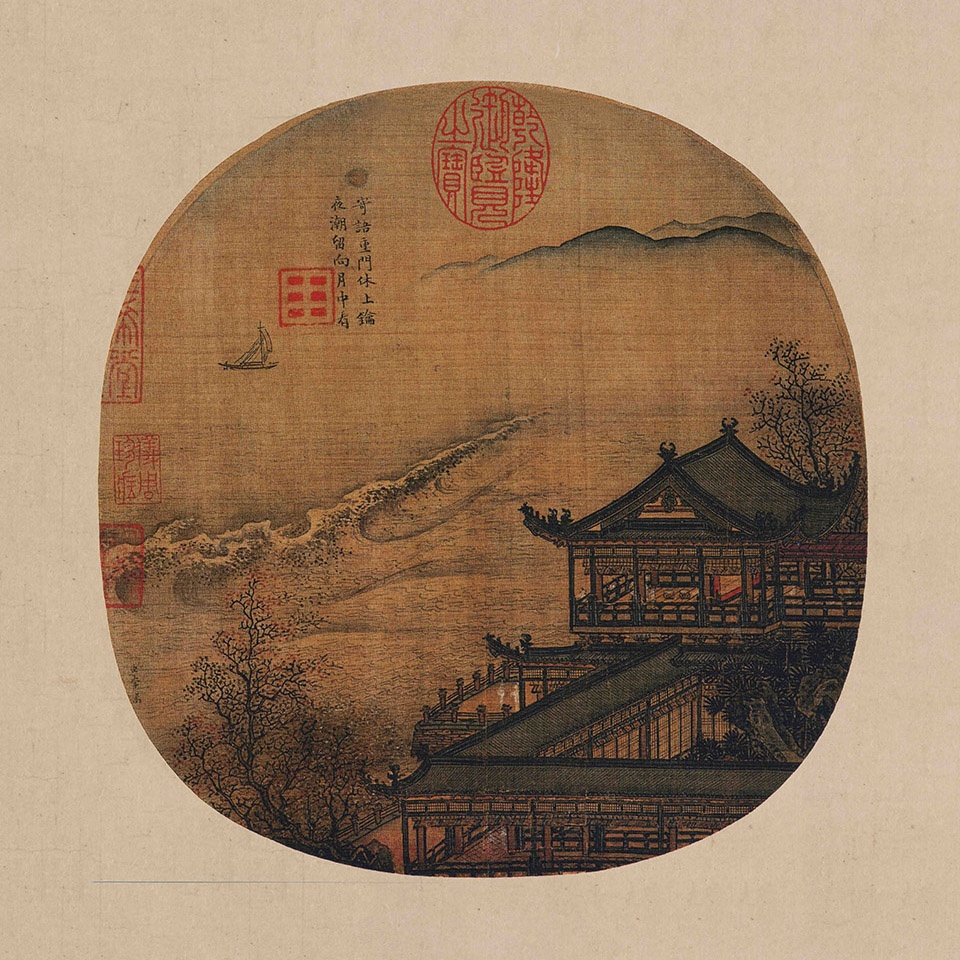
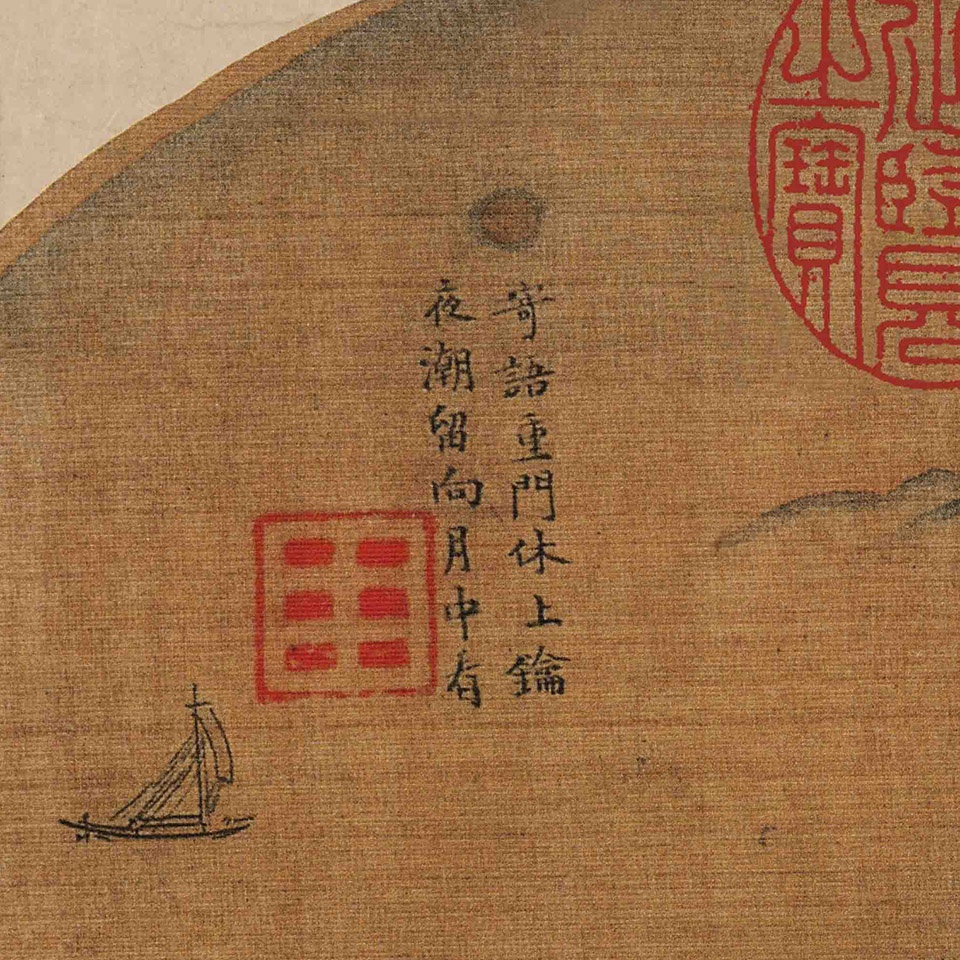
Recalling the evening of the site visit: the tidal flats of Hangzhou Bay at night, where sea and sky merged, and the bright moon hung in the void. At that moment, Zhang Ruoxu’s Tang-dynasty poem “Spring River, Flower Moon Night” resounded within me. The ancients sought to unify human experience with the movements of heaven and earth, creating a symphony of cosmic contemplation and human scenery—a transcendent panorama in which the minutest emotions roamed freely, where past lives and the present moment crossed paths. With the bright moon as mirror, they beheld the varied landscapes of human fate, giving rise to a nearly compassionate and transcendent universal gaze. The moon, as an eternal scene, has participated in the making and witnessing of countless human circumstances. Zhang Ruoxu, through words, created a series of “theatres of moonlit witness.”
▼海月剧场轴测图,Isometric Drawing of the Sea-Moon Amphitheater © 造园建筑
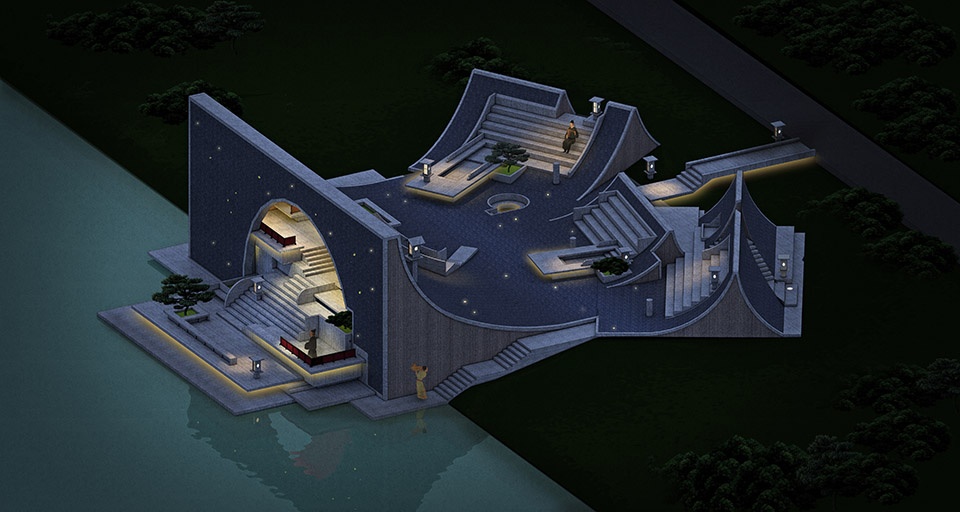
内心升起这样的诗,是因为一直想要营造一个境遇来回应古人,回应这潮汐,回应这里千年来一面欣赏着自然奇观,一面与潮汐灾害斗争的“勇立潮头”精神。当代建筑师创造意境,建筑并不是复现或者模仿传统诗意,而应该建立一种对等的“古今关系”,刘畑老师曾经在策展《唐诗之路》时聊起:“如今我们有什么作品,是好意思拿给李白看的”,我们与古人造境,应是一种“问答”与“唱和”的关系,古人用诗歌创造了一场历史境遇,今天的建筑师用几何与材料造一个时空剧场。
This poem arose in my heart because I had long wished to create a circumstance that would respond to the ancients, to this tide, to the spirit of “courageously standing at the forefront of the waves”—a spirit that has for a thousand years both appreciated this natural marvel and struggled against tidal disasters. For contemporary architects to create artistic conception, architecture should not reproduce or imitate traditional poetics, but rather establish a commensurate “relationship between ancient and modern.” Liu Tian once remarked during curating the exhibition “The Road of Tang Poetry”: “What works do we have today that we would feel comfortable showing to Li Bai?” Our engagement with the ancients in creating circumstances should be a dialogue of “question and answer,” of “singing in harmony.” The ancients used poetry to create historical circumstances; today’s architects use geometry and materials to build a theatre of time and space.
▼对岸所见另一座剧场,Another theatre visible across the river © 造园建筑
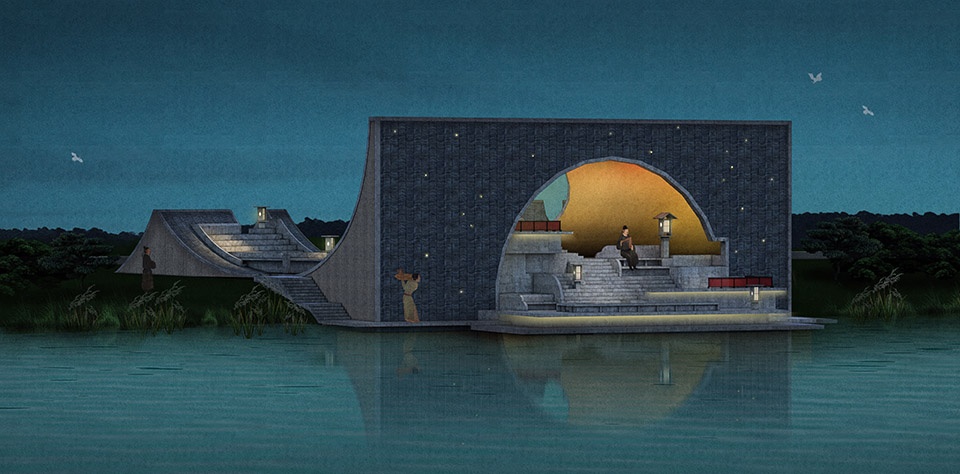
很多人说我们的作品都具有舞台感,我们不是简单地做设计,而是主动地创造一种“历史性境遇”,且以这个作为责任。在二十余年的教学中,有一个主题一直没有中断过,即《中国诗空间》,发掘诗歌中时空组织与叙事结构,找到古人的观想方式,再试图复现或者转译中国的诗境遇,以此来重新找回我们的建筑语言。我记得有一年,有个学生选择了李白的《玉阶怨》,一首不能再小的诗,是关于几步台阶之上的一种无望等待。李白,是懂运镜的导演,创造了一部半分钟的电影,语言却只有20字。我们看到了台阶的可能性,层层阶推再转圜,放大时间的流痕,释出空间的孤寂感。空间的营造并非为了空间自身的静态审美,而是为了某个“艺术时刻”,这是空间生成的动机。一如千利休的“待庵”,这个“待”字,说明了茶室的目的,这是一座为了某个时刻而生成而演进的茶室。
Many say our works have a theatrical quality. We do not simply design; we actively create “historical circumstances,” and regard this as our responsibility. Over more than twenty years of teaching, one theme has never ceased: “Chinese Poetic Space”—exploring the spatio-temporal organisation and narrative structures in poetry, uncovering the ancients’ modes of contemplation, and attempting to reproduce or translate Chinese poetic circumstances, in order to rediscover our architectural language. I recall one year when a student chose Li Bai’s “Jade Steps Grievance,” a poem so small it concerns a hopeless wait upon a few steps. Li Bai was a director who understood camera movement, creating a half-minute film in just twenty characters. We saw the potential of steps—layer upon layer, turning and circling, magnifying the traces of time, releasing the solitude of space. Spatial construction is not for the static aesthetics of space itself, but for a certain “artistic moment”—this is the motive for space’s generation. Just as Sen no Rikyū named his tea house “Tai-an” ( *Waiting Hut* )—the character “*tai*” (wait) indicates the tea house’s purpose: a space generated and evolving for a certain moment.
▼海上明月共潮生,The moon rises over the sea with the tide© 造园建筑
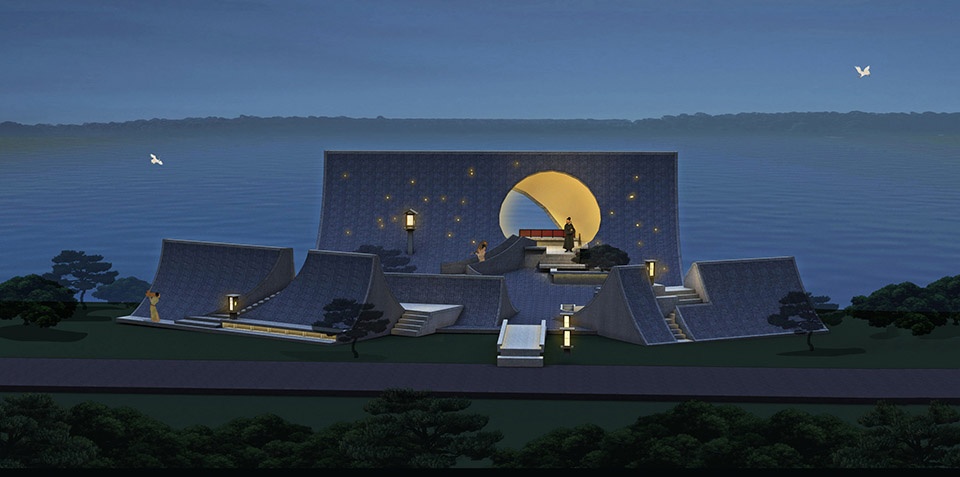
这个公共艺术,总有一个作品名,我更愿意为它起名为一句诗,以突出它的场域与时态,最后我还是决定为是“海月剧场”,剧场一词,是一种重要的提示,这是一直期待着发生,或者说这里本来就是一种发生与演出,即使没有人的出现。杭州湾新城,是一座从“千年滩涂”上快速崛起的科技移民新城。“新城与艺术的共生长”是策展的初心,艺术在此如何续接历史记忆,如何建立在地认同?如何让历史的“根”与移民的“流”在当下产生情感连接?
This public artwork requires a title. I would prefer to name it with a line of poetry, to emphasise its field and temporality. In the end, I settled on “Sea-Moon Amphitheater.” The word “theatre” is an important prompt—it is a place that perpetually awaits something to happen, or rather, a place where occurrence and performance are inherent, even in the absence of people. Hangzhou Bay New Town is a new city of technological migrants, rising rapidly from a “millennial tidal flat.” “Co-growth of new city and art” was the curatorial. How can art here reconnect with historical memory and establish local identity? How can the “roots” of history and the “flows” of migration forge an emotional connection in the present?
▼项目鸟瞰,aerial view of the project © 造园建筑
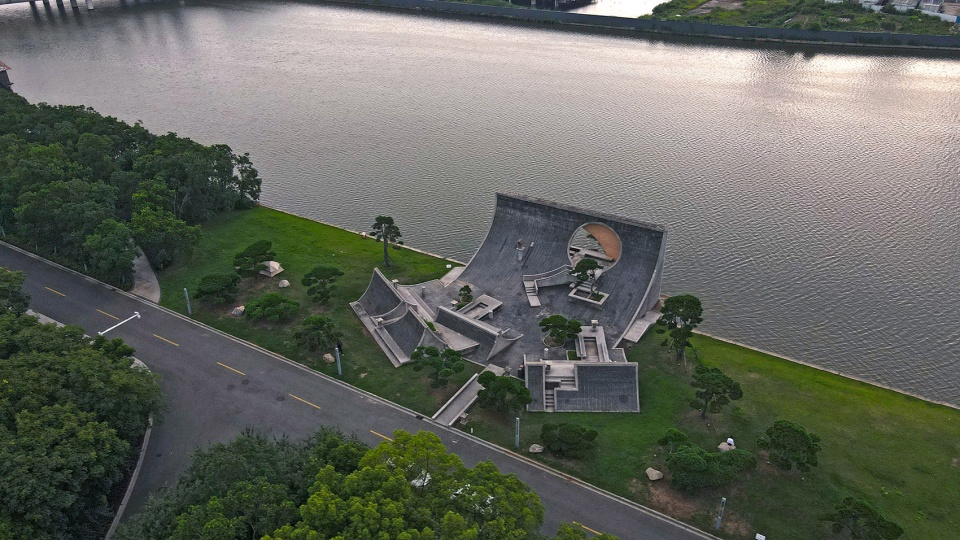
海月剧场是一种地方生存经验与诗歌意象在此交响混合形成“自然力演化的现场”。诗画美景与生存困境,总是伴随交织在一起的,“海上明月共潮生”,这“潮”不止是美景,也是几千年来反复摧毁又重建的力量,更是人类修建海塘、围垦造田、与潮汐周旋的“人潮”,“海上明月共潮生”本身就是一场持续千年的人与自然起伏进退的“演出”,海月剧场把这个看不见的纠葛的历史现场,以空间的方式复现了。“吴儿生长狎涛渊,冒利轻生不自怜。”海月剧场,既是潮汐形态的模拟,也是人与潮汐数千年缠斗后留下的身体记忆——那种被巨浪冲击,在波浪中行走的体感。园林给与人的不应只有温软的诗情画意,更应是自然力演化的悲欣交集。这个时候,我的耳边回响起《庄子》里的一句:“与万物沉浮于生长之门。”策展人沈老师计划在海月剧场举行这次公共艺术展的开幕式,且在晚上,在此听闻潮生,观明月升起,意义非比寻常,这也是一幕剧,关于艺术与新城共生的宣言之剧,艺术、城市、自然、历史在此一起随着潮的起伏,共唱和。然而,那时遭遇了疫情的发生,开幕式不得不一再推迟,最终改为线上举行。
The Sea-Moon Amphitheater is a site where local experience of survival and poetic imagery converge in symphony, forming a “scene of natural force evolution.” Scenic beauty and existential struggle have always been intertwined. “The bright moon over the sea rises with the tide”—this “tide” is not only a beautiful scene, but also a force of repeated destruction and reconstruction over millennia; it is also the “human tide” of those who built seawalls, reclaimed land, and contended with the tides. “The bright moon over the sea rises with the tide” is itself a thousand-year “performance” of advance and retreat between humans and nature. The Sea-Moon Amphitheater makes visible this entangled historical site through spatial means. “The sons of Wu grow up playing with the abyss of waves, risking their lives for gain without self-pity.” The Sea-Moon Amphitheater is both a simulation of tidal forms and a bodily memory left by millennia of human struggle with the tides—that sensation of being struck by giant waves, of walking amidst the surge. What the garden offers should not be only gentle poetic charm, but also the intermingling of joy and sorrow in the evolution of natural force. At this moment, a line from Zhuangzi echoes in my ears: “Rise and fall with all things at the gate of growth.” Curator Shen planned to hold the opening ceremony of this public art exhibition at the Sea-Moon Amphitheater, at night—to hear the tide rise and witness the moon ascend. The significance was extraordinary; it was itself a drama—a declarative drama about the symbiosis of art and the new city, where art, city, nature, and history would sing in harmony with the ebb and flow of the tide. However, the pandemic intervened; the opening ceremony had to be postponed repeatedly and was ultimately held online.
▼项目鸟瞰,aerial view of the project © 造园建筑
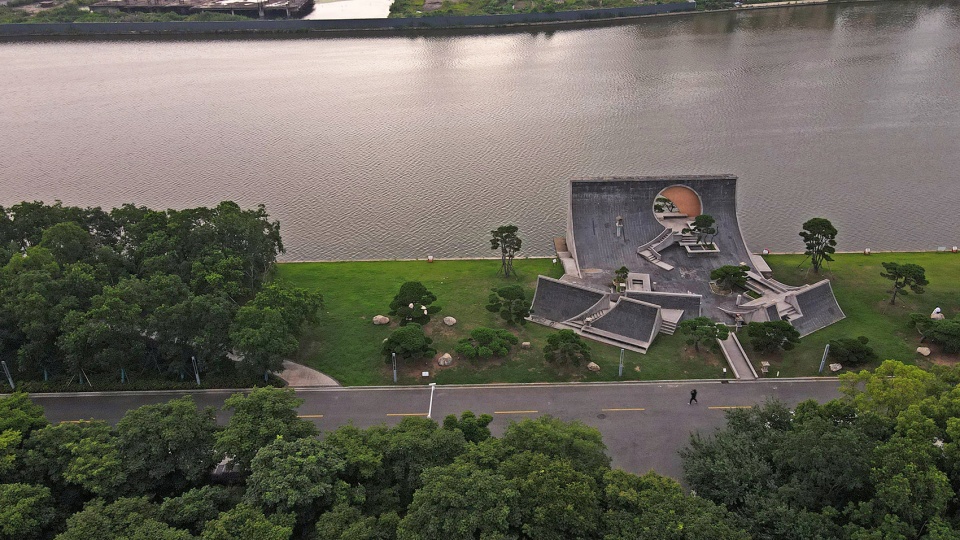
从雕塑到公共艺术,本来就是一场尺度与视野的变革,雕塑变成了场域,有形变成了无形,不是对物体的一目了然的观看,而是不断地出入,远近,周回,怀疑,观看变成了加入,审美变成了思考,从一个不相干的路人,忽而变成历史境遇中的角色,变成了共演与共情。在这样的剧场中,我们重新看到我们的自然,看到了“自然之道”。
From sculpture to public art is fundamentally a revolution of scale and vision. Sculpture becomes field; the tangible becomes intangible. It is no longer a single glance at an object, but a continual entering and exiting, a shifting between near and far, a circling and questioning. Viewing becomes participation; aesthetics becomes reflection. A passer-by, once unrelated, suddenly becomes a character in a historical circumstance, a co-performer and co-feeler. In such a theatre, we see our nature anew, and see the “Way of nature.”
▼总平面图,site plan © 造园建筑
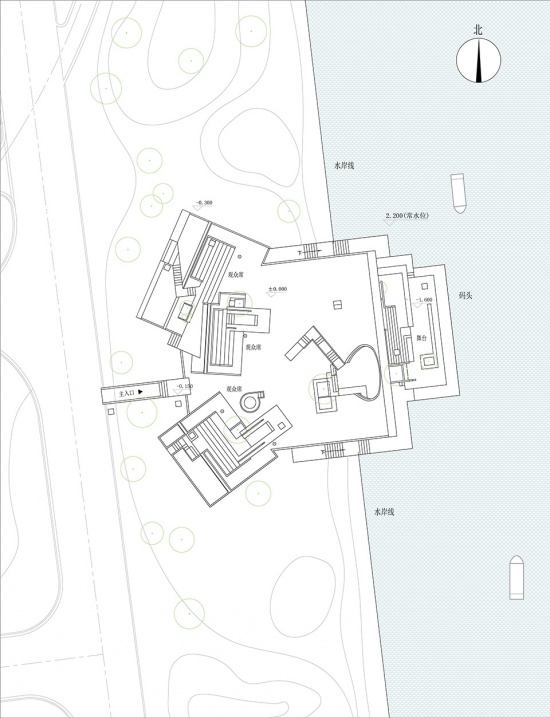
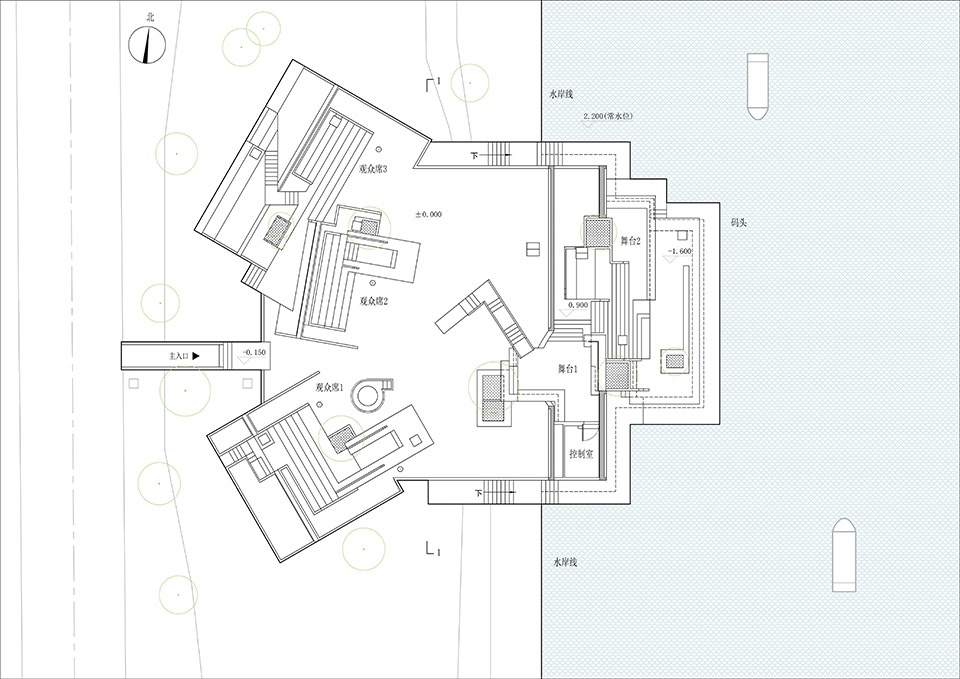
▼一层平面图,ground floor plan © 造园建筑
▼北立面图,north elevation © 造园建筑
▼东立面图,east elevation © 造园建筑
▼南立面图,east elevation © 造园建筑
作品所属展览:梦无界|宁波杭州湾新区第三届国际公共艺术邀请展
展览主办方:宁波杭州湾新区开发建设管理委员 中国美术学院
展览承办方:中国美术学院雕塑与公共艺术学院承办
策展人:沈烈毅
项目名称:海月剧场
项目类型:公共艺术,园林
项目地点:杭州湾新城
建成状态:建成
设计时间:2020年5月
建设时间:2021年10月
用地面积:910平米
设计单位:造园建筑工作室 中国美术学院建筑艺术学院
设计单位联系方式:info@gardeningarchitects.com
主创建筑师:王欣 孙昱
施工单位:浙江沧海建设有限公司
摄影师:造园建筑工作室
Exhibition: Dream Without Boundaries | The 3rd International Public Art Invitational Exhibition, Ningbo Hangzhou Bay New District
Exhibition Organiser: Ningbo Hangzhou Bay New District Development and Construction Management Committee, China Academy of Art
Exhibition Executor: School of Sculpture and Public Art, China Academy of Art
Curator: Shen Lieyi
Project Name: Sea-Moon Amphitheater
Project Type: Public Art, Garden
Project Location: Hangzhou Bay New Town
Completion Status: Built
Design Period: May 2020
Construction Period: October 2021
Site Area: 910 sqm
Design Firm: Gardening Architects, School of Architecture, China Academy of Art
Design Firm Contact:info@gardeningarchitects.com
Principal Architects: Wang Xin, Sun Yu
Construction Contractor: Zhejiang Canghai Construction Co., Ltd.
Photography: Gardening Architects
完美啊
假设野口勇可以和王欣坐一桌交流下,那该多有趣
前不久刚在这看到一个差不多的
一个景观建筑竟然设计的如此有存在感,有点狂妄