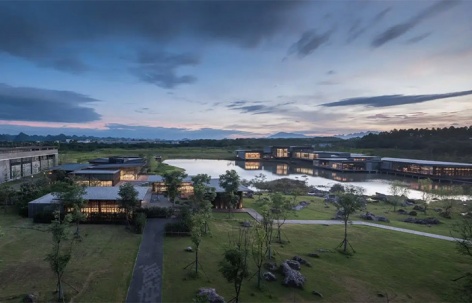

“这是一个美丽且具有多重意义的项目,它展示了有趣且深度参与的过程。”
—— 2026年评审委员会“A beautiful multivalent project. Interesting, engaged process.”
—— 2026 Awards Jury
来自 ASLA 对 gooood 的分享。
Industrial Revival – From Pollution to Regeneration | P Landscape Co., Ltd.
项目陈述
PROJECT STATEMENT
溢达可持续发展园林将一座昔日的砖厂重新构想为再生型活态景观,收复285,725平方米退化的工业用地,使生产、生态与社区和谐共生。项目受佛教“圆融”理念启发——强调自我、宇宙与生命本质之间的平衡——展示了工业景观运作方式的转变:不再是孤立的功利性区域,而是生态愈合、文化延续与环境教育的催化剂。
Integral – Esquel’s Sustainable Development Garden reimagines a former brick factory as a regenerative, living landscape, reclaiming 285,725 sq.m. of degraded industrial land to harmonize production, ecology, and community. Inspired by the Buddhist concept of “Integral,” which emphasizes balance between the self, the universe, and the nature of life, the project demonstrates a shift in how industrial landscapes can function, not as isolated utilitarian zones, but as catalysts for ecological healing, cultural continuity, and environmental education.
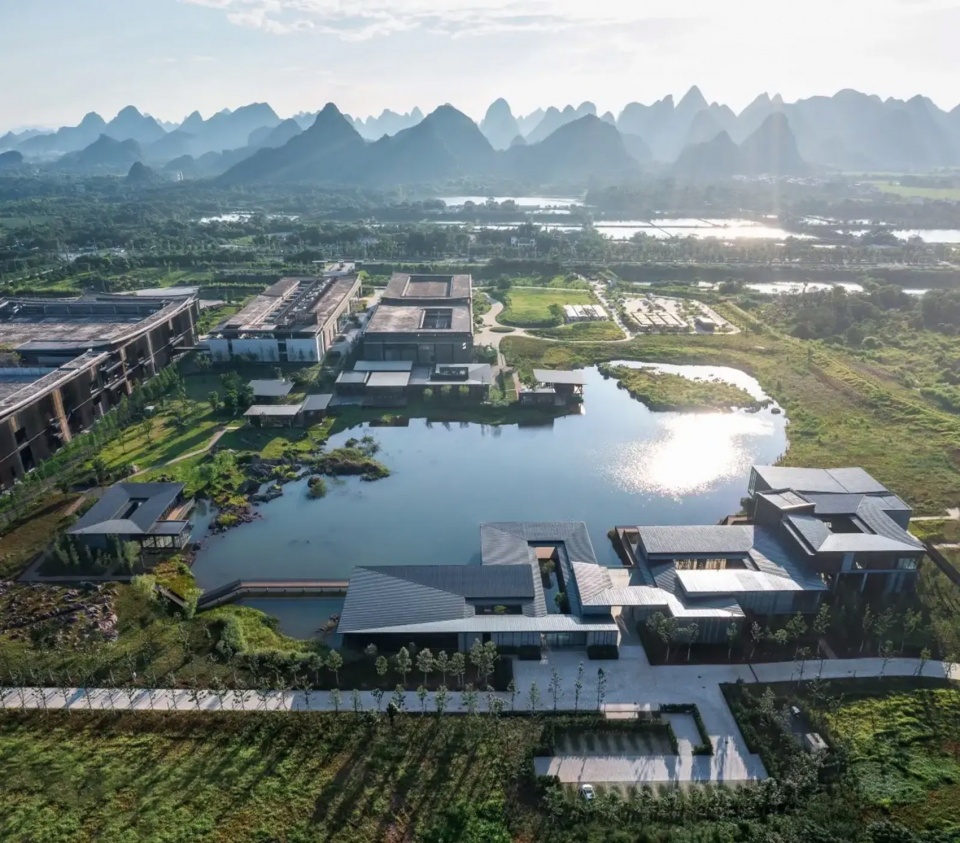
▲桂林的再生景观 | 项目位于桂林喀斯特群山附近,溢达通过由生态系统塑造的景观主导框架,使退化土地得以再生。A Regenerated Landscape in Guilin | Located near Guilin’s karst mountains, Integral regenerates degraded land through a landscape-led framework shaped by ecological systems. © Ronald Lu and Partners
项目说明
PROJECT NARRATIVE
复兴与共生:工业景观的再生模式
溢达可持续发展园林位于中国桂林九美桥,场地至今仍作为活跃的纺织制造园区运营。这里曾是因数十年砖块制造、土壤开采和工业径流而严重退化的棕地,如今通过景观主导的系统得以转型。湿地、种植和水文策略构成了水修复、栖息地恢复和长期环境管理的框架。
生态框架与材料再利用
项目坐落于具有内在湿地潜力的低洼盆地中,设计优先考虑现有地形与水文,在最小化开挖的同时,实现自维持的栖息地系统。湿地、种植和水管理支持土壤稳定、洪水缓解、水修复和长期环境韧性。超过95%的植物物种为桂林地区本土物种,通过与植物学家、园艺专家、工厂员工和当地人的合作在场地内繁育。
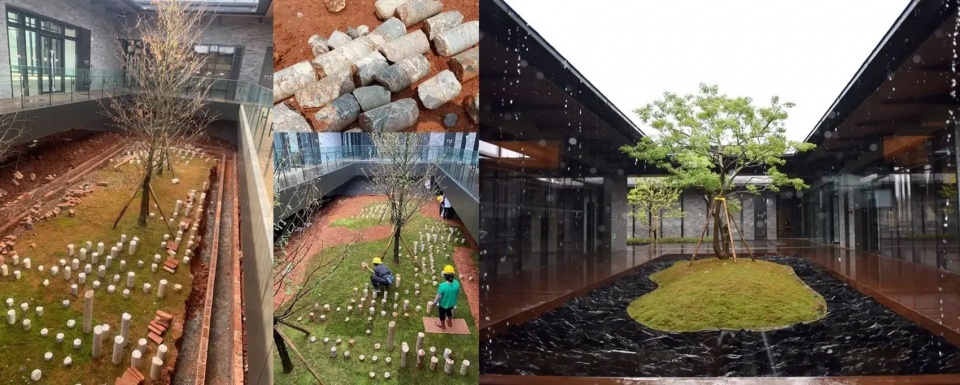
来自旧地基的再生混凝土被重新用于侵蚀控制和梯田,而附近工厂的废塑料被转化为透水铺装,以改善入渗并减少径流。这些策略将循环资源利用直接嵌入景观之中,同时减少了建筑废弃物。
可量化的环境成果
在湿地重建和水系统恢复之后,观察到了可量化的生态响应。2021年至2024年的完工后监测证实,水质从V类改善至II类,使水生栖息地得以重建。
生物多样性恢复随之而来。中央湿地岛屿被保留为无人进入区,没有路径或构筑物,允许不受干扰的栖息地形成。自完工以来,鸟类物种从7种增加到21种,包括普通翠鸟和黑尾蜡嘴雀等本土和迁徙指示物种。水生群落也重新建立,本土淡水鱼类和无脊椎动物回归,包括鮈鱼、麦穗鱼和河虾,以及两栖动物。观察到的变化与湿地和栖息地系统的建立相对应。
人与自然融合与文化项目
景观被组织为可渗透的环境,而非封闭的工业区。栈道、慢跑路径和沉思小径避开敏感栖息地,同时允许人们接触生态系统。屋顶花园、社区种植区和户外教室支持日常使用和学习。
天然染料花园引入了传统上用于纺织生产的植物物种,将生态修复与当地工艺知识和制造业联系起来。工厂员工和当地合作者参与了苗圃运营和种植,将管护融入日常使用之中。
再生工业的活态模式
园区于2019年完工,并持续作为活态实验室演进。水文、栖息地保护和材料再利用被协调为单一框架,在支持持续生产和公共访问的同时,实现可量化的生态恢复。该项目为将生态绩效融入生产性工业景观提供了清晰的参考。最重要的是,它仍然是一个关于回归的故事——自然的回归、记忆的回归,以及共生的回归。
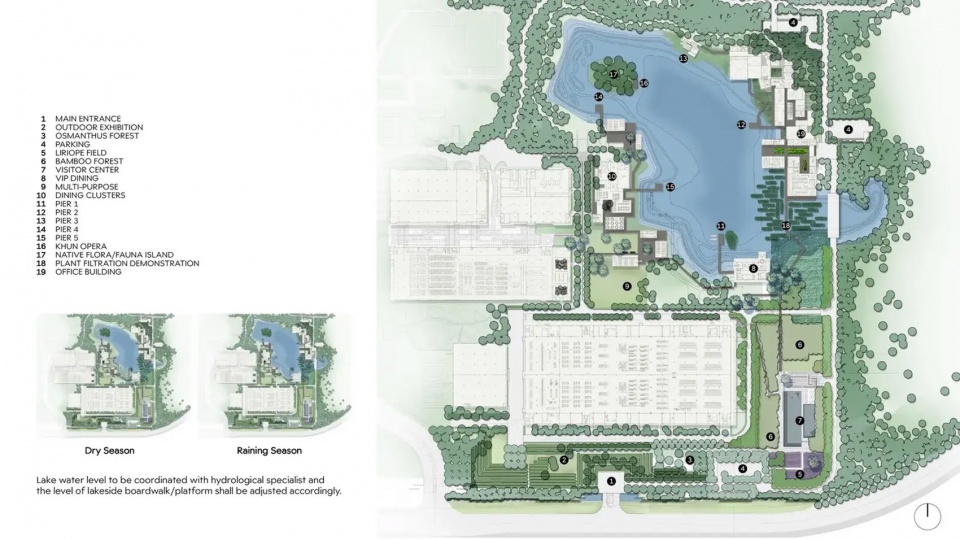
▲总体规划与季节性水策略 | 湿地结构与季节性水位在活跃的制造园区内协调,以支持洪水控制和生态绩效。Master Plan and Seasonal Water Strategy | Wetland structure and seasonal water levels are coordinated within an active manufacturing campus to support flood control and ecological performance. © P Landscape Co., Ltd.
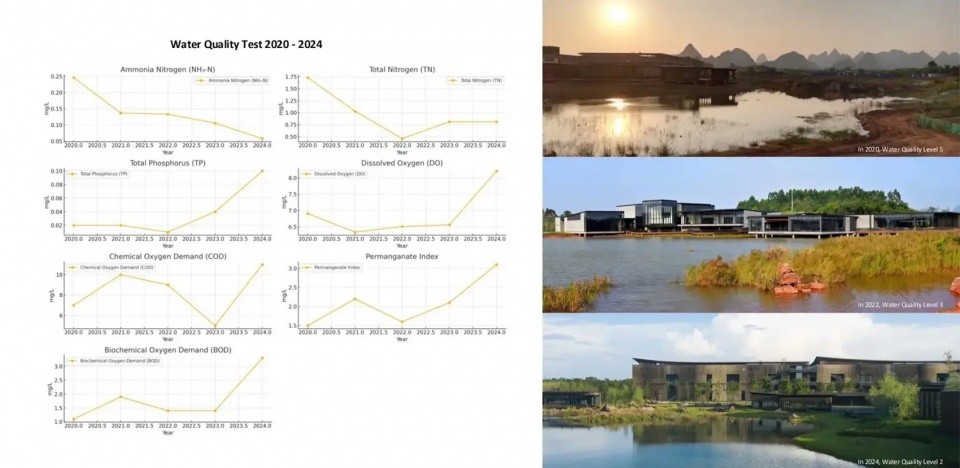
▲可量化的水质改善(2021–2024)| 2021-2024年的监测证实,水质从V类改善至II类,这得益于污染物减少和溶解氧提高。Measured Water Quality Improvement (2021–2024) | Monitoring between 2021-2024 confirms water quality improvement from Class V to Class II, driven by reduced pollutants and higher dissolved oxygen. © Guilin Esquel Textiles Co., Ltd./ P Landscape Co., Ltd.
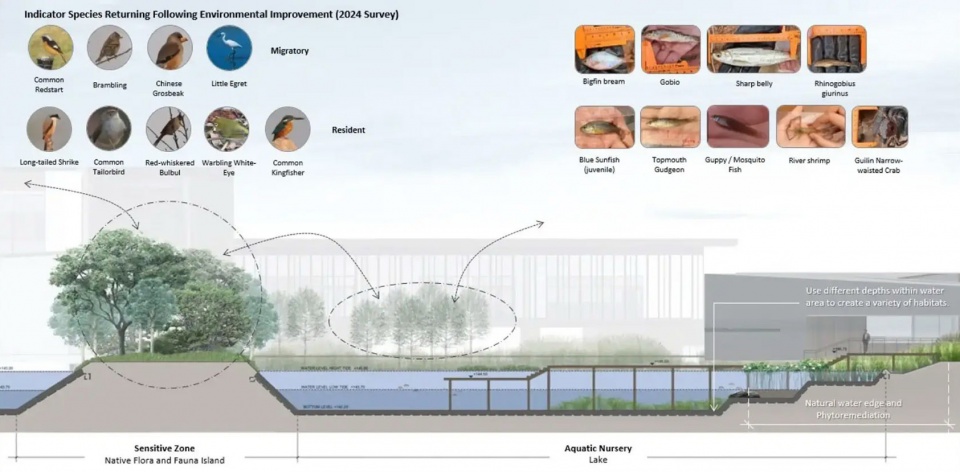
▲从退化地面到生态庇护所 | 园区如今是一片再生的湿地景观,支持本土植被以及回归的迁徙和留鸟物种。From Degraded Ground to Ecological Sanctuary | The campus is now a regenerated wetland landscape supporting native vegetation and returning migratory and resident species. © Guilin Esquel Textiles Co., Ltd./ P Landscape Co., Ltd.
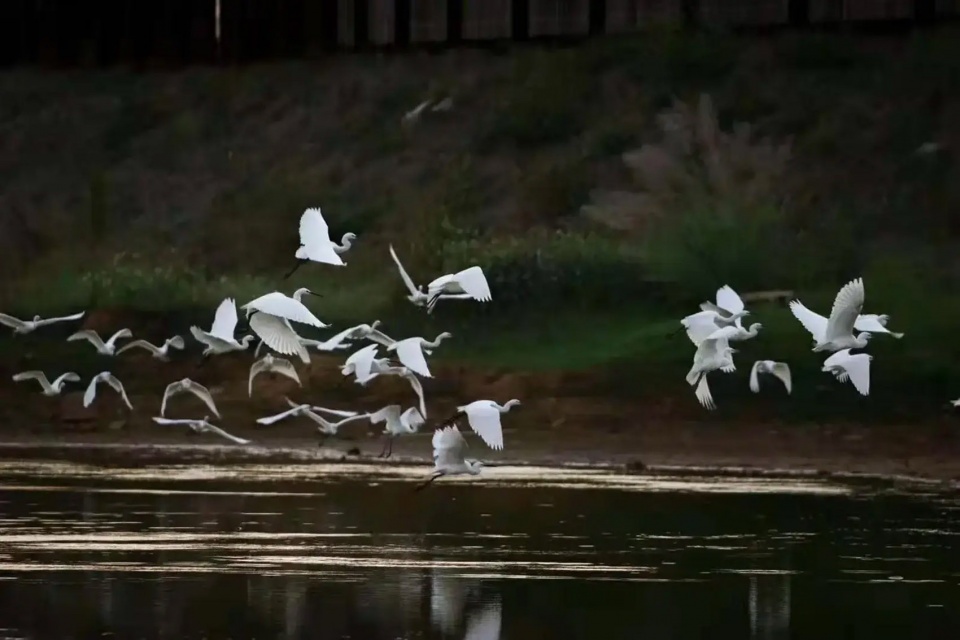
▲栖息地恢复的迹象 | 完工后,小白鹭等迁徙鸟类已经回归,标志着栖息地条件的恢复。Signs of Habitat Recovery | Following completion, migratory birds such as the Little Egret have returned, signaling restored habitat conditions. © Guilin Esquel Textiles Co., Ltd.
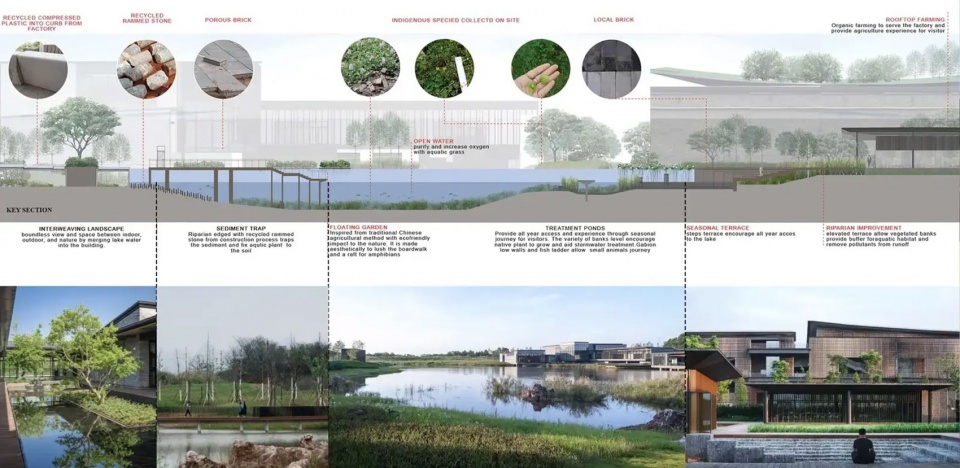
▲循环系统与场地内资源循环 | 整合的循环策略,如场地内材料再利用、种植和屋顶农业,形成闭环景观系统。Circular Systems and On-Site Resource Cycles | Integrated circular strategies, such as on-site material reuse, planting, and rooftop farming, forming a closed-loop landscape system. © Guilin Esquel Textiles Co., Ltd./ P Landscape Co., Ltd.
▲动线与热舒适 | 遮荫步道和透气材料减少热量吸收,同时允许自然通风和采光,改善热舒适。Circulation and Thermal Comfort | Shaded walkways and breathable materials reduce heat gain while allowing natural ventilation and daylight, improving thermal comfort. © Guilin Esquel Textiles Co., Ltd.
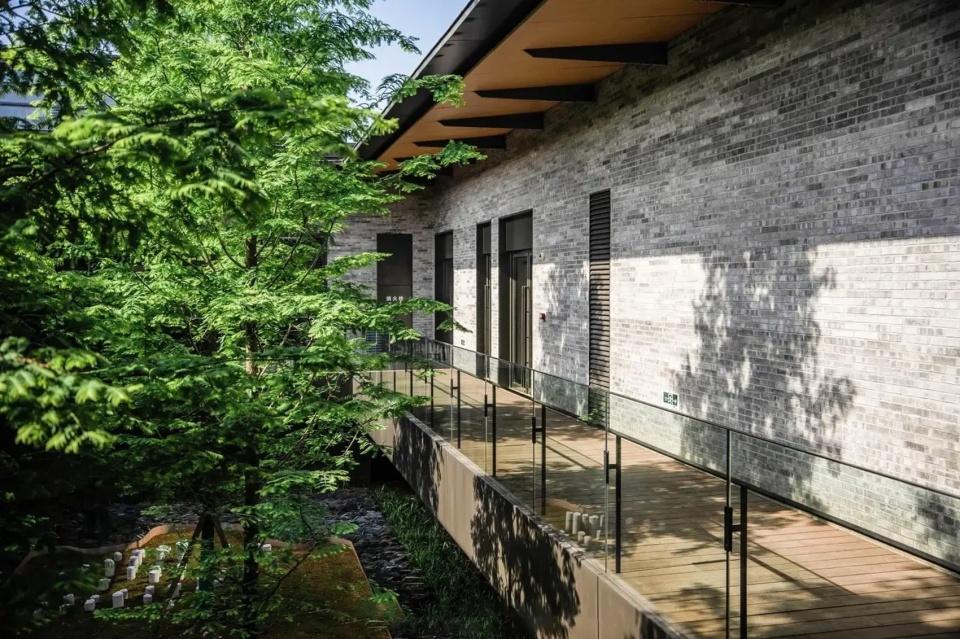
▲动线与热舒适 | 遮荫步道和透气材料减少热量吸收,同时允许自然通风和采光,改善热舒适。Circulation and Thermal Comfort | Shaded walkways and breathable materials reduce heat gain while allowing natural ventilation and daylight, improving thermal comfort. © Guilin Esquel Textiles Co., Ltd.
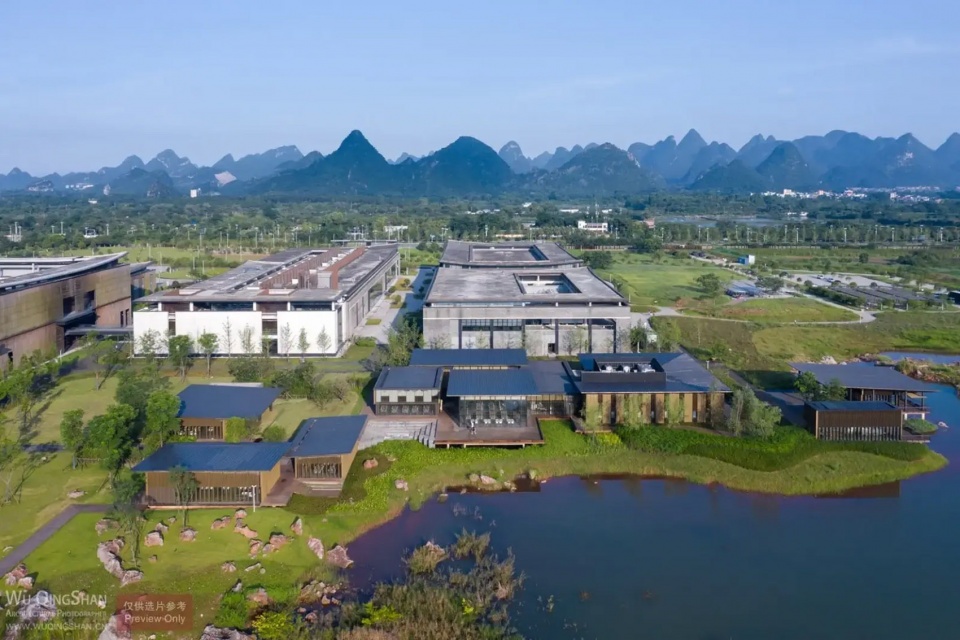
▲地形主导设计 | 场地坐落于自然低地,其湿地潜力引导了一种利用现有地形和水文、最小化开挖的生态方法。Topography-Led Design | Set in a natural lowland, the site’s wetland potential guided an ecological approach using existing topography and hydrology with minimal excavation. © Ronald Lu and Partners
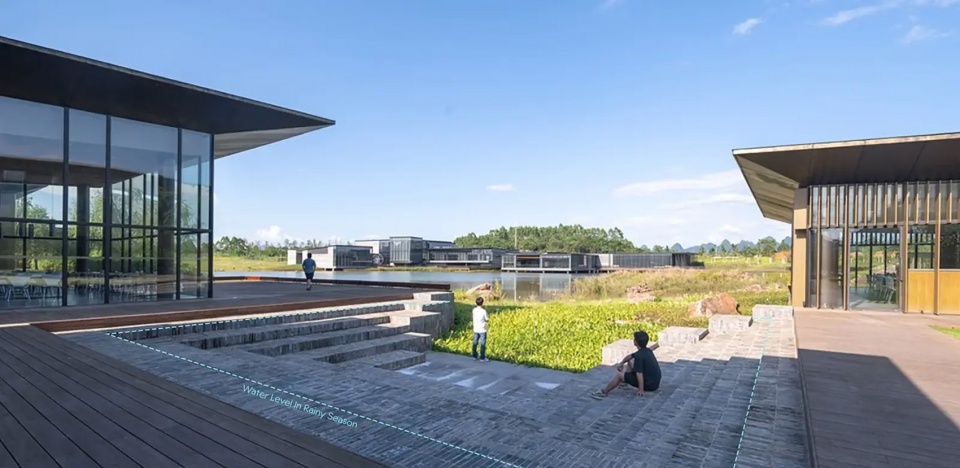
▲季节性水位作为公共空间 | 阶梯式座椅既是聚会空间,也是季节性水位的微妙标尺,在保持通行和视野的同时揭示变化。Seasonal Water Levels as Public Space | Stepped seating serves as a gathering space and a subtle gauge of seasonal water levels, revealing change while maintaining access and views. © Guilin Esquel Textiles Co., Ltd.
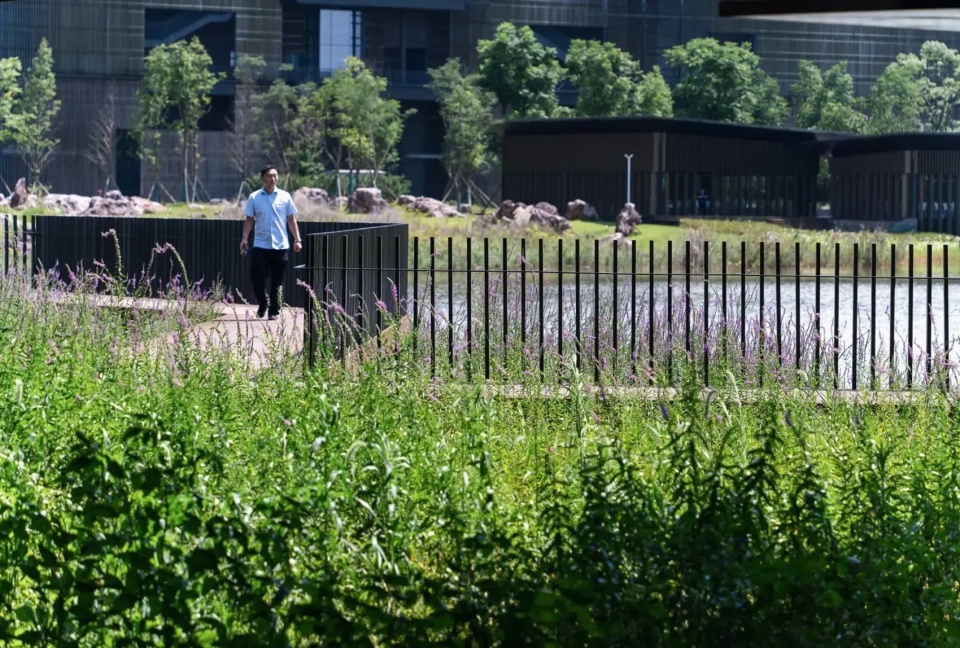
▲栖息地敏感的动线 | 栈道、慢跑小径和安静路径融入地形,尊重野生动物活动,鼓励使用者用心参与。Habitat-Sensitive Circulation | Boardwalks, jogging trails, and quiet paths are integrated into the terrain, respecting wildlife movement and encouraging mindful user engagement. © Ronald Lu and Partners
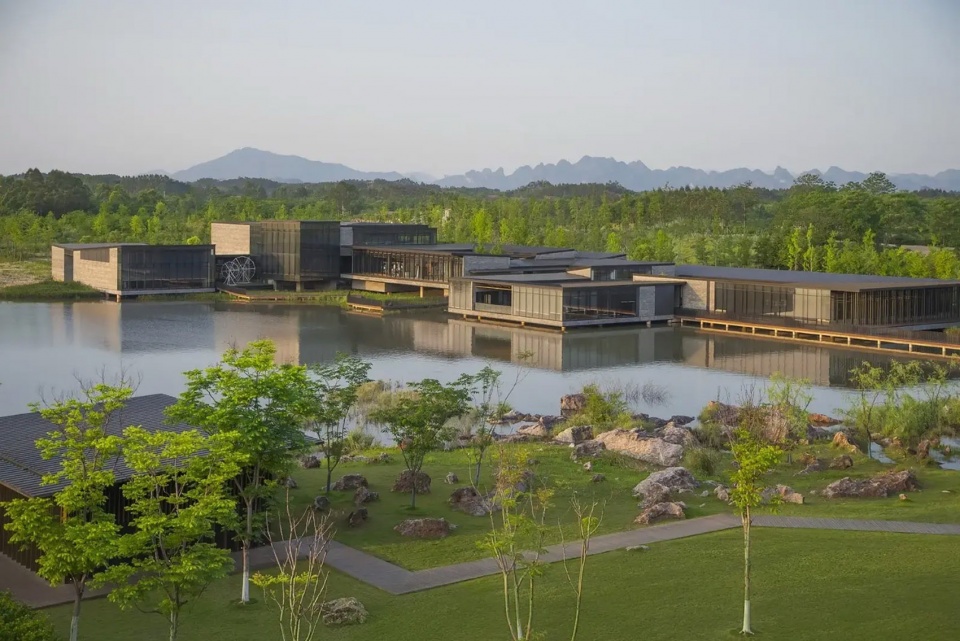
▲整合路径 | 场地现有岩石被保留,步道融入景观之中。Integrated Pathways | Existing site rocks were preserved, with the walkway integrated into the landscape. © Guilin Esquel Textiles Co., Ltd.
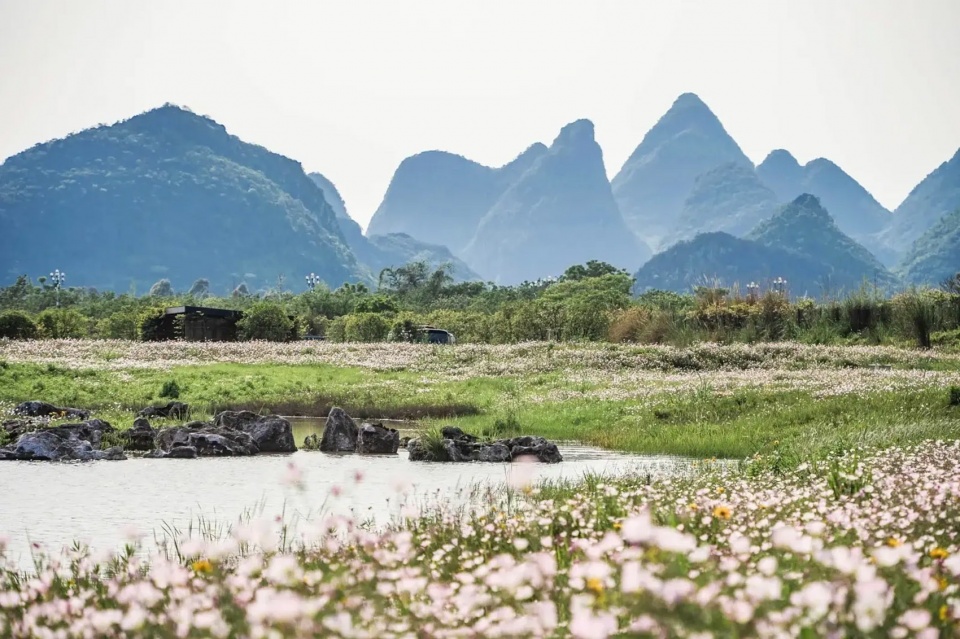
▲支持传粉昆虫的本土草甸 | 本土种植恢复了生态身份,创造出支持季节变化和传粉昆虫的生物多样性景观。Pollinator Supporting Native Meadow | Native planting restores ecological identity, creating a biodiverse landscape that supports seasonal change and pollinators. © Guilin Esquel Textiles Co., Ltd.
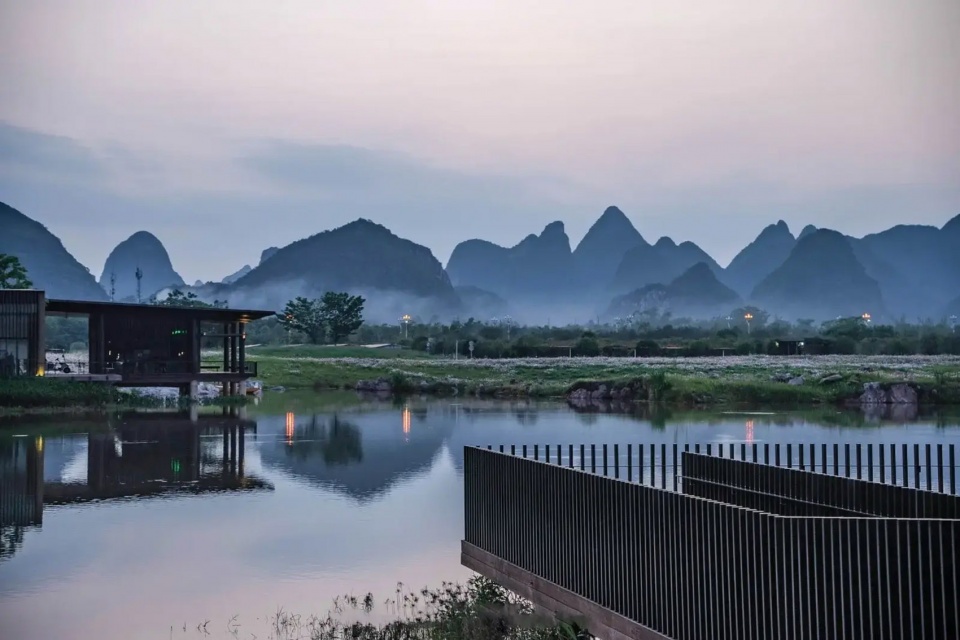
▲生态响应的本土景观 | 本土物种减少维护,同时节约用水并最小化化学投入,并通过区域采购支持当地经济。Ecologically Responsive Native Landscape | Native species reduces maintenance also conserves water, and minimizes chemical input. While supporting local economies through regional sourcing. © Guilin Esquel Textiles Co., Ltd.
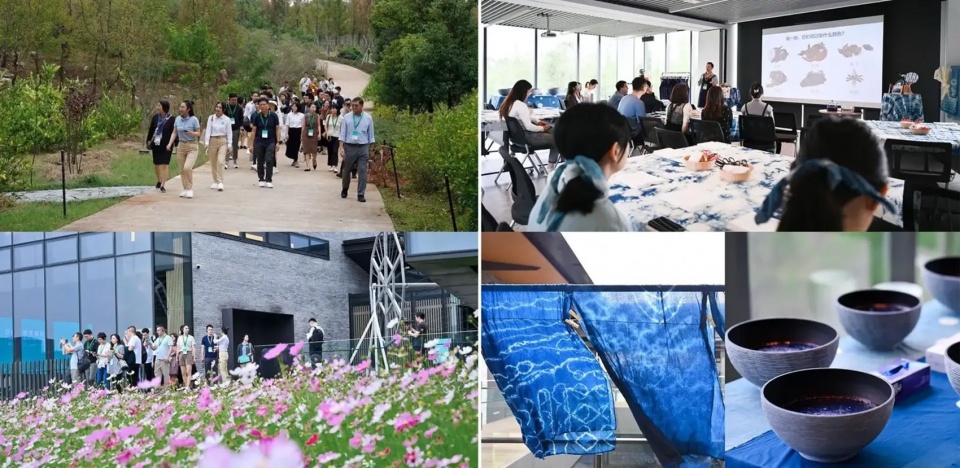
▲人与自然融合与文化项目 | 教育项目通过工作坊、导览和讲座探索天然染料植物,通过动手学习支持知识共享。Human–Nature Integration and Cultural Programming | Educational programs explore natural dye plants through workshops, tours, and talks, supporting knowledge sharing through hands-on learning. © Guilin Esquel Textiles Co., Ltd.
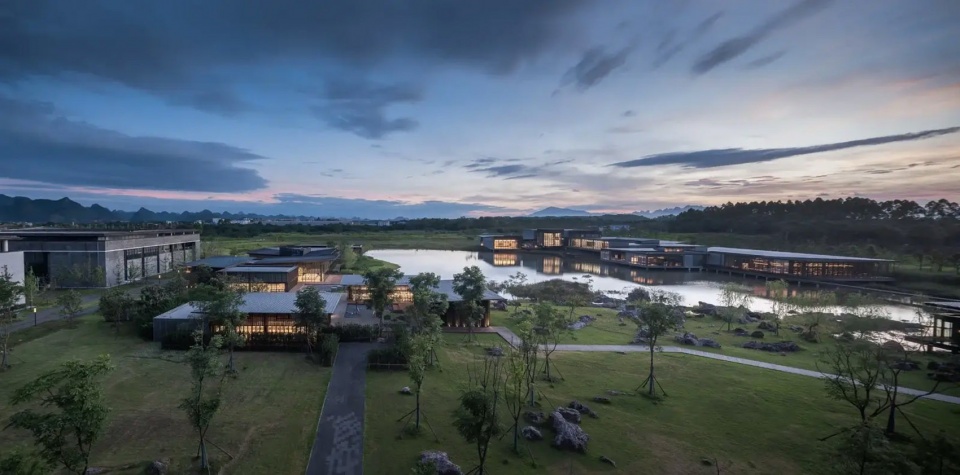
▲自然主导的工业园 | 再生后的园区支持生态韧性和场地内的可持续福祉。A Nature-Led Industrial Campus | The regenerated campus supports ecological resilience and on-site sustainable wellbeing. © Guilin Esquel Textiles Co., Ltd.
PROJECT NARRATIVE
Revive and Co-Exist: A Regenerative Model for Industrial Landscapes
Integral – Esquel’s Sustainable Development Garden is located in Jiumeiqiao, Guilin, China, on a site that continues to operate as an active textile manufacturing campus. Formerly a severely eroded brownfield degraded by decades of brick manufacturing, soil extraction, and industrial runoff, the the site has been transformed through landscape-led systems. Wetland, planting, and hydrological strategies form the framework for water remediation, habitat recovery, and long-term environmental management.
Ecological Framework and Material Reuse
Situated within a low-lying basin with inherent wetland potential, the design prioritized existing topography and hydrology, minimizing excavation while enabling self-sustaining habitat systems. Wetlands, planting, and water management support soil stabilization, flood mitigation, water remediation, and long-term environmental resilience. More than 95% of plant species are native to the Guilin region propagated on site through collaboration with botanists, horticultural specialists, factory staff, and locals.
Recycled concrete from former foundations was repurposed for erosion control and terracing, while waste plastic from nearby factories was transformed into porous paving to improve infiltration and reduce runoff. These strategies embedded circular resource use directly into the landscape while reducing construction waste.
Measurable Environmental Outcomes
Following wetland reconstruction and water system recovery, measurable ecological response was observed. Post-completion monitoring between 2021 and 2024 confirmed water quality improvement from Class V to Class II, enabling the re-establishment of aquatic habitats.
Biodiversity recovery followed. A central wetland island was preserved as a no-access zone, free of paths or structures, allowing undisturbed habitat formation. Since completion, bird species increased from 7 to 21, including native and migratory indicators such as Common Kingfisher and and Chinese Grosbeak. Aquatic communities also re-established, with the return of native freshwater fish and invertebrates, including gobio, topmouth gudgeon, and river shrimp, alongside amphibians. The observed changes correspond with the establishment of wetland and habitat systems.
Human–Nature Integration and Cultural Programming
The landscape is organized as a permeable environment rather than a closed industrial zone. Boardwalks, jogging paths, and contemplative trails avoid sensitive habitats while allowing access to ecological systems. Rooftop gardens, community planting areas, and outdoor classrooms support daily use and learning.
A Natural Dye Garden introduces plant species traditionally used in textile production, linking ecological restoration with local craft knowledge and manufacturing. Factory workers and local collaborators participated in nursery operations and planting, integrating stewardship into everyday use.
A Living Model for Regenerative Industry
Completed in 2019, The campus continues to evolve as a living laboratory. Hydrology, habitat protection, and material reuse are coordinated as a single framework, enabling measurable ecological recovery while supporting ongoing production and public access. The project offers a clear reference for integrating ecological performance into productive industrial landscapes. Above all, it remains a story of return – of nature, of memory, and of coexistence.
PROJECT CREDITS
* Ronald Lu and Partners, Architect
* PuBang Design Institute, Local Landscape
* Ray Chen + Partners Architects, Architect & Interior
* Guilin Design Institute, Structural & Mechanical, Electrical and Plumping Engineer
* Professor Shengji Pei from Kunming Institute of Botany, Project Advisor
PLANT LIST
* Erythrina crista-galli
* Podocarpus macrophyllus
* Osmanthus fragrans ‘Aurantiacus’
* Cinnamomum camphora
* Magnolia denudata
* Sapium sebiferum (L.) Roxb.
* Taxodium distichum
* Bauhinia variegata
* Liquidambar formosana
* Liriodendron chinense
* Prunus cerasifera
* Phyllostachys edulis
* Magnolia liliiflora
* Albizia julibrissin
* Eriobotrya japonica
* Ficus virens
* Ginkgo biloba
* Salix babylonica
* Malus halliana
* Camellia sasanqua
* Elaeocarpus decipiens
* Metasequoia glyptostroboides
* Pterocarya stenoptera
* Citrus maxima
* Ilex rotunda
* Koelreuteria paniculata
* Lythrum salicaria
* Vallisneria natans
* Arundo donax
* Schoenoplectus tabernaemontani
* Cyperus alternifolius Linn.
* Punica granatum
* Camellia sinensis
* Euonymus japonicus
* Liriope platyphylla F.T. Wang & Tang
* Linum usitatissimum L.
* Ruellia simplex
* Hosta plantaginea
* Strobilanthes cusia
* Phragmites australis
* Camellia impressinervis
* Citrus microcarpa
* Morus alba L.
* Evolvulus nummularius (L.)
* Polygonum sp.
* Spiraea japonica
* Strobilanthes hamiltoniana
* Mentha piperita
* Artemisia lactiflora
* Pilea cadierei
* Hymenocallis littoralis (Jacq.) Salisb.
More:ASLA , P Landscape Co., Ltd.


发表评论
你需要先 才能发表评论
社交登录