来自 ASLA 对 gooood 的分享。
Sediment Strategies: Considerations and Case Studies for Beneficial Use | Proof Projects LLC / Anchor QEA, Inc.
项目陈述
PROJECT STATEMENT
预计到2050年,大西洋沿岸一半的湿地将会消失。与此同时,每年有数亿立方码的沉积物被疏浚。《沉积物策略》 是一本创新指南,将疏浚的副产品视为复兴沼泽的机遇。它借鉴了美国各地的应用研究,呈现经过验证的最佳实践,以协调疏浚与修复。复杂的信息以易于理解且引人入胜的形式呈现,为参与沉积物管理和海岸修复的人们解答疑问并提供共同语言。该文件赋能机构、社区和从业者,将一场迫在眉睫的危机转化为气候韧性的典范。
Half of the wetlands on the Atlantic coast are projected to be lost by 2050. At the same time, hundreds of millions of cubic yards of sediment are dredged annually. Sediment Strategies is an innovative guide that sees this as an opportunity to transform the byproduct of dredging into a lifeline for marshes. It draws on applied research from across the U.S., presenting proven best practices to align dredging and restoration. Complex information is presented in an accessible and engaging format answering questions and providing a common language for those involved in sediment management and coastal restoration. This document empowers agencies, communities, and practitioners to turn a looming crisis into a model for climate resilience.
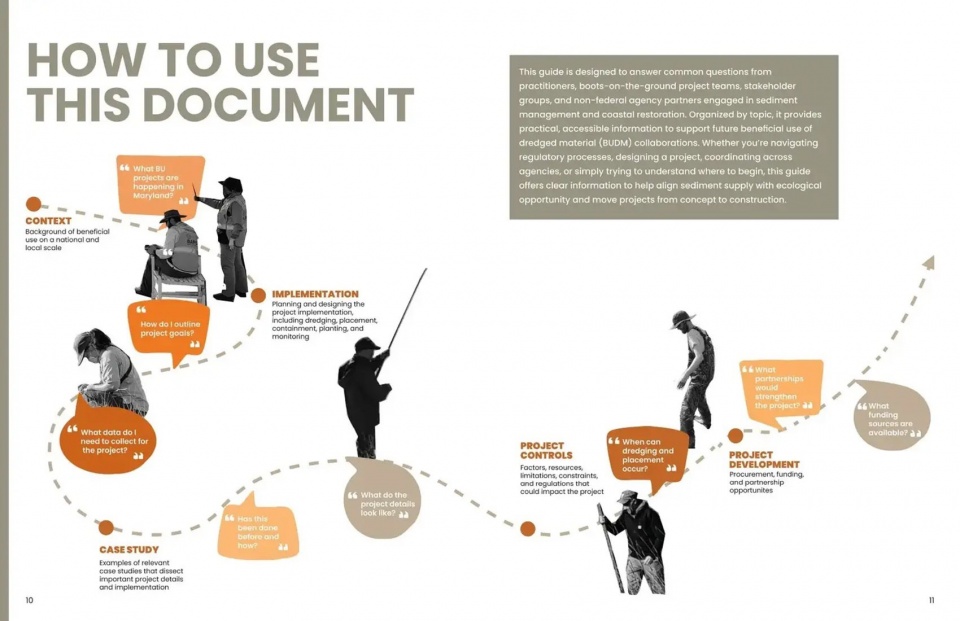
▲如何使用本文件 | 该指南的分步框架帮助从业者从概念到施工全程驾驭疏浚材料的有益利用。How to Use This Document | The guide’s step-by-step framework helps practitioners navigate beneficial use of dredged material from concept through construction. © Proof Projects, LLC
项目说明
PROJECT NARRATIVE
《沉积物策略》 是一本操作指南,为希望将疏浚材料有益利用(BUDM)作为美国海岸沼泽生命线的从业者、机构和社区提供共同语言和易于获取的技术参考,重点强调在马里兰州的实施。
在大西洋沿岸,沼泽在日常生活中扮演着至关重要的角色。它们缓冲风暴、过滤水质、支持渔业、储存碳。它们是水上休闲、商业和社区的支柱。然而到2050年,预计近一半将会消失。与此同时,每年有数亿立方码的沉积物通过疏浚被移动——这是一项关键的管理行动,保持港口开放、支流可通航、商业流通。这些系统之间的联系就是沉积物。然而,尽管一个是沉积物来源,另一个是沉积物汇,它们却往往未被协同管理。
这正是有益利用之美:回收沉积物以增强水生生态系统,同时降低疏浚成本。这是一个简单的理念,但实现它却绝非易事。它需要共同愿景、有意识的协调和技术理解。《沉积物策略》 是为经验丰富的从业者和早期采用者提供的BUDM资源。文件分为五个用户友好的部分:
* 背景 — 构建沉积物回收的生态和政策驱动因素
* 实施 — 概述技术考量和实施策略
* 案例研究 — 深入考察典范项目
* 项目管控 — 提供如何驾驭许可和采购路径的洞见
* 项目开发 — 识别关键资金和战略合作机会
BUDM项目的最大障碍是涉及众多组织且海岸条件不断变化的复杂、多学科流程。《沉积物策略》 通过与州和联邦机构、非营利组织和从业者的合作开发而成。它借鉴了同行评审研究、州和联邦监管框架、美国陆军工程兵团最佳实践,以及来自美国各地的典范案例研究。
这些复杂的动态要素被综合为易于阅读的图表、工作流程和比较视觉,为有益利用项目提供完整路线图:从选址、许可、潜在资金选项和合作伙伴,到施工和项目后监测。该指南专为规划者、修复人员和拨款撰写者设计,帮助项目从早期概念推进到实施。
该文件以免费PDF形式通过专业网络、机构渠道和自然保护协会网站分发,具有广泛影响力且易于获取。随着海平面上升和极端风暴事件日益频繁,将疏浚与修复协调一致对海岸韧性而言从未如此紧迫。面临沼泽消失的社区需要持久、具有成本效益的工具,将生态目标与地方优先事项相结合。美国陆军工程兵团的目标是到2030年有益再利用70%的疏浚材料。《沉积物策略》 在这一关键时刻应运而生,作为一本将从业者、机构和社区聚集在一起的操作手册,提供可操作、易于遵循的步骤来启动BUDM项目。
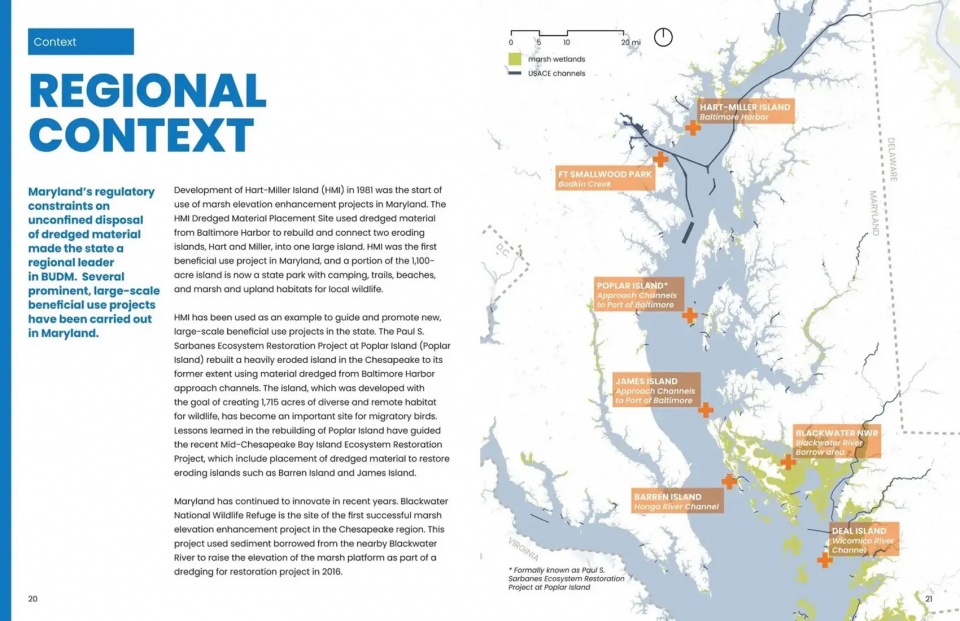
▲区域背景 | 区域背景地图突出显示了马里兰州的主要BUDM场地,展示航道、沉积物来源与沼泽湿地之间的联系。Regional Context | Regional context map highlighting major BUDM sites across Maryland, showing links between navigation channels, sediment sources, and marsh wetlands. © Proof Projects, LLC
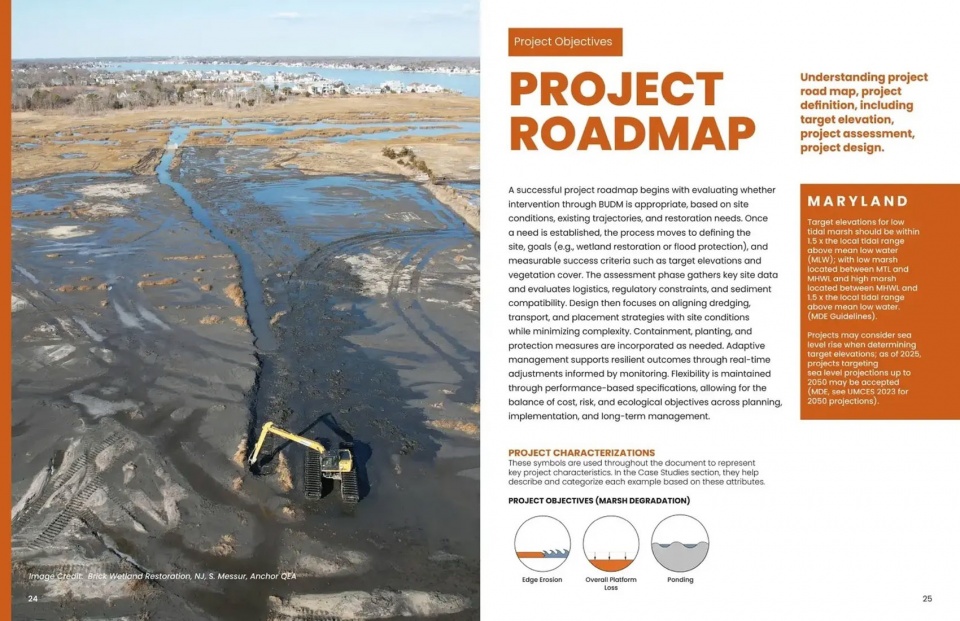
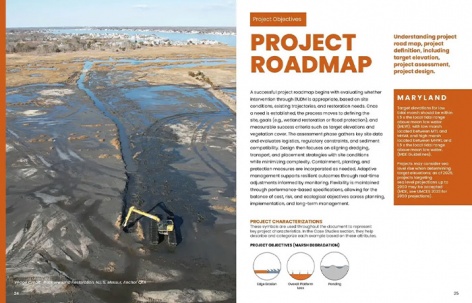
▲项目路线图 | 疏浚材料有益利用的框架,从项目定义和目标高程,到设计、施工和适应性管理。Project Roadmap | Framework for beneficial use of dredged material, from project definition and target elevations through design, construction, and adaptive management. © Proof Projects, LLC
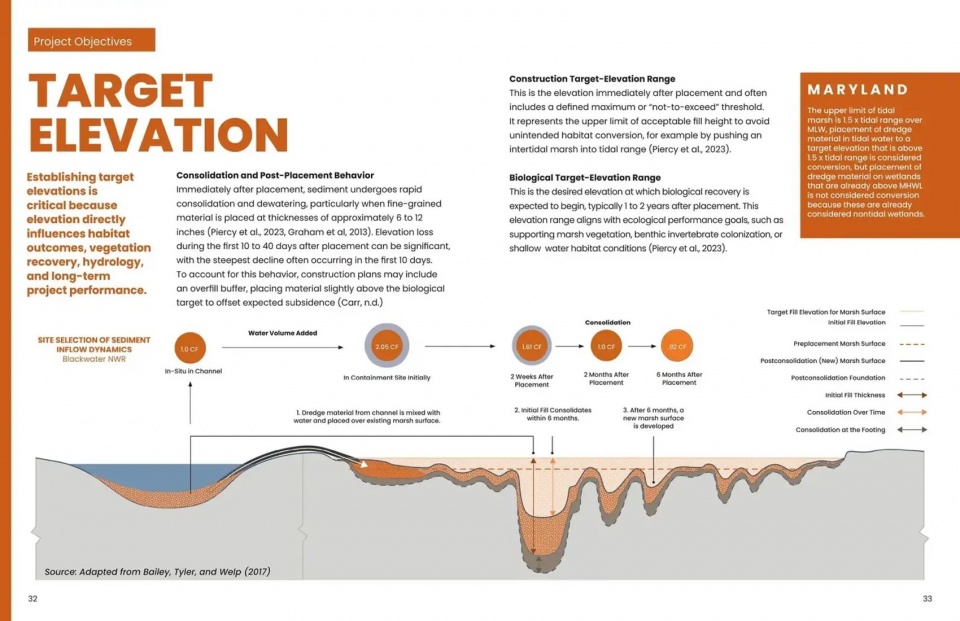
▲目标高程 | 展示设定BUDM目标高程的阶段和考量因素的图解,兼顾固结和脱水。Target Elevation | Diagram showing stages and considerations for setting BUDM target elevations, accounting for consolidation and dewatering. © Proof Projects, LLC
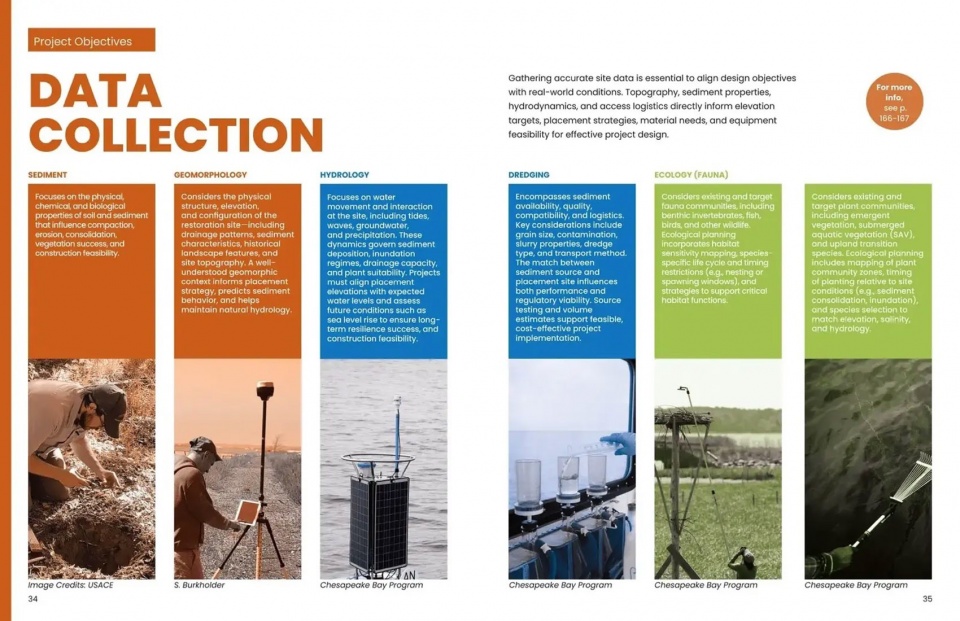
▲数据收集 | BUDM规划的多学科数据概览,整合沉积物、地貌学、水文学、疏浚物流和生态学以指导设计。Data Collection | Overview of multidisciplinary data for BUDM planning, integrating sediment, geomorphology, hydrology, dredging logistics, and ecology to guide design. © Proof Projects, LLC
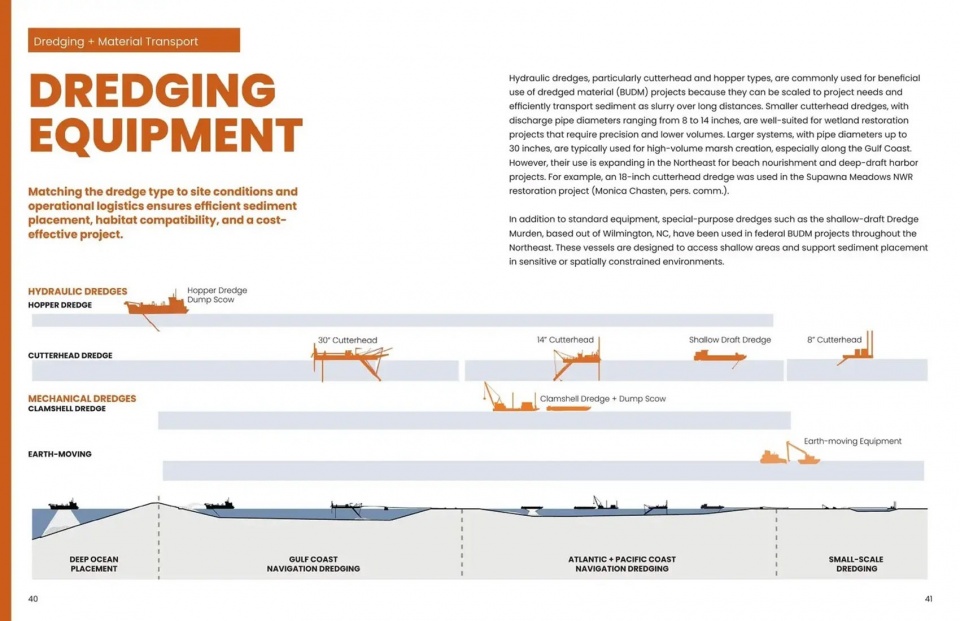
▲疏浚设备 | 疏浚设备概览,展示疏浚类型如何匹配场地条件、沉积物体积、通道限制和放置需求。Dredging Equipment | Overview of dredging equipment, showing how dredge types match site conditions, sediment volumes, access limits, and placement needs. © Proof Projects, LLC
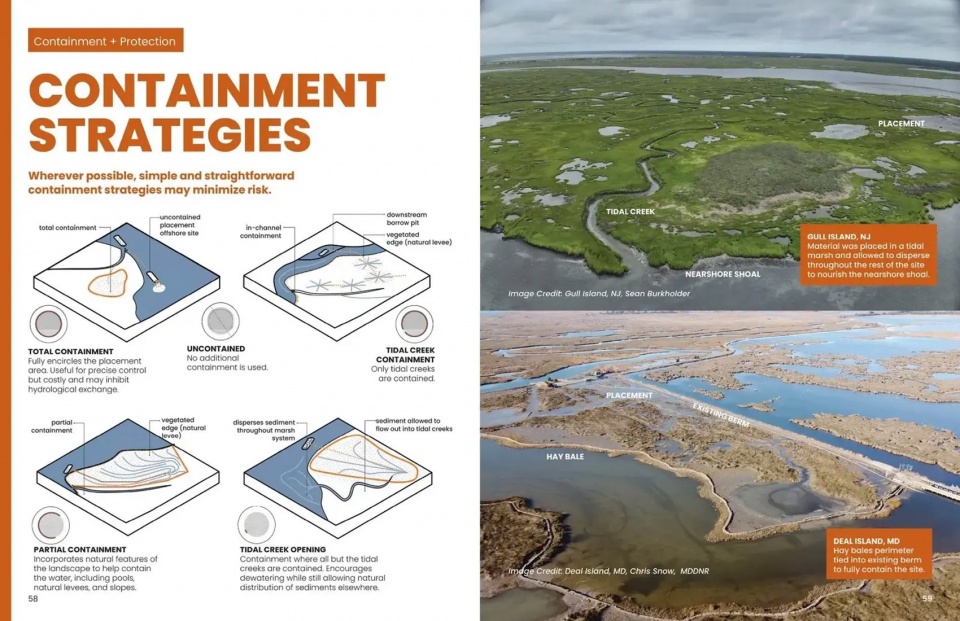
▲围隔策略 | 图解和航拍展示沉积物围隔策略,说明沉积物控制、水文与栖息地之间的权衡。Containment Strategies | Diagram and aerials showing sediment containment strategies, illustrating tradeoffs between sediment control, hydrology, and habitat. © Proof Projects, LLC
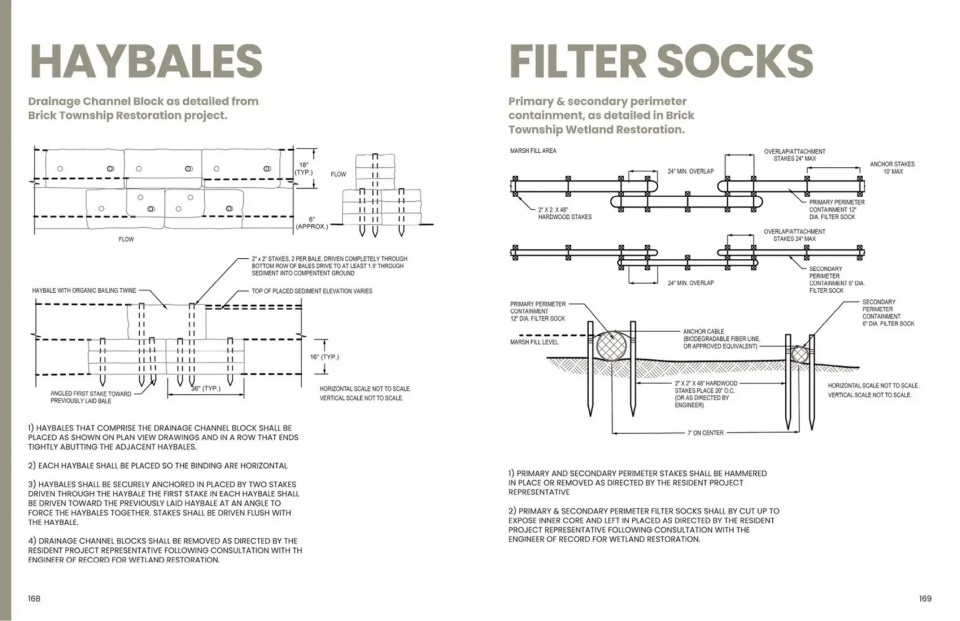
▲施工细节 | 附录细节展示用于排水控制和周边围隔的干草捆和过滤袋,以管理沉积物并保护沼泽表面。Construction Details | Appendix details showing hay bales and filter socks for drainage control and perimeter containment to manage sediment and protect marsh surfaces. © Proof Projects, LLC
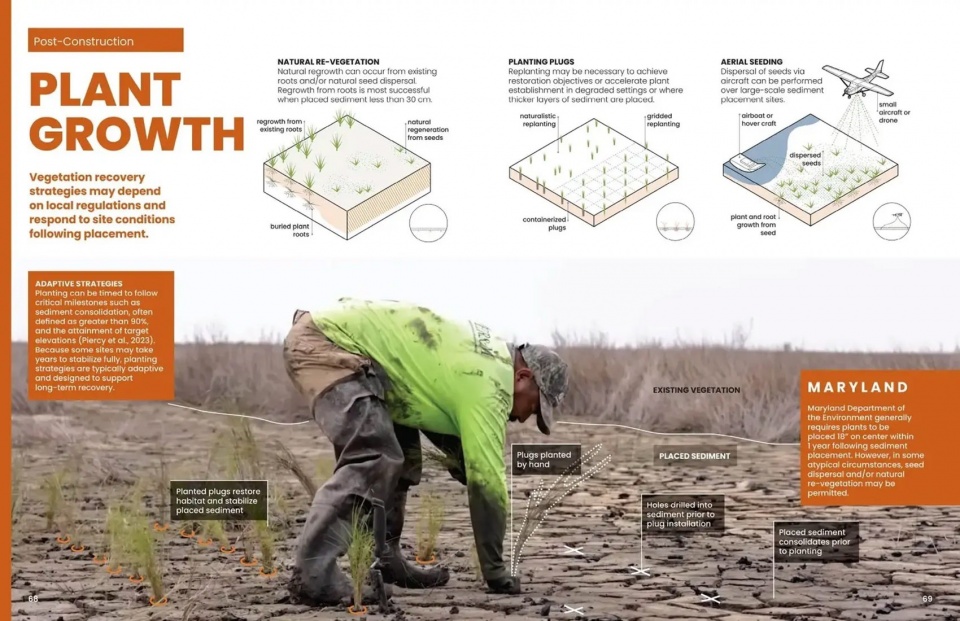
▲植被恢复 | 展示沉积物放置后植物策略的图解,包括自然恢复、穴盘苗和 aerial seeding。Revegetation | Diagram showing plant strategies after sediment placement, including natural revegetation, plugs, and aerial seeding. © Proof Projects, LLC
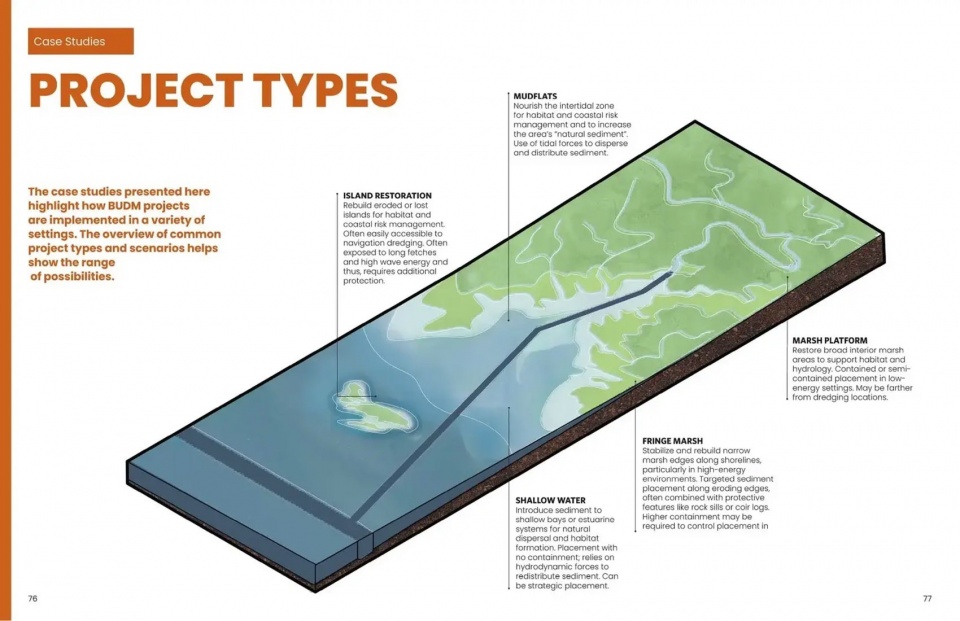
▲项目类型 | 项目类型按波浪能量和场地背景分类,包括泥滩、浅层放置、边缘沼泽、沼泽平台和岛屿。Project Types | Project types are classified by wave energy and site context, including mudflats, shallow placement, fringe marsh, marsh platforms, and islands. © Proof Projects, LLC
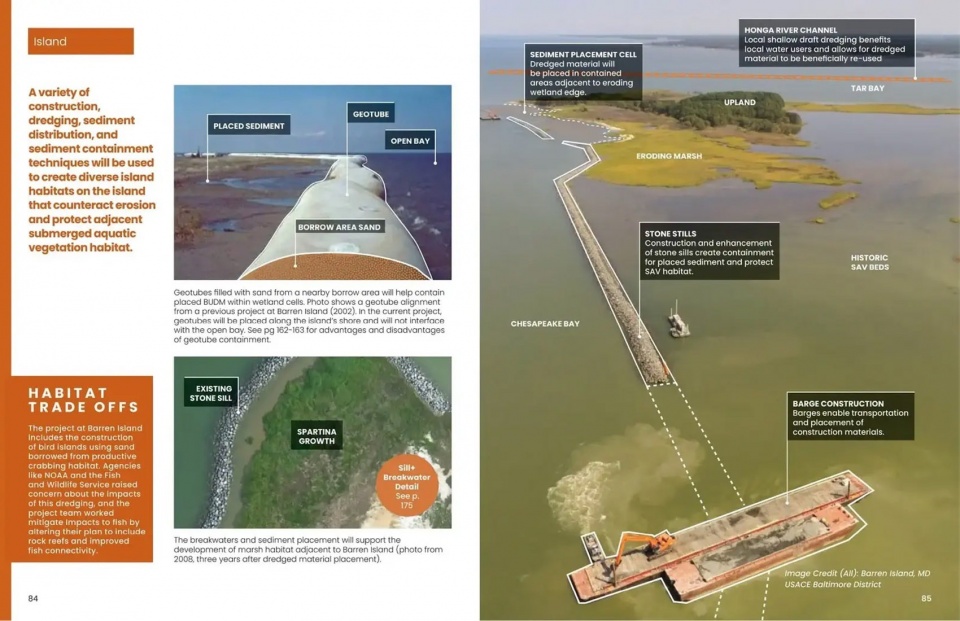
▲案例研究 | 航拍和剖面图展示使用土工管袋和石坎放置疏浚沉积物,在恢复沼泽的同时保护邻近海湾水域。Case Studies | Aerial and section diagrams showing dredged sediment placement with geotubes and stone sills to restore marsh while protecting nearby bay waters. © Proof Projects, LLC
▲栖息地转换 | 沉积物放置使栖息地随高程变化而转换,突出栖息地变化、物种响应和生态系统权衡。Habitat Conversion | Sediment placement shifts habitats across elevations, highlighting habitat change, species response, and ecosystem tradeoffs. © Proof Projects, LLC
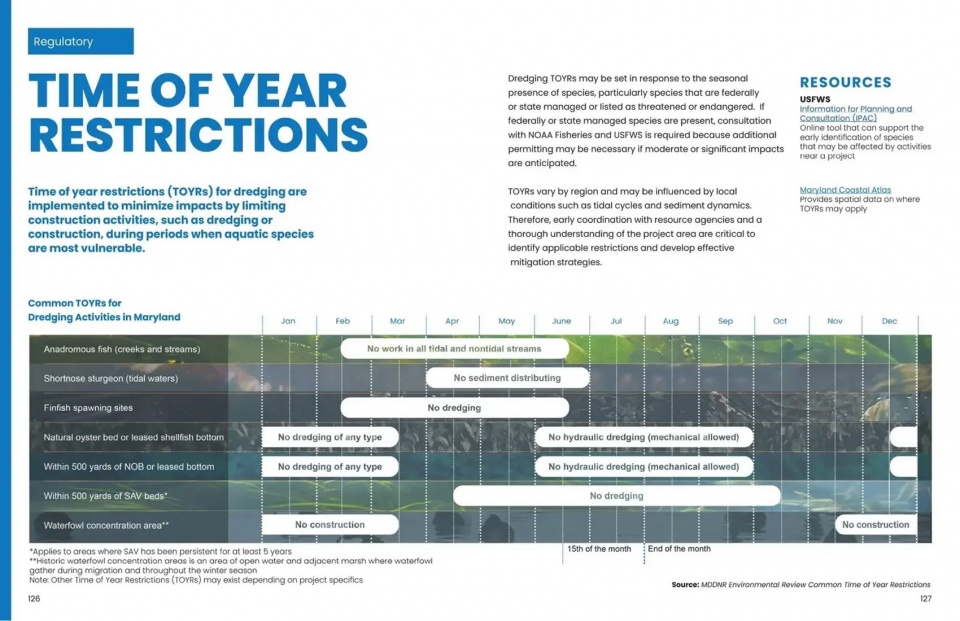
▲年度时间限制 | 图表展示马里兰州的季节性疏浚限制,以及鱼类、鸟类、SAV和贝类保护如何影响时间安排。Time of Year Restrictions | Chart showing seasonal dredging limits in Maryland and how protections for fish, birds, SAV, and shellfish affect scheduling. © Proof Projects, LLC
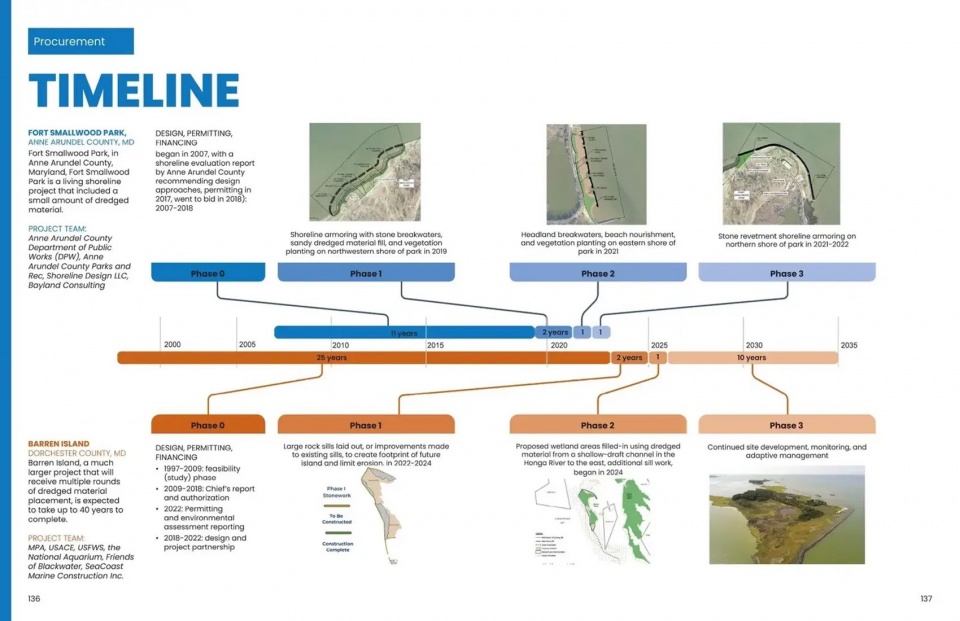
▲项目时间线 | 时间线展示Fort Smallwood公园和Barren Island的分阶段BUDM项目,从规划和许可到施工和适应性管理。Project Timelines | Timeline showing phased BUDM projects, from planning and permitting to construction and adaptive management, at Fort Smallwood Park and Barren Island. © Proof Projects, LLC
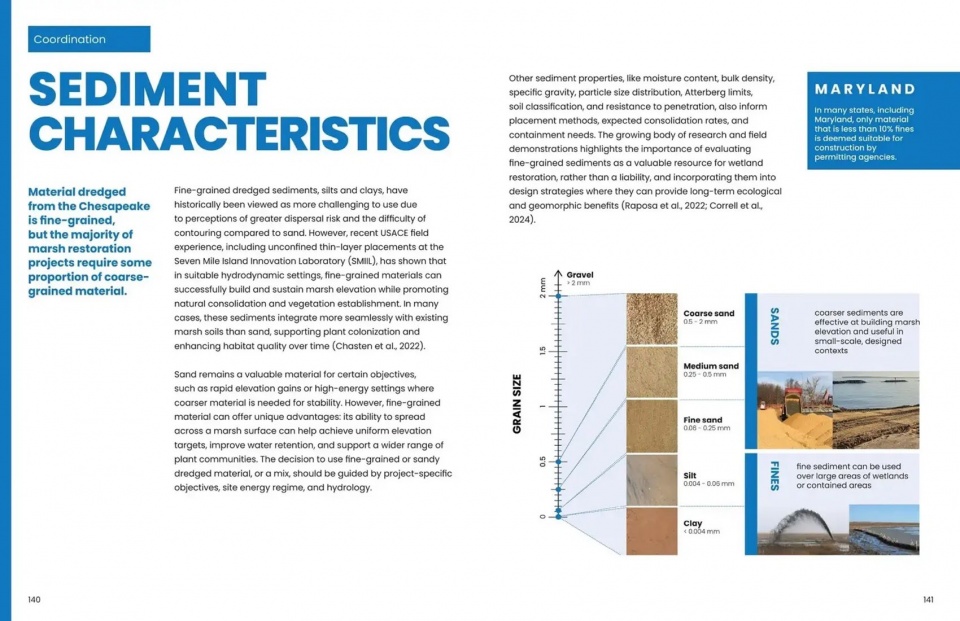
▲沉积物特征 | 沉积物粒径影响放置、固结和栖息地,进而影响项目目标、场地能量和法规。Sediment Characteristics | Sediment grain size affects placement, consolidation, and habitat, and in turn, influences project goals, site energy, and regulations. © Proof Projects, LLC
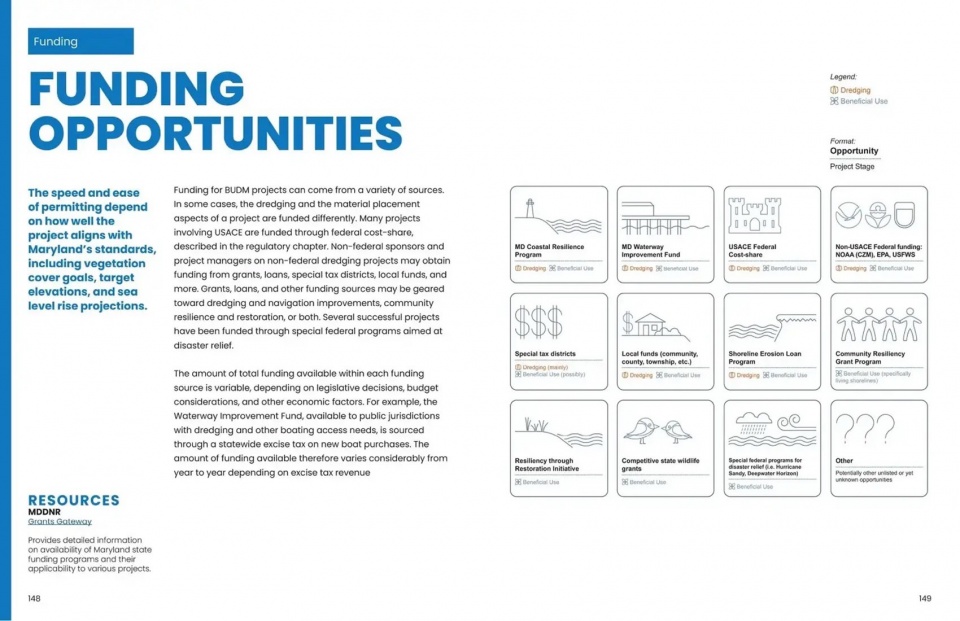
▲资金机会 | BUDM的联邦、州和地方资金路径,展示疏浚和修复资金如何在各阶段协调一致。Funding Opportunities | Federal, state, and local funding pathways for BUDM, showing how dredging and restoration funds align across stages. © Proof Projects, LLC
PROJECT NARRATIVE
Sediment Strategies is a how-to guide that provides common language and an accessible technical reference for practitioners, agencies, and communities who want to utilize the beneficial use of dredged material (BUDM) as a lifeline for coastal marshes across the United States, with an emphasis on implementation in Maryland.
Up and down the Atlantic Coast, marshes play an essential role in daily life. They buffer storms, filter water, support fisheries, and store carbon. They are the backbone of aquatic recreation, commerce, and community. Yet by 2050, nearly half are projected to be lost. At the same time, hundreds of millions of cubic yards of sediment are moved annually through dredging—a critical management action that keeps ports open, tributaries navigable, and commerce flowing. The link between these systems is sediment. Yet even though one is a sediment source and the other a sediment sink, they are not often managed together.
That is the beauty of beneficial use: recycling sediment to enhance aquatic ecosystems and lower the cost of dredging. It is a simple idea, but making it happen is anything but simple. It requires a shared vision, intentional coordination, and technical understanding. Sediment Strategies is a BUDM resource for both seasoned practitioners and early adopters. The document is organized in five user-friendly sections:
* Context — Frames the ecological and policy drivers for sediment recycling
* Implementation — Outlines technical considerations and implementation tactics
* Case Studies — In-depth examinations of exemplary projects
* Project Controls — Gives insight on how to navigate permitting and procurement pathways
* Project Development — Identifies key funding and strategic partnership opportunities
The biggest hurdle to BUDM projects is the complex, multidisciplinary process involving numerous organizations and constantly changing coastal conditions. Sediment Strategies was developed through collaboration with state and federal agencies, nonprofits, and practitioners. It draws from peer-reviewed research, state and federal regulatory frameworks, USACE best practices, and exemplary case studies from across the United States.
This complex collection of moving parts is synthesized into easy-to-read diagrams, workflows, and comparative visuals that offer a complete roadmap for a beneficial-use project: from site selection, permitting, and potential funding options and partners through construction and post-project monitoring. Designed for planners, restoration staff, and grant writers alike, the guide helps move projects from early concept to implementation.
Distributed as a free PDF through professional networks, agency channels, and The Nature Conservancy’s website, the document has broad reach and is easily accessible. As sea levels rise and extreme storm events become more common, aligning dredging with restoration has never been more urgent for coastal resilience.
Communities facing marsh loss need durable, cost-effective tools that align ecological goals with local priorities. The U.S. Army Corps of Engineers aims to beneficially reuse 70% of dredged material by 2030. Sediment Strategies meets this pivotal moment as a playbook that brings practitioners, agencies, and communities together and provides actionable, easy-to-follow steps to initiate a BUDM project.
PROJECT CREDITS
* Isaac Hametz, Project Principal, TNC
* Austin Bamford, Project Manager, TNC
* Theresa Ruswick, Lead Author, Proof Projects
* Brian Davis, Lead Author, Proof Projects
* Walt Dincola, Lead Author, Anchor QEA
* Katie Haviland, Lead Author, Anchor QEA
* Mindy Strevig, Contributing Author, Anchor QEA
* Vanessa Woolley, Contributing Author, Anchor QEA
* Jill Zwierz, Contributing Author, Anchor QEA
* Zheng Fang, Graphic Design, Anchor QEA
* Lucy Salwin, Graphic Designer, Proof Projects
* Ruth Pensberthy, Graphic Designer, Proof Projects
* Ken Mayo, Editor, Anchor QEA
More: ASLA; Proof Projects LLC / Anchor QEA, Inc.





发表评论
你需要先 才能发表评论
社交登录