“这本新著就的619页的教科书,通过11个章节和73个案例研究详细介绍了在北美西部地区广泛实施的绿色屋顶策略。凭借对20个生态区域的分析,这一全面的“资源库”强调了本地知识的重要价值:人们在当地生态系统方面的经验可以指导本地种植、抵御入侵植被,并将绿色屋顶的通用概念应用到当地的生态环境中。本书还展示了在设计初期引入绿色屋顶策略的重要性,以及一些通过初期整合带来额外利益的研究案例。本书提供了详实又吸引人的一站式绿色屋顶实践标准,专业人士仅凭本书即可对多样的环境条件进行参考和比较。”
– 2021年评审委员会“A new, 619-page textbook details a wide range of green roof strategies for the western parts of North America across 11 chapters and 73 illustrative case studies. Through analysis of 20 eco-regions, this comprehensive resource highlights the value of local knowledge in the form of people whose experience with local ecosystems can guide native plantings and avoid invasive vegetation, propelling the generic notion of a green roof toward an ecologically local palette. Also featured are designs that demonstrate the value of integration of green roof strategies early in the process as well as some case studies where further initial integration would have led to additional benefit. The book is a highly compelling one-stop shop for baseline green roof standards that allows professionals to reference and compare a host of diverse environmental conditions in a single source.”
– 2021 Awards Jury
来自 ASLA 对gooood的分享。
Ecoregional Green Roofs: Theory and Application in the Western USA and Canada | Bruce Dvorak, ASLA
项目陈述
Project Statement
《生态区绿色屋顶:在美国西部和加拿大的理论和应用》是一本新的(2021年)同行评审书籍(Springer出版社,城市与自然系列,619页),它探讨了生态区(ecoregion)如何对绿色屋顶产生作用。本书包含以下几个重点内容:(1)绿色屋顶的植被研究(Blank 2013);(2)炎热干燥气候下的绿色屋顶研究(Williams等,2010);(3)绿色屋顶的新理念报告(Sutton和Lambrinos,2015);(4)关于用于绿色屋顶的本土植物的讨论(Cook-Patton和Bauerle,2012);以及(5)绿色屋顶的全面应用研究。第一部分介绍了绿色屋顶生态区的历史、理论以及研究方法;第二部分包含案例研究结果;第三部分是经验总结和未来展望。通过实地考察、设计师和业主采访以及文献研究,本书的九位作者对北美西部20个生态区的73个绿色屋顶的案例研究进行了深入探索。最终成果包括一个基线数据集,涵盖830个分类群和357个属的植物、生态区绿色屋顶的维护要求以及使用后的观察。
Ecoregional Green Roofs: Theory and Application in the Western USA and Canada is a new (2021) edited and peer-reviewed book (Springer, Cities and Nature series, 619 pages), that explores how ecoregions can be useful for green roofs. It addresses needs for (1) research on vegetation for green roofs (Blank 2013); (2) research on green roofs in hot and dry climates (Williams et al. 2010); (3) reporting of emerging ideas for green roofs (Sutton and Lambrinos 2015); (4) discussions on native plants for green roofs (Cook-Patton and Bauerle 2012); and (5), green roof research on full-scale applications. Part I introduces the history and theory of ecoregions for green roofs, and research methods. Part II covers case study results and Part III covers lessons learned and future outlook. Through on-site visits, interviews with designers and owners, and reviews of literature, nine authors explore 73 green roof case studies in 20 ecoregions in western North America. Results yield a baseline dataset of 830 taxa, and 357 genera of plants, maintenance requirements, and post-occupancy observations for ecoregional green roofs.
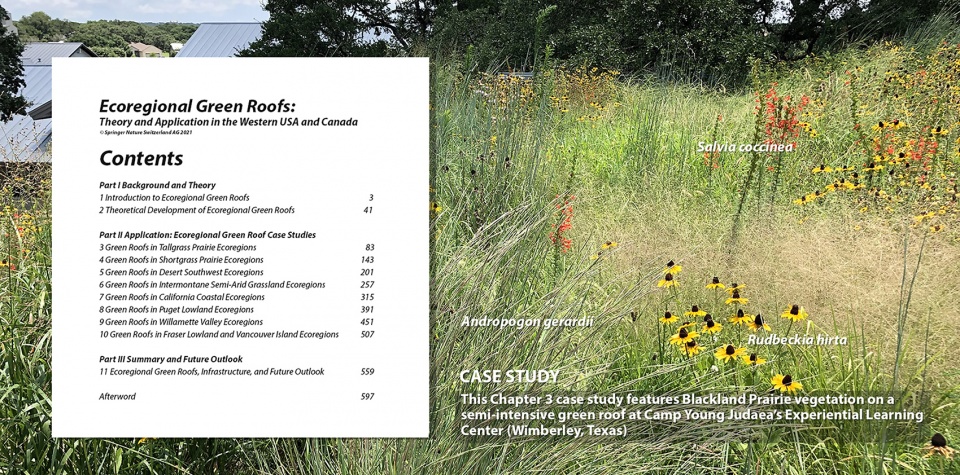
▲本书目录以及第三章内容:种植黑土草原植被的绿色屋顶。高草草原植被在德克萨斯州奥斯汀市外的一处半密集型绿色屋顶上茁壮生长。具有恢复力的绿色屋顶在灌溉系统停止运作后休眠了九个月。当灌溉系统修好之后,顶端植物的生长很快便恢复如初(如图)。Table of Contents and a Green Roof with Blackland Prairie Vegetation (Chapter 3). Tallgrass prairie vegetation thrives on this semi-intensive green roof outside of Austin, Texas. This resilient green roof sat dormant for nine months after the irrigation system stopped functioning. Top-growth was revived soon after the irrigation system was repaired (shown here). © Bruce Dvorak, August 2019
项目说明
PROJECT NARRATIVE
呼吁
环境研究界已经明确呼吁发现能够让城市更具弹性、再生能力和生物多样性,同时满足人类与城市生态系统更广泛的需求的新型绿色基础设施(Tzoulas等,2007;Pereira等,2010;Kowarik,2011;Weber,2013),比如绿色屋顶,能够提供包括雨水衰减、节能、减少城市热岛、碳固存以及野生动物栖息地在内的一系列生态系统服务 (Oberndorfer,2007;Sutton,2015; Williams等,2014)。 在北美,关于绿色屋顶生态系统的研究正在兴起,并着重于提升其可持续性和弹性(Sutton,2015),尤其是在那些日间经历高温、降雨间隔长达数周或数月的生态区(Williams等,2010;Milburn,2014)。通过观察和了解生态区的原生植被如何适应自然环境并茁壮生长,研究人员和设计师将学习如何制定正确的策略,以巧妙地利用绿色屋顶上的原生植被(Butler,2012;Cook-Patten,2012)。此外,还需要在灌溉水源的可持续获取和使用上进行创新。在本书中,九位作者对以上问题进行了研究,并将书中的案例研究方法应用到了对26个保护地、以及73个分布在美国中西部和加拿大的绿色屋顶的研究和探索当中。
第一部分
本书的第一部分介绍了位于100度经线以西的北美本地景观、生态区和绿色屋顶的发展以及研究的目标和方法。
背景和研究陈述
美国原住民对整个北美西部的陆地生态系统的发展和持续产生了至少1万年的影响。丰富、多样、美丽的自然环境吸引了北美景观的第一批管理者,并长期成为他们生活中不可或缺的一部分。然而,从刘易斯和克拉克在1804年首次探索西部开始,到19世纪末期后的西部迁移,新的土地使用者以强势的姿态对这些景观进行了转换、变更或永久开发。例如,曾经大范围分布在各州的高草草原生态系统退化成了一个个孤立的斑块。考虑到以土地为基础的保护措施很难迅速地得到应用,因此可以通过设计绿化屋顶来维持其所在区域的本地植被的多样性——这些地区几乎没有留存下来的原生栖息地(Lundholm,2006)。
今天,分散在北美西部的保护地仍然存在,并成为了新一代设计师打造绿色屋顶的灵感来源。不过,对于西部的数百个绿色屋顶的案例研究仍然十分有限。《生态区绿色屋顶:在美国西部和加拿大的理论和应用》一书正式为了发现和报告更多相关的设计案例,并向读者呈现这些案例的成功与失败,以及设计师从已建项目中吸取到的经验教训。本书的写作目标之一,正是为了填补专业人士、设计师、研究人员、学生和教育工作者在获取与绿色屋顶相关的文献资料上的空白。
方法
案例研究的数据来自于对26个保护地和140多个绿色屋顶项目的实地访问、与生态区域绿色屋顶的所有者、设计者及管理者的交谈,以及网站、报告和同行评审出版物等在线资料。这些案例研究从设计概念、材料、灌溉和维护方法、野生动物、植物种类以及经验心得等几个方面展开探讨。
第二部分
本书的作者考察了26个能够代表草原、沙漠、山地草甸、沿海草甸、灌木和亚高山生态区的保护地,并对73个位于城市地区的绿色屋顶进行了案例研究。
“案例研究”摘录
生态区绿色屋顶属于以下四个类别之一:1)所有植被都来自本地或附近的绿色屋顶;2)植被来自一个或几个相邻生态区的绿色屋顶(例如,来自高山生态系统的植被种植在位于山谷的绿色屋顶上);3)植被来自不同但相似的北美生态区(100度经线以西)的绿色屋顶;4)植被是本地(100度经线以西)和非本地(引进或外来)植物组合的绿色屋顶。
案例研究得出了数百项事实和结论,其中几个重点包括:
• 在20个生态区的调查得出了在广泛型、半密集型和密集型的绿色屋顶上种植的830个本地植物分类群(代表了357个属)的相关知识。植物形式包括乔木、灌木、草、野花、鳞茎、球茎、莎草、芦苇、多肉植物和原产于干燥、中度和湿润生境的矮生木本植物。
• 性能最优的绿色屋顶中有一位“冠军”,它对当地的生态系统和绿色屋顶而言具有极丰富的价值,同时具备预测入侵植物的潜在爆发的能力。
最佳的绿色屋顶通常是采用综合型设计的,其中“活屋顶”发挥着基本的建筑功能,例如减少能源消耗、处理废水(灰水)、衰减雨水以及为特定的当地、稀有或正在迁徙的野生动物提供栖息地。
• 综合设计需要在项目规划初期就需要考虑到多种角度和技能。一些项目原本可以更好地从综合设计的过程中受益,却由于在过程初期缺少投入的情况下就做出了重担决定而产生局限。
• 鉴于美国西部和加拿大生态区植被存在的固有差异,一些绿色屋顶可能需要增加额外的说明和教学,以便用户了解和欣赏一些本地植物的美学特征和功能。
“非结论性的成果”摘录
已有的绿色屋顶研究多数涉及的是绿色屋顶的生态系统服务(例如能源和水),而在(大多数生态区的)植物种类、植物组合、维护要求或生物多样性效益方面则十分欠缺。
一些植物苗圃已经能够很好地适应在绿色屋顶上使用本土植物的探索和试验。然而,在美国西部和加拿大,很少有苗圃会和当地大学建立合作关系,以利用它们的潜力来研究北美数千种原生植物中的一小部分。
• 一些地区已得到当地政府的大力支持,而其他地区才刚刚开始将绿色屋顶技术纳入市政法规、条例、政策和激励措施。对于如何将绿色屋顶运用于城市政策和区域规划工作、培养恢复力以及防止栖息地损失和应对气候变化等问题,现有的研究仍较为缺乏。
第三部分
本书的第三部分包括一段综述、一段对于生态区案例研究的概述以及对未来的展望。
展望
Aldo Leopold主张保护生物多样性,因为本地植物和动物可以保持能量回路的畅通并维持生态系统的健康、稳定和美丽(Leopold 1966)。Aldo Leopold提出的土地伦理学最初可能是为了保护非城市环境中的生态系统;而本书的研究结果表明,种植了本地植被的绿色屋顶能够提供全方位的生态系统服务,并且可以在一些特定方面重塑能量回路,改善以建筑物和硬路面为主的城市环境中的生态和人类健康。该书的73个案例研究阐明了项目的设计目标、所使用的植物、材料和施工方法,以及设计师、建筑所有者和作者本人的使用后评价。每个章节的总结都可以作为专业人员、教育从业者、研究人员和政策制定者的工作指南和资源,帮助他们不同的生态区——高草和矮草草原、西南部沙漠、加利福尼亚沿海、西北太平洋和山间地区——建造具有复原能力且美观的“活”的建筑。《生态区绿色屋顶》的11个章节建立了一个关于北美西部生态区屋顶绿化的基准记录。
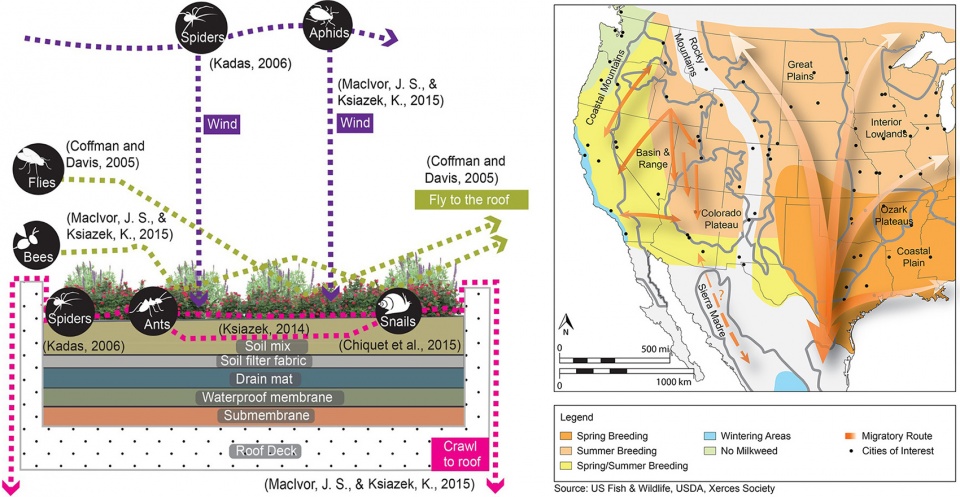
▲绿色屋顶的生物多样性。左侧图例展示了无脊椎动物进入绿色屋顶的方式。书中附有大量的定制地图,例如右图描绘了帝王蝶在北美中部和西部以及一些主要城市(黑点所示)中的迁移路线。Biodiversity on Green Roofs. (Left) Graphic depicts ways that invertebrates can arrive at green roofs. The book includes many custom maps (right), including this one which depicts migration routes of Monarch butterflies in central and western North America and major cities (black dots). © (left) Yinghui Chen and Bruce Dvorak, (right) Trevor Maciejewski and Bruce Dvorak
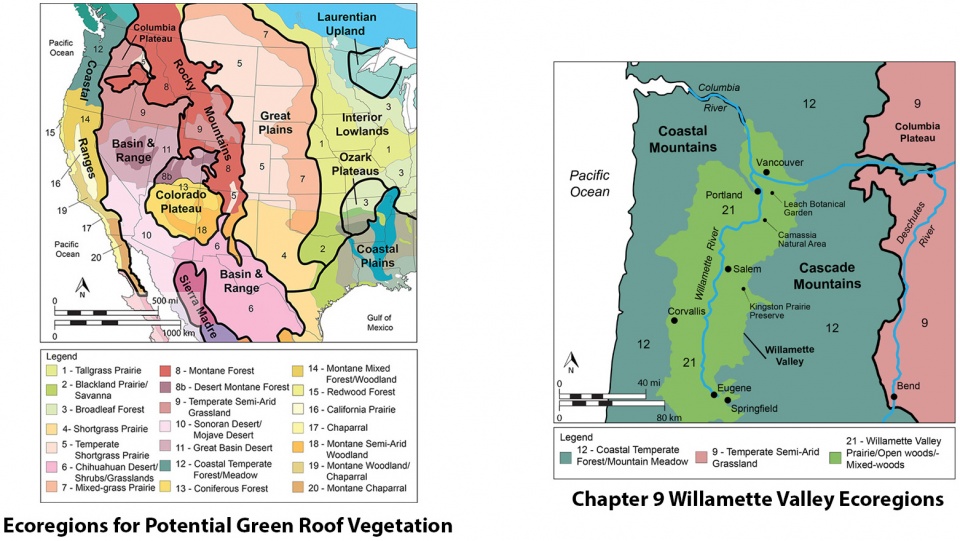
▲绿色屋顶生态区。左图是本书涉及的生态区概览图。每个案例研究章节都包括一张放大的生态区地图,展示了潜在的自然植被、主要河流、自然地理区域和人口中心。地图改编自1995年的Bailey和Omernik地图。Ecoregions for Green Roofs. Overview map of ecoregions covered in the book (left). Each case study chapter includes enlarged ecoregion maps showing potential natural vegetation, major rivers, physiographic regions, and population centers. Maps are adapted from Bailey (1995), Omernik (1995), and others. © Trevor Maciejewski and Bruce Dvorak (based on Hammond 1964, Bailey 1995, Omernik 1995, others)
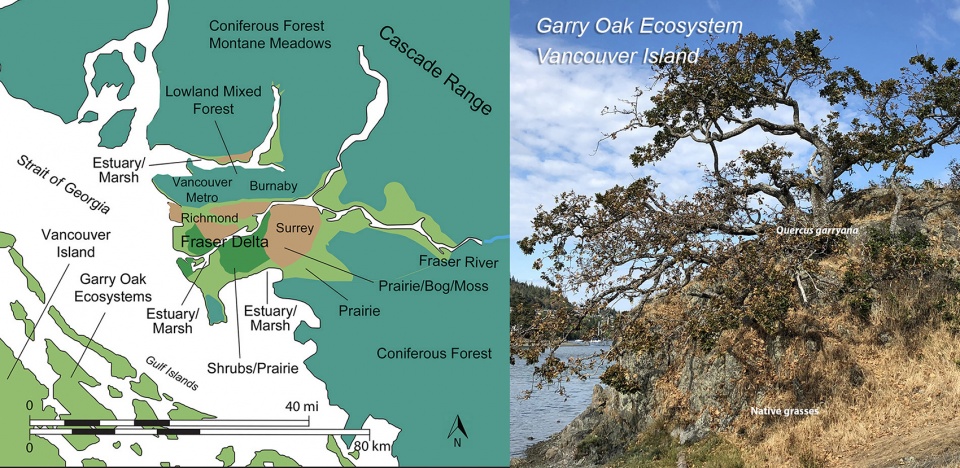
▲生态区特征。各章节涵盖了对生态区的潜在自然植被和文化影响的描述,以及一些具有历史意义的生态区地图(左)。此外还提供受保护的生态区植被所在的位置和照片(右),以及一些历史性的生态区地图(左)。各章包括生态区植被保护的地点和图片(右),例如位于Pipers Lagoon公园(加拿大B.C.省纳奈莫市)的俄勒冈白栎生态系统。Ecoregion Characteristics. Chapters include ecoregion descriptions of potential natural vegetation, cultural influences, and some historic ecoregion maps (left). Chapters include locations and images (right) of conserved ecoregion vegetation such as this Garry oak ecosystem located at Pipers Lagoon Park (Nanaimo, B.C. Canada). © Map by Bruce Dvorak (adapted from North and Dunn 1979, McCune et al. 2013 and others), photo Bruce Dvorak, September 2018
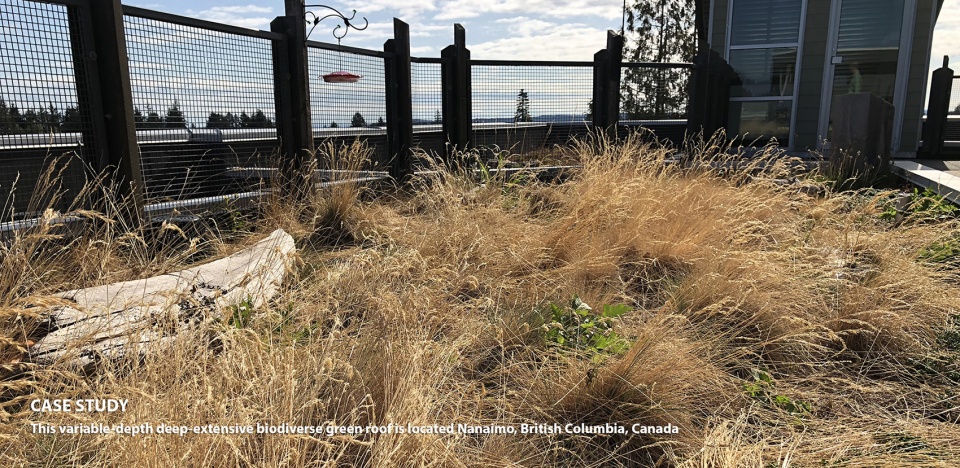
▲以俄勒冈白栎生态系统为灵感设计的绿色屋顶(第10章)。在加拿大不列颠哥伦比亚省纳奈莫市的广泛型绿色屋顶上,原生于俄勒冈白栎生态系统的草、野花和景天属植物正茁壮生长。这张照片于8月下旬拍摄的,接近夏季旱季的尾声,一些植被已经进入休眠期。Green Roof Inspired by a Garry Oak Ecosystem (Chapter 10). Grasses, wildflowers, and sedums native to Garry oak ecosystems thrive on this extensive green roof in Nanaimo, British Columbia, Canada. This photo was taken during late August, near the end of the summer dry season, when some vegetation becomes dormant. © Bruce Dvorak, August 2018
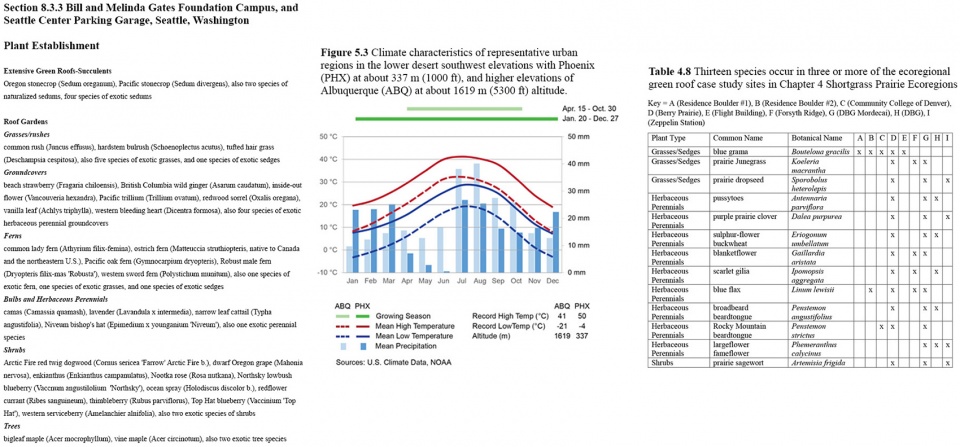
▲案例研究中的植被、气候数据和章节摘要。每个案例研究包括生长在绿色屋顶上的本地植物清单(左)、气候数据和图表(中),以及突出显示常见于绿色屋顶的植被的章节总结(右)。Examples of Case Study Vegetation, Climate Data, and Chapter Highlights. Each case study includes plant lists of native vegetation growing on the green roof (left), climate data and graphs (center), and chapter summaries highlighting popular vegetation on green roof (right). © Bruce Dvorak, Tess Menotti, Nancy Rottle, Jennifer Bousselot
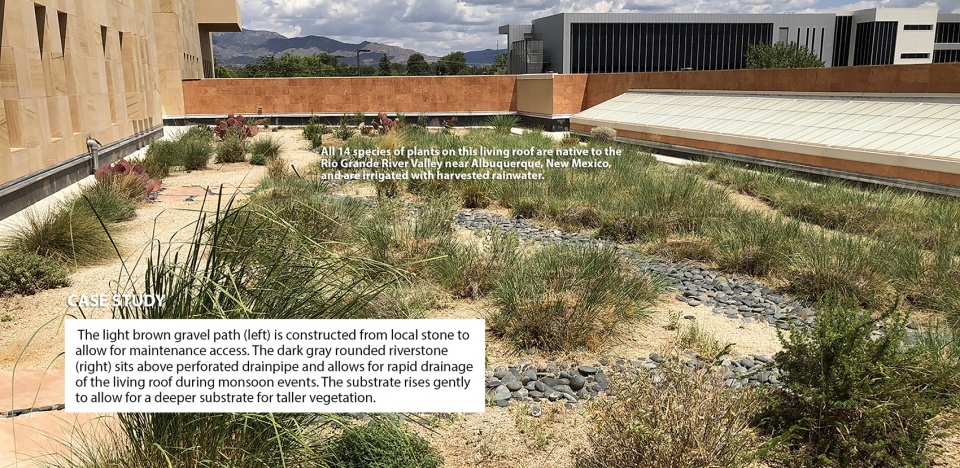
▲西南部沙漠地区新墨西哥州案例研究(第5章)。新墨西哥州上诉法院的半密集型绿色屋顶是经LEED黄金级别认证的建筑项目的一部分。该书的研究结果显示,西南部沙漠的屋顶绿化基质通常较深,这有利于深根性的沙漠植被生长,并且可以防止过热。New Mexico Case Study in the Desert Southwest (Chapter 5). The New Mexico Court of Appeals semi-intensive green roof is part of a LEED-certified gold project. Our findings revealed that green roof substrates in the Desert Southwest are typically deeper to support deep-rooted desert vegetation and prevent heat stress. © Bruce Dvorak, July 2018
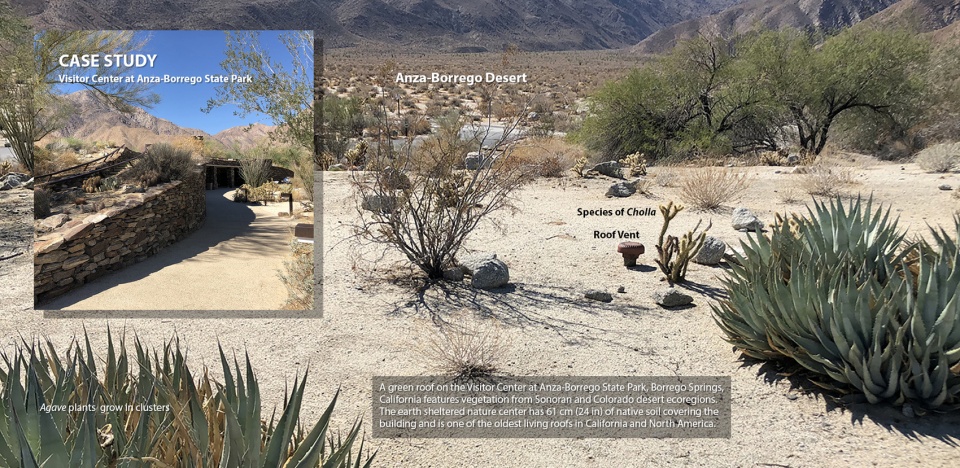
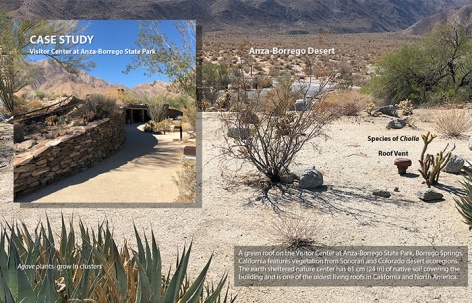
▲Anza-Borrego沙漠的生态区绿色屋顶(第5章)。建造于1979年、位于加州Borrego Springs的Anza-Borrego游客中心拥有西南部沙漠地区最古老的绿色屋顶之一。从该图的中右部可以看见屋顶上的通风口,防水层也依然保留在原处。Ecoregional Green Roof in the Anza-Borrego Desert (Chapter 5). Constructed in 1979, the living roof on top of the Anza-Borrego Visitor Center in Borrego Springs, California is one of the oldest green roofs in the Desert Southwest. A roof vent is visible center right, and the original waterproofing remains. © Bruce Dvorak, October 2018
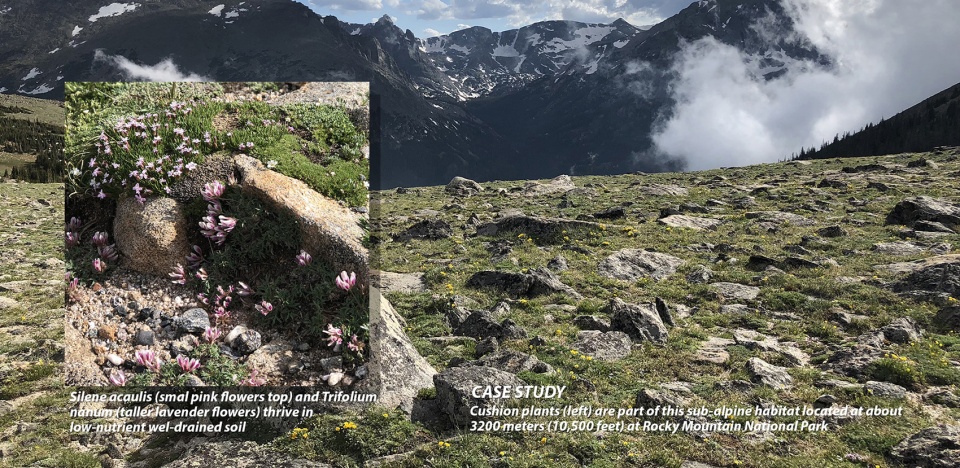
▲绿色屋顶的亚高山栖息地(第1章,生态区绿色屋顶介绍)。高山和亚高山栖息地,例如图中所示的这块位于落基山国家公园的栖息地,包含了生长在浅层、营养不足但排水良好的土壤中的垫状植物。这些植物群落中的成员是绿色屋顶的良好“候选者”。Sub-alpine Habitat for Green Roofs (Chapter 1 Introduction to Ecoregional Green Roofs). Alpine and sub-alpine habitats such as this one at Rocky Mountain National Park include cushion plants, which grow in shallow and nutrient-deficient, and well-drained soils. Members of these plant communities make good candidates for green roofs. © Bruce Dvorak, June 2018
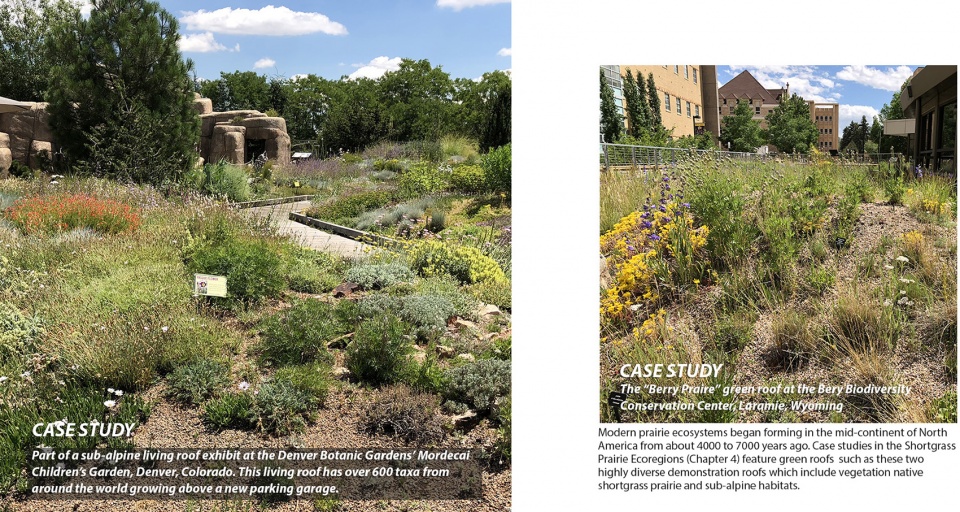
▲落基山Front Range地区的绿色屋顶(第4章)。图中展示的是丹佛植物园Mordecai儿童花园和怀俄明大学贝瑞生物多样性保护中心的绿色屋顶。它们各自持有170个和110个本地分类群,其中包括一些来自亚高山和高山栖息地的物种。Green Roofs along the Front Range of the Rocky Mountains (Chapter 4). Green roofs at the Mordecai Children’s Garden at the Denver Botanic Garden and the Berry Biodiversity Conservation Center, at the University of Wyoming. These feature 170 and 110 (respectively) native taxa including species from sub-alpine and some alpine habitats. © Bruce Dvorak, June 2018
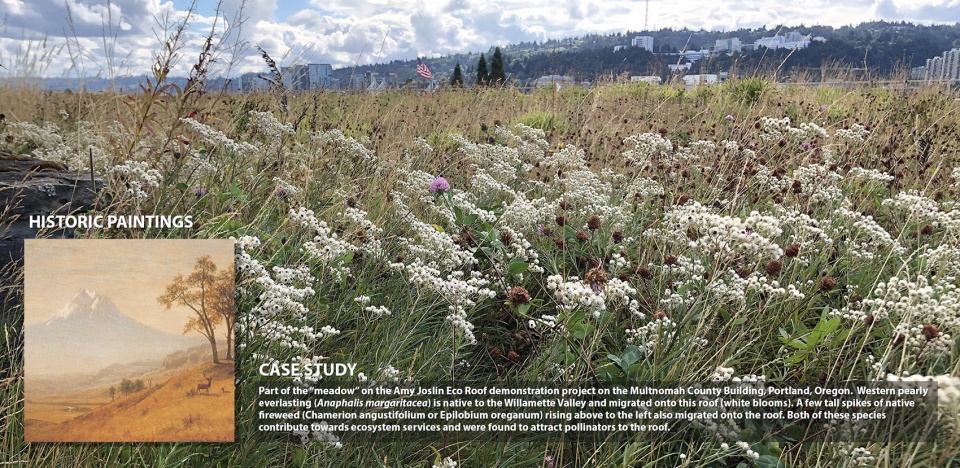
▲研究历史画作和俄勒冈州波特兰的生态屋顶(第9章):该章节涵盖了本地生境的历史画作(如小图所示)。这幅由Albert Bierstadt于1863年创作的绘画描绘了俄勒冈州波特兰附近的大草原和橡树稀树草原生态系统。背景图中,马尔特诺马县的建筑上种植着本地草和野花,作为其生态屋顶示范项目的一部分。Learning from Historic Paintings and an Ecoroof in Portland, Oregon (Chapter 9)。Chapters include historic paintings of native habitats (inset). This 1863 painting by Albert Bierstadt depicts prairie and oak savanna ecosystem near Portland, Oregon. (background) The Multnomah County building includes native grasses and wildflowers as part of its ecoroof demonstration project. © Albert Bierstadt https://uploads2.wikiart.org/images/albert-bierstadt/mounthood- 1863.jpg (inset) Bruce Dvorak, September 2018 (background)
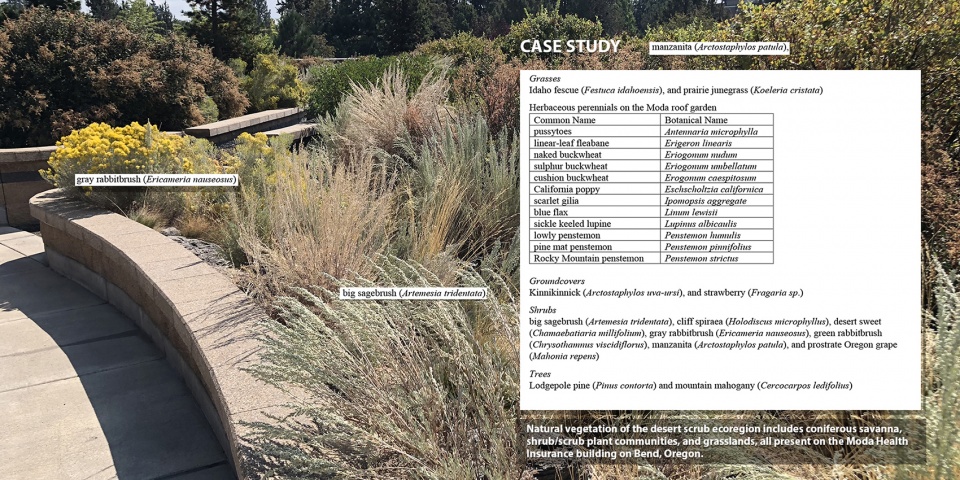
▲山间半干旱草原生态区的10个绿色屋顶研究案例之一(第6章)。这是一个利用多种植物形式的全本地半密集型屋顶花园。该花园充分利用了俄勒冈州东部以及山间半干旱草原生态区部分地区的原生半干旱灌丛植被。 One of 10 Green Roofs Studied in the Intermontane Semi-arid Grassland Ecoregions (Chapter 6). Example of an all-native semi-intensive roof garden that makes use of many forms of plants. This roof garden makes use of semi-arid scrub vegetation native to eastern Oregon, and across parts of the Intermontane semi-arid grassland ecoregions. © Bruce Dvorak, September 2018
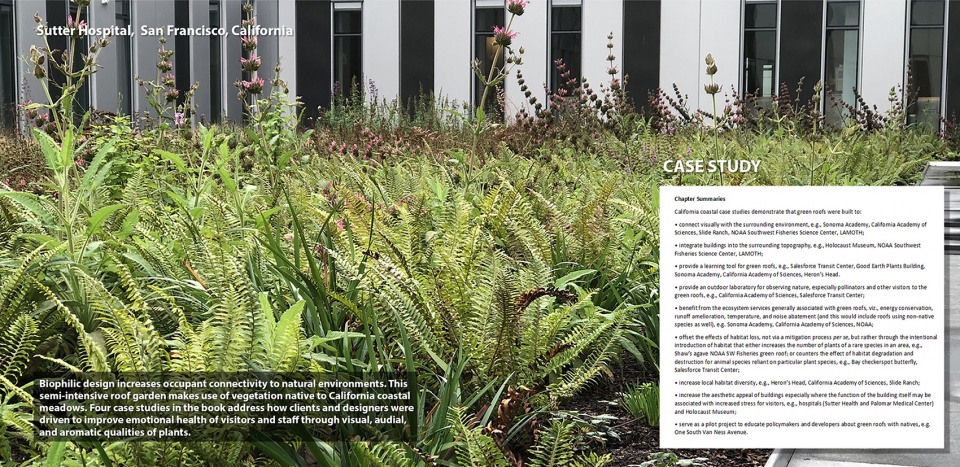
▲绿色屋顶和亲生物设计:该章节强调了案例研究中常见的屋顶绿化功能(图右)。 位于Sutter医院的无障碍半密集型屋顶花园是五个全本地植物绿色屋顶之一,可以从医院的访客区(如图)、康复室和其他有利位置直接望见。Green Roofs and Biophilic Design. Chapter summaries highlight green roof functions common to the case studies (right). This accessible semi-intensive roof garden at Sutter Hospital is one of five all native green roofs visible from visitor areas (shown here), recovery rooms, and other strategic locations. © Bruce Dvorak, October 2018
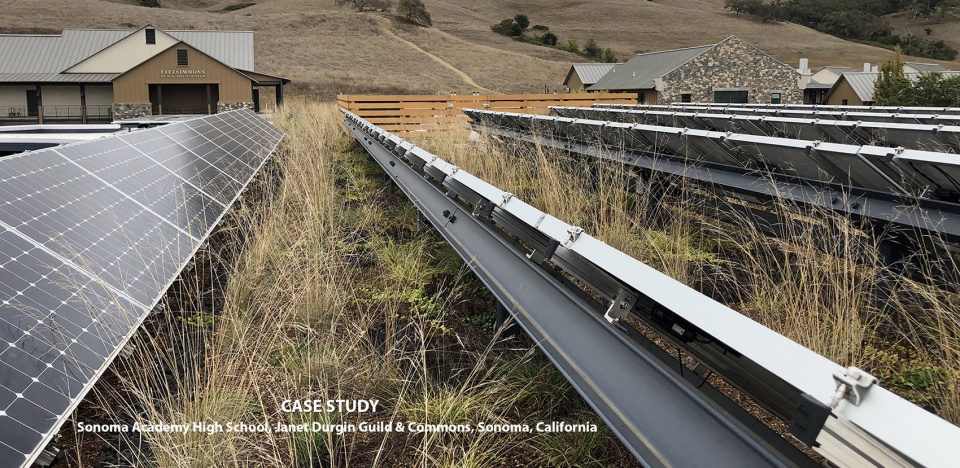
▲用绿色屋顶教导下一代:书中的几个案例研究花园包含了光伏板装置,图中的花园的光伏板安装在屋顶草甸上。索诺玛学院的建筑设计旨在鼓励教导学生参与周围环境,成为批判性的思考者,同时观察并收集数据。Living Roofs for Teaching the Next Generation. Several case studies include photovoltaic panels, this one is on a rooftop meadow. Buildings at Sonoma Academy are designed to teach students to engage their environments, to be critical thinkers, and to observe and collect data, including this green roof. © Bruce Dvorak, October 2018
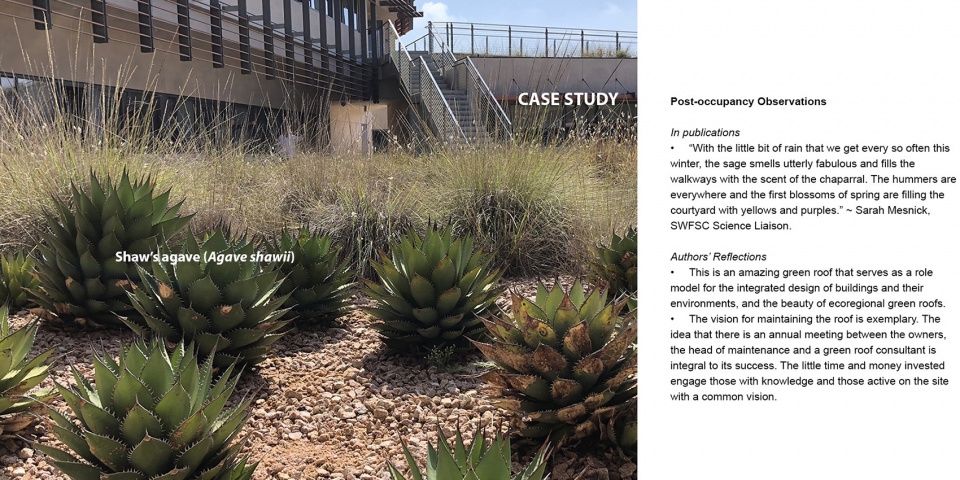
▲用生物多样的绿色屋顶来保护和亲近生物。亲生物性设计鼓励人们经常与自然进行亲密接触,为空间的使用者带来情感和精神上的幸福。这座位于加州拉荷亚的半密集型屋顶花园将该地区的本地植被与在大楼内部工作的科学家联系起来。Biodiverse Green Roofs for Conservation and Biophilia. Biophilic design encourages close and frequent contact with nature for the emotional and psychological well-being of those using the space. This semi-intensive roof garden in La Jolla, California connects the locally native vegetation of the region to the scientists working inside. © Bruce Dvorak, October 2018
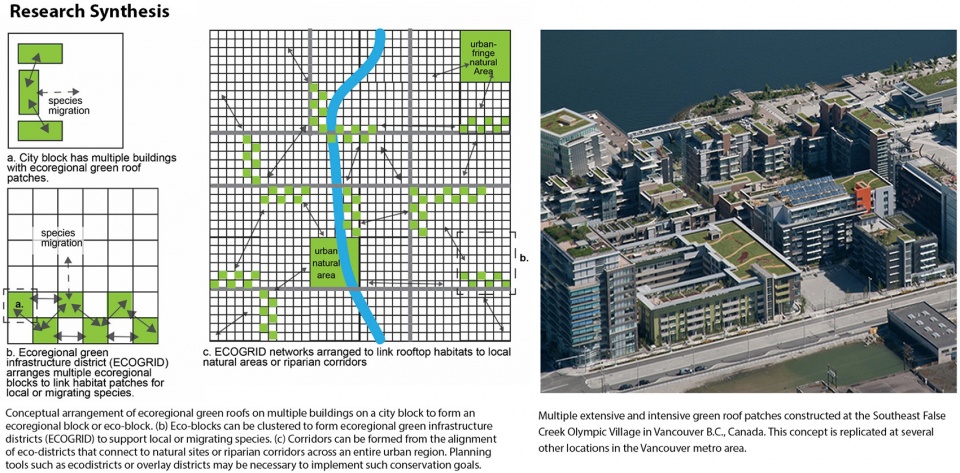
▲研究总结、综述和景观生态学。左图描述了多栋带有绿色屋顶的建筑如何形成屋顶斑块、区域和绿廊。右图展示了位于加拿大温哥华市的一项能够体现该理念的建筑实例。如图右上角所示,其中一些绿色屋顶设定了栖息地的目标。Research Summary, Synthesis, and Landscape Ecology. (Left) Diagrams depicting how multiple buildings with green roofs can form rooftop patches, districts, and corridors. (right) Built examples of this concept exist in Vancouver, B.C. Canada. Some of these green roofs have habitat goals (upper right). © Bruce Dvorak (diagram left), Courtesy Flightpath Aerial Photography–Vitaroofs International Inc. (right)
PROJECT NARRATIVE
The Call
There is a clear call in the environmental research community for the discovery of novel forms of green infrastructure that can make cities more resilient, regenerative, biologically diverse, and responsive to the broader needs of humans and urban ecosystems (Tzoulas et al. 2007; Pereira et al. 2010; Kowarik 2011; Weber 2013). Green roofs, for example, provide ecosystem services including stormwater attenuation, energy conservation, reduction of urban heat islands, carbon sequestration, wildlife habitat, and more (Oberndorfer 2007, Sutton 2015; Williams et al. 2014). In North America, research on green roof ecosystems is just emerging on how they can become more sustainable and resilient (Sutton 2015), especially in ecoregions that experience high daytime temperatures and many weeks or months between precipitation events (Williams et al. 2010, Milburn 2014). By observing and learning how vegetation native to ecoregions adapts and thrives in its natural settings, researchers and designers can learn how to make decisions about the resourceful use of native vegetation on green roofs (Butler 2012, Cook-Patten 2012). Also, innovations in the sustainable sourcing and use of water for irrigating green roofs are needed (Lambrinos 2015). Nine authors investigate these issues and more in Ecoregional Green Roofs: Theory and Application in the Western USA and Canada a new (2021) peer-reviewed three-part book published by Springer in their Cities and Nature series (619 pages). A case study method is used in the exploration of 26 conservation site case studies, and 73 green roof case studies that are built and maintained in the central and western United States and Canada.
Part I
This section introduces native landscapes of North America west of the 100th meridian, the development of ecoregions and green roofs, and research goals and methods.
Background and Research Statement
Native Americans have influenced the development and persistence of terrestrial ecosystems across the western landscapes of North America for at least the previous 10,000 years. The abundantly rich, diverse, and beautiful natural environments were integral and ever-present in the lives of the first stewards of North American landscapes. However, between the time of the first exploration of the West by Lewis and Clark beginning in 1804 and the settlement of the West from the late 1800s onward, those same living landscapes were persuasively altered, modified, and/or permanently developed by new tenants of the land. Tallgrass prairie ecosystems, for example, were reduced to isolated patches that represent about one-tenth of one percent of the land in some states where they were once abundant. As land-based conservation practices are slow to be adopted, vegetated rooftops can be designed to be biologically diverse and sustain vegetation that is native to areas where no little or no native habitat remains (Lundholm 2006).
Today, scatterings of conservation sites remain across the West and serve as a source of inspiration for a new generation of green roof designers. However, there is only limited research on the hundreds of green roofs in the West. Ecoregional Green Roofs: Theory and Application in the Western USA and Canada was written to discover and report on the many designs, successes, setbacks, and lessons learned from built projects. Ecoregional Green Roofs was written to begin to fill a gap in the literature for professionals, designers, researchers, students, and educators with an interest in biodiverse green roofs populated with native plants.
Methods
Data for case studies was attained through on-site visits to 26 conservation sites and over 140 green roofs, interviews with owners, designers, and managers of ecoregional green roofs, and reviews of online sources such as websites, reports, and peer-reviewed publications. Case studies explore design concepts, materials, watering and maintenance, wildlife, plant species, and lessons learned.
Part II
Authors investigate the vegetation from 26 case studies of conservation sites representing prairie, desert, montane meadow, coastal meadow, scrub, and sub-alpine ecoregions, and 73 green roof case studies located in urban regions.
Excerpts from Case Studies
Ecoregional green roofs belonged to one of four categories: 1) A green roof where all of the intended vegetation is native to the site, or nearby; 2) A green roof where the intended vegetation is native to one or several adjacent ecoregions (i.e. vegetation from an alpine ecosystem that is planted on a green roof in a valley below); 3) A green roof where the intended vegetation is native to various, but similar ecoregions of North America (west of the 100th meridian); 4) A green roof with vegetation from a combination of native (west of the 100th meridian) and non-native (introduced/exotic) vegetation.
Case studies yielded hundreds of facts and insights. A few highlights include:
• Investigations in 20 ecoregions yielded knowledge of 830 taxa of native plants representing 357 genera on extensive, semi-intensive, and intensive green roofs. Plant forms include trees, shrubs, grasses, wildflowers, bulbs, corms, sedges, rushes, succulents, and low-growing woody vegetation native to dry, mesic, and wet habitats.
• The best performing green roofs had a “champion”, someone that was knowledgeable about the local ecosystems, green roofs, and the ability to anticipate potential outbreaks of unwanted volunteer or invasive exotic vegetation.
• The top-performing living roofs were integrated designs, where living roofs performed essential building functions such as energy reduction, treatment of wastewater (greywater), attenuation of rainwater, and habitat for targeted local, rare, or migrating wildlife.
• Integrated designs required a process where multiple perspectives and skills were considered early in the planning stages of the project. Some projects could have taken advantage of a more integrated design process and were limited because major project decisions were made early in the process without a variety of inputs.
• Due to the inherent differences in ecoregional vegetation across the western U.S. and Canada, some green roofs may require interpretation and education for users to appreciate the aesthetic qualities and functions of some native plants.
Excerpts from “What is Not Conclusive”
• Much of the existing green roof research covers green roof ecosystem services (e.g. energy, water), and there is little research (in most ecoregions) on plants, plant assemblages, maintenance requirements, or biodiversity benefits.
• Some plant nurseries are well-adapted to explore and trial the use of native plants on green roofs. However, few nurseries in the western US and Canada are taking advantage of their potential to lead and team up with local universities to study some of the thousands of plants native to North America.
• Some regions have strong support from local governments, and other regions are just beginning to integrate green roof technology into municipal codes, ordinances, policies, and incentives. There is a lack of research on how green roofs can be employed in municipal policies, regional planning efforts, address resiliency, habitat loss, or climate change.
Part III
This section provides a synthesis, an overview of ecoregional case studies, and future outlook.
Outlook
Aldo Leopold argued for the conservation of biodiversity because the native plants and animals keep the energy circuit open and retain the health, stability, and beauty of ecological systems (Leopold 1966). Aldo Leopold’s land ethic was perhaps intended for the conservation of ecosystems in exurban environments; however, the findings presented in this book demonstrate how living roofs that are planted with native vegetation can provide a full spectrum of ecosystem services and can re-create certain aspects of the energy circuit, improve ecological and human health in urban environments where buildings and pavement dominate. The book’s 73 case studies reveal design objectives, plants, materials, and construction methods used, post-occupancy comments from designers, building owners, and the authors. The chapter summaries serve as a guide and resource for professionals, educators, researchers, and policymakers interested in making resilient and beautiful living architecture in ecoregions spanning from the tallgrass and shortgrass prairies, the Desert Southwest, coastal California, the Pacific Northwest, and Intermountain regions. The eleven chapters of Ecoregional Green Roofs establishes a baseline record of what is known about ecoregional green roofs in western North America.
More:ASLA。Bruce Dvorak, ASLA








来个中文版吧
还需要时间去验证