感谢 土人设计 对gooood的分享。更多关于他们:Turenscape on gooood
Appreciation towards Turenscape for providing the following description:
1. 项目简介
Project Statement
淮阳古称“陈”,相传东夷族部落首领太昊伏羲氏都宛丘,炎帝神农氏继都之,则曰“陈”,“陈”名自此始。龙湖又称“城湖”,由历代修堤护城逐年形成,湖环古城,围堤14公里,面积11平方公里,是中国内陆最大的环城湖,也是国家级湿地公园。《诗经·陈风》中的城水描述,在今天的淮阳依然可见。
Huaiyang, formerly referred to as “Chen,” has a legendary history. According to tradition, the tribe leader of Dongyi, Taihao Fuxi, established his capital in Wanqiu. Subsequently, the Yan Emperor Shennong continued the town development and designated it as “Chen,” thus marking the commencement of this appellation. Longhu, also known as the “City Lake”, gradually took shape over the years through successive dike and city protection. For a thousand years, this expansive lake has encircled the ancient Huaiyang, with a surrounding dike stretching 14 kilometers and covering an area of 11 square kilometers. It is not only China’s largest inland city-surrounding lake but also a nationally designated wetland park. The city and water descriptions found in the “Book of Songs • Chen Feng” are still observable in present-day Huaiyang.
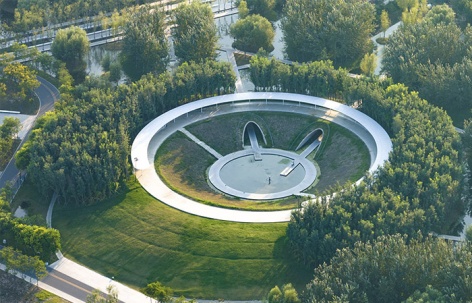
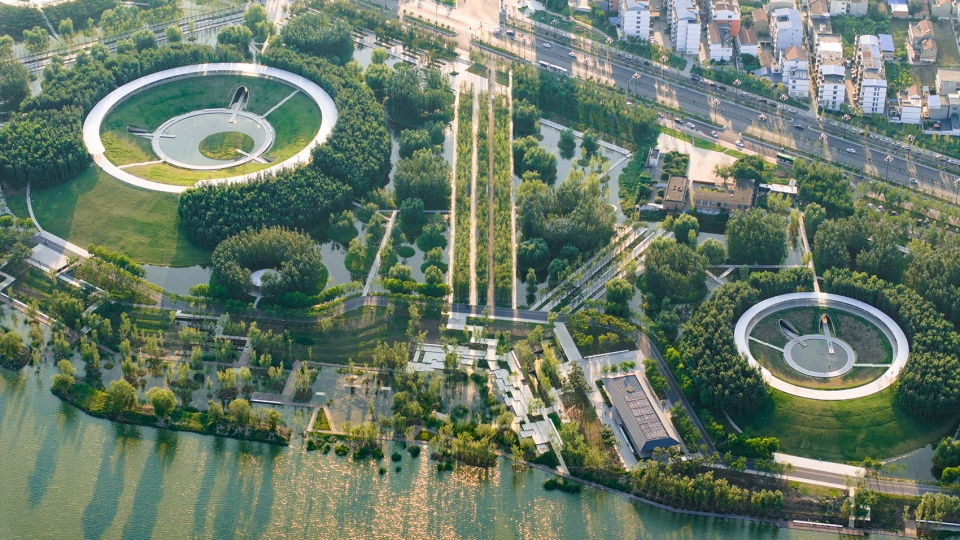
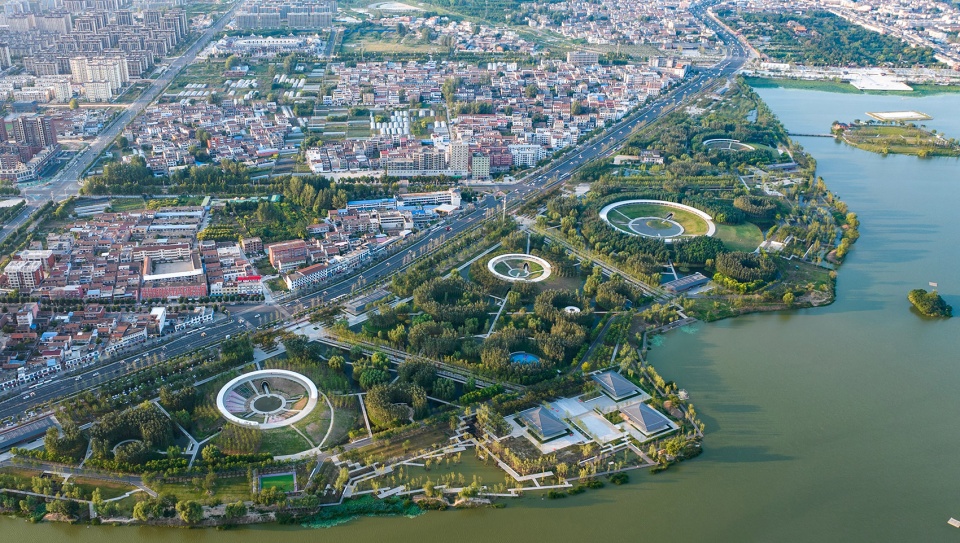
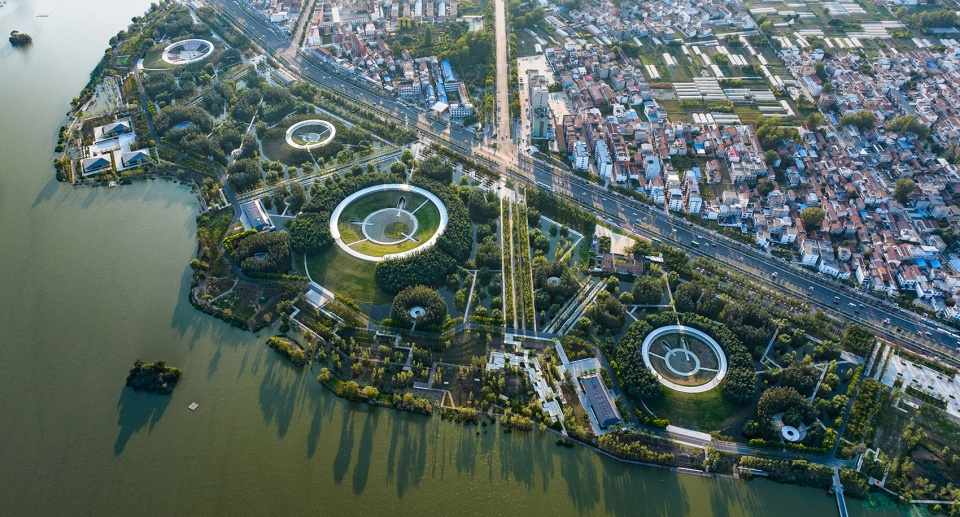
▼项目鸟瞰,Aerial view © 张锦影像工作室
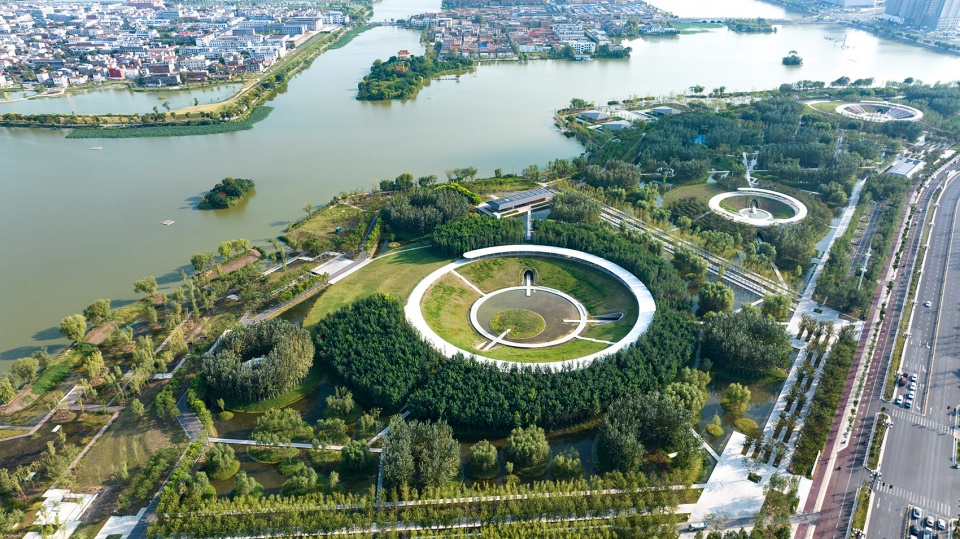
伏羲文化公园位于龙湖西岸,东望古城,西临龙都路,北面是全国重点文物保护单位、中国十八大名陵之一——太昊陵。项目总用地面积43万平米,场地原为两个城中村——苏花园村、田湾村,村庄围湖而建,密集的建筑将城湖阻隔开来,使得2.1公里长的滨水空间相对封闭,其公共属性未充分发挥,城市“临水不见水”、“见水不亲水”,现状硬质、陡直的驳岸,亲水性差,2.1公里硬质驳岸亟需修复。
Fuxi Cultural Park is located on the west bank of Longhu Lake, facing the ancient city to the east, Longdu Road to the west. To the north lies one of China’s eighteen famous imperial mausoleums, a nationally significant cultural heritage site, Taihao Mausoleum. The project encompasses a total land area of 430000 square meters, originally comprising two urban villages, Suhuayuan Village and Tianwan Village, both of which was built around the lake. The presence of dense buildings in these villages separated the city from the lake, resulting in a 2.1-kilometer long waterfront space that felt relatively closed. Its public attributes were not fully utilized, and the city’s “water is not visible” and “water is not hydrophilic”. The current hard and steep embankment has poor hydrophilicity, and the 2.1 kilometer hard embankment urgently needs to be repaired.
▼文化公园和城中村环境,The Cultural Park and the context of urban villages © 张锦影像工作室
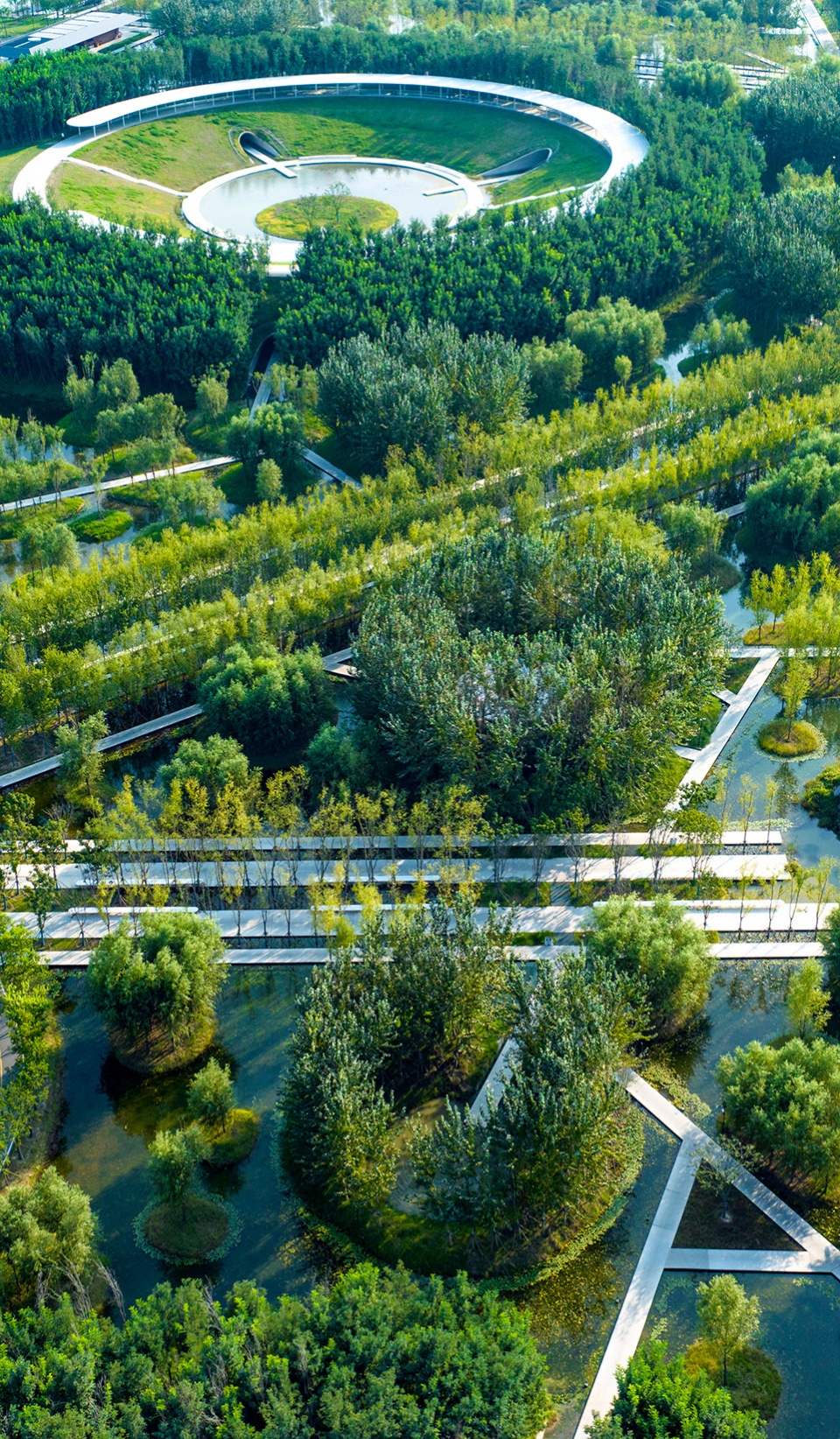
本着显陵透湖的目的,设计依托本底资源,将场地修复为“会呼吸”的海绵城市公园,同时统筹兼顾文化旅游功能及公共服务功能,将伏羲文化公园建设成为集生态科教、休闲观光、文化展示于一体的综合城市公园。
With the aim of highlighting the visibilityof Mausoleum and the transparency of Lake, the design leverages existing resources to transform the site into a “breathing sponge city park”. Simultaneously, the design will orchestrate a harmonious balance between cultural tourism and public service functions, shaping Fuxi Cultural Park into a comprehensive urban park that seamlessly integrates ecological science education, leisure tourism, and cultural displaying.
▼“会呼吸”的海绵城市公园
A “breathing sponge city park”© 张锦影像工作室
2. 现场挑战和目标
On-Site Challenges and objectives
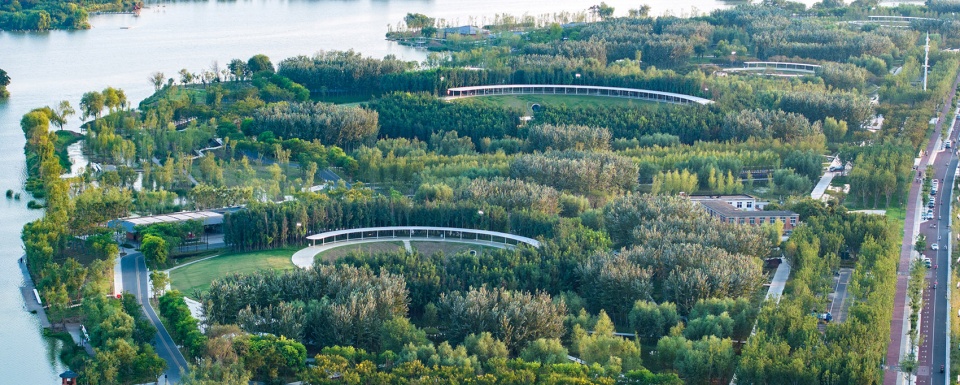
场地为龙湖与城市的过渡带区域,如何在人类活动与生态保护之间达到平衡是设计面临的核心挑战;另外,场地虽濒临龙湖但滨湖水体能见度差,硬质陡岸,水环境退化,且无开放的亲水体验空间,如何在实现龙湖水体生态提升的同时营造大量亲水活动空间是设计面临的另一个核心挑战。
The site is the transitional zone between Longhu Lake and the city, and achieving a balance between human activities and ecological protection is the core challenge facing the design. In addition, although the site is adjacent to Longhu Lake, the visibility of the lakeside water is poor, characterized by steep, hard embankments, and a degraded water environment. There is also a lack of open waterfront experience space. Creating a large substantial waterfront activity area while achieving the ecological improvement of Longhu Lake water is another primary design challenge.
▼滨水环境,Lakeside environment © 张锦影像工作室
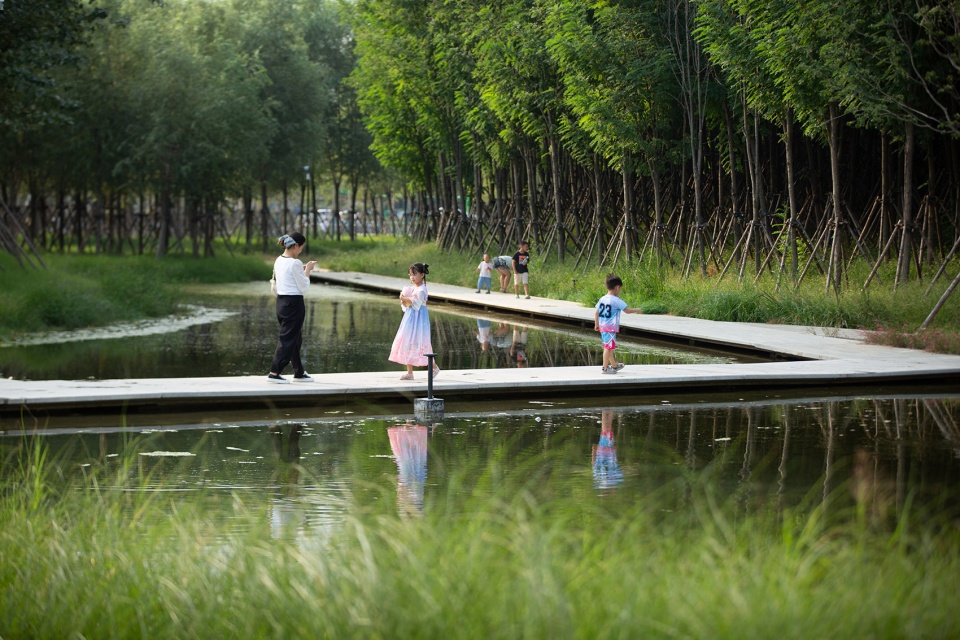
▼营造大量亲水活动空间,Creating a large substantial waterfront activity area © 张锦影像工作室
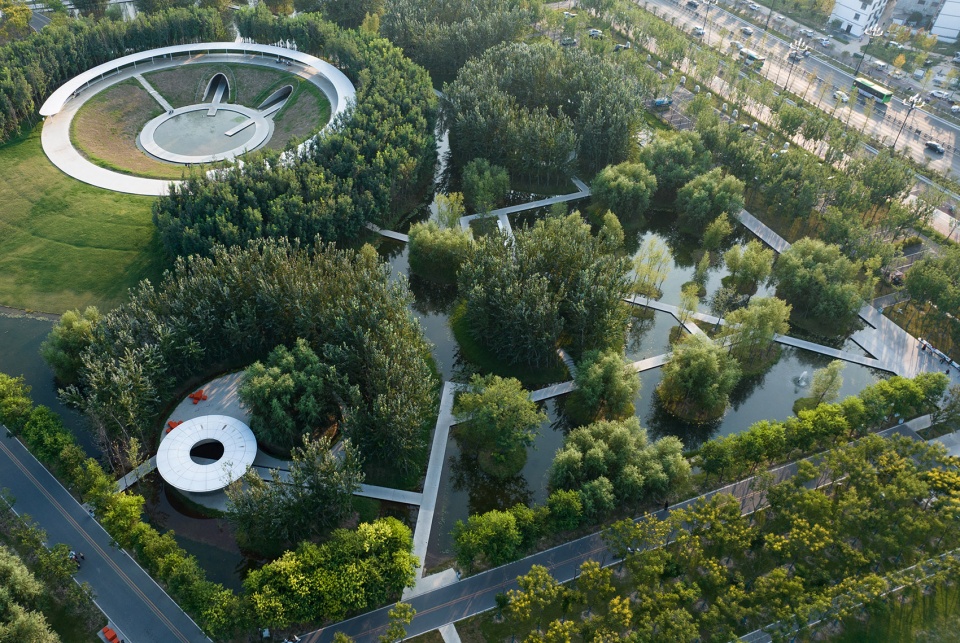
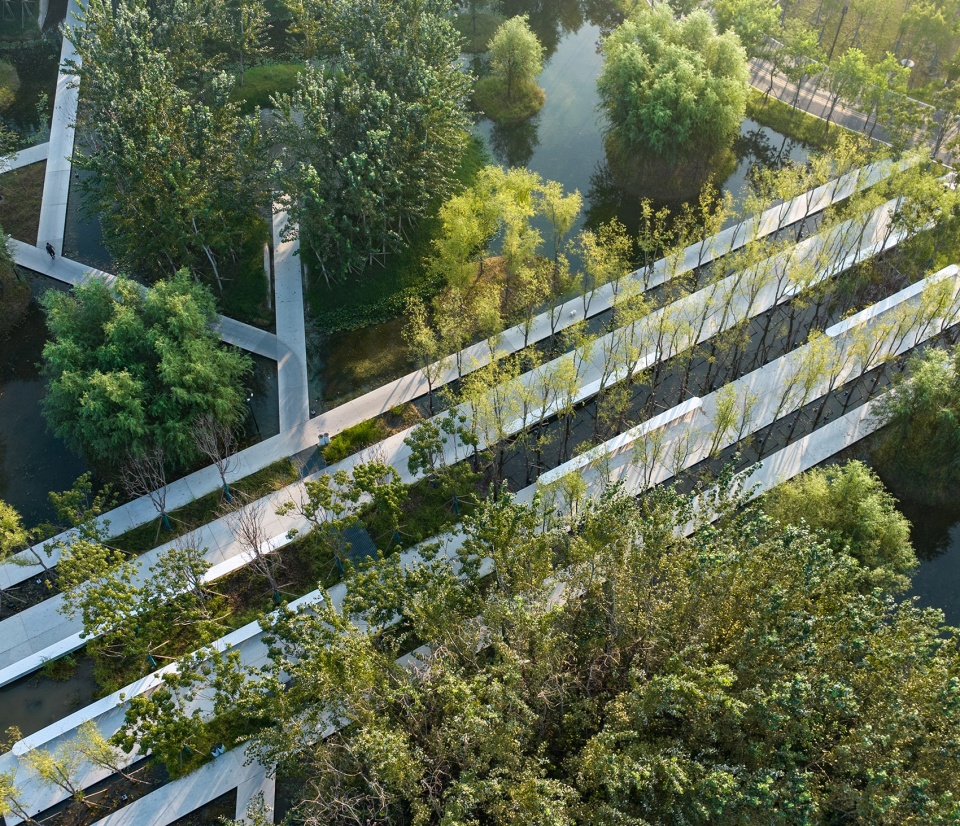
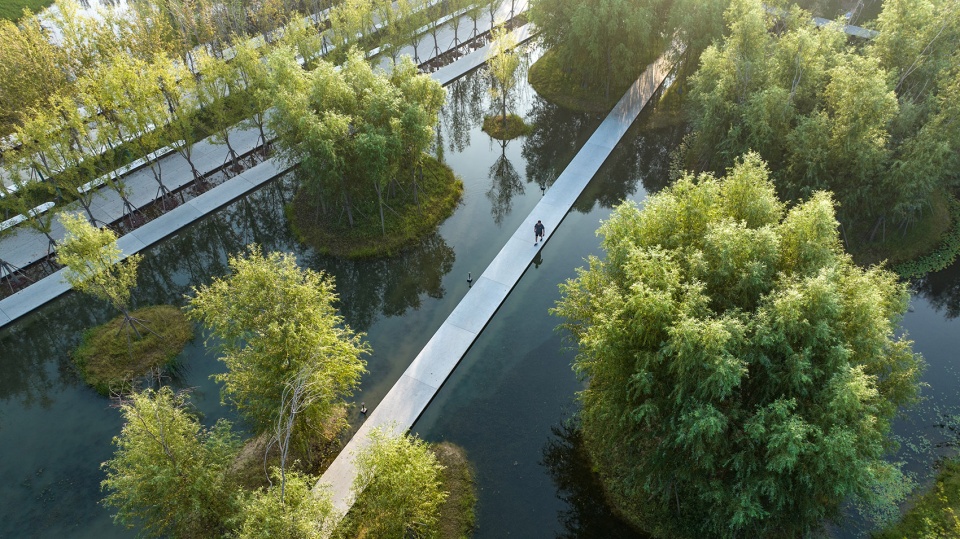
设计旨在建设一个城湖过渡带的生态建设示范区,打破城、湖边界,融合蓝绿。建成后的伏羲文化公园里,百姓可以与水为友,与景对话,可再唱《陈风》“彼泽之陂,有蒲与荷,有蒲与蕳,有蒲菡萏,有美一人”。
The design aims to build an ecological construction demonstration area in the urban lake transition zone, breaking the boundaries between the city and the lake, and integrating blue and green. In the completed Fuxi Cultural Park, people can harmonize with water, engage in a dialogue with the landscape, and perhaps, as in the “Chen Feng” poem, sing: In that marshy lake, there is the bulrush and lotus, there is the bulrush and orchids; there is the bulrush, lotus flowers, and there is a beautiful person.
▼与水为友,与景对话,Harmonize with water © 张锦影像工作室
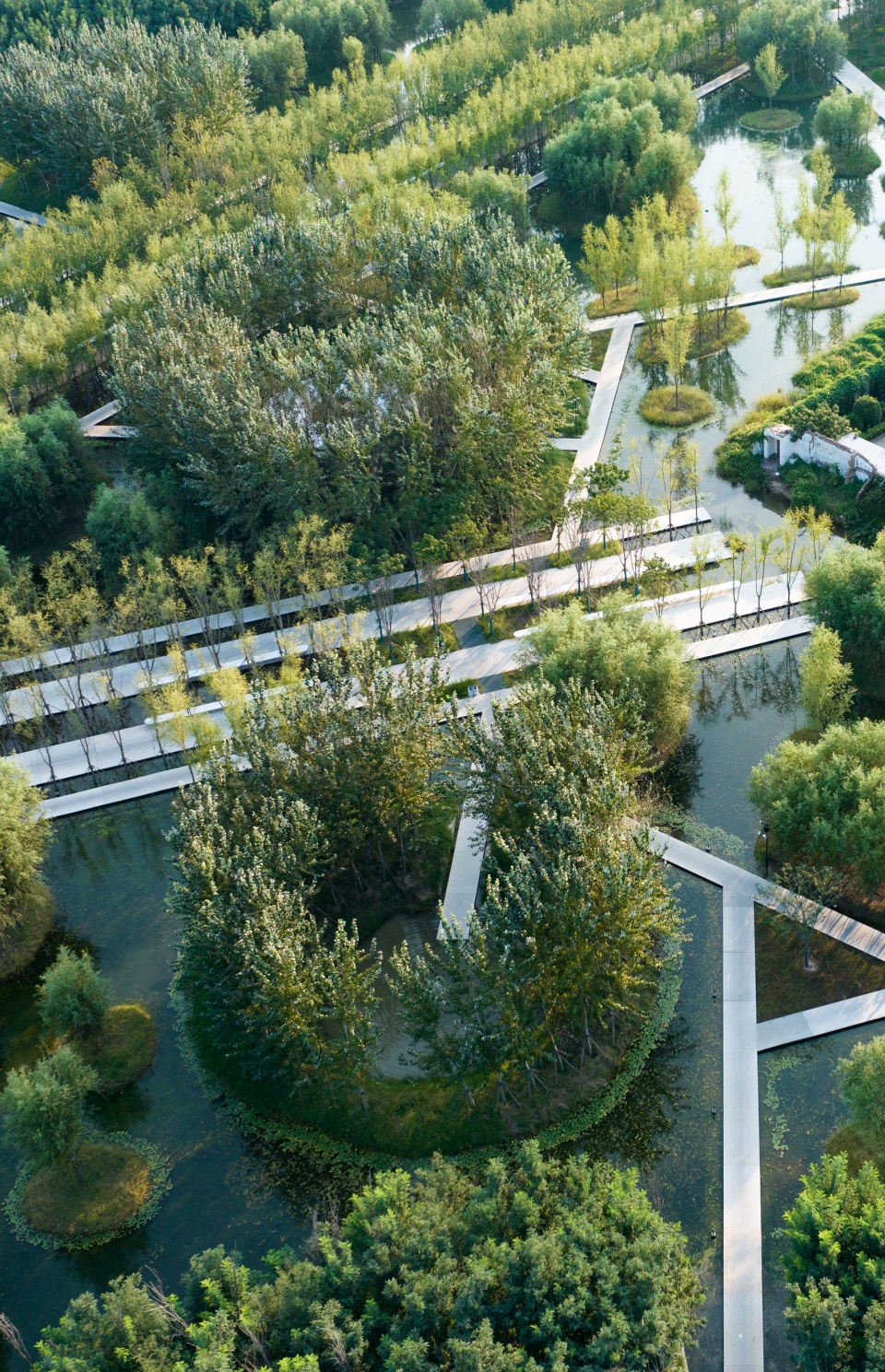
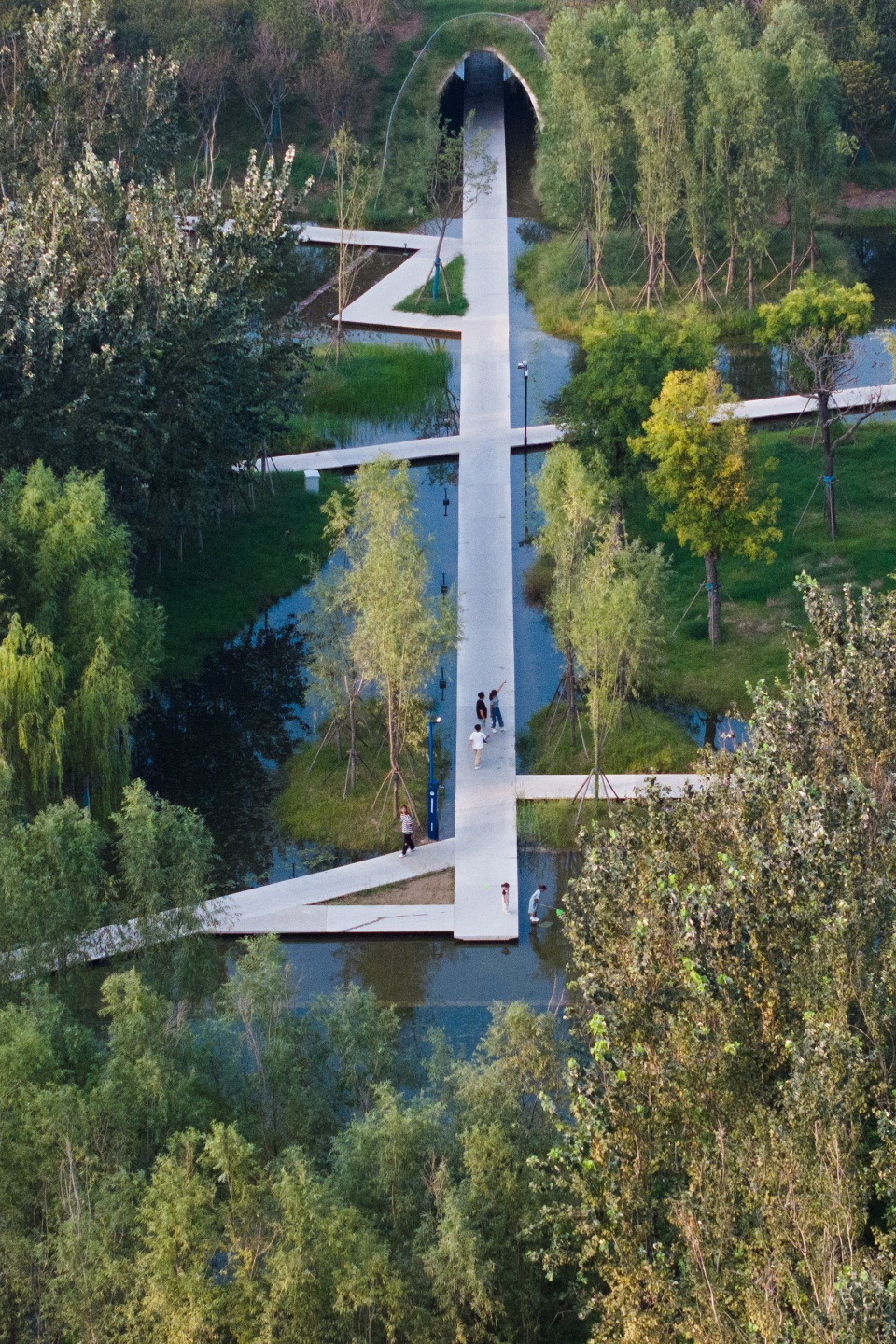
3. 设计策略
Design Strategies
策略一,“绿色海绵”,打造龙湖与城市之间的生态缓冲带。降低公园整体标高,营造龙湖边上的大海绵体系;一方面蓄纳场地及相邻城市地块雨水,另一方面局部利用光伏能源提排湖水进入海绵体系;经由湿地形成多个水净化单元,提供更安全的景观用水。
Strategy 1: “Green Sponge” – Creating an ecological buffer zone between Longhu Lake and the city. Reduce the overall elevation of the park and create a large sponge system on the edge of Longhu Lake; On the one hand, this system will retain rainwater from the site and adjacent urban plots. On the other hand, it partially utilizes photovoltaic energy to pump lake water into the sponge system; Through wetland features, multiple water purification units will be formed, providing a safer source of landscape water.
▼公园“矩阵”,The matrix © 张锦影像工作室
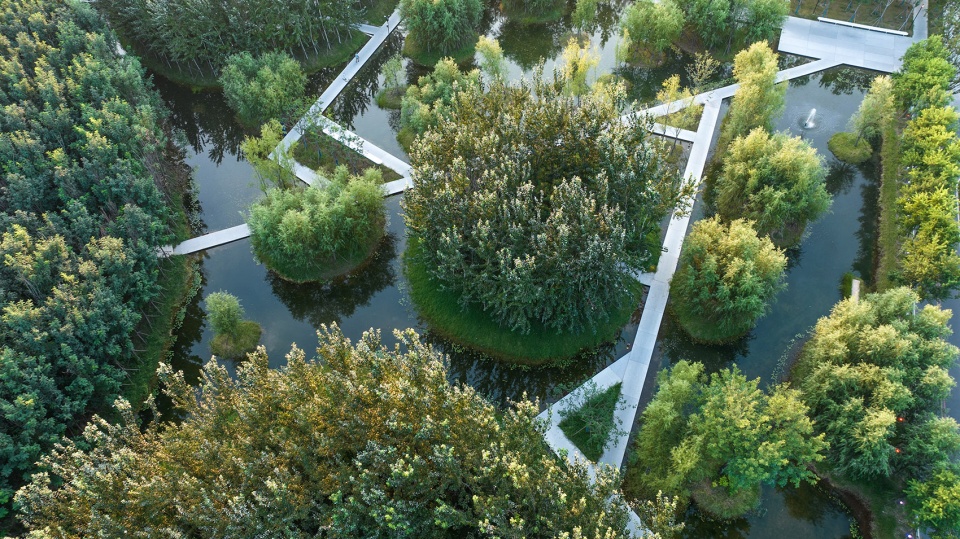
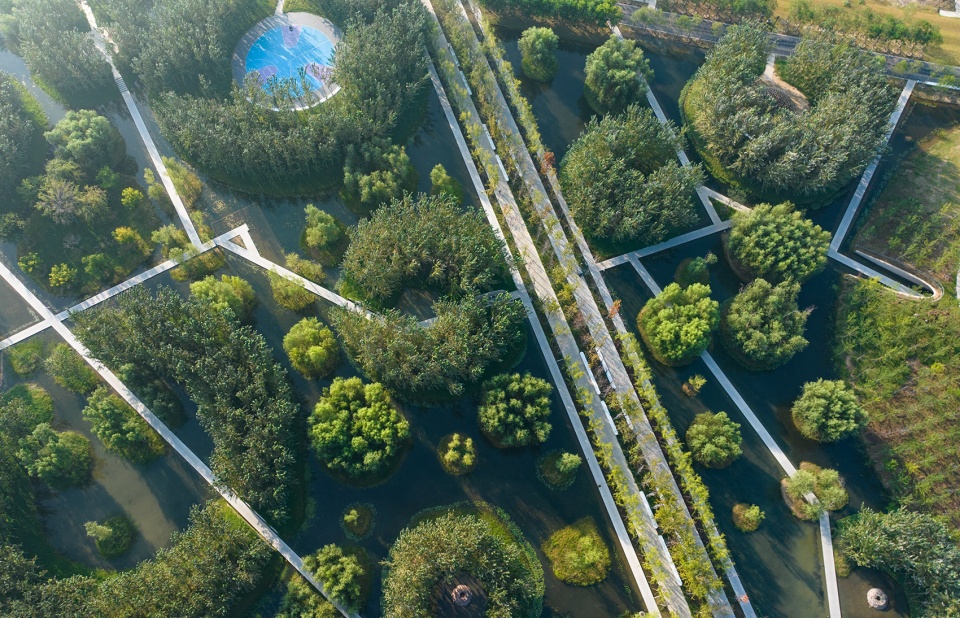
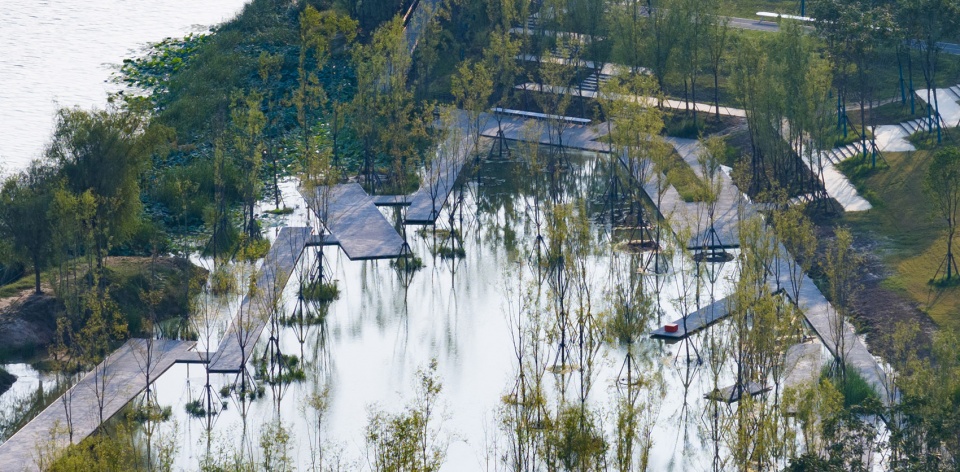
策略二,“陈风植栽”,以《陈风》为文化基底的种植设计体系。乔木栽植多以成活率较高的乡土树木为主,减少养护成本较高的花灌木,风格自然轻松。树种以杨、柳、槐、椿本地乔木作为主体,辅以适生的乌桕、榉树、流苏等。公园内的水生植被也再现了《陈风》中清水坑塘野生着蒲和荷的“池”和“泽”景观。
Strategy 2, “Chen Feng Planting “- A planting design system based on the cultural foundation of “The Book of Songs: Chen Feng”. Arbor planting is mainly based on local trees with a high survival rate, while reducing flower shrubs with high maintenance costs, resulting in a natural and relaxed style. Main tree species include poplar, willow, locust, and Chinese toon, supplemented by suitable Chinese tallow, beech, and tassel. The aquatic vegetation in the park also reflectsthe “pool” and “Ze” landscapes of wild cattails and lotus in the Qingshui Pond in the “Book of Songs: Chen Feng”.
▼深入湿地,Into the wetland © 张锦影像工作室
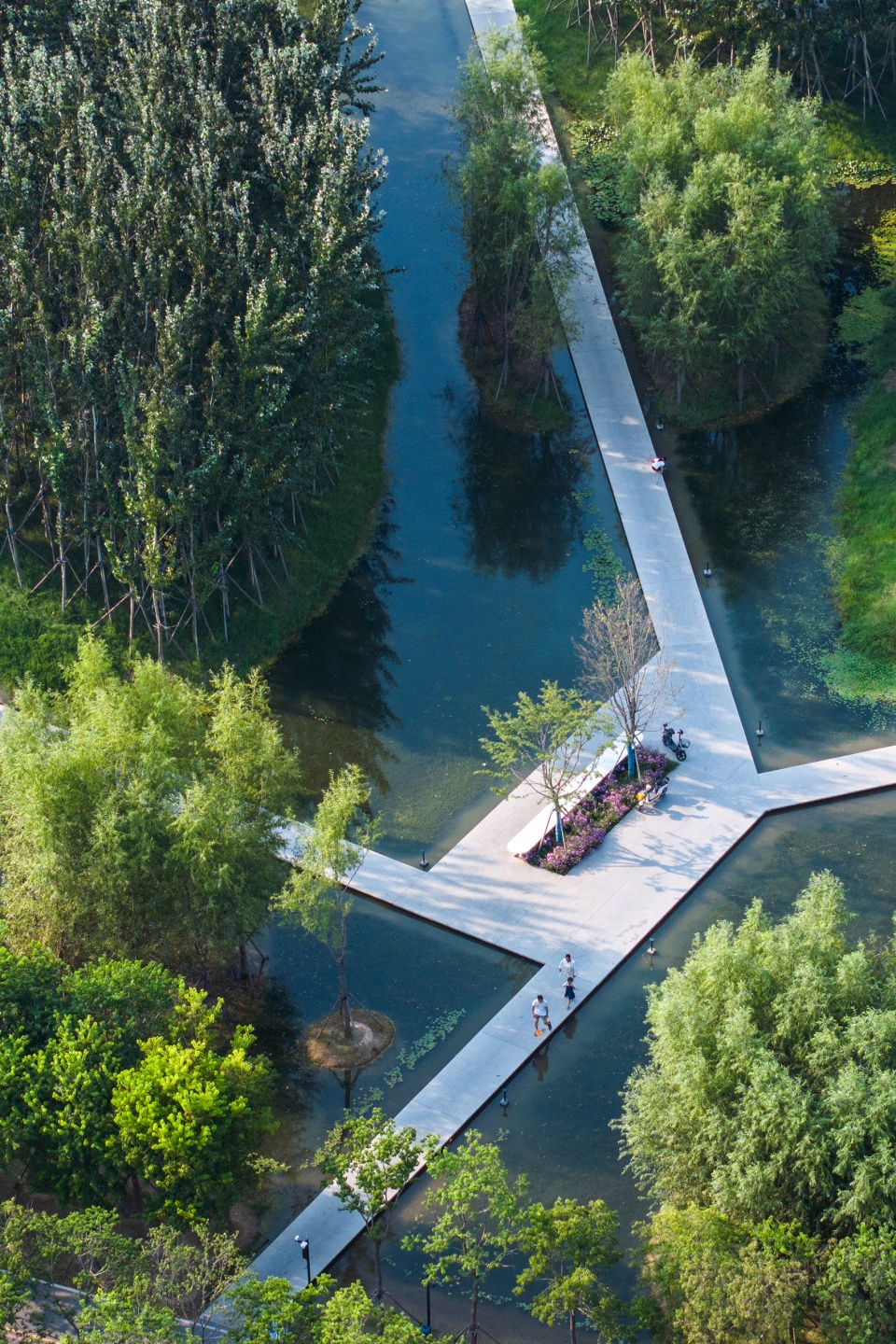
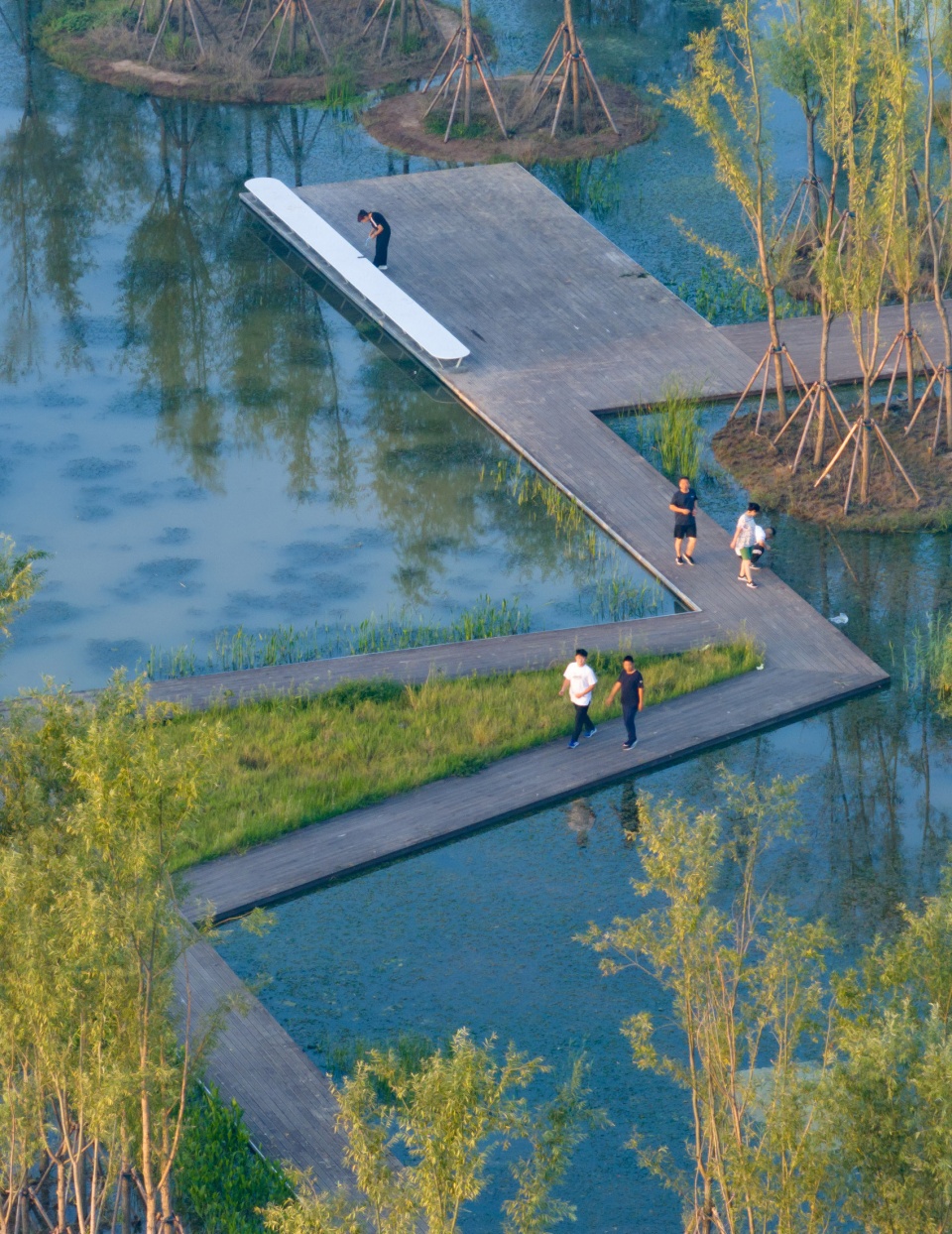
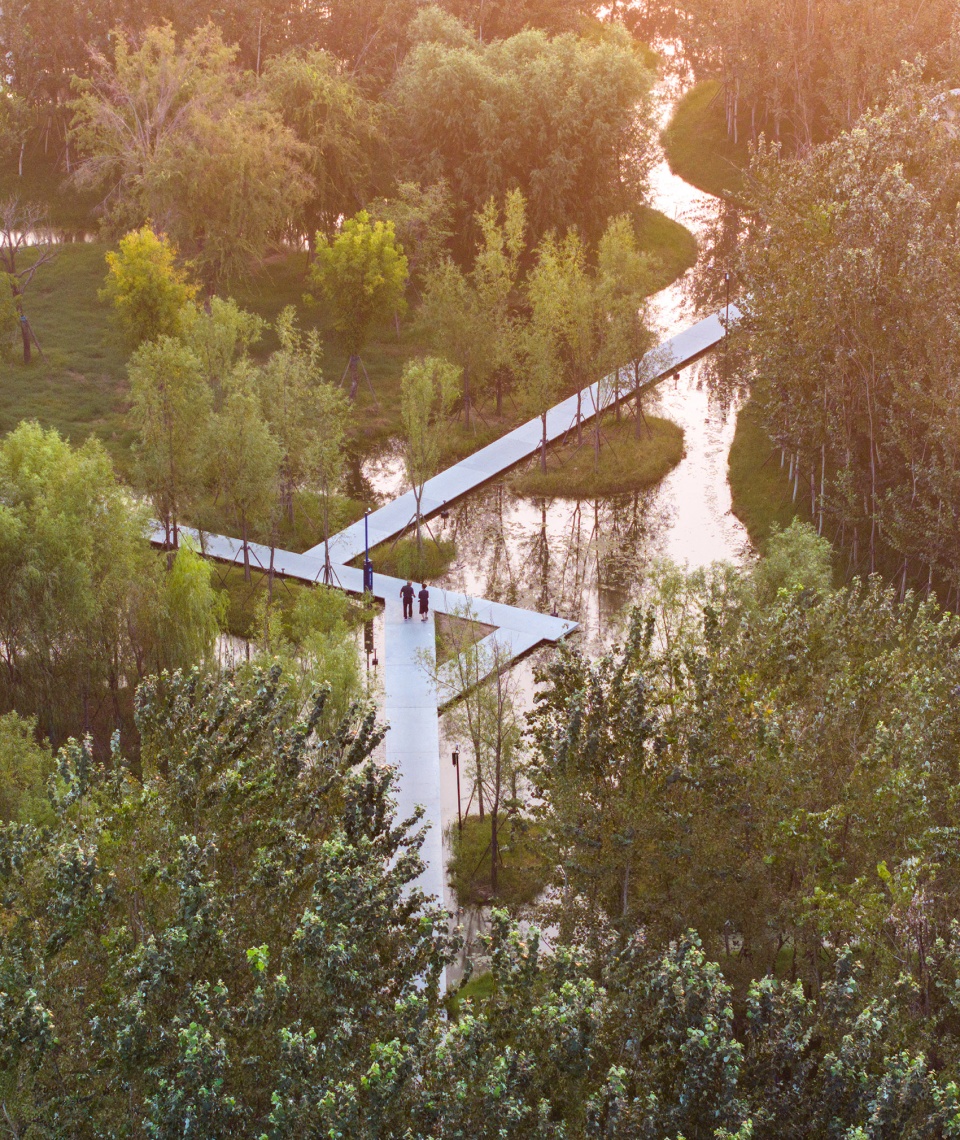
策略三,“巧用土方”,叠土为山,坎水为池。后退湖岸取土扩大水面,掩埋建筑垃圾堆高地形,通过土方平衡,营造池水与山丘相结合的立体游憩体验。
Strategy 3, “Use earthwork skillfully”- Shaping earth into hills and hollows for water features.. Retracting the lake’s shore to expand the water surface, concealing elevated areas with building debris. Through earthwork balance, create a three-dimensional recreational experience that combines pool water and hills.
▼大型“宛丘”,The big circle © 张锦影像工作室
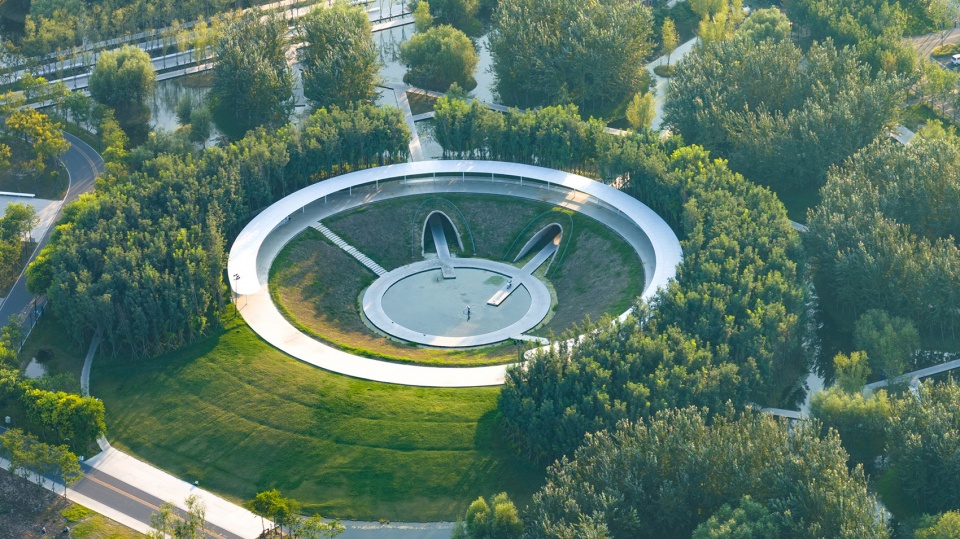
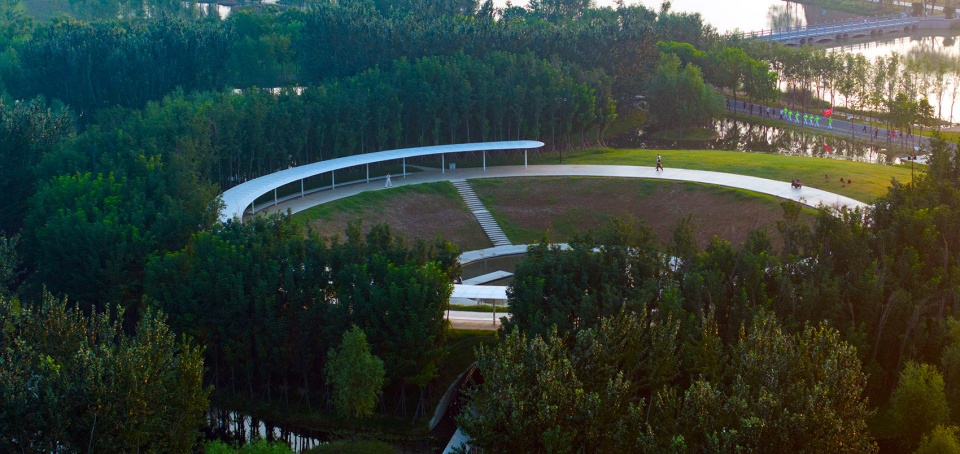
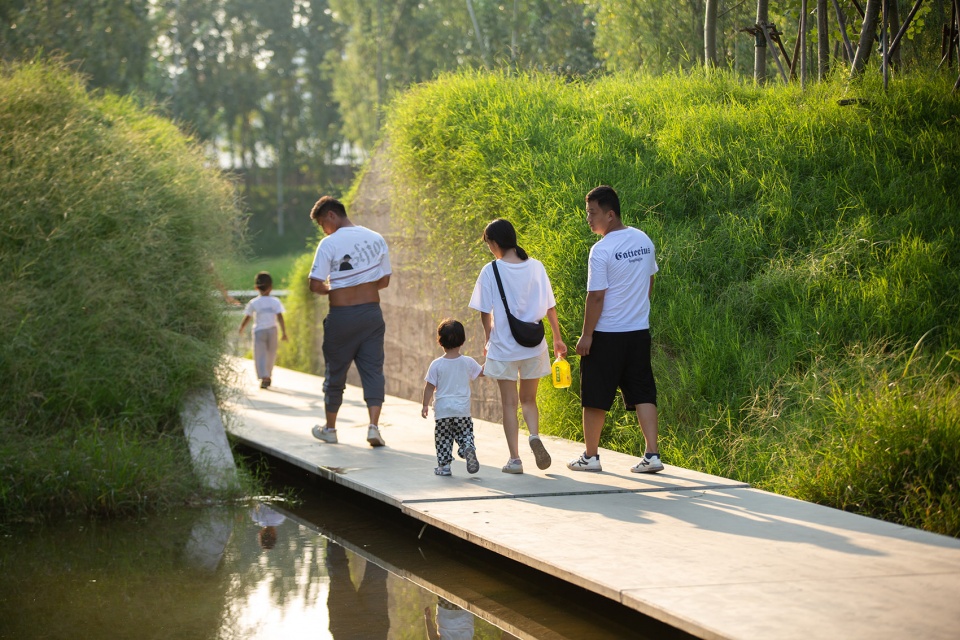
▼池水与山丘相结合的立体游憩体验,A three-dimensional recreational experience that combines pool water and hills © 张锦影像工作室
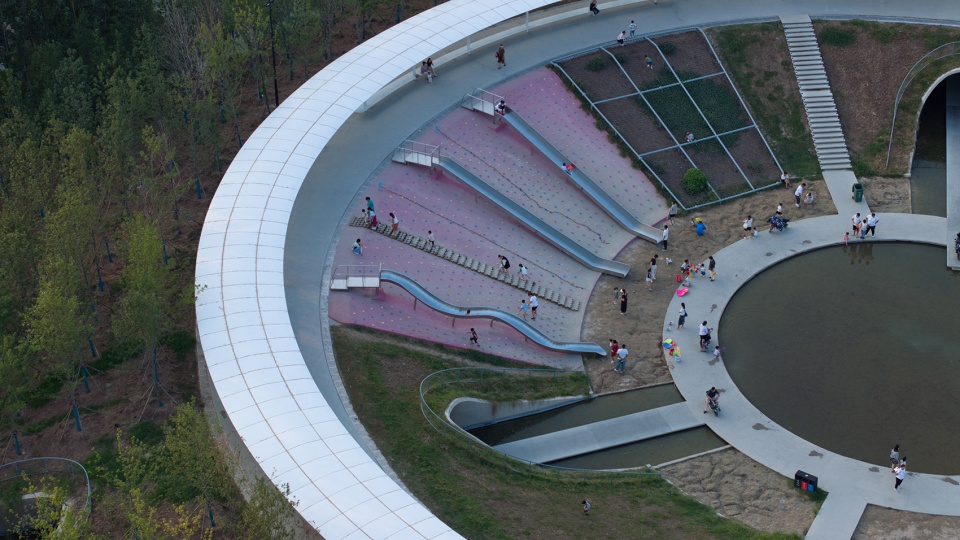
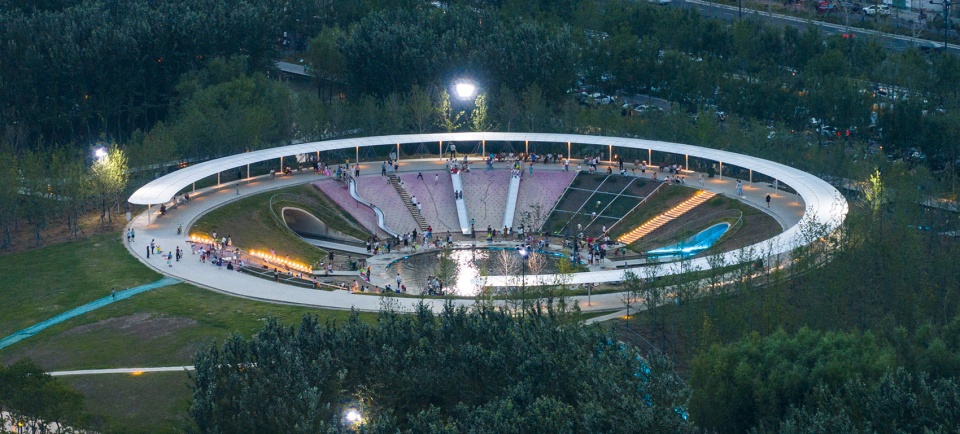
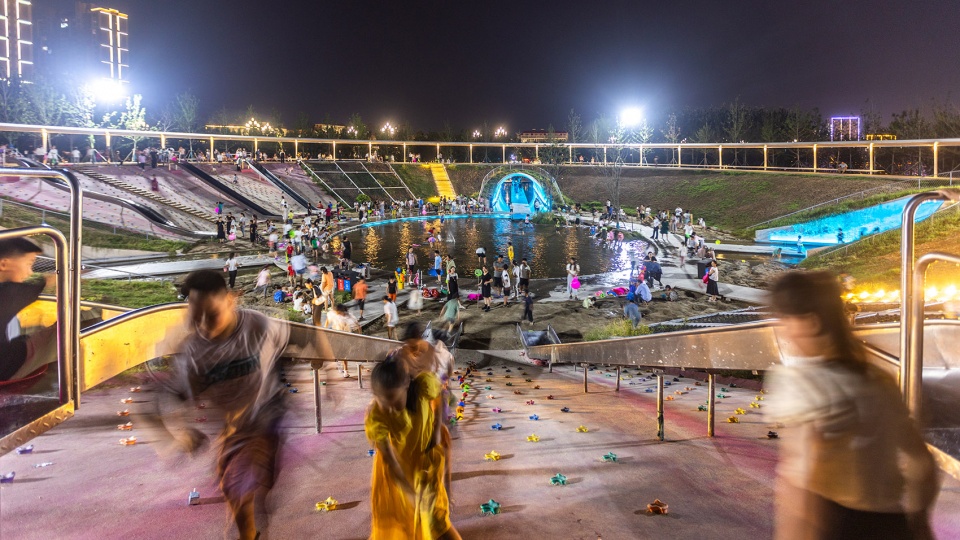
▼游戏场景,Playing © 张锦影像工作室
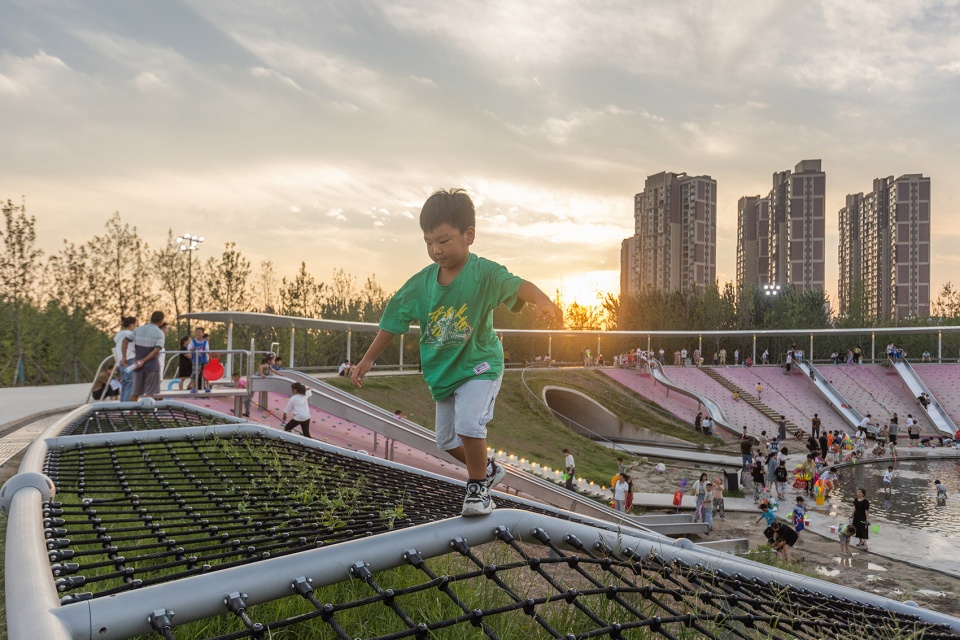
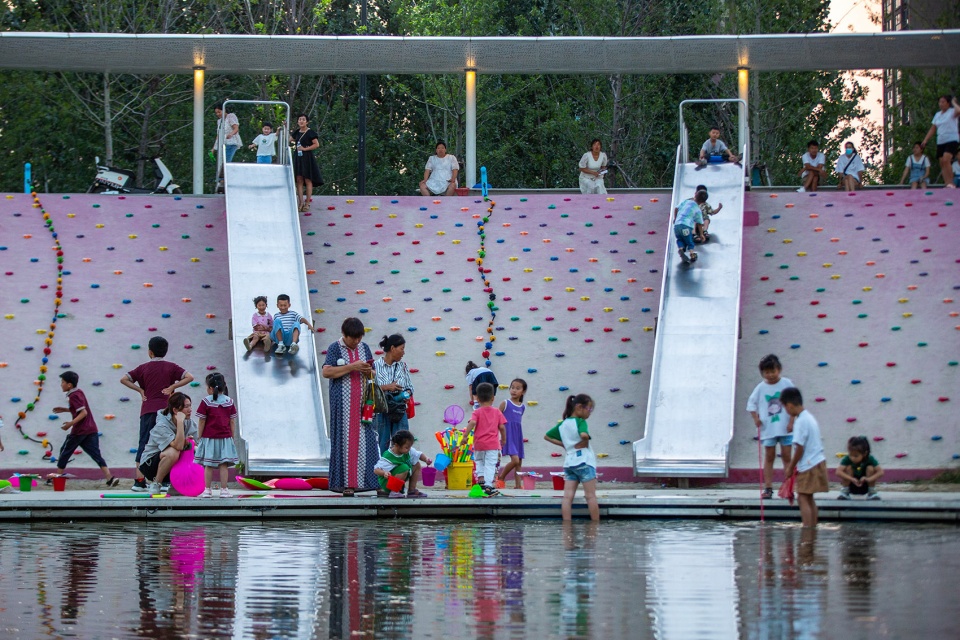
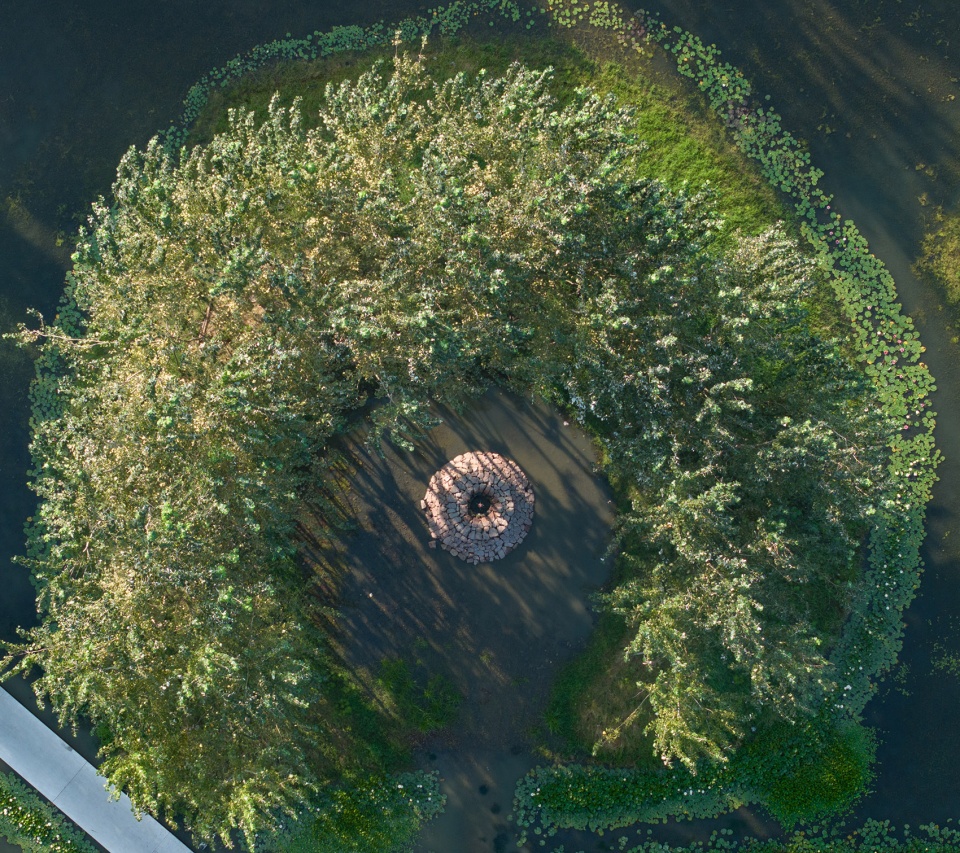
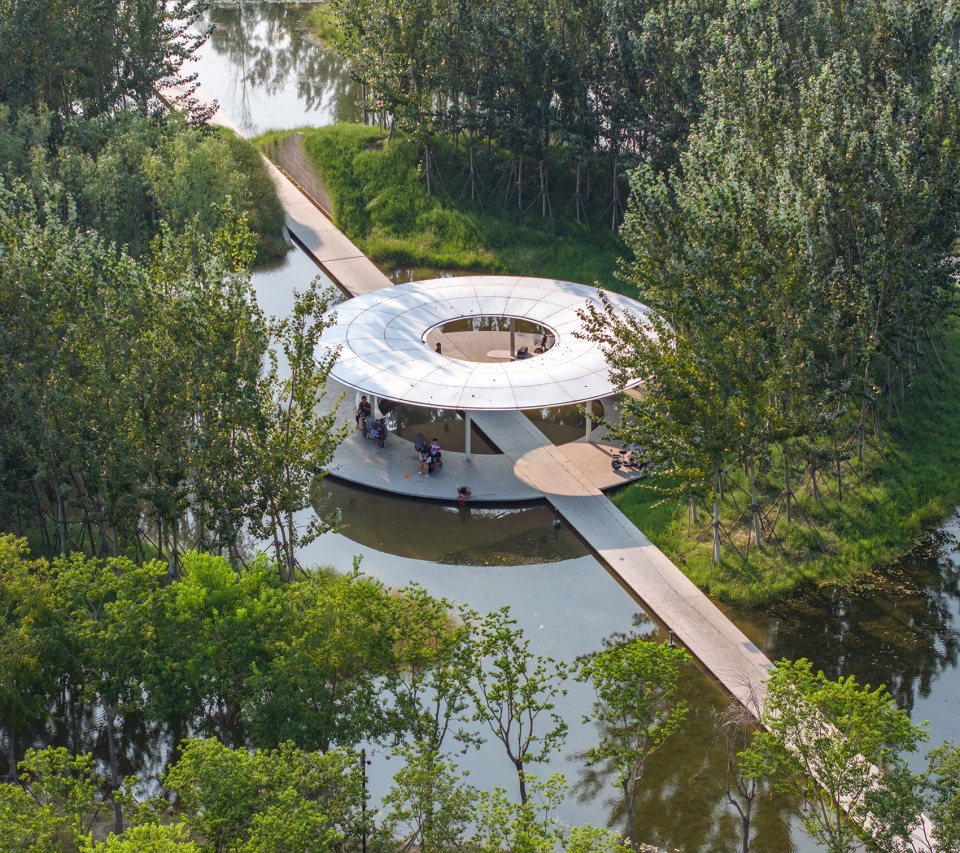
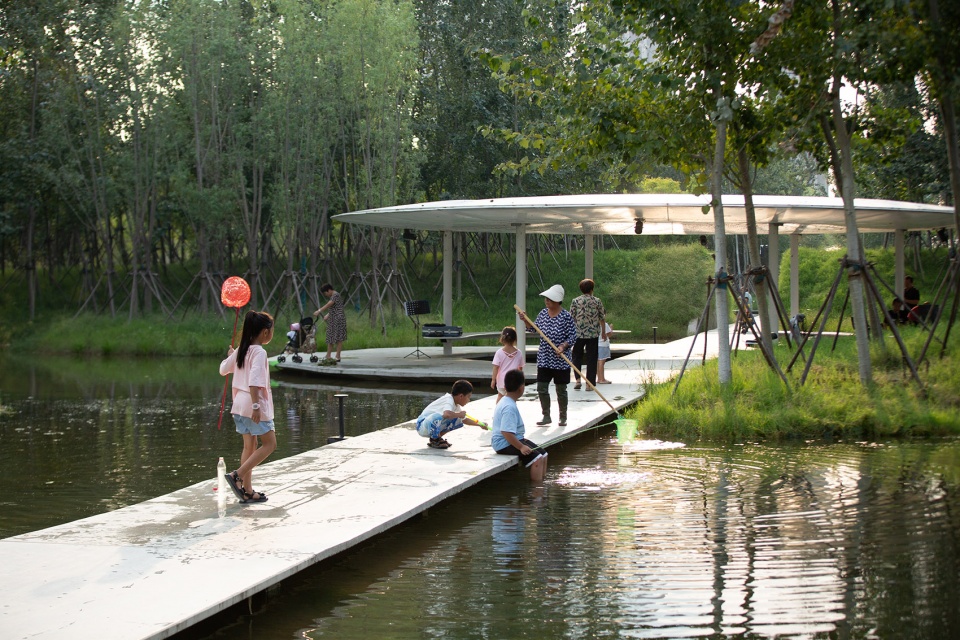
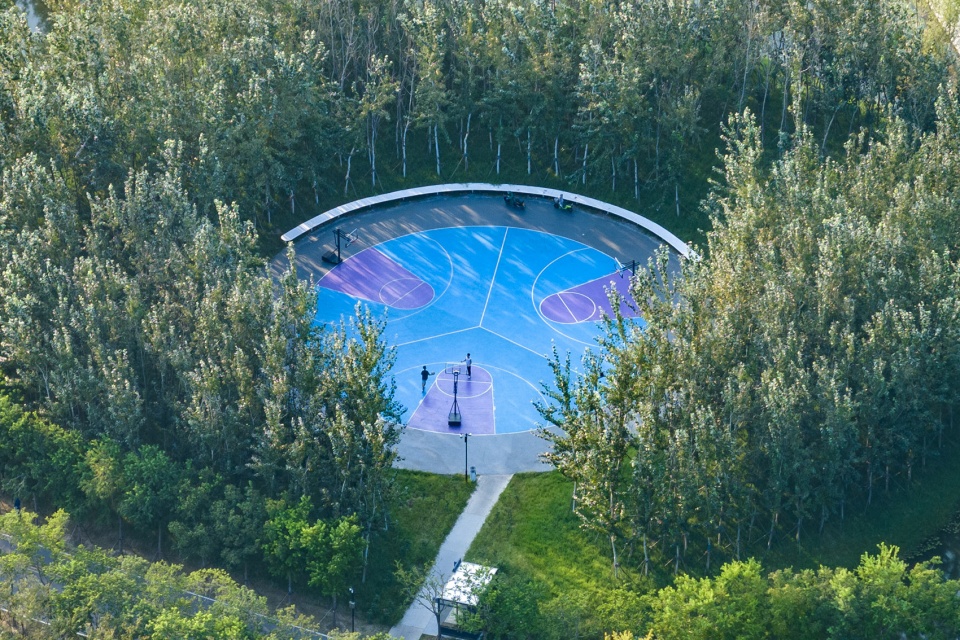
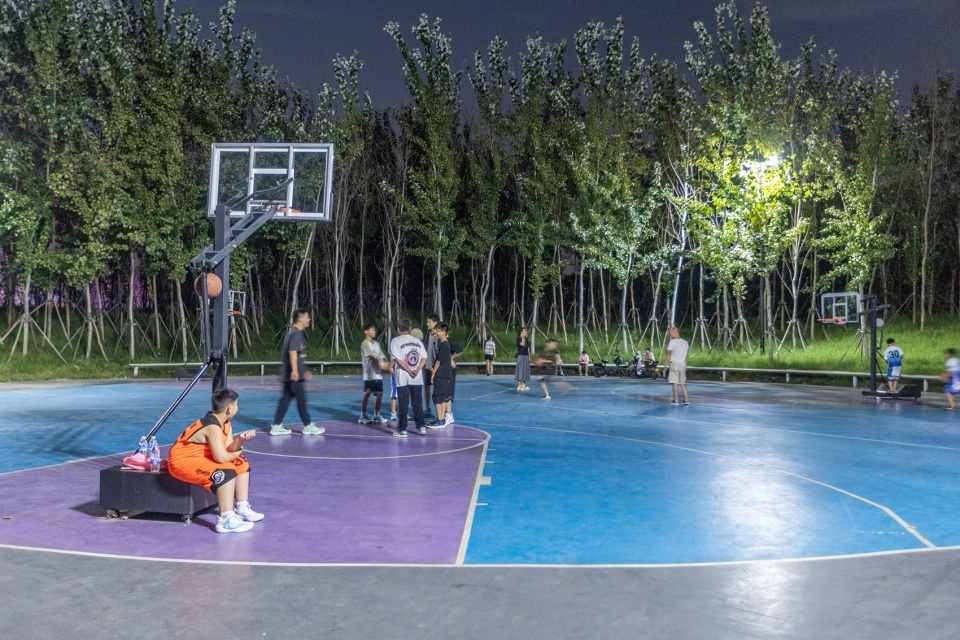
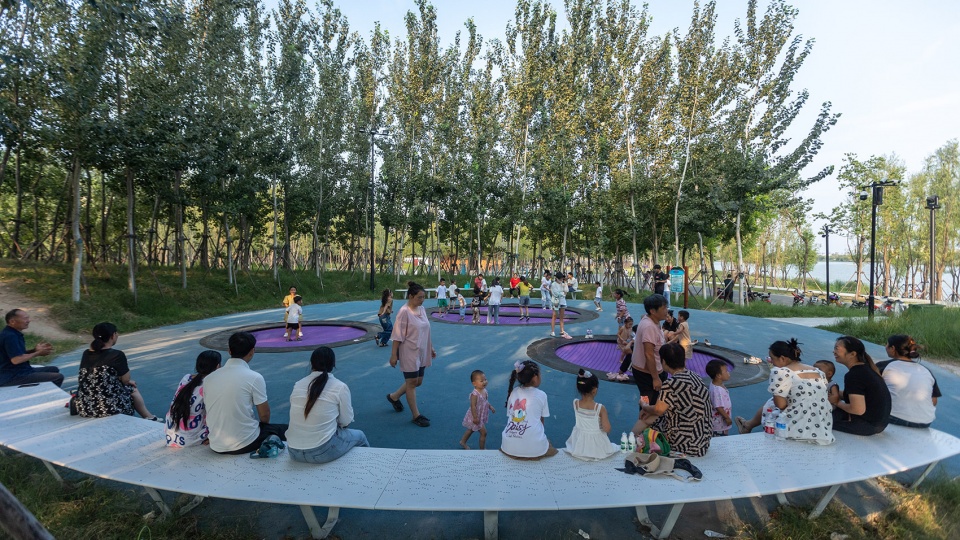
策略四,“多变容器”,基于宛丘的空间特点形成多变的空间容器。宛丘结合多功能草坡、嬉水浅滩、退台等形成27处园中园,并将伏羲文化、柳湖文化、名人文化、苏花园历史融入园内,实现古韵新生。
Strategy 4, ” Adaptable container” Utilizing Wanqiu’s spatial characteristics to form adaptable spatial containers . Wanqiu combines multi-functional grassy slopes, shallow water beaches, and retreating platforms to form 27 gardens within the park, integrating Fuxi culture, Liuhu culture, celebrity culture, and Su Garden history into the park, achieving a new generation of ancient charm.
▼圆形亲水空间,Small circles © 张锦影像工作室
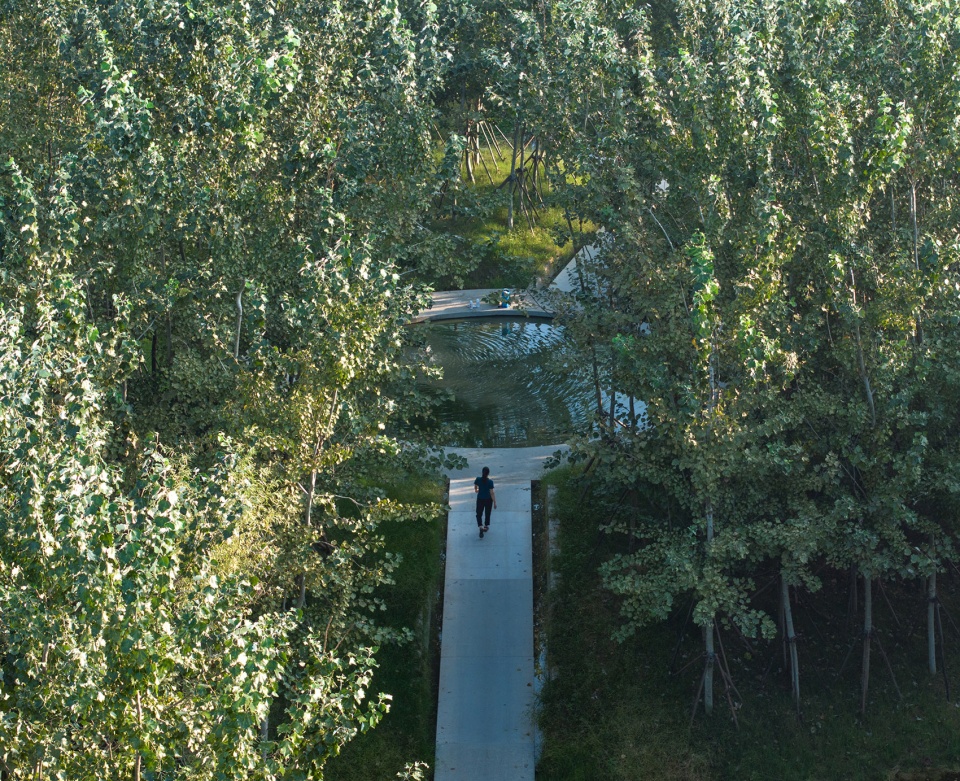
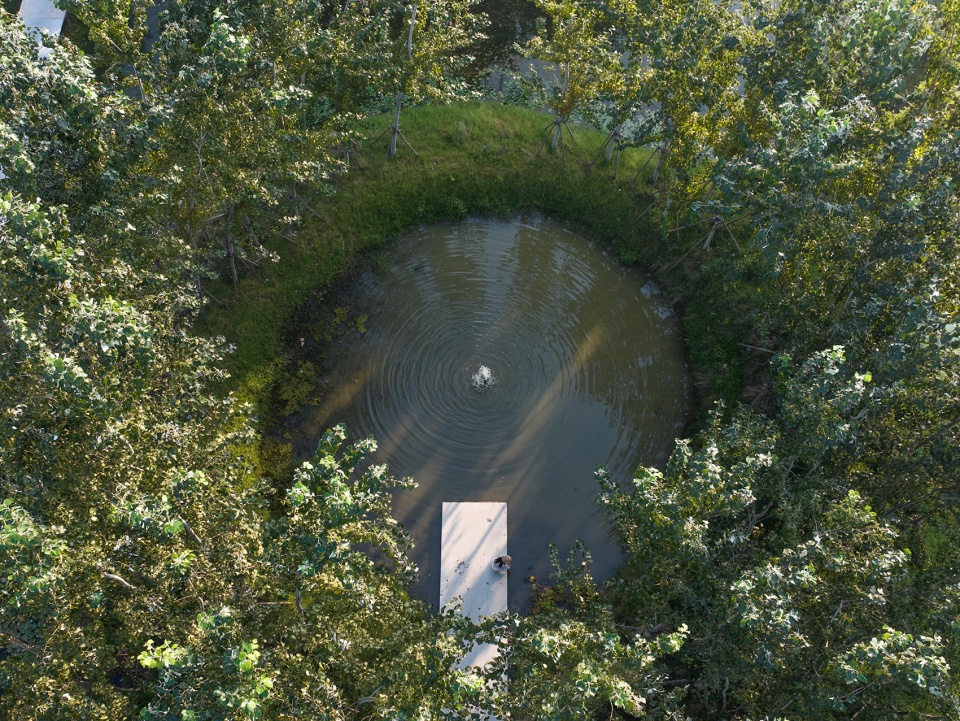
▼圆亭,Round pavilion © 张锦影像工作室
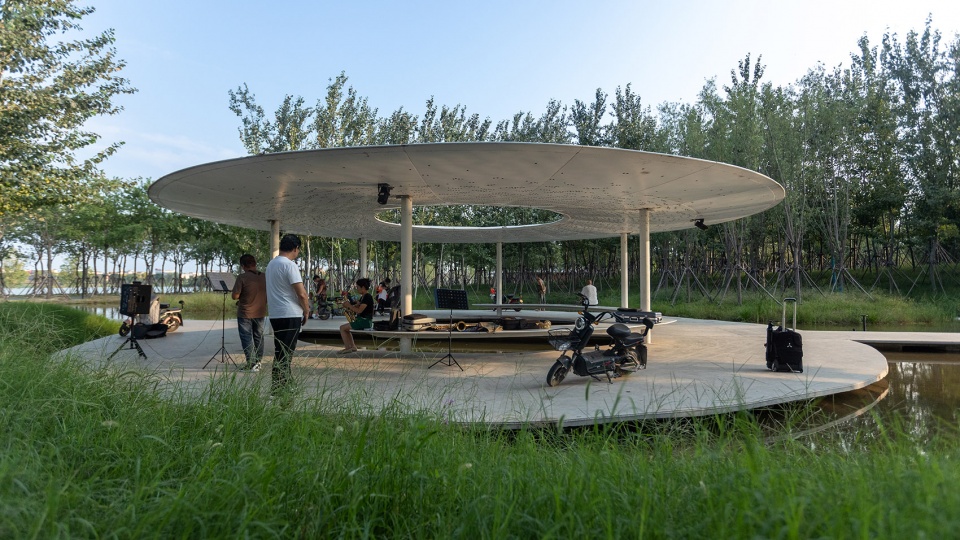
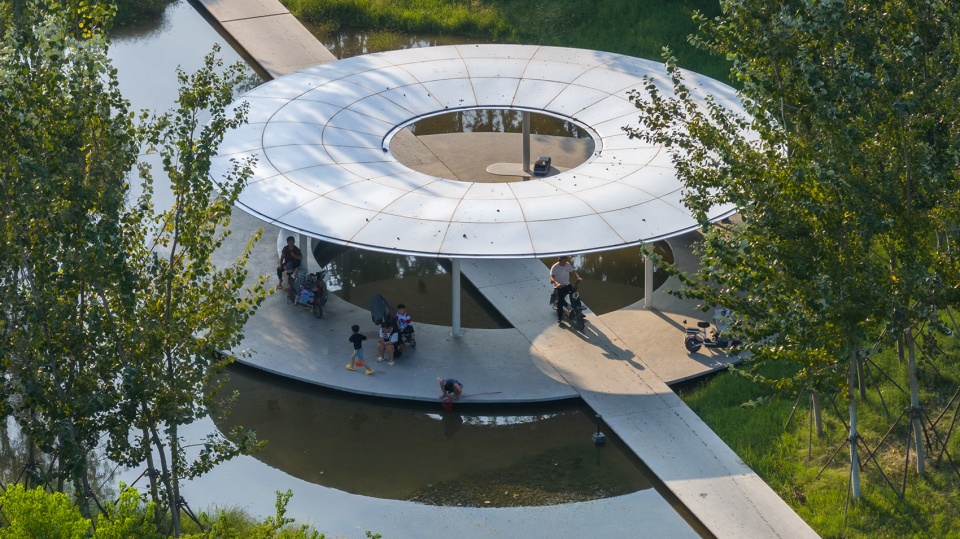
▼圆形球场,Basketball court © 张锦影像工作室
▼游乐场,Playground © 张锦影像工作室
4. 结论
Conclusion
在混沌中构建秩序,是人类的伟大力量,而同样伟大而神秘的或许是在秩序中感应混沌和变化。伏羲文化公园内“叠土为山,坎水为池”的独特秩序,为游人提供链接远古与未来的神秘空间体验,诠释一种全新的文化体验方式。
Building order in chaos and sensing chaos and change in order is a great power of humanity, and perhaps equally great and mysterious is sensing chaos and change in order. The unique order of “shaping earth into hills and using hollows for water features” in Fuxi Cultural Park provides visitors a mysterious spatial experience that links ancient and the future, interpreting a new way of cultural exploration.
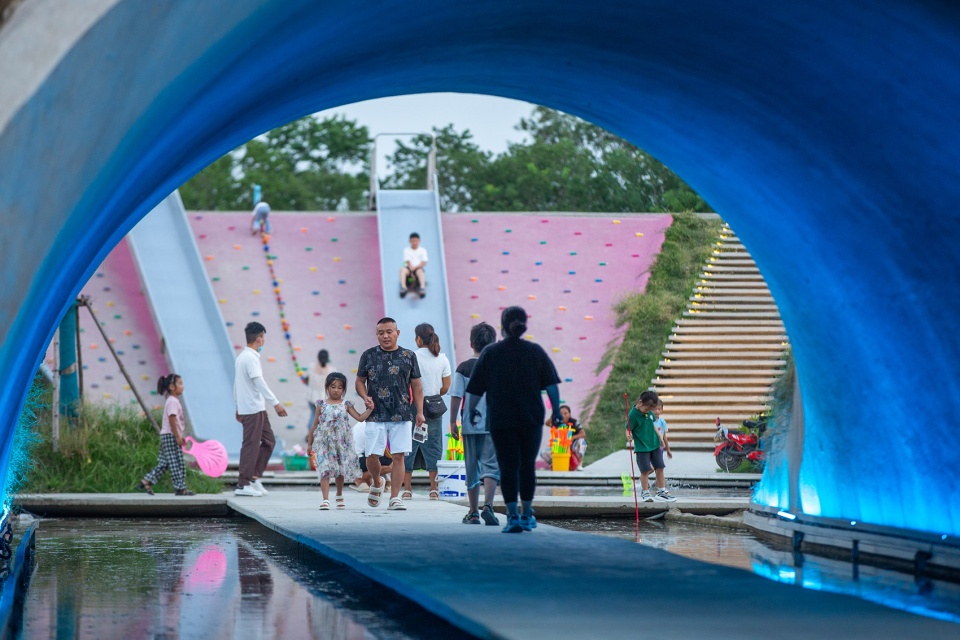
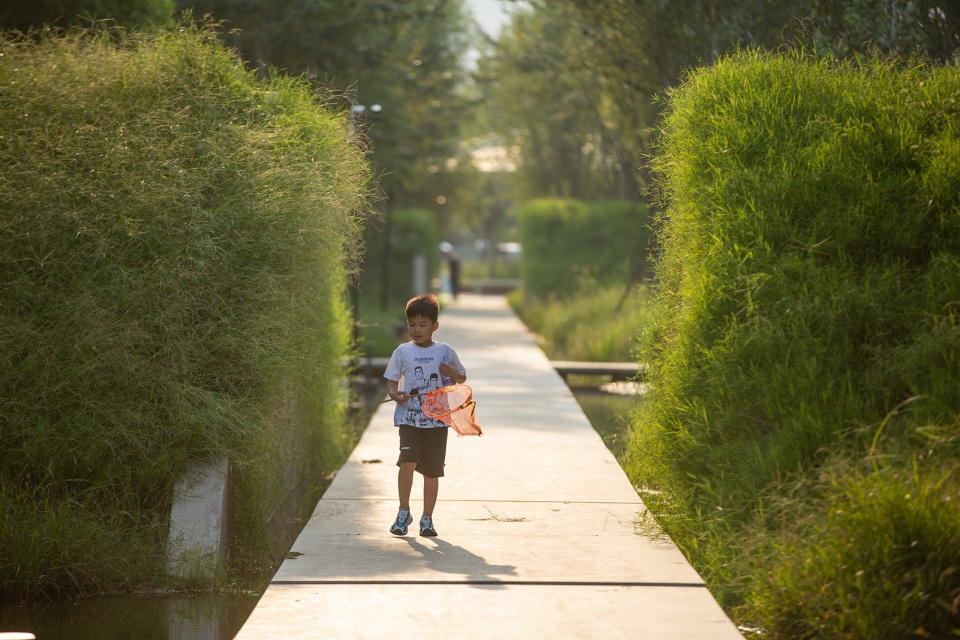
▼步道与隧道,Path and Tunnel © 张锦影像工作室
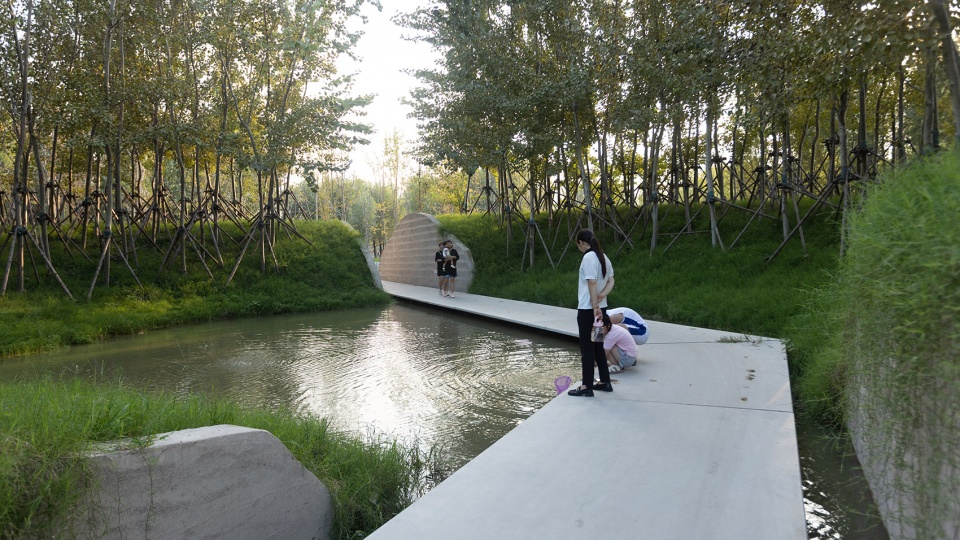
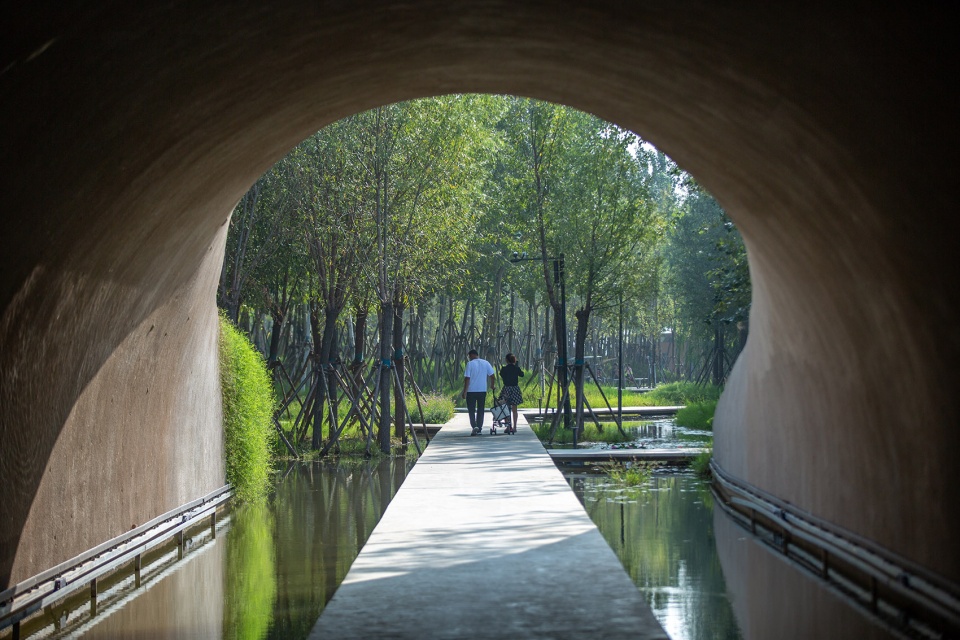
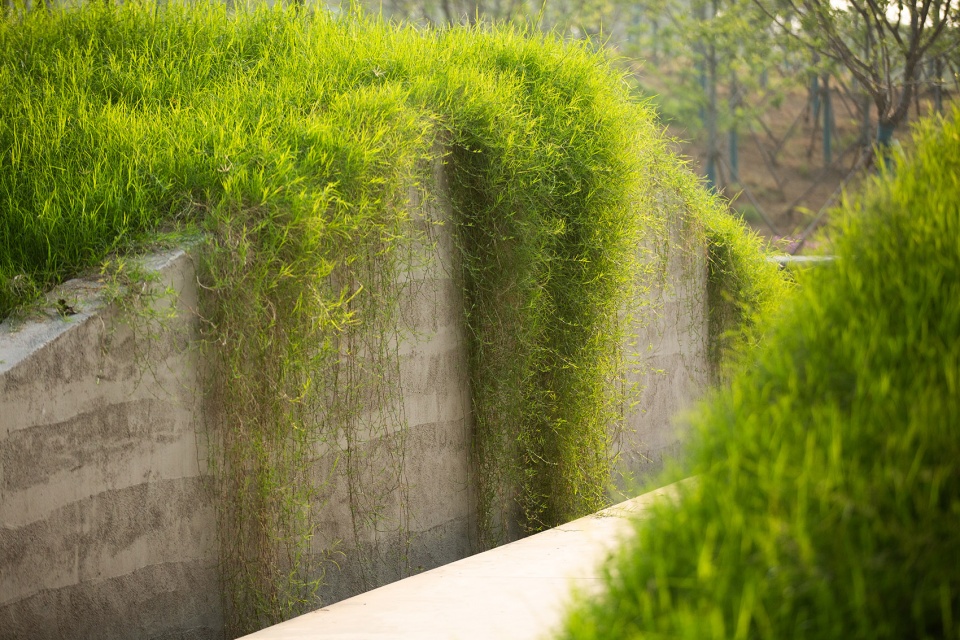
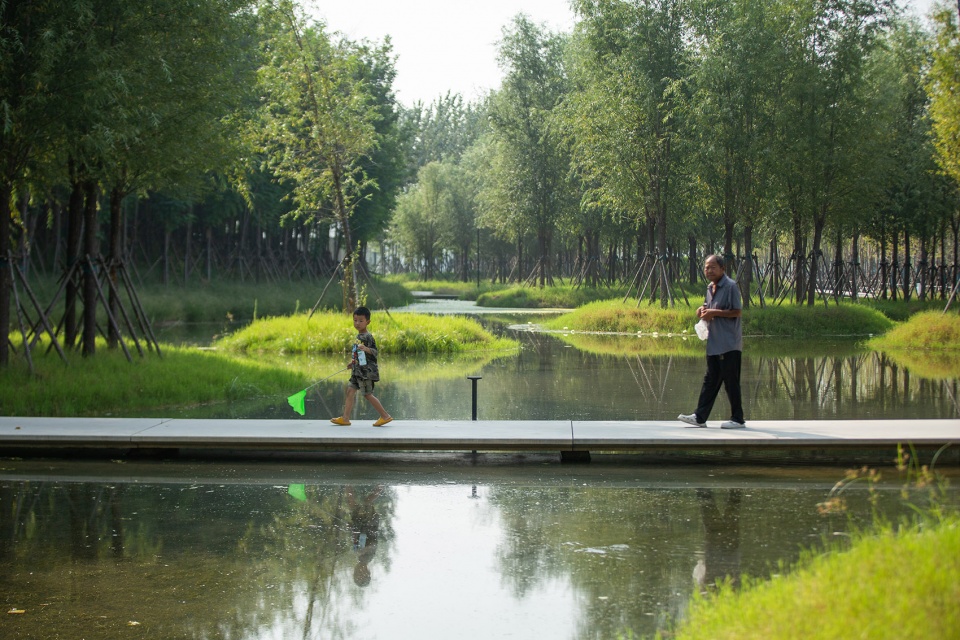
▼步行游览体验,Walking experience © 张锦影像工作室
周口淮阳伏羲文化公园
项目阶段 施工阶段
委 托 方 中文:周口市淮阳区住房和城乡建设局
英文:Zhoukou Huaiyang Housing and Urban Rural Development Bureau
项目地点 中文:中国/河南省/周口市/淮阳区
英文:Huaiyang District, Zhoukou City, Henan Province, China
项目规模 面积:430000㎡
设计时间 2021年-2022年
建成时间 2023年
设计部门 设计六院
首席设计师 俞孔坚
项目负责人 吴晓丹
设计人员 吴晓丹、方渊、贾健敏、晏林林、马双枝、宗建、李杰、张翰君、陈凌雪、刘秉卓、刘鑫、孔海龙、佟辉、桑雅、周景飞、赵兴雅、雷春霞、李昊、徐丽
More: 土人设计。更多关于他们:Turenscape on gooood



就目前这各种状况,土人要完了
这地方钓鱼一定不会空军了
土人的构图还是那么大气
伏羲文化公园,没有一点体现伏羲文化?改名淮阳生态公园吧
顺带把导弹发射井修了吧 ^_^
没去过现场,不过完成度真的蛮高的
圆形的文化说法可以给大家讲一讲。另外所有内容都是在河道管理范围线之内,种了这么密的树,堆了地形,请教审批如何通过的?
XL
整体概念还是比较有趣,通过山丘创造丰富的空间关系,但文化的表达在哪里?伏羲文化、柳湖文化、名人文化、苏花园历史等,没有看到。空间形式大于功能,几个大圈,就只有一个儿童活动的功能,其他圈有什么文化和功能上的表达吗?作为一个大型公园,能为市民提供什么多样的功能呢?钓鱼、放风筝、跑步等的功能场地有吗?典型的现代主义设计套了一个文化的皮,没有深挖文化与场地的关系,文化的现代性表达。
近看战术核显卡,远看HiFi大喇叭(doge
所以景观设计还是搞艺术不是搞生态啊,做土人没有前途要做潮人O(∩_∩)O哈哈~
终于没有再用飞来飞去的彩色架空桥了。////从鸟瞰上看,整体构图还是挺不错的。细部空间也很丰富。圆丘形态让人联想到台州的一个滨江设计。但是,感觉上这几个大圆丘,除了儿童游戏那一个,其他好像没有安排实质内容////圆丘尺度很大,环形廊架中休息的游人,或者是草坡上坐着的游人,视线往内,但视觉焦点处都没有足够吸引的内容,只是一块圆形水面。稍显无聊。////另外从鸟瞰上明明外侧有宽阔的湖面,文案没有看到望向湖面的摄影视角,似乎并没有很重视。构图上也强调是圆丘的内向视线,不知道是出于什么考虑。////前三张鸟瞰明明显示湖景很漂亮啊。///另外对于儿童游戏的那个圆丘来说,尺度也稍微偏大了些。感觉如果不是周末人很多的时段,也会显示有点荒凉。///整体构图虽很大气,但空间的分析是否,,,,…
coool
去过现场,很震撼,全体2-3m乔木间距以及没有一棵常绿树震碎三观!
额,平面有点像3.1音响
lihai
宛丘不是很好理解
老家的
很不错的设计,想法到实施到呈现效果都不错
希望武汉也能邀请这样的景观设计团队来做设计
现在应该没人再敢说土人“粗制滥造”了吧。
土人一直不错
装了几个超重低音