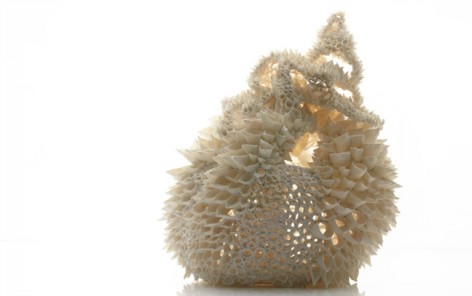
非常感谢设计方 Nuala O’Donovan 将项目介绍和项目图片授权gooood发行。更多请至:Nuala O’Donovan on gooood
Appreciation towards Nuala O’Donovan for providing the following description:
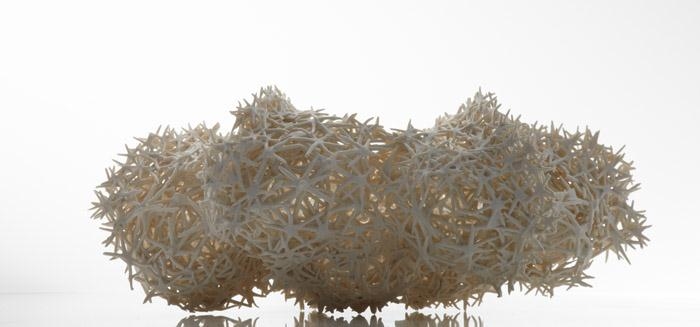
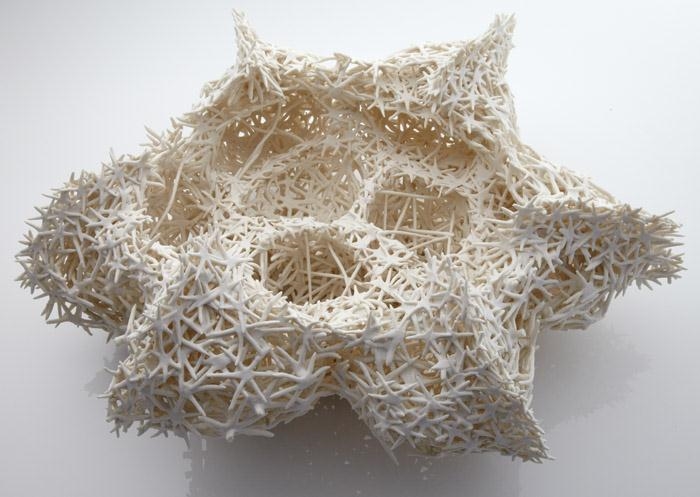
Title of work: ‘Coral, Six-Sided’, plan view.
Material: High Fired, (1240 centigrade), unglazed porcelain paperclay.
Technique: Handbuilt. Multiple firings.
Dimensions: 45cm diameter x 20cm high.
Date: 2010
Photographer: Sylvain Deleu
© Nuala O’Donovan]
“…….the purpose of a thing. Aristotle assumes this to be the equivalent to the logos…and the logos is always the beginning point for things arising from nature….the logos of a thing is the inherent design that it carries within itself. Things carry within themselves a narrative of their purpose, for logos at this time meant something like ‘a reasoned tale’, whether they arise from nature or whether, as for a work of architecture, they arise from culture. Aristotles’ studies on nature noted that nature was a progression rather than a static form and that each progression contained a history of its beginning as well as progress from a primitive to a more perfect form” Stephen Frith – Architectural Theorist. Ph.D. University of Cambridge.
Professor of Architecture, University of Cambridge.
Artistic Statement: Inspirations/Concepts/Sources I make sculptural pieces from unglazed porcelain clay. My hope is that my work communicates a sense of energy and life through a combination of the use of abstracted pattern and geometry from natural forms.
The starting points for my work are drawings of patterns from plants, shells and seeds. In order that the form of the finished work is consistent with the source material, I use a set of constraints based on a combination of regular and irregular geometric principles found in natural forms.
I am interested in the history of the use of geometry in the aesthetics of classical Western art, in particular, classical Greek symmetry, (the creation of harmonious form by the use of a repeated proportion). Regular geometry has been used in Western art and architecture from the Ancient Egyptian and Greek Civilisations through to Le Corbusiers use of the ‘Modular’ in the Twentieth Century. The characteristics of irregular geometry relate more to the traditional Eastern aesthetic and its’ acceptance of the beauty of the imperfect and transitory in nature. I find the narratives suggested by imperfections and irregularities within patterns fascinating. The use of the characteristics of irregular forms, (regular irregularity, self-similarity, response to random events), allows the imperfections to exist in the finished piece which record a history of events that occurred during the making of the work.
The characteristic of self-similarity creates a space for suggested future possibilities to the outcome of a resolved form. I feel that this quality includes the viewer in the creative process by allowing their experience to influence their perception of the outcome of future forms. I am interested in the contrasts and similarities between traditional Western/Christian aesthetics, which sought to portray beauty through perfection and classical geometry, and Eastern/Buddhist aesthetics of beauty which celebrates the imperfection and relates to the Twentieth Century definition of irregular geometry in nature. I feel that the common area recognised by both of these traditions lies between classical symmetry in regular geometry and the characteristic of self similarity in irregular geometry, that is; the beauty of harmonious form created by the repetition of proportion. Just as the patterns in a natural form refer to the past as well as offering indications to it’s future, I hope that these historical and contemporary references to aesthetics in my work also form part of its’ narrative. I feel that my work is enriched by the artistic traditions of the past, which offer a strong foundation for experimentation with future possibilities in my studio practice and research. I hope in the future to research and experiment more with the principle of ‘dynamic symmetry’.
This was a term used by early twentieth century designers to describe the geometric principles used in the design of contemporary pattern. These principles were based on the geometry of Classical Greek art and architecture, which they believed to be true to the geometry and proportions found in nature. Their theory was that the application of these principles to abstracted patterns communicated the dynamism of the living form. I am interested to see how a more rigorous application of these geometric principles would affect the outcomes of my studio work and the viewers’ perception of it.
Nuala O’Donovan
January 2010
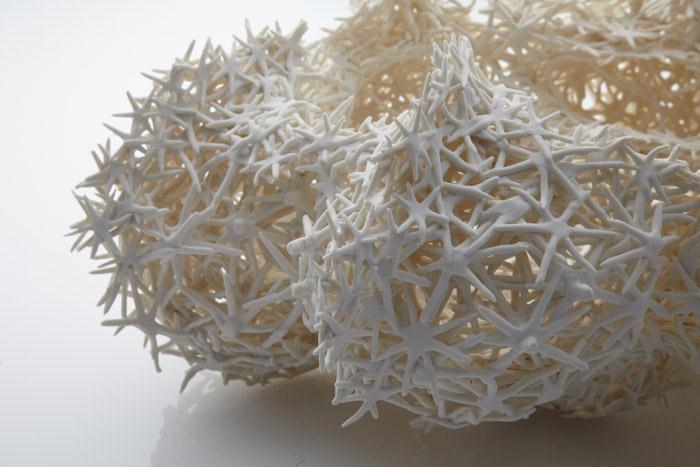
Title of work: ‘Coral, Six-Sided’,detail.
Material: High Fired, (1260 centigrade), unglazed porcelain paperclay.
Technique: Handbuilt porcelain paperclay. Multiple firings.
Dimensions: 45cmW x 20cmH.
Date: 2010
Photographer: Sylvain Deleu
© Nuala O’Donovan
ARTIST STATEMENT
My work combines regular pattern with the characteristics of fractal forms from nature. The finished forms are a result of an intuitive response to the direction that the pattern takes as well as the irregularity in the handmade elements of the pattern.
I am interested in the narrative quality of irregularities in patterns in living organisms. The history behind a scarred or broken surface fascinates me.
Each element of the pattern from which the forms are built is individually made in porcelain. The form is constructed slowly over a period of weeks or months, and fired a number of times during the making process.
Nuala O’Donovan studied 3D Design in Metal and Glass at Middlesex University, London, U.K. graduating with a BA (Hons) and an MA from the Crawford College of Art and Design in Cork. She lives and works in Cork City, Ireland.
WORKING METHODS:
I use different types of porcelain in my work, Limoges porcelain, Ming porcelain, Leach porcelain and porcelain paperclay. The clay is left unglazed, as I want the structure of the piece to have an integral colour, and glaze is a surface treatment. I sometimes use stained clay for sections of a piece to draw attention to a change in pattern or to experiment with changing the focus of the viewer by drawing the eye into the structure beyond the surface.
In the future I am interested in experimenting with the inclusion of other materials such as cast metals, glass, bamboo, paper, textiles etc in the pieces. I am also interested in the use of computer technology and 3D printing as a tool to experiment with form and plan to set aside some time in 2012 to learn more about the possibilities of these technologies.
All of my pieces are hand-built. I roll the clay by hand and make each of the elements from wet clay, scoring the surfaces of each one so that it can be joined to the other elements. The components are allowed to become bone dry, and are then assembled using slip.
The forms are built slowly so as to allow sections of the piece to dry and the slip to harden. I don’t use hot air dryers as I feel the structures are too complex for fast drying and it would result in cracking due to uneven movement. The forms can sometimes takes months to finish so I work on two to three pieces at a time.
I fire the work to 1000deg Centigrade initially- then to a temperature of between 1240 and 1300 deg Centigrade depending on the strength of the structure. The clay shrinks by an average of 20% so I fire very slowly placing the work on layers of silica sand and ‘expansion plates’ of porcelain which shrink at the same rate and reduce the stress on the moving structure.
Some of the work moves and slumps considerably so it’s always a surprise, (and hopefully a relief), when the kiln door is opened. Sometimes I re-fire a piece at high temperature to change the form slightly.
My work is about the inclusion and acceptance of the imperfections in the patterns and forms. That is the reason that I don’t use extruders or mechanical rollers as I feel that the surface of the elements of the pattern would be too regular and this would conflict with the irregularity of the forms. I like the work to be consistent, the surface, pattern and form, interior and exterior are all part of the work. Each handmade element of the pattern is unique and influences the outcome of each form.
I refer to classical proportions to decide when the piece is finished so the decision to end is based on measurements. I hope that this allows the form to appear symmetrical or harmonious while still allowing the viewer, and maker, to imagine future possibilities. I think that the possibilities of change and unknown outcomes are the exciting part of life, as well as art, and I hope that my work communicates that concept to the viewer.
Nuala O’Donovan
August 2011
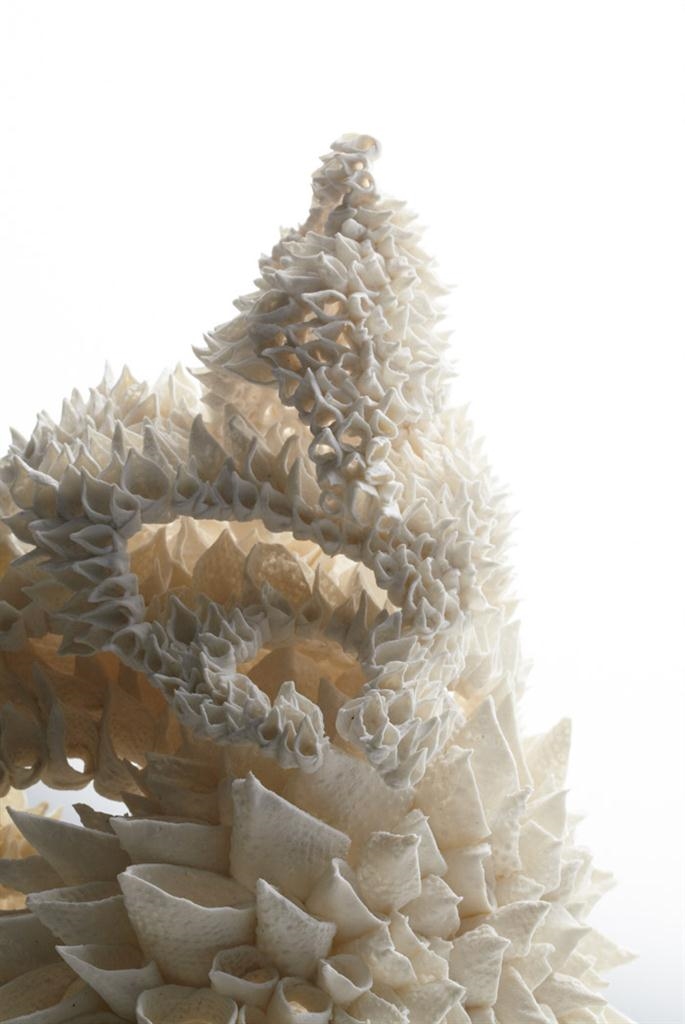
Title of work: ‘Teasel, Combined Pattern’.
Material:High Fired, (1240 centigrade), unglazed porcelain.
Technique: Handbuilt porcelain paperclay . Multiple firings.
Dimensions: 37cm diameter x 43cm high.
Date: 2008
Photographer: Sylvain Deleu
© Nuala O’Donovan
“一件事的目的。亚里士多德假设这就是事物的标记,标记始终源于大自然,并反映其自身,自我则诠释目的。就像一个合理的故事,无论从何而来,是否成为建筑,他们皆逃脱不了文化的烙印。亚里士多德研究自然得出,事物并非静止,而是呈发展状态,每一次发展基于过去的历史,并进化到更完美的下一步形式。”斯蒂芬弗里斯—建筑理论家—剑桥大学建筑学教授
艺术声明:启示/概念/来源
艺术家的上釉陶瓷雕塑,其几何形态及关于能量生活的抽象意义皆源于自然。从植物,贝壳,种子等形态开始,在固定的材料来源下,使用一套规则及不规则的几何原理,在自然形态下演化出一种自发的约束。
艺术家对西方古典美学艺术很感兴趣,特别是希腊的对称(通过一个重复的比例创造和谐的形式。从古埃及及古希腊文明的体系结构吸取能量,依靠二十世纪西方模块化艺术。作品具有不规则几何特征与东方传统美学,以及发展过程中不完善之美。这是艺术家追寻的不完美及无规则。这里的不规则包不常规,自相似性,对事件随机反应。同时其允许不完美,也包含作品过程中的历史。自相似反应空间解析结果并引发未来可能性。这些质量反映了创作过程并会影响到观众对结果的看法。西方美学描绘的是古典完美的几何没敢,而东方的美学却随意,这与二十世纪的那种不规则的几何流行又相似之处。艺术家西方在这个两个传统之间找到相似点,然后重复,创建出和谐之美。
并希望自然,过去,未来贯穿在工作中。
也希望未来一直研究“动态对称”。原理基于古希腊的艺术和建筑,那在自然发现的几何形态。运用那个这些原则生成抽象的图像,传达非凡的活力。艺术家对在更为严格的应用程序下生成的几何形式的结果以及观众的反应感兴趣。
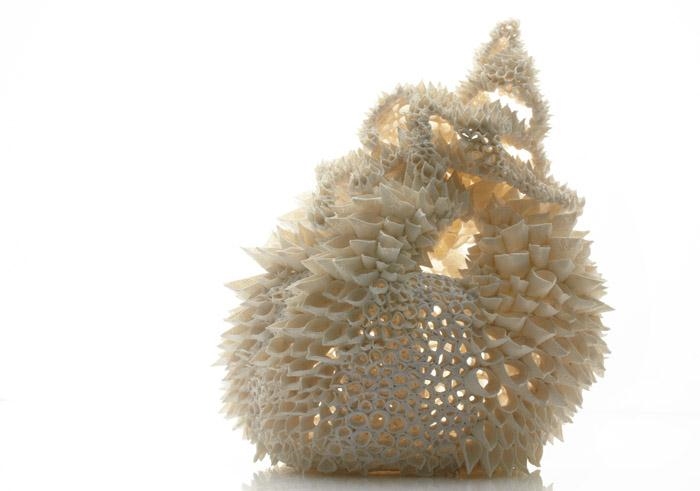
Title of work: ‘Teasel, Combined Pattern’.
Material: High Fired, (1240 centigrade), unglazed porcelain.
Technique: Handbuilt porcelain paperclay . Multiple firings.
Dimensions: 37cm diameter x 43cm high.
Date: 2008
Photographer: Sylvain Deleu
© Nuala O’Donovan
艺术家的工作与大自然息息相关,研究生物体中的不规则形式,其上面的伤痕和破损的表面蕴藏的历史也让艺术家深深着迷。
艺术家曾在伦敦学习,现在在爱尔兰的科克城生活。
目前主要是制作瓷器并和各种各样的瓷器打交道,她的作品常常上釉。
在未来,艺术家将实验更多的材料,比如金属,玻璃,竹木,纸张,纺织品,以及三维打印技术下的一些操作。并将在2012年安排时间进行试验。
作品均为手工,分别制作然后组装。让其缓慢干燥而不是使用热风干机。这是为了避免干燥速度过快而导致复杂的作品开裂。经过缓慢的高温过程后,打开窑门就是一个惊喜。其实手工的不完美是独特的,所以艺术家尽可能不用机器。保持整体的手工过程。
在未来当完美形态真的出现时,希望仍然给人们以想象的空间。生活的精彩之处在于变化和未知。艺术家希望她的工作,她的艺术,传递给大家这样的概念。
更多信息请参见上方英文。
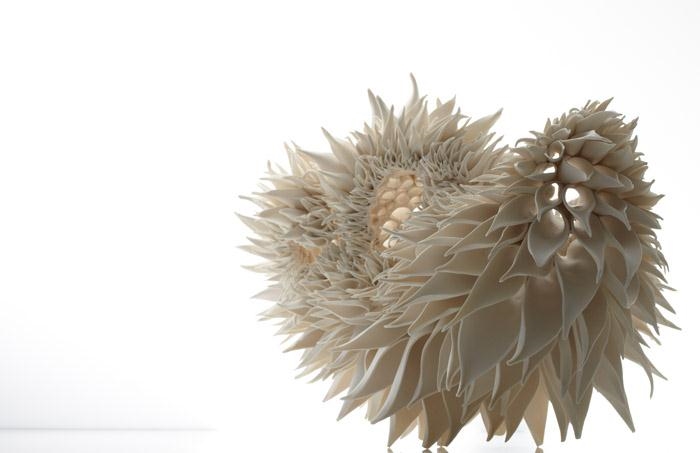
Title of work: ‘Teasel, Standing’.
Material: High Fired, (1240 centigrade), unglazed porcelain.
Technique: Handbuilt porcelain paperclay. Multiple firings.
Dimensions: 55cmL x 33cmW x 38cmH.
Date: 2011
Photographer: Sylvain Deleu
© Nuala O’Donovan
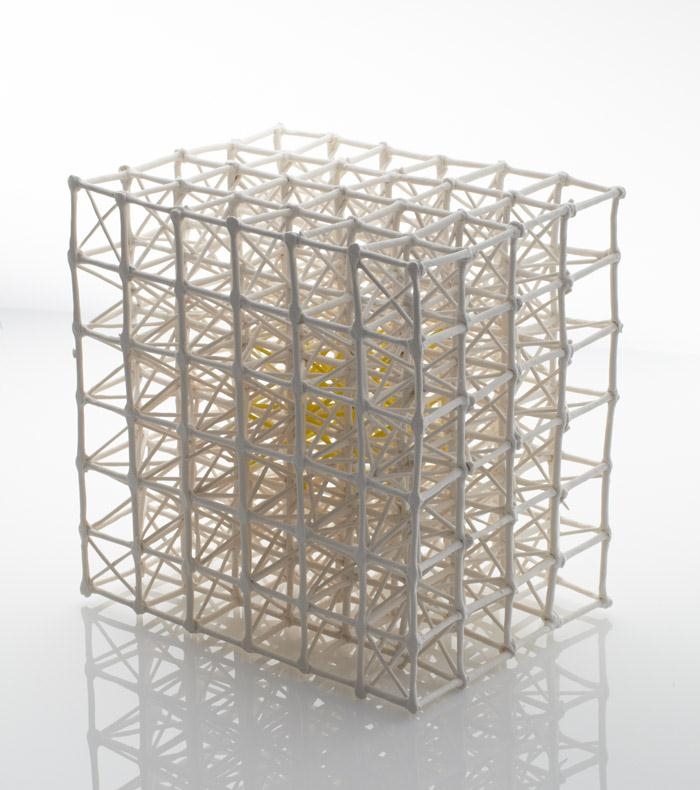
Title of work: ‘Radiolaria, Grid Yellow Centre’.
Material:High Fired, (1260 centigrade), unglazed and stained porcelain.
Technique: Handbuilt porcelain paperclay. Multiple firings.
Dimensions: 36cm W x 24cmD x 36cmH.
Date: 2011
Photographer: Sylvain Deleu
© Nuala O’Donovan
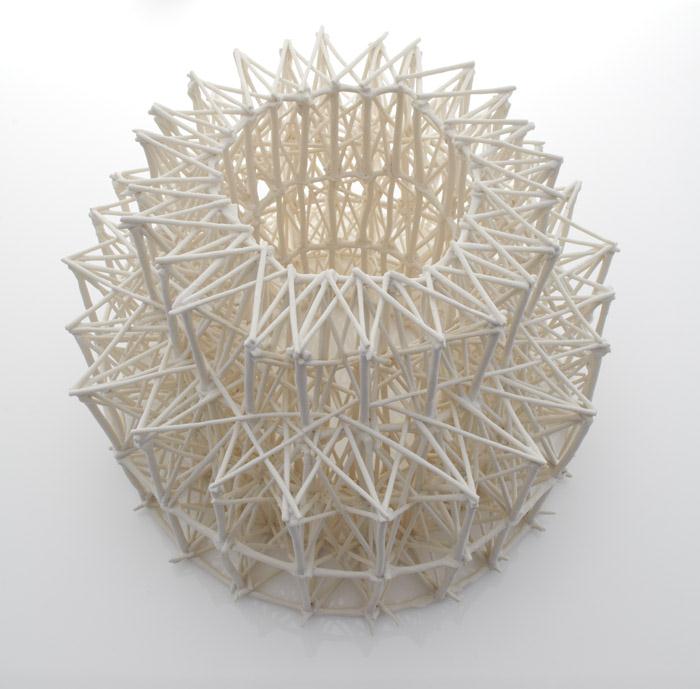
Title of work: ‘Radiolaria, Grid-Symmetrical Cylinders’.
Material: High Fired, (1280 centigrade), unglazed porcelain paperclay.
Technique: Handbuilt. Multiple firings.
Dimensions: 43cmL x 43cmW x 28cmH.
Date: 2011
Photographer: Sylvain Deleu.
© Nuala O’Donovan
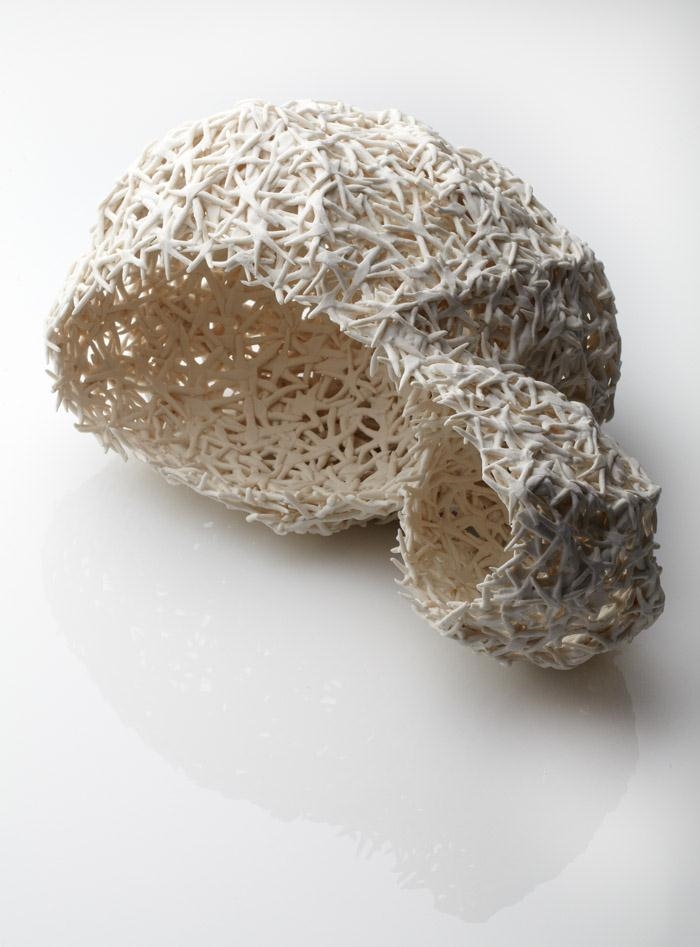
Title of work: ‘Coral, Figure of Eight’..
Material:High Fired, (1240 centigrade), unglazed porcelain paperclay.
Technique: Handbuilt porcelain paperclay. Multiple firings.
Dimensions: 30cmL x 30cmW x 20cmH.
Date: 2011
Photographer: Sylvain Deleu.
© Nuala O’Donovan
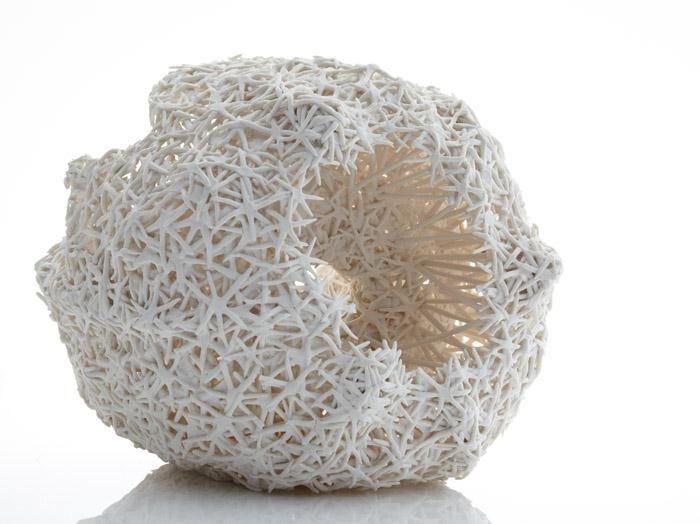
Title of work: ‘Coral, Fragment’, View 1.
Material:High Fired, (1240 centigrade), unglazed porcelain paperclay.
Technique: Handbuilt porcelain paperclay. Multiple firings.
Dimensions: 30cmL x 33cmW x 30cmH.
Date: 2011
Photographer: Sylvain Deleu.
© Nuala O’Donovan
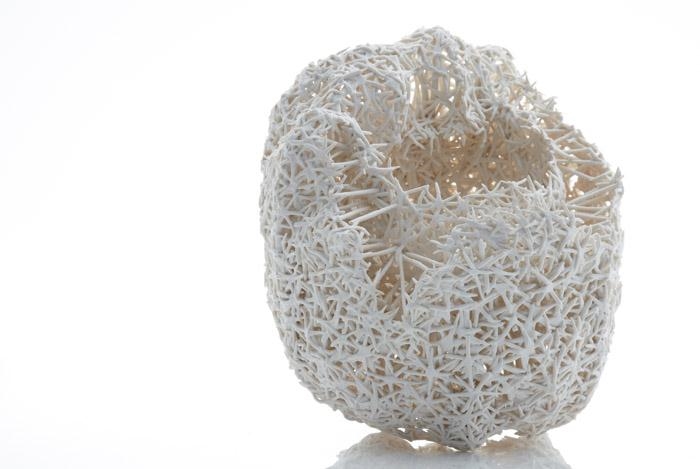
Title of work: ‘Coral, Fragment’, View 2.
Material: High Fired, (1240 centigrade), unglazed porcelain paperclay.
Technique: Handbuilt. Multiple firings.
Dimensions: 30cmL x 33cmW x 30cmH.
Date: 2011
Photographer: Sylvain Deleu.
© Nuala O’Donovan
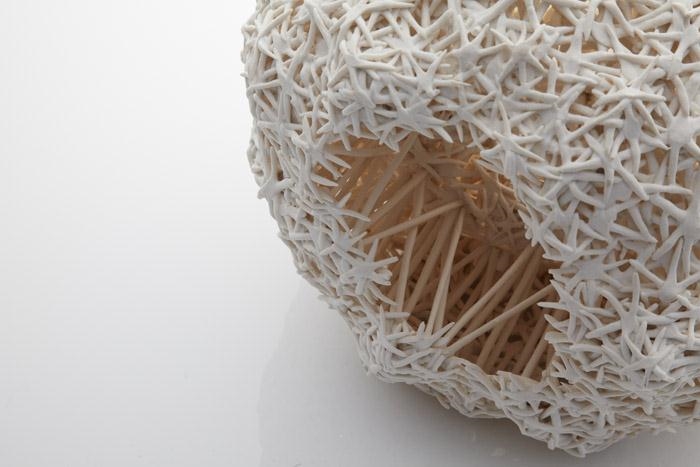
Title of work: ‘Coral, Fragment’, detail 1.
Material: High Fired, (1240 centigrade), unglazed porcelain paperclay.
Technique: Handbuilt porcelain paperclay. Multiple firings.
Dimensions: 30cmL x 33cmW x 30cmH.
Date: 2011
Photographer: Sylvain Deleu.
© Nuala O’Donovan
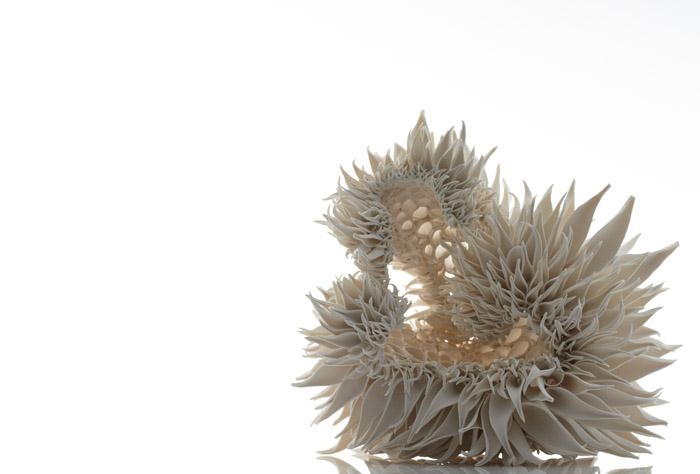
Title of work: ‘Teasel, Three-Sided’.
Material: High Fired, (1240 centigrade), unglazed & stained porcelain.
Technique: Handbuilt porcelain papreclay. Multiple firings.
Dimensions: 45cmL x 30cmW x 32cmH.
Date: 2011
Photographer: Sylvain Deleu.
© O’Donovan
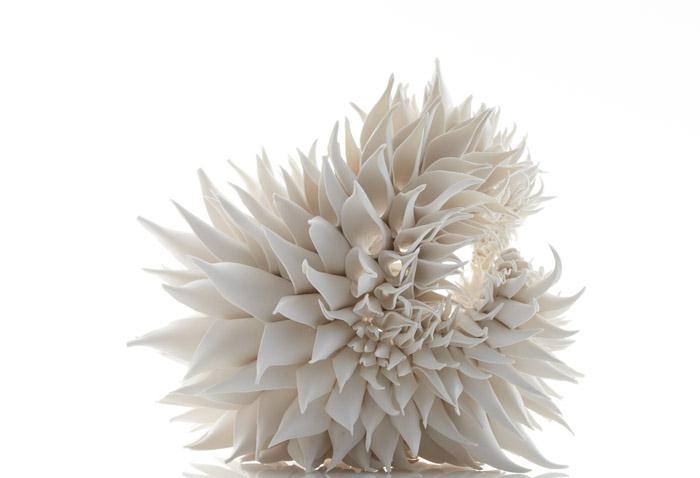
Title of work: ‘Teasel, Three-Sided’, view 2.
Material: High Fired, (1240 centigrade), unglazed & stained porcelain.
Technique: Handbuilt porcelain papreclay. Multiple firings.
Dimensions: 45cmL x 30cmW x 32cmH.
Date: 2011
Photographer: Sylvain Deleu
© Nuala O’Donovan
‘Dubh, Dialogues in Black’, Exhibition at the American Irish Historical Society, 991 5th Avenue, New York City, 10028. From October 7th to November 14th 2011.
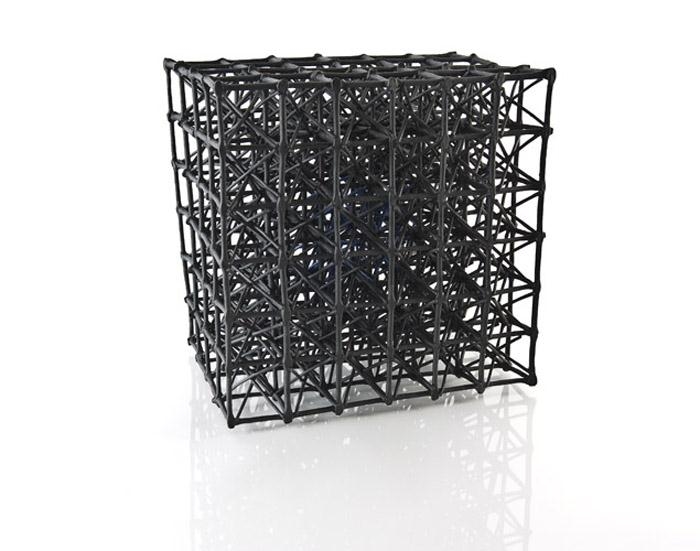
Title of work: ‘Black Grid, Hidden Blue’.
Material: High Fired, (1280 centigrade), unglazed.
Technique: Handbuilt stained black porcelain. Multiple firings.
Dimensions: 36cmW x 24cmD x 36cmH
Date: 2011
Photographer: Stefan Syrowatka
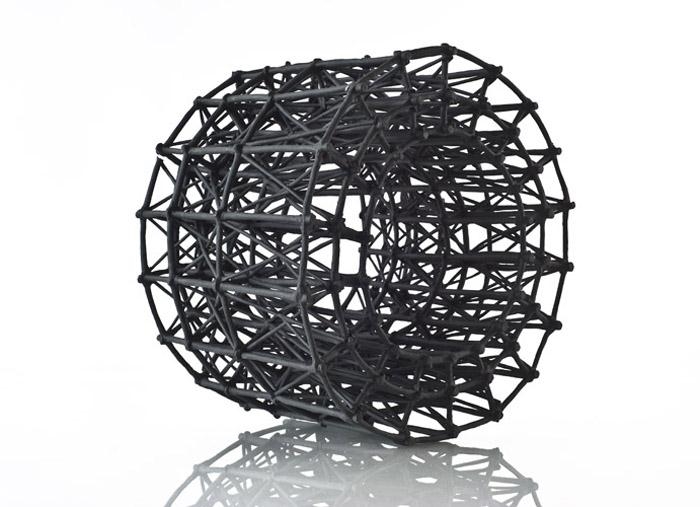
Dimensions: 45cm diameter x 20cm high.
Title of work: ‘Black Grid, Light Tunnel’
Material: High Fired, (1260 centigrade), unglazed porcelain.
Technique: Handbuilt porcelain papercly. Multiple firings.
Dimensions: 32cm Diameter x 20cmD
Date: 2011
Photographer: Stefan Syrowatk
MORE: Nuala O’Donovan,更多请至:Nuala O’Donovan on gooood



炸了