非常感谢Karina Smigla Bobinski将以下内容授权gooood发行。
Appreciation towards Karina Smigla Bobinski for providing the following description:
SIMULACRA是女性艺术家Karina Smigla Bobinski最近给我们分享的一个神奇控制“视觉可见”的互动装置。在曾经,她还给我们分享了同样充满互动且效果立竿见影的艺术项目ADA。与运动性的ADA相反,SIMULACRA只需要人们安静的站立,通过挂在装置上的“放大镜”观看本来是一片白的屏幕。观测圆镜揭示出了白色屏幕隐藏的真正本质,人们能看见原本看不见的影像。太迷人了不是吗。很多观众被吸引,并挪不开脚步。如果要知道原理,往下阅读吧~
点击下方视频(VIDEO)进行观看, 建议选择高清 ▼
Karina Smigla Bobinski打造的SIMULACRA是一个融合媒体技术与观念哲学的互动装置。放大镜是一个调动观众感官的介质。放大镜能揭示原本空白屏幕上的隐藏影像信息,暴露其“本质”。
SIMULACRA is an optophysical experimental arrangement with which Karina Smigla-Bobinski succeeds to build a bridge between media technology and perception philosophy. The artist used magnifying glasses to reveal her video art playing with our senses. She withdrew the flood of images from the medium and left its true nature bare: the light.
web: http://www.smigla-bobinski.com/english/works/SIMULACRA
video: http://youtu.be/LtcAu1PODMc
▼这装置如同水母般,四个LCD显示屏背对背形成一个中空的形状—就像水母的头。挂线,电缆,设备线,放大镜垂在四周如同水母触须。
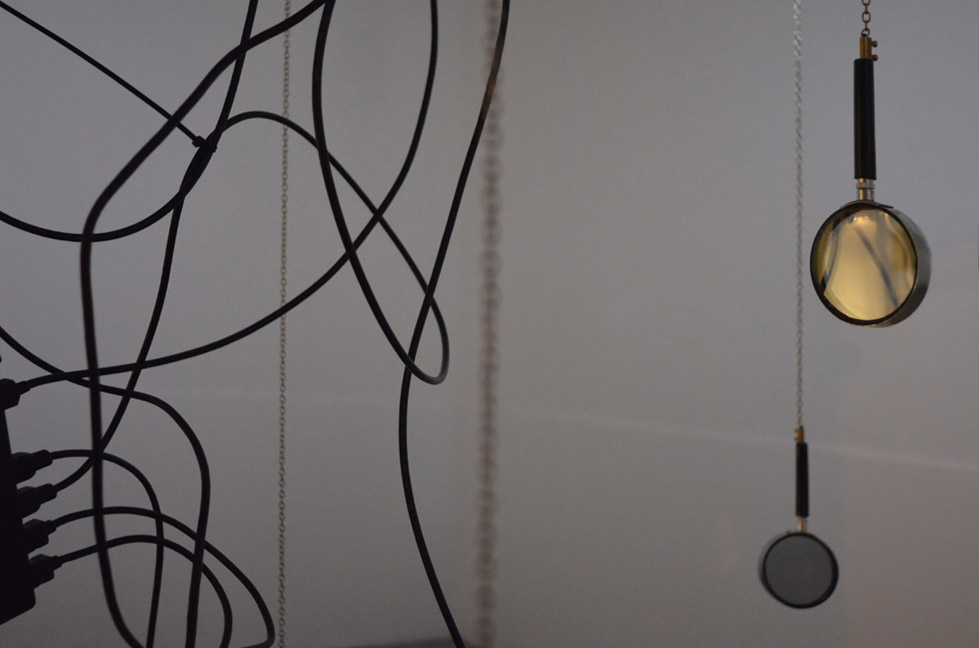
four LCD monitor panels, which are assembled in the form of a hollow square, and installed at eye level in the middle of the room. The ensemble appears internally gutted, overgrown and embraced. A tangle of cables and control devices pours out of the middle of the square. All around it several magnifying lenses dangle from chains.
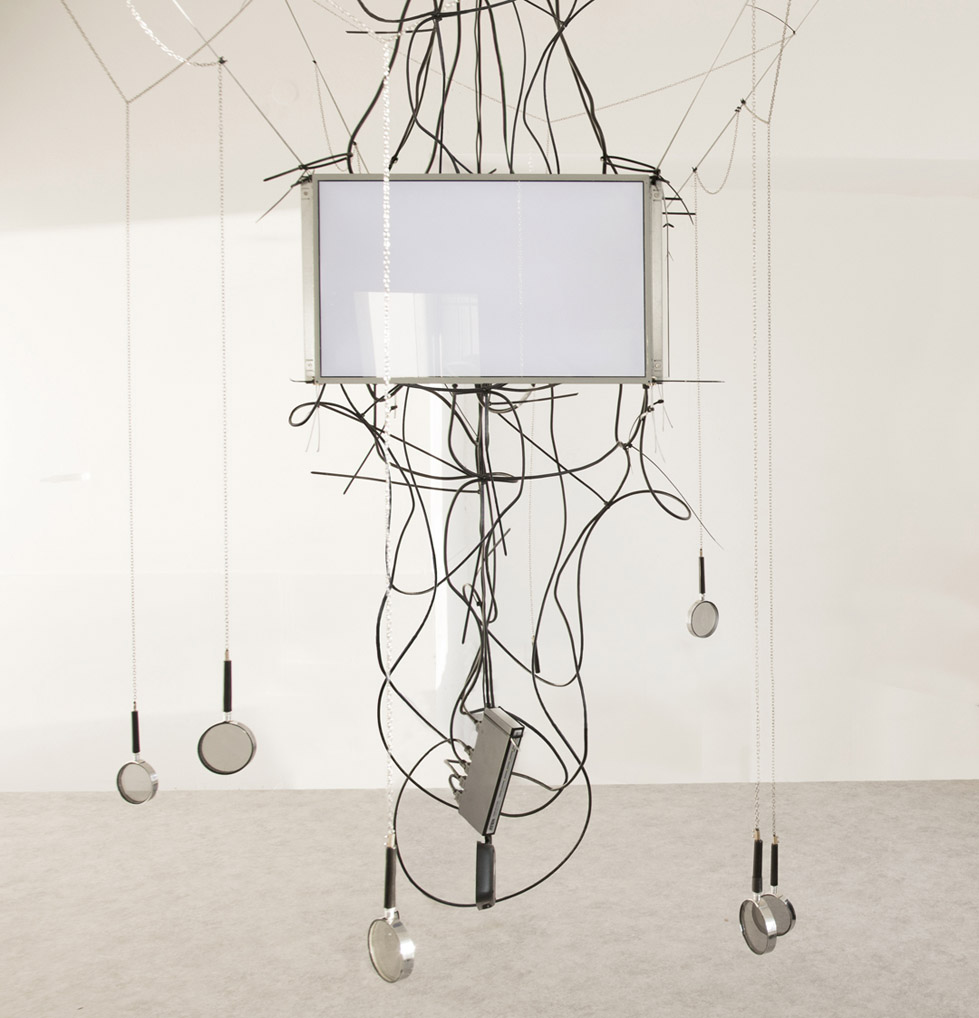
▼ 从下朝上看,A view from below: four LCD monitor panels, which are assembled in the form of a hollow square.
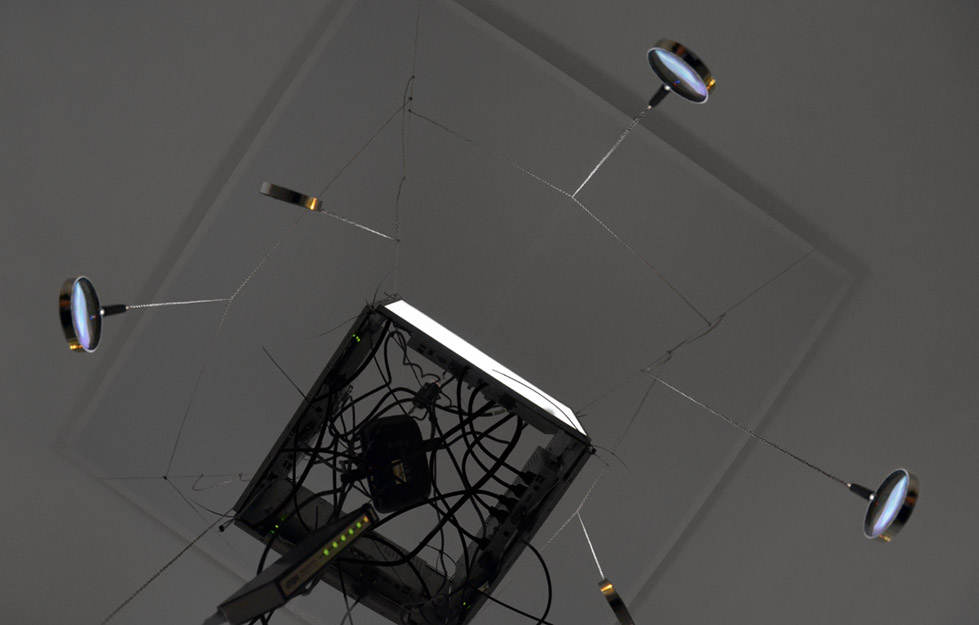
▼吊着的放大镜表面贴着一层偏光膜,Magnifying glasses with a polarising foil, suspended from the ceiling.
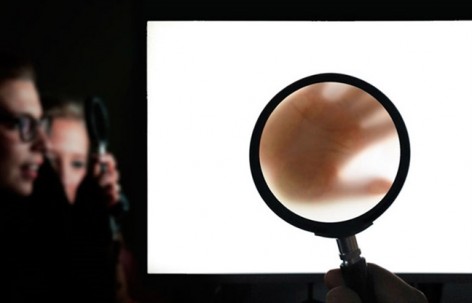
▼游客使用放大镜观看屏幕,通过放大镜上的偏光镜的屏幕的光,在游客眼中变成了可以看见的影像
The visitor hold a magnifying glass before the monitor and the video seem to merge directly from light in the eyes of the viewer, pulled from space into being by magnifying glasses.
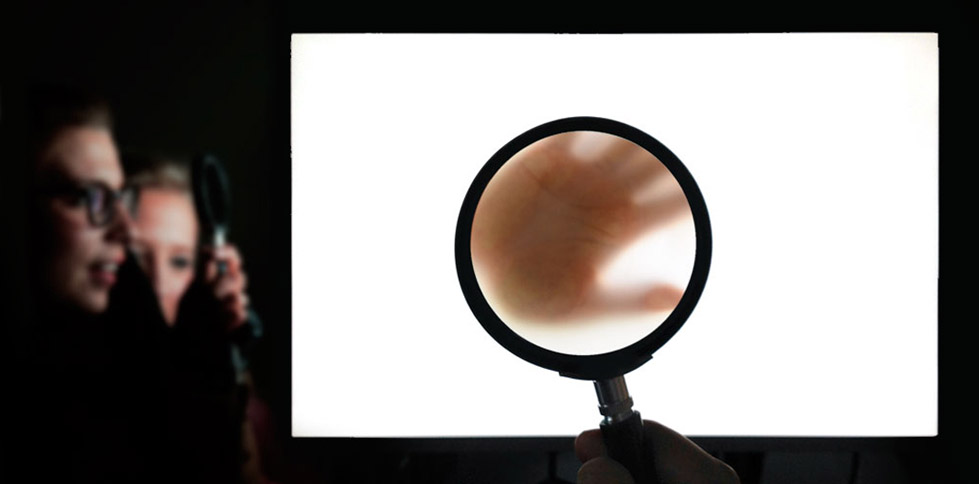
▼ 游客从放大镜中发现视频的内容,Visitor looking through the magnifying glasses and discover the figure in the video.
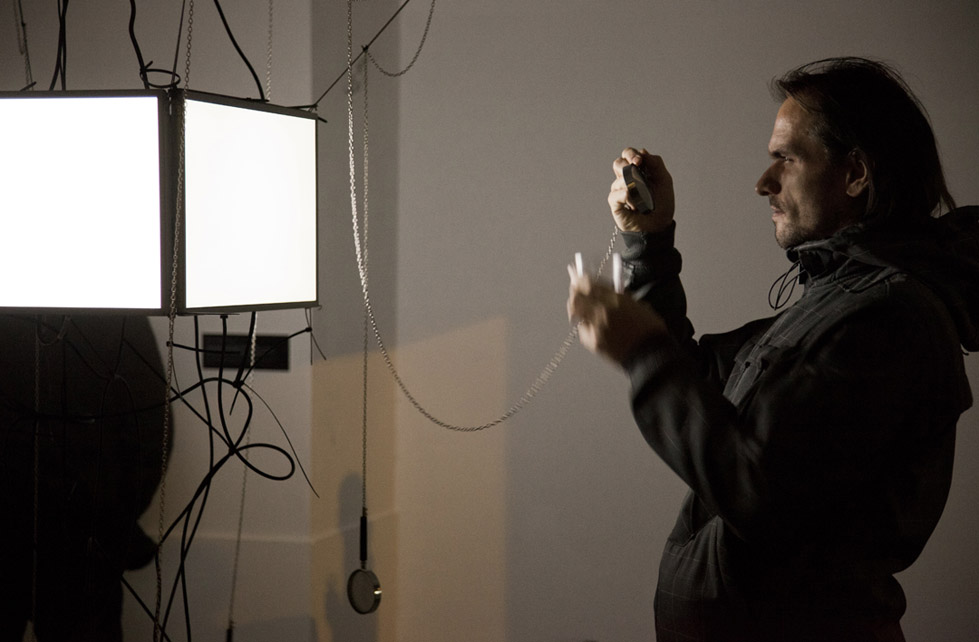
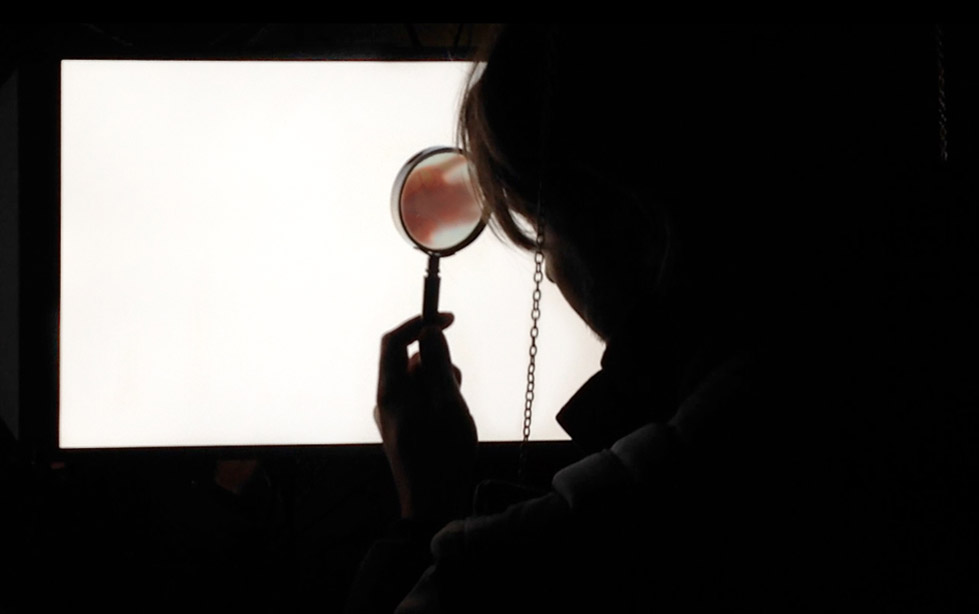
▼纯白的屏幕在偏光镜的重叠下显示出内容。
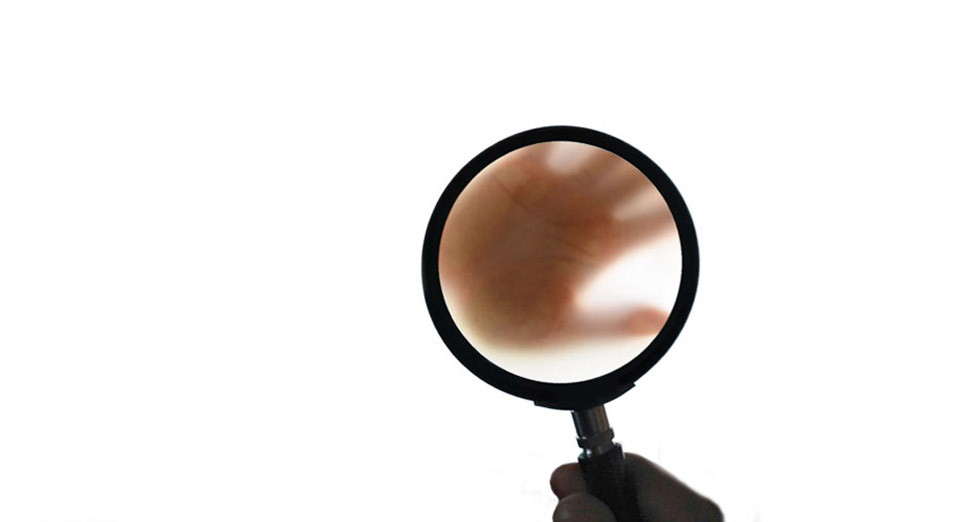
Images (video) appear from the pure white of the monitor through magnifying glasses with a polarising foil.
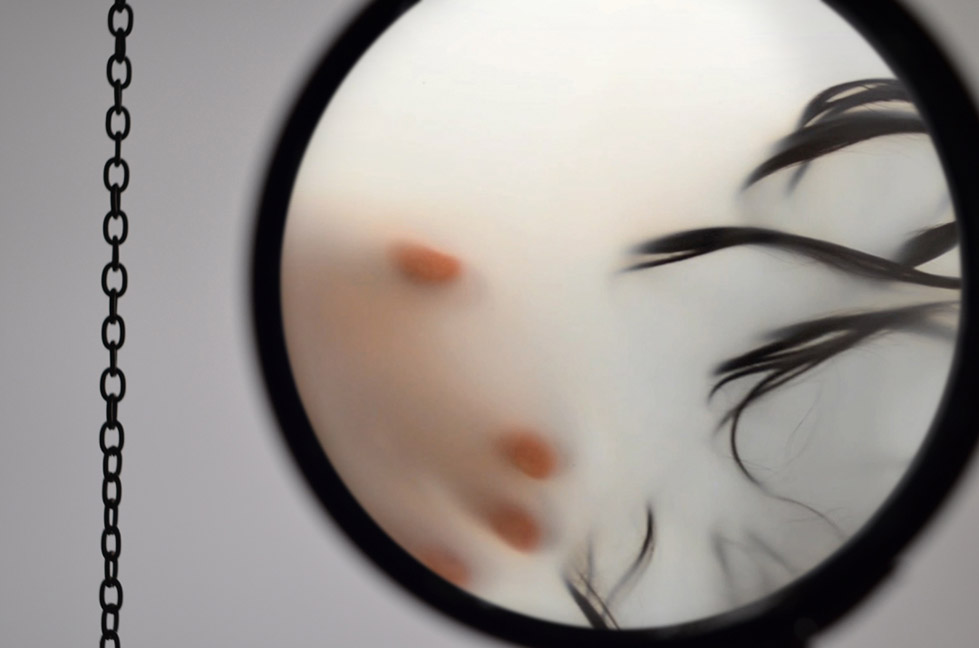
▼举着带有偏光镜的放大镜这么看屏幕感受真是太奇妙了。偏光镜的色彩有多种,形成的效果也是多样化。
If you hold a magnifying glass before the monitor, then it is an impressive, wondrous experience when images suddenly appear. But if you turn the lens in front of your eyes, the polarising structure of the film creates wild colour shifts or even complementary negative images.

▼ 这个互动模式非常简单也容易被效仿,整个屏幕都隐藏着影像,放大镜移动到不同的位置,就能看到不同位置的影像。当然如果把它提在眼睛上就能看见整个屏幕的内容了。
In the interaction with SIMULACRA other visual experiences were discovered by the visitors: If you hold a magnifying glass in front of each eye and turn them differently, the result is a hologram-like image.
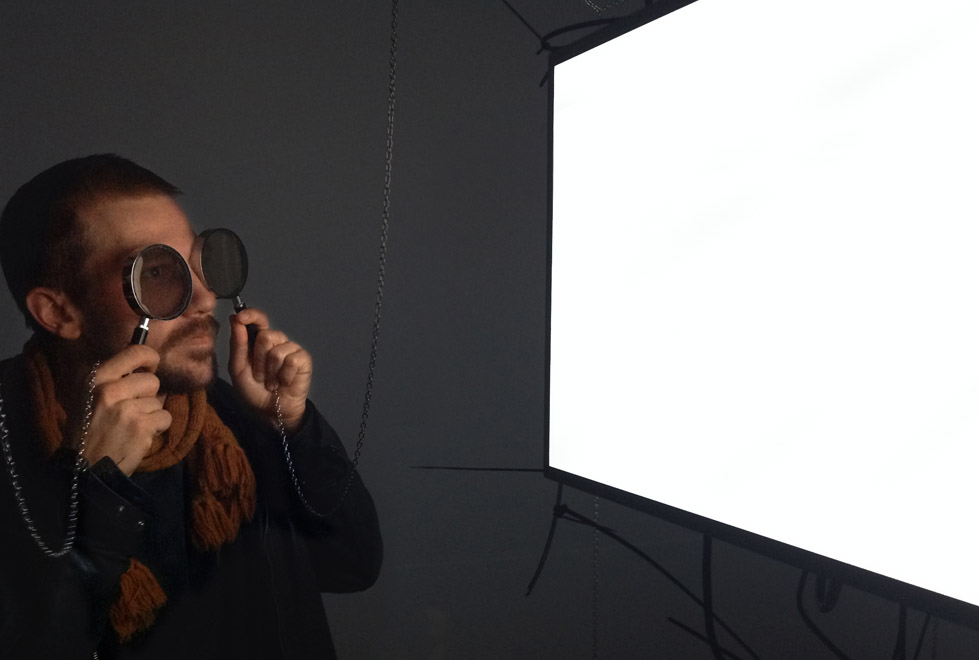

有评论认为,这个通过带有偏光膜辅助器观看影像的装置,使人们从白色的虚无发现“有”,并能通过距离和各种操作获得不同的信息量与信息体验。是一个在虚拟和现实间感知与体验的全新模式。在现实的社会中,数字革命以后的媒介影像已经泛滥,已经无穷多。控制信息需要人们有意识的去选择,这可以理解为一种互动。这个纯白光的屏幕上演着介于魔法与科学之间的关于技术与图像,感知与想象的体验,并以其批判性让人们进行思考。
here is more information form Karina Smigla Bobinski
“White Cube” – text by Dr. Thomas Huber
SIMULACRA is an optophysical experimental arrangement with which Karina Smigla-Bobinski succeeds to build a bridge between media technology and perception philosophy. At its heart are four LCD monitor panels, which are assembled in the form of a hollow square, and installed at eye level in the middle of the room. The ensemble appears internally gutted, overgrown and embraced. A tangle of cables and control devices pours out of the middle of the square. All around it several magnifying lenses dangle from chains. The imageless glaring ray of the monitors looks as if the images had fallen out of them. What remains is the essence of the medium: Light.
But the images are still in the screens. It requires only a small visual aid to recognise them. LCD-Monitors require several polarising films in front and behind the pixel layers to produce visible images. These polarising films filter the certain vibration directions of the emitting light. One of them is located on the surface of the monitor and can easily be scraped off using solvent and a glass scraper.
The stripped monitor doesn’t display any more pictures, but shines with an intense white light.
If you hold a polarising film, as in SIMULACRA in a magnifying glass version, before the monitor, then the function is restored. It is an impressive, wondrous experience when images suddenly appear from the pure white by the mare glance through a seemingly transparent film. But if you turn the lens in front of your eyes, the polarising structure of the film creates wild colour shifts or even complementary negative images. In the interaction with SIMULACRA other visual experiences were discovered by the visitors: If you hold a magnifying glass in front of each eye and turn them differently, the result is a hologram-like image. Two lenses stacked on each other in a ninety degrees angle darken the picture completely.
In the design of video images that run across the screens, Karina Smigla-Bobinski worked skilfully with the effect of an opaque glistening body of light: – hands, feet, long black hair press against the inside surface of the screens, making them only visible within the contact, before disappearing into the white nothingness.
SIMULACRA penetrates deep into the discourses of subject and view, image and reality. Taking a magnifying glass (possibly waiting until one is free), to position one-selves between other people in front of the screens, viewing the images clearly or alienated with a magnifying glass – perceiving the work requires physical actions, an active positioning, which surpasses the accustomed visual process.
Thus, the viewers are motivated to reflect on their patterns of perception. Smigla-Bobinski particularly tries to create an awareness for the visual culture of the virtual space and its process of imagination.We all move through our worlds in constant interaction between external and internal imagesand ourselves.. Virtuality and reality are questions of perception, and perception is a matter of awareness.
In an era of an unending possibility of increasing the development imaging media, these terms have experienced an equally infinite fragmentation.
In the works title Karina Smigla-Bobinski uses a term that is being used since the ancient philosophy for various forms of pictorial representation. Understood as a “similar ” or “realistic” image of natural things and divine beings, the ” simulacrum” was regarded as deficient due to its subordination in relation to what is depicted original. The term won a new meaning in the reassessment of signs in postmodern philosophy. The difference between the sign and the signified and thus also between the image and what it represents has been defined by Roland Barthes, Jacques Derrida and Gilles Deleuze as the nucleus of creative processes . In dealing with the signs, even in its mere reading , there will be a profound examination of the levels of reality , each sign is a reconstructional process in which there may be gaps and shifts in meaning . This leaves space for not only interpretation but also new creation.
The images have mushroomed in recent decades in the evolution of media. In the early 1980s, Jean Baudrillard subjected ” Simulacra and Simulation” to a fundamental critique . He noted a surfeit of images, which leads to a general loss of reference to reality. The world behind it begins to become irrelevant as the experiential space, in which a differentiation between virtual and real is still possible, increasingly dwindles. But this antagonism has become historic. The new media are not new anymore – back in the late 1990s Nicholas
Negroponte proclaimed the digital revolution to be finished and viewed the later spawned technologies as a “compost for new ideas.”
Karina Smigla – Bobinski designed SIMULACRA with exactly this historical awareness : The installation seems crude , the devices have lost their glory , their auratic presence. The tangle of cables and wires seem like the climbing plants that start to overgrow sunken wreckages – an association that is particularly strong due to the video. The laborious modification of the monitors with solvent and glass scraper was called by Smigla-Bobinski herself “an analog attack on the digital images technique” .
The Virtual is an essential part of our contemporary reality. It refers to a form of existence beyond the physical world, but it carries physical qualities in the form of a potential. The categories “real” and “virtual” are no indicator for the strength of an image. Zizeks analysis of film, for example, demonstrates through a psychoanalytic perspective based on Lacan, the persistent interaction between levels of realty, images and consciousness we encounter on our journey through an medial universe.
The decisive factor is the awareness to this interaction. In Simulacra, Smigla-Bobinski lets the viewer have a peek into her view of the how the virtual works: in the digital video, body parts appear on a white glowing surface , but we recognise this as a person who is swimming in a brightly lit tank filled with a milky fluid. Without the ‘seeing aid’ the screens seem to show the empty tank, but viewed through the film, the figure is partially visible. This results in the impression that the visual aid gives rise to the figure itself. However, the person is always present in the monitor pixels. What is brought to light is the video in itself – a significant difference in the context of negotiating the remuneration of virtuality and reality. A disembodied medium seems to create a body, a person. Another illusion as an impulse for reflection lies in the arrangement of the monitors: Under the influence of the video it is almost inevitable to not conceive the radiant square as just that space in which the person is swimming – similar to believing as a child, that miniature people are living in or on TV. But since the same video is playing on all four screens, spatial experiences are pure imagination.
That play of absence was done by Alphonse Allais at the end of the 19th century. He created soundless songs and monochrome black or white images , in which only the title heralded the content. Karina Smigla-Bobinski puts the accent on the virtuality of the absence, in the apparent emptiness a representation of something appears. It is a representation devoid of imagery, unencumbered by the pictorial .
It is a representation that shows nothing but the presentation layer itself, it is the pure light in which any occurrence is possible. The magnifiers in SIMULACRA only let one of many possible representations emerge . SIMULACRA is a space of experience of the interaction between the magic of the images and the intellectual understanding, with plenty of space for critical reflection. Its kind of deconstruction – both technically and aesthetically – is aimed at easing the basic relations: between ( technical ) media and image , between picture and the pictured there , between perception and imagination. These are the gaps from which something new can arise .
MORE: Karina Smigla Bobinski









视频看不了啊
视频普通显示器就可以实现么。?