非常感谢 北京观筑景观规划设计院孔祥伟工作室(邮箱:guanzhula@163.com)予gooood分享以下内容。更多关于他们,请至:Guanzhu landscape & plandesign institute-Kong Xiangwei Studio on gooood
Appreciations towards Kong Xiangwei Studio (email: guanzhula@163.com) for providing the following description:
山中造园
Build a garden in the mountains
泉山云顶,山东日照的一个景区,座落于河山南麓一隅。有河谷森林、泉水溪流,亦有山野民宿、茶馆工坊,景区草木丰茂,游人络绎不绝。今春,园主孙胜邀我在茶园民宿间造园,我们围炉夜话,讨论如何让人们在游园的同时获得些许思想上的收获,聊及庄子、陶渊明及隐逸思想,造园命题遂即“思想游园”。
Quanshan Yunding, a scenic spot in Rizhao, Shandong Province, is located in a corner of the southern foot of the river mountain. There are river valley forests, springs and streams, as well as mountain lodgings and teahouses, and the scenic area is rich in grass and trees, with an endless stream of tourists. This spring, the owner of the garden Sun Sheng invited me to create a garden in the teahouse lodging, we talked around the fireplace at night, discussing how to let people in the garden at the same time to get some ideas on the harvest, chatting about Zhuangzi, Tao Yuanming and hermitage ideas, the garden proposition then “thought garden”.
▼项目视频,Video © 孔祥伟工作室
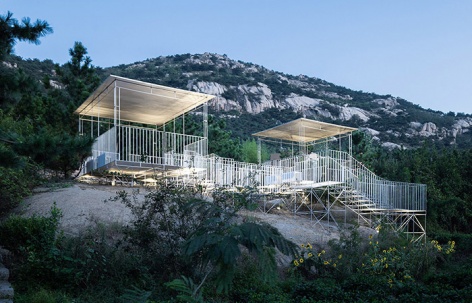
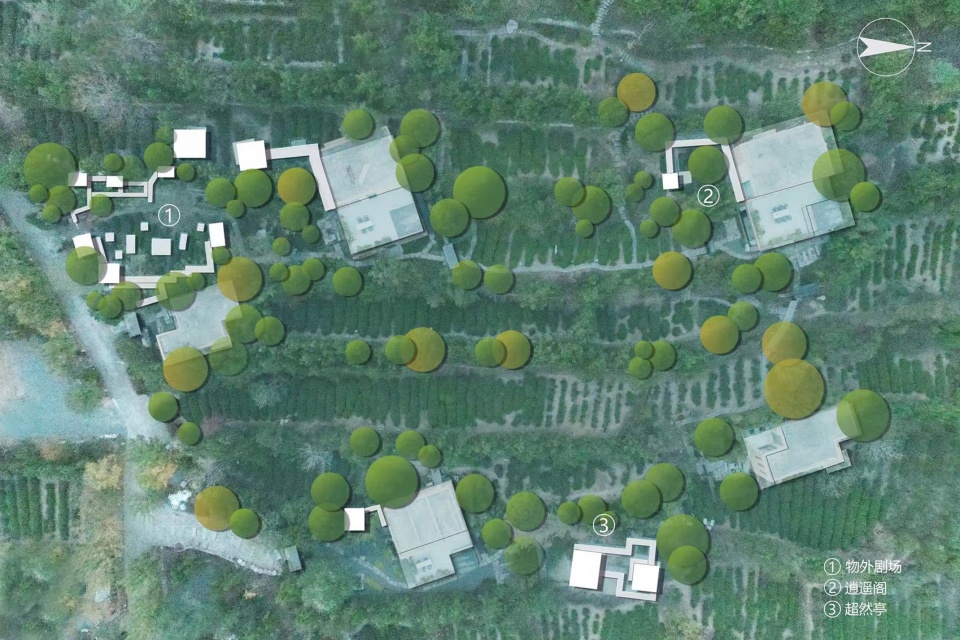
山林经岁月涵养,已生机盎然,民宿处在正常运营待客中,从环境到经营,都不易大兴土木。我建议用中国山水画的经营之法来造园,仿古人画山水,路、桥、亭、阁,居舍茅舍,恰当散落于山林水溪之间,散点式布局,不动山林,仅以构筑点题,由此可将自然放在高位,让其成为隐逸思想表达载体。直入现场,和工匠配合,在场地之中自然生发设计,以钢筋为线条,依据模数,不断建构,构筑自然生长于山林之中,间隙穿行,不伤草木。从春入秋,历经半载,点构成园,生成物外剧场、超然亭与逍遥阁,游人流连其间,可体味隐逸之趣,又或有瞬时超脱的心境。
The mountains and forests have been cultivated over the years, and have been full of vitality, and the B&B is in normal operation and waiting for customers, from the environment to the operation, it is not easy to make a big construction. I suggest to use the operation method of Chinese landscape painting to build a garden, imitating the ancient people painting landscape, roads, bridges, pavilions, pavilions, houses, thatched houses, appropriately scattered in the mountains, forests, water and streams between the scattered layout, do not move the mountains and forests, only to build the theme, which can be placed in a high position in the nature, so that it can become a carrier for the expression of the idea of seclusion. Directly entering the site and cooperating with the craftsmen, the design is naturally generated in the midst of the site, using the steel bars as the lines, based on the modulus, constantly constructing, and the structure naturally grows in the mountains and forests, traveling through the gaps without hurting the grass and trees. From spring to fall, after half a year, the garden has been formed into a garden, generating the Out-of-The-Box Theater, the Transcendental Pavilion and the Pavilion of Escape, where visitors can experience the fun of seclusion, or have an instantaneous state of mind of transcendence.
▼物外剧场,Theater of Things ©直译建筑摄影
▼超然亭,Pavilion of Transcendence ©直译建筑摄影
▼逍遥阁,Pavilion of Prosperity ©直译建筑摄影
隐逸思想的表达
The idea of seclusion
隐逸思想贯穿中国历史,山水则是隐逸思想的生发之地,南朝沈约《宋书·隐逸传》,记叙了十七位隐士,多好慕山水, 恒处幽林。中国造园,内循隐逸思想,思想游园把自然山林作为造园的对象,将人工构筑隐入其间。
The idea of seclusion throughout Chinese history, landscape is the birthplace of the idea of seclusion, the southern dynasty, Shen Yao “Song book – seclusion biography”, recounted seventeen hermits, more than adore the landscape, always in the quiet forest. Chinese gardening, within the idea of seclusion, the idea of gardening the natural mountains and forests as the object of gardening, the artificial structures hidden in between.
▼总平面图,master plan © 孔祥伟工作室
“轻”与“线”
“Lightness” & “Line”
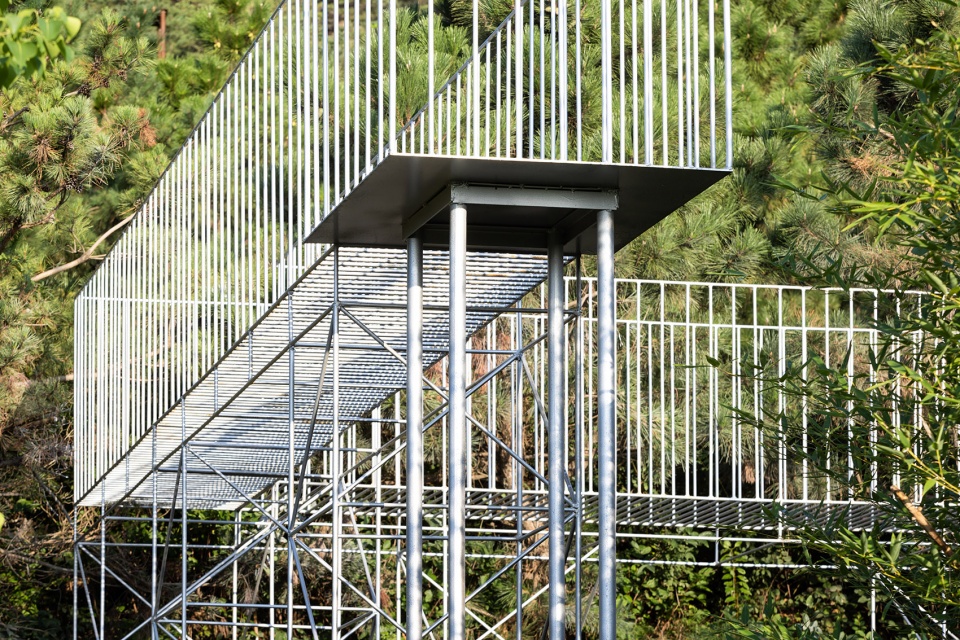
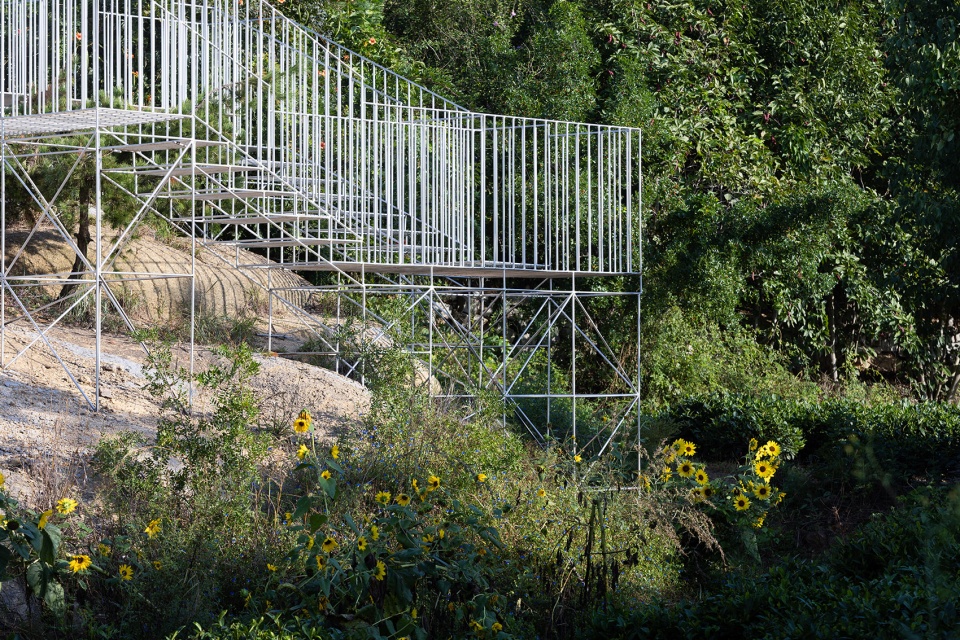
把“轻”作为建构的姿态,来对话隐逸思想。李安的电影《卧虎藏龙》,最经典的镜头之一便是李慕白和玉娇龙在竹林之上比剑的场景,“轻”是一种中国元素,而“线”则最能表达“轻”,所谓“吴带当风”,线由钢筋来实现,可以在一片山林中,自由表现各类构筑。
“Lightness” is used as a constructive gesture to dialog the idea of seclusion. In Ang Lee’s movie “Crouching Tiger, Hidden Dragon”, one of the most classic scenes is the sword fight between Li Mu Bai and Jade Jiao Long in the bamboo forest. Lightness” is a Chinese element, and “line” can best express “lightness”, the so-called “Wu belt when the wind”, the line is realized by steel bars, can be freely expressed in a mountain forest, all kinds of constructions.
▼以钢筋为线条,using the steel bars as the lines ©直译建筑摄影
物外剧场
Theater of Things
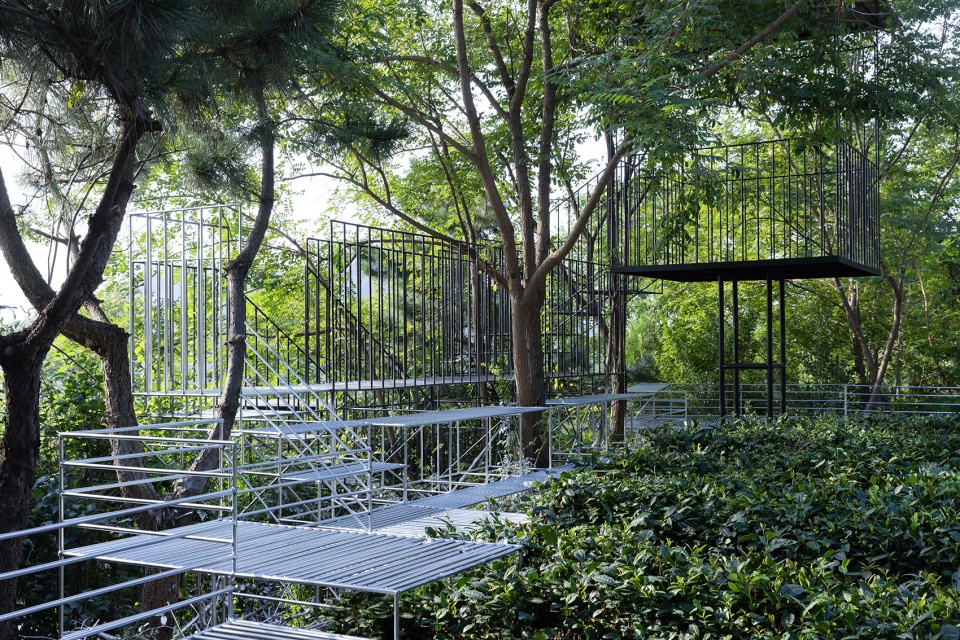
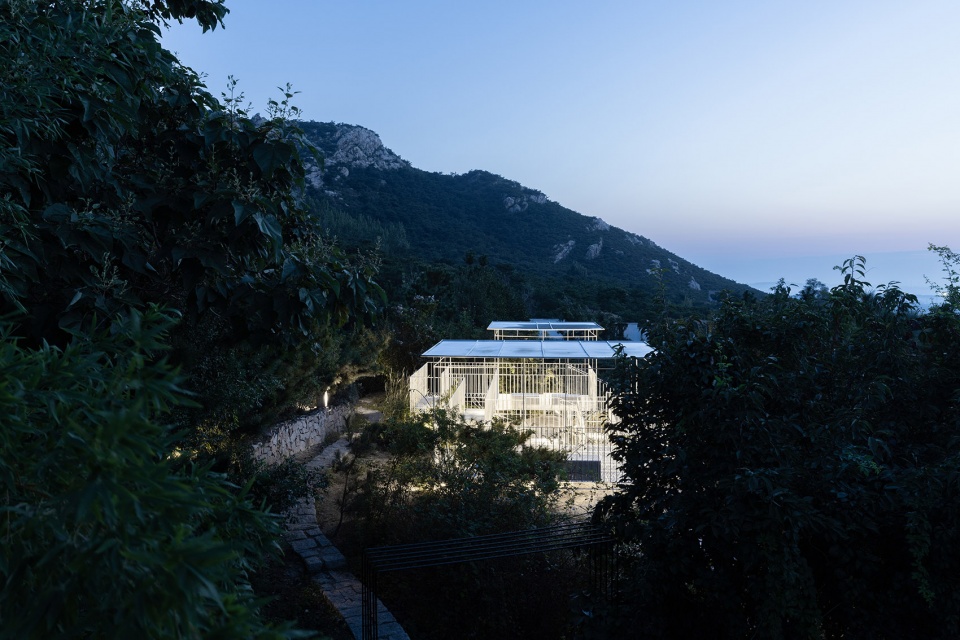
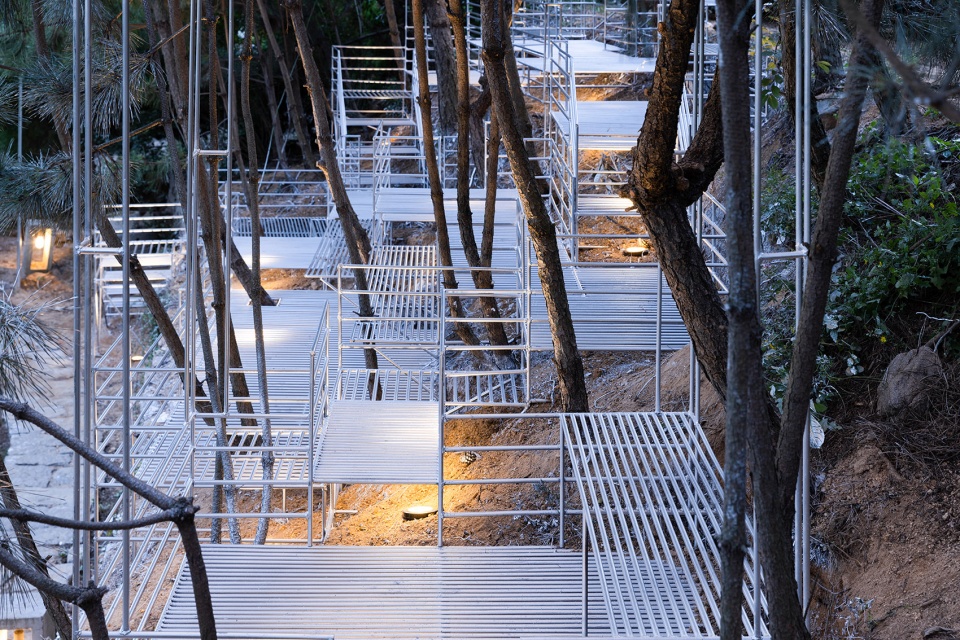
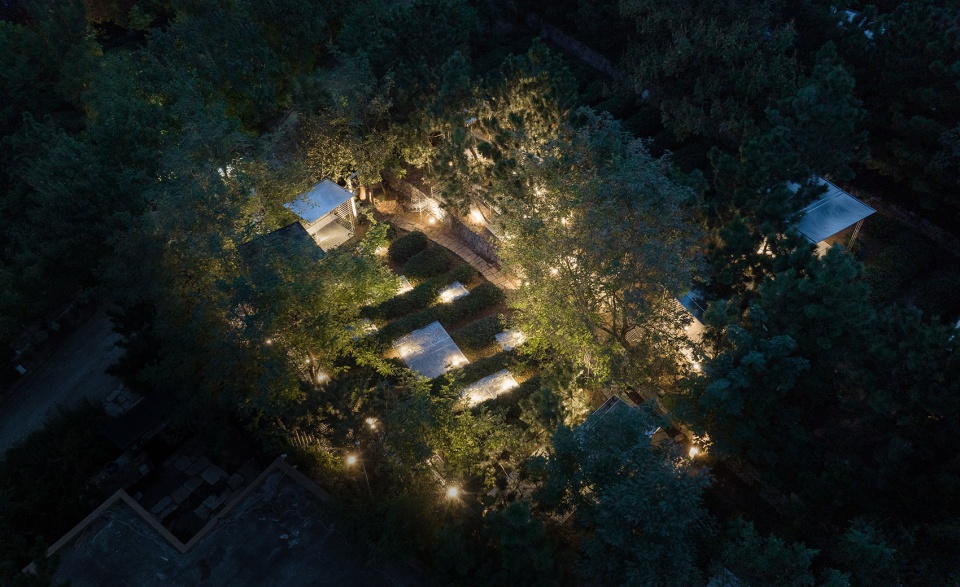
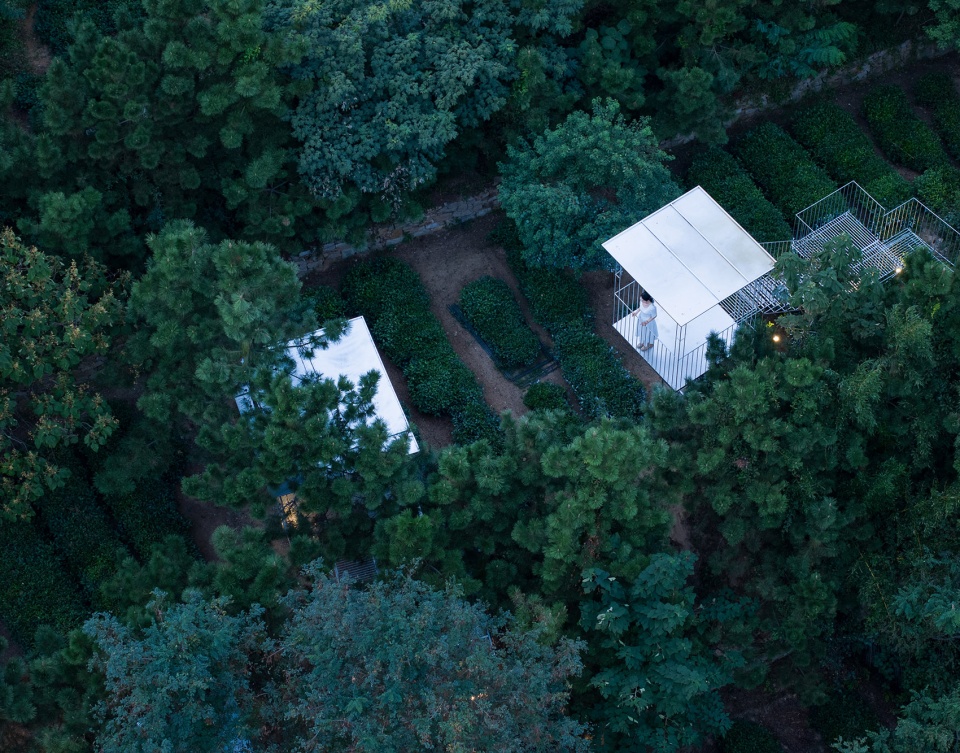
整个园子不同地方拥有特定的场域气氛。在中南部,有一片松林和槐树围绕的茶园,藏风纳气,草木俱佳,经连续营造,最终形成了一个林间剧场。最早构建的是一个亭子,悬挑于茶园的东南边角,通过转折的廊道和下方民宿的庭院连接,廊道由钢筋焊接而成,廊亭皆着墨色,穿越一片茂密的树林,并消隐其间。
The whole garden has a specific atmosphere in different places. In the south-central part, there is a tea garden surrounded by pine and acacia trees, which hides the wind, the grass and the trees, and which has been continuously created, eventually forming a forest theater. The earliest construction was a pavilion, cantilevered in the southeast corner of the tea garden, connected to the courtyard of the lodging house below by a twisting corridor made of welded steel, all colored in ink, which passes through a dense forest and disappears into it.
▼远观物外剧场,viewing the Theater of Things at distance ©直译建筑摄影
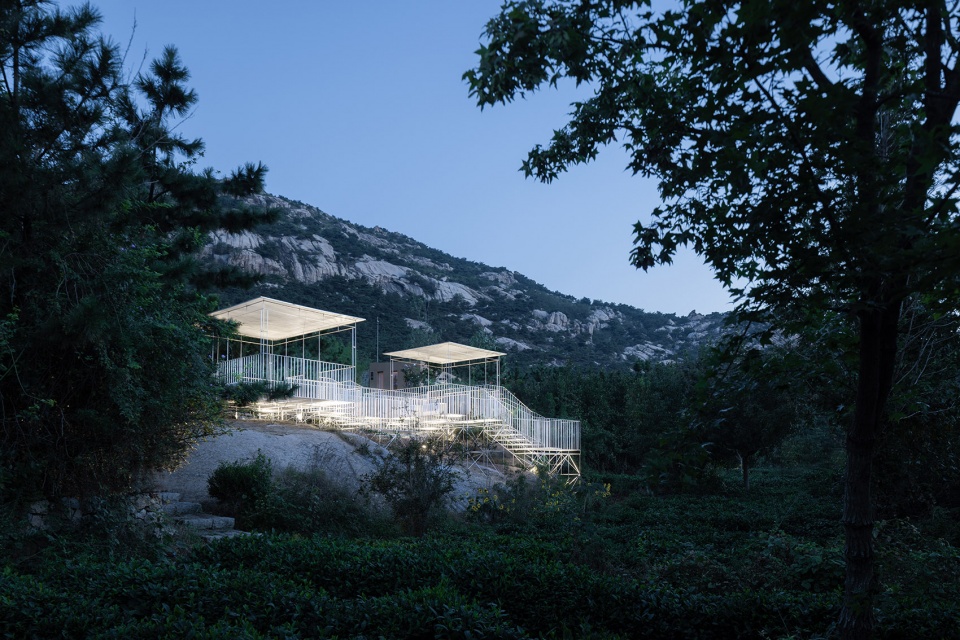
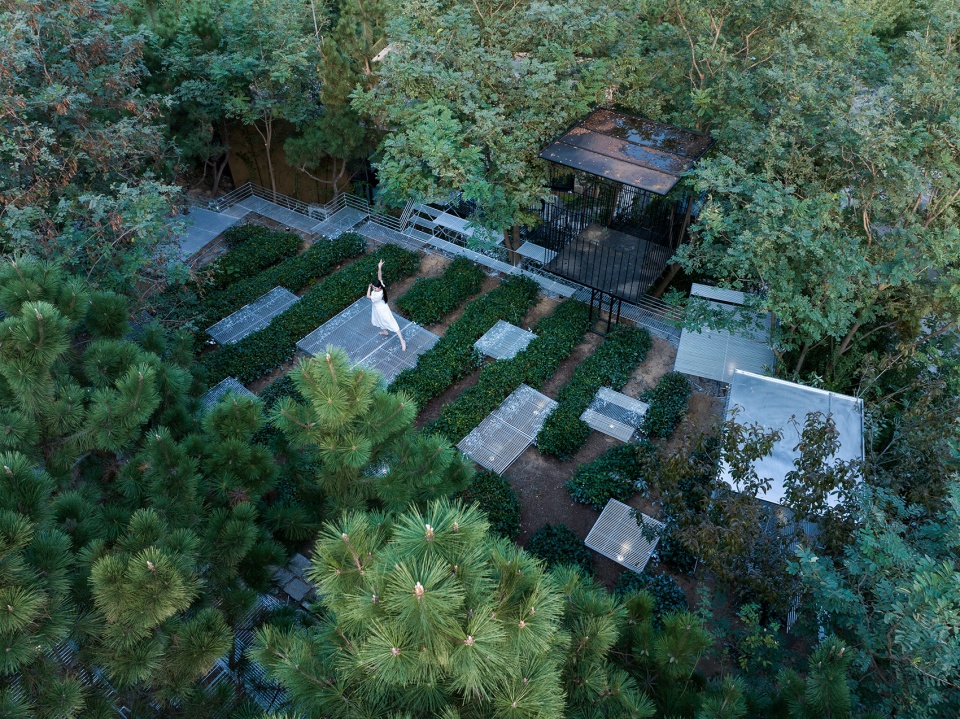
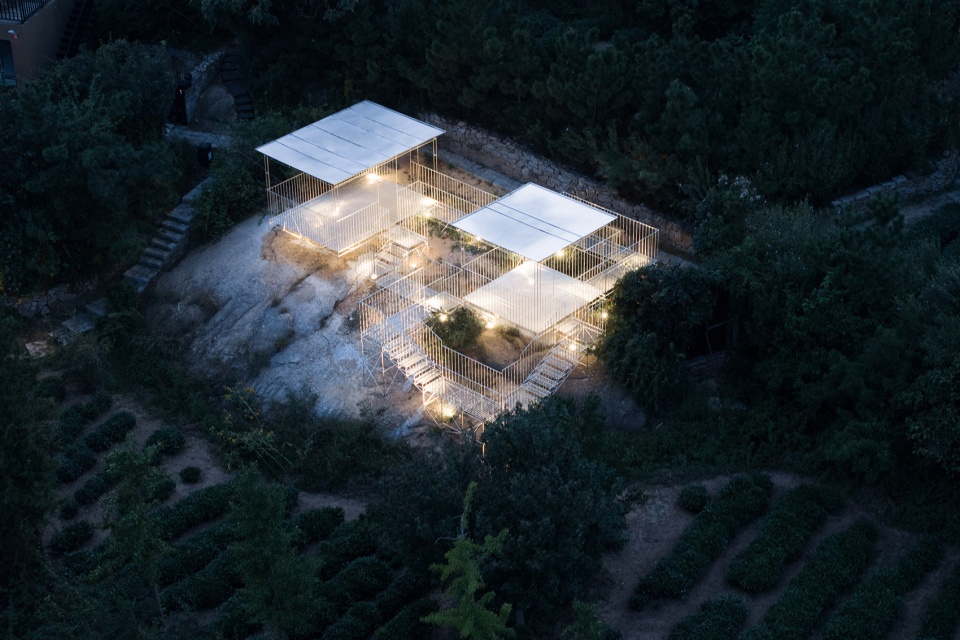
▼物外剧场鸟瞰,aerial view of the Theater of Things ©直译建筑摄影
▼物外剧场顶视图,top view of the Theater of Things ©直译建筑摄影
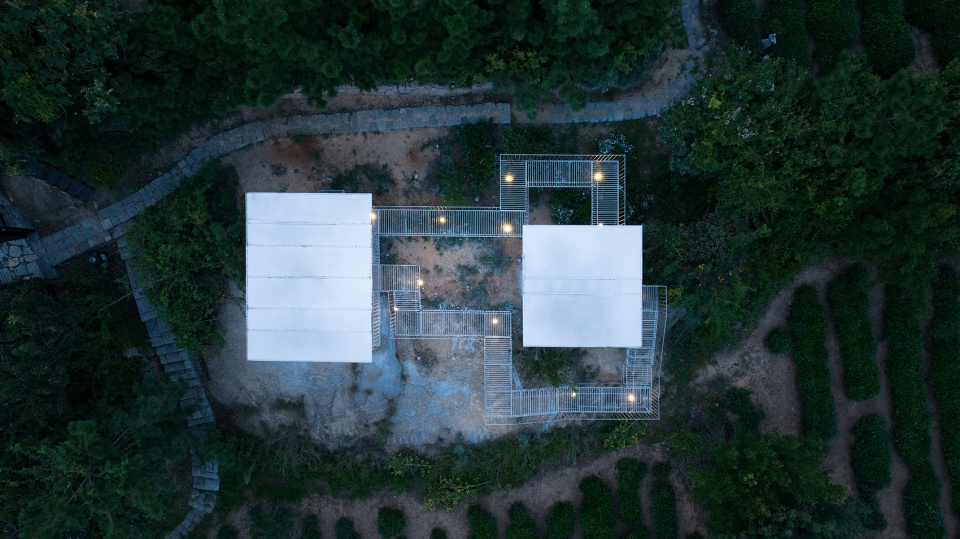
登上槐树树冠下的亭子,可以眺望远山之间的城市,颇有处江湖又可见庙堂之意。接续,在其斜对坡地的一棵大槐树下,搭建一处琴台,自此,中国山水画常常描绘的雅集空间的意趣逐渐出现。在琴台下方的几棵松树一侧增设平台,形似《韩熙载夜宴图》中的床榻。琴台上方几棵大松树下,则生出另一亭子,松间明月,欲表现王维田园诗之意境。东北望去,又有一亭,着银色浮在空中,略带太白诗篇的豪放。
Climbing up to the pavilion under the canopy of acacia trees, one can look out over the city between the distant hills, with a sense of being in the middle of a lake and a temple. Next, under a large acacia tree on the slope diagonally across from it, a qin terrace was built, and since then, the interest in the space for elegant gatherings that is often depicted in Chinese landscape paintings has gradually appeared. Below the platform, a platform was added to the side of several pine trees, resembling the bed in Han Xizai’s Night Banquet. Above the piano platform under a few large pine trees, there is another pavilion, the moon between the pines, want to express the mood of Wang Wei’s idyllic poetry. Looking northeast, there is another pavilion, floating in the air with silver color, slightly with the boldness of Taibai’s poetry.
▼物外剧场外观,exterior view of the Theater of Things ©直译建筑摄影
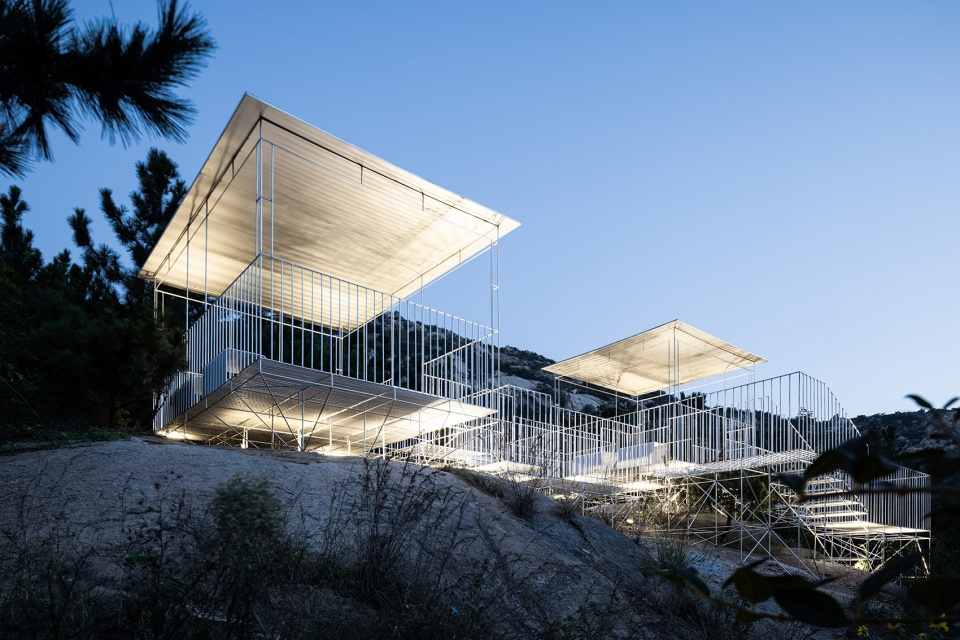
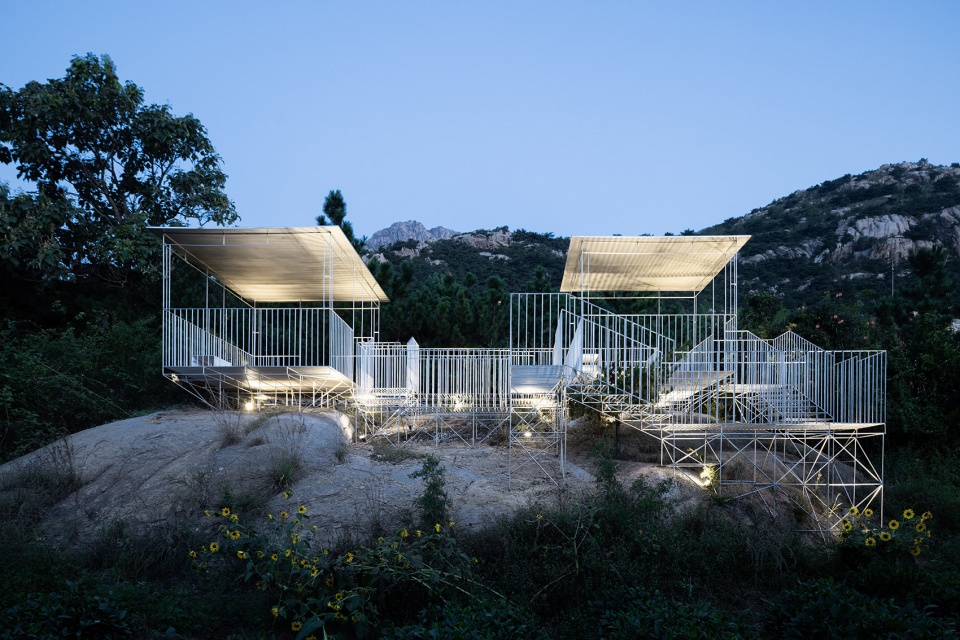
▼坡地上的琴台,the pavilion on the hill under the canopy of acacia trees ©直译建筑摄影
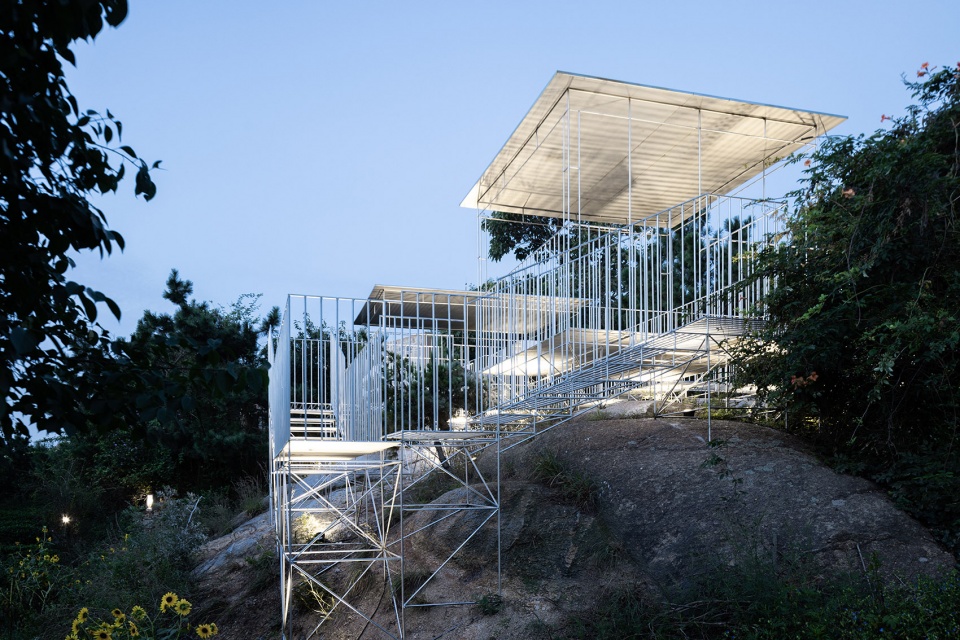
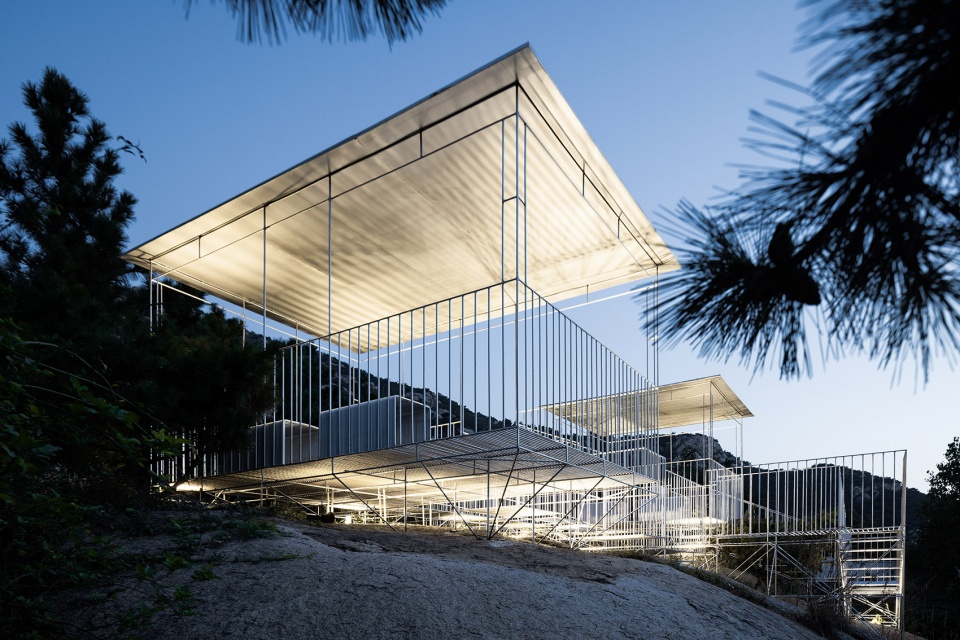
▼浮在空中的银色亭子,a silver pavilion floating in the air ©直译建筑摄影
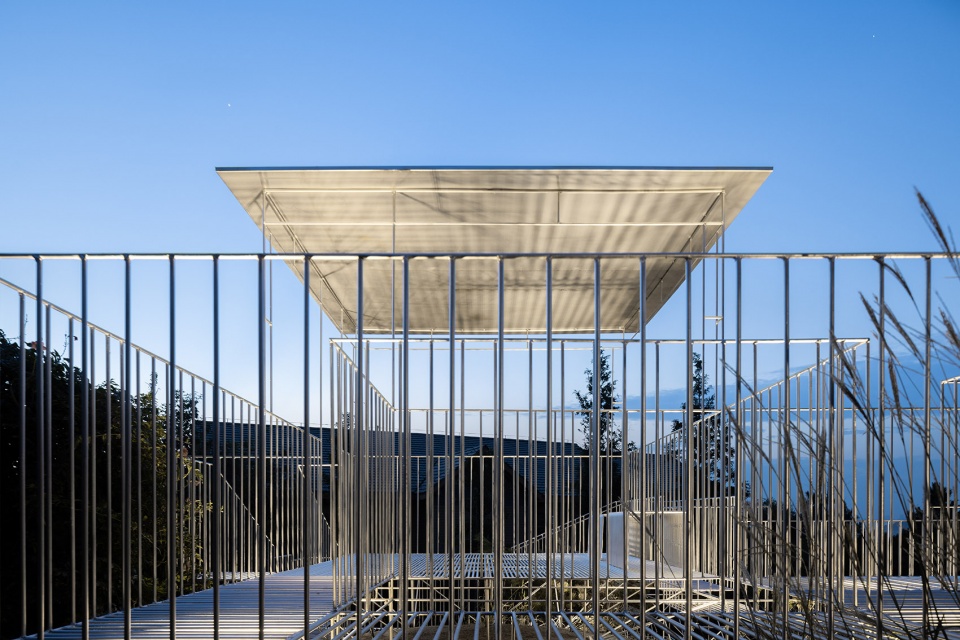
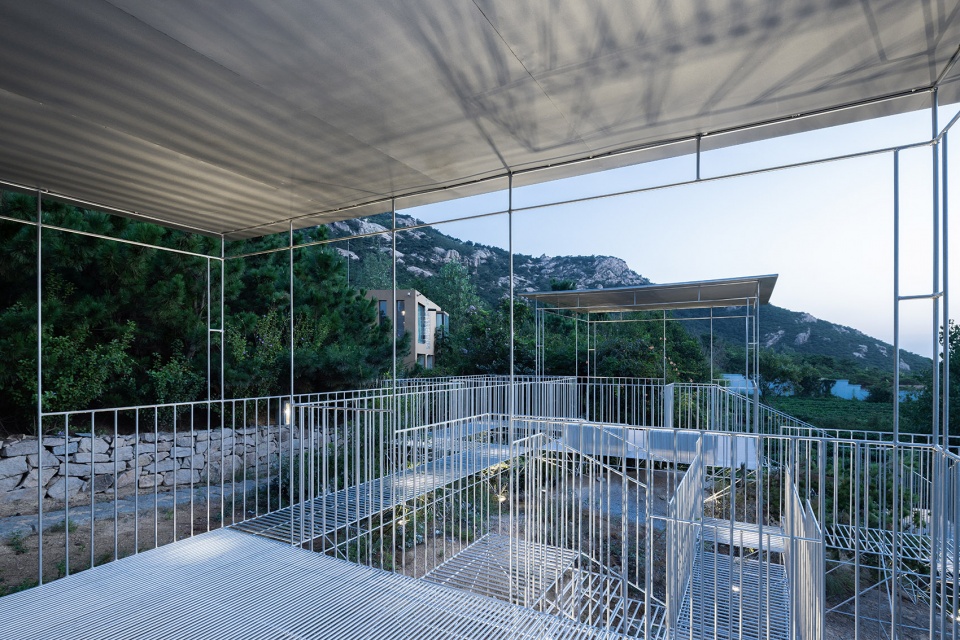
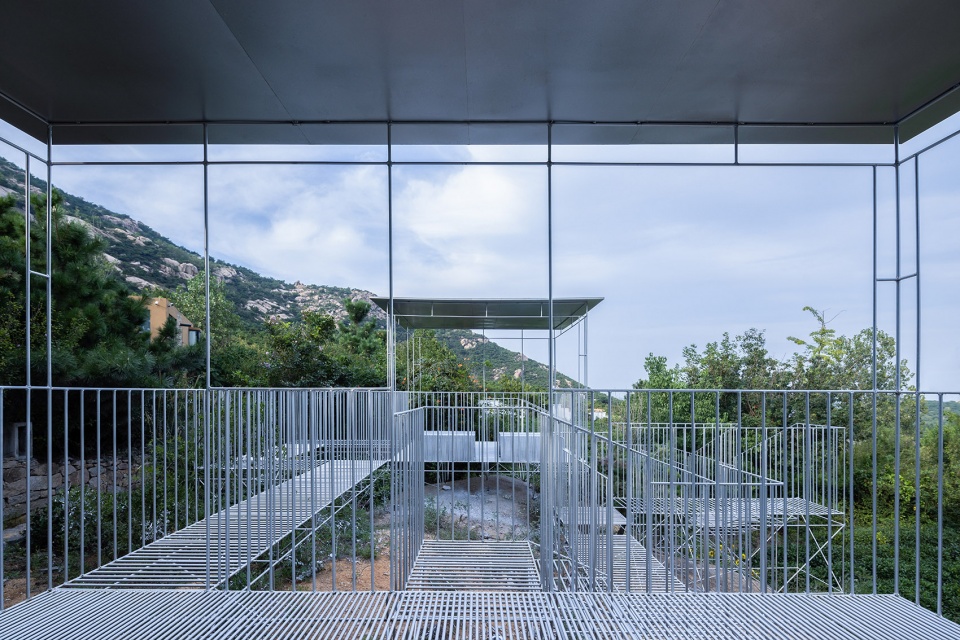
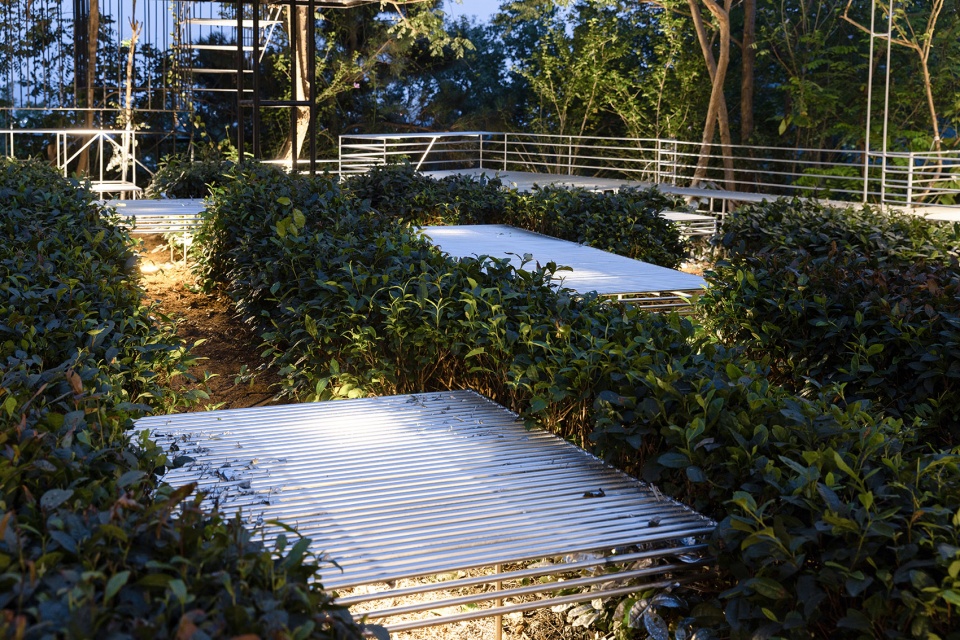
随着按照中国画散点透视法散置的构筑的成形,场地愈来愈像一个围合的剧场。遂在场地四周设置看台,在一片茂密的松林之间,以树为伞,高低错落。中心茶园的正南方,与路相邻,做隔栅屏障,与看台结合,如东篱、南山,对应陶潜诗中的闲适田园。最后在中心茶园点布大小不一的舞台,飘于茶树之上。剧场完成,有虚空之意,似超然物外。
With the formation of the structures scattered according to the Chinese painting method of scattered perspective, the venue became more and more like an enclosed theater. A grandstand was set up around the site, between a dense pine forest, with trees as umbrellas and a staggered height. To the south of the center tea garden, adjacent to the road, there is a fence, which is combined with the grandstand, such as Dongli and Nanshan, which corresponds to the idyllic idyll in Tao Qian’s poem. Finally, in the center of the tea garden, different sizes of the stage, floating above the tea trees. The theater is completed, there is a sense of emptiness, seems to be beyond the world.
▼物外剧场内部视角,interior of the Theater of Things ©直译建筑摄影
超然亭
Pavilion of Transcendence
“春未老,风细柳斜斜。试上超然台上看,半壕春水一城花”。苏轼被贬密州,修复了城外一处观景台,其弟苏辙很明白他当时的处境,故在诗中将观景台命名“超然台”,取自《道德经》中“虽有荣观,燕处超然”。超然二字也总能概括苏轼,苏轼也总是能够在一贬再贬中超然处之。
“Spring has not yet grown old, the wind is fine and the willow is slanting. Try to go up to the superlative platform to see, half trench spring water a city of flowers”. Su Shi was relegated to Mizhou, restored a scenic terrace outside the city, his brother Su Zhe understood his situation at that time, so in the poem he named the scenic terrace “Chaoran Terrace”, from “Tao Te Ching” “Although there is a glorious view, the swallow at the Chaoran”. The word “Chaoran” always sums up Su Shi, and Su Shi is always able to be in the midst of repeated relegations.
▼超然亭鸟瞰,aerial view of the Pavilion of Transcendence ©直译建筑摄影
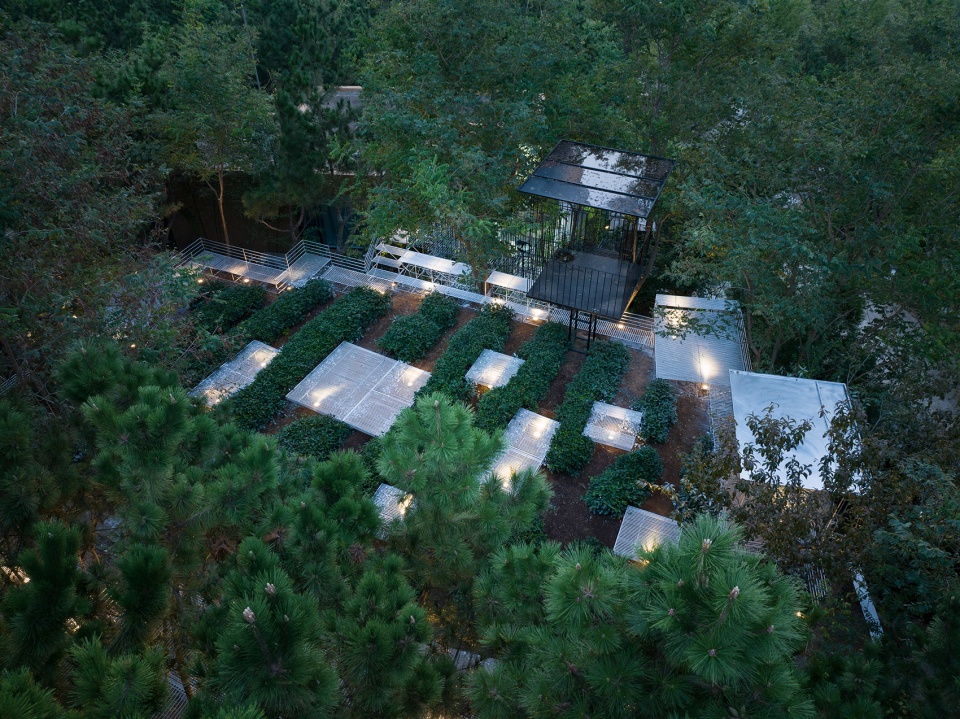
▼超然亭顶视图,top view of the Pavilion of Transcendence ©直译建筑摄影
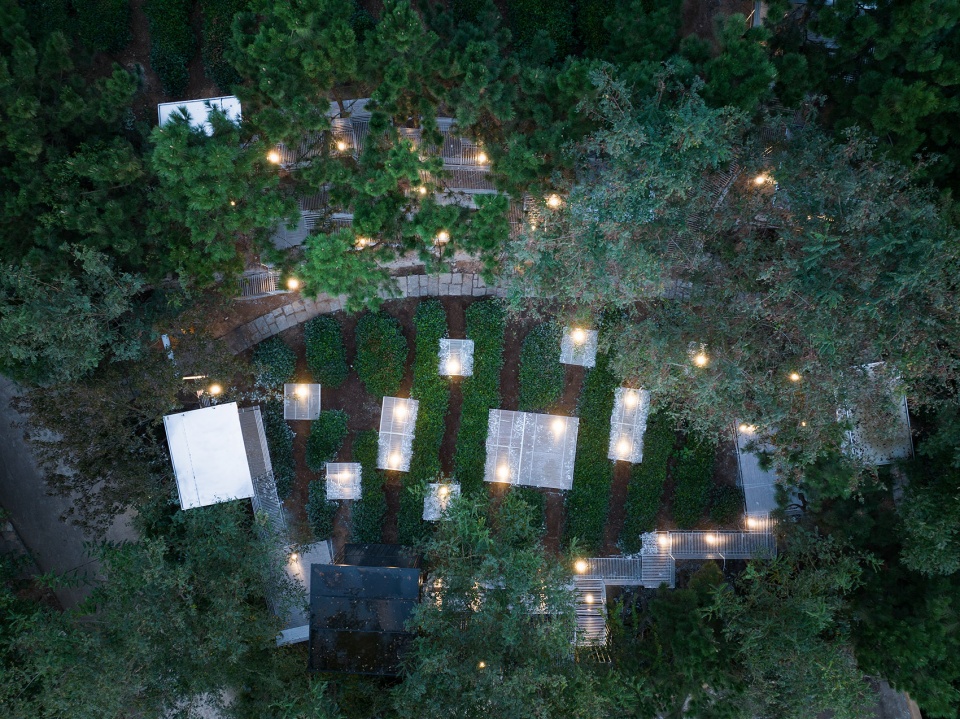
▼散落在林中的景观亭,landscape pavilion scattered in the forest ©直译建筑摄影
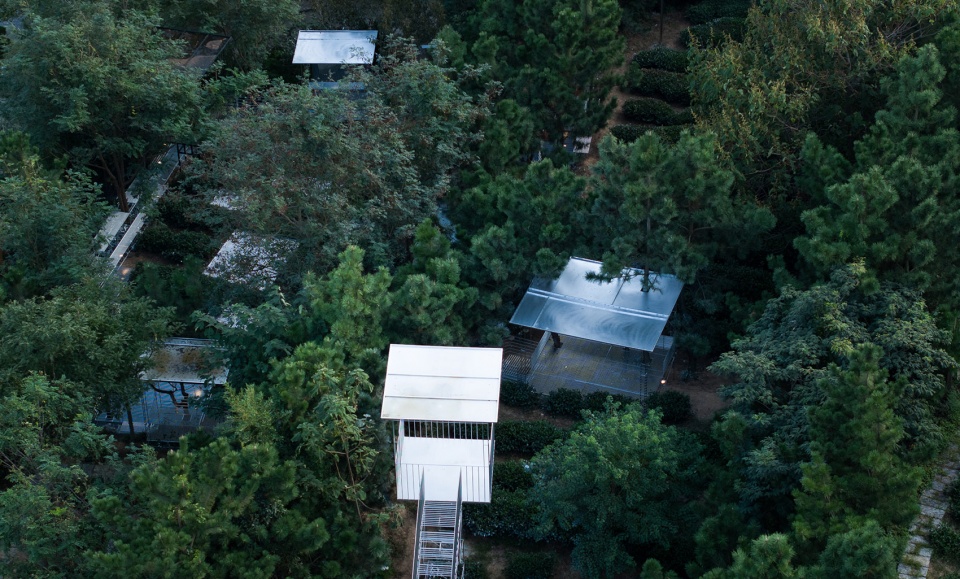
▼局部顶视图,local top view ©直译建筑摄影
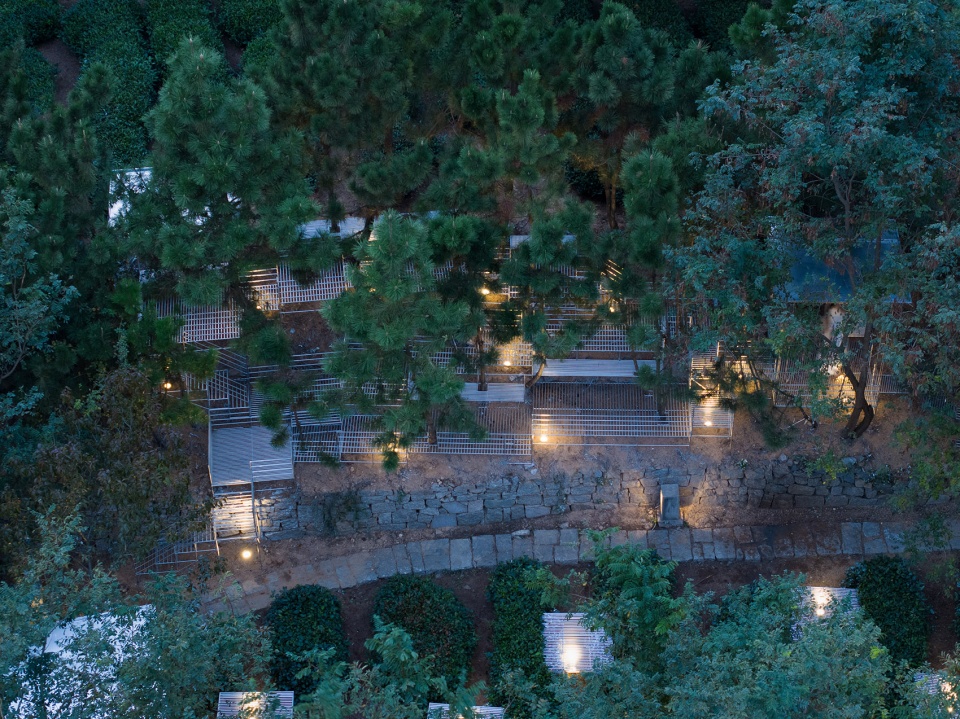
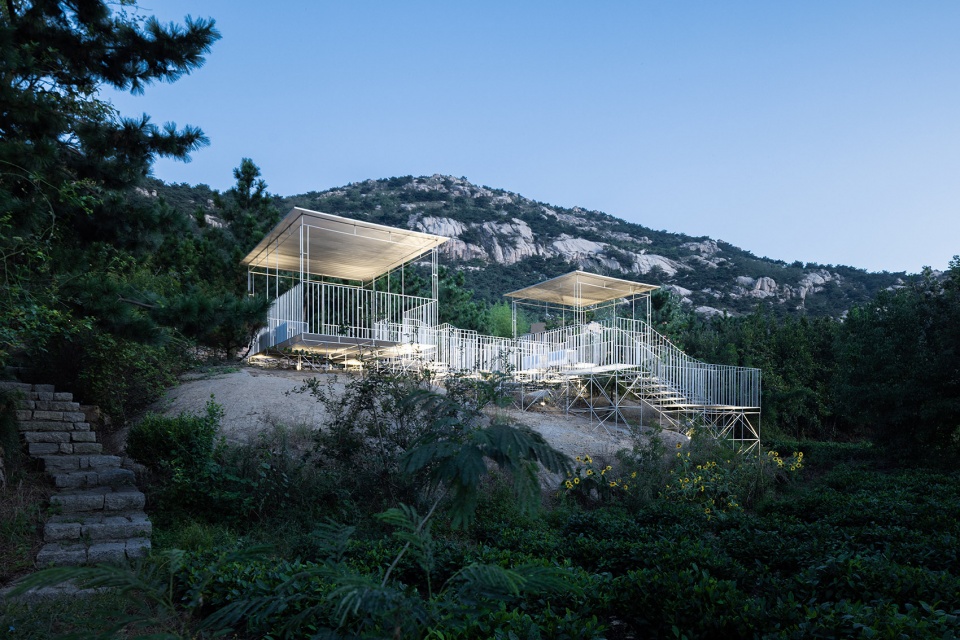
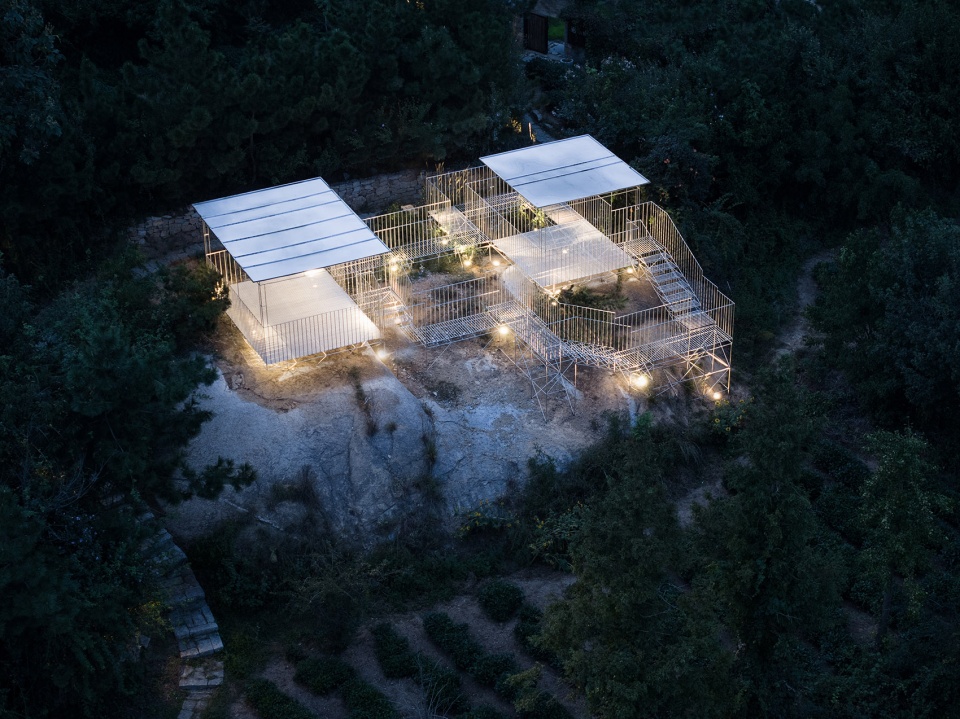
超然台,离此地相去不过百余里,此山为河山,和苏轼赞誉的“奇秀不减雁荡”的五莲山对望,再过去就是他做官之地密州。园子东部的中心,有一块巨石,处在茶园之间,站在巨石上,可以看周边的山色,宛如苏轼的超然台,于此台加一处亭子,名之超然亭,岂不有趣?钢筋在岩石上生根,亭子飘于其上,岩石有两处凸起,便在这两处做亭,用回转的廊道把这两处亭子连接,廊道也顺应地势高差,既有跌宕起伏,又有峰回路转。夜幕下,环境遁入黑暗,亭子亮起,一袭银白飘浮于岩石之上。
Chaoran Terrace, only a hundred miles away from this place, this mountain is Heshan, and Su Shi praised “the wondrous beauty is not less than Yandang” Wulian Mountain, and then the past is the place where he was an official, Mizhou. The center of the eastern part of the garden, there is a huge rock, in between the tea garden, standing on the rock, you can see the surrounding mountains, like Su Shi’s Chao Ran Terrace, in this Terrace plus a pavilion, the name of the Chao Ran Pavilion, is not it interesting? Reinforcement bars rooted in the rock, the pavilion floats on it, the rock has two bumps, so in these two places to do the pavilion, with the turn of the corridor to the two pavilions connected to the corridor also follow the terrain height difference, both ups and downs, but also the peaks and peaks of the road. At night, the environment disappears into darkness, the pavilion is lit up, a silver white floating above the rocks.
▼钢筋在岩石上生根,亭子飘于其上,reinforcement bars rooted in the rock, the pavilion floats on it ©直译建筑摄影
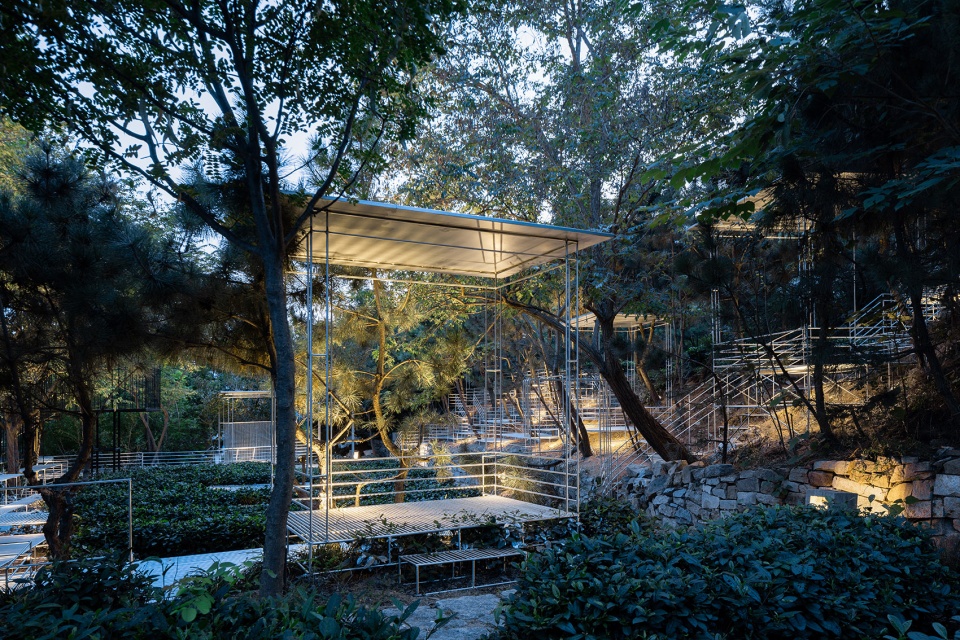
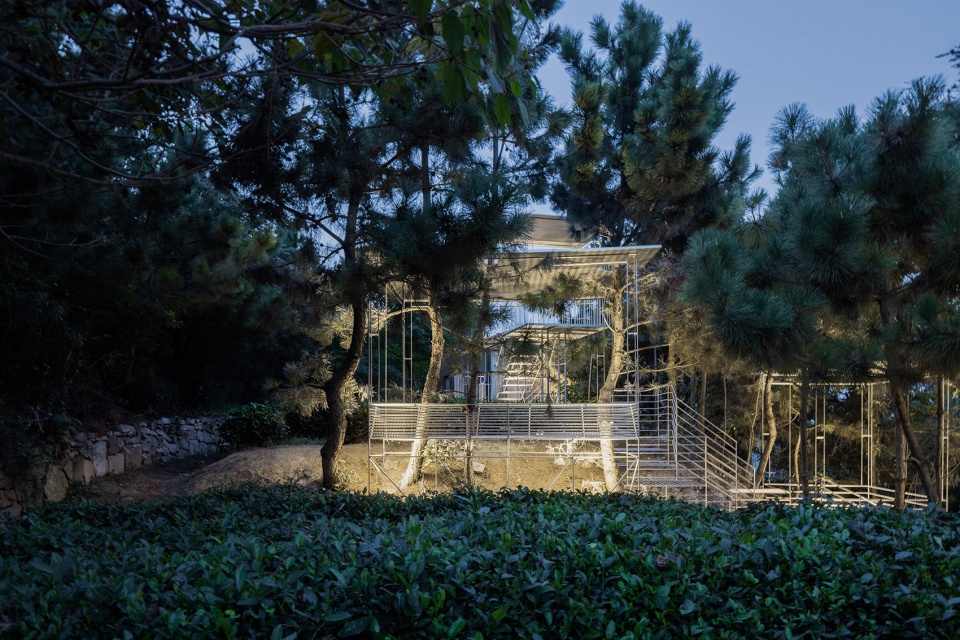
▼回转的廊道将两处亭子连接,the two pavilions connected to the corridor ©直译建筑摄影
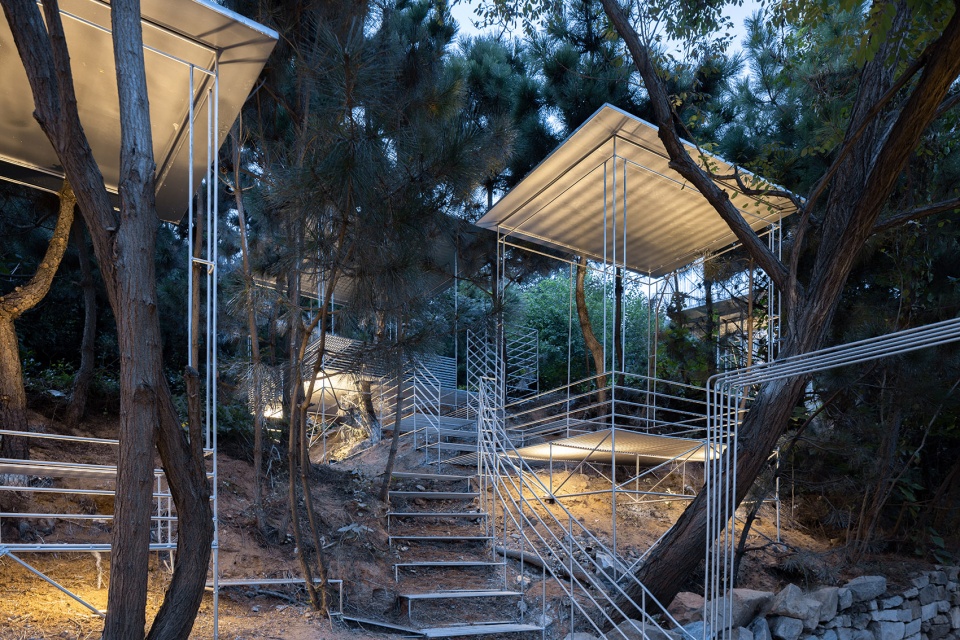
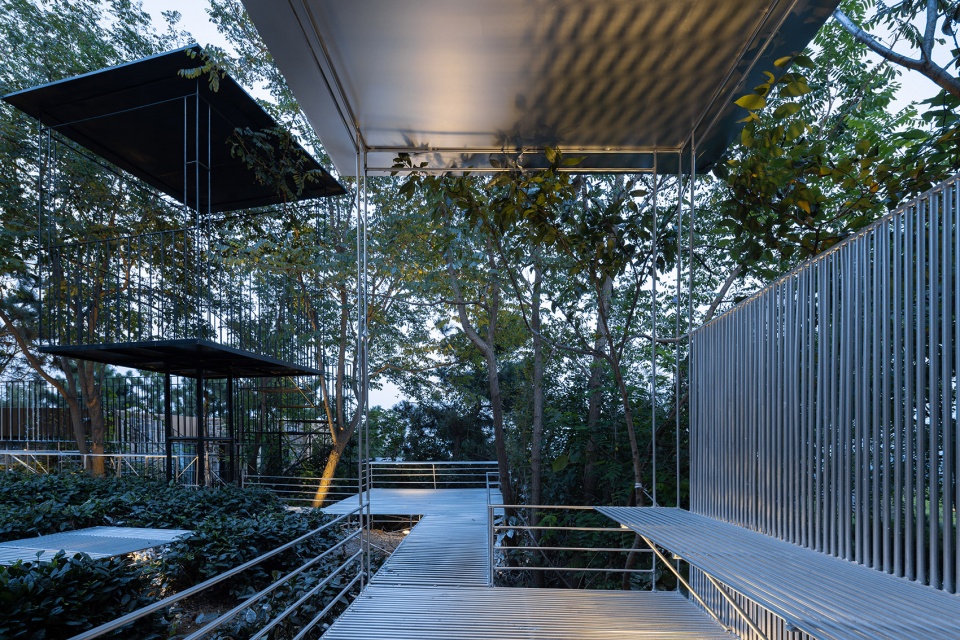
▼亭子亮起,一袭银白飘浮于岩石之上,the pavilion is lit up, a silver white floating above the rocks ©直译建筑摄影
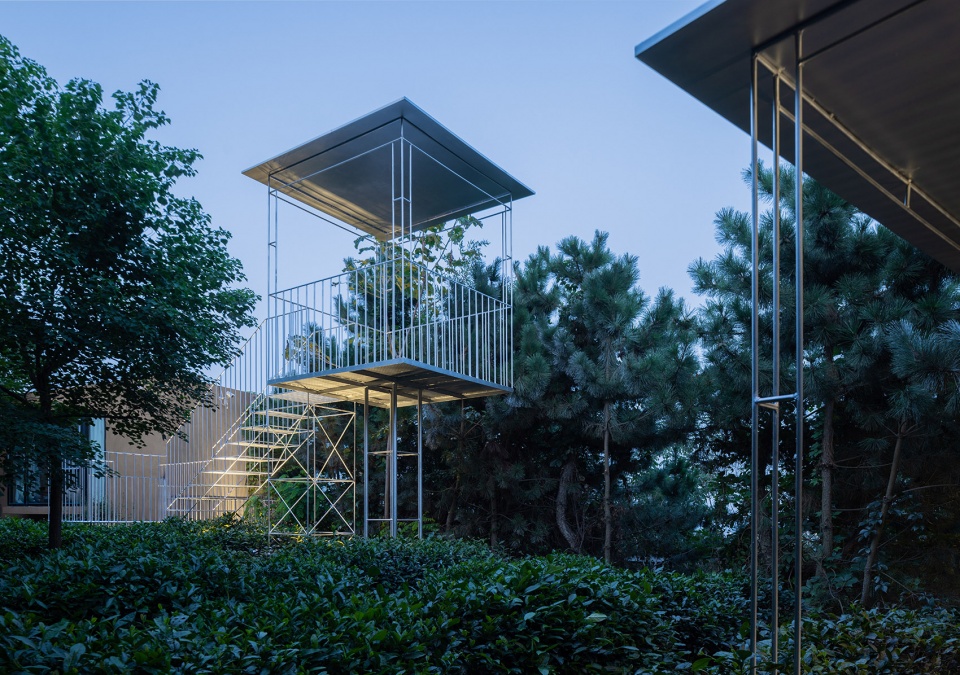
▼茶园之间的景观节点,landscape pavilions in the tea field ©直译建筑摄影
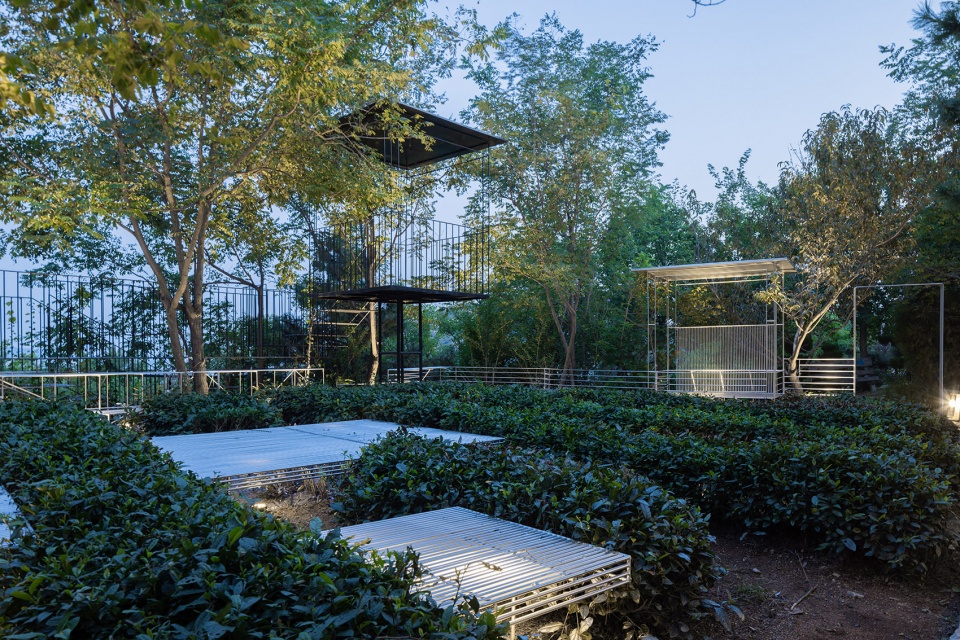
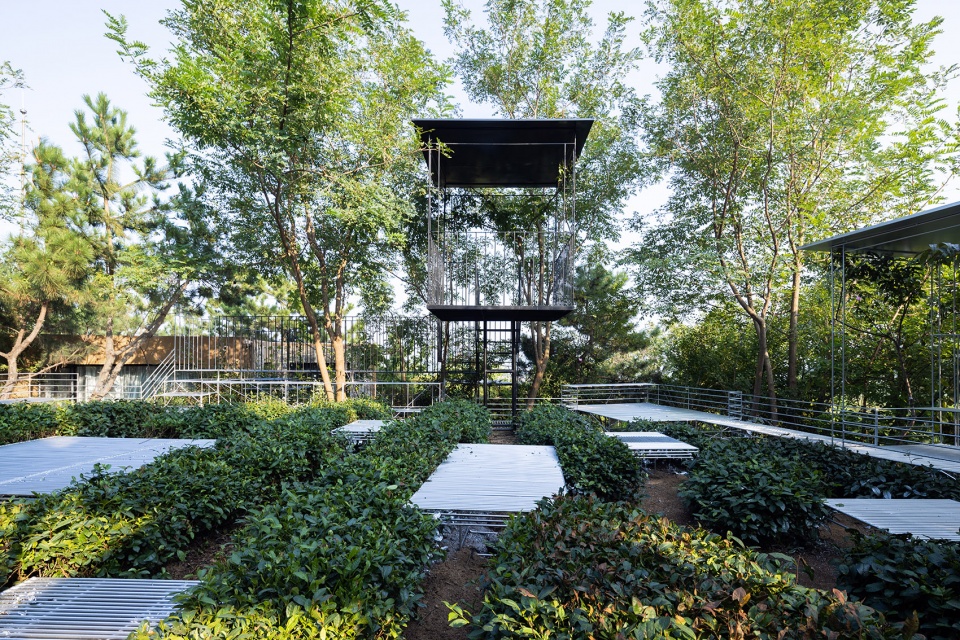
▼装置细部,details of the structure ©直译建筑摄影
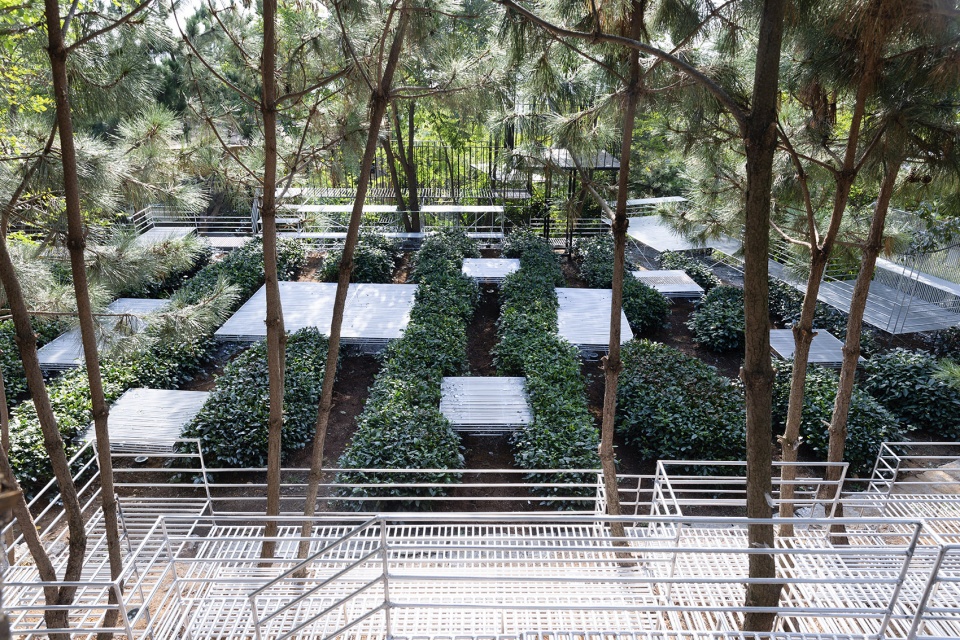
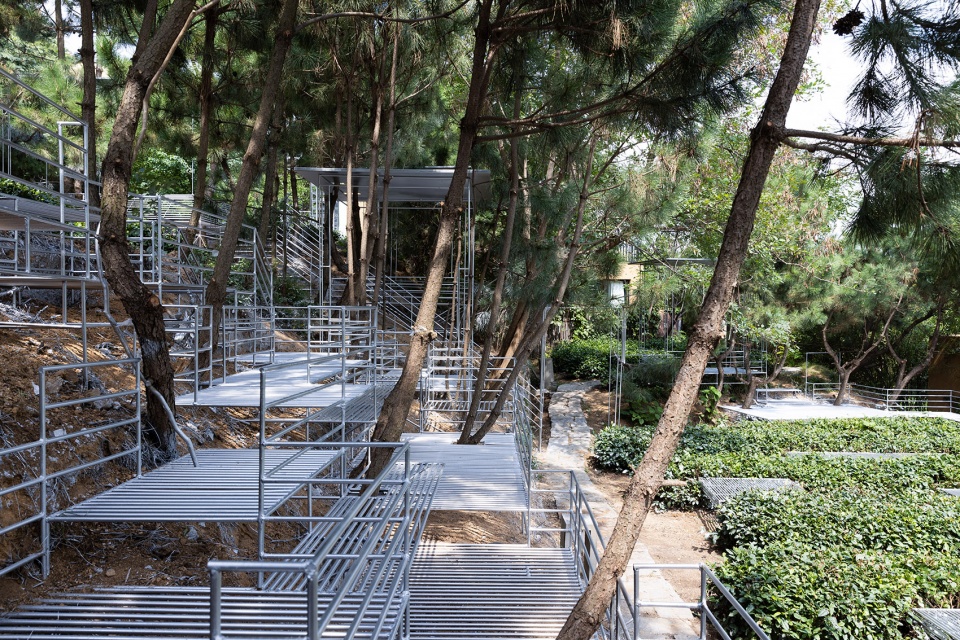
▼材料细部,details of the rebar ©直译建筑摄影
逍遥阁
Pavilion of Prosperity
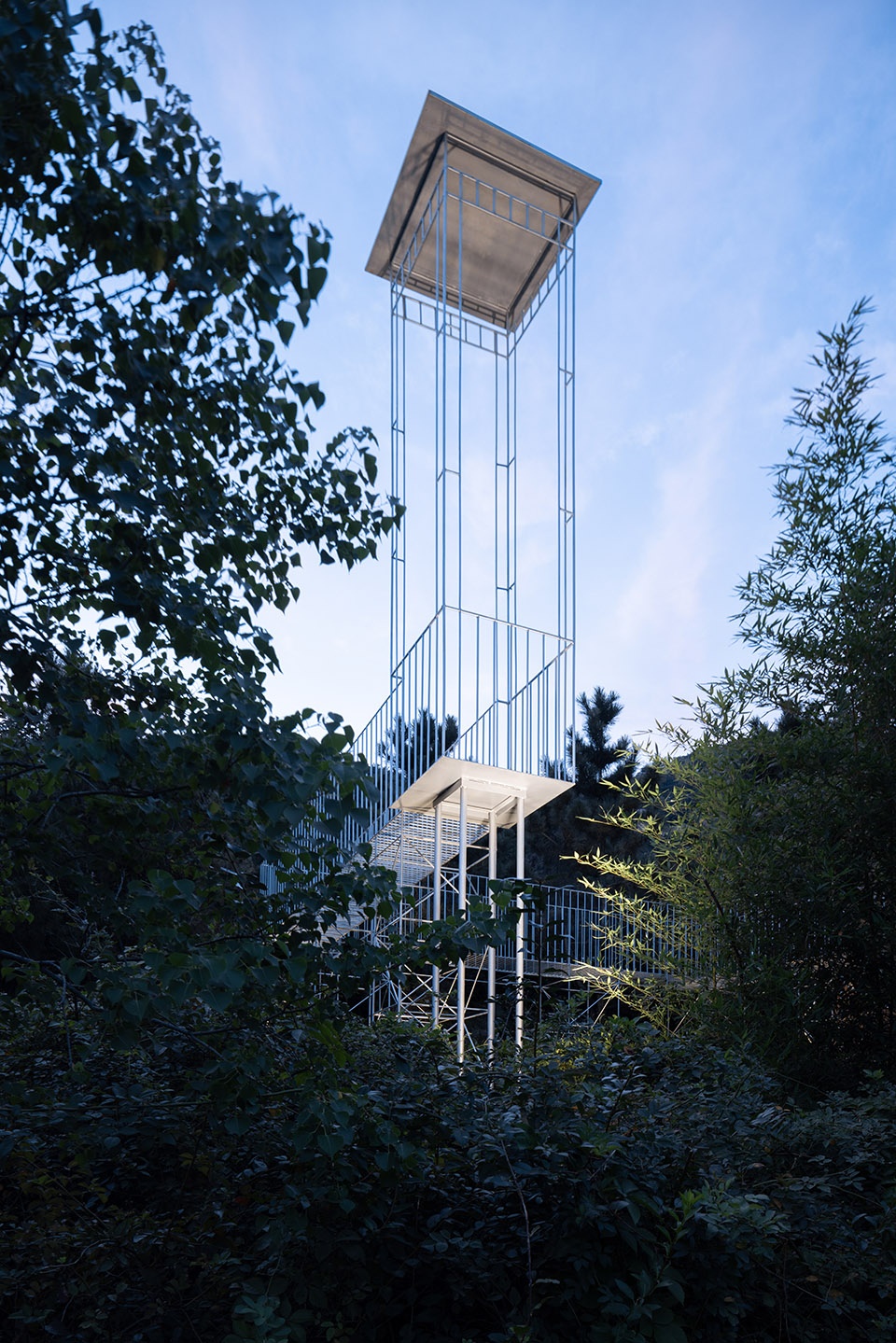
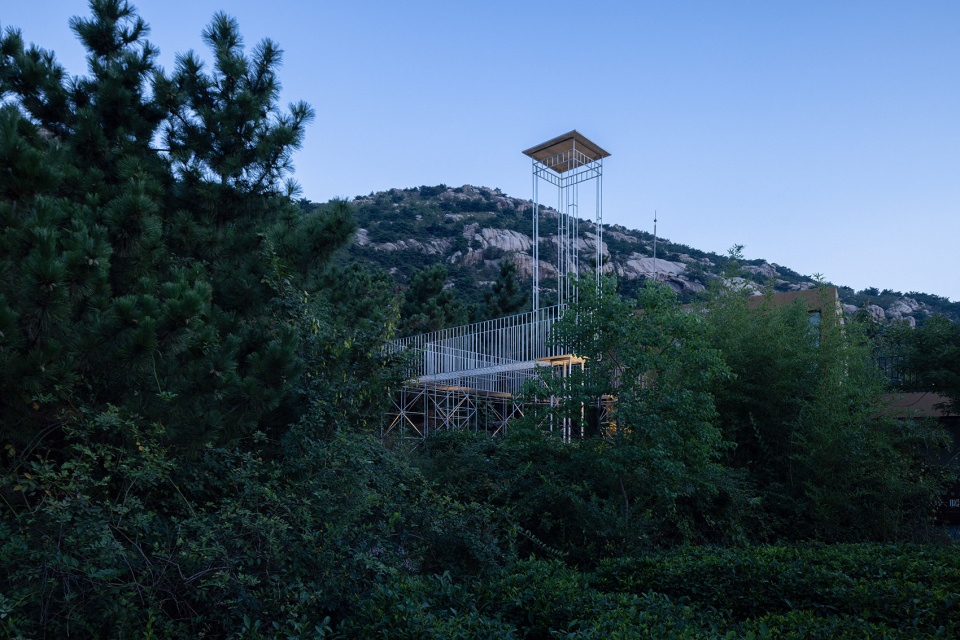
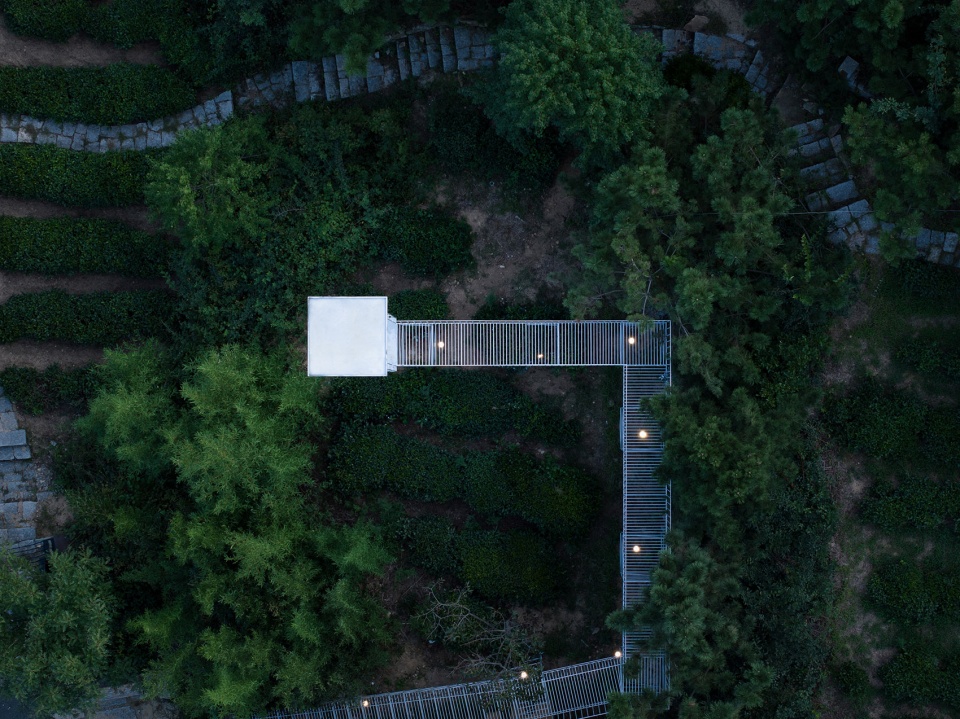
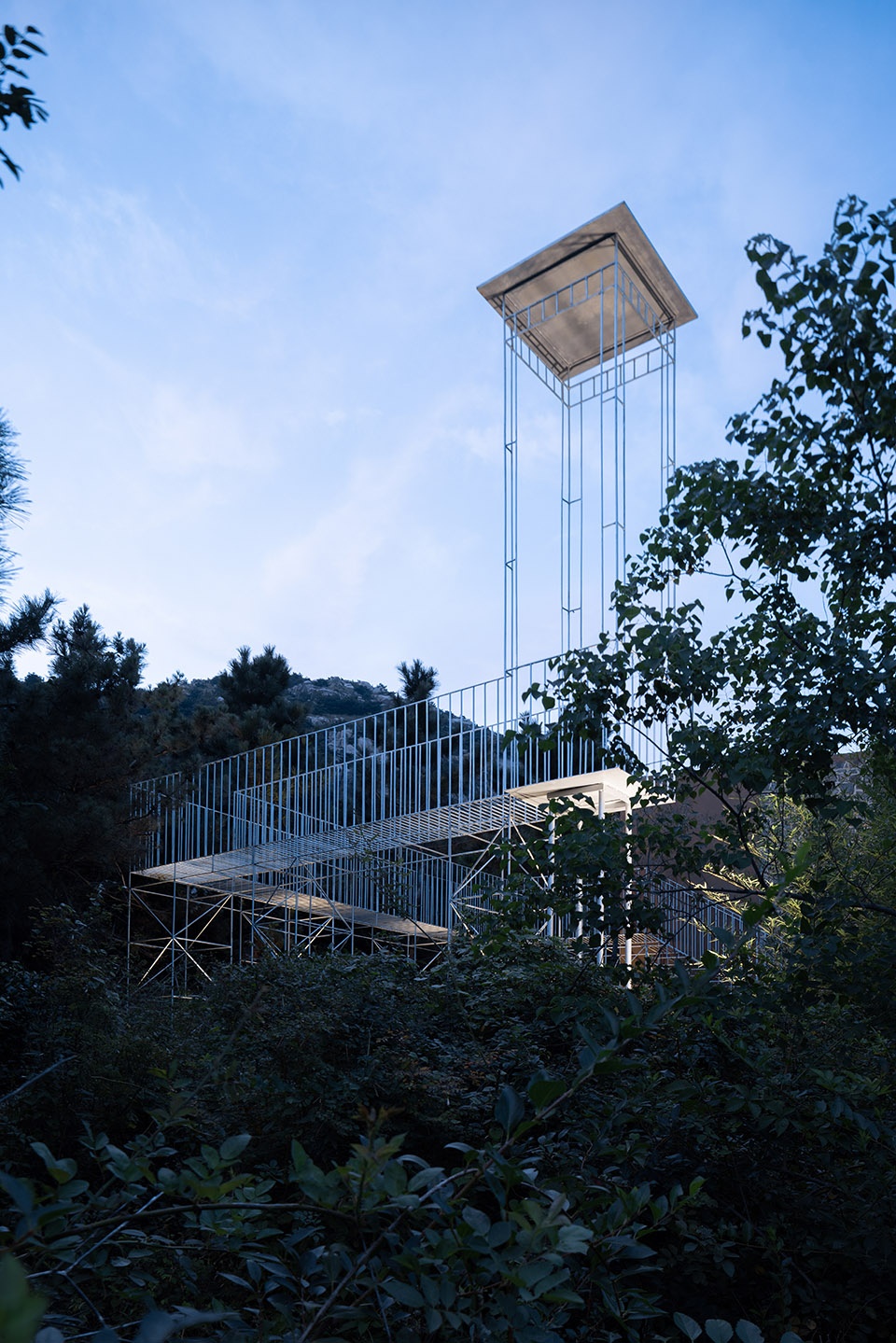
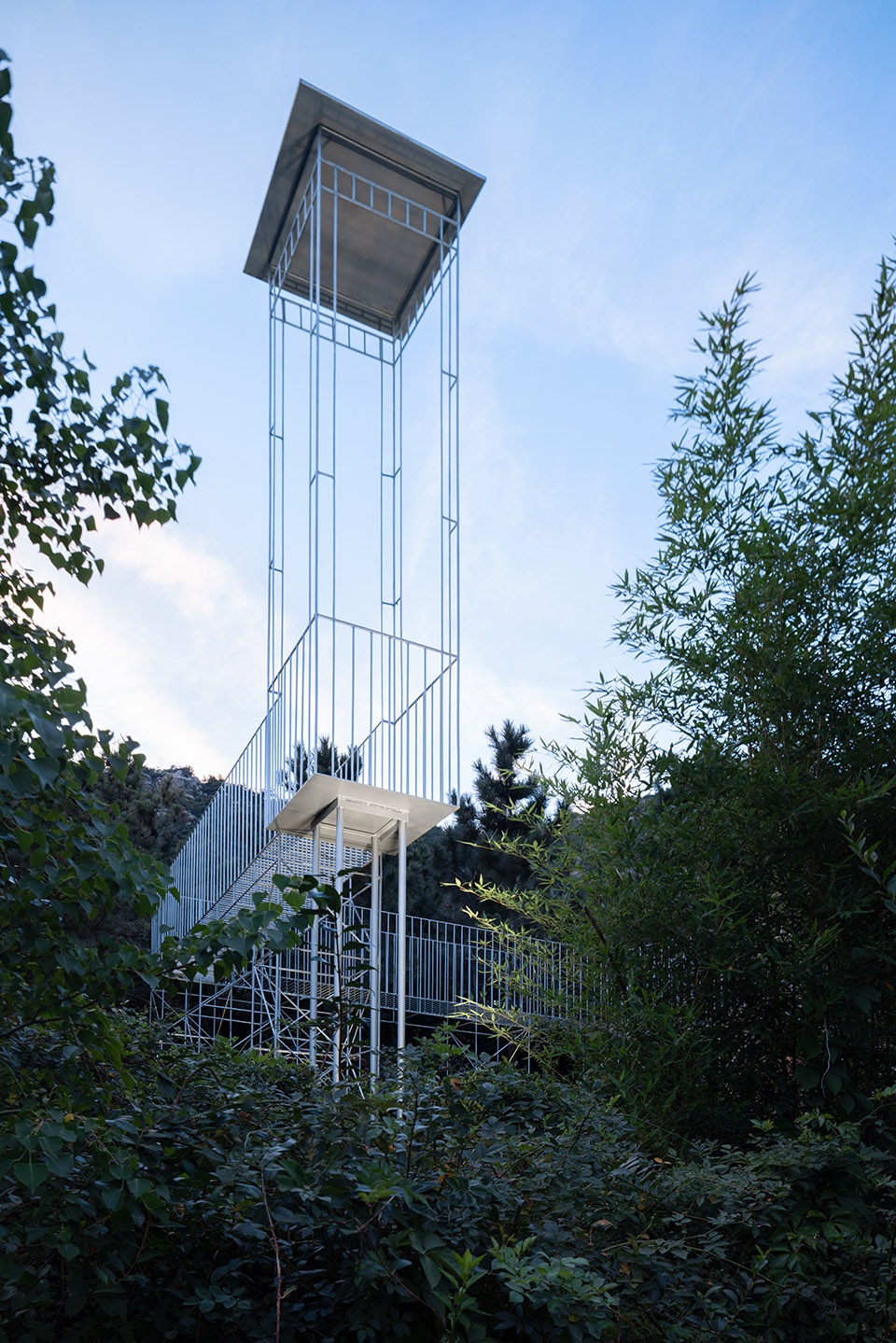
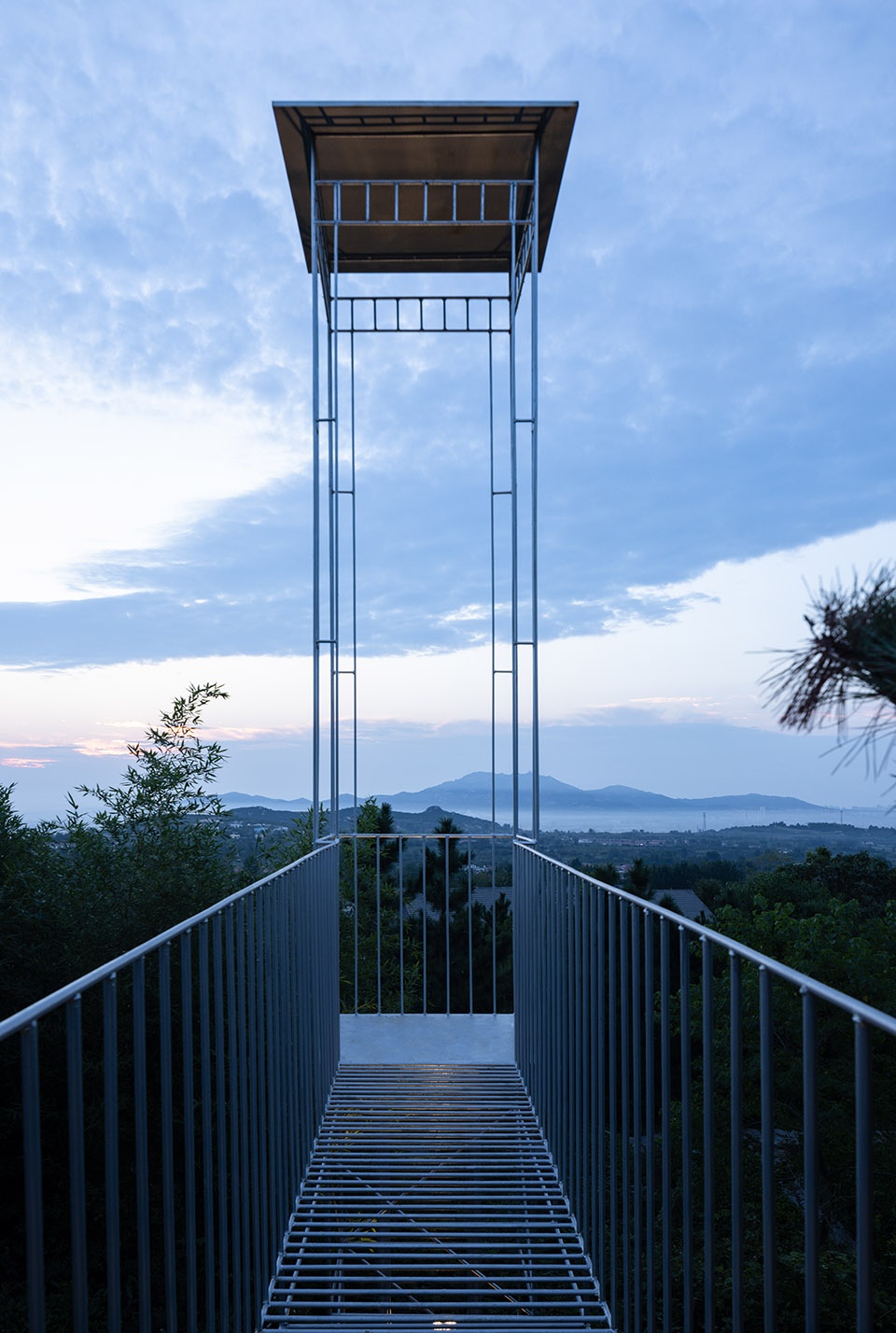
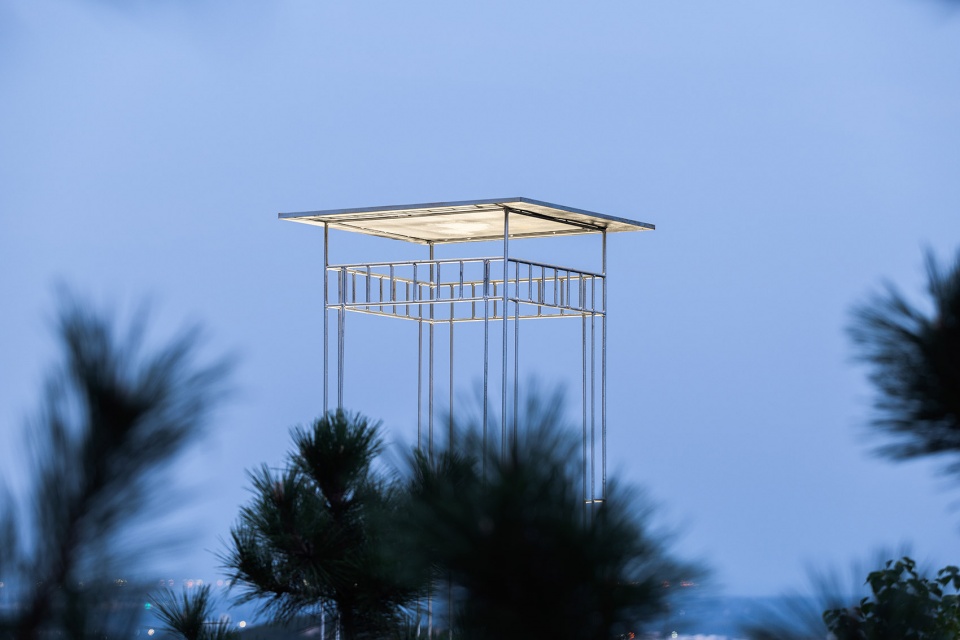
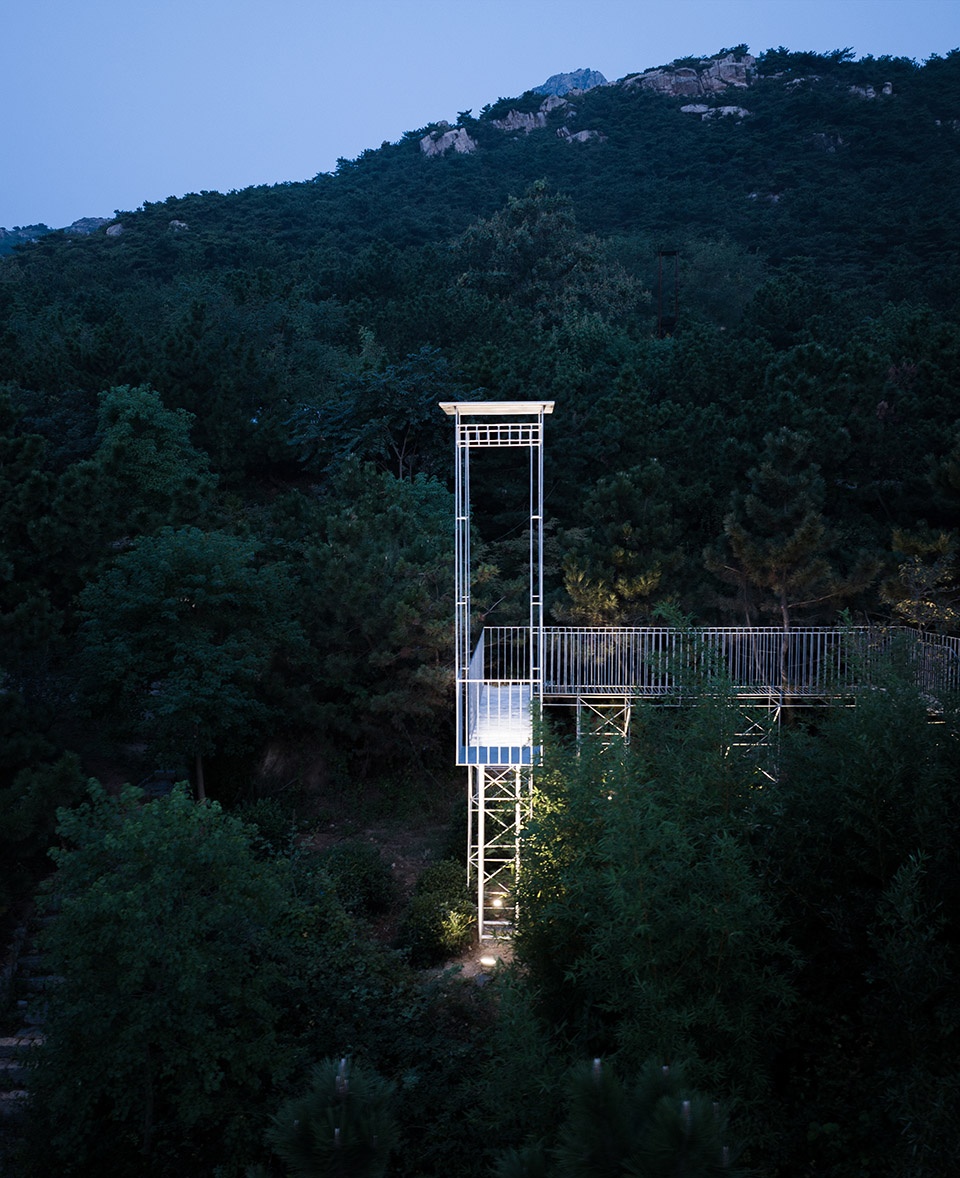
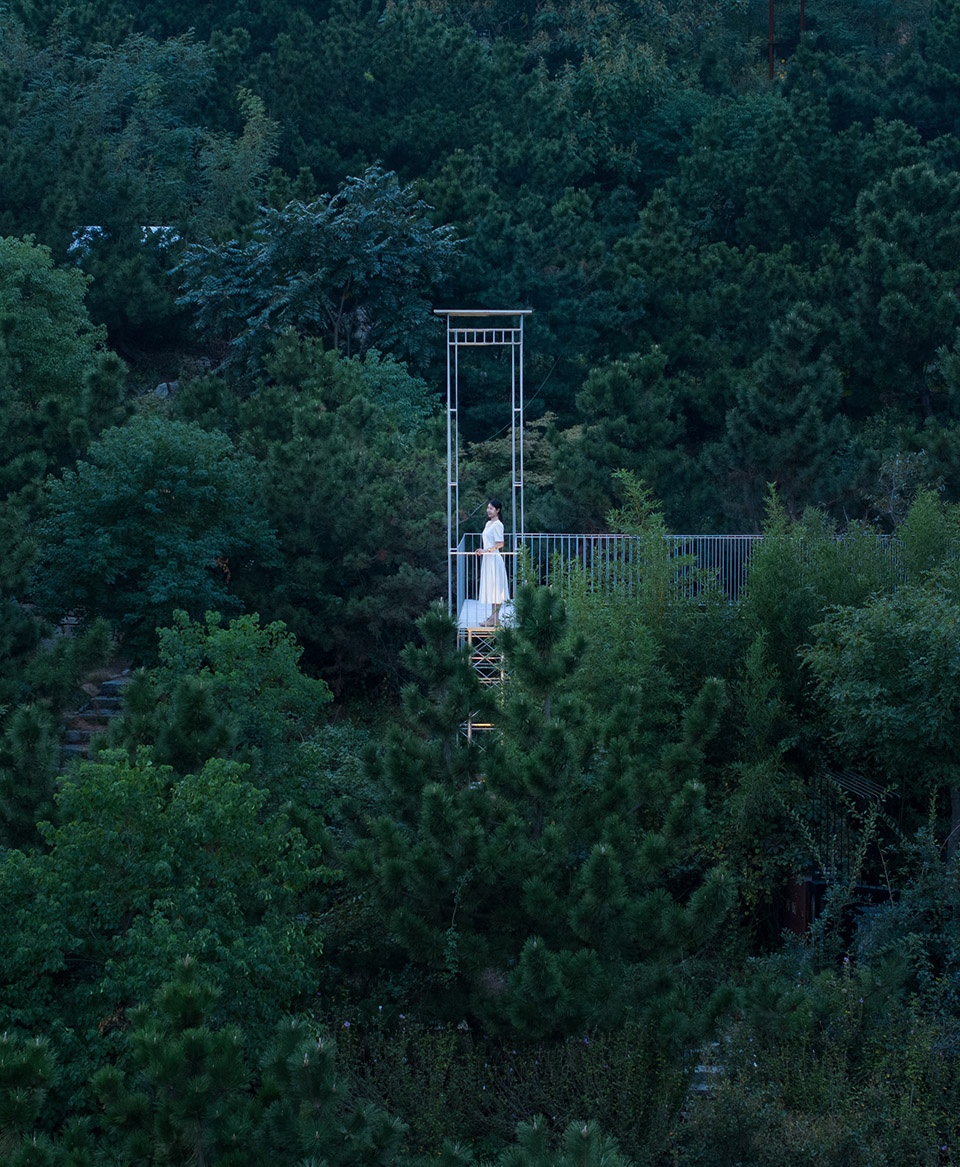
庄子的《逍遥游》,渗透着自由,有着超乎世俗之境界,“鹏之徙于南冥也,水击三千里,抟扶摇而上者九万里,去以六月息者也。”鹏御风而行,洒脱无比,逍遥游是隐逸哲学的精准表达,如何化以物象呢?一者高,二者远,三者轻。传统园林中的“阁”恰可表达高远之趣,阁为架空之小楼房,四周设栏杆回廊,供远眺、游憩、藏书和供佛之用,又成为架空的栈道。简约的钢筋来表现“阁”,栈道仅一人游走,《庄子·在宥》:“出入六合, 游乎九州, 独往独来, 是谓独有。独有之人, 是之谓至贵。”,独往是《隐逸传》中最高的思想境界。楼阁也用最少的线条来实现。一个在空中转折的栈道连接着一个高阁,飘在天空之中,也时常消隐于山林的云雾当中。
Zhuang Zi’s “Easy Travel”, permeated with freedom, with a realm beyond the world, “the roc’s migration in the South Hades also, the water strikes three thousand miles, Tuan Fuyao up to ninety thousand miles, to go to the June rest also.” Peng wind, free and easy, free travel is the precise expression of the philosophy of seclusion, how to materialize it? One high, two far, three light. Traditional garden in the “pavilion” can express the interest of the high and distant, the pavilion for the elevated small building, surrounded by balustrades and corridors, for the distant view, leisure, books and Buddha, and become an elevated trestle. Simple steel to show the “pavilion”, trestle only one person walking, “Zhuangzi – in the Yu”: “in and out of the six, traveled to the nine states, alone to come alone, is said to be unique. The person who is unique is the most noble.” The “solitary” is the highest state of mind in the “Hidden and Beautiful Biographies”. The pavilion is also realized with minimal lines. A trestle that twists and turns in the air connects a high pavilion that floats in the sky and often fades into the clouds of the mountains and forests.
▼远观逍遥阁,viewing the Pavilion of Prosperity at distance ©直译建筑摄影
▼逍遥阁顶视图,top view of the Pavilion of Prosperity ©直译建筑摄影
▼逍遥阁,Pavilion of Prosperity ©直译建筑摄影
▼栈道,walkway ©直译建筑摄影
尊重自然和最少介入
Respect nature and minimal intervention
中国古人有着和自然深度相处的超能力,自然既是寄情与审美的对象,同时也是栖居之所。思想游园,将尊重自然作为第一要义,对自然实现最少介入,做到最小干扰,纤细的钢筋几乎在不破坏一棵树的情况下,实现了承载身体的构筑。人们游走其间,与自然实现最亲密的接触。
Ancient Chinese people had the superpower of getting along with nature in depth, and nature was both an object of affection and aesthetics, as well as a place to live in. The Garden of Ideas, respecting nature as the first priority, realizes the least intervention in nature and the least interference, and the slender steel bars almost realize the construction of carrying body without destroying a single tree. People walk around and realize the most intimate contact with nature.
▼超然亭夜景鸟瞰,aerial night view of the Pavilion of Transcendence ©直译建筑摄影
▼物外剧场夜景鸟瞰,aerial night view of the Theater of Things ©直译建筑摄影
▼超然亭,aerial view of the Pavilion of Transcendence ©直译建筑摄影
在场营造与有机生长Presence creation and organic growth
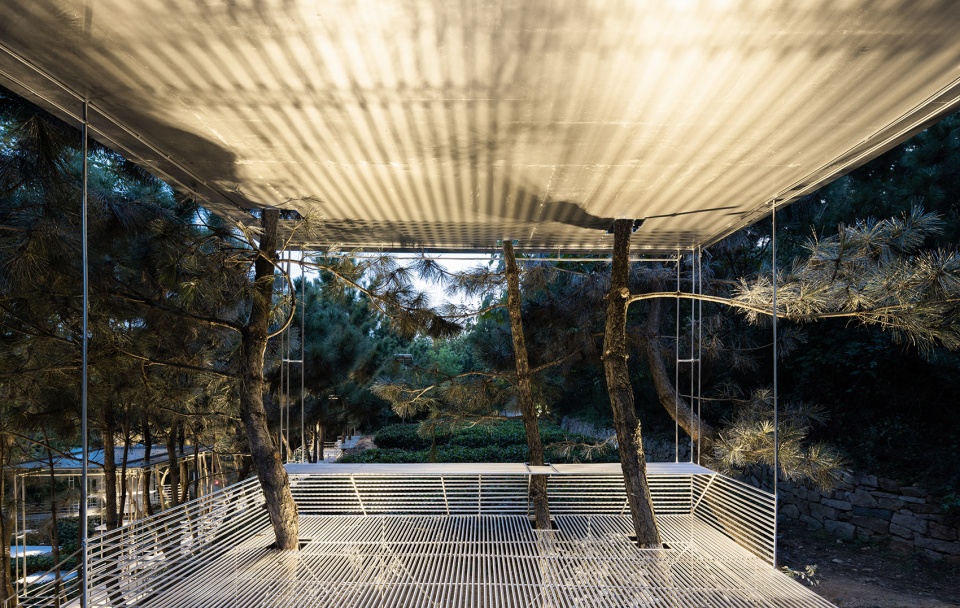
山林中造园,以构筑点缀其间,需要以“在场营造”的方式来实现,难以依赖现成的图纸,接近雕塑家创作的状态。我以少量的草图导引,亲自定点,和工匠通过口述,渐次生发完成。构筑有机生长,如同从一片树林中生出另一片树,身体作为尺子,丈量构筑尺度,避让树枝,包容树木,在一种不能预知结果的过程中,常常产生颇有妙趣的物象。
To create a garden in the mountains and forests, and to embellish it with structures, it is necessary to realize it in a way of “presence creation”, which is difficult to rely on ready-made drawings, and is close to the state of creation of a sculptor. I use a small number of sketches to guide me, and I personally set the points, and the craftsmen and I complete the work through oral narratives, which gradually evolve. The organic growth of the construction is like the birth of another tree from a forest, where the body serves as a ruler to measure the scale of the construction, avoiding the branches and embracing the trees, which often produces interesting objects in a process where the outcome cannot be predicted.
▼构筑物避让树枝,包容树木,the construction avoiding the branches and embracing the trees ©直译建筑摄影
自然淡远的美学风格
Aesthetic style of “natural and distant”
思想游园,试图形成一种“自然淡远”的美学风格。唐代诗人司空图著《二十四诗品》,以其为审美风格来阐释诗歌的境界。思想游园的构筑线条所表现出来的“轻”,正合自然淡远。构筑的建构也映合了二十四品格,在“物外剧场”中,林间看台含蓄而自然,茶间舞台则疏野、旷达;“逍遥阁”,传达了典雅、清奇、洗炼、绮丽与飘逸;而“超然亭”则将劲健、缜密、委曲、旷达、豪放、超诣融为一体。
The idea is to travel to the garden and try to form an aesthetic style that is “natural and distant”. The Tang Dynasty poet Sikongtu wrote Twenty-four Poetry Pieces to explain the realm of poetry in terms of its aesthetic style. The “lightness” of the architectural lines of the Garden of Thought is in line with nature and lightness. The architecture of the garden also reflects the twenty-four qualities. In the “Theater of Things Outside”, the forest terrace is subtle and natural, while the stage in the tea room is sparse and open; the “Loose Pavilion” conveys elegance, purity, refinement, beauty, and ease; and the “Pavilion of Transcendence” is a place where one can enjoy the beauty of the world and the beauty of the world. The “Pavilion of Transcendence” is a combination of robustness, meticulousness, compendiousness, openness, boldness, and superexpansion.
▼自然淡远的美学风格,aesthetic style of “natural and distant” ©直译建筑摄影
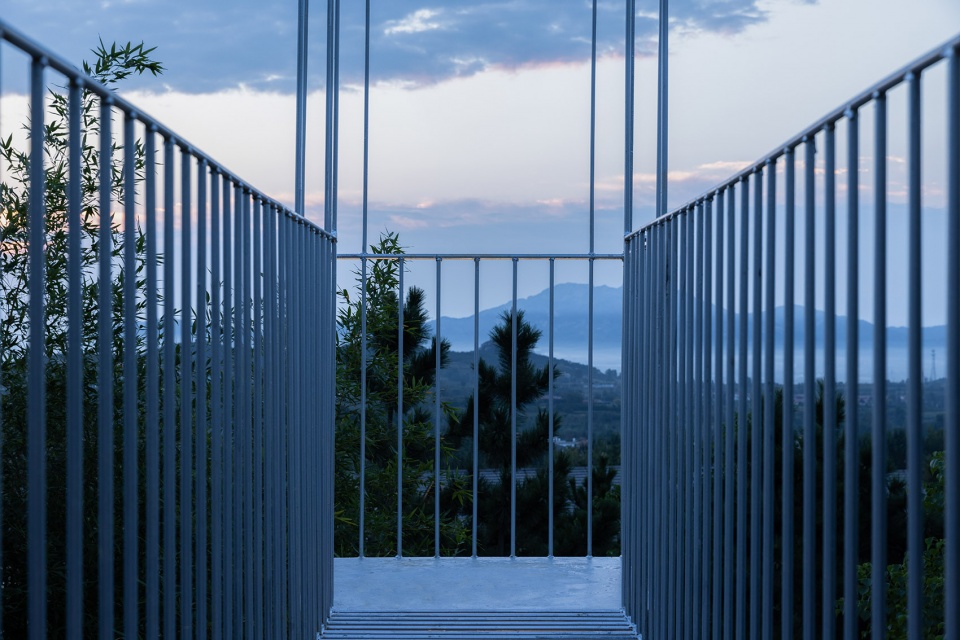
▼构筑线条所表现出来的“轻”,the “lightness” of the architectural lines ©直译建筑摄影
物象与思想
Image and thought
物外剧场,超然亭和逍遥阁,似乎脱离了重力的影响,漂浮在自然之中。游走其间,参与者的身体获得一种超乎寻常的体验,处在真实和虚空之间,或许,游人可以获得些许思想上的感知,物外,逍遥,隐逸,超然。
The Theater of Things, the Pavilion of Transcendence and the Pavilion of Prosperity seem to be free from the influence of gravity, floating in the midst of nature. Wandering through them, the participants’ bodies get a kind of extraordinary experience, between the real and the empty space, perhaps, the visitors can get a little thought perception, outside the thing, free, hidden, transcendental.
▼漂浮在自然之中,floating in the midst of nature ©直译建筑摄影
项目地点:山东省日照市泉山云顶风景区
委托方:山东不负文旅集团
设计施工时间:2023年5月——10月
设计单位:孔祥伟工作室
主持建筑师:孔祥伟
参与者:高灼见、孔雀、崔峻、李国栋
摄影:直译建筑摄影
文字:孔祥伟
Project location:Quanshan cloudy resort,rizhao, Shandong province, china
Client:bufu culture&traveling group
Construction duration:May-Oct 2023
Design company:Kong xiangwei studio
Chief architect:Kong xiangwei
Participation:Gao zhuojian、Kong que、Cui jun、Li guodong
Photographer:Archi-translator
Article:Kong xiangwei
更多:Kong Xiangwei Studio (email: guanzhula@163.com),More:Guanzhu landscape & plandesign institute-Kong Xiangwei Studio on gooood
说实话设计的挺一般,就是个登山铁架子,感觉不大结实、更多的在靠堆积辞藻和观念来强行提高逼格,网红性的东西。
孔老师真是洒脱啊,喜欢直接在现场指导工匠完成作品,无图纸无预构,像轻吟一首诗,淡品一杯茶一样,像文人骚客,不似造园匠师,随意间佳作已成。但是我印象中的大师应该费心竭虑的思考,在图纸与场地间数次徘徊,在脑中与现实行频频交互,作品乃成。看这个作品挺有新意,国内在自然与古人相映的理念下,这样的成品,是我见识浅薄,实属首见。
细观作品,处于民宿茶馆一侧、茂林碧溪之间,寻常人来到此间,早已与自然身心相融。轻松惬意,自在无拘。但是走在森森林间,尤其到了夜幕渐深之时,温暖的灯光,坚实的墙壁才能给人以安心吧。在这三处钢筋上的人,冷风骤吹,寒凉浸骨,林间暗处窸窣,惶然无所依也。可能这就是大自在逍遥之境吧。
文人误事
赞,这篇给我的感觉就像是一边让我品茶感悟人生浮沉,一边给我看恐怖片。。。
怎么,你的逍遥阁也是直接extrude8000吗?
不看文字,一个字不看,单看照片,很赞,甲方也很赞,可以认同这样的材料去自然中落地,效果还是非常好的,且施工工艺也很赞,整体很酷,看文字,看功能,看结合,那就不评论了,很难评。
屎
混沌(是说我自己)。不看文字完全不打眼这堆东西,看完文字之后,喔靠,很有中国文化内涵啊,整个设计有理有据有逻辑,夜景图片好唯美,然后,陷入混沌,如果好的设计要我们这么长篇大论去解释才让人去理解,设计的意义何在?其二,这些是否真如文中所说,就真的只是点在自然山水里边,了解施工的人更明白,实际造出来是怎样的,先破坏后完善,只是自己遮自己的丑,这样说不太恰当,也不是这样因为建设之后再去修缮不可,但我想表达的既然这样做了,为什么把这件事儿说的那么。。。(不知道怎么形容)其三,这些构筑物的实用性在哪呢?我还没get到,只是作为一件艺术品,或者是拍照引流量吗?其四,我承认对一件事物的认知是分层级的,比如我很多时候理解不了大师级设计者的一些想法,这也是我的局限性。
山水画经营之法何在?虽不伤草木,却强奸了整片山林。
这个逍遥阁用来上吊蛮好的!
学生习作?有趣又无用的东西
从环保角度做轻质结构o(* ̄︶ ̄*)o,从设计费角度做一堆轻质结构(*/ω\*)
没有编织落地童话呼应文化,像“故乡的云”、“故乡的月”,导致落地较硬,只有构筑物的感觉。
搭了一堆脚手架子和方框笼子。。。。。。
搞笑
家后山有这么一个设施就好了
结实吗
这年头不管什么材料什么造型山顶搭个棚子就超然物外了,一点没看出地域文化,就别往文化上扯了
夜景不错