非常感谢设计方 Barry X Ball 将项目介绍和项目图片授权gooood发行。更多请至:Barry X Ball on gooood
Appreciation towards Barry X Ball for providing the following description:
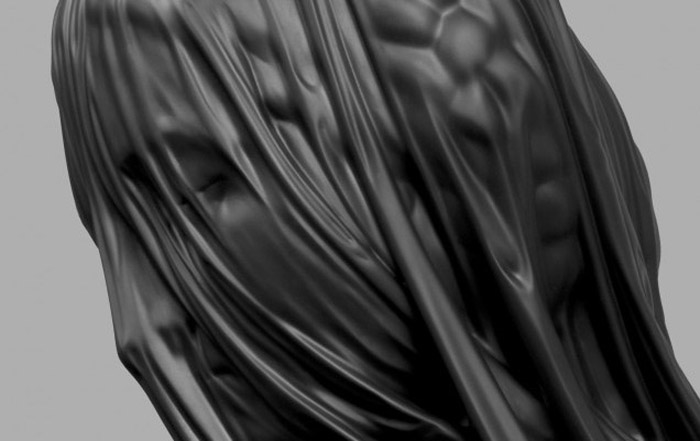
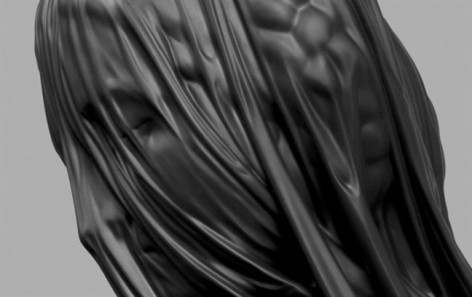
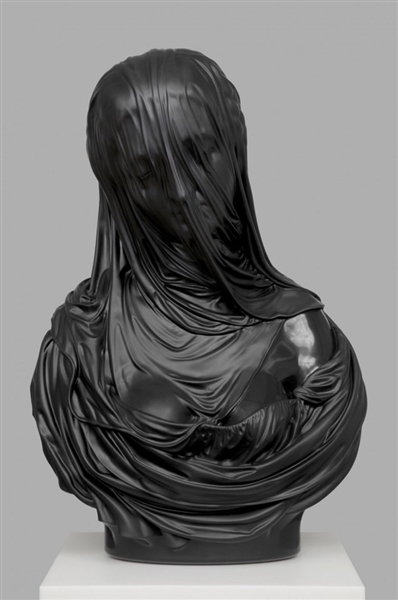
“Purity”这一系列雕塑无疑是艺术家作品的一个巅峰。这系列作品分成多个色系,这里只介绍黑色系。
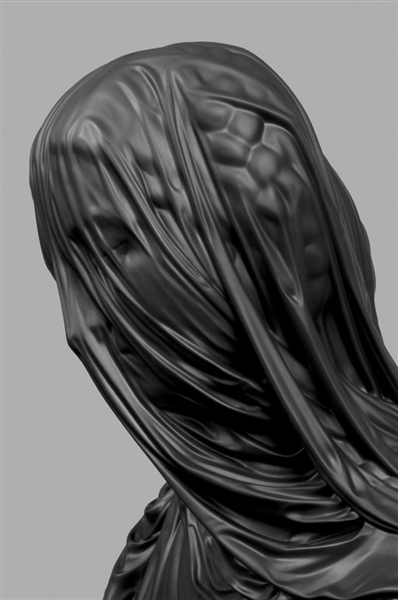
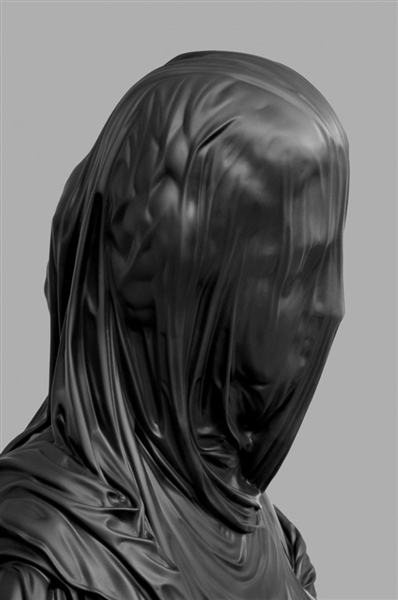
艺术家对待这一系列作品的态度是雕塑艺术品,而不是放在壁龛和墙边的陈设。材料也没有选择传统的白色意大利石,而是采用了一些半透明的玛瑙,方解石等石材。雕塑们普遍带着面纱,在外观的塑造上,更具有流畅的,柔和的动感,人们观看的角度仿佛从镜中看到,增加了陌生感。这些雕塑非常丰满,肉体裸露的地方还被打上了高光,因此面纱下的人物显得有些性感,这是作者为雕塑加入一些感性的平衡感而有意为之。
这些雕塑,优雅,美丽但是又纯洁。艺术家希望突破传统,找到革命性的方法。
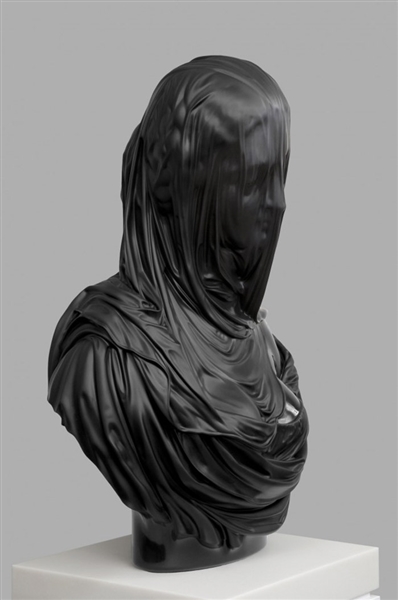
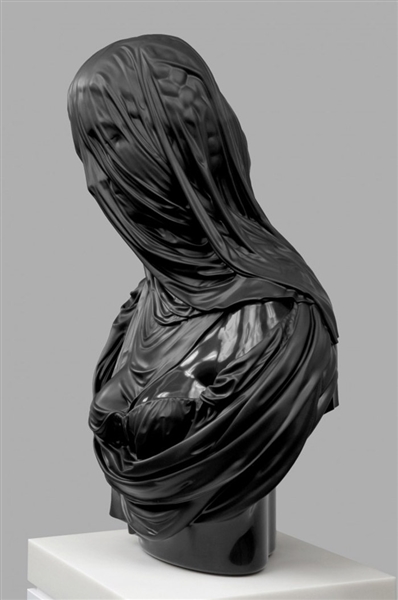
Purity: some differences between these, the first of my Masterpiece sculpture series, and their historical “starting place” antecedent, Antonio Corradini’s La Purità (Dama Velata) in Ca’ Rezzonico, Venice. In general, I have set for myself the difficult task of making new sculptures that are “more perfect” than the “perfect” Corradini, a “Masterpiece” of Baroque sculpture. Here is a partial list of the ways I have gone about attaining that goal:
1. The substantial additions I have affected and the way I have carved/polished my works have made mine true sculptures-in-the-round, not frontal portraits intended for placement in niches or against walls.
2. I have employed non-traditional (for sculpture) stones for my works, not stereotypical white Italian Marble. My translucent stones (e.g. onyx and calcite) render the veil, shawl, and drapery diaphanous. The calcite’s exuberant veination establishes a parallel surface network, one that alternately camouflages and reveals the sculpture’s network of folds and sweeps while adding a dizzying complexity. The more subtle onyx patterning works in a similar, yet less-assertive way. The translucent stones, when carefully lit, appear to glow from within, to have an inner light that radiates outward, that penetrates the veil. This is not possible with opaque marble. Corradini used the material that he was familiar with, the most readily available carving stone in Italy, the one that responded well to traditional hand-carving techniques. Because of my high-tech techniques and my access to and knowledge of worldwide stone sources, I have many more options. I made a concerted attempt to select stones that work with the form to create something rich and new.
3. My sculptures are mirror images of their sources. The mirroring, a feature of many of my portraits, is intentional. It is the view that the subject “sees” in a mirror. This feat is extremely difficult (i.e. near-impossible) to accomplish through traditional means of sculptural reproduction (e.g. “pointing up”). It is possible through my use of advanced technology, and I hope, adds a significant element of strangeness, of unfamiliarity, of newness to my sculptures (especially for those who are familiar with the Corradini).
4. I eliminated the Christian Latin cross from the bodice area of the veil. By so doing, I intend to make the veil more universal. The veil is a widely used head covering ¬Christian, Islamic, Indian, mourning (think Jackie Kennedy at the funeral), etc. The universal veil is especially appropriate for Venice (location of the Corradini source sculpture) because of that city’s role as crossroads of Islam and Christianity. I hope that by removing the cross, I have made the veil one of rich mystery, not just a relic of religious devotion, mourning, penitence, or modesty. The white Iranian Onyx of one version of my sculpture adds yet another layer of meaning and counterpoint to the veil and the enhanced sexuality (see below) of the woman. I purchased the last block of this material available on the world market last year. The Iranian government has requisitioned the entire quarry for the construction of the tomb of Ayatollah Khomeini, that prudish patriarch of the Iranian Revolution.
5. I eliminated the lace border from the veil to freshen its appearance and enhance its smooth, sensual liquidity.
6. My sculptural treatment of the veil and drapery is intentionally softer, more flowing, less sharp than that of the Corradini. In my works, the veil has become more than a covering – it is the form itself. This difference is subtle, but important. The Corradini woman appears to be covered by an improbable, wet-look, relatively crisp pile of cloth. In my sculptures, the body and veil are more unified. It almost appears that the body has departed and left behind a misty, swirling, dematerialized fabric surrogate.
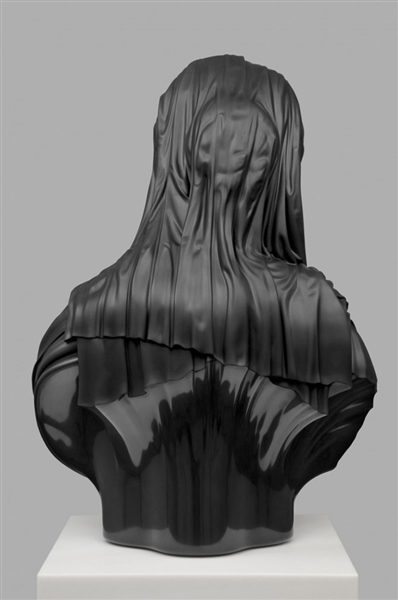
7. I have corrected several of Corradini’s sculptural errors. Corradini not only didn’t finish the bottom, sides, and back of his sculpture, certain passages of his work are confused. In particular, the layers of his drapery sometimes don’t make sense or were not completely resolved. I fixed those problems in my works.
8. I subtly enlarged the breasts. For a sculpture ostensibly with devout “purity” as its subject, the Corradini woman is quite sexy. By my breast enhancement, I have tried to gently tip the pious/sensual balance a bit farther toward the latter.
9. I have polished the small patch of exposed flesh to differentiate it from the matte finish of the cloth. The entire lower back of my sculpture is also mirror-polished. The Corradini has a dull surface finish throughout. I have worked hard to give the cloth passages of my works a fine, ultra-uniform satin finish so that the surface softly “disappears”.
10. The Baroque-era Corradini has suffered damage in some areas over time. Its carved surface also has several rough, chipped, unfinished passages. This could be because Corradini didn’t feel the need to finish those areas, because he didn’t have sufficient time to complete the work, or because those sections have been subject to abrasion. My sculptures are completely finished and damage-free. I have treated backs, sides, fronts, and tops with equal fastidiousness. The bottom of my work is also scrupulously finished, and I have permanently affixed a custom stainless steel insert and ABS base plate to ensure display/transport safety. Corradini’s sculpture lacks these accommodations. The Corradini is very much in need of cleaning -it is absolutely filthy!
11. My pedestals are fitting accompaniments to the sculptures. The Corradini is displayed in a corner at Ca’ Rezzonico on an unfortunate, too-large, too-dark wood base, to which it is crudely attached. My pedestals are refined, multi-part, carefully¬designed-and-constructed ensembles that I believe present my sculptures far more elegantly. They permit my works to be seen from all sides. They are beautiful pieces of furniture, but they don’t interfere with the ‘Purity’ of the sculptures.
I hope this list answers your sincere inquiry about my intentions and adequately addresses the subject of “originality”. I want my works to induce questions, not dictate answers. While almost forcing a type of refined viewing, of connoisseurship, the sculptures should seduce. Ultimately, the analytical approach I have employed in the creation of these pieces doesn’t feel all that different from the one I have used to make my portraits. Yet it is undeniable that the net result is quite new.
There is a long tradition of artists making works “after” the works of their forebears. Although utilizing an unprecedented, advanced, complex technological armamentarium, I am, in a way, working in that great tradition. I don’t think, however, that my project owes much to “appropriation” and the contemporary artists whose works have been labeled as such. Fueled by love, I’m reaching way back to a time centuries before the Modernist Revolution, searching for a way to make something equally revolutionary.
Purity
2008 – 2010
sculpture: Belgian Black Marble, stainless steel pedestal: Macedonian
Marble, stainless steel, wood, acrylic lacquer, steel, nylon, plastic
sculpture: 24 x 16-1/2 x 11-1/4 inches (61 x 41.9 x 28.6 centimeters)
pedestal: 45 x 14 x 12 inches (114.3 x 35.6 x 30.5 centimeters)
after Antonio Corradini
La Purità
1720 – 1725 Ca’ Rezzonico, Venice
MORE: Barry X Ball,更多请至:Barry X Ball on gooood








有种黑巧克力的感觉~