非常感谢设计方 Karina Smigla Bobinski 将项目介绍和项目图片授权gooood发行。更多请至:Karina Smigla Bobinski on gooood
Appreciation towards Karina Smigla Bobinski for providing the following description:
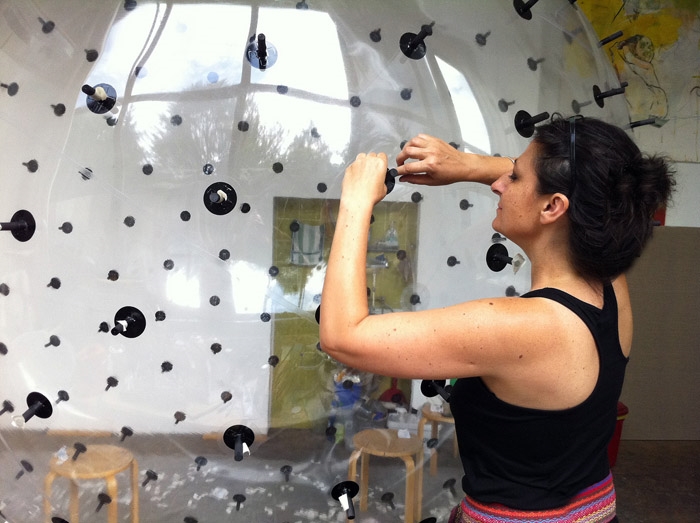
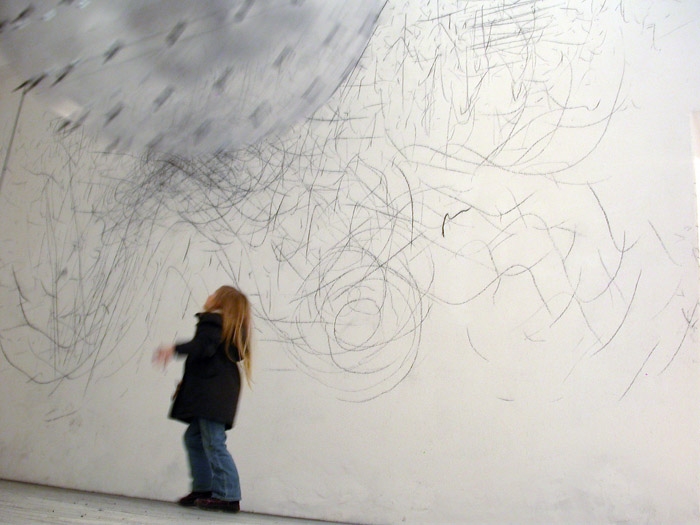
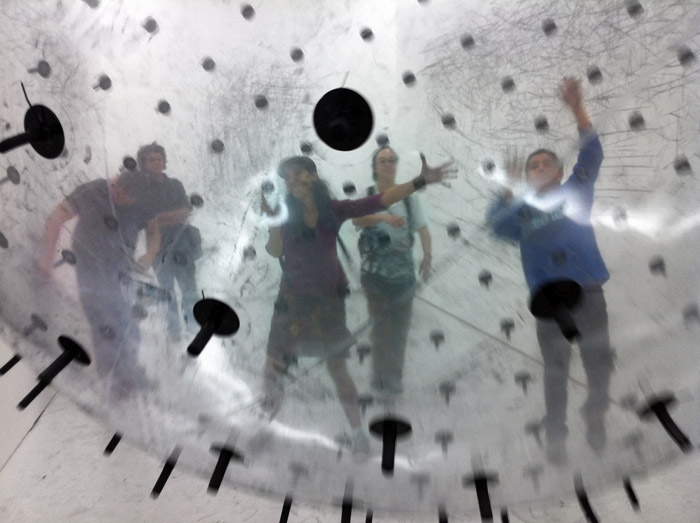
While I work, I think about everything I’ve observed in Sao Paulo. Ada seems to respond to some kind of human instinct. In ancient times people left their hand marks on cave walls. I often had to think about it, when I saw people handling the balloon in this “cave”. Constantly visitors fell in some kind of a trance while trying to control Ada in such a way, that the would leave their intended marks.
But Ada is constructed as to have her own will. She does not follow “programs” or commands of people, once you set her into motion she just works away. The blacker she gets from the charcoal and the more she is handled by visitors, the more she seems to be some kind of alive. Even I, who built her, sometimes gets the illusion of her being a living thing. It is great to have the feeling of having created a piece of art that is autonomous. The feeling is enhanced by the peoples reaction to it. Sometimes people forget that they are in a gallery and that Ada is balloon, that can be damaged or destructed, and get a little bit too rough.
We had to get a guard for the festival who would look out for such roughians and trying to avoid too long lines in front of her. But amongst the thousands of visitors there were some in Germany that didn’t even dare to enter the room were Ada was still rotating after someone left her. Maybe the scruples were too big as it might seem like a big organism. But this might only be a first reaction. After working with her many describe her a post industrial creature, a molecular hybrid, such as a one from nano biotechnology, in the sense of Ada Lovelace a machine that is able to create works of art and saves the memories.
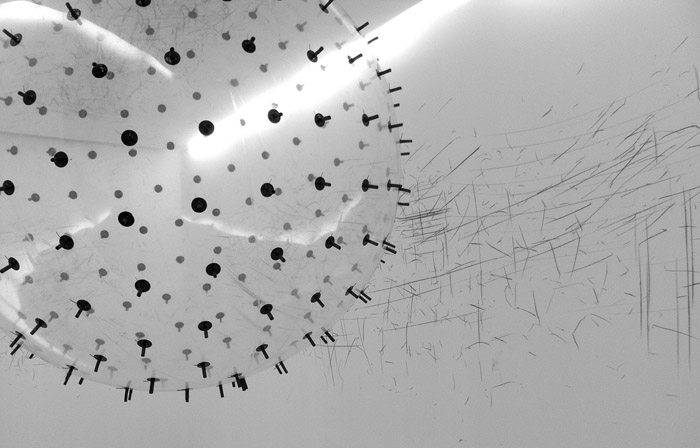
“ADA uprose in nowadays spirit of biotechnology. She is a vital performance-machine, and her paterns of lines and points, get more and more complex as the number of the audience playing-in encreases. Leaving traces which neither the artist nor visitors are able to decipher, not to mention «ADA» herself either. And still, «ADA’s» work is unmistakable potentially humane, because the only available decoding method for these signs and drawings , is the association which our brain corresponds at the most when it sleeps: the truculent jazziness of our dreams.” “Similiar to Tinguely’s «Méta-Matics», is “ADA” an artwork with a soul. It acts itself. At Tinguely’s it is sufficient to be an unwearily struggling mechanical being. He took it wryly: the machine produces nothing but its industrial self-destruction. Whereas «ADA» by Karina Smigla-Bobinski, is a post-industrial “creature”, visitor animated, creatively acting artist-sculpture, self-forming artwork, resembling a molecular hybrid, such as a one from nano biotechnology. It developes the same rotating silicon-carbon-hybrids, midget tools, miniature machines able to generate simple structures.
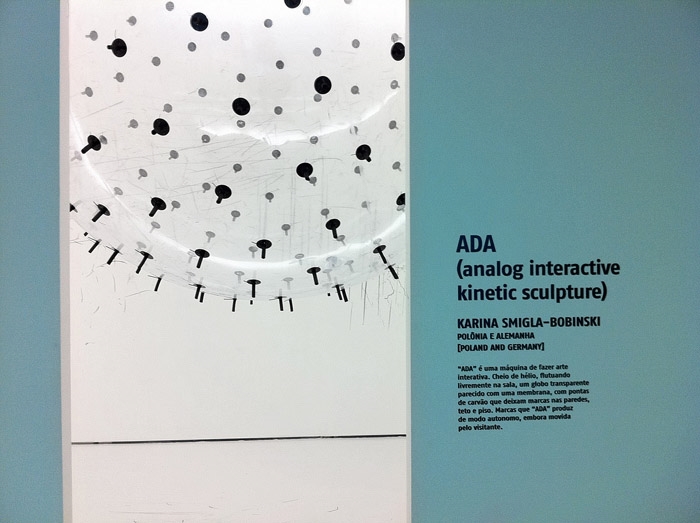
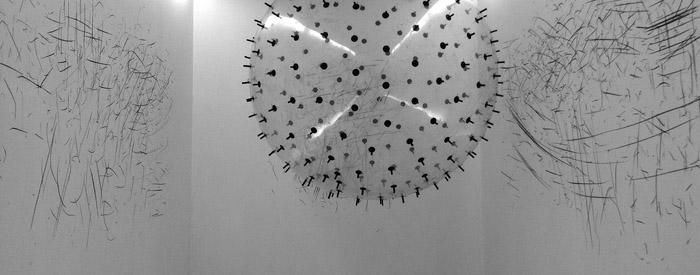
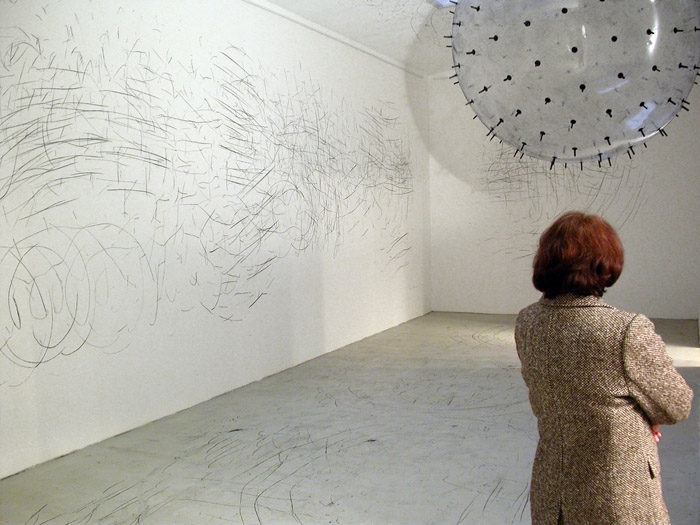
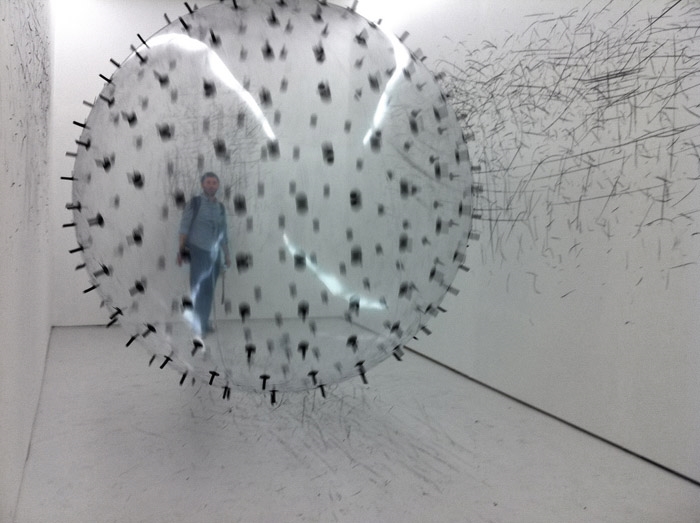
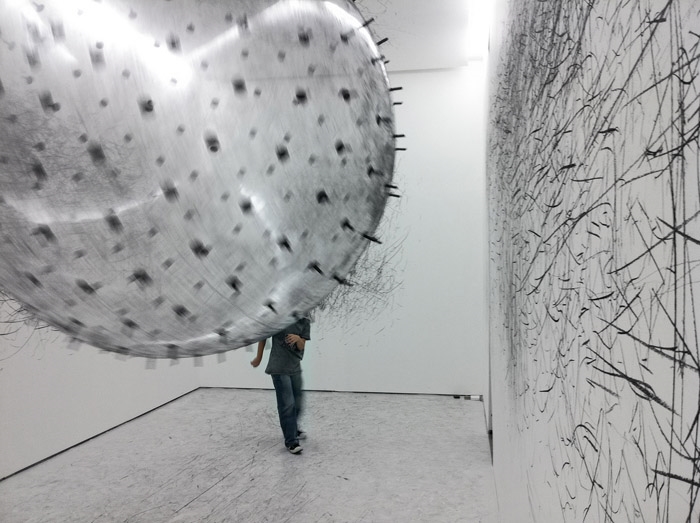
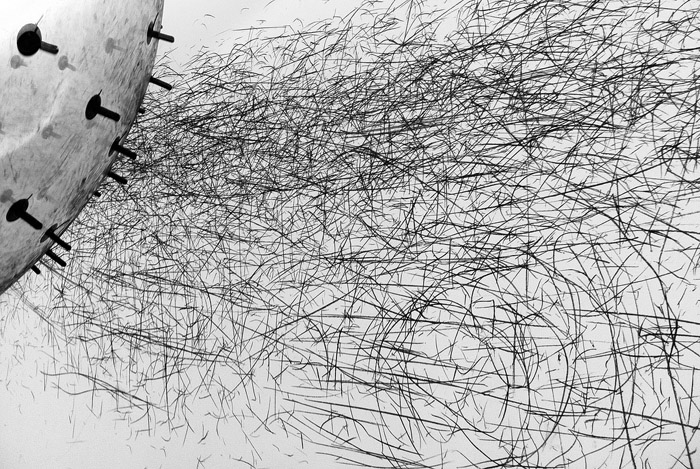
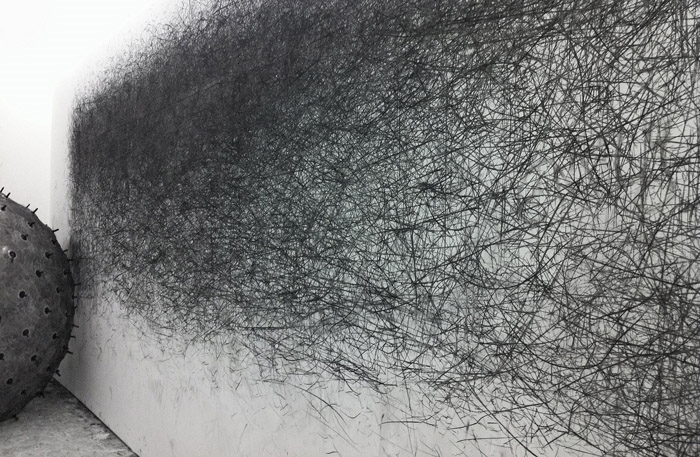
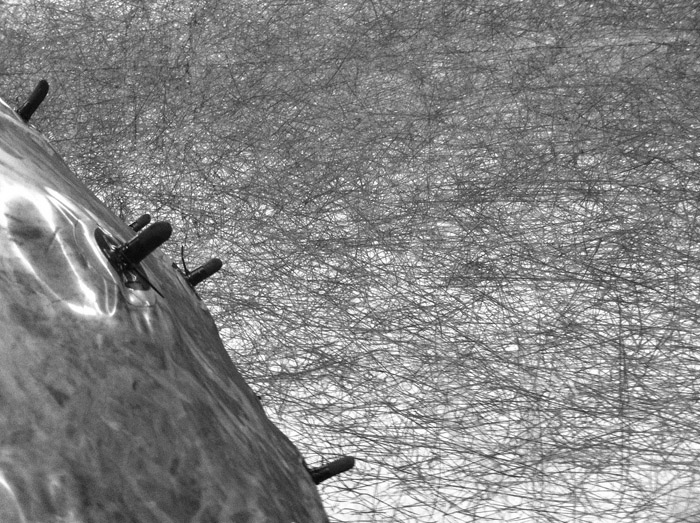
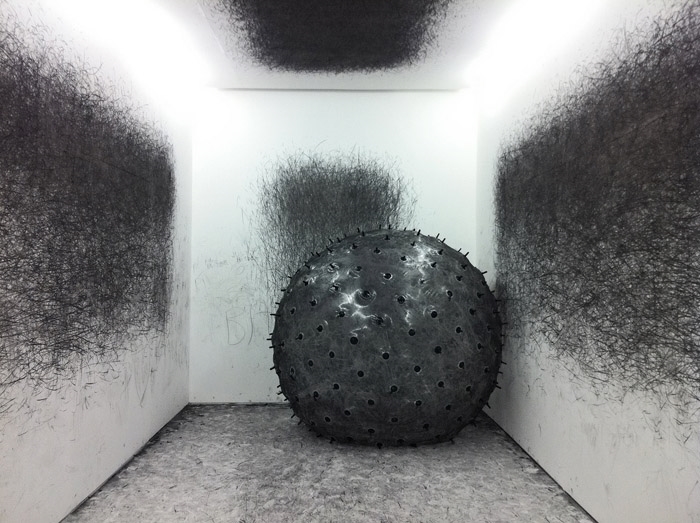
«ADA» is much larger, esthetical much complexer, an interactive art-making machine. Filled up with helium, floating freely in room, atransparent, membrane-like globe, spiked with charcoals that leave marks on the walls, ceilings and floors. Marks which «ADA» produces quite autonomously, athough moved by a visitor. The globe obtains aura of liveliness and its black coal traces, the appearance of being a drawing . The globe put in action, fabricate a composition of lines and points, which remains incalculable in their intensity, expression, form however hard the visitor tries to control «ADA», to drive her, to domesticate her. Whatever he tries out, he would notice very soon, that «ADA» is an independent performer, studding the originaly white walls with drawings and signs. More and more complicated fabric structure arise. It is a movement exprienced visually, which like a computer make an unforeseeable output after entering a command. Not in vain « ADA» reminds of Ada Lovelace, who in 19th century together with Charles Babbage developed the very first prototype of a computer. Babbage provided the preliminary computing machine, Lovelace the first software. A symbiosis of mathematics with the romantic legacy of her father Lord Byron emmerged there.
Ada Lovelace intended to create a machine that would be able to create works of art, such as poetry, music, or pictures, like an artist does. «ADA» by Karina Smigla-Bobinski stands in this very tradition, as well as in the one of Vannevar Bush, who build a Memex Maschine (Memory Index) in 1930 (“We wanted the memex to behave like the intricate web of trails carried by the cells of the brain”), or the Jacquard’s loom, that in order to weave flowers and leaves needed a punch card; or the “analytic machine” of Babbage which extracted algorithmic paterns. ” (© Arnd Wesemann, 2010)
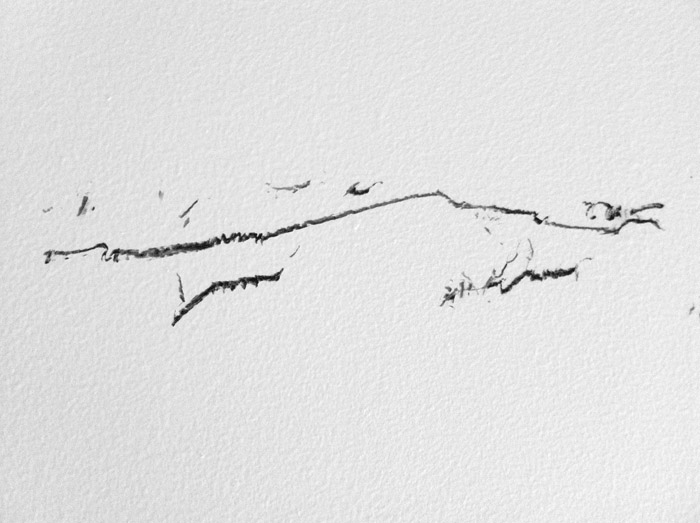
-The question is, what here is exactly the work of art: ADA? … or the drawing on the wall? … Or both?
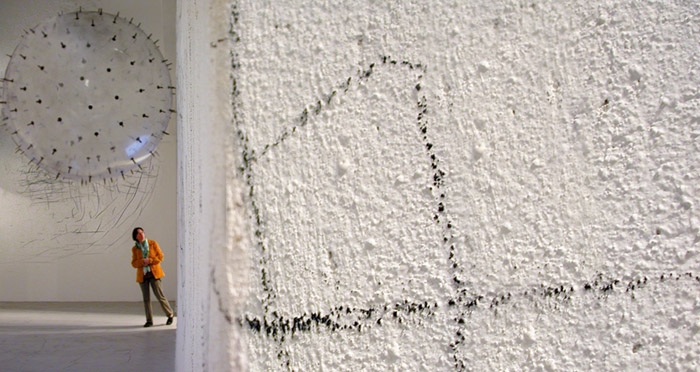
Ada is appr. 2,5m in diametre, the exhibition halls and therefore the scatching on the walls were 14 x 4 x 4 m in Munich, 8 x 4 x 4 m in Sao Paulo and 5 x 5 x 4 m in Bello Horizonte. The work is temporal, just as Tinguelys Meta-Matics or the Nano Silicon-Carbon-Hybrids. The interesting thing about its way of working is, that the artist, the visitor and the ball itself have an influence on the outcome, e.g. the scatchings on the walls.
– What was the inspiration for the piece? How long did it take to make?
I had first idea about some years ago, i have many ideas but no time to follow them all through immediately so I write them down into an idea sketchbook. Sometimes they have to mature, sometimes it is me that has to develope, some ideas only wait for a room to be set free.. And sometimes it is all of those things. In the case of Ada it was both the space and my fascination with flying balloon objects that catapulted the idea out of the loop.
I was able to gain Lars Schubert (www.hochhinaus.de) as my sponsor for an earlier project and after that it developed into a fruitful cooperation. He offered technical support and know-how at the same time I was able to work freely on my ideas. His corporation became my second art studio.
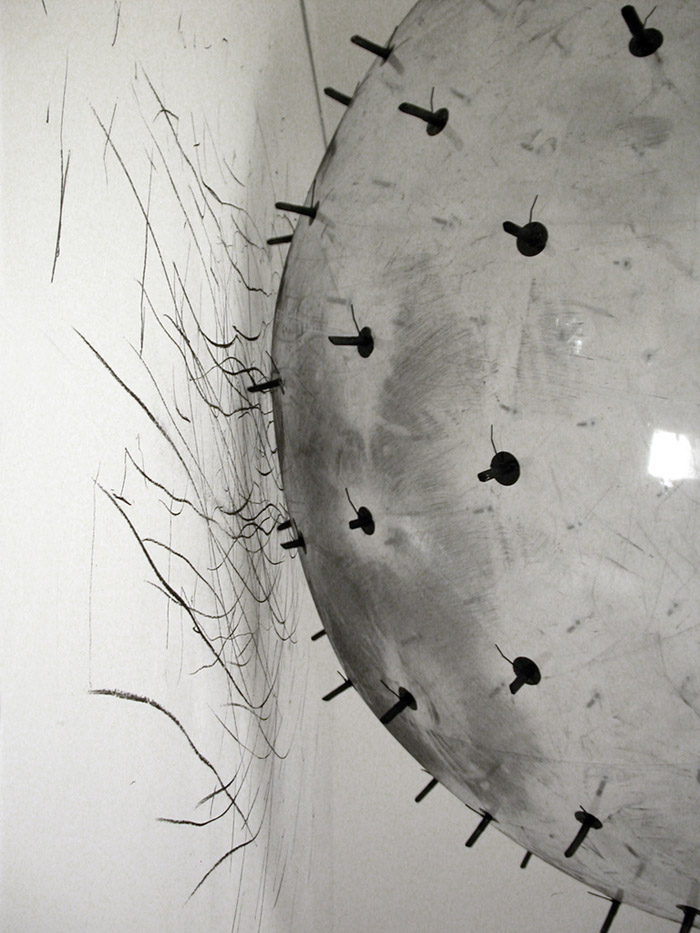
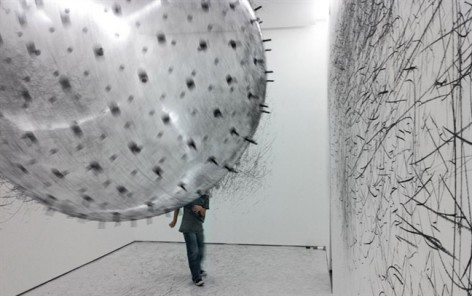
这个氦气填充的透明球体上安装着很多的黑炭,当人们推动这个球体使之与墙壁发生碰撞,球体外的黑炭将在墙上留下黑色的炭迹。
艺术家本人看到人们在这个“白色洞穴”中与这个球体发生互动时,认为这个艺术装置似乎回应了人类的本能,就像远古时代人们离开洞穴时的留下的那些画一样。但是在这个球有自己的意愿,就像是活物般。人们在里面进行非百分百控制的互动体验。许多人徘徊在展区门口迟迟不进入,因为这个球体看起来就像是一个大的有机体。
有评论认为就这当这个球体在人力的驱动下,在白色的墙壁和天花上留下越来越多的交织线条时,这成为一个独立的表演。更多信息请参考上方英文。
MORE: Karina Smigla Bobinski,更多请至:Karina Smigla Bobinski on gooood









污水池里的河豚