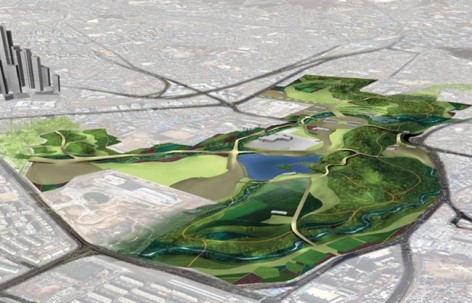
“A park of this size would be excellent under any circumstances, but Seoul is starved for green space so a healthy, green park of that magnitude is particularly desirable. The perfection of the ordinary. It has attributes that only a really large park can have, such as providing a regional link for wildlife.”
—2011 Professional Awards Jury“这种尺度的公园在任何条件下都是出色的,但是首尔及其渴望绿色空间,因此一个健康的巨大绿色的公园是迫切急需的。完善的日常公园,拥有真正的大型公园才有的属性,比如为野生动物提供生态廊道。”
—2011专业奖评审委员会
By UnitedLAB, Seoul, South Korea and Isaac Brown Ecology Studio, Los Angeles 更多请至:UnitedLAB, Seoul, South Korea on gooood, Isaac Brown Ecology Studio on gooood
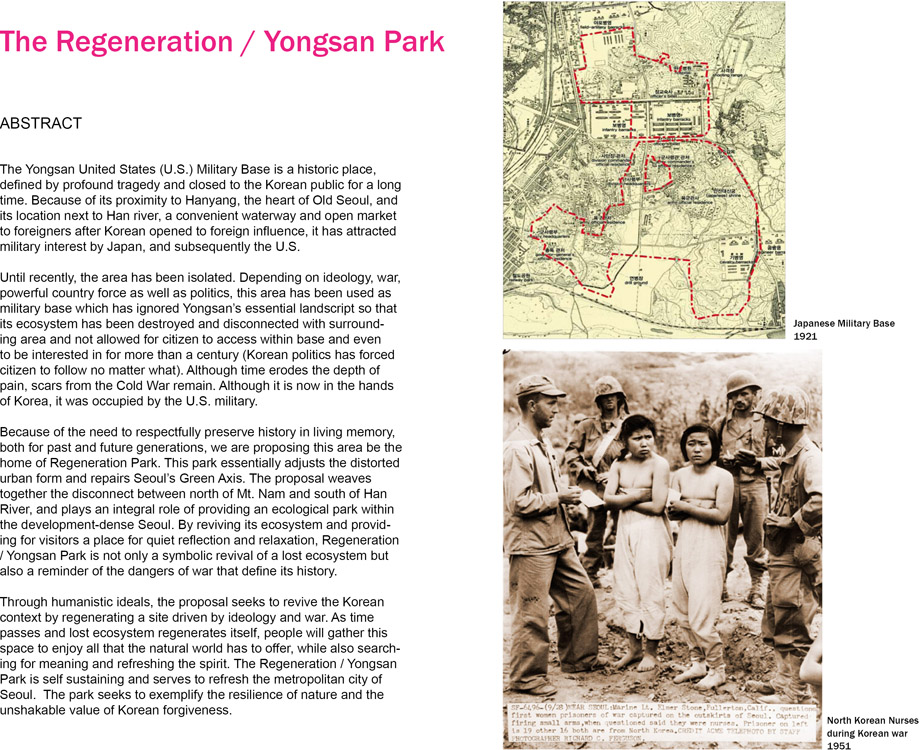
▲Abstract 概要
龙山公园是韩国的国家象征和21世纪可持续发展的典范。其象征着韩国人民,景观文化,生态遗产的繁荣,是生态的可持续性规划典范。
龙山美军基地再生:“怒放的莎伦玫瑰”
将经典的爱国儿童游戏“怒放的莎伦玫瑰”与生态设计理念及历史保护观念结合,创造出活力而多样的可持续生态公园。
“怒放的莎伦玫瑰”是韩国人的国民儿童游戏,莎伦玫瑰象征着20世纪处日本殖民时代结束后文化解放。首尔龙山公园的建立则是殖民时代传统后韩国文化繁荣的重要发展证据之一。龙山位于汉江和南山之间,目前是一个面积超过600英亩的美国军事基地。
公园的设计主要遵循三点:
整合重要历史文化建筑、旅游名胜和重要景观
链接生态系统和区域栖息地廊道,使其在空间和时间上再生;
高性能设计实现了:社会经济生态目标的可衡量化。
设计团队整合总体设计,规划,分析的过程,将景观,建筑,城市设计,可持续发展规划和生态分析的知识结合,开发出一个可持续的框架,这个框架关联重要历史建筑,旅游胜地,视点,地形地貌等要素。同时团队在景观分析的基础上在开发出一个当地的生态系统框架:包含生态分析,现状条件和栖息地的联通现状。保证未来的漫长发展中,原生的生态系统可以得以恢复。同时将生态服务系统也植入到该框架之中,如再生能源发电,水文管理,当地食品生产,生物碳储存。举例,将场地中的生物碳(垃圾或枯萎的植物)用来做再生能源发电;场地中的当地粮食生产可满足整个
公园的需求。推着时间的推移,公园将恢复以往原生的农业景观和自然生态,物种多样性。
Yongsan Park is to be a national symbol of Korea and an exemplar of sustainability forthe 21st century.
This concept symbolizes a blossoming of the cultural and ecological legacy of Korea’s people and landscape. It provides and exemplar for ecological performance based sustainability planning and ecosystem based natural areas planning.
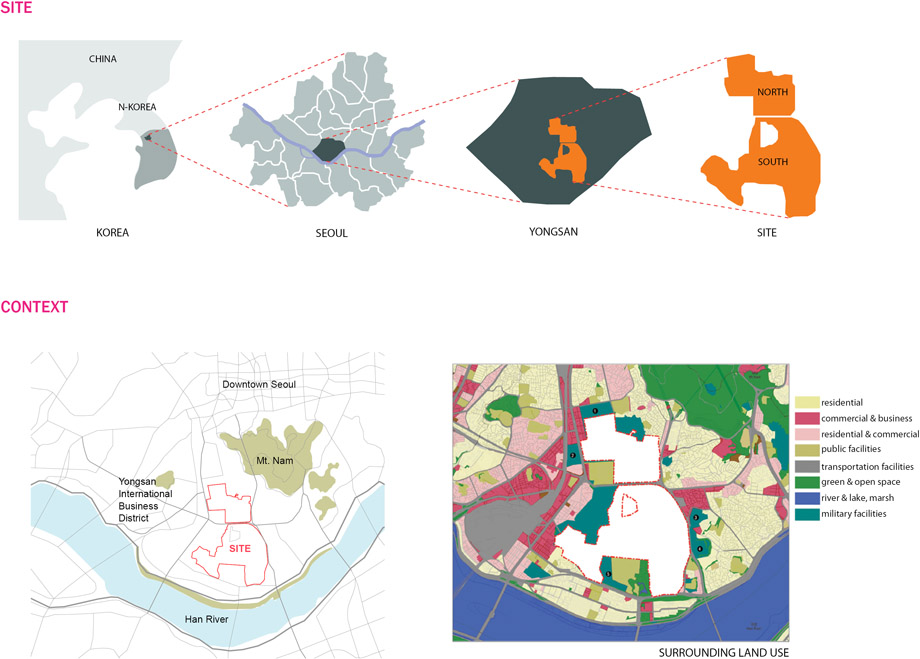
▲网站与背景 Site and Context
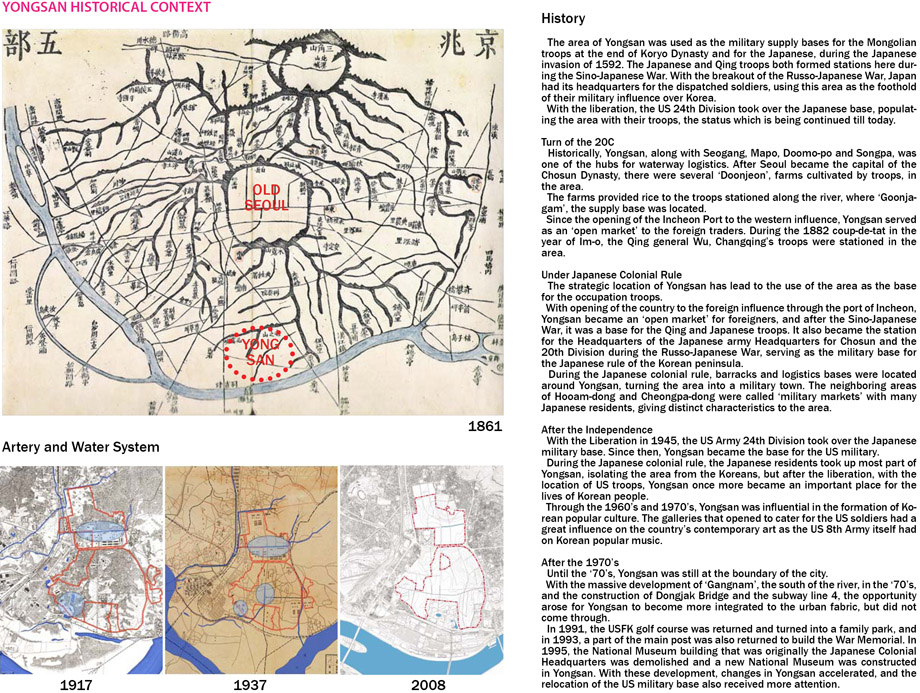
▲历史背景 Yongsan Historical Context
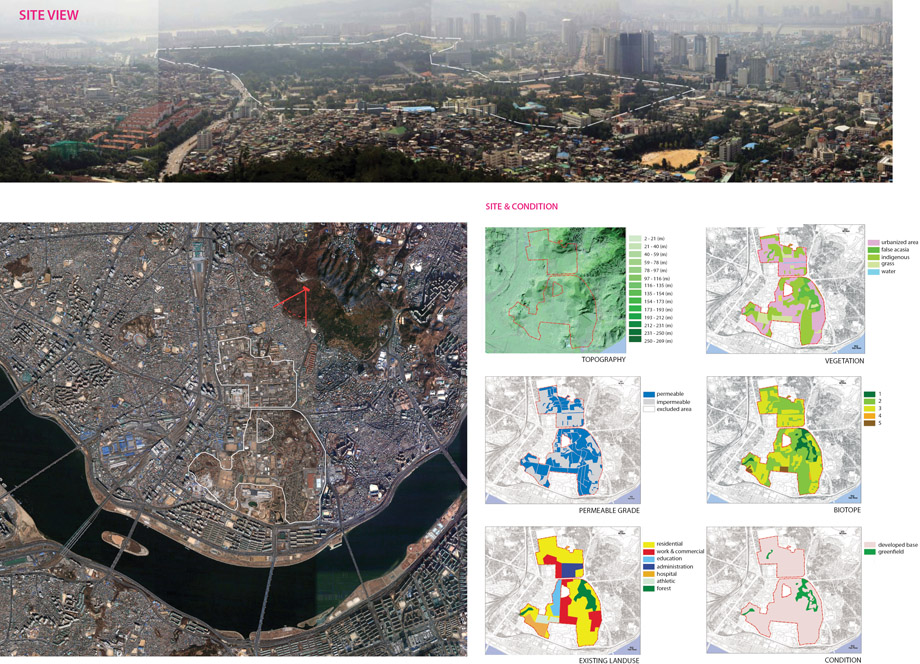
▲现状,场地条件 Site View and Site Condition
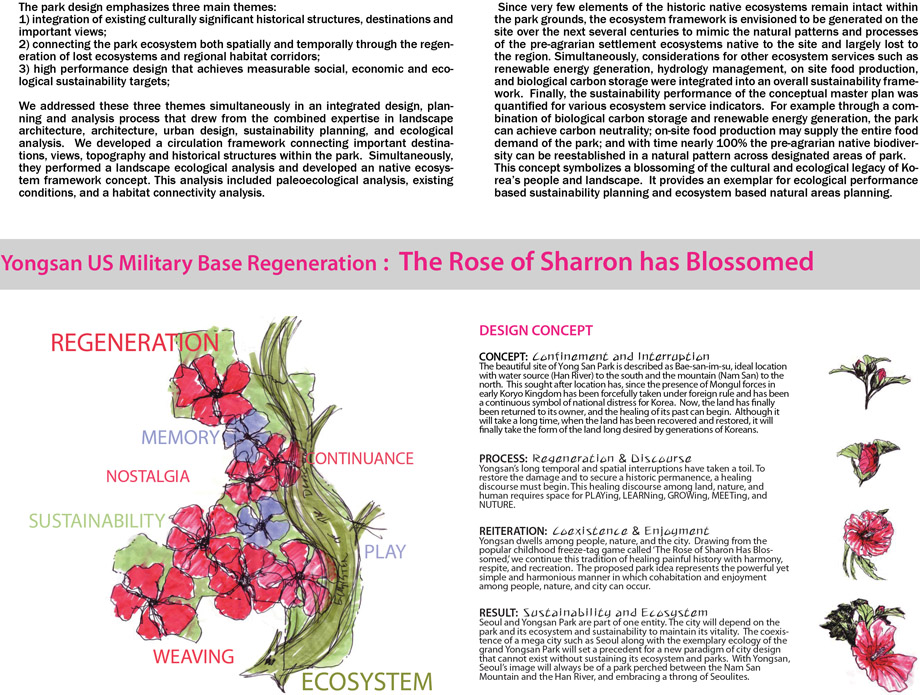
▲设计理念 Design Concept
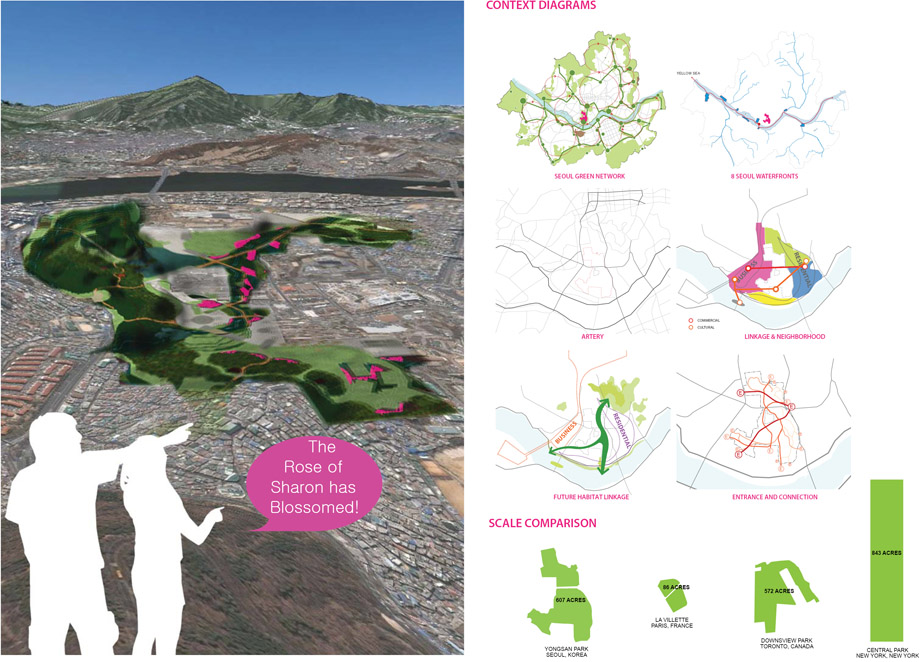
▲上下文图和规模比较 Context Diagrams and Scale Comparison
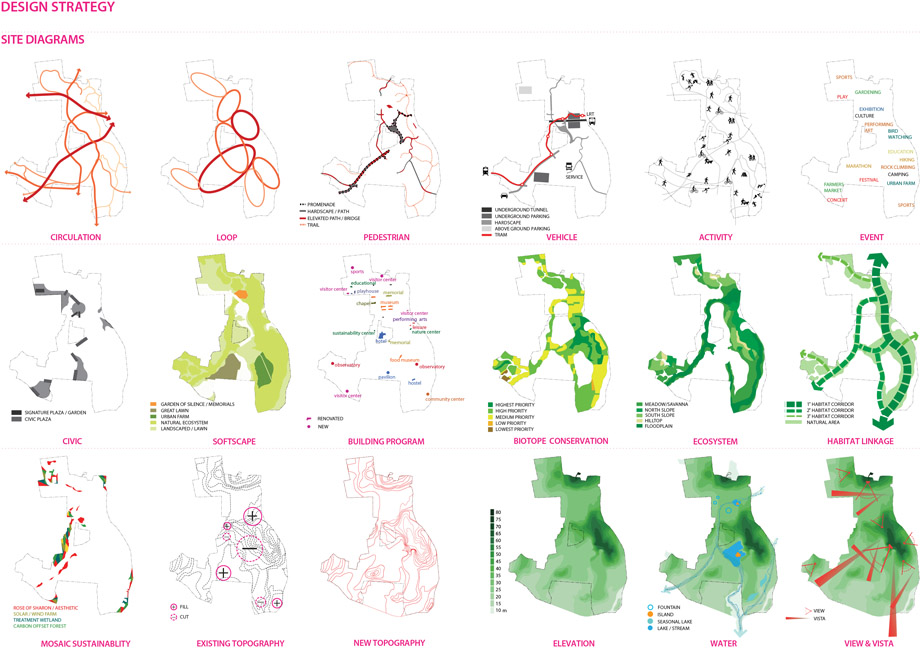
▲设计策略 Design Strategy
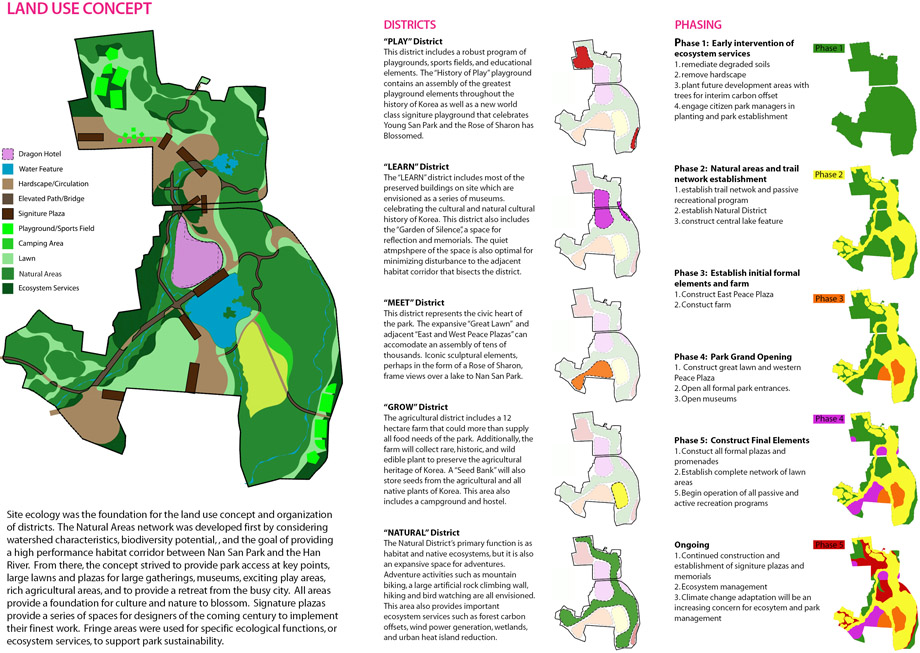
▲土地利用概念 Land Use Concept
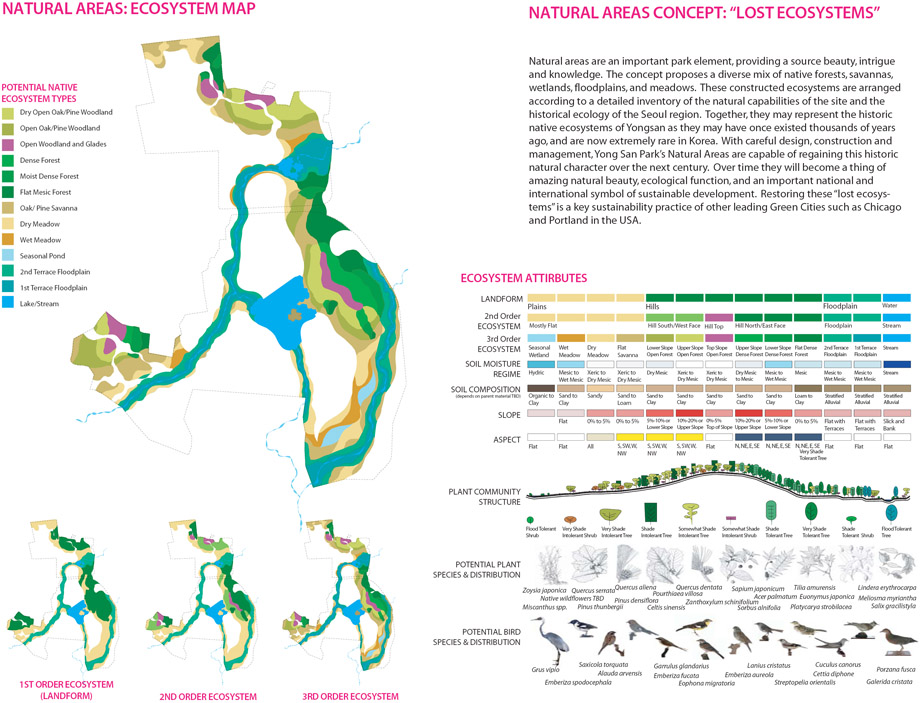
▲自然区:生态地图和自然区概念“遗失的圣药系统” Natural Areas: Ecosystem Map and Natural Areas Concept: “Lost Ecosystems”
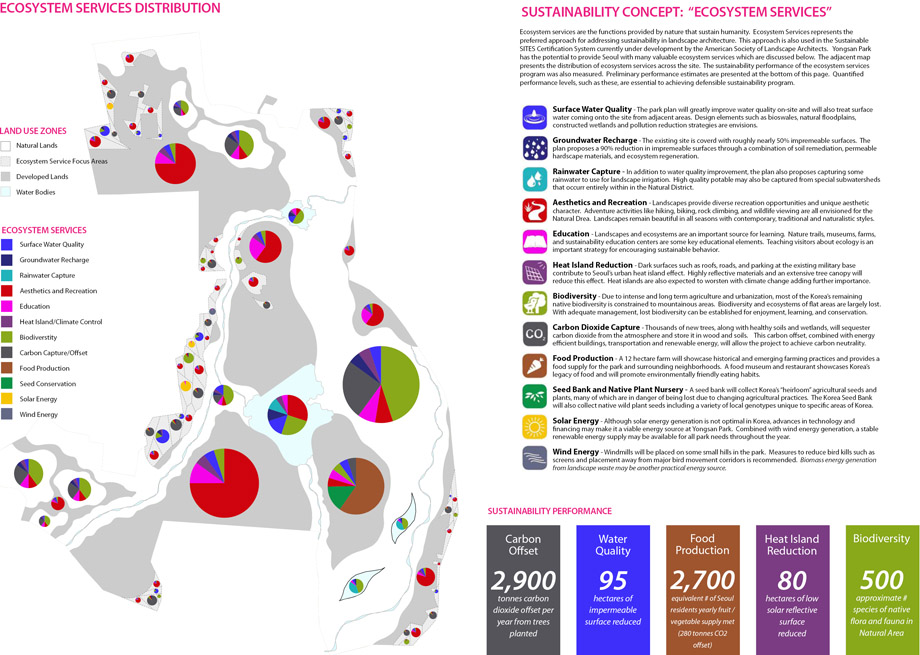
▲生态系统服务分布和可持续发展理念“生态系统服务” Ecosystem Services Distribution and Sustainability Concept: “Ecosystem Services”
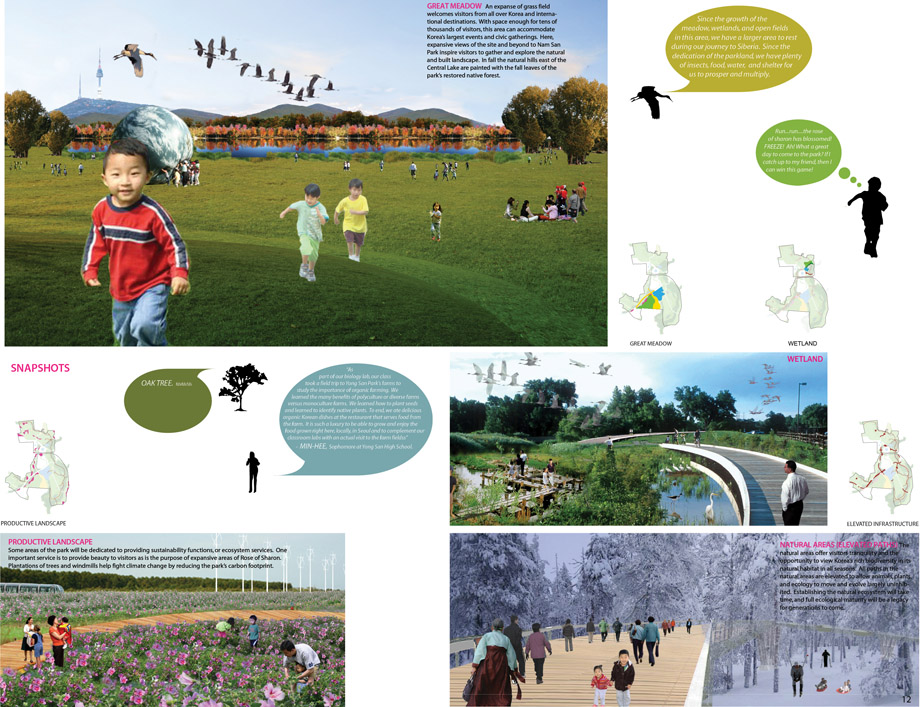
▲展望 Snapshots
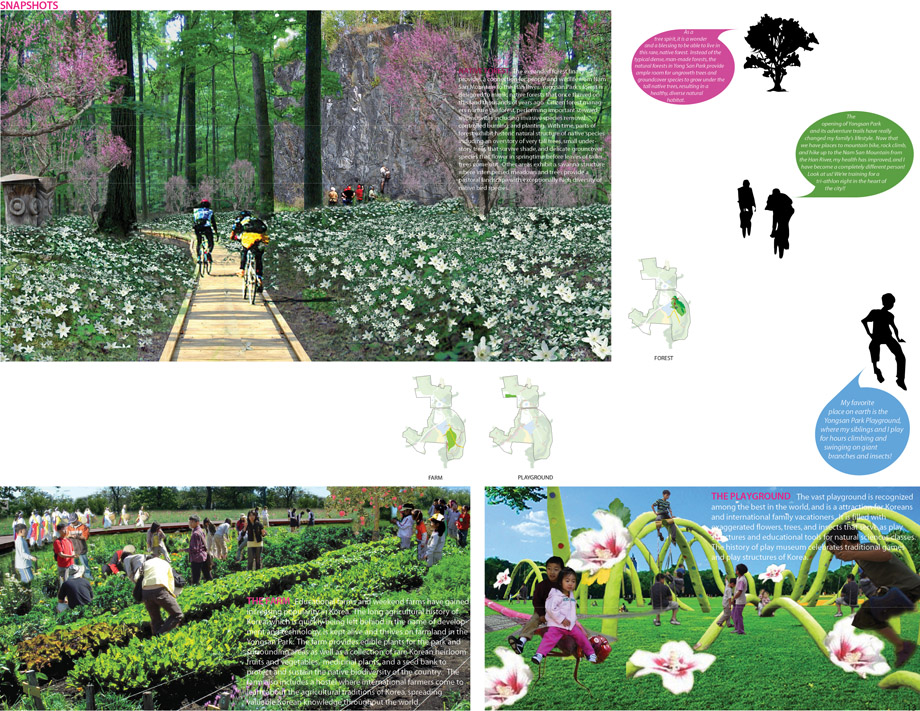
▲展望 Snapshots
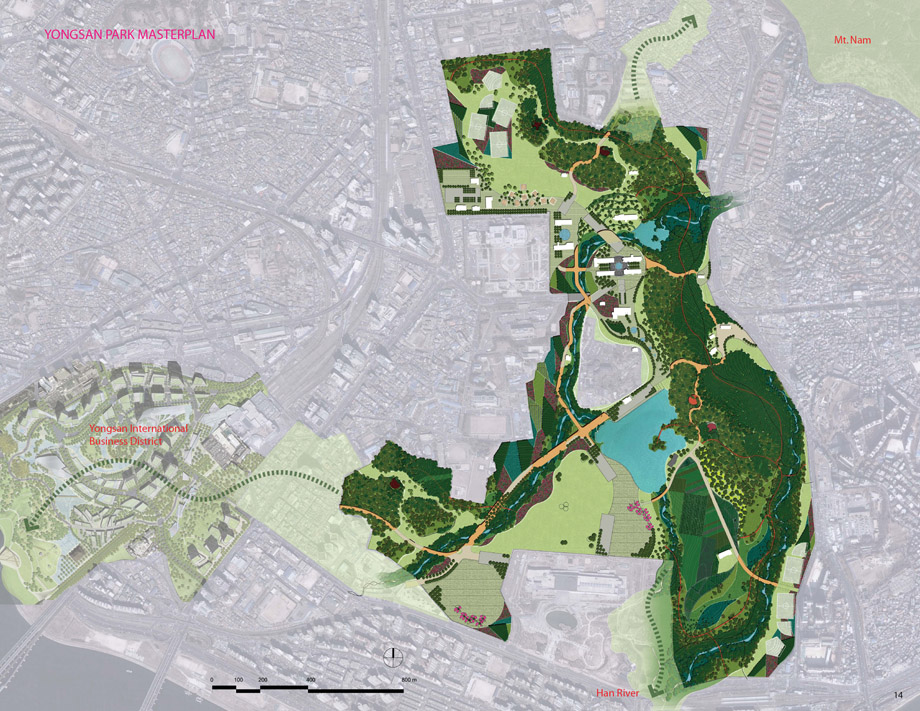
▲龙山公园总体规划 Yongsan Park Masterplan
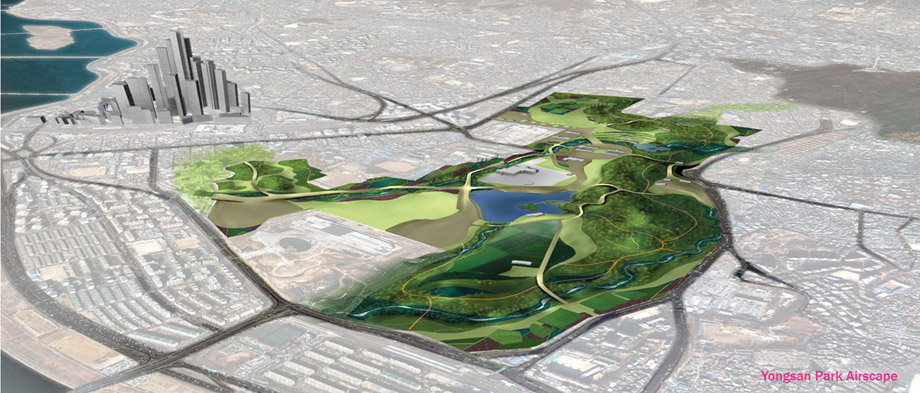
▲龙山公园鸟瞰 Yongsan Park Airscape
Here’s some more information:
Yongsan US Military Base Regeneration : ‘The Rose of Sharron has Blossomed’ Weaving the patriotic message of the iconic children’s game, The Rose of Sharron has Blossomed, with deep ecological design concepts and historic preservation to generate a vibrant, ecologically rich, and culturally sustainable park ecosystem.
“The Rose of Sharron has Blossomed” is a children’s game known to every Korean. As Korea’s national flower, the game symbolizes the liberation of the culture from Japanese colonization ending in the early 20th century. Development of a central park for Seoul at Yongsan in many ways represents one of the final significant events in the blossoming of Korean culture following this legacy of colonization. Yongsan is located in the geographic center of Seoul between the Han River and Mt. Nam, and is currently home to a 600 plus acre United States military base. Yongsan Park is to be a national symbol of Korea and an exemplar of sustainability for the 21st century.
The park design emphasizes three main themes: Integration of existing culturally significant historical structures, destinations and important views; Connecting the park ecosystem both spatially and temporally through the regeneration of lost ecosystems and regional habitat corridors; High performance design that achieves measurable social, economic and ecological sustainability targets.
The team addressed these three themes simultaneously in an integrated design, planning and analysis process that drew from the combined expertise of the team in landscape architecture, architecture, urban design, sustainability planning, and ecological analysis. The team developed a circulation framework connecting important destinations, views, topography and historical structures within the park.
Simultaneously, they performed a landscape ecological analysis and developed an native ecosystem framework concept. This analysis included paleoecological analysis, existing conditions, and a habitat connectivity analysis. Since very few elements of the historic native ecosystems remain intact within the park grounds, the ecosystem framework is envisioned to be generated on the site over the next several centuries to mimic the natural patterns and processes of the pre-agrarian settlement ecosystems native to the site and largely lost to the region. Simultaneously, considerations for other ecosystem services such as renewable energy generation, hydrology management, on site food production, and biological carbon storage were integrated into an overall sustainability framework. Finally, the sustainability performance of the conceptual master plan was quantified for various ecosystem service indicators. For example through a combination of biological carbon storage and renewable energy generation, the park can achieve carbon neutrality; on-site food production may supply the entire food demand of the park; and with time nearly 100 percent the pre-agrarian native biodiversity can be reestablished in a natural pattern across designated areas of park.
This concept symbolizes a blossoming of the cultural and ecological legacy of Korea’s people and landscape. It provides and exemplar for ecological performance based sustainability planning and ecosystem based natural areas planning.
MORE:
UnitedLAB, Seoul, South Korea
Isaac Brown Ecology Studio, Los Angeles
更多请至:UnitedLAB, Seoul, South Korea on gooood, Isaac Brown Ecology Studio on gooood
Via ASLA





感觉挺nb的一个项目,就是没表现出来。
66
分析图和鸟瞰图不是一个地方出的 一定不是
感覺看不大懂啊。。
生态的延续
分析图碉堡了,我一点也不想吐槽鸟瞰图。。。规划果然是看过种种分析下来才能理解那么点儿。真的是多层因素的叠加而生成的结果啊。可是自己规划的话该怎么入手哇。
说的好,风声大雨点小