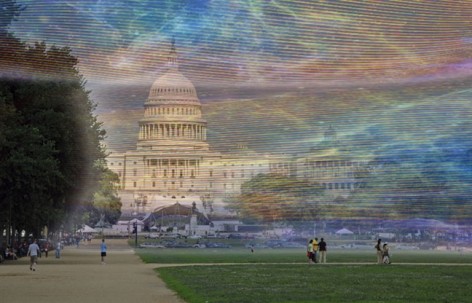
非常感谢Nickolay Lamm(nickolay@mindworklabs.com )将以下内容授权gooood发行。更多请至:Nickolay Lamm on gooood
Appreciation toward Nickolay Lamm(nickolay@mindworklabs.com ) for providing the following description:
人人都爱方便的WiFi,虽然我们经常使用WiFi,但我们很少去想它们到底怎样工作。艺术家Nickolay Lamm以华盛顿为例,演示了能WiFi看见是怎样的效果。他用红黄绿等色彩显示无线传输波的子通道。此外建议大家可以猛击蓝色链接WiFi到百度上去看看百度详细的定义。
What If You Could See WiFi?
Who doesn’t love free WiFi? Although we use it often, we rarely think about how it
works. If you’ve ever wondered, here’s how…
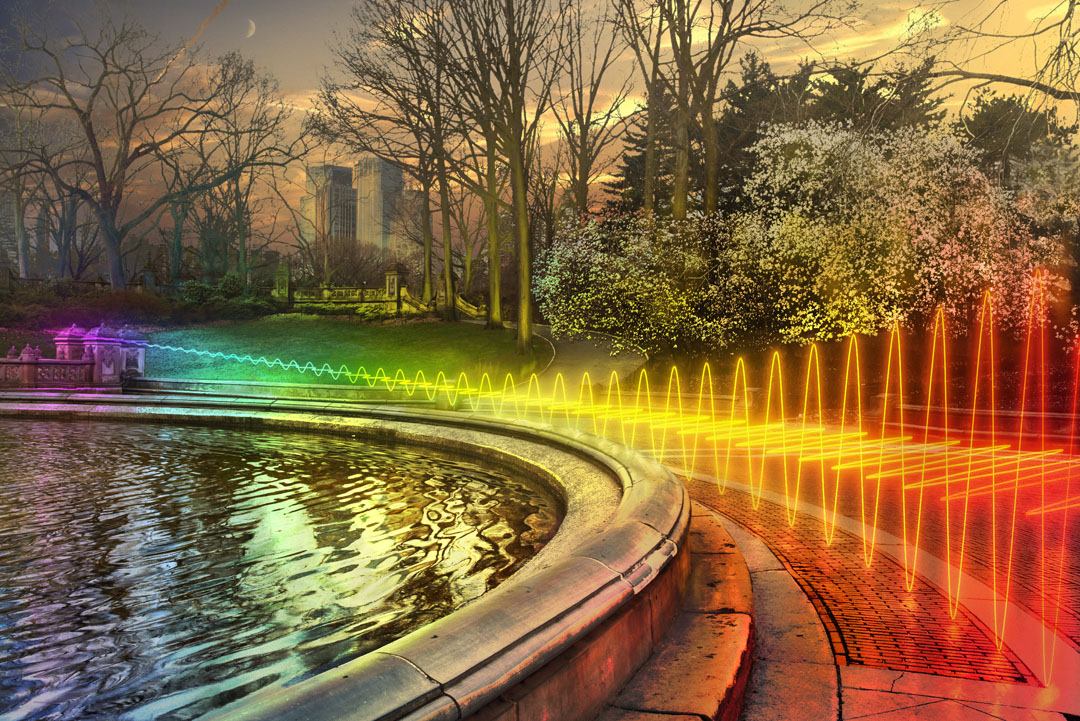
Wifi is an energy field that is transmitted as waves. The waves have a certain height, distance between them and travel at a certain speed. The distance between wifi waves is shorter than that of radio waves and longer than that of microwaves, giving wifi a unique transmission band that can’t be interrupted by other signals. Wifi waves are about 3 to 5 inches from crest to crest. The crests of waves is translated to a 1 by a computer, and the the troughs equal a 0. Chains of 1s and 0s that can be translated into the letters, numbers and codes that make up websites, email and other internet content. Typical wifi waves decrease in amplitude as they travel further from the source which is why the waves are larger to the right and smaller to the left, assuming the source is somewhere near the right of the image. This image shows an idealized wifi data transmitted over a band that is divided into different sub-channels, which are shown in red, yellow, green and other colors.

Wifi occupies the radio frequency band of the electromagnetic spectrum between actual radio waves and microwaves (used to listen to the game, and cook your dinner, respectively). This frequency band means that wifi boxes and computers can send and receive data as electromagnetic wave that have a 3 to 5 inch distance distance between each pulse of the wave. The wifi pulses are shown here as multicolored spheres radiating out from the source, near the right of the image. Wifi transmitters are basically an antenna equipped with a transmission protocol that splits the frequency band into several segments, referred to as channels. Data can be transmitted over each channel or in order to send and receive greater quantities of data at faster rates. Although color represents its own unique, visible segment of the electromagnetic spectrum, we use red, orange, yellow and other colors to show the invisible wifi channels that make up the overall wifi signal. Wifi fields are usually spherical (like the one here) or ellipsoidal and extend about 20-30 meters, assuming a typical off the shelf wifi box.
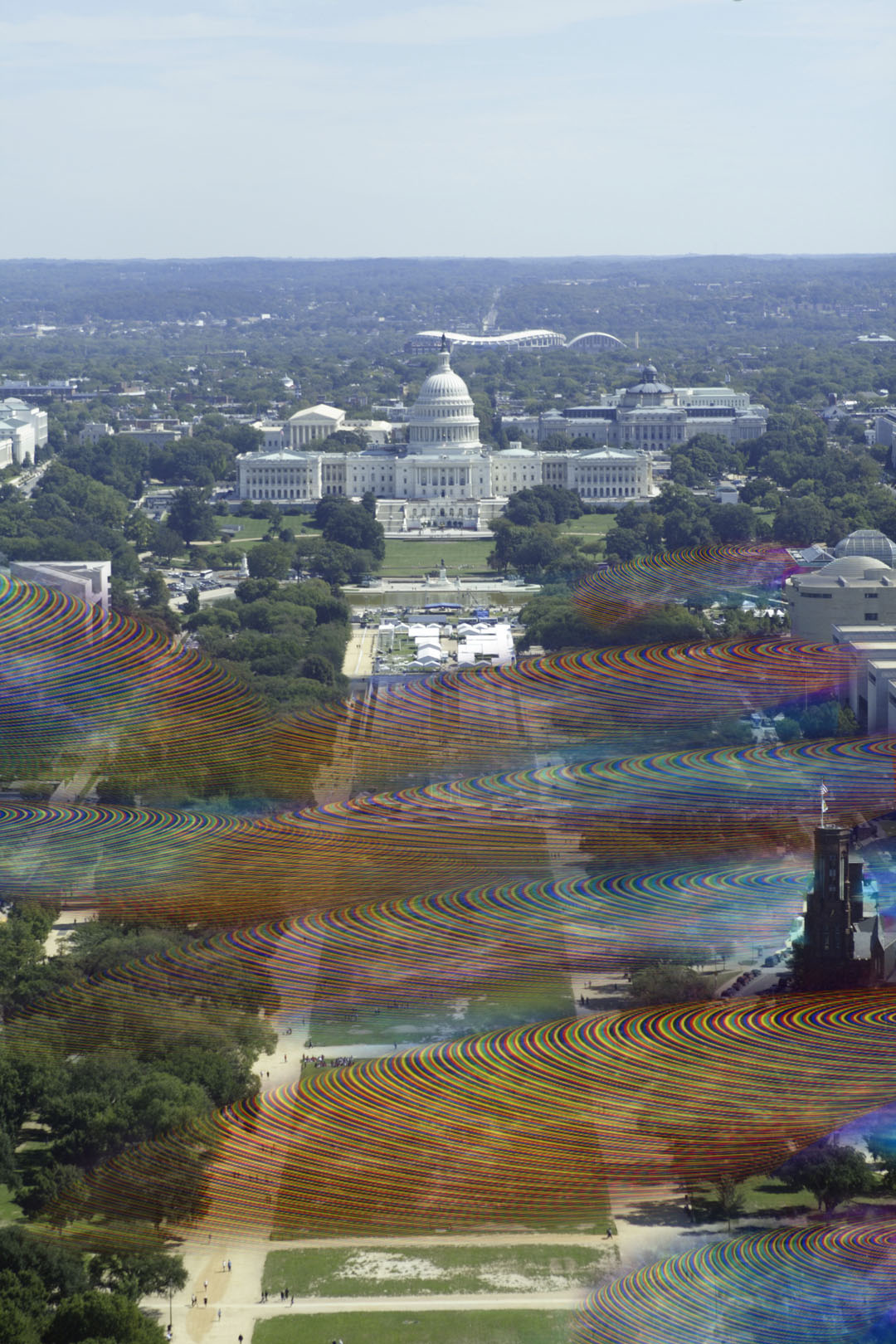
Wifi waves travel through space as rapid, data encoded pulses or waves. A freeze frame of these pulses would show that the pulses are about 6 inches apart (as shown by the lightly colored bands traveling through space in this image). Wifi routers are basically antenna that can send data over multiple frequencies all at the same time. These multiple frequencies are shown as blue, green, yellow, and red colors that pervade the space around the mall. The data from these multiple frequencies swirls around in space as shown here, but can be translated using a common tag system understood by wireless devices.
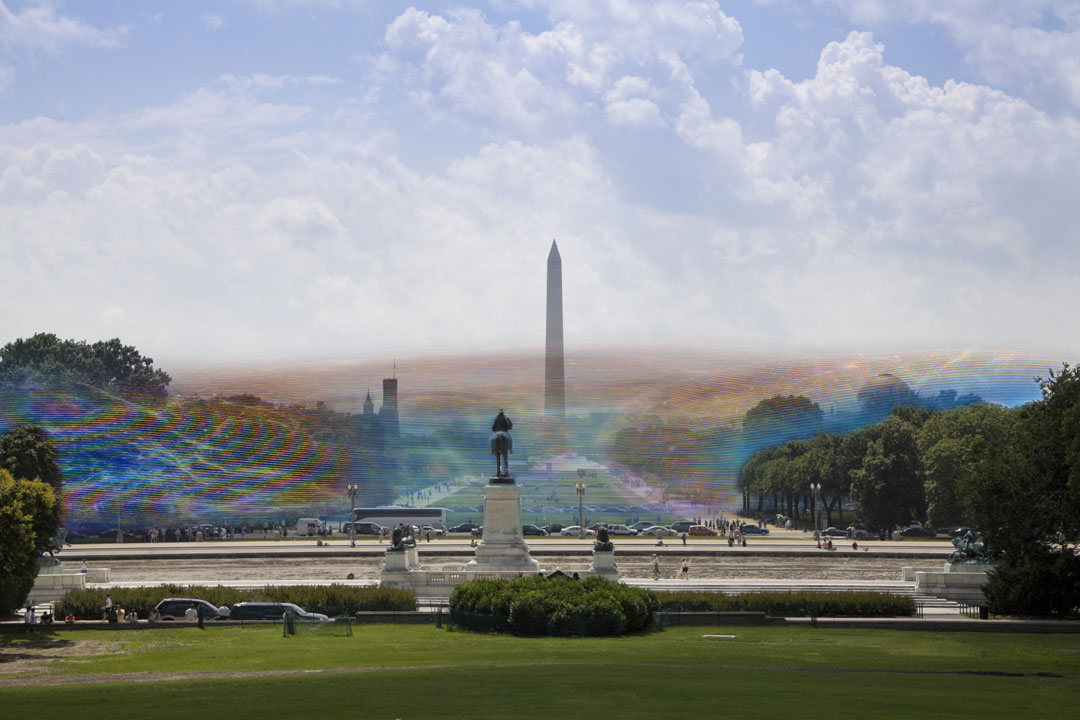
Wifi routers or antenna can be attached to trees, buildings, lamp posts and other structures. A typical outdoor router can project its signal 300 feet or more from its location. Objects such as trees can obstruct the signal such that it has to be augmented by multiple wifi routers placed in different positions. Multiple routers can create a field that extends all the way across Washington DC’s National Mall as shown here.
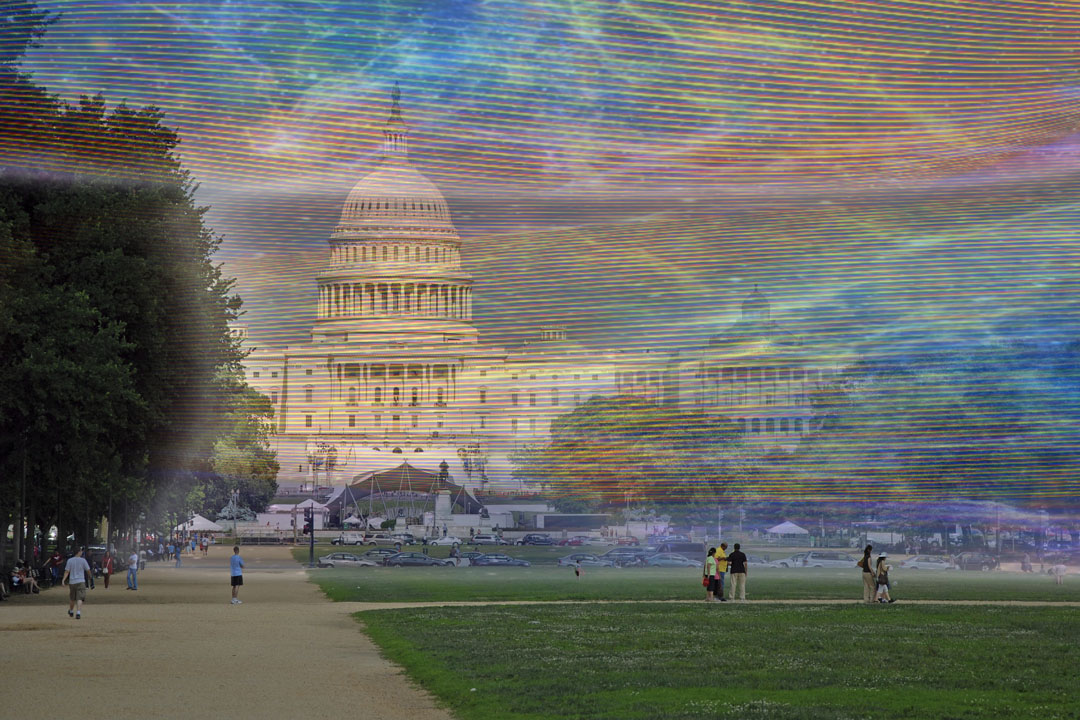
Wifi routers affixed to buildings, lamp posts and other object create a circular data field around them. These antenna have an omnidirectional signal that extends equally in all directions, shown as the circular bands. Wifi broadcasts at a frequency between radio and microwaves, meaning that the waves or pulses are about six inches apart, as shown by the colored, circular bands.
The illustrations were produced with the help of M. Browning Vogel. She has a Ph.D. in Astrobiology, worked at NASA Ames for five years, and now teaches science at the University level.
Nickolay Lamm from MyDeals.com
To approximate the size of the WiFi on The National Mall we used the 3D WiFi shapes from this map: http://3ddc.dc.gov/dcnet/wifi/)
MORE: Nickolay Lamm (nickolay@mindworklabs.com ),更多请至:Nickolay Lamm on gooood









怎么有点毛骨悚然的感觉。。
这算是摄影?!如何把电波变为可见?
趟在wifi中[口哨]
还是中国好,显示完wifi,跟没显示一模一样的