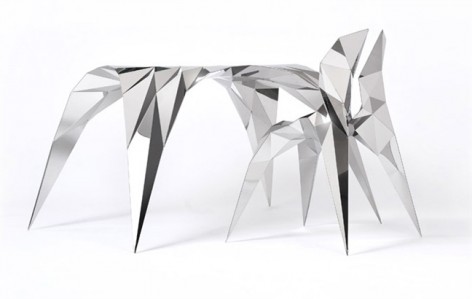
非常感谢 张周捷将项目介绍和项目图片授权gooood发行。更多请至:Zhang Zhoujie on gooood
Appreciation towards Zhang Zhoujie for providing the following description:
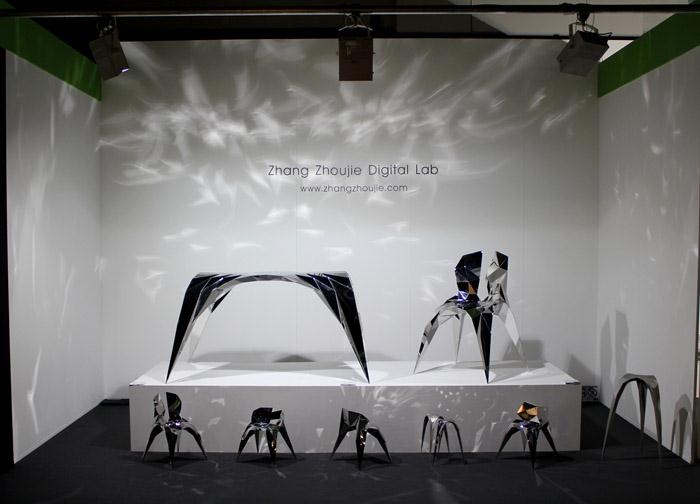
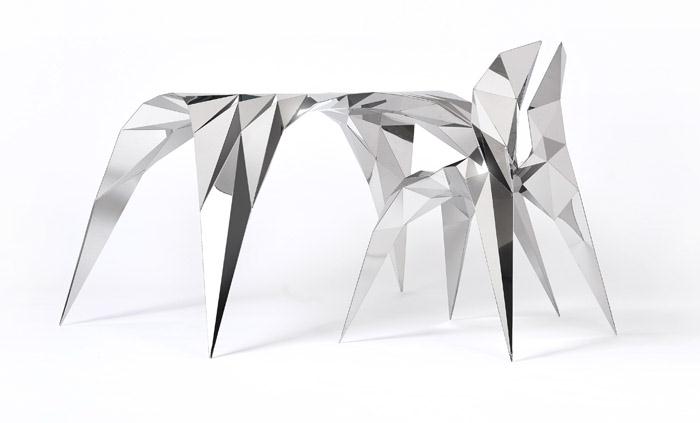
该设计的核心理念是探讨数字物体的成形方式,并结合手工艺和前沿的数控技术,把虚拟转为现实。通过特定的软件,每件家具都可以根据客户的形态实现数字化定制。在计算机生成产品模型后,通过激光切割不锈钢板、手工弯折、焊接、抛光等加工流程,一件个性化定制的家具在设计师的手中诞生了。
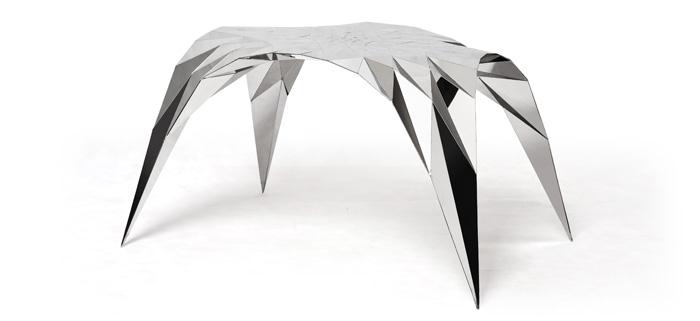
张周捷出生于中国宁波一个艺术家庭。自小学习传统绘画,在青年的时代,设计慢慢成为了他主要内容。张周捷就读于中国美术学院并在中央圣马丁艺术与设计学院学习工业设计。在伦敦学习期间,不同文化不同思维的碰撞深深刺激了他对设计的理解,张周捷开始反思创作的意义和自己的设计理念。并在一年后建立了自己的设计理念和设计方法,他希望能够寻找到可以做一辈子的项目,而不是一个速成的结果,他认为:“过程比结果重要,故事比样式重要,可能性比实践性重要”。
其作品基于“自然而然”的概念。遵循数字逻辑和遵从在数字环境下的法则。他的设计没有预期,不知道会有什么样的结果,出来的东西全凭‘可能性’。张周捷认为一个设计师应该“无为”,或者说“无设计”,尽可能少的干预事物发展的程序,所以其设计体现出一种诚肯,自然,不加修饰,他将东方传统艺术的观点,西方的设计方法,前沿数字技术和手工艺融合到一个项目中。
他的想法才刚刚开始展露,但已经在国际上获得巨大成功。继伦敦的100%设计和德国科隆的IMM D3设计天才展之后,其作品已经被来自世界各地的收藏家所收藏,并在许多媒体所报道,包括Wallpaper,ICON和Vogue。
当然,对张周捷来说未来比当下更重要,他将会持续不断的继续推进自己的理念和想法。
Zhang Zhoujie grew up in the countryside of China and was privileged with traditional fine art training. Since a young age, design has always been a part of his life. His studied at the China Academy of Art and MA Industrial design at Central Saint Matins College of Art and Design. It was during his mater studies that he found his design philosophy and personal direction.
Zhoujie believes that “Process is more important than outcome, the story is more important than style and the potential is more important than practical”.
His key project is based on the concept of ‘Spontaneity’自然而然. It pays respect to the logic of mathematics and objects are generated following the law of the digital environment. It is designing without anticipation. He believes that his role as a designer is to be ‘Actionless’ 无为, to interfere as little as possible and give space for imagination. His design is honest, revealing the true properties of materials and forms. There is no painting and no pretending. In his work, he blends Chinese traditional art perspectives, western design methodology, digital engineering and handmade craftsmanship into a single project.
Only at the beginning of his idea, Zhoujie has already had tremendous international success. Since his exhibition at 100% design in London and imm D3 design talent show in Cologne, his work has been requested by collectors from around the world and featured in numerous publications including Wallpaper*, ICON and Vogue.
He has his own studio in Shanghai where he continues to explore eastern values, future technology and ways to combine various disciplines..
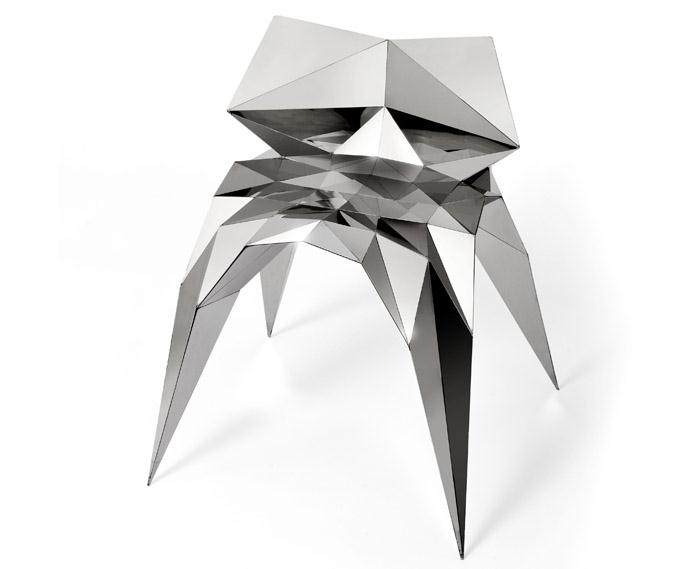
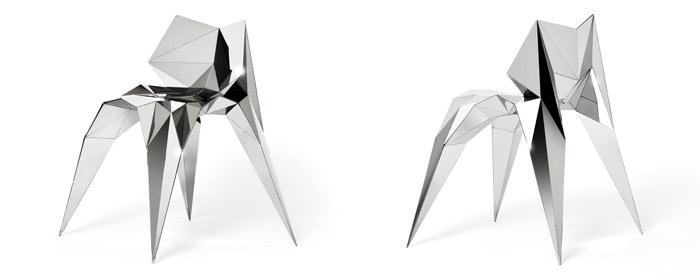
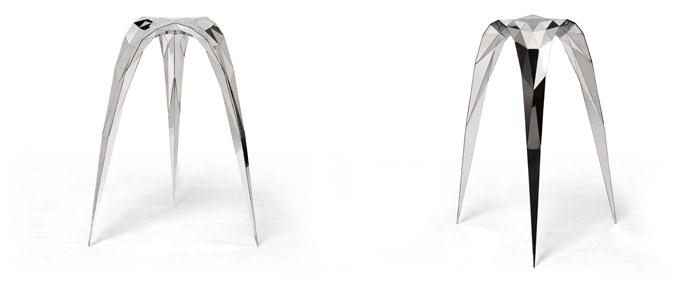
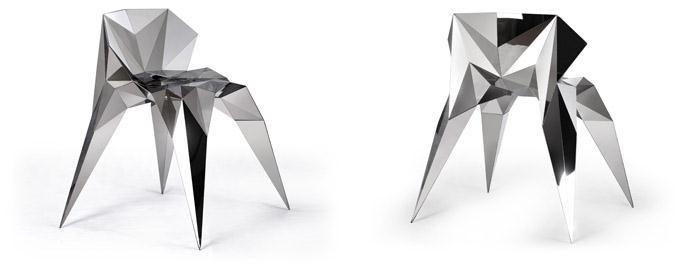
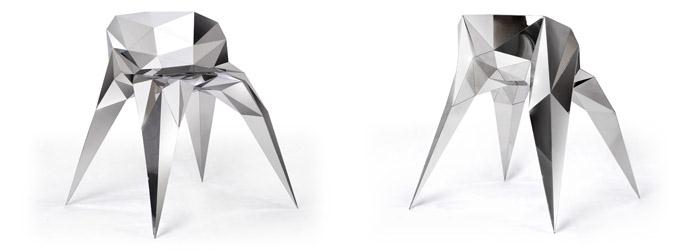
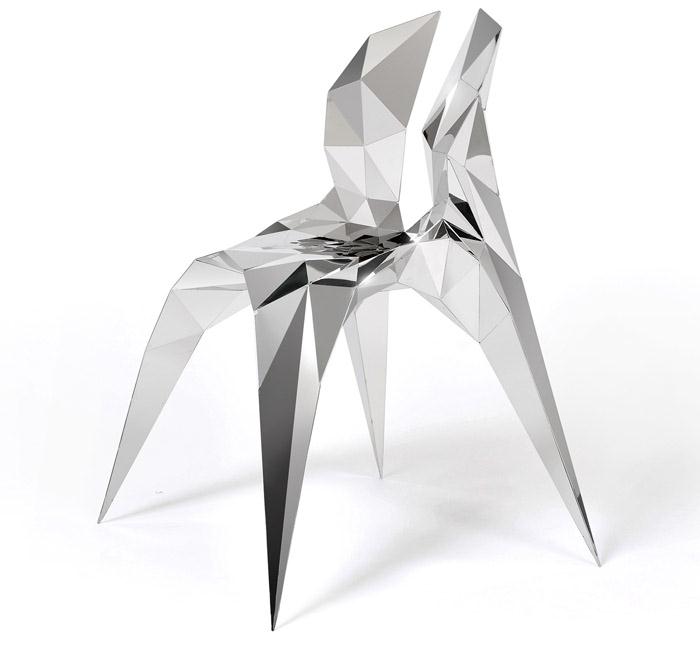
Triangulation Project
Chinese designer Zhang Zhoujie founded his eponymous digital laboratory in 2010 after graduating from MA Industrial Design at Central Saint Martins, building on a background in traditional Chinese fine art. The digital laboratory aims to explore the latest trends towards parametric design and to investigate new digital workflows which seamlessly integrate the latest computer technology with Wu Wei. Wu Wei is one of the principles of the philosophy of Taoism. It means actionless, or lack of intervention. It is the principle which inspired the methods utilized in the digital laboratory, to generate form. The goal of the lab is to use these new digital workflows to turn the virtual into the real, currently through the initiation of two projects: triangulation and simulation (currently under development). The laboratory is focused on exploring new digital form creation methods, combining traditional handmade techniques with the latest digital fabrication processes.
▼An outcome of the triangulation experiments
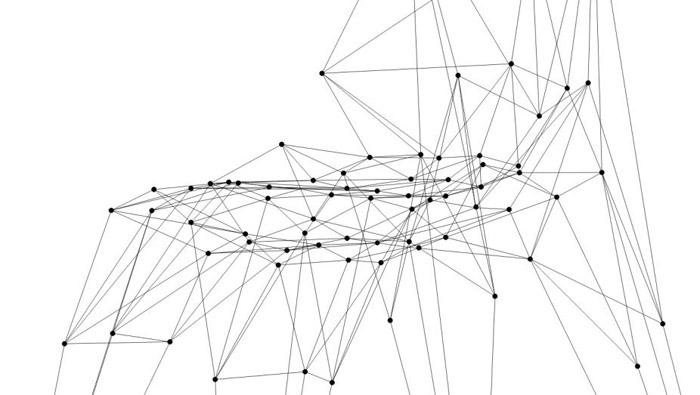
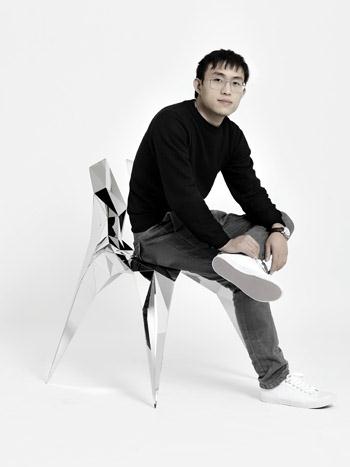
The triangulation project explores the relationships and interactions of faceted triangularsurfaces in the creation of beautiful objects, following the principles of the lab. Theproduced objects are selected from a range of 100’s of experimental objects. These objectsare generated in an evolutionary way with families of objects sharing parents, grandparentsand relatives. This creates a family tree of objects, with characteristics of differentelements following through the family line like DNA. The objects begin life as a flat meshof interconnected triangles. Depending on the original shape of the meshes differenttypologies are created. For example the triangle is it’s own family line and creates astool. The square creates the chair and table. The digital laboratory offers the possibilityto create bespoke personalised chairs by taking key measurements from the customer. This ismade possible by a specially developed measuring device. By using hundreds of sensorsembedded into a measuring apparatus the shape of the client can be directly imported intothe digital model. When the object is generated it will grow up to meet this shape withoutintervention or input. This creates an almost action-less individual object. (I’m not surewhat you mean by action-less?) Currently this technology is in development and the chairsshown are based on the creators personal measurements, created using the same process.
▼Digitizing personal measurements
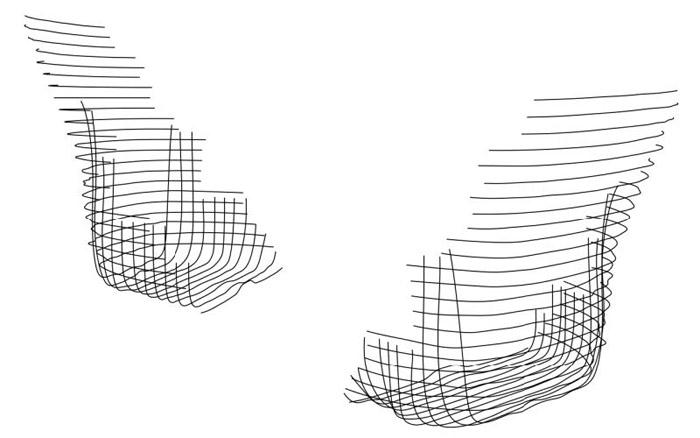
The outcomes are one-off bespoke pieces of furniture, at an affordable price. Using high-end materials such as titanium and stainless steel, every chair can be customised to the unique personal measurements of the client, made achievable by the advanced digital fabrication processes, resulting in a chair which is precise and comfortable.
The fabrication process begins life by preparing the digital model of the chair for a birth into the real world. The digital output of the 3D model is turned into a 2D layout of the individual triangles which creates the data that is sent to be laser cut.
▼View of SQN1-FA with its surfaces exploded
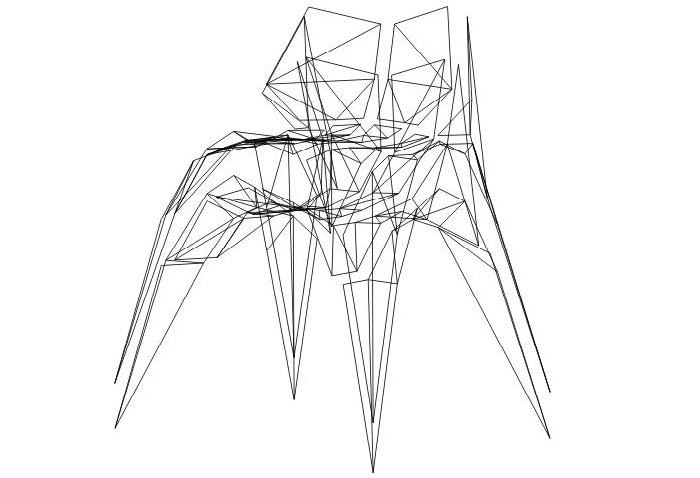
The shapes are then cut-out of the base material (stainless-steel or titanium). Afterreceiving the laser cut material, a precise set of angle guides are produced for each of thedifferent contact angles which are present on the chair. These are then used to bend theindividual metal elements into the correct alignment based on an angle map, also createdfrom the 2D layout.
▼2D layout of surface segments showing contact angles for bending
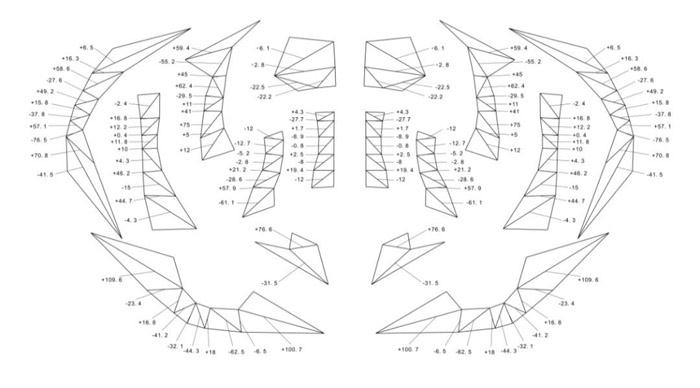
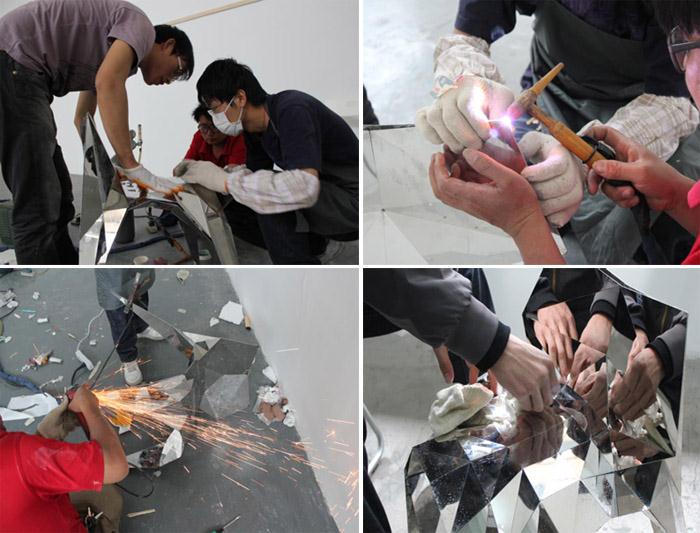
The bending process is meticulously carried out by hand and optically checked using the guides. Once the bending is complete the contact points are fixed in place using a special treatment on the underside surface of the chair. This process is then repeated for all the individual segments of the chair as received from the laser cutting stage. The individual segments are then mated with their adjoining parts before being fixed in place, again with a special treatment. Once the upper and lower half of the chair have been fabricated they are strengthened with 3 layers of glass fiber, applied to the underside surface of both parts. The combined 6 layers of glass fiber produces the strength and rigidity necessary for the chair to be used as an everyday object.
The next step is to add a layer of high density foam which is sandwiched between the upper and lower halves of the chair, giving it solidity and toughness. The two halves of the chair are welded together at the seams using a specially developed process which leaves no join marks.
Once completed the chair is polished and sharp edges softened to produce the completed chair.
MORE: 张周捷 Zhang Zhoujie,更多请至:Zhang Zhoujie on gooood


这世许多好东西是不和人互动的↓
这世上许多好东西是不和人互动的↓
回答@安全性欠佳的问题。有些好设计是合适的设计,有些好设计是心动的设计,道理就像斯塔克的经典榨汁机设计一样。