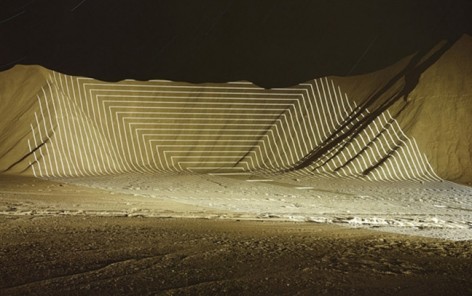
非常感谢 Jim Sanborn 将项目介绍和项目图片授权gooood发行。更多请至:Jim Sanborn on gooood
Appreciation towards Jim Sanborn for providing the following description:
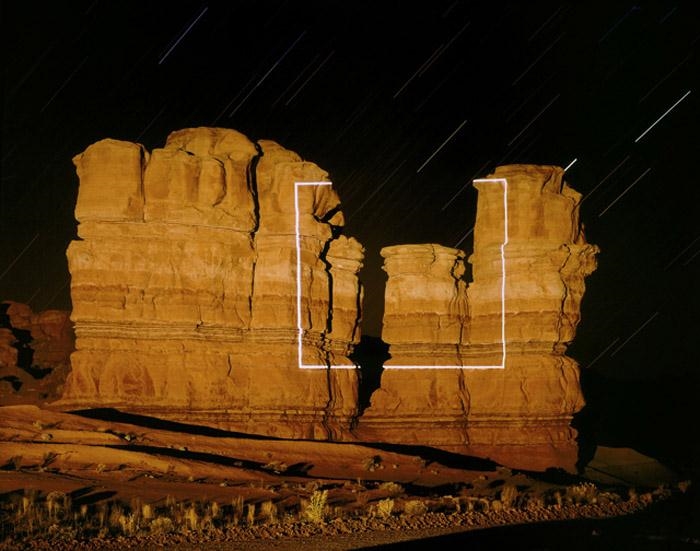
Notom, Utah
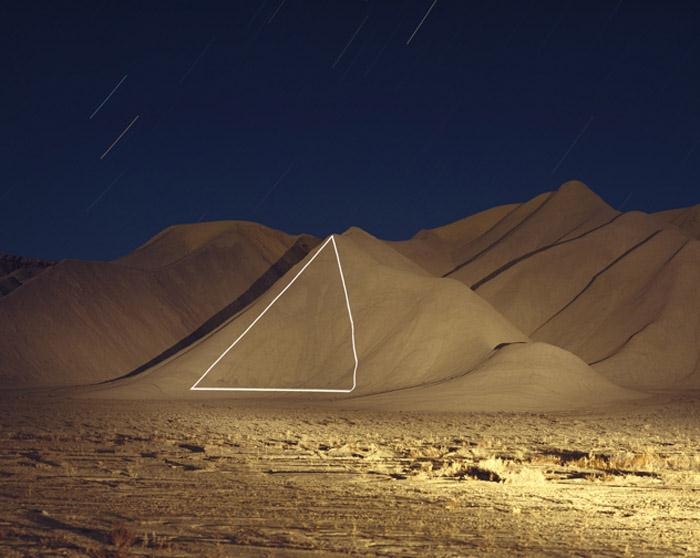
Cainville, Utah
The topographic projections developed in this way, a year before this project I did a commission for the MIT Microbiology Department in Cambridge Mass, I used a very powerful projector to project an image of a microscopic slide on a white marble disk on the floor of the entrance to the microbiology building, the slides were interchangeable and were provided by me and the Lab scientists to reflect the things they were seeing through their microscopes. The projector cost about $50,000. I could not afford to buy one for myself so I copied it precisely and made my own using only their lenses, for a couple thousand dollars. The slides I used were about 12″ square. I had many different grids and patterns made on black film with clear lines. I practiced long-range projections on warehouses near my studio in Washington DC. I also made small landscape models with trees and rocks and projected slides onto them to test the angles etc. When I was satisfied with the results I bought a generator, piled all the equipment into a jeep and headed out west to work. I was very familiar with the areas and landforms I projected onto because I had been visiting these places for many years because I found these places inspiring. In 1995 computer generated photographic imagery was just getting started and I felt that It would be ironic to make images that appeared computer generated but were not. In fact in order to have made these works with a computer would have required almost more effort than doing it the way I did “the hard way”. I would drive many miles off-road to a remote site where city and car lights could not reach. I used a hand held device I made to determine, during the day, how far away the projector and camera had to be and at what angle as well. That night I set up the equipment, tested the result and usually had to adjust the angles again before shooting. This was in the fall, sometimes 15-20 degrees F, very cold and very windy. The equipment was heavy 200 lbs on the projector 100 lbs on the generator, a 4×5 camera with 100 lbs of sandbags to keep it from vibrating in the wind, in Ireland because of the boglands I had to pour concrete footers under the camera tripod. I was at the camera, my assistant operated the projector, we communicated by CB radio, I would tell her to turn on the projection and when to turn it off and use a searchlight to illuminate the landscape if there was no moonlight. I usually shot 8 4×5 images per night, exposures ranging from 10 to 40 minutes depending on the moon. what you see in the photos is what it looked like in real life at the site. The images were so strong on one night that it caused a semi-truck traffic jam on interstate 80 in Wyoming , the interstate was 4 miles away but the truckers thought it was some sort of beam me up scotty moment. After shooting we would drive all night to get the film developed in Denver to see if it had to be re-shot the next night, (full moons do not last long) all in all, I got, over a three season period 95,96,97, 22 images that I am happy with. My memories of those nights are very clear and magical, the sky was amazing, many stars and shooting stars and even a UFO, or at least something in the sky I could not explain. I was very happy with the resulting images. Most people though assumed they were computer generated, they missed the point. I am currently developing a body of work about the global trade in looted antiquities, and just returned from Cambodia and Angkor Wat where I was studying the problem.
The Topographic Projections (the grid pieces)were inspired by the 19th century US Government project to map the American West, many photographers were sent out to photograph the dramatic landscapes. The Grid pieces are linked to GPS mapping coordinates, and the titles of the works are these coordinates. The Implied Geometry works use Euclidian geometric forms projected on landforms that seem appropriate geometrically. The geometric projection images are more or less the original precise crystalline geometric forms of the landforms before erosion and entropy softened their shape. The photographs are presented and sold as 30″ x 36″ and 48″ x 60″ inch digital prints.
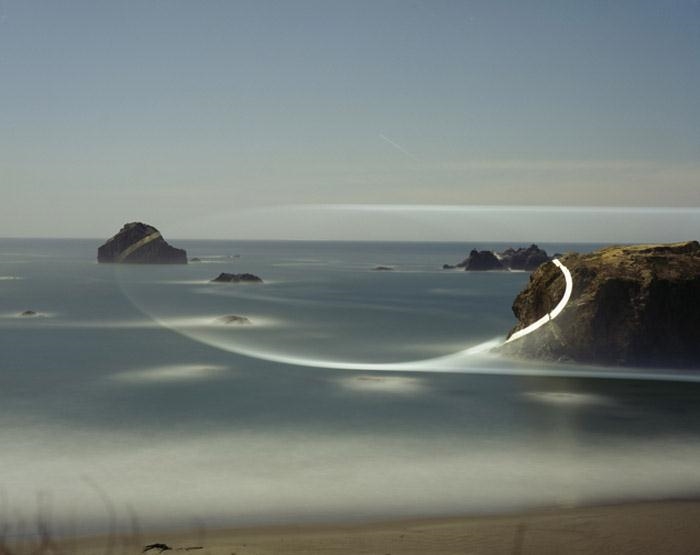
Bandon, Oregon II, Projected Light
这一系列惊人的大地长曝光摄影完成于15年前。
当时作者还在MIT的微生物系学习念书,他使用强大的投影机投影在白色大理石地板上,并观察微生物的生成。投影机造价达到50000美元,所以只有借用别人的仪器。这一切为他做这一系列艺术品提供了契机,他到达自己的熟悉的地方,制作了这些作品,在当时,这些作品具有讽刺意味。白天,他抱着设备到处决定在那里拍摄,什么样的角度拍摄,到晚上,他进行拍摄前的效果调整。那个时候是秋天,温度在15—20度,有的时候很冷,还有风,所以不得不在设备上挂了沙袋以防设备倒落。在爱尔兰,因为作业要求,他不得不与助手用对讲机通话。深夜,没有月光的空隙,艺术家抓紧时间拍摄10—40分钟。从照片上看,这些场景非常逼真。其实投射的效果很强烈,一次在里怀俄明州洲际公路四公里的地段进行拍摄,甚至引发了当地的交通堵塞,因为司机以为发生了什么超现实事儿。拍摄受自然天气限制,常常需要等待。但是让艺术家非常高兴地是,他所呆的那些夜晚都让他记忆清晰:美丽的夜空,迷人的星星,流星还有不明飞行物,这些拍摄的图片与众不同,虽然很多人认为这是计算机生成的。实际上艺术家现在为处理全球贸易中的文物流失的机构中工作,并刚刚从柬埔寨的吴哥窟回来。
项目的灵感来源于早期美国政府的项目以及一些摄影师作品中的戏剧性效果景观。GSP系统网格生成的几何体代表着地貌。这些作品在呈现原始地貌的同时,也改变着它们。目前30″ x 36″ and 48″ x 60″寸的数码打印照片正在销售。
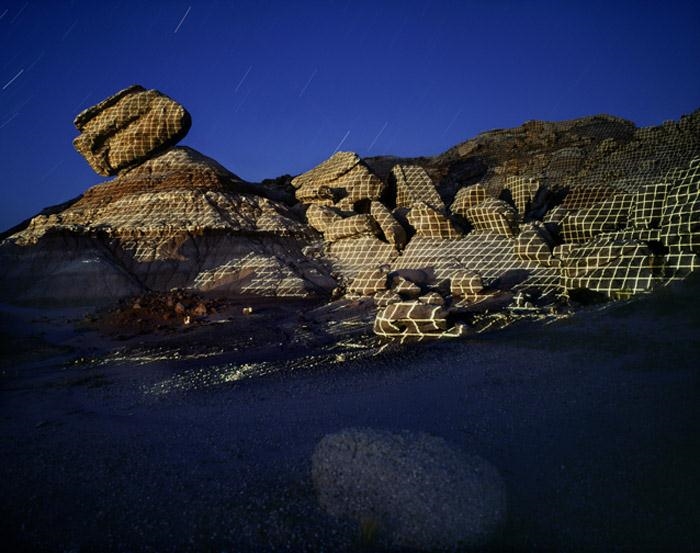
Green River, Utah, Projected Light
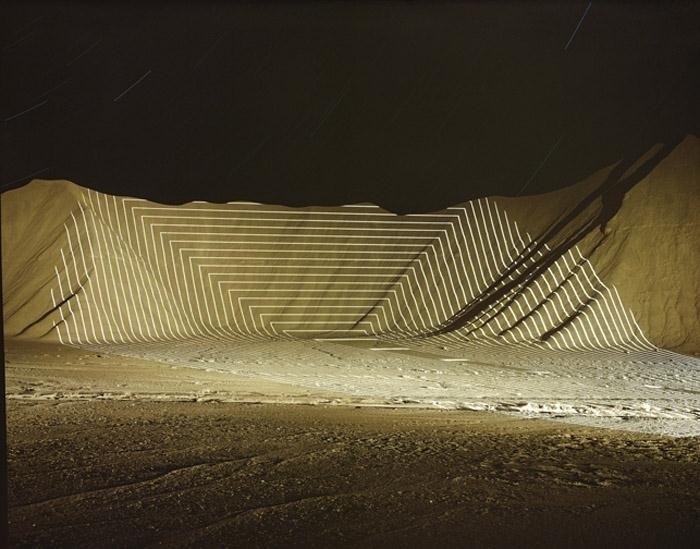
Horse Valley, Utah IV
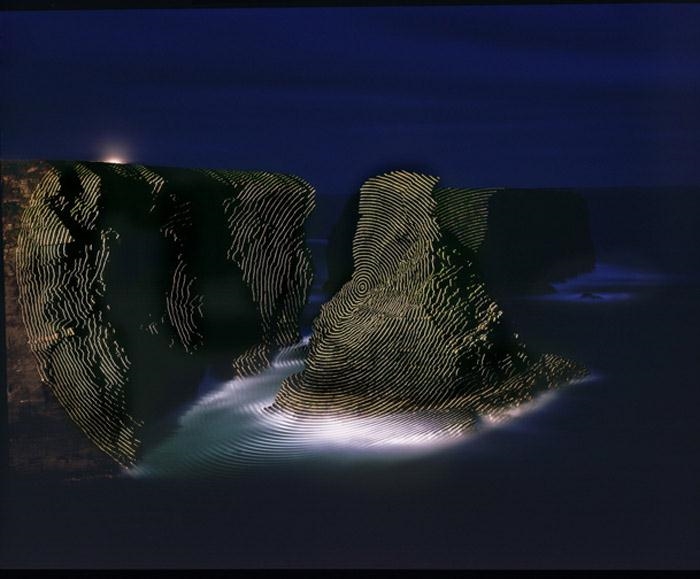
KIlkee County Claire, Ireland
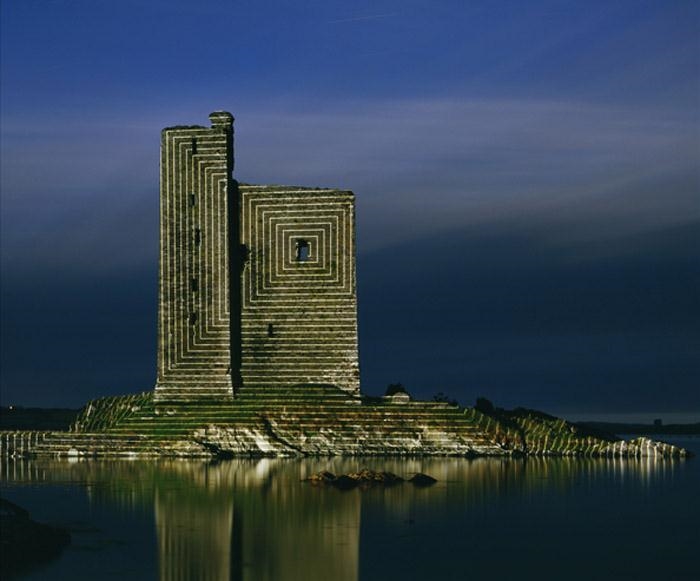
Longsturn County Cork, Ireland
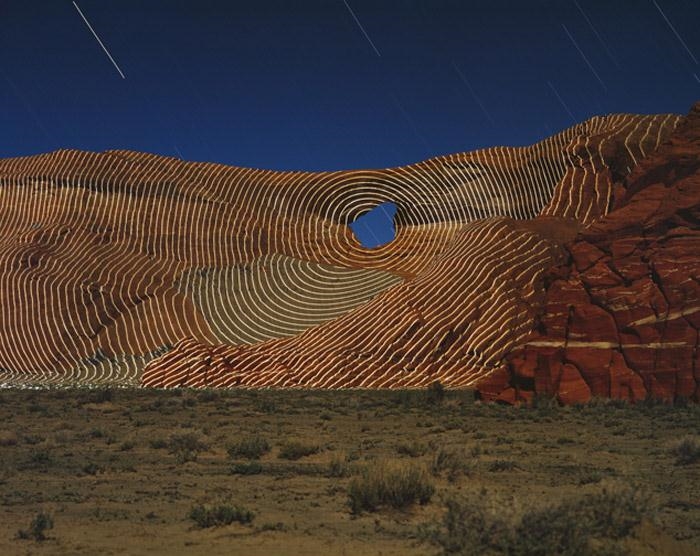
Rough Rock, Arizona, Projected Light
MORE: Jim Sanbor,更多请至:Jim Sanborn on gooood









发表评论
你需要先 才能发表评论
社交登录