THE BUILDING SOCIETY (建造社)是香港大学建筑学院的一门全新硕士课程,课程全名 Master of Science in Advanced Architectural Design 。2024年6月课程报名截止日期为2024年1月15日,课程信息与报名方式请浏览课程网站
www.thebuildingsociety.arch.hku.hk
以下对话,是课程主任John Lin (林君翰) , Jze Yi Kuo (郭子怡)与建筑师Sam Jacob针对课程创办背景与愿景的解读。
建造社—面向当下的建筑学校
一篇关于建筑教育的讨论,与为何香港大学要开设硕士级高级建筑设计课程 —“建造社”。
对谈者:
郭:Jze Yi Kuo 郭子怡,香港大学助理教授,课程副主任,建造社
林:John Lin林君翰,香港大学教授,课程主任,建造社
SJ:Sam Jacob,Director Sam Jacob Studio; Professor, The Institute of Architecture, die Angewandte, Vienna
郭:今天的讨论将围绕我们的新课程“建造社”,同时探讨建筑教育的演变,以及在当下,我们为什么需要新的建筑教育。先从这个新课程的主任林君翰开始:该课程取名为“建造社”的原因是什么?这与你一直关注的中国城乡状况的工作有关吗?我感兴趣的是你在工作中面临的挑战与困难,还有为何要创办这个新课程?
林:好的,这与我过去18年里在中国的工作有关。决定创办新课程的动机始于一个疑问:当今的世界需要什么样的建筑学校?更深地思考,建筑教育怎样才能切实有用?关于“建造社”这个名字,我的想法很简单,“building”这个词并不是指实体的建筑,而是指一种将人们聚集在一起的活动,就是这么简单。在建筑史上,总有一个不断变化的焦点,到底是过程还是结果更为重要。在新冠疫情之后,我认为人们对建筑过程中的集体性产生了兴趣。
这个课程的构想, 应追溯到90年代初至2002年间,我在Cooper Union学习经历的一些反思。我接受的是相对正式的教育,被灌输建筑等同于文化的认知,强调对历史的学习。当我到香港开始实践时,我更关注现场的背景与情境——正在面临着快速的城市化。在实践的过程中,现场的情境(context)非常的丰富,也非常的迫切,需要面临许多挣扎与奋斗。在这个过程中——与参与者、获益者、非专业的建筑工人的接触,塑造和启发了我,改变了我对设计过程的看法。
当下,社交媒体的发展、新的制造技术以及最近的人工智能技术——这些都让我们更少地参与到真实的情境中。我们正在创建的这个课程,它是因真实的建造所驱动的,也是因建造过程中的那些有趣的不确定性因素所驱动的。所以这是一所创办在建设过程中的建筑学校,透过亲自动手来学习的学校。每年,学生与老师将做研究、建造样板,并最终一起建成一个真实的项目。、
(以下为英文访谈原文)
THE BUILDING SOCIETY is a new postgraduate programme, Master of Science in Advanced Architecture, at Faculty of Architecture, The University of Hong Kong. Application deadline for June 2024 programme ending on 15 January 2024. For more information please visit www.thebuildingsociety.arch.hku.hk
Below is the conversation about the context and vision of the new programme ,between the programme directors and architect Sam Jacob.
THE BUILDING SOCIETY – a school of architecture for today’s world
A discussion on the relevance of architectural education and the reasons for starting a new Master of Science in Advanced Architectural Design – “The Building Society” at The University of Hong Kong.
Participants:
KJY – Kuo Jze Yi, Assistant Professor, The University of Hong Kong. Deputy Director, The Building Society
JL – John Lin, Professor, The University of Hong Kong. Director, The Building Society
SJ – Sam Jacob, Director Sam Jacob Studio; Professor, The Institute of Architecture, die Angewandte, Vienna
INTRODUCTION
KJY: The conversation is going be about our new program “The Building Society” but more generally about how architecture education has transformed over the past 20-30 years and why we might need new ideas for the education of the architect today. But let’s start with John, the director of this of the new program: the program is called The Building Society – why this name? Does it relate to your work focused on the conditions of rural and urban in China? I’m particularly interested in the challenges and difficulties you might have faced and the decision to start this new program?
JL: Okay, yes its related to having worked in China for over the past 18 years. The decision to start a new program began with the question: what does the world need from a school of architecture today? And in a deeper sense, how is the education of the architect useful? So I should say something about the title “The Building Society”. Very simply, the word “building”, is not referring to a physical building, but building as an activity – it’s an activity that brings people together. Its as simple as that. In architectural history, there is always a shifting emphasis on whether the process or the product is more important. I think post-Covid, there’s an interest in the sense of collectivity that emerges in the process of building architecture.
This program began as a reflection on the things which I experienced myself studying at the Cooper Union from the early nineties till 2002. The context for my education was quite formal – I was presented with architecture as a culture and there was emphasis on the study of history. When I started to actually practice after I arrived to Hong Kong I became much more engaged with the context of my sites – which were undergoing rapid urbanization. When you practice, the context is very rich, it’s imminent and you struggle a lot with it. The engagement with the context – with the actors, the shareholders, with people who are not professional builders shaped and inspired me, changing my view on the design process.
If we fast forward to today, to consider the development of social media, new fabrication technologies and more recently, AI – these things all allow us to be less engaged with the real context. And I think we’re trying to create a program which is very driven by realities of making, by uncertainties that are embedded in the building process. It’s a school which tries to establish itself in this impure condition of architecture making where you learn directly from doing. So every year, students work with teachers to do research, prototyping, but essentially to build an actual project together.
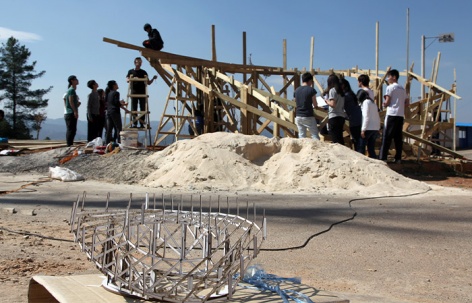
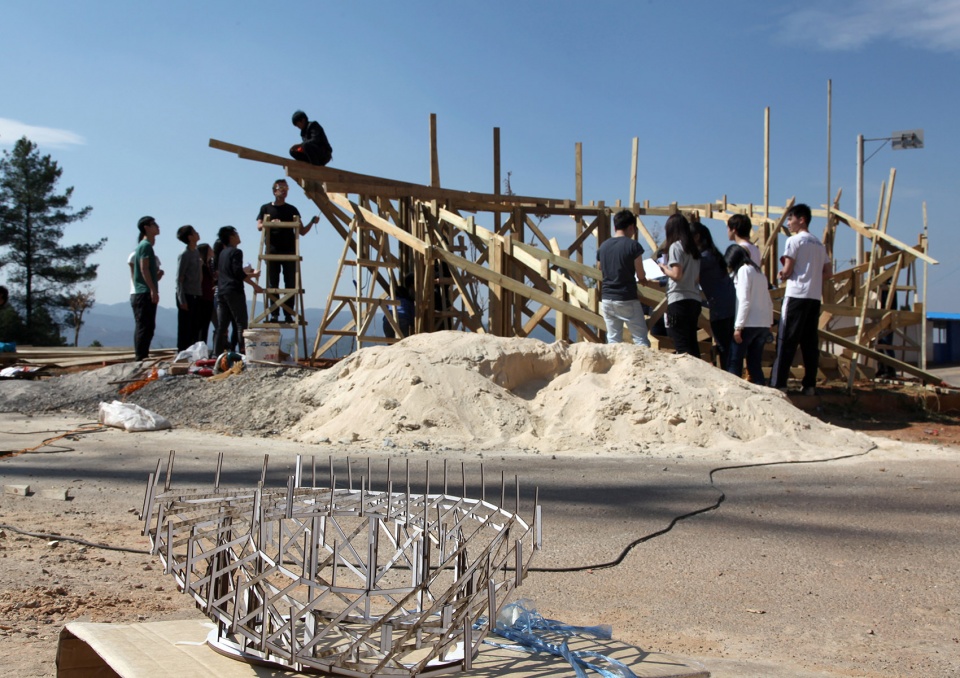
▼HKU Students and teachers designing and building on site © Olivier Ottevarere and John Lin
WHEN WE WERE IN SCHOOL – AND HOW IT DIFFERS FROM TODAY
KJY: I studied at the AA, where we were taught to carry out our own year-long research project since year one. Each student had to write their individual project brief, and finding own ways to research, and eventually we had to test our speculations as direct as possible. For example, building one to one prototype on site to test details, structure and behaviour, or hosting events to engage and observe the transformation in the neighbourhood. Speculations and representation of ideas, are not sufficient to pass the project review. Therefore, we identify architecture discipline as an action or as a progressive process rather than designing a product. This approach of year-long project consists of research, prototyping making and test directly on site is very much aligned with this new HKU programme.
This approach of architects writing our own project brief and finding ways to realise the project, has formed my practice methods of not relying on commissions. Also, the notion of architecture is not a product but a progressive action has led me to work in community development projects, where I have also learned that architectural education lacks holistic approaches to sustainable development and especially lacks providing platforms for collective explorations.
This new programme is not called Building Workshop or Building Studio, but The Building Society. Why do we want to emphasis on the notion of society in the new programme? How is this idea of society responding to new architectural education?
JL: Well, when you go to Cooper Union, there’s only 24 students every year. So the idea of a community is very embedded within the identity of the school, because there are so few people. Its very demanding that every student does an independent proposal. There’s a lot of competition, individuality and that’s how you learn. You learn from this collective – from a catalogue of different approaches and solutions to a given problem, not just your own project. I think that the sense of community is always in a school. It changes when you work with real communities, but the principle is there. But, let’s bounce this question back to Sam, because you’re a practitioner and educator. I was talking about the difference between two different educations, one which is the education you get in school and then an entirely education when starting to practice.
SJ: Looking back on what I’ve learned – or how I learned – is that a key part of the architecture is to imagine what architecture can be. Before architecture school I don’t think I really had an idea of what architecture was. It’s an esoteric subject even though it’s all around us, all the time. Part of architecture school was induction in this world. Beginning to see architecture as a history and a culture on one hand. How architectural drawings work. The process of design. But at the same time, I think the model that I was educated under – of what architecture was, or what an architect is, was quite fixed. Fixed in a late 20th century mode, where the architect had a certain role, projects had a particular process and briefs were assumed to be for a certain kind of building project. The idea of the job that we were heading towards was equally fixed. The way we would be employed, who we might be working for, what we might be working on and so on was assumed to be continuous with the generation that taught us.
But looking back, even then, that model was already outmoded. The traditional role of the architect has changed, even in straight forward building projects. The rise of design and build, of project managers, of corporate construction and development modes all mean that the architect has become something different.
While some lament this erosion of the old model, there is another way to imagine the possibilities of what an architect could be and of what architecture might do in the world. Perhaps the lack of such strict definition could be a good thing.
Maybe one of the first jobs you have as an architect or a designer, is to design yourself . Design what your practice could be. Design your relationship to the world, to other people, Design what your form of architectural practice might achieve.
Coming out of formal education began a process of trying to figure out how to relate to the world as a designer given the circumstances. Of figuring out a more specific definition of architecture responding to the specifics of time and place. It’s in that context that new ideas of architecture begin to take shape. That shape might be different in different situations, or with very different people.
JL: Where did you go to school?
SJ: I started first in the in the Macintosh in Glasgow, and then at the Bartlett in London.
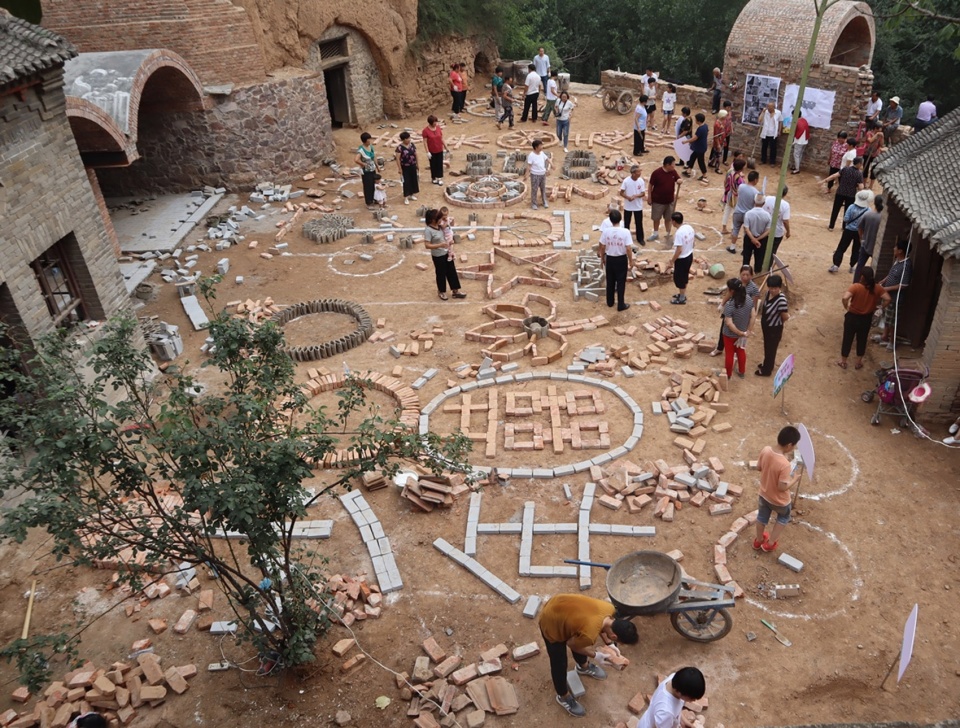
▼Collective construction in Zhoushan © Zhoushan Community and Jze Yi Kuo
THE CHANGING ROLE OF THE ARCHITECT
JL: Sam, you brought up the issue of power. And I think this is really important because, does the school have the responsibility to try and empower the architect? If you ask me, I think the program is about finding ways to do this. So I wanted to ask the both of you, what strategies or methods can the architect use to reclaim power? As opposed to the traditional idea of the grandiose architect who is empowered by a patron or client.
SJ: I think there’s so many other possibilities beyond The Fountainhead caricature of the heroic individual that has pervaded architecture in different ways for so long. Other ways to think, work and organise.
Perhaps that starts with imagining other ‘how’s’. Different kinds of agency. Different ways for architecture to intersect, respond and make the world. Asking what role architecture can have in the world, what kind of things can it make happen, what things it can improve in our lives. Sometimes that might mean like throwing out the accepted rule book. Maybe it’s not about building walls. Perhaps it’s how you paint the wall. What you hang on the wall. How you lean on the wall.
In a strange way architecture is a very weak discipline. Yet it’s very broad. Its lack of definition is perhaps its strength. It means architecture can engage with the world in all of its breadth – from the very small to incredibly massive, things that are ephemeral to things that last forever. Things that are intimate to things that are public.
Maybe architectures real agency is recognizing that the built environment is an expression of society, of organization, politics, and social relations. And these ideas are embedded at every scale. Even the smallest of projects is able to engage with profound ideas about how architecture makes the world.
I find this endlessly optimistic. Full of possibilities.
Maybe this something you are thinking about in terms of establishing The Building Society an experiment. It can keep changing. It can keep evolving. It doesn’t have to be the same even year to year. Maybe responding to external changes. Or it mutates from the inside as its interests and ways of working change.
JL: Kuo, your practice is very interesting because on the surface it seems to disempower the architect as a result of working collectively. But I actually think that is part of a larger strategy for how the architect partners with a community of people – your real client. By stepping back, and allowing the villagers to participate in the design, is a way for you to empower the role of design. So could you talk a little about your understanding of power? And about how you see your role as an architect?
KJY: My practice works focus on community development, where we try to achieve collective goals towards social, cultural and environmental improvements. This is very difficult to do from a traditional architects’ role which is focused on designing buildings. Therefore, we have to learn to collaborate with the locals and learn from the locals, including local values, skills, local resources and finding collective solutions. So, I see architect’ role more like a project participant who has sensitivity to ask questions about what is the relationships between culture, habits, material, skills, nature and space, and then the architect has the ability to construct relationships through building activities. Our power would be even more powerful if we invites others to empower ourselves, and of course finding way to empower the others.
One thing I think needs to be addressed in current architectural education is that we are trained to be individualist, this is somehow damaging in current development. We would need to find a new format for collective teaching and learning, and even combine education activity with practice in order to be more effective. The ideal situation is to organise education process (research and design) in the form of practice, directly engaging the productions of the teachers and students in the society. A school that generates and realises dreams at the same time, this could be an alternative architectural approach.
▼Building workshop in Fujian © Rural Urban Framework
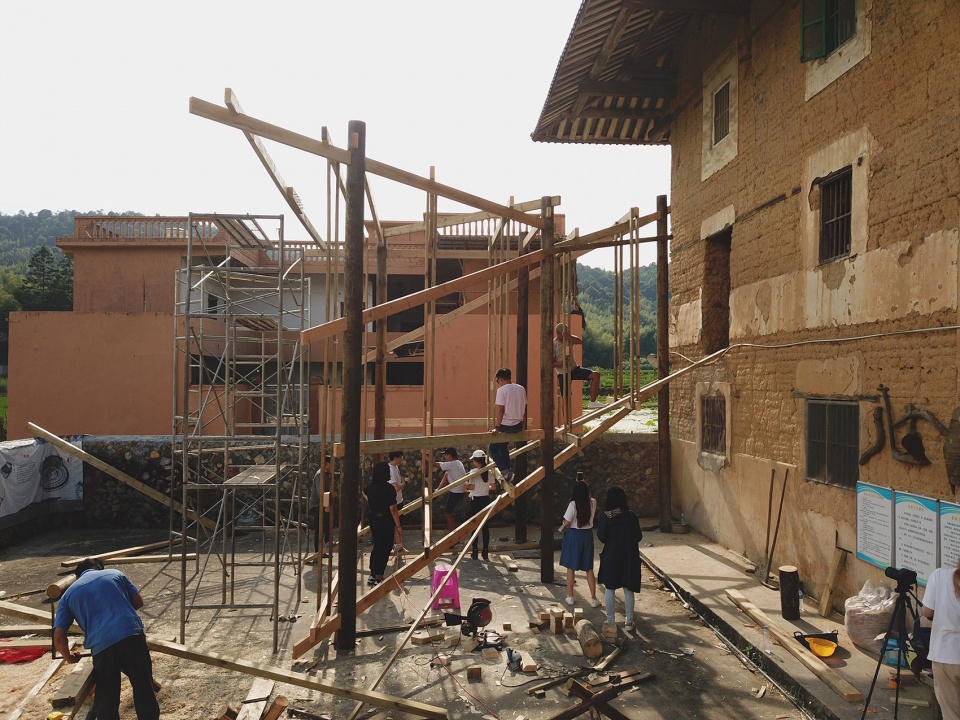
DCIM100MEDIADJI_0052.JPG
The role of teachers and students and the question of where does knowledge come from?
SJ: The traditional model has the master teacher who tells the student how to do things with the students expected to follow in their footsteps. A very top down way of educating.
It feels like what you guys are talking about is different. Even the name ‘The Building Society’ suggests something more mutual. That the relationships and mechanisms of how it might educate, or how it produces knowledge, how it shares knowledge would work in a different way.
Reconfiguring the relationship between teacher and student is, opening up the roles of both and placing the idea of school in a different context so that its boundary is more porous feel like parts of the experiment you are setting up.
JL: Sometimes a school is about insulating you from, or suspending the real world. But on the contrary, the program we’re setting up now is about bringing the real world into the studio or the studio directly into the world. And in the process of doing that, challenging the teacher / student hierarchy. At the heart of it we’re talking about knowledge in relation to research. In our own experience, research is the first step to generate knowledge, which allows you to build. When you work closely with communities, you cannot bring your own knowledge from your school, your teachers. It comes from a research process that was done collectively, and that is how we can respond to some of the challenges of today’s world.
KJY: What specific challenges are we talking about? What knowledge do we need to research/equip ourselves as an architect right now?
JL: I can give you an example of a project happening right now. It’s a renovation of underground houses in North Western China, in Sanmenxia. In this project I’m working with Lidia Ratoi and Olivier Ottevaere (who are also going to be part of the teaching faculty of the Building Society). The project is responding to a reality, which is that 2 years ago the area had the heaviest rains in recorded history, and because they had no drainage, suddenly these underground houses became flooded like swimming pools – they couldn’t respond to climate change. So, when we talk about new knowledge, I’d rather talk about the challenges that are creating new problems. There was nothing wrong with these houses before, but now suddenly, a typology which lasted more or less intact for a thousand years, is now being challenged as a way of living.
There’s other challenges – like the urbanization of the rural. People have new kinds of desires, needs, lifestyles, and we’re responding to that as well, as a school. We think that you need to have a new school to deal with these emerging challenges. Climate change is, of course, very big, but there are also societal transformations. Political transformations. The way society has changed as a driver for how you design.
And there is also the technological component. Technology – it’s changing so fast. Just in recent years we’ve seen the rise of AI, and I don’t want to speculate on any of that, but I’d say you either embrace it or resist it. But our school is interested in making in a physical sense, as opposed to speculating – going back to the core knowledge that architects do have – which is how to build. Going into various places, learning how to build from others, beginning to transform information into process. It’s very much about something which this kind of technology cannot duplicate at all.
SJ: Yeah, that’s interesting. Perhaps it’s a question of what knowledge might be, where might it be found and how it might be created. Maybe it’s a product of context. Within the academy, architecture naturally wears an academic cloak, right? Maybe less practical and more theoretical. A distinction is often made between what happens in school and what happens professionally.
But it’s a false distinction. Architecture as a discipline sits somewhere between the practical and an art form. And its in the dual and simultaneous practice that its ideas emerge. How you put on material next to another can be highly theoretical. How you fix things together can be a grand political statement, or a cultural comment at the same time as being a way of building.
The way you make something is not just practical. It’s also an idea. It’s also an idea about how the world can be, or what a community can become.
JL: I think for me the primary change and shift in the way in which the architect works with knowledge could be expressed by, for example, Frank Lloyd Wright when he did Falling Water. He had people go and literally draw every rock and plant and stone. There was this idea that only through deep exploration of the site the architect can transform and create an appropriate response. In today’s world, that’s not enough; it’s now important to include things which are happening on site but are not visible – economically, politically, socially, climatically, etc. And I think that’s where research comes in.
The architect working in this newer, more complex and expanded field has to have many different kinds of skills and the ability to uncover this kind of knowledge. Our program is in a way two different schools. It’s a school which is very much about deepening the kind of physical and inherent knowledge that architects need to know in order to build. But it’s also a school which is about research and research methods. We’re thinking also about other sciences and interdisciplinary forms of research such as architectural ethnography which has emerged as a crucial tool of the architect today.
▼Traditional House of the Future © Lidia Ratoi and John Lin
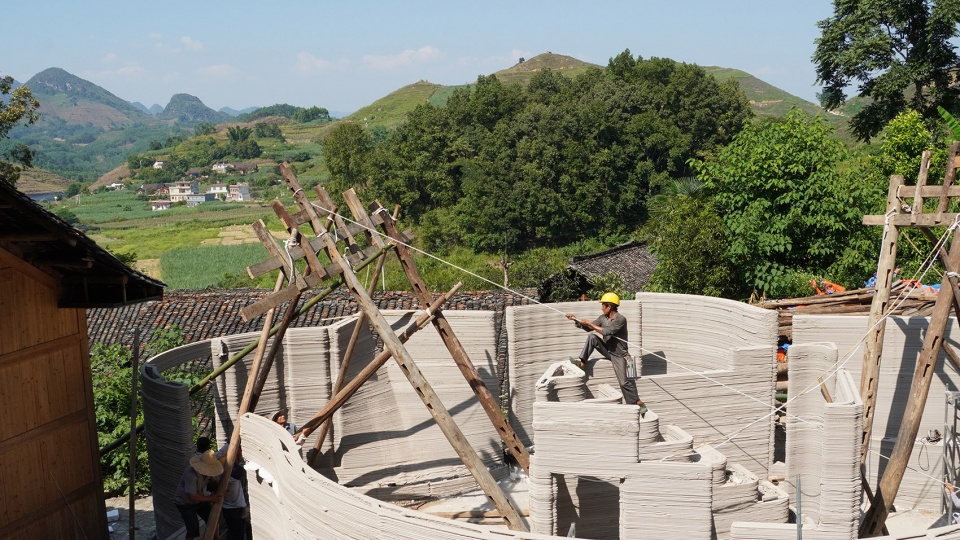
Confronting today’s urgent challenges and the idea of research
KJY: We know the challenges we face nowadays is not just about building design problem, but much larger issues. And there is a very specific approach about MAKING in the new programme. We are going to focus on making/building as a way of research, and as a way to respond to the larger challenges. Although I am not sure if making is still one the best ways for architects to carry out research, but for myself, physical modelling is the only way I can be precise to test and develop ideas. Such a basic skill of making, seems to be losing its presence due to AI, computer modelling and the cost implication of making. Why do we still want to embrace this traditional skill in the new school? Are we trying to resist new technology and the monotonous of mass production?
JL: Traditionally, the architect was not only the designer but the expert builder – the conceptual and physical development of the building was hand-in-hand. The renaissance architect was a builder, engineer and painter. Gradually, the professionalization of the architect means that the role of the designer, engineer and builder has become very separate. This is being enabled by technology.
We have to take a position on technology. For example, vernacular architecture has a lot to teach us about living sustainably – through lifestyle choices and habits alongside technological innovation. So there are ways to resist the compartmentalization of the profession of the architect. This is also happening when it comes to research. But on the other hand, together with Lidia Ratoi, who will be joining our program next year, we’ve recently made a project about breaking down categories. We made a project where she took one of her specialties, digital fabrication, and brought a robot to a remote site in rural Guizhou province. We tried to demonstrate that the robot and the traditional carpenter could work together to strengthen the unique advantages and inherent flexibility of these two very different ways of building. This project was called, “The Traditional House of the Future”. Its one of the themes we hope to continue to explore within this program. Its both hi-tech and lo-tech…resulting in a project with a lot of social participation.
So, I think there is a lot of potential in experimenting with ways to combine different forms of research. Unlike other schools, which may be focused on a particular type of research culture or building culture, we are trying to bring the two aspects together and engage the social contract of the architect: hence the building society.
SJ: Architecture takes place slightly in the future. We are always working on thing that are going to happen right? Which means you are always thinking or modelling the world as it will be.
Often in education there’s an abstract idea of what that model is – and of what the model of an architect should be. But rather than trying to impose a model onto the world, perhaps there are ways to create a more productive dialogue. A way of making those models less abstract and more engaged.
Mabe its then that ad hoc surprises and the kind of strange hybrids you’re talking about begin to occur. Maybe it’s in recognising the possibilities of the un-ideal. Maybe architecture is something you can discover rather than try to impose. A little like Venturi and Scott Brown taking their Yale students to Las Vegas – at the time the absolute opposite of capital A architecture – as an experiment in trying to recognize its real architectural and urban qualities.
JL: Sam, one of the aspects about “Learning from Las Vegas”, is that Venturi and Brown thought about a new way to document the city – a simple hypothesis about experiencing the city through the car and mounting a camera on the car as the first approach to this city. So the method is invented to suit the context. I think that’s very important. And I think we’re going to try and have an attitude about experimentation, to invent the kinds of tools we need. So the research is not necessarily done with standard methods about part of the research process is the invention of new methods and approaches.
KJY: What kind of new school do we want? How do you want the school to be different from the school you know? Otherwise, there is no point to create a new programme.
JL: For me, it’s very simple. We’re not going to teach. We’re going to find new ways to learn together. Because the school is shaped by the kinds of problems we want to tackle – these don’t have easy or expected solutions already. That’s why the spirit of experimentation is so important. And in this school, with you, Kuo and Sam in the future, we will lead the process through our former experiences, but explore something we don’t know yet.
KJY: To me, this is a school not going to look for right answers but to look for inspiring questions. I think the problem we face is that we have been living a world that chases future solutions but miss the chance to enjoy the present time.
SJ: Yeah, I think I think it’s really interesting. I mean, a generation of students have lived through so many crises. Perhaps that frames their questions and their ambitions for architecture?
For me, architecture and design is much more than providing solutions. But it’s also not just asking questions. It’s something in between. Which I think is very productive.
What’s exciting about the Building Society is its positive engagement with the world. A form of education that sits explicitly in context. A combination of the realities of practice with the imagination of education. Something very real, yet also exceeding the typical realties of architecture.
That exists in a terrain that more difficult to define. Or rather that the things, knowledge, skills and ideas that it will generate will emerge out of its own actions and relations. Creating a space that allows students and teachers to think through the kinds of issues they face.
Maybe that’s what you guys are talking about. A thing you can’t define at the beginning of an endeavour. A thing you can only discover along the way. A thing that unlocks, or enables. Not as simple as an answer, but also not just rhetorical. Something productive rather than reductive, a new proposition that itself provokes new ways of being in the world.


实践性很足
DK