感谢 同济大学建筑设计研究院 对gooood的分享。更多关于:TJAD on gooood
Appreciation towards TJAD for providing the following description:
全国社区花园设计营造竞赛与社区参与行动始于2021年,在中国风景园林学会、上海市风景园林学会的指导下,同济大学景观学系协同《中国园林》杂志社和全国风景园林院校联合举办,旨在响应国家“人民城市”“健康中国”战略与城市更新行动,推动公众参与城市公共性生产。行动秉持开放共享的核心精神,创新采用共享文档搭建交流平台,推动各参与团队相互学习、经验互通;同时设立公共导师团开展开源支持,为参赛队伍提供专业指导与资源帮扶,2025年更与小红书设计周开源城市计划深度合作,进一步拓宽开源协作边界,让园林设计营造的智慧与经验在开放生态中持续生长。本届竞赛以“百姓园林,共生发展”为主题,贯彻落实中国风景园林学会倡导的“百姓园林”核心行业理念。推动园林建设回归大众、服务民生,实现共建共治共享,2025年学会年会主题“百姓园林 乡土风景”也在业内形成了广泛共识。秉承以人民为中心的发展思想,本次竞赛以待改造的城乡绿地空间为实践载体开展社区参与式花园设计、营造实验,不仅是为了优化城市空间、提供休闲场所,更深层的意义在于发动基层力量参与,将“园林即生活”的愿景转化为社区层面的具体行动,大学生与社区居民、商户等形成合作团队进行共创,从而增强社区凝聚力,并系统探索人与自然、社区与城市的和谐共生之道,是学会理念从行业倡议转化为人才培养和社会参与的关键实践。
Initiated in 2021 under the guidance of the Chinese Society of Landscape Architecture (CHSLA) and the Shanghai Landscape Architecture Society, the National Community Garden Design and Community Engagement Competition and Action is jointly organized by the Department of Landscape Architecture at Tongji University, the Chinese Landscape Architecture journal, and landscape architecture schools nationwide. It aims to respond to the national “People’s City” and “Healthy China” strategies and urban renewal initiatives, promoting public participation in urban public space production. The action upholds the core spirit of openness and sharing, innovatively using shared documents to build communication platforms, encouraging participating teams to learn from each other and share experiences. Simultaneously, a public mentor group is established to provide open-source support, offering professional guidance and resources to participating teams. In 2025, a deeper collaboration with the PRDC Design Week City Open Source Project further broadens the boundaries of open-source collaboration, allowing the wisdom and experience of landscape design and construction to continuously grow within an open ecosystem. This year’s competition, themed “People’s Landscapes, Symbiotic Development,” implements the core industry concept of “People’s Landscapes” advocated by CHSLA. It aims to promote landscape construction returning to the public, serving people’s livelihoods, and achieving co-construction, co-governance, and sharing. The 2025 CHSLA annual conference theme, “People’s Landscapes, Vernacular Landscapes,” has also garnered broad consensus within the industry. Adhering to the people-centered development philosophy, the competition takes urban and rural green spaces to be renovated as practice carriers for community-participatory garden design and construction experiments. It not only optimizes urban spaces and provides leisure venues, but more importantly mobilizes grassroots participation, turning the vision of “Landscape is Life” into concrete community actions. University students collaborate with community residents, merchants and other stakeholders to co-create, strengthening community cohesion and systematically exploring harmonious symbiosis between humans and nature, communities and cities. It is a key practice translating the society’s philosophy from industry initiatives into talent cultivation and social engagement.
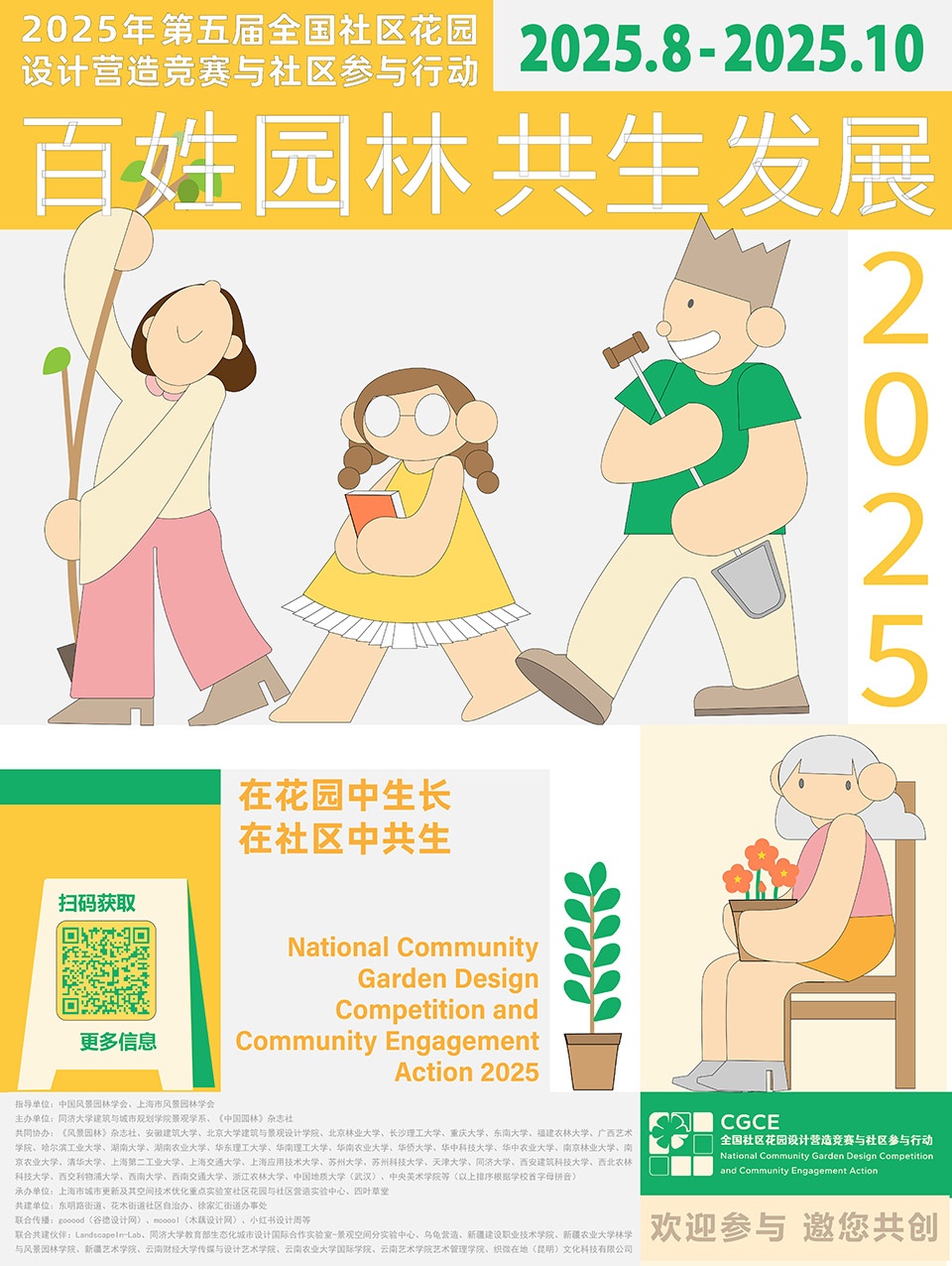
▼活动海报,Activity poster © 全国社区花园设计营造竞赛与社区参与行动参与团队
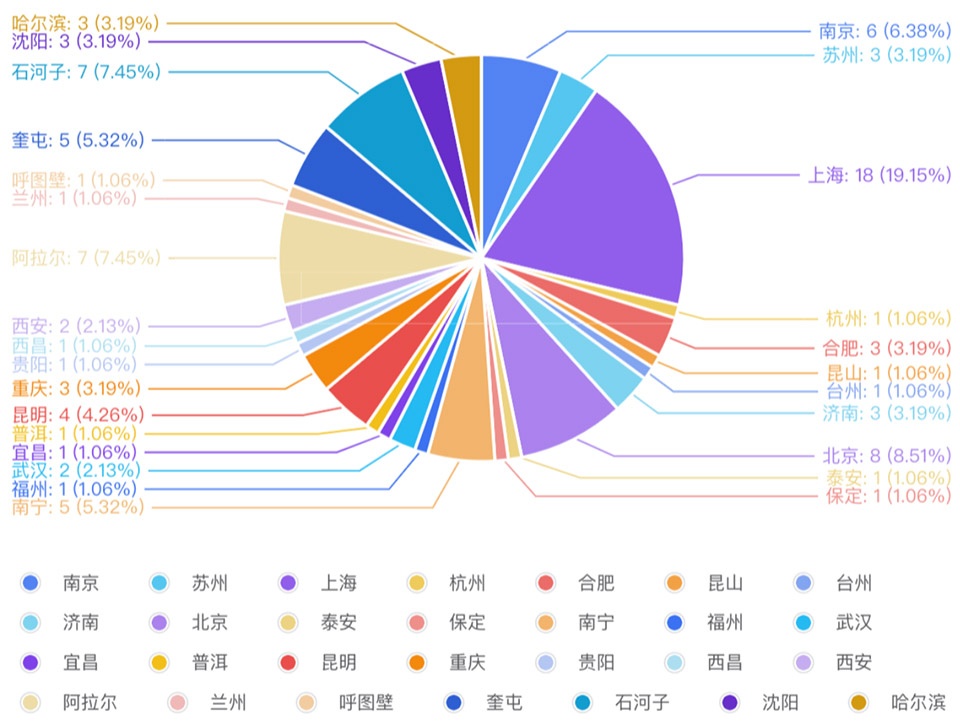
本届行动覆盖全国36个城市,合计93所院校的115个小组参与落地了86个社区花园,总参与人数近千人,共累计开展上千场活动。其中以上海、北京、石河子、阿拉尔、南京等城市报名最多。花园主题多以共建共享、儿童友好、自然疗愈为主。
This year’s action covered 36 cities nationwide, with 115 groups from 93 institutions participating in the establishment of 86 community gardens, involving nearly a thousand people and conducting over a thousand activities. Cities with the highest number of registrations included Shanghai, Beijing, Shihezi, Alar, and Nanjing. Garden themes mainly focused on co-construction and sharing, child-friendliness, and natural healing.
▼参与地区,Participating regions © 全国社区花园设计营造竞赛与社区参与行动参与团队
本届竞赛共报名115组,落地花园经45位专家、13位往届参赛代表、小组互评等,三项综合评审后,评选出一等奖1组、二等奖3组、三等奖5组、特别专题奖27组,获奖名单已经于2025年11月19日学会年会期间经特别论坛一:百姓园林理念与实践现场予发布。获奖项目涵盖儿童友好、自然疗愈、代际融合、零碳循环、非遗传承等多个方向,展现了社区花园作为公共空间在促进社区凝聚力、生态教育与可持续运营方面的多元价值。活动不仅提升了公众参与城市更新的积极性,也为高校与社会协同育人提供了实践平台,体现了“园林即生活”的深层内涵。
A total of 115 groups registered for this competition. After comprehensive evaluation by 45 experts, 13 previous competition representatives, and peer review among groups, the winners were selected: 1 first prize, 3 second prizes, 5 third prizes, and 27 special topic awards. The award list was announced during the CHSLA annual conference on November 19, 2025, at the Special Forum 1: People’s Landscapes – Concept and Practice. The winning projects covered diverse directions such as child-friendliness, natural healing, intergenerational integration, zero-carbon cycles, and intangible cultural heritage inheritance, demonstrating the多元 value of community gardens as public spaces in promoting community cohesion, ecological education, and sustainable operation. The activity not only enhanced public enthusiasm for participating in urban renewal but also provided a practical platform for collaborative education between universities and society, reflecting the deep connotation of “landscape as life.”
行动展示
Project Showcase
一等奖
First Prize
共生·“味”来花园
Symbiosis·”Wei” Lai (Taste/Future) Garden
地点:南宁
Location: Nanning
指导老师:何贤福-南宁市南湖公园、贺光辉-南宁市卉芫园林有限责任公司、陈炜-南宁市卉芫园林有限责任公司
Instructors: He Xianfu – Nanning Nanhu Park, He Guanghui – Nanning Huiyuan Landscape Architecture Co., Ltd., Chen Wei – Nanning Huiyuan Landscape Architecture Co., Ltd.
华南-04小组:邓丹丹(组长)、朱莎莎、吴迪妮、周森、孙冬、欧永聪、阮丽娜、韦灿斌、缪琳、施永杰、金小燕、徐源江
South China-04 Team: Deng Dandan (Leader), Zhu Shasha, Wu Dini, Zhou Sen, Sun Dong, Ou Yongcong, Ruan Lina, Wei Canbin, Miao Lin, Shi Yongjie, Jin Xiaoyan, Xu Yuanjiang
方寸花园里的 “建园为民”
“Building Gardens for the People” in a Small Space
“我们不懂怎么做社区花园”,曾是我们的迷茫。建一座小花园不难,难的是与社区、企业共建时如何做出亮点与创新,可我们也因此陷入误区。一次与社会工作者的座谈,让我们跳出 “如何建得好看” 的执念,开始思考园林能否解决社会问题。我们发现,社区花园不止于绿化,更是居民生活的延伸空间,承载休闲、社交、科普等多重功能,契合公园 “建园为民” 的理念与管理提质要求。作为城市公共空间的微缩样本,它的在地性、参与性与共建共治实践,能为公园建设提供鲜活启示。由此我们提出 “大花园带动小花园、小花园引领大花园”:依托南湖公园的专业资源与影响力,激活社区花园,将节约型园林、零碳理念等落地,使其成为百姓园林的实验场,反哺公园管理服务。我们的营造工作,也演变为探索园林社会与功能属性的实践。我们重新以需求为导向,通过调研、访谈协调资源,将社会效益与功能置于美学之上;角色也从 “决策者” 转为协作者与资源连接者,前期搭框架,后期引导居民参与。花园的状态随动态设计、植物生长而变化,居民才是其核心。
“‘We didn’t know how to build a community garden’ was our initial confusion. Building a small garden isn’t difficult; the challenge lies in creating highlights and innovations when co-building with communities and enterprises, and we fell into this trap. A discussion with social workers helped us move beyond the obsession with ‘how to make it look good’ and start thinking about whether landscaping could solve social problems. We discovered that community gardens are more than just greening; they are extensions of residents’ living spaces, carrying multiple functions like leisure, social interaction, and science education, aligning with the park’s concept of ‘building gardens for the people’ and management quality improvement requirements. As a microcosm of urban public space, its locality, participatory nature, and co-governance practices offer fresh insights for park construction.” “From this, we proposed ‘large gardens driving small gardens, small gardens leading large gardens’: leveraging the professional resources and influence of Nanhu Park to activate community gardens, implementing concepts like economical landscaping and zero carbon, making them experimental fields for people’s landscapes, and in turn enhancing park management services. Our construction work evolved into a practice exploring the social and functional attributes of landscaping. We reoriented oriented ourselves towards needs, coordinating resources through research and interviews, prioritizing social benefits and functions over aesthetics. Our role shifted from ‘decision-maker’ to collaborator and resource connector, setting the framework initially and guiding resident participation later. The garden’s state changes with dynamic design and plant growth; residents are its core.”
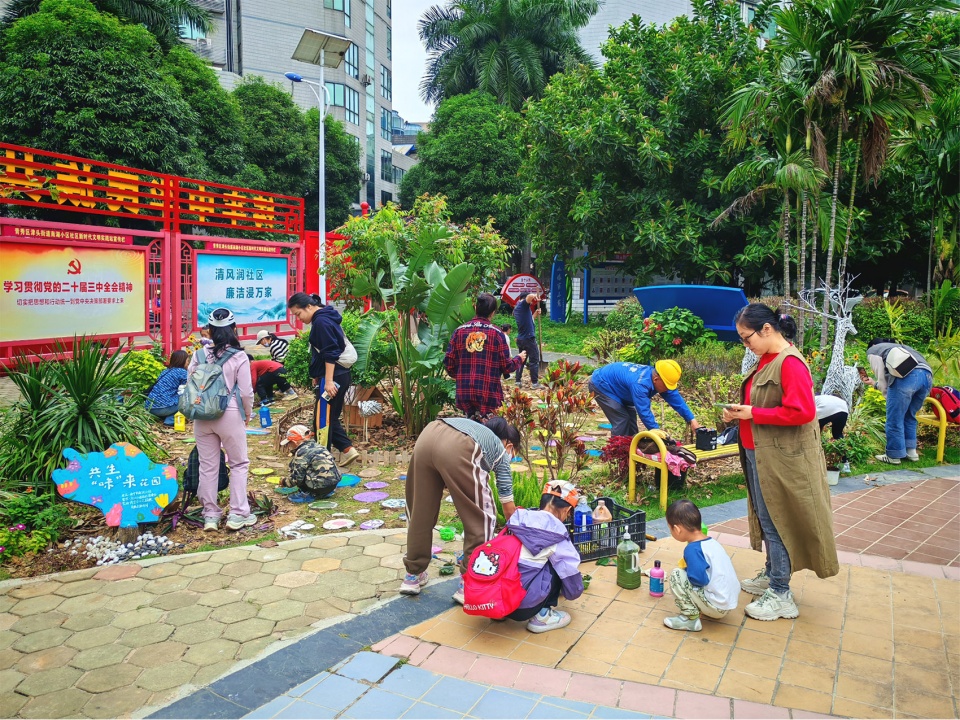
▼活动过程照片,Activity process photos © 全国社区花园设计营造竞赛与社区参与行动参与团队
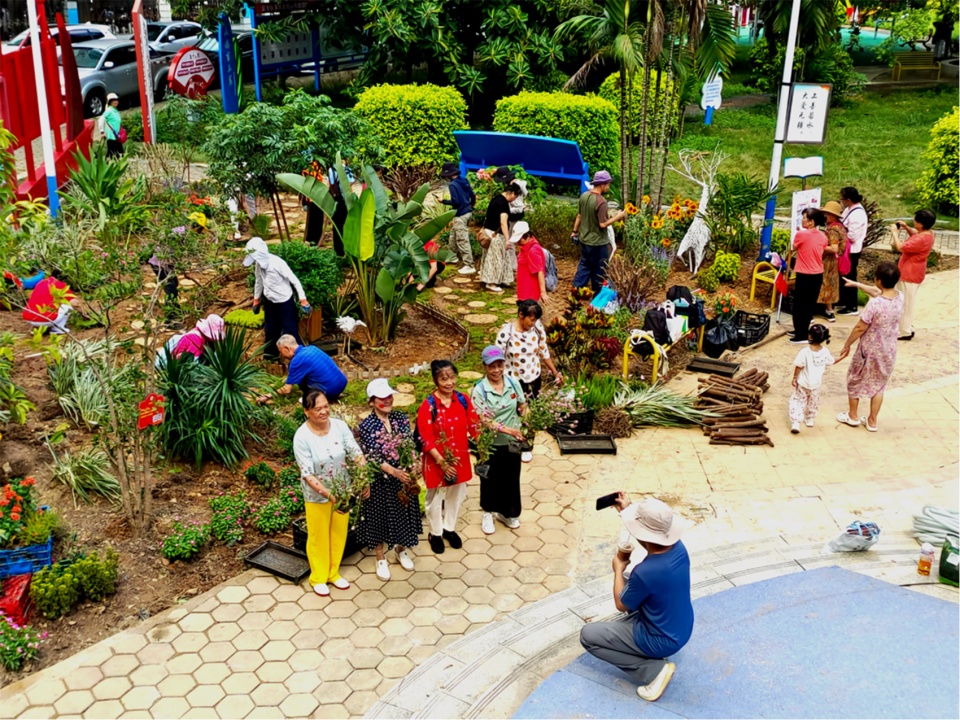
动人的故事总在计划之外:旁观的工人孩子、路过的奶奶、玩耍的孩子与老党员纷纷加入,一句 “我可以加入吗” 成为最美回响,居民的自发参与让花园真正 “属于大家”。幼少青中老在此相聚,重建社会关系,而非仅完成空间改造。社区花园的核心启示是 “人” 的回归:当公园成为公众可参与、共建、共享的生活空间,“公” 便有了生动注脚。唯有让百姓园林扎根公众生活,才能守住建园为民的本质。
“Moving stories always happen beyond the plan: a worker’s child watching from the sidelines, a passing grandmother, playing children, and an elderly party member all joined in. The words ‘Can I join?’ became the most beautiful echo. The residents’ spontaneous participation made the garden truly ‘belong to everyone.’ The young, children, adults, and elderly gather here, rebuilding social connections, not just completing a spatial transformation. The core revelation of the community garden is the return of ‘people.’ When a park becomes a living space that the public can participate in, co-build, and share, the word ‘public’ gains a vivid footnote. Only by letting people’s landscapes take root in public life can we uphold the essence of building gardens for the people.”
▼活动过程照片,Activity process photos © 全国社区花园设计营造竞赛与社区参与行动参与团队
评委评语:该作品以“共生·味来”为主题,成功将一处荒废绿地转化为融合民族特色、生态功能与社会活力的社区花园。项目通过公园、社区、企业多元共建,巧妙运用旧物改造与本土植物,在兼顾生态环保与实用功能的同时,深度回应“一老一小一新”群体的需求,构建了充满邻里温情的友好空间。其机制成熟、参与广泛,以系统的设计和清晰的运维策略激发了居民的持续参与,实现了“小花园引领大社区”的示范效应,生动诠释了“共生发展”理念。
Judge’s Comment: This project, themed “Symbiosis·Future,” successfully transformed a neglected green space into a community garden integrating ethnic characteristics, ecological functions, and social vitality. Through multi-party co-construction involving the park, community, and enterprises, and skillfully using recycled materials and native plants, it balanced ecological protection with practical functions. Deeply responding to the needs of the elderly, children, and new community members, it created a friendly space full of neighborly warmth. Its mature mechanisms and broad participation, combined with systematic design and clear operational strategies, stimulated continuous resident engagement, achieving a demonstrative of “small gardens leading the big community” and vividly interpreting the concept of “symbiotic development.”
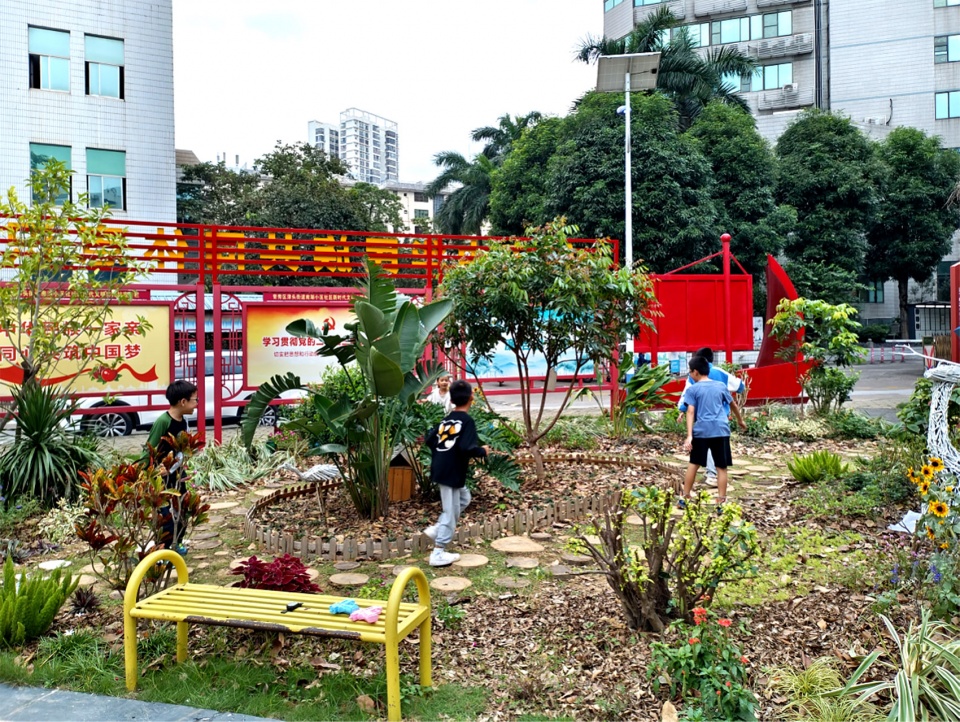
▼场地照片,Site photos © 全国社区花园设计营造竞赛与社区参与行动参与团队
二等奖
Second Prize
成长花园
Growth Garden
地点:北京
Location: Beijing
指导老师:陈宇琳-清华大学、谈小燕-中共北京市委党校、钱云-北京林业大学
Instructors: Chen Yulin – Tsinghua University, Tan Xiaoyan – Beijing Municipal Party School of CPC, Qian Yun – Beijing Forestry University
华北-03小组:李华(组长)、张基政、常闻桐、刘一鲁、王紫莹、赵原、李瑜、邵志平、刘红健
North China-03 Team: Li Hua (Leader), Zhang Jizheng, Chang Wentong, Liu Yilu, Wang Ziying, Zhao Yuan, Li Yu, Shao Zhiping, Liu Hongjian
基于社群情感需求的老旧社区微更新
Micro-renewal of an Old Community Based on Emotional Needs
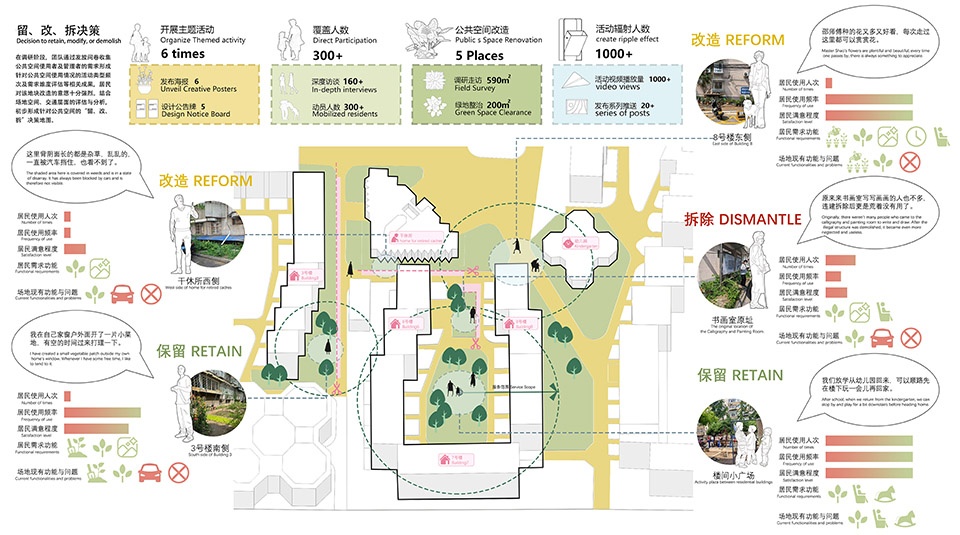
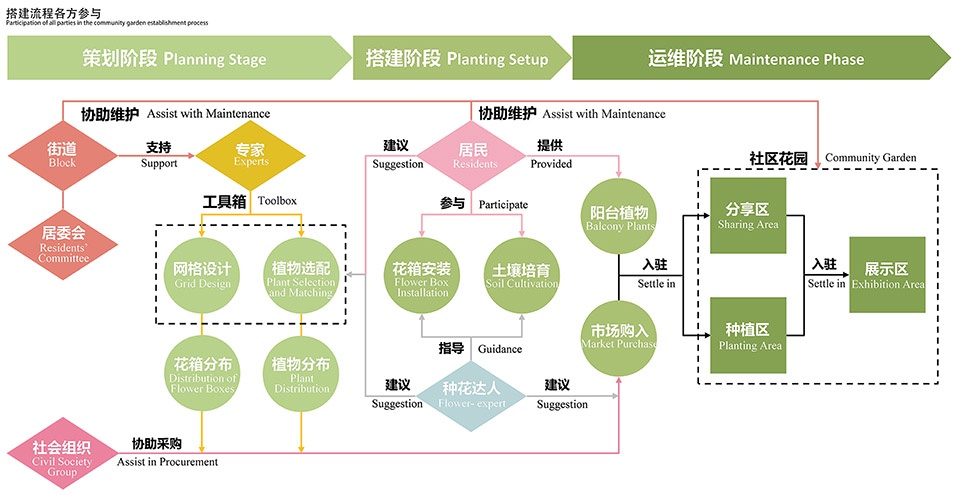
成长花园位于北京市海淀区安宁里社区,是一个充满活力与温情的“参与式共建花园”。面对社区产权复杂、公共空间不足、居民诉求多元等现实挑战,项目以“大家商量着办”为根本遵循,启动“安宁里绿色成长计划”,旨在通过一系列小尺度、低成本、共建式的社区营造行动,激活居民自组织能力、增强公共空间活力,进而促进居民之间的关系重建。团队依托INPA系统方法论有序推进社区营造。In-深入社区调研,绘制“留、改、拆”决策地图;Needs-通过问卷访谈明确居民核心需求;Public-举办参与式设计工作坊,吸引居民深度参与并发掘社区园艺达人;Action-组建护花志愿队,建立长效运维机制,推动居民从旁观者转变为社区治理的参与者。
Located in Anningli Community, Haidian District, Beijing, the Growth Garden is a vibrant and warm “participatory co-built garden.” Facing challenges such as complex property rights, insufficient public space, and diverse resident demands, the project adhered to the principle of “discussing and deciding together” and launched the “Anningli Green Growth Plan.” It aimed to activate residents’ self-organization capacity, enhance the vitality of public spaces, and promote the rebuilding of relationships among residents through a series of small-scale, low-cost, co-constructed community building actions. The team systematically advanced community building using the INPA methodology: In-depth community research, mapping decisions for “retention, renovation, demolition”; Needs-identified core resident needs through questionnaires and interviews; Public-held participatory design workshops, attracting deep resident involvement and discovering community gardening enthusiasts; Action-formed a volunteer flower care team, established a long-term operation and maintenance mechanism, transforming residents from bystanders into participants in community governance.
▼设计策略,Design strategy © 全国社区花园设计营造竞赛与社区参与行动参与团队
▼共建流程图,Co-construction flowchart © 全国社区花园设计营造竞赛与社区参与行动参与团队
项目成功将闲置空间改造为集休憩、观赏、社交功能于一体的社区微花园,在美化人居环境的同时增强社区凝聚力。近百名居民主动参与花园共建、志愿维护等活动中,护花志愿队持续壮大,社区认同感与公共意识显著提升。“安宁里绿色成长计划”不仅是一次空间改造,更是一场以社群情感为纽带、以居民为主体、以协商协作为基础的社区共建实践。它逐步探索出一条老旧社区可持续更新的路径,在尊重居民意愿、促进人际联结的过程中,推动实现人与环境、人与人的和谐共生,迈向更具归属感的美好社区生活。
The project successfully transformed idle space into a community micro-garden integrating rest, viewing and social functions, beautifying the living environment while strengthening community cohesion. Nearly 100 residents actively participated in co-construction and volunteer maintenance. The volunteer team kept growing, and community identity and public awareness improved significantly. The “Anningli Green Growth Plan” is more than spatial renovation — it is a community co-construction practice bonded by community emotions, led by residents and based on consultation and collaboration. It gradually explores a sustainable renewal path for old communities. Respecting residents’ wishes and promoting human connections, it advances harmonious symbiosis between people and the environment, and between people, moving toward a better community life with a stronger sense of belonging.
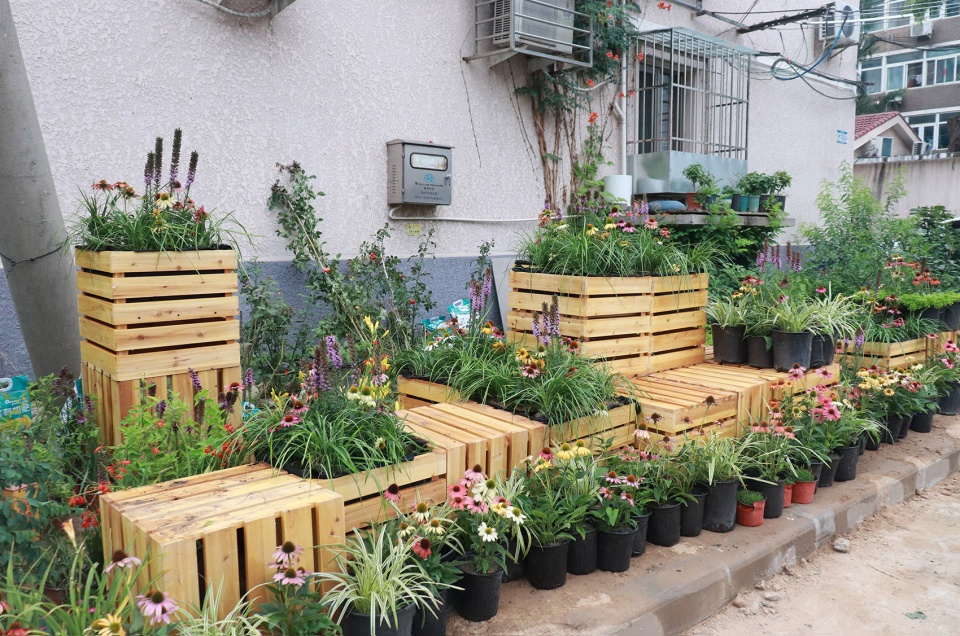
▼场地照片及活动过程,Site photos and activity process © 全国社区花园设计营造竞赛与社区参与行动参与团队
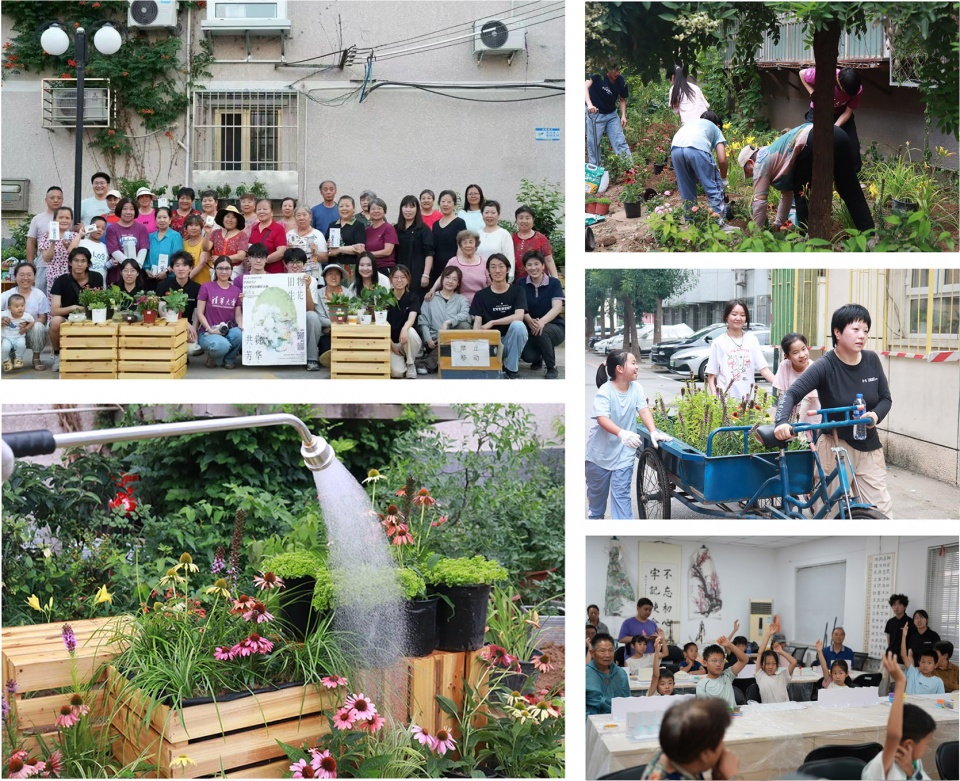
评委评语:该项目以其将花园营造深度融入社区治理的创新实践而独具价值,通过“旧物焕新”的情感化设计激活公共空间,并以“村民自治公约”等机制破解产权复杂、空间紧缺的治理难题。项目依托扎实的社区调研与持续的多元协作,系统运用INPA等方法论,通过“一册五牌”运维设计、社区画展等丰富活动,有效激发了居民参与并提升了自治能力,实现了环境改善与社区凝聚力的同步提升。其以低成本、可复制的模式,为“共生发展”理念提供了兼具治理智慧、人文温度与扎实成效的优秀范本。
Judge’s Comment: This project is uniquely valuable for its innovative practice of deeply integrating garden construction into community governance. It activated public space through the emotional design of “renewing old items” and addressed governance challenges like complex property rights and space scarcity through mechanisms like “Villagers’ Autonomy Convention.” Relying on solid community research and continuous multi-party collaboration, it systematically applied methodologies like INPA. Through rich activities such as the “one booklet, five signs” O&M design and community art exhibitions, it effectively stimulated resident participation and enhanced self-governance capacity, achieving simultaneous improvement in the environment and community cohesion. Its low-cost, replicable model provides an excellent template for the “symbiotic development” concept, combining governance wisdom, humanistic warmth, and solid results.
▼场地照片及活动过程,Site photos and activity process © 全国社区花园设计营造竞赛与社区参与行动参与团队
百味农场
Baiwei Farm
地点:南京
Location: Nanjing
指导老师:赵迪-天津大学、文乔-南京朴育生态科技有限公司、张敏-朴育生态
Instructors: Zhao Di – Tianjin University, Wen Qiao – Nanjing Puyu Ecological Technology Co., Ltd., Zhang Min – Puyu Ecology
华东-28小组:范盟恩(组长)、万飞、张雅、米粒、邱明莉、顾晓燕、吴慧
East China-28 Team: Fan Meng’en (Leader), Wan Fei, Zhang Ya, Mi Li, Qiu Mingli, Gu Xiaoyan, Wu Hui
从荒芜屋顶到“百味农场”:一所学校的共建共生实践
From Barren Rooftop to “Baiwei Farm”: A School’s Co-Construction & Symbiosis Practice
在南京市金陵河西学校的屋顶上,曾经闲置的“灰空间”,如今已蜕变为充满生机的“百味农场”。这不仅仅是一个共建花园项目,更是一次关于教育创新与生态可持续的生动实验。设计团队从儿童视角出发,围绕“教育+生态+共建”的设计策略,以 “参与式、跨学科、可持续”为导向进行花园共建的创新实践。
On the rooftop of Nanjing Jinling Hexi School, a previously idle “gray space” has transformed into a vibrant “Hundred Flavors Farm.” This is not just a co-built garden project but a vivid experiment in educational innovation and ecological sustainability. Starting from a child’s perspective, the design team centered on the “Education + Ecology + Co-construction” strategy, conducting innovative garden co-construction practices oriented by “participation, interdisciplinarity, and sustainability.”
▼场地照片,Site photos © 全国社区花园设计营造竞赛与社区参与行动参与团队
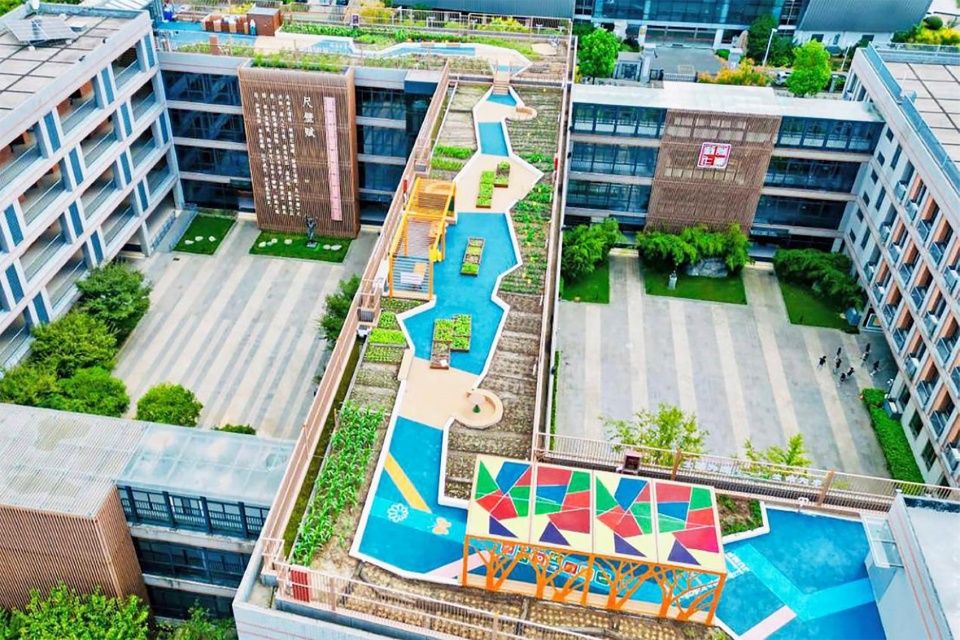
方案采用朴门永续理念,构建了一个循环共生体:螺旋香草花园创造多样微气候;植物废弃物和动物粪便可制成花园堆肥;雨水被收集用于灌溉;小动物养殖区与种植区形成“饲料-肥料”闭环,此外,“百味农场”还建设了一套依靠太阳能、风能发电及储能的能源运作系统,依靠农场自身的发电和储能,供温室及农场的日常用电,成为零碳示范学校,让学生在实践中触摸未来农业科技。这堂课,从设计之初就在讲述“循环”与“共生”。
The plan adopted permaculture concepts to build a circular symbiosis: a spiral herb garden created diverse microclimates; plant waste and animal manure were composted; rainwater was collected for irrigation; small animal raising and planting areas formed a “feed-fertilizer” closed loop. Additionally, “Baiwei Farm” installed an energy system relying on solar and wind power generation and storage, supplying electricity for the greenhouse and farm daily use, making it a zero-carbon demonstration school, allowing students to touch future agricultural technology in practice. This lesson, from its initial design, told the story of “circulation” and “symbiosis.”
▼活动过程,Activity process © 全国社区花园设计营造竞赛与社区参与行动参与团队
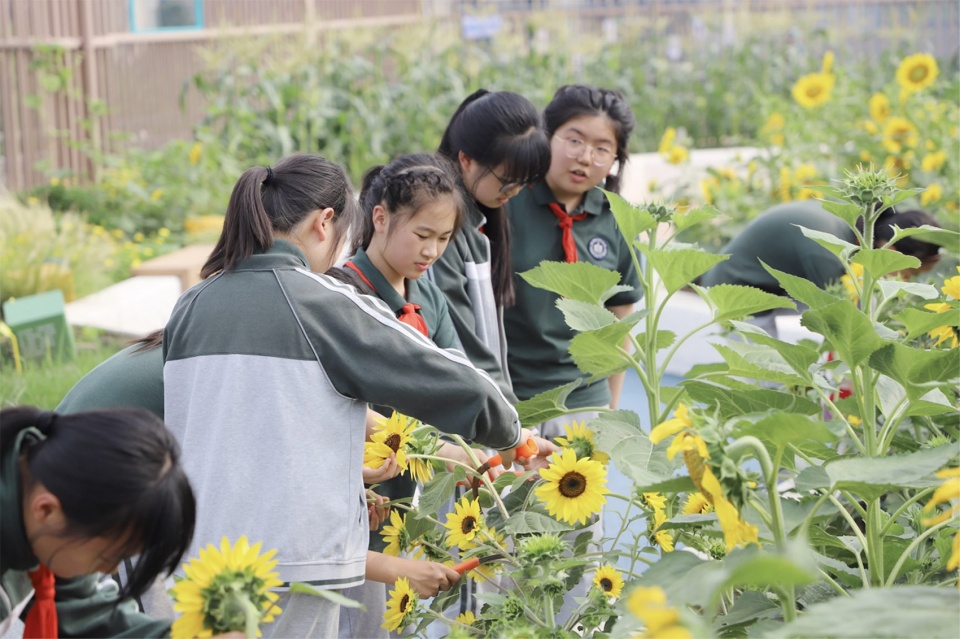
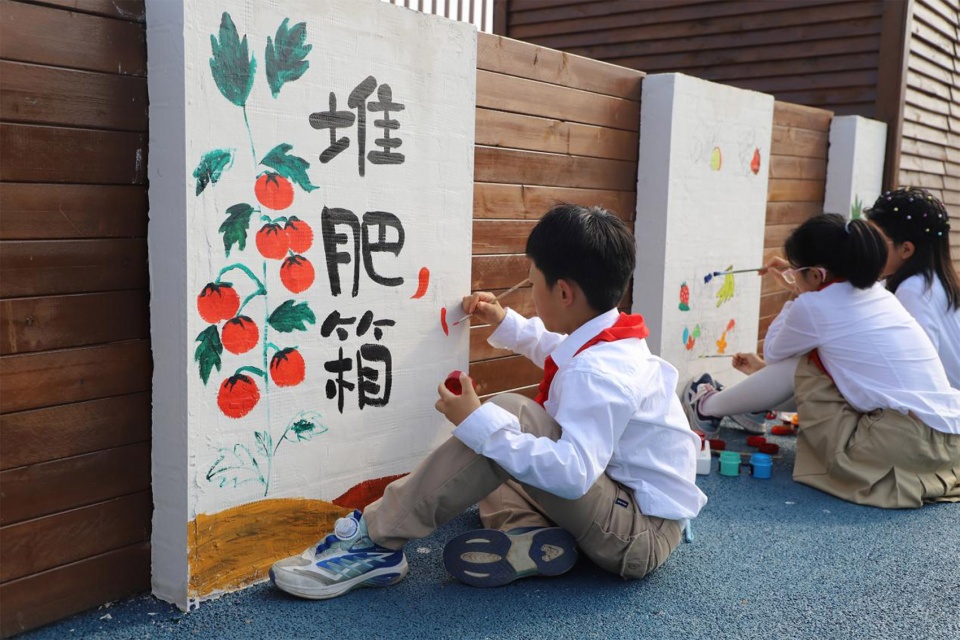
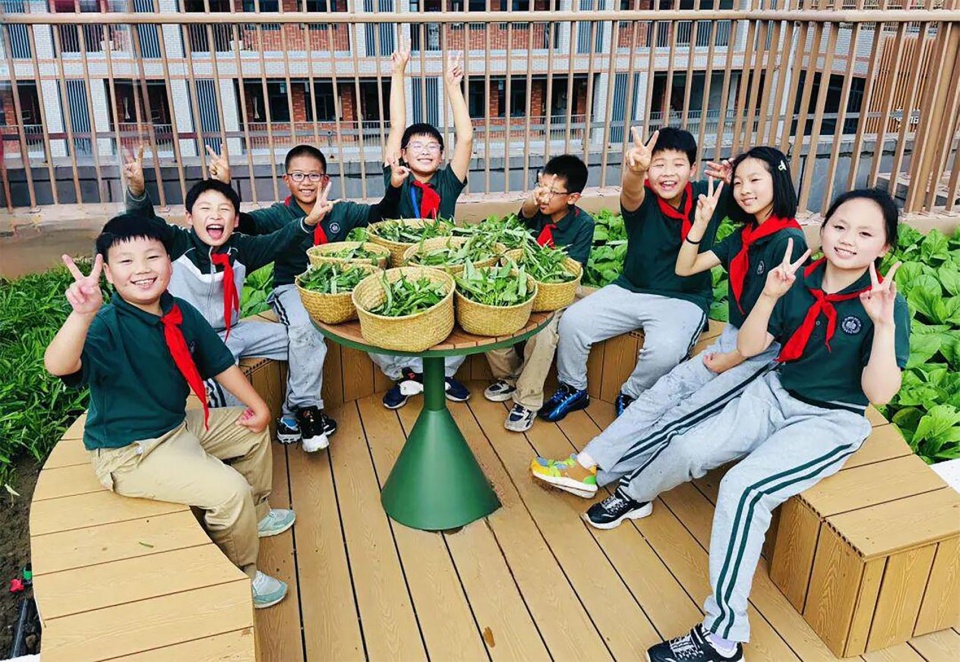
项目联合多方主体协同推进,高校团队提供专业设计支持;社会企业-朴育生态提供技术与指导;学校提供场地与资金并纳入课程体系。最动人的旋律来自南京市金陵河西学校小学部的师生们,在学校的支持下,花园的日常维护与劳动课相结合,从花园设计搭建、种植、施肥、扎藤架到草莓授粉、驱鸟设计,都成为一节节生动的“户外课堂”,既让孩子们能够在花园共建中体验种植和建造的乐趣 ,也能够使花园得到稳定的维护。“百味农场”成了孩子们最爱的户外教室,在直接体验中培养了生态观念、责任感和动手能力。但项目也折射出当前推广学校花园共建面临的普遍挑战——认知度不足、系统性政策支持缺失等问题。然而,“百味农场”的探索性实践证明,当教育回归生活、学生真实参与、设计尊重自然时,一片有限的屋顶也能孕育出无限的教育可能和成长活力。
The project advanced collaboratively with multiple parties: the university team provided professional design support; the social enterprise Puyu Ecology provided technology and guidance; the school provided the site and funding and integrated it into the curriculum. The most touching melody came from the teachers and students of the primary school department. With school support, daily garden maintenance was combined with labor classes. From garden design and construction, planting, fertilizing, and trellis building to strawberry pollination and bird-repelling design, everything became vivid “outdoor classrooms,” allowing children to experience the joy of planting and building through garden co-construction, while also ensuring stable garden maintenance. “Baiwei Farm” has become children’s favorite outdoor classroom, cultivating ecological awareness, responsibility and hands-on skills through direct experience. However, the project also reflects common challenges in promoting school garden co-construction: insufficient awareness and lack of systematic policy support. Nevertheless, the exploratory practice of “Baiwei Farm” proves that when education returns to life, students participate authentically, and design respects nature, a limited rooftop can nurture unlimited educational possibilities and growth vitality.
▼活动过程,Activity process © 全国社区花园设计营造竞赛与社区参与行动参与团队
评委评语:该作品以劳动教育与生态共生的深度融合为核心,将校园屋顶空间创新转化为名为“百味农场”的实践教育基地,通过参与式设计和多元主体共建,智慧科技赋能,实现了自然感知、课程教学与可持续运维的有机结合。项目调研扎实,生态逻辑清晰,不仅构筑物与植物配置营造了自然舒适的景观体验,更形成了系统的管理策略与市场化运营机制,充分体现了花园建设与学校教学相互促进的先进理念,为校园屋顶花园的可持续实践提供了具有示范价值的优秀范本。
Judge’s Comment: Centered on the deep integration of labor education and ecological symbiosis, this work innovatively transforms the campus rooftop into a practical education base named “Baiwei Farm”. Through participatory design, multi-stakeholder co-construction and smart technology empowerment, it organically integrates nature perception, curriculum teaching and sustainable operation. The project has solid research and clear ecological logic. Its structures and plant arrangements create a natural and comfortable landscape experience, and it forms a systematic management strategy and market-oriented operation mechanism. It fully embodies the advanced concept of mutual promotion between garden construction and school teaching, providing an exemplary model for the sustainable practice of campus rooftop gardens.
▼活动过程,Activity process © 全国社区花园设计营造竞赛与社区参与行动参与团队
循环农场
Circular Farm
地点:台州
Location: Taizhou
指导老师:闵冠 – 行于乡野(在地整村运营团队)、陈沛新 – 行于乡野(在地整村运营团队)
Instructors: Min Guan – Rural walks (Local Village Operation Team), Chen Peixin – Rural walks (Local Village Operation Team)
华东-23小组:黎思睿(组长)、左慧燕、郑兴增、王艺蒙、金珂宇、焦奔、陈灵敏、陈仙花、陈爱萍、陈梅英、何水姝
East China-23 Team: Li Sirui (Leader), Zuo Huiyan, Zheng Xingzeng, Wang Yimeng, Jin Keyu, Jiao Ben, Chen Lingmin, Chen Xianhua, Chen Aiping, Chen Meiying, He Shuishu
循环农场 —— 乡野闲置地的循环共生营造
Circular Farm — Circular Symbiotic Construction of Rural Idle Land
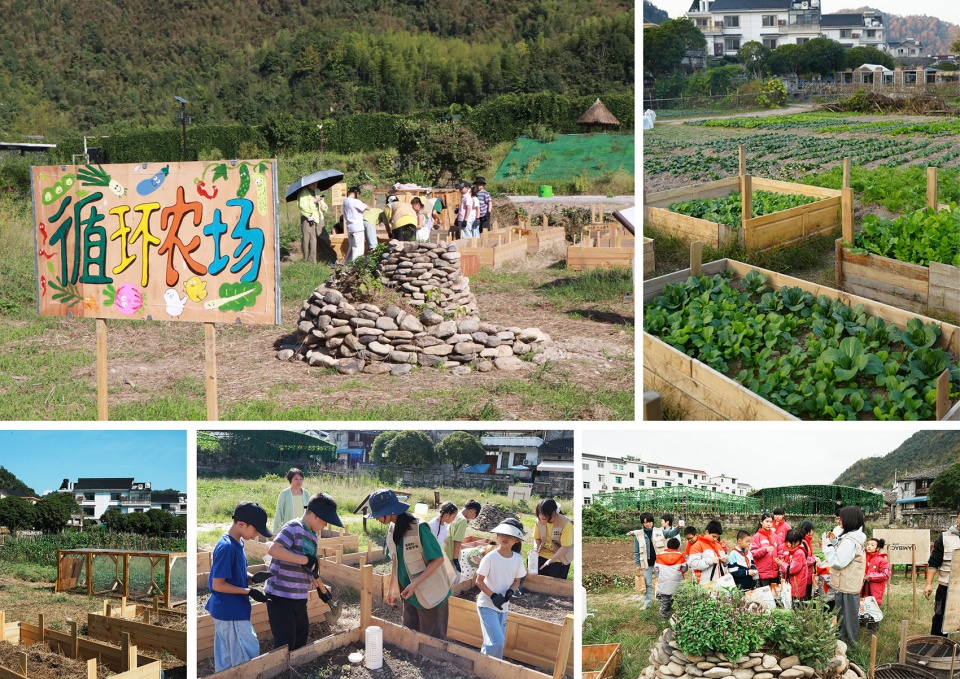
项目以“空间生产—关系建构—知识流动—价值创造”为框架,推动物理空间、社区关系与乡土知识的协同更新。我们将农场划分为螺旋花园、种植床、传统田垄等功能区,融合朴门永续设计与在地材料,如利用溪石搭建螺旋花园、旧蒸屉改造种植架。同时,通过“线上招募+在地融合”策略,吸引多元志愿者短期共创,快速引入专业智慧。农场建设始于一次“借葱”的启示——我们从村民处获得的不只是食材,更是对“回馈社区”的觉醒。在堆肥系统搭建中,我们与农家乐合作收集厨余,用咖啡渣加速发酵;在开垄种植时,村民阿姨主动挥锄示范,传授乡土经验。螺旋香草花园中,村民赠送的紫苏苗与城市引入的香草共植一地,成为城乡风味的微小对话现场。
The project used the framework “Space Production – Relationship Building – Knowledge Flow – Value Creation” to promote the synergistic renewal of physical space, community relations, and local knowledge. We divided the farm into functional areas like a spiral garden, planting beds, and traditional ridges, integrating permaculture design with local materials, such as using stream stones to build the spiral garden and repurposing old steamers into planting racks. Simultaneously, through a strategy of “online recruitment + local integration,” we attracted diverse volunteers for short-term co-creation, quickly introducing professional wisdom. The farm’s construction began with the inspiration from “borrowing scallions” – what we gained from villagers was not just ingredients, but an awakening to “giving back to the community.” During compost system construction, we cooperated with local restaurants to collect kitchen waste, using coffee grounds to accelerate fermentation. When ridging and planting, village aunts proactively demonstrated with hoes, imparting local knowledge. In the spiral herb garden, perilla seedlings gifted by villagers were planted alongside herbs introduced from the city, becoming a site of micro-dialogue between urban and rural flavors.
▼行动框架,Action framework © 全国社区花园设计营造竞赛与社区参与行动参与团队
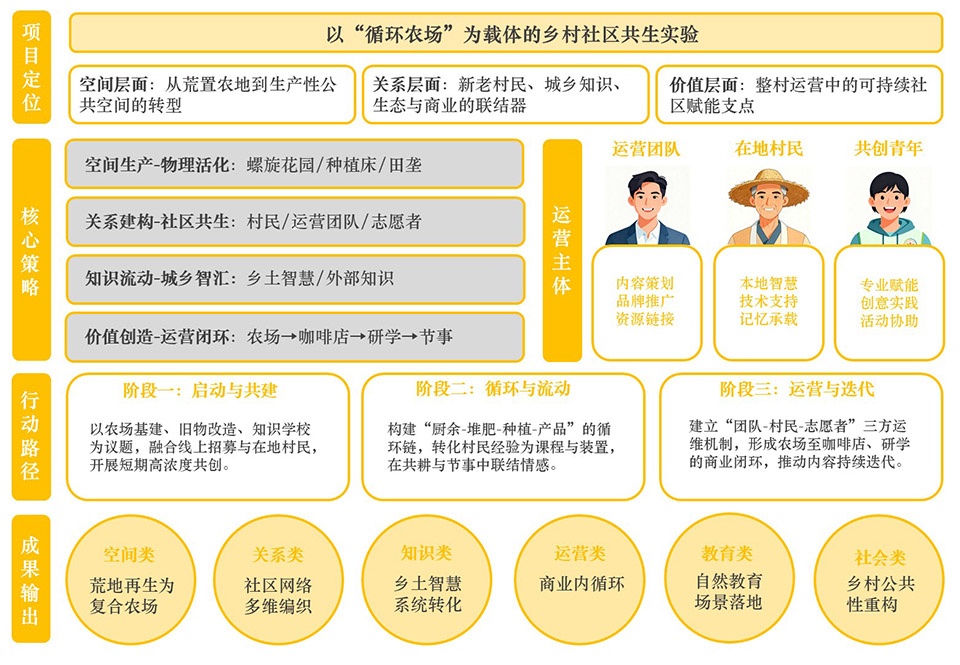
在行动中我们始终在“开放与边界”和“设计与生活”之间寻找平衡。熟人社会的私密性与公共空间的开放性需谨慎调和,我们不强求广泛链接,而是通过日常互动——如分享香草茶、举办“爷爷奶奶的菜铺”——让关系自然生长。项目最终得以持续,得益于“三方协同”运维机制:运营团队负责策划推广,村民负责日常农作,志愿者灵活支持,形成可持续的运营闭环。循环农场已成为一个社会关系得以生发的土壤:它产出蔬菜香草,也孕育社区认同;它承载研学课程,也激活旧物记忆;它连接咖啡店运营、研学与节事活动,形成内循环商业生态。农场的建成不是一个终点,而是一个关于“联结”的起点——在这里,耕植的是作物,更是关系;流动的是资源,更是情感。
In our actions, we constantly sought balance between “openness and boundaries” and “design and life.” The privacy of an acquaintance society and the openness of public space need careful reconciliation. We didn’t force extensive connections but allowed relationships to grow naturally through daily interactions – like sharing herb tea or holding “Grandparents’ Vegetable Stall” events. The project’s sustainability ultimately benefited from a “tripartite collaborative” operation and maintenance mechanism: the operation team responsible for planning and promotion, villagers responsible for daily farming, and volunteers providing flexible support, forming a sustainable operational closed loop. The Circular Farm has become soil where social relationships can germinate: it produces vegetables and herbs, but also cultivates community identity; it carries study courses and activates memories of old objects; it connects coffee shop operations, study tours, and festival events, forming an internally circulating commercial ecosystem. The farm’s completion is not an end, but a starting point for “connection” – here, what is planted are crops, but more importantly, relationships; what flows are resources, but more importantly, emotions.
评委评语:该项目以其对乡村土地与社群关系的深刻理解与真诚实践而独具价值,它扎根乡土,以朴门永续理念为指导,通过螺旋香草花园、厨余堆肥等低干预、高智慧的生态设计,将闲置土地转化为充满生机的活力空间。项目不仅成功动员村民深度参与,更创新性地引入在地教育与技能换宿机制,促进了城乡之间的知识流动与情感联结。其由“阿姨挥锄”、“奶奶赠苗”等无数动人细节共同编织的实践,生动诠释了“宇宙的起点是乡野”的深远立意,为乡村闲置土地活化与城乡共生发展提供了一个充满温度的故事。
Judge’s Comment: This project is uniquely valuable for its profound understanding and sincere practice regarding rural land and community relations. Rooted in the locality, guided by permaculture concepts, it transformed idle land into vibrant spaces through low-intervention, high-wisdom ecological designs like spiral herb gardens and kitchen waste composting. The project not only successfully mobilized deep villager participation but also innovatively introduced local education and skill-exchange mechanisms, promoting knowledge flow and emotional connection between urban and rural areas. Its practice, woven from countless touching details like “aunts wielding hoes” and “grandmas giving seedlings,” vividly interprets the profound concept that “the universe starts in the countryside,” providing a warm story for the activation of rural idle land and urban-rural symbiotic development.
▼场地照片及活动过程,Site photos and activity process © 全国社区花园设计营造竞赛与社区参与行动参与团队
三等奖
Third Prize
感官花园
Sensory Garden
地点:南京
Location: Nanjing
指导老师:杨艺红-南京林业大学
Instructor: Yang Yihong – Nanjing Forestry University
华东-26小组:马颜可卿(组长)、刘一帆、杨腾、董一瑾、吴东辰、
East China-26 Team: Ma Yankeqing (Leader), Liu Yifan, Yang Teng, Dong Yijin, Wu Dongchen
红花儿·儿童友好街区改造项目
Red Flower · Child-Friendly Street Renovation Project
南京市秦淮区红花街道“红・花儿”儿童友好空间,是街道级儿童友好社区微更新实践。项目立足铁路与河道交织的独特街区格局,在有限公共空间中,探索儿童友好理念融入社区日常的可落地路径。
项目采用“政府出资、街道统筹、团队执行、社区参与”模式,各社区分担资金与支持责任,既优化资源配置,又强化社区认同与归属,让项目成为共建空间,而非单向交付设施。核心创新在于将儿童与社区双向互动贯穿全流程,遵循 “调研-设计-共创-呈现-再利用” 逻辑。通过街区探索、儿童行为观察、IP征集等捕捉其需求,这些表达直接转化为设计要素:感官花园的探索路径、法治广场的儿童共创地绘、趣味 IP 标识系统,以及可自由组合的游戏模块等。
The “Red·Flower” child-friendly space in Honghua Subdistrict, Qinhuai District, Nanjing, is a micro-renewal practice of a subdistrict-level child-friendly community. Based on the unique street pattern interwoven with railways and rivers, the project explores a feasible path to integrate the concept of child-friendliness into daily community life within limited public space. The core innovation lies in integrating the two-way interaction between children and the community throughout the entire process, following the logic of “Research – Design – Co-creation – Presentation – Reuse.” Their needs were captured through street explorations, observations of children’s behavior, and (soliciting ideas for an IP image). These expressions were directly translated into design elements: the exploration path in the Sensory Garden, the children’s co-created ground painting in the Rule of Law Square, the playful IP signage system, and freely combinable game modules.
▼行动及理念框架图,Action and concept framework diagrams © 全国社区花园设计营造竞赛与社区参与行动参与团队
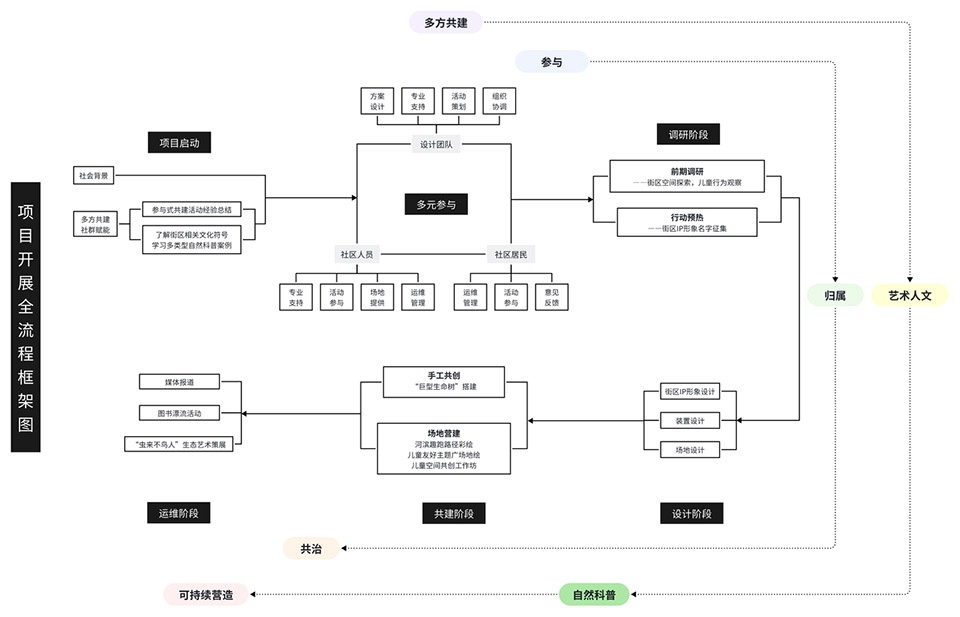
实施层面构建 “调研共创-协同营建-长效运维” 完整框架:前期调研明确需求,中期以工作坊推动多方协作,后期建立“共建-共管-共用”机制,实现空间持续更新。如今,“红・花儿”已成为社区活力节点,生态站变身自然教育课堂,红花园成儿童乐园与邻里交流场,单一功能空间升级为承载生活温度与社区记忆的社区公园。
At the implementation level, a complete framework of “Research & Co-creation – Collaborative Construction – Long-term Operation & Maintenance” was established: preliminary research clarified needs, mid-term workshops promoted multi-party collaboration, and later stages established a “co-construction, co-management, co-use” mechanism to achieve continuous spatial renewal. Today, “Red·Flower” has become a vibrant community node. The ecological station has transformed into a nature education classroom, and the Red Garden has become a children’s playground and a neighborhood communication hub, upgrading a single-function space into a community park carrying the warmth of life and community memory.
▼行动及理念框架图,Action and concept framework diagrams © 全国社区花园设计营造竞赛与社区参与行动参与团队
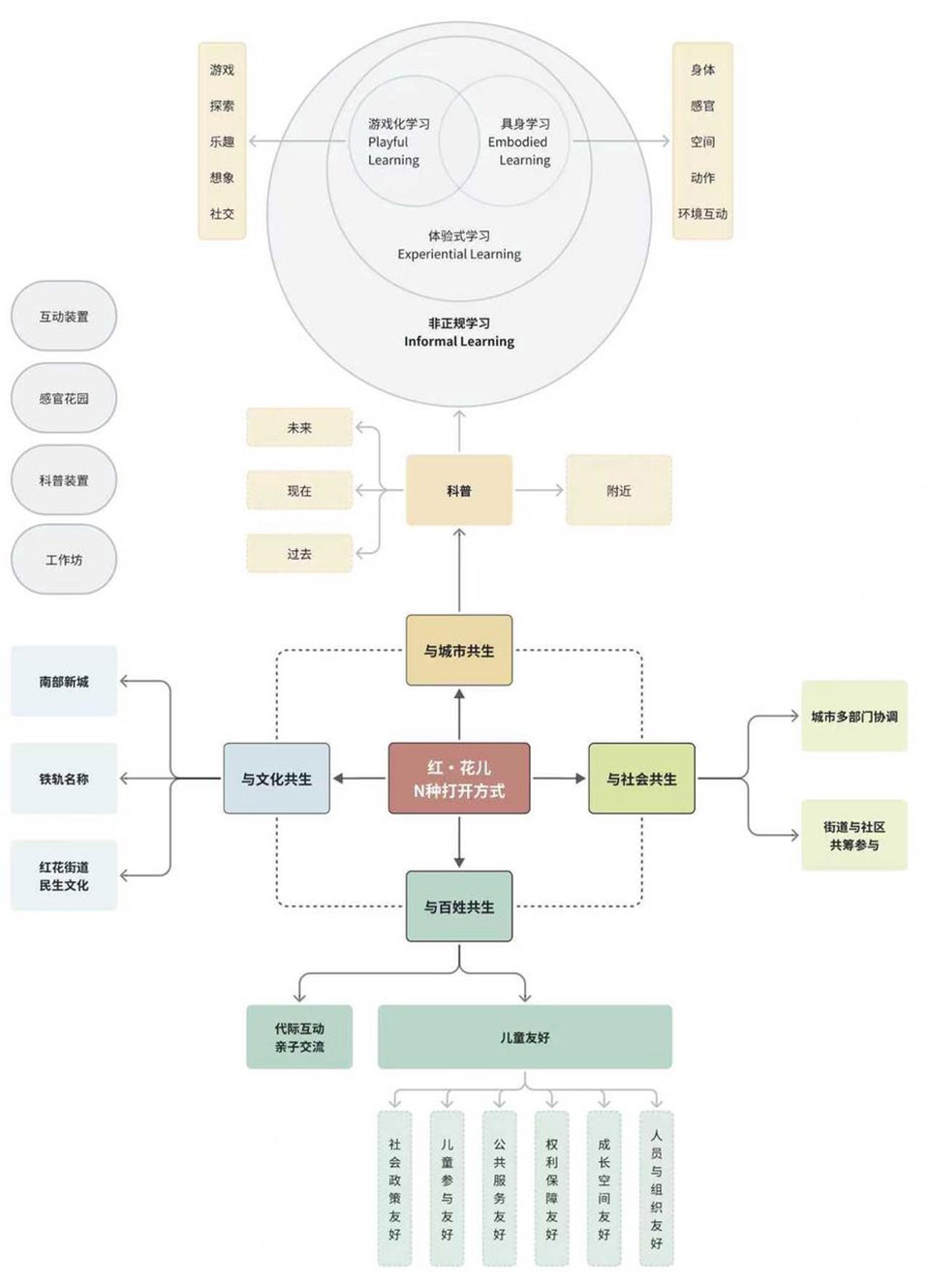
项目以 “轨迹之上,红花童行” 为主题,嵌入街区空间与生活路径,既补足儿童活动空间短板,又激活社区协作与情感连接,成为连接妇女建设记忆与儿童成长经验的载体。未来,项目将鼓励儿童以“小小规划师”“民生观察员”等角色参与管理反馈,总结可复制经验推动理念落地,让童趣与温暖成为社区动人底色。
Themed “Blooming Children’s Journey Along the Tracks,” the project is embedded into the street space and life paths, not only compensating for the lack of children’s activity space but also activating community collaboration and emotional connections, becoming a carrier linking the memories of women constructors with the growth experiences of children. In the future, the project will encourage children to participate in management and feedback as “little planners” and “livelihood observers,” summarize replicable experiences to promote the implementation of the concept, and let playfulness and warmth become the touching foundation of the community.
▼场地照片及活动过程,Site photos and activity process © 全国社区花园设计营造竞赛与社区参与行动参与团队
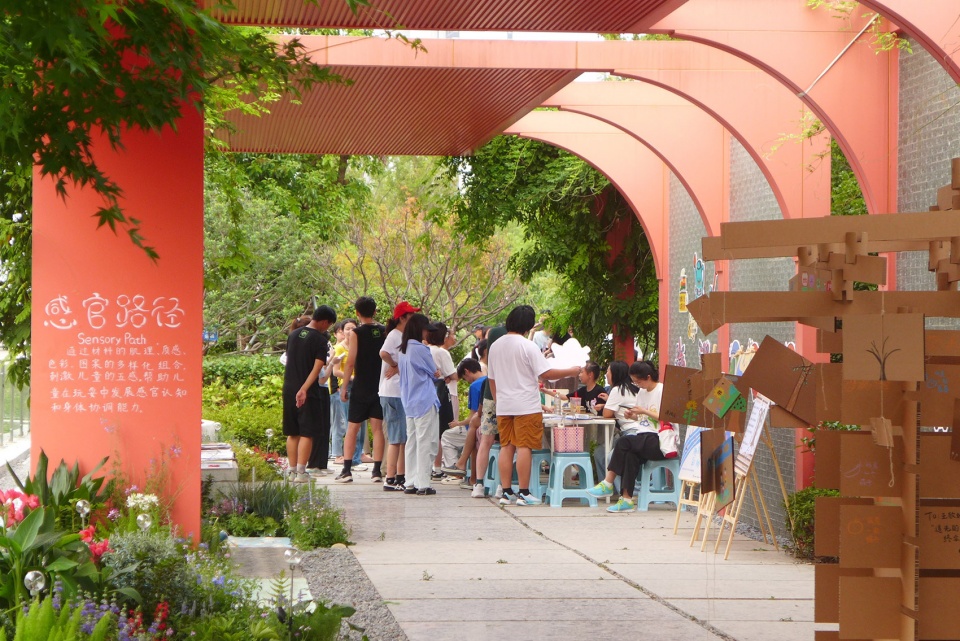
评委评语:该作品的核心亮点在于以儿童友好为导向,通过“空间改造+儿童参与+社区共建”的系统性策略,对城市线性公共空间进行了富有活力的更新。项目不仅主题鲜明,通过IP形象设计与多个特色节点强化了文化传承与场所归属感,更构建了从“调研、设计到共创、呈现”的完整参与机制,确保了儿童在全程中的主体性与创造性。其丰富的共建活动、多元的主体协作以及兼具艺术性与实用性的落地效果,为如何在城市更新中深度融合儿童需求、社区活力与文化传承,提供了可复制、具有示范意义的创新范式。
Judge’s Comment: The core highlight of this work is its child-friendly orientation, achieving a vibrant renewal of urban linear public space through a systematic strategy of “spatial transformation + children’s participation + community co-construction.” The project not only has a clear theme, strengthening cultural heritage and sense of place belonging through IP image design and multiple characteristic nodes, but also establishes a complete participation mechanism from “research, design to co-creation, and presentation,” ensuring children’s subjectivity and creativity throughout the process. Its rich co-construction activities, diverse collaboration, and implemented results that are both artistic and practical provide a replicable and exemplary innovative paradigm for how to deeply integrate children’s needs, community vitality, and cultural heritage in urban renewal.
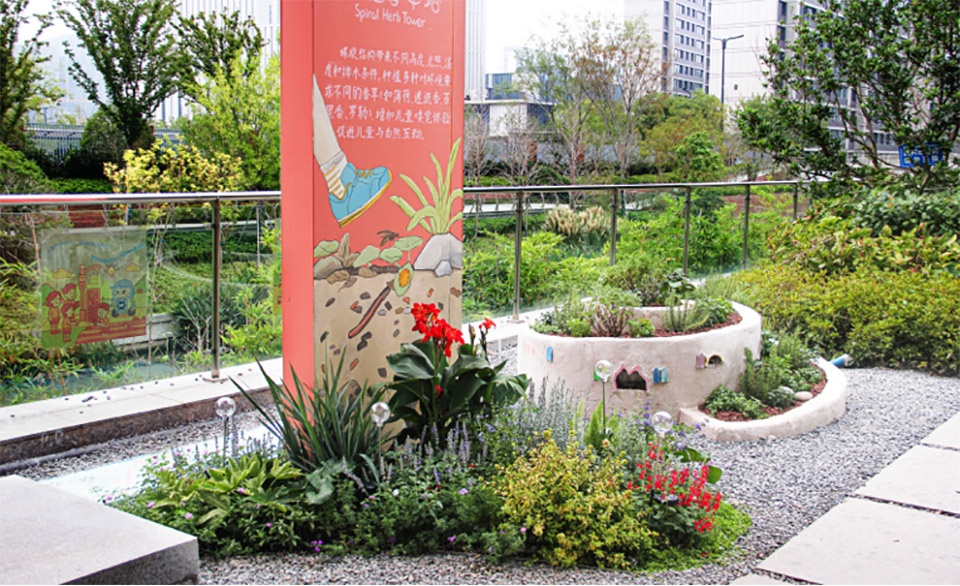
▼场地照片及活动过程,Site photos and activity process © 全国社区花园设计营造竞赛与社区参与行动参与团队
邻心林趣儿童花园信用社
Neighborhood Heartwood Children’s Garden Credit Cooperative
地点:北京
Location: Beijing
指导老师:边思敏-北京林业大学
Instructor: Bian Simin – Beijing Forestry University
华北-09小组:邓玥兮(组长)、朱思彤、解明达、魏莎莎、胡可菲、梁紫音、章祺皓、程莞清
North China-09 Team: Deng Yuexi (Leader), Zhu Sitong, Xie Mingda, Wei Shasha, Hu Kefei, Liang Ziyin, Zhang Qihao, Cheng Wanqing
以社区花园为载体的金融启蒙创新
Financial Literacy Innovation through Community Gardens
邻心林趣儿童花园信用社是北京市金融街丰融园的自然科普与金融启蒙行动,本项目依托金融街独特背景,以社区花园为载体,为儿童提供一个体验金融生活的小型社会花园,创新性构建以植物和花园货币为基础的金融系统,实现“自然科普+金融启蒙”双重教育目标,链接生态循环与经济思维,赋予社区花园全新的社会创新价值。在教育目标上,本项目将“植物-昆虫-土壤”的生态链与“资源-信用-价值”的金融链类比关联。自然科普层面,引导儿童亲手种植、维护地块,直观感受生态循环的奥秘与劳作的价值;金融启蒙层面,引入“花园币”、“信用积分”及“花园信用社”等机制,让儿童在模拟“初创企业”的实践中,轻松掌握基础经济与信用概念,打破抽象金融知识的学习壁垒。
Neighborhood Heartwood Children’s Garden Credit Cooperative is a nature education and financial literacy initiative in Fengrongyuan, Beijing’s Financial Street. Leveraging the unique background of Financial Street and using the community garden as a platform, it provides a small-scale social garden for children to experience financial life. It innovatively constructs a financial system based on plants and garden currency, achieving the dual educational goals of “nature education + financial literacy,” linking ecological cycles with economic thinking, and endowing the community garden with brand new social innovation value. In terms of educational goals, this project draws an analogy between the ecological chain of “plants-insects-soil” and the financial chain of “resources-credit-value.” At the nature education level, it guides children to plant and maintain plots themselves, intuitively experiencing the mysteries of the ecological cycle and the value of labor. At the financial literacy level, it introduces mechanisms such as “Garden Coins,” “Credit Points,” and the “Garden Credit Union,” allowing children to easily grasp basic economic and credit concepts through the practice of simulating a “startup,” breaking down learning barriers to abstract financial knowledge.
▼行动框架图,Action framework diagram © 全国社区花园设计营造竞赛与社区参与行动参与团队
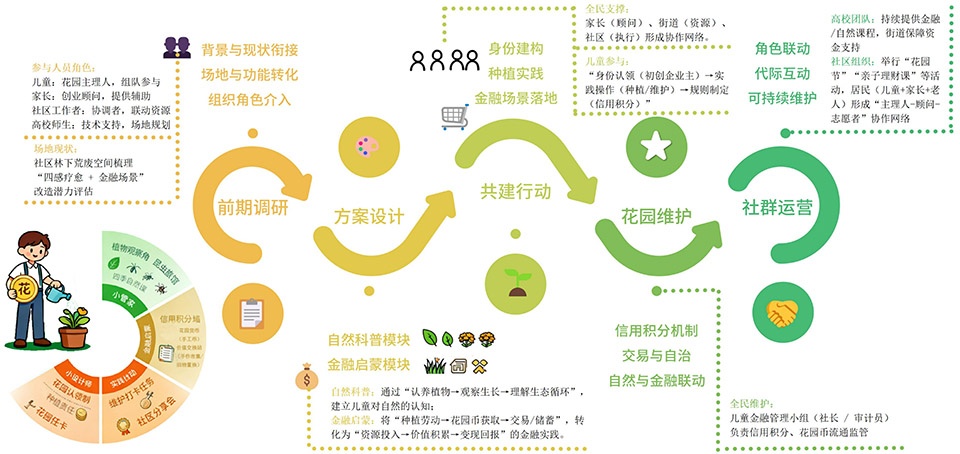
花园种植设计以儿童四感疗愈为核心,秉持“沉浸式自然感知,全方位身心疗愈”理念,融合视觉、触觉、嗅觉、听觉四大感官体验,充分结合儿童设计意愿,打造“可看、可触、可闻、可听”的自然疗愈空间,让儿童在亲近自然的过程中完成学习与成长。该项目通过游戏化机制设计,活化社区闲置空间,借助清晰可复制的参与模式及线上线下联动运营,调动全龄居民参与,形成良好社群互动与可持续社区治理路径,充分践行“百姓园林”共建共享精神。
The garden planting design focuses on children’s four-sensory healing, adhering to the concept of “immersive nature perception, comprehensive physical and mental healing.” It integrates the four sensory experiences of sight, touch, smell, and hearing, fully incorporating children’s design wishes to create a therapeutic natural space that is “seeable, touchable, smellable, and hearable,” allowing children to learn and grow while getting close to nature. Through gamified mechanism design, the project revitalizes idle community spaces. With a clear and replicable participation model and online-offline integrated operation, it mobilizes residents of all ages to participate, forming good community interaction and a sustainable community governance path, fully practicing the spirit of “People’s Landscapes” co-construction and sharing.
▼场地照片及活动过程,Site photos and activity process © 全国社区花园设计营造竞赛与社区参与行动参与团队
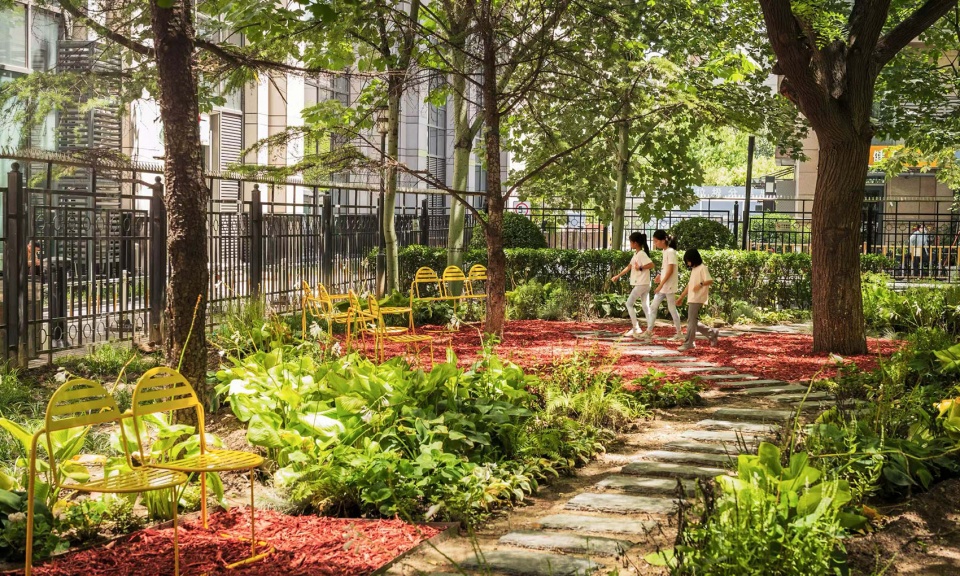
评委评语:该作品开创性地将“自然科普”与“金融启蒙”进行了有机融合,通过“儿童信用社”、花园积分货币等极具巧思的游戏化机制设计,构建了一个沉浸式、可运营的教育场景。项目以金融逻辑活化社区闲置空间,并通过一套清晰可复制的IPO参与模式与线上线下结合的运营机制,扎实地调动了全龄居民持续参与,形成了活跃的社群互动与可持续的社区治理新路径。其富有童趣与深度的设计,成功将空间活化转化为生动的社区教育与关系共建实践,充分体现了“百姓园林”共建共享的精神,为社区花园赋予了独特的社会创新价值与广泛的推广潜力。
Judge’s Comment: This work pioneeringly integrates “nature education” and “financial literacy.” Through ingenious gamified mechanisms like the “Children’s Credit Union” and garden point currency, it constructs an immersive and operable educational scenario. The project activates idle community space using financial logic and, through a clear and replicable IPO participation model combined with online-offline operation mechanisms, solidly mobilizes continuous participation from residents of all ages, forming active community interaction and a new path for sustainable community governance. Its design, full of childlike fun and depth, successfully transforms spatial activation into vivid community education and relationship-building practice, fully embodying the spirit of “People’s Landscapes” co-construction and sharing, granting the community garden unique social innovation value and broad potential for promotion.
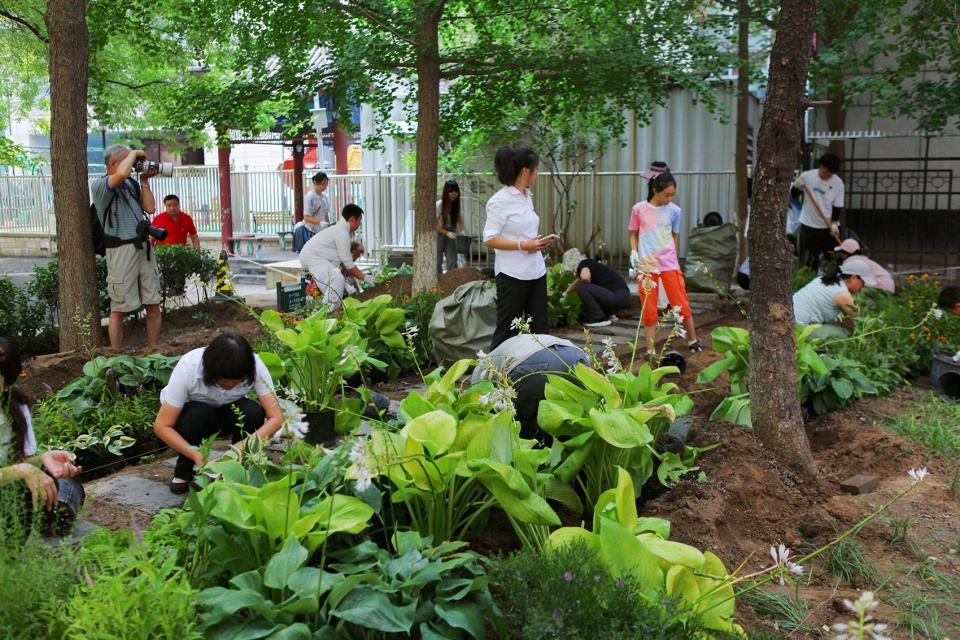
▼场地照片及活动过程,Site photos and activity process © 全国社区花园设计营造竞赛与社区参与行动参与团队
“我们的”花园
“Our” Garden
地点:北京
Location: Beijing
指导老师:李险峰-中国农业大学、刘剑 -中国农业大学、黄越-中国农业大学
Instructors: Li Xianfeng – China Agricultural University, Liu Jian – China Agricultural University, Huang Yue – China Agricultural University
华北-07小组:梁爽(组长)、张家骏、张雨欣、李勃裕、肖安鹏、朱文涛、胡扬、王吉喆
North China-07 Team: Liang Shuang (Leader), Zhang Jiajun, Zhang Yuxin, Li Boyu, Xiao Anpeng, Zhu Wentao, Hu Yang, Wang Jizhe
基于P-EPCO理念的中关村街道老旧社区废弃花园改造项目
Renovation Project of an Abandoned Garden in an Old Community on Zhongguancun Street Based on the P-EPCO Concept
老旧社区参与式花园常因参与机制短期化、运营主体单一、制度支持不足,建成后快速衰退。“我们的花园” 以中关村街道科育社区废弃花园为对象,回应参与式更新从 “过程导向” 转向 “可持续共生发展” 的命题。项目基于传统 EPCO 模式,提出P-EPCO理念,将“参与”嵌入认知建构、方案生成、空间实施与长期运营全流程,核心是通过组织设计提升参与结构的稳定性与弹性,而非单纯环境美化。实施上遵循“合作共识-创意共筹-行动共建-共同运维”路径:前期以可视化模型、设计小课堂促成居民共识;中期将居民需求转化为空间策略;后期聚焦运营结构优化,实现从空间生产到治理机制建构的转变。
Participatory gardens in old communities often decline rapidly after completion due to short-term participation mechanisms, single operation subjects and insufficient institutional support. Targeting the abandoned garden in Keyu Community, Zhongguancun Subdistrict, “Our Garden” responds to the proposition of shifting participatory renewal from “process-oriented” to “sustainable symbiotic development”. Based on the traditional EPCO model, the project proposes the P-EPCO concept, embedding “Participation” into the entire process of cognitive construction, plan generation, spatial implementation, and long-term operation. The core is to enhance the stability and resilience of the participation structure through organizational design, rather than mere environmental beautification. Implementation follows the path of “Cooperative Consensus – Creative Co-funding – Action Co-construction – Collaborative Operation & Maintenance”: in the early stage, visual models and design workshops facilitate resident consensus; in the mid-term, residents’ needs are transformed into spatial strategies; in the later stage, the focus is on optimizing the operation structure, achieving a transformation from spatial production to governance mechanism construction.
▼场地设计平面图,Site design plan © 全国社区花园设计营造竞赛与社区参与行动参与团队
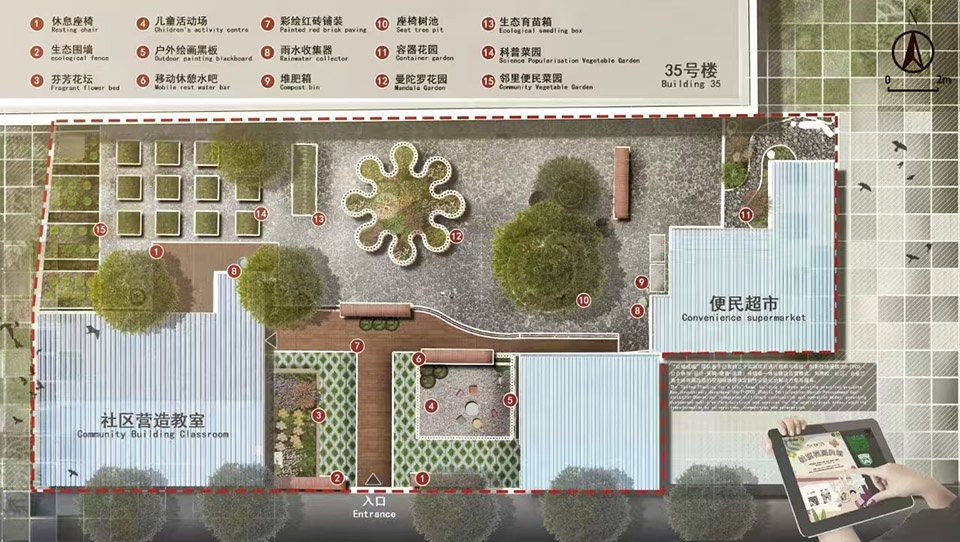
项目核心创新为多主体并行运营:中国农业大学学生团体负责日常维护与自然教育;清华大学设 “手机值班室” 为老人提供智能手机辅导;中关村一小志愿家庭结合儿童志愿与自然教育;政府承担协调、经费与制度保障;普通居民灵活参与。常态化机制形成参与惯性,多主体结构兼具稳定性与弹性,避免花园荒废,打造韧性公共基础设施。作为街道社会创新实验,项目在低成本下重组空间与社会资源,既解决问题,更重构问题认知,促进政民新型契约关系。项目获海淀区推广,具备复制潜力,使社区公共空间成为复合平台。但参与式设计的长期挑战仍存,未来需持续优化参与主体继任与协同机制。
The core innovation of the project is the parallel operation by multiple: the student group from China Agricultural University is responsible for daily maintenance and nature education; Tsinghua University set up a “Mobile Phone Duty Room” to provide smartphone guidance for the elderly; volunteer families from Zhongguancun No.1 Primary School combine children’s volunteerism with nature education; the government provides coordination, funding, and institutional guarantees; ordinary residents participate flexibly. The normalized mechanism creates participation inertia. The multi-subject structure has both stability and resilience, preventing the garden from being abandoned and creating resilient public infrastructure. As a subdistrict social innovation experiment, the project reorganizes spatial and social resources at low cost, not only solving problems but also reconstructing the perception of problems, promoting a new type of contractual relationship between the government and citizens. The project has been promoted by Haidian District and has replication potential, making community public spaces a multi-functional platform. However, the long-term challenges of participatory design remain, and future efforts need to continuously optimize the succession and coordination mechanisms of participating subjects.
▼场地照片及活动过程,Site photos and activity process © 全国社区花园设计营造竞赛与社区参与行动参与团队
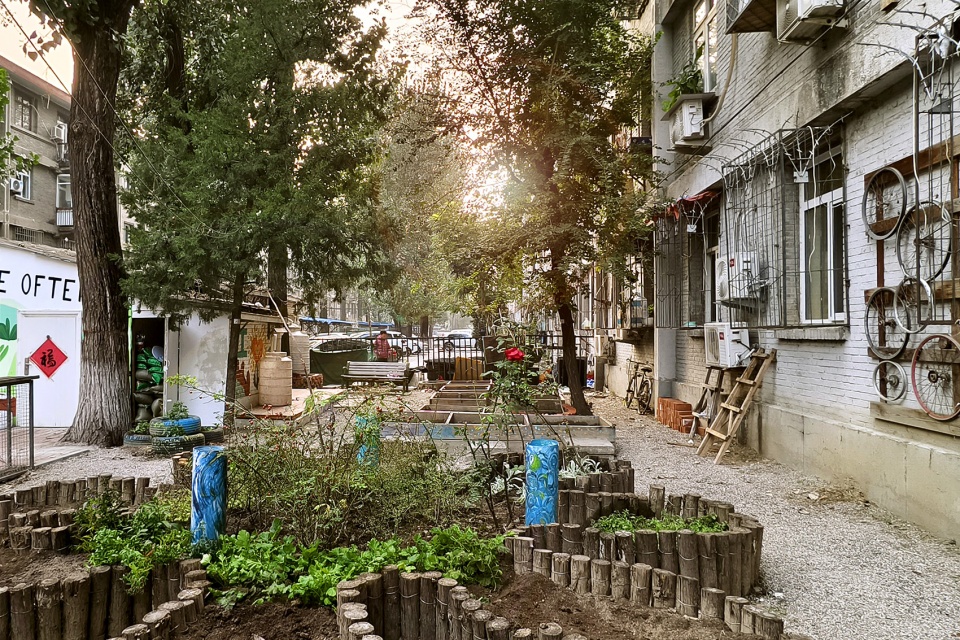
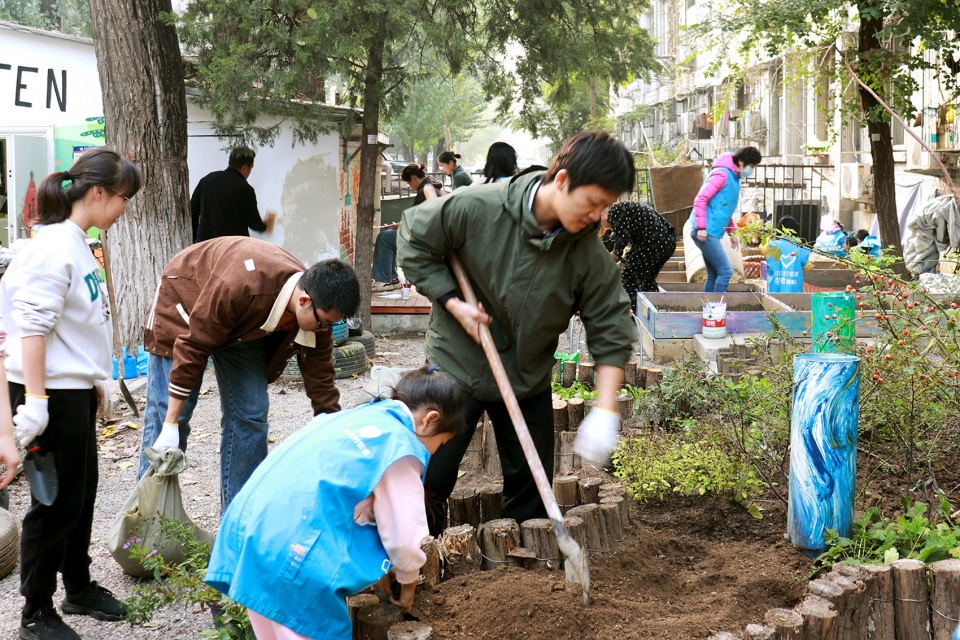
评委评语:该项目通过创新应用P-EPCO全链条模式,成功构建了一个多方协同、全龄参与的社区共建网络,将废弃空间活化与社区治理深度融合。设计以全过程、全龄段、多学科共融为特色,精准回应社区痛点,通过引导居民尤其是儿童深度参与从设计到运维的全流程,并注重废弃物创意利用,有效培育了社区归属感与凝聚力。其扎实的社会参与机制、清晰的可持续运维策略以及复合实用的空间功能,使之成为“生态营造、社群培育与治理赋能”三位一体的标杆性实践,为社区更新提供了具有显著示范价值的优秀范例。
Judge’s Comment: By innovatively applying the full-chain P-EPCO model, this project successfully constructed a multi-party collaborative, all-age participatory community co-construction network, deeply integrating abandoned space activation with community governance. Characterized by the integration of the whole process, all age groups, and multiple disciplines, the design accurately responds to community pain points. By guiding residents, especially children, to deeply participate in the entire process from design to operation and maintenance, and focusing on the creative use of waste, it effectively cultivates community belonging and cohesion. Its solid social participation mechanism, clear sustainable operation and maintenance strategy, and composite and practical spatial functions make it a benchmark practice integrating “ecological construction, community cultivation, and governance empowerment,” providing an excellent example with significant demonstrative value for community renewal.
▼场地照片及活动过程,Site photos and activity process © 全国社区花园设计营造竞赛与社区参与行动参与团队
赤脚花园
Barefoot Garden
地点:南京
Location: Nanjing
指导老师:杨艺红-南京林业大学、吴东辰-罗德岛设计学院
Instructors: Yang Yihong – Nanjing Forestry University, Wu Dongchen – Rhode Island School of Design
华东-29小组:黄宇桐(组长)、覃小月、王奕、张昊辰
East China-29 Team: Huang Yutong (Leader), Qin Xiaoyue, Wang Yi, Zhang Haochen
一场以儿童为主角的校园焕新试验
A Campus Renewal Experiment with Children as the Protagonists
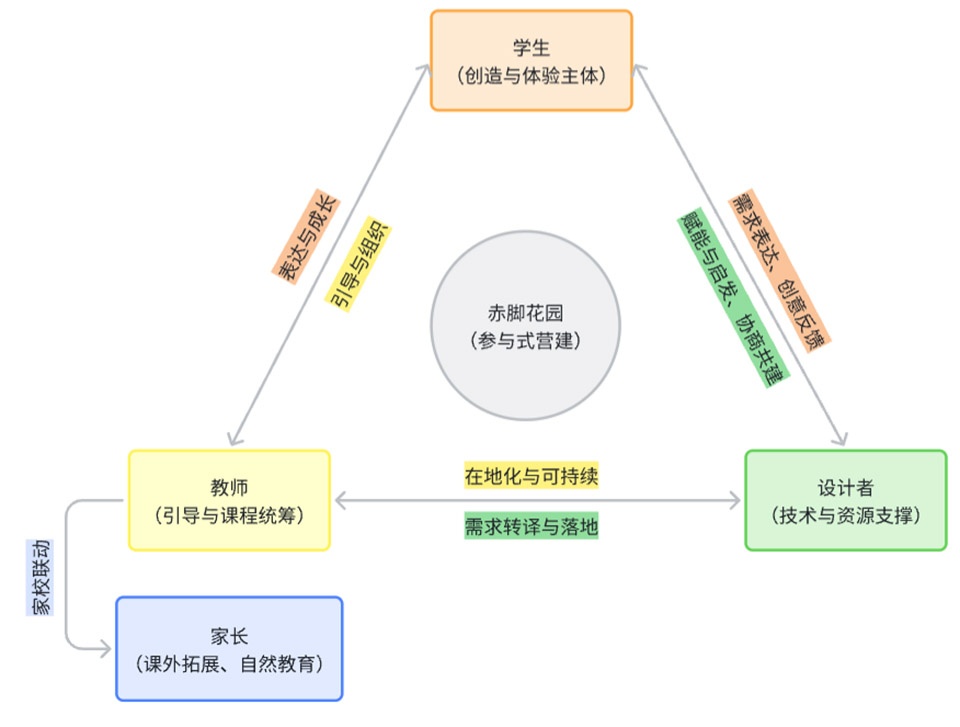
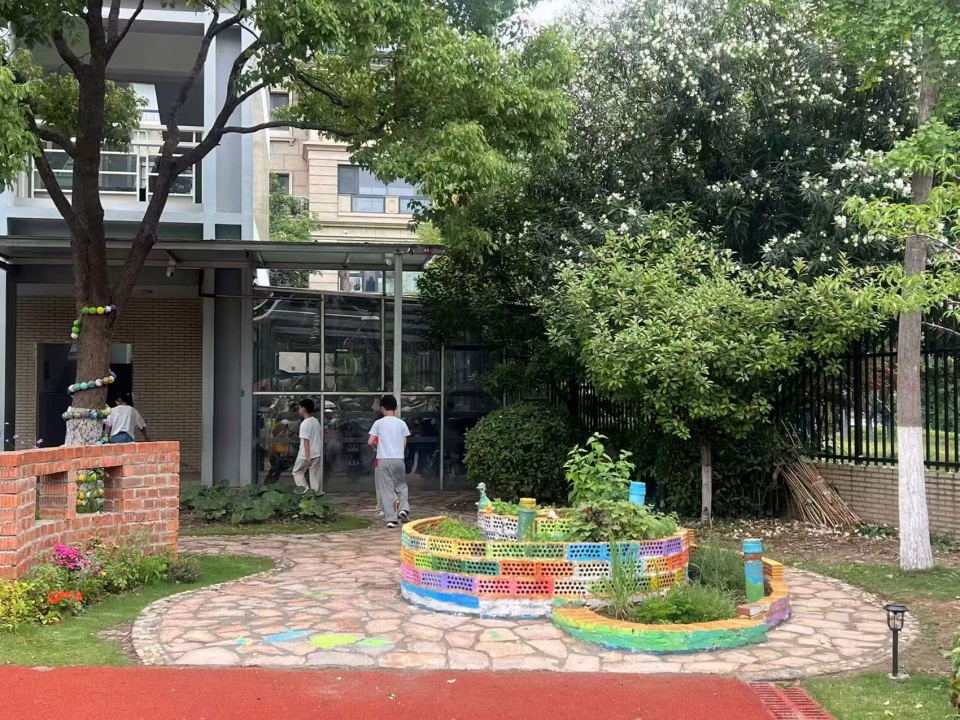
针对儿童自然体验缺失的现状,项目以南京市姜家园小学 300㎡边角绿地为载体,围绕 “儿童如何从空间使用者转变为共建者” 展开探索。“赤脚” 既指赤足接触自然的物理状态,更象征追求自由的真我态度:鼓励儿童通过触摸、探寻建立与土地的联结,在参与中表达真实自我。
In response to the lack of children’s nature experience, the project takes the 300 ㎡ marginal green space of Jiangjiayuan Primary School in Nanjing as the carrier, exploring “how children transform from space users to co-builders”. “Barefoot” refers not only to the physical state of touching nature barefoot but also symbolizes the true attitude of pursuing freedom: encouraging children to build connections with the land through touching and exploring, and express their true selves in participation.
▼场地照片及活动过程,Site photos and activity process © 全国社区花园设计营造竞赛与社区参与行动参与团队
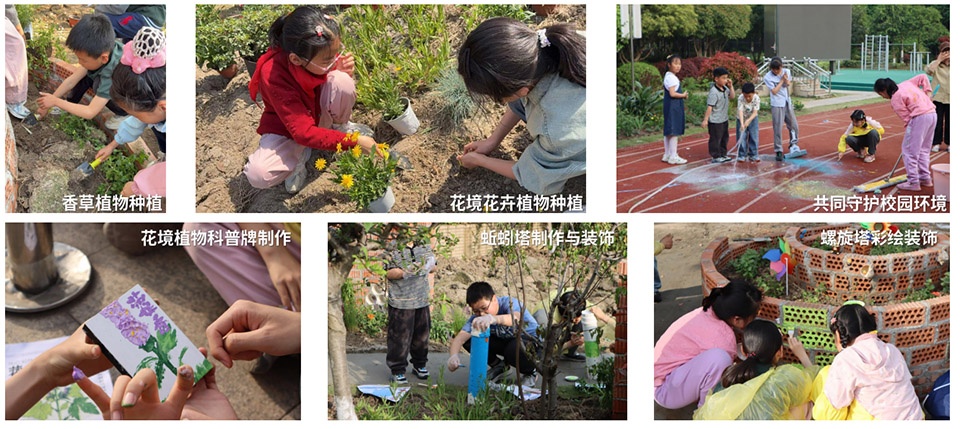
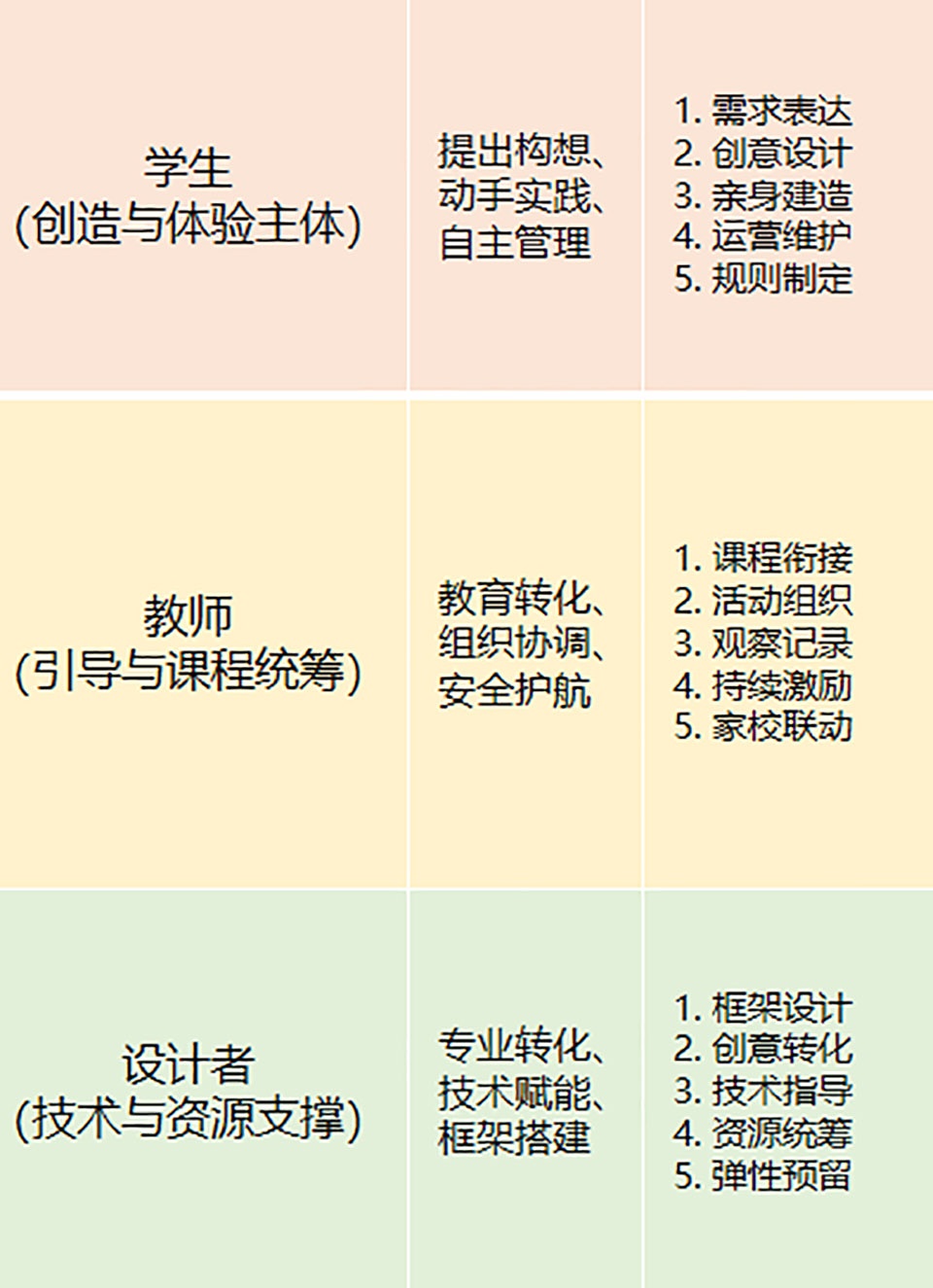
项目组建 “小小营造社”,开设空间感知、生态认知等系列课程,构建“感知-共议-设计-共建-共治”渐进路径,让儿童全程介入花园营造。启动阶段,通过全校宣讲与互动工作坊,激发儿童对校园空间的观察与想象,收集改造诉求;实践阶段,依托系列共建活动,引导儿童从观察认知到动手维护,逐步提升参与度与责任感。同时,儿童全程参与施工营造:亲手种植、彩绘设施,用卵石、回收材料等铺就脚感丰富的 “赤脚路径”,打造沉浸式自然体验通道。
The project sets up a “Little Builders’ Club”, offering courses on spatial perception and ecological cognition, building a progressive path of “perception — joint discussion — design — co-construction — co-governance”, allowing children to participate in the whole garden construction process. In the initiation stage, school-wide presentations and interactive workshops stimulate children’s observation and imagination of campus space and collect renovation demands. In the practice stage, a series of co-construction activities guide children from observation and cognition to hands-on maintenance, gradually improving participation and sense of responsibility. Meanwhile, children participate in the whole construction process: planting and painting facilities personally, paving the “barefoot path” with rich foot feel using pebbles and recycled materials, creating an immersive nature experience channel.
▼场地设计平面图,Site design plan © 全国社区花园设计营造竞赛与社区参与行动参与团队
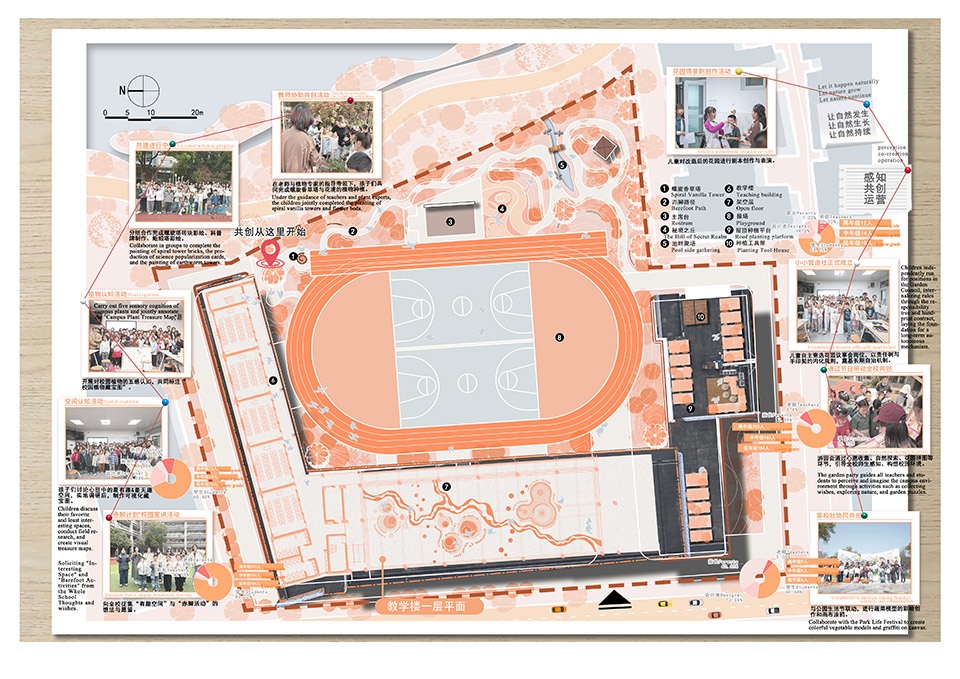
项目以“赤脚无界 自由生长”游园会呈现成果,实现从社团核心成员到全校师生的参与辐射。赤脚计划的核心,是将儿童参与视为持续成长历程而非孤立活动。通过角色赋予与实践反馈,激发儿童主体意识,使其成为校园空间更新的推动者。当儿童亲手塑造环境,校园从物理场所升级为开放动态的教育生态,儿童也成为空间叙事的主角。
The project presents results through the “Barefoot Without Boundaries, Grow Freely” garden party, radiating participation from core club members to all teachers and students. The core of the Barefoot Plan is to regard children’s participation as a continuous growth process rather than an isolated activity. Through role empowerment and practical feedback, it stimulates children’s subjective consciousness and makes them promoters of campus space renewal.
▼行动框架,Action framework © 全国社区花园设计营造竞赛与社区参与行动参与团队
评委评语:该作品以充满童真的“赤脚”为主题,构建了一个真正由儿童主导、与自然教育深度融合的校园花园。项目以小学生认知特点为核心,通过层次丰富的共建活动与课程化设计,将空间更新转化为生动的自然课堂,有效弥补了传统校园绿地体验单一的不足。其系统性的共建机制、环保的材料运用以及初步建立的运维体系,不仅为缓解学业压力、培育生态素养提供了可落地的解决方案,更探索了儿童参与校园更新的完整路径。
Judge’s Comment: With the childlike theme of “Barefoot,” this work constructs a campus garden truly led by children and deeply integrated with nature education. Centered on the cognitive characteristics of primary school students, the project transforms spatial renewal into a vivid nature classroom through richly layered co-construction activities and curriculum-based design, effectively compensating for the shortcomings of monotonous experiences in traditional campus green spaces. Its systematic co-construction mechanism, environmentally friendly material use, and initially established operation and maintenance system not only provide a implementable solution for alleviating academic pressure and cultivating ecological literacy but also explore a complete path for children’s participation in campus renewal.
▼场地照片及活动过程,Site photos and activity process © 全国社区花园设计营造竞赛与社区参与行动参与团队
碳汇花园
Carbon Sink Garden
地点:上海
Location: Shanghai
指导老师:陈静-同济大学
Instructor: Chen Jing – Tongji University
华东-13小组:朱虹谕(组长)、齐艺璇、蔡邦彦、吴蕴榕、赵文祺、史瑞翔、陈梓怡、薛辉
East China-13 Team: Zhu Hongyu (Leader), Qi Yixuan, Cai Bangyan, Wu Yunrong, Zhao Wenqi, Shi Ruixiang, Chen Ziyi, Xue Hui
校园景观微更新 × 无废艺术共创
Campus Landscape Micro-renewal × Zero-Waste Art Co-creation
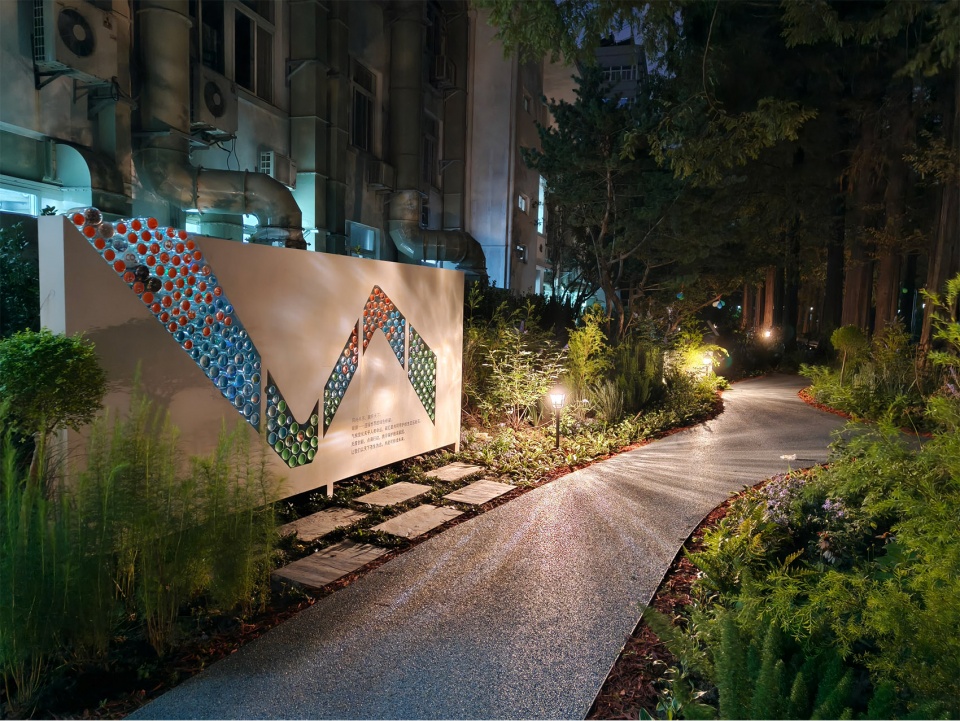
“同瓶共振” 是同济大学碳汇花园的低成本、可复制校园微更新实践,以 “无废艺术” 为媒介,依托废弃物再利用,探索 “社区花园营建 + 公众参与” 共建路径,激活师生及周边居民参与空间更新维护。项目核心由两大开放可操作节点组成,预留共创接口:1.“石绘星河” 艺术铺地,以废弃鹅卵石与水泥基底打造可参与铺装,鼓励公众共建场地再生;2.“同瓶共振”景墙,用回收玻璃瓶构建,瓶底橙绿渐变视觉化呈现 “碳排-碳汇” 循环逻辑。
“Bottles Resonance” is a low-cost, replicable campus micro-renewal practice at Tongji University’s Carbon Sink Garden. Using “Zero-Waste Art” as a medium and relying on waste reuse, it explores a co-construction path of “community garden building + public participation,” activating teachers, students, and surrounding residents to participate in spatial renewal and maintenance. The project’s core consists of two open and operable nodes, reserving co-creation interfaces: 1. “Stone Painting Star River” art pavement, creating participatory paving with abandoned pebbles and a cement base, encouraging public co-construction for site regeneration; 2. “Bottles Resonance” feature wall, constructed with recycled glass bottles, with the orange-green gradient at the bottle bottoms visually presenting the circular logic of “carbon emission – carbon sink.”
▼行动理念,Action concept © 全国社区花园设计营造竞赛与社区参与行动参与团队
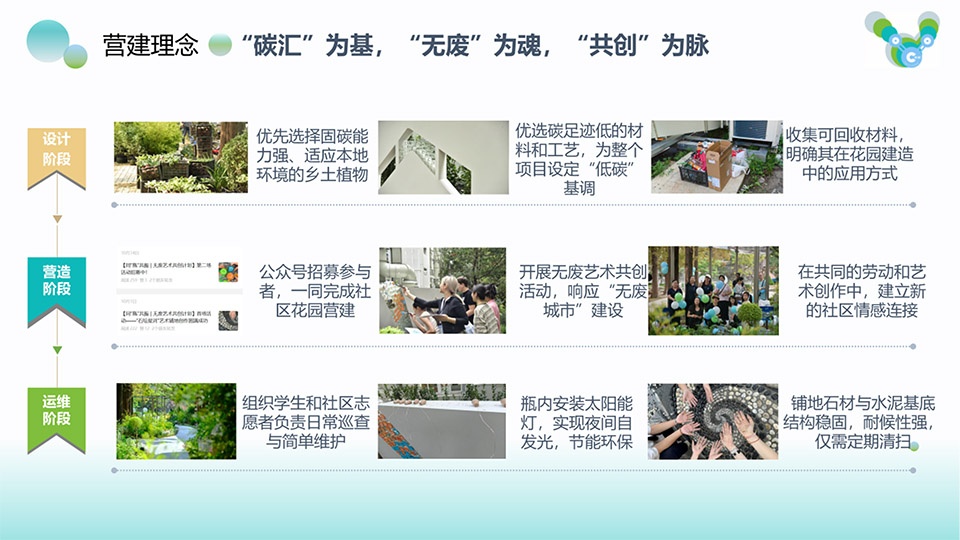
共建过程中,团队通过公众号征集材料、招募参与者,组织两次线下共创,覆盖校内外多元群体,累计参与约 40 人次,回收玻璃瓶 229 个。参与者在协作中建立情感联结,直观体验废弃物到公共空间的转化。
During the co-construction process, the team collected materials and recruited participants via public accounts, organized two offline co-creation sessions, covering diverse groups inside and outside the university, with a total participation of about 40 people and recycling 229 glass bottles. Participants established emotional connections through collaboration and directly experienced the transformation of waste into public space.
▼场地照片及前后对比,Site photos and before-and-after comparison © 全国社区花园设计营造竞赛与社区参与行动参与团队
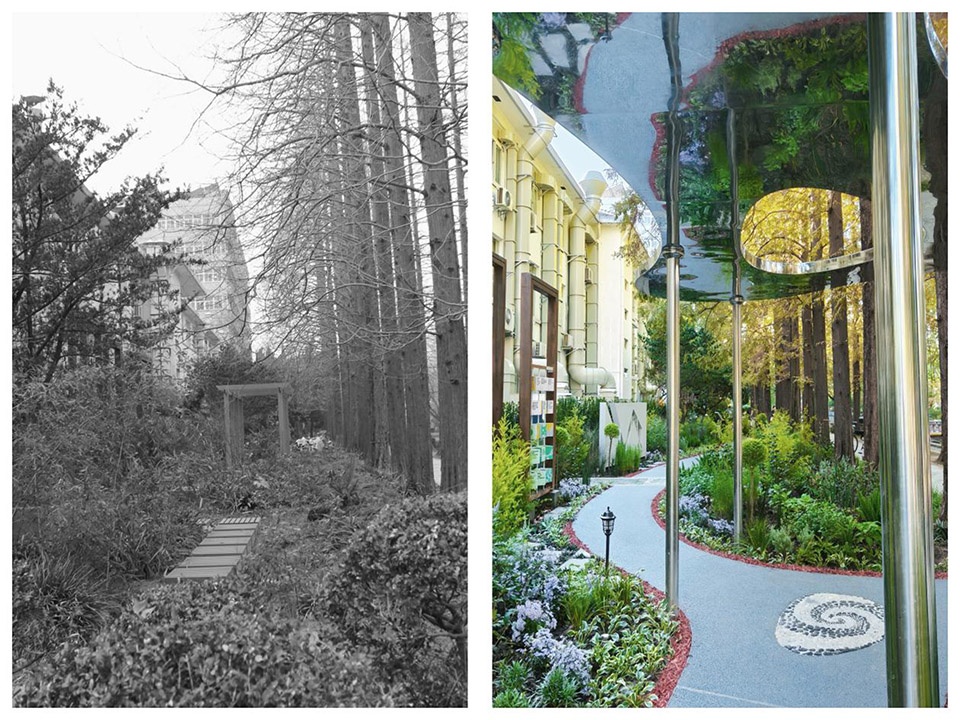
项目不仅优化景观(夜间自发光景墙成校园打卡点),更形成可持续运维机制:学生志愿者日常维护,选用耐候、低成本材料保障后续迭代。该项目验证 “设计搭框架、社区填内容” 的共建模式,为高校及城市社区微更新提供兼具过程性、参与性与生态性的实践范本。
The project not only optimizes the landscape (the self-luminous feature wall at night has become a popular check-in spot on campus) but also forms a sustainable operation and maintenance mechanism: student volunteers for daily maintenance, using weather-resistant, low-cost materials to ensure subsequent iterations. This project validates the co-construction model of “design provides the framework, community fills the content,” providing a practical model combining process, participation, and ecology for micro-renewal in universities and urban communities.
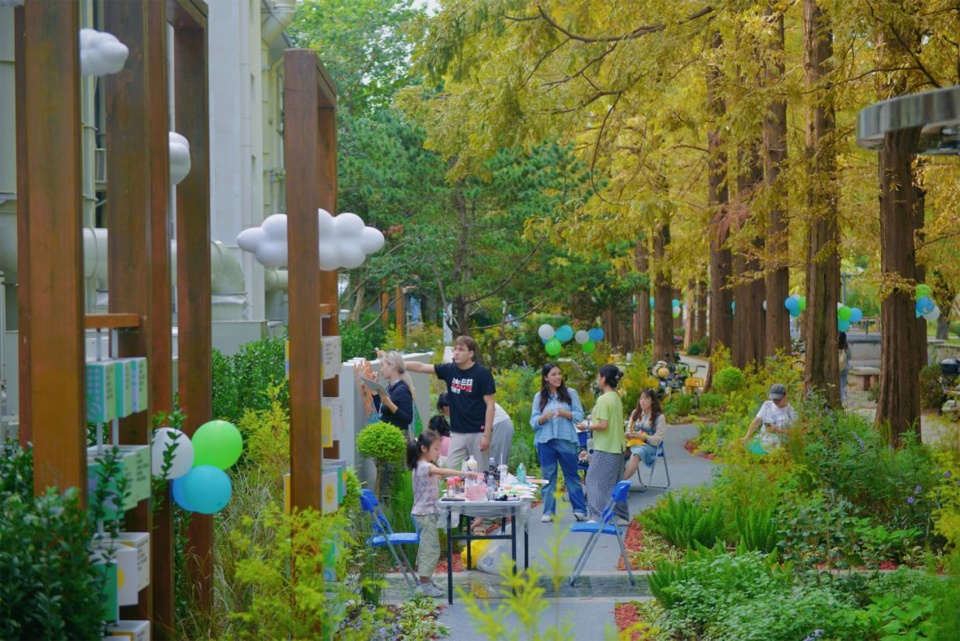
▼场地照片,Site photos © 全国社区花园设计营造竞赛与社区参与行动参与团队
评委评语:该项目以“无废+碳汇”为核心主题,将循环经济理念与社区艺术共创进行了深度融合,通过极具创意的“同瓶共振”玻璃瓶景观装置等实践,巧妙地将废弃材料转化为隐喻社区共生的艺术载体。项目不仅系统传播了低碳科普知识,更通过富有互动性的系列活动有效动员了高校师生与社区居民的广泛参与,在提升生态意识、凝聚社区情感的同时,为高校社区的绿色微更新提供了一个兼具艺术性、社会价值与可操作性的示例,生动诠释了“无废”理念下的共生发展内涵。
Judge’s Comment: Centered on the theme of “Zero-Waste + Carbon Sink,” this project deeply integrates circular economy concepts with community art co-creation. Through highly creative practices like the “Bottles Resonance” glass bottle landscape installation, it ingeniously transforms waste materials into artistic carriers metaphorically representing community symbiosis. The project not only systematically disseminates low-carbon science knowledge but also effectively mobilizes broad participation from university teachers, students, and community residents through interactive activities. While enhancing ecological awareness and consolidating community emotions, it provides an example combining artistry, social value, and operability for the green micro-renewal of university communities, vividly interpreting the connotation of symbiotic development under the “Zero-Waste” concept.
▼场地照片,Site photos © 全国社区花园设计营造竞赛与社区参与行动参与团队
特色花园
Featured Gardens
种点代际花园
Plant Point Intergeneration Community Garden
地点:重庆
Location: Chongqing
指导老师:李震-中央美术学院、陈光辉
Instructors: Li Zhen – Central Academy of Fine Arts, Chen Guanghui
西南-14小组:张悦(组长)、张童、李金宸、杨达人、杨莉、孙宗芬、惠儿
Southwest China -14 Team: Zhang Yue (Leader), Zhang Tong, Li Jinchen, Yang Daren, Yang Li, Sun Zongfen, Hui Er
在后堡,把公共艺术做成一座“会继续长出来”的社区花园
In Houbao, Turning Public Art into a Community Garden That “Keeps Growing”
后堡公共艺术花园项目以公共艺术为工作方法,通过融入社区日常、推动多方协商共建,实现公共空间从“被设计”到“被共同生活”的转变,打造可停留、可参与、可维护的公共场景,核心价值在于构建社群关系、沉淀集体记忆。项目初期调研社区日常需求时,发现场地存在代际空间使用冲突,不同人群使用节奏、行为方式分歧明显且缺乏协商通道,调研方向随即转向探索代际关系与空间公共性,聚焦如何让空间容纳多元需求、化解人群排斥问题。
The Houbao Public Art Garden project uses public art as its working method. By integrating into daily community life and promoting multi-party consultation and co-construction, it achieves the transformation of public space from being “designed” to being “lived together,” creating public scenes that are livable in, participable, and maintainable. The core value lies in constructing community relations and accumulating collective memory. During the initial research on daily community needs, the project found conflicts in the use of space between generations. Different groups had obvious differences in usage rhythms and behavior patterns, lacking channels for consultation. The research direction immediately shifted to exploring intergenerational relations and spatial publicness, focusing on how to make space accommodate diverse needs and resolve issues of exclusion among groups.
▼行动理念,Action concept © 全国社区花园设计营造竞赛与社区参与行动参与团队
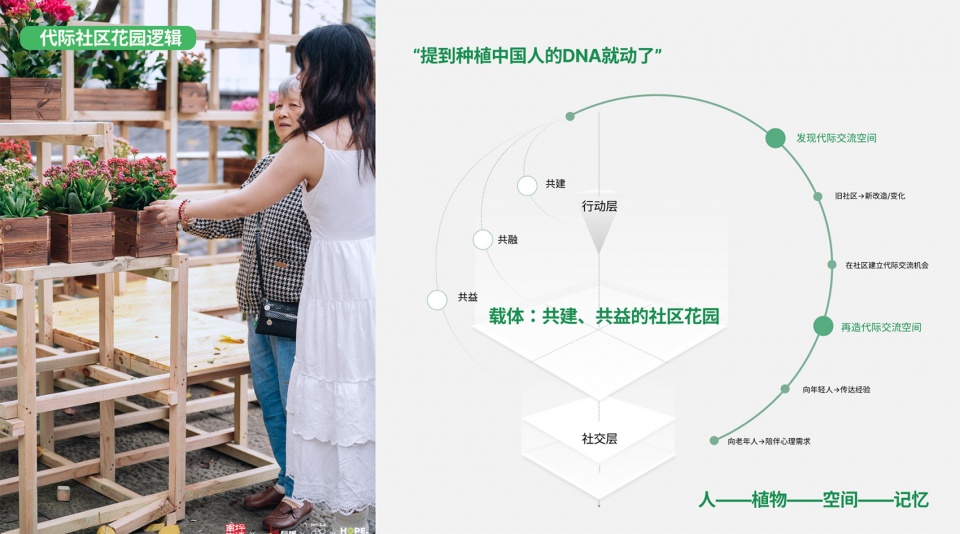
落地的关键在于信任建立与运营前置,通过长期在地驻留、与居民常态化沟通搭建信任联结,挖掘真实需求;以轻量工作坊邀请不同年龄段人群表达花园期待,梳理共识并转化为装置设计与活动框架依据。装置搭建以重庆地形为线索,采用模块化结构,适配现场调整、居民参与及后续维护需求,且结合居民在地反馈持续优化,居民的使用与互动成为空间公共性的重要体现。
The key to implementation lay in trust building and pre-positioning operation. Through long-term on-site residency and normalized communication with residents, trust connections were built to unearth real needs. Lightweight workshops invited people of different ages to express their expectations for the garden, sorting out consensus and transforming it into the basis for installation design and activity frameworks. Installation construction used Chongqing’s topography as a clue, adopting modular structures adaptable to on-site adjustments, resident participation, and subsequent maintenance needs, and was continuously optimized based on residents’ on-site feedback. Residents’ use and interaction became an important manifestation of spatial publicness.
▼场地照片及活动过程,Site photos and activity process © 全国社区花园设计营造竞赛与社区参与行动参与团队
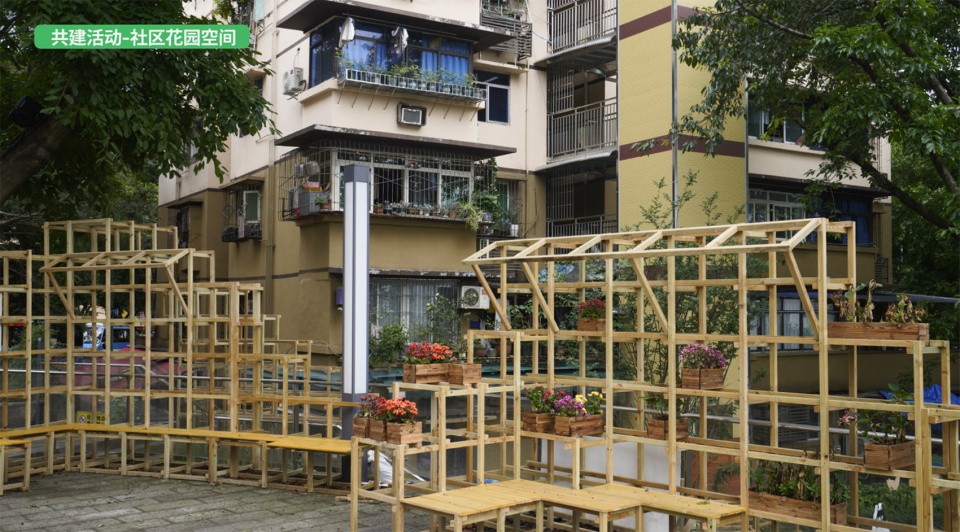
项目构建 “1+1+N” 协作机制,以在地商管公司、社区党群为核心支点,吸纳居民、商户等多主体参与;建立 “共建 — 共治 — 共享 — 共识” 运营闭环,推动全流程参与和长效维护,促进代际融合、凝聚社群认同。过程成果印证了公共艺术的 “未完成性”,其生命力源于持续公众参与,核心是通过共建共治修复社区社会关系,让公共空间成为可共同生活、持续生长的社区日常。
The project constructed a “1+1+N” collaboration mechanism, with the local commercial management company and the community’s Party-mass service center as the core fulcrums, absorbing residents, merchants, and other subjects for participation. It established an operational closed loop of “Co-construction – Co-governance – Sharing – Consensus,” promoting full-process participation and long-term maintenance, facilitating intergenerational integration and consolidating community identity. The results of the process confirmed the ” incompleteness ” of public art, its vitality stemming from continuous public participation. The core is to repair community social relations through co-construction and co-governance, allowing public space to become a part of daily community life that can be lived together and continuously grows.
▼场地照片及活动过程,Site photos and activity process © 全国社区花园设计营造竞赛与社区参与行动参与团队
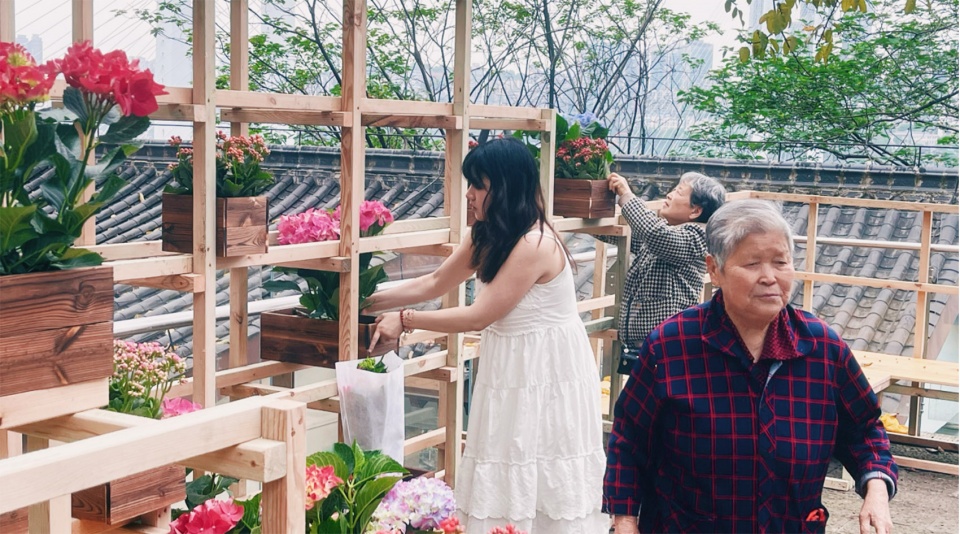
评委评语:该小组聚焦社区花园营建,以“代际融合”为切入点,关注多元人群需求,空间营造效果显著,活动质量高,宣传运营良好。项目调研深入,问题意识强,通过共建共管共享机制与统一的视觉系统,实现了广泛的社区参与,展现出独特的实践智慧。方案为老旧社区代际共生提供了创新范式,具有推广价值。
建议后续重点关注营建的可持续性,加强后期养护机制与自然教育的融合,并在设计形式上进一步回应主题,以深化解决方案的独特性。
Judge’s Comment: This group focused on community garden construction, taking “intergenerational integration” as the entry point, paying attention to the needs of diverse populations. The spatial construction had remarkable results, with high-quality activities and good promotion and operation. The project had in-depth research and a strong sense of problem awareness. Through a co-construction, co-management, and sharing mechanism and a unified visual system, it achieved broad community participation, demonstrating unique practical wisdom. The plan provides an innovative paradigm for intergenerational symbiosis in old communities and has value for promotion.
It is suggested that follow-up efforts focus on the sustainability of construction, strengthen the integration of later-stage maintenance mechanisms with nature education, and further respond to the theme in design form to deepen the uniqueness of the solution.
▼场地照片及活动过程,Site photos and activity process © 全国社区花园设计营造竞赛与社区参与行动参与团队
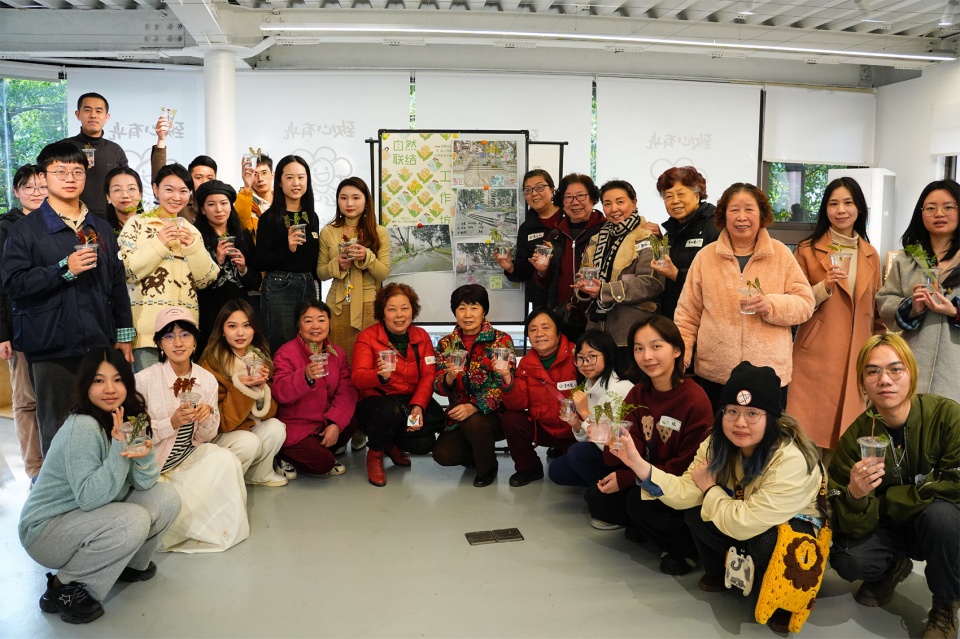
时序花园
Seasonal Garden
地点:武汉
Location: Wuhan
指导老师:夏欣—华中农业大学
Instructor: Xia Xin – Huazhong Agricultural University
华中-01小组:俞卓远(组长)、张宁、王子萱、黄文荣、金新媛、刘瀚之、程佳蕊、张莹、金秀娥、陈玉奋、陈见波
Central China-01 Team: Yu Zhuoyuan (Leader), Zhang Ning, Wang Zixuan, Huang Wenrong, Jin Xinyuan, Liu Hanzhi, Cheng Jiarui, Zhang Ying, Jin Xiu’e, Chen Yufen, Chen Jianbo
花点时间,浇个朋友 —— 一座时序花园的共建小记
Take a moment to grow a friendship – A Brief Record of Co-constructing a Seasonal Garden
这座花园的起点并非浪漫。在推广“社区共建花园”理念时,我们因概念陌生、运营顾虑等原因屡屡碰壁,直到遇见华大家园一位热情的社区书记,才找到真正的合作者。调研中发现,该社区本就注重“顺时而学”,幼儿园常以节气组织课程。于是我们顺势提出“时序花园”主题,让花园随四季节律更新,将原有文化转化为空间体验。花园位于小区北门约168平方米的通道旁。面对人流匆匆、难以参与和维护的现状,我们以二十四节气为主线,将其设计为可持续使用的活态空间,兼顾自然教育与日常体验,并采用低门槛、可复制的建造方式,让环保成为触手可及的实践。
The beginning of this garden was not romantic. When promoting the concept of “community co-built gardens,” we repeatedly encountered obstacles due to unfamiliarity with the concept, operational concerns, and other reasons. It wasn’t until we met an enthusiastic community secretary that we found a true collaborator. During research, it was found that the community already emphasized learning according to the seasons, with kindergartens often organizing courses based on the solar terms. So we seized the opportunity) to propose the “Seasonal Garden” theme, allowing the garden to renew with the rhythm of the four seasons, transforming the existing culture into spatial experience. The garden is located beside a passageway of about 168 square meters at the north gate of the residential area. Facing the current situation of people passing by hurriedly, making participation and maintenance difficult, we used the 24 solar terms as the main thread, designing it as a sustainably usable living space, balancing nature education and daily experience, and adopting low-threshold, replicable construction methods to make environmental protection a tangible practice.
▼行动理念,Action concept © 全国社区花园设计营造竞赛与社区参与行动参与团队
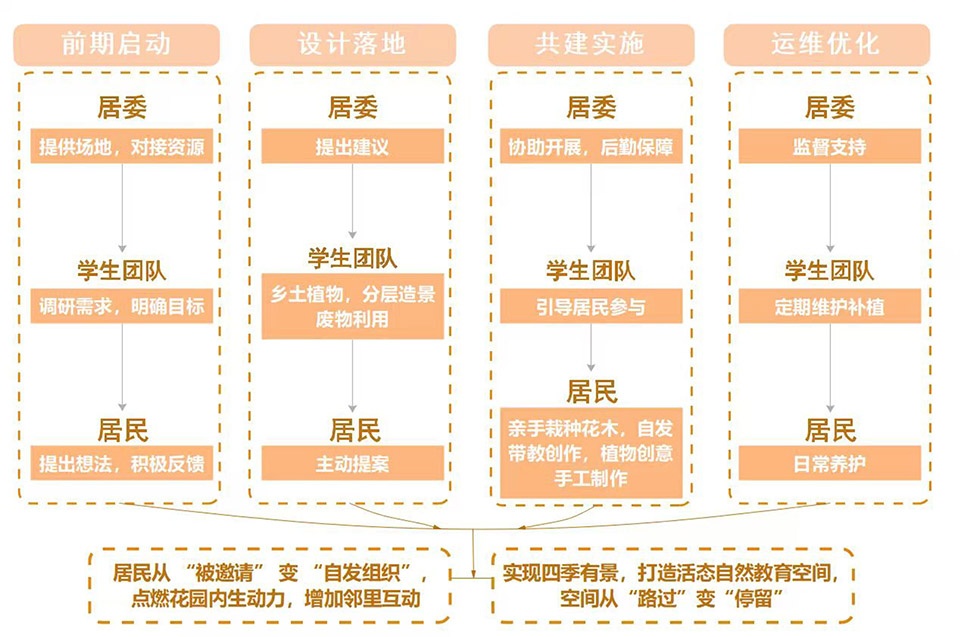
我们与12组家庭一同改造原有蜂巢花箱,种植月季、鸢尾、迷迭香等百余株植物,划分为花境、菜畦与香草角。居民李女士和女儿一起种下月季,并约定定期养护,让孩子在亲手种植中亲近自然。花园建成后,社区举办了创意节:孩子奔跑嬉戏,老人驻足交谈,居民李阿姨现场教学编织,干花手作摊位也备受喜爱。这不仅是一片绿地,更是一次可借鉴的社区行动——以节气凝聚共识,用共创推动参与,靠协作实现长效。植物在生长,邻里关系也在焕新。未来社区计划推广此模式,组建“1个专业团队+N个社群组织”的共治联盟,让这样的幸福在更多小区生根。
Together with 12 families, we renovated the original honeycomb flower boxes, planting over a hundred plants such as roses, irises, and rosemary, divided into flower borders, vegetable plots, and a herb corner. Resident Ms. Li planted roses with her daughter and agreed to maintain them regularly, allowing the child to get close to nature through hands-on planting. After the garden was completed, the community held a creative festival: children ran and played, the elderly stopped to chat, resident Aunt Li taught knitting on the spot, and the dried flower handicraft stall was also very popular. This is not just a green space, but a community action worthy of reference — building consensus through solar terms, promoting participation through co-creation, and achieving long-term through collaboration. Plants are growing, and neighborly relations are also renewing. In the future, the community plans to promote this model, forming a co-governance alliance of “1 professional team + N community organizations” to let such happiness take root in more residential areas.
▼活动过程,Activity process © 全国社区花园设计营造竞赛与社区参与行动参与团队
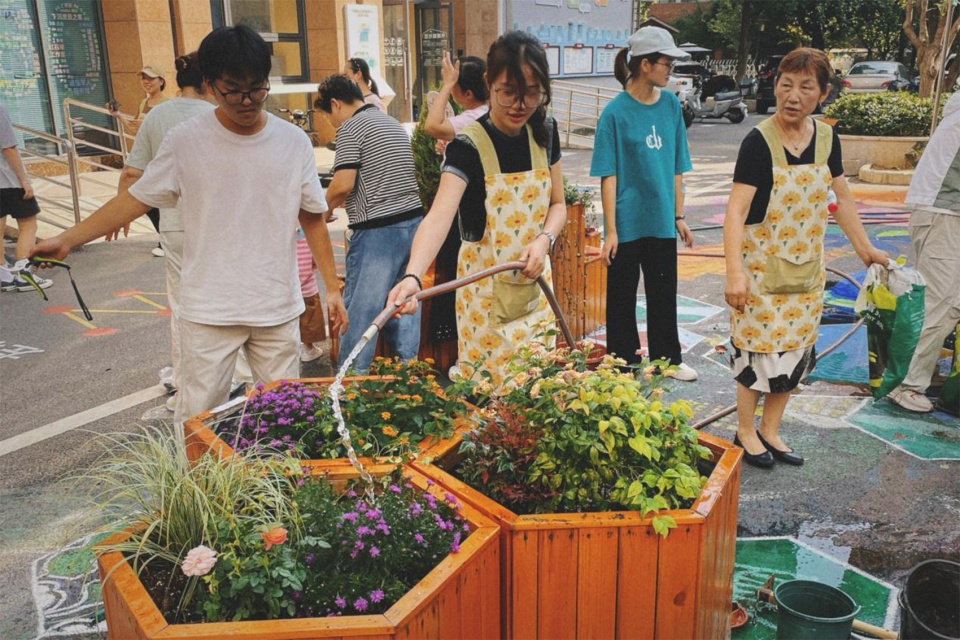
评委评语:该小组以“二十四节气”传统文化赋能社区花园,通过“花点时间,浇个朋友”与“串门计划”等创意主题,有效激活全龄参与,重建人际与自然联结。项目调研扎实,共建过程完整,居民参与积极,通过地绘、盆栽入户等可见成果与多元活动,成功收集到“久违的邻里情”留言并吸引居民主动加入志愿岗,显著提升了社区温情与活力。
项目展现了校社协同的良好执行力,是“文化+生态+社交”融合的微更新范本。建议未来在材料选择上加强废弃物利用以深化环保理念,并进一步完善长期运维机制与植物适配细节,使主题特色更加鲜明。
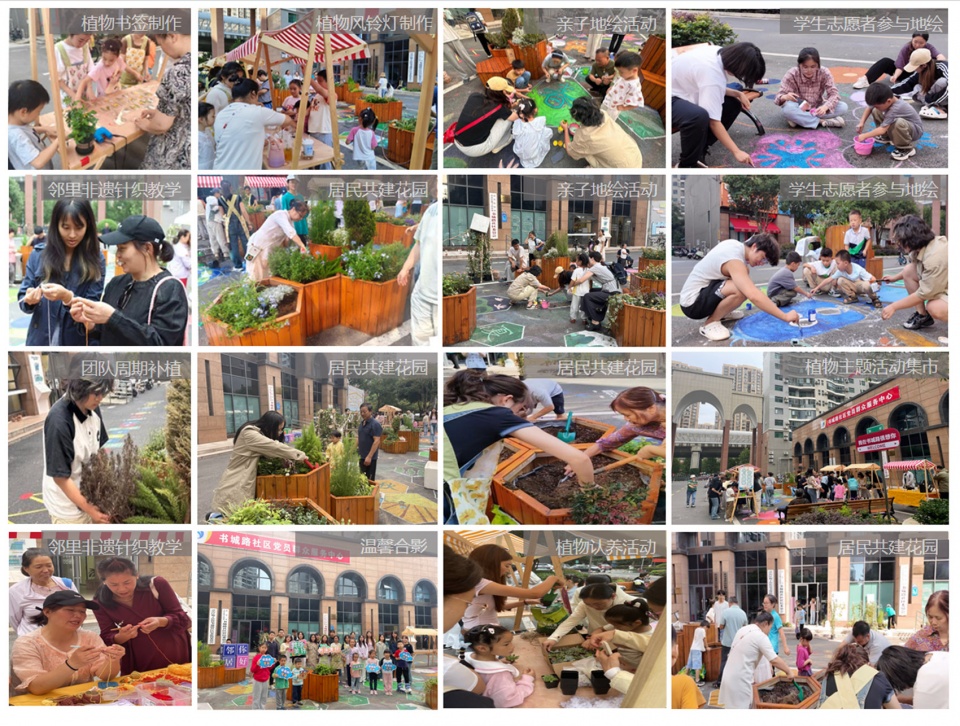
Judge’s Comment: This group empowered the community garden with the traditional culture of the “24 Solar Terms.” Through creative themes like “Spend Some Time, Make a Friend” and the “Visit Plan,” it effectively activated all-age participation, rebuilding connections between people and nature. The project had solid research, a complete co-construction process, and active resident participation. Through visible results like ground painting and potted plants entering homes, and diverse activities, it successfully collected messages about “long-lost neighborhood feelings” and attracted residents to voluntarily join volunteer posts, significantly enhancing community warmth and vitality.
The project demonstrates the good execution capability of school-community collaboration and is a micro-renewal model integrating “culture + ecology + social interaction.” It is suggested that future efforts strengthen the use of waste in material selection to deepen the environmental concept, and further improve the long-term operation and maintenance mechanism and plant adaptation details to make the theme characteristics more distinctive.
▼活动过程,Activity process © 全国社区花园设计营造竞赛与社区参与行动参与团队
柔软星球
Soft Planet
地点:哈尔滨
Location: Harbin
指导老师:刘炳熙-东北林业大学、王春琦-苏州石湖景区管理处、杨菲-东北林业大学
Instructors: Liu Bingxi – Northeast Forestry University, Wang Chunqi – Suzhou Shihu Scenic Area Management Office, Yang Fei – Northeast Forestry University
东北-02小组:王一依(组长)、姚汇泽、陈婧、晏文情、徐诺、许潇予、张容绮、邵梦蝶、罗海霞、王磊
Northeast China-02 Team: Wang Yiyi (Leader), Yao Huize, Chen Jing, Yan Wenqing, Xu Nuo, Xu Xiaoyu, Zhang Rongqi, Shao Mengdie, Luo Haixia, Wang Lei
促进智力障碍儿童“感官-社交”的自然疗愈花园共建行动
A Co-construction Action for a Therapeutic Natural Garden Promoting “Sensory-Social” Abilities for Children with Intellectual Disabilities
在城市更新与社会融合的背景下,特殊教育学校常面临环境单调、学生与社会连接薄弱等问题。东北林业大学团队以“感知柔软的世界”为主题,在哈尔滨燎原学校开展自然疗愈花园共建实践,探索“高校—特校—家庭”三方协作的微更新路径。“柔软”是贯穿始终的设计理念,既指身体的触感,更指向心灵的开放。团队通过三次渐进式活动,引导孩子从感知自我、连接他人到理解生命:1.身体的柔软:通过五感体验建立与自然的初步信任;2.花园装点计划:邀请健康儿童家庭与特殊儿童共建“零废弃花园”,促进融合协作;3.给树朋友一个家:以枯树为载体开展生命教育,理解资源循环与情感寄托。通过高校引导、学校支持、家庭参与的小团体协作,孩子们用旧纸板做留言板、为枯树穿旧衣,在动手中打开心扉,实现“从物到朋友”的情感联结。花园不仅成为校园里的疗愈角落,更成为特殊儿童与社会的情感桥梁。孩子们开始主动照料植物,家长和老师也反馈他们更愿意表达、更积极参与集体。未来,团队将持续推进“柔软花园”课程化,探索可复制的“自然疗愈+融合教育”模式,为更多特殊教育环境提供温暖可持续的更新路径。
In the context of urban renewal and social integration, special education schools often face problems such as monotonous environments and weak connections between students and society. The Northeast Forestry University team, themed “Perceiving the Soft World,” carried out a Healing Garden co-construction practice at Harbin Liaoyuan School, exploring a micro-renewal path through the collaboration of “University – Special School – Family.” “Softness” was the design concept running through the whole process, referring both to physical touch and, more importantly, to the openness of the heart. Through three progressive activities, the team guided children from perceiving themselves) to connecting with others and understanding life: 1. Softness of the Body: building initial trust with nature through five-sense experiences; 2. Garden Decoration Plan: inviting healthy children and their families to co-build a “zero-waste garden” with special needs children, promoting integration and collaboration; 3. Giving a Home to Tree Friends: using dead trees as carriers for life education, understanding resource circulation and emotional sustenance. Through small-group collaboration guided by the university, supported by the school, and with family participation, children used old cardboard to make message boards and dressed dead trees in old clothes, opening their hearts through hands-on activity, achieving an emotional connection “from objects to friends.” The garden not only became a healing corner on campus but also an emotional bridge between special children and society. Children began to actively care for plants, and parents and teachers reported that they were more willing to express themselves and participate more actively in the group. In the future, the team will continuously promote the “Soft Garden” curriculum, exploring a replicable model of “nature therapy + inclusive education,” providing a warm and sustainable renewal path for more special education environments.
▼行动框架,Action framework © 全国社区花园设计营造竞赛与社区参与行动参与团队
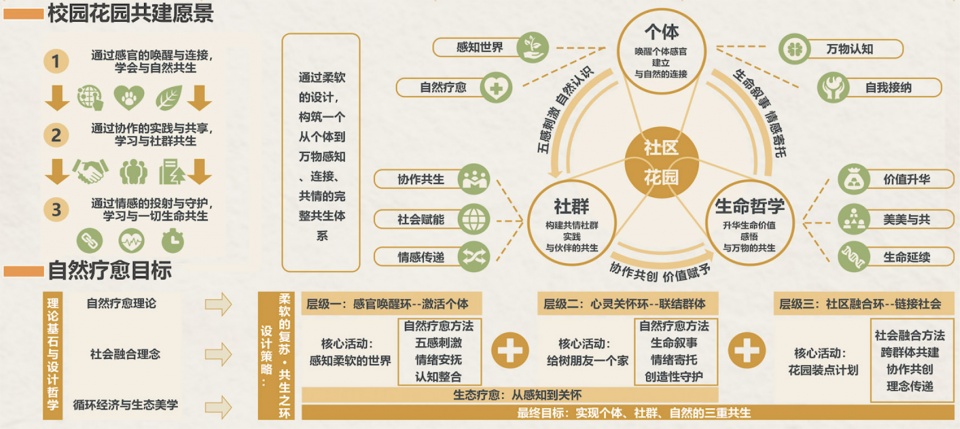
评委评语:该小组聚焦智力障碍儿童“户外接触少、社会融合难”的痛点,以“柔软星球”为主题,构建了“感官唤醒-社群融合-社区链接”三重行动体系,将低效空间转化为兼具五感疗愈与生命教育功能的包容性场域。项目立意充满社会关怀,多方共建机制完善,环保材料运用突出,活动设计严谨暖心,成果制作精良,让特殊儿童在接触自然中感受生命意义,是极具价值的融合教育实践。
由于哈尔滨气候限制,目前花园以临时性装置呈现。建议未来在可持续运营角度深化思考,待春暖时补充真实植物配置,强化五感效应,并争取社会各界更广泛参与,为特殊儿童打造一个真正安全、永久且具有科学艺术性的疗愈花园。团队用心温情,令人动容。
Judge’s Comment: Focusing on the pain points of children with intellectual disabilities — “limited outdoor contact and difficulty in social integration” — and themed “Soft Planet,” this group constructed a three-fold action system: “Sensory Awakening – Community Integration – Social Connection,” transforming inefficient space into an inclusive field combining five-sense therapy and life education functions. The project’s concept is full of social concern, with well-established multi-party co-construction mechanisms, outstanding use of environmentally friendly materials, rigorous and heartwarming activity design, and exquisitely produced results, allowing special children to feel the meaning of life through contact with nature. It is a highly valuable inclusive education practice.
Due to climatic constraints in Harbin, the garden is currently presented with temporary installations. It is suggested that future thinking deepen on sustainable operation, supplement with real plant arrangements when spring arrives to strengthen the five-sense effect, and strive for broader participation from all sectors of society to create a truly safe, permanent, and scientifically-artistic therapeutic garden for special children. The team’s dedication and warmth are touching.
▼活动过程,Activity process © 全国社区花园设计营造竞赛与社区参与行动参与团队
旗乐融融花园
Qile Rongrong Garden
地点:昆明
Location: Kunming
指导老师:文佳-云南财经大学、丁绍莲-云南财经大学、王婧婕-织微在地
Instructors: Wen Jia – Yunnan University of Finance and Economics, Ding Shaolian – Yunnan University of Finance and Economics, Wang Jingjie – Wovemote
西南-04小组:冉韦涛(组长)、李云艳、彭子桐、王姮鹭、杨水艳、张景飒、刘德苹
Southwest-04 Team: Ran Weitao (Leader), Li Yunyan, Peng Zitong, Wang Henglu, Yang Shuiyan, Zhang Jingsa, Liu Deping
多元共筑,绿意共生:“旗乐融融花园”的百姓园林实践与社区赋能
Diverse Co-construction, Green Symbiosis: The “Qile Rongrong Garden” Practice of People’s Landscapes and Community Empowerment
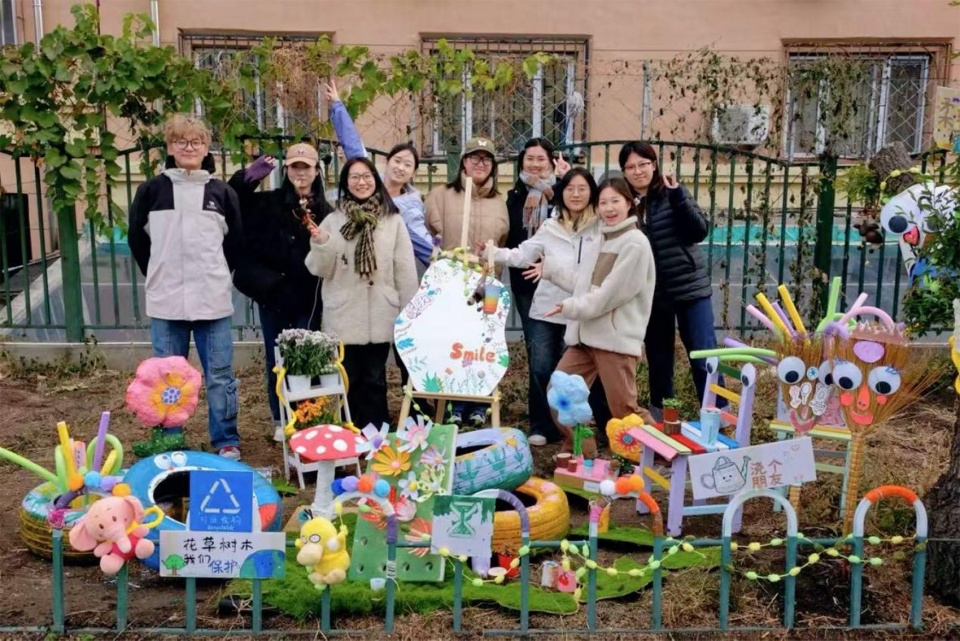
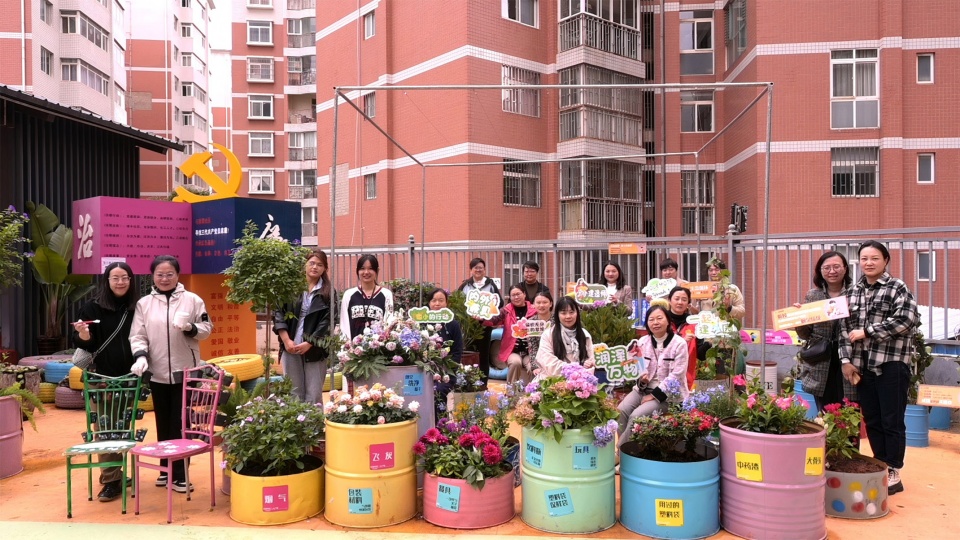
旗乐融融社区花园由云南财经大学绿芽社造团队与昆明任旗营社区共同打造,将百余平方米的闲置角落转化为集生态、休闲与文化于一体的社区绿色客厅,成为“园林服务百姓”的生动实践。花园贯彻“与自然共生”理念,采用创造性“零废弃”循环策略。面对资金限制,团队向社区内部挖掘资源:废弃油桶、轮胎被改造成花盆与种植槽,旧家具变为休憩座椅。“变废为宝”不仅降低成本与环境负担,更让居民在亲手改造中理解资源循环,实现从“消耗者”到“共建者”的意识转变。
The Qile Rongrong Community Garden, jointly created by the Yunnan University of Finance and Economics’ Green Buds Community Building Team and Kunming Renqiying Community, transforms a idle corner of over 100 square meters into a community green living room integrating ecology, leisure, and culture, becoming a vivid practice of “landscaping serving the people.” The garden implements the concept of “symbiosis with nature,” adopting a creative “zero-waste” circular strategy. Facing financial constraints, the team tapped resources within the community: discarded oil drums and tires were transformed into flower pots and planting beds, and old furniture became resting seats. “Turning waste into treasure” not only reduced costs and environmental burden but also let residents understand resource circulation through hands-on transformation, achieving a shift in consciousness from “consumers” to “co-builders.”
▼行动理念,Action concept © 全国社区花园设计营造竞赛与社区参与行动参与团队
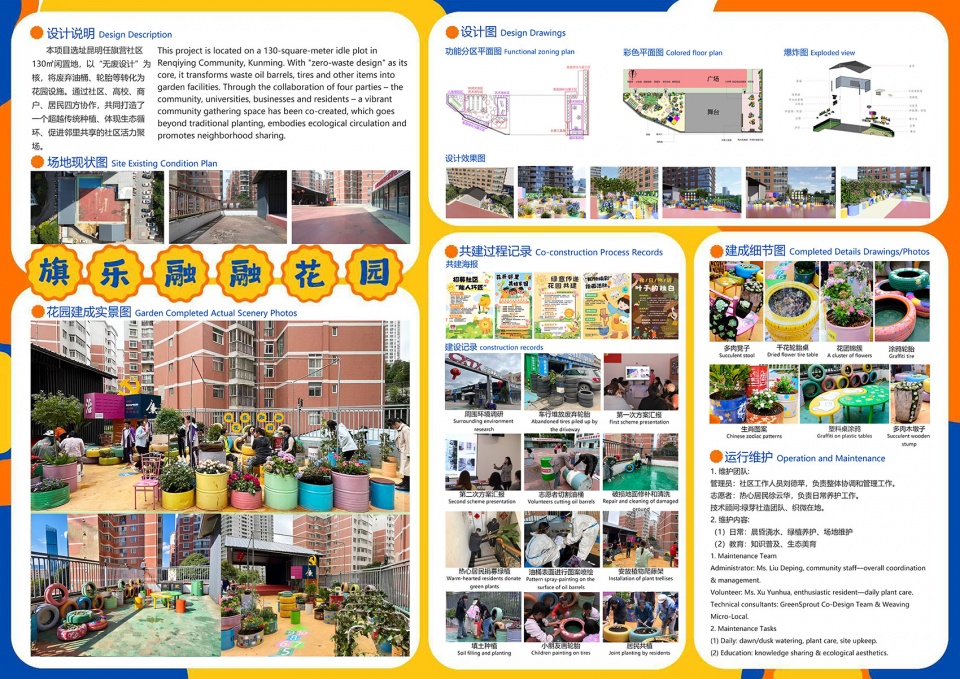
项目成功依托“社区-高校-居民”三方共建模式。社区居委会作为“连心桥”整合资源;高校团队担任“智囊团”,提供规划设计并组织工作坊赋能居民;居民则成为核心驱动力——从彩绘轮胎到分享种植技巧,再到组建“搬运志愿队”,大家从“旁观者”转变为“共建守护者”,建立起牢固的社区情感纽带。花园注重培育内生机制。落成后,社区牵头组建“花园守护者”志愿队,制定公约负责日常养护。同时引入“生态美育”计划,将花园转化为户外课堂,通过系列体验活动,让居民在互动中不仅欣赏花园之美,更理解其背后的生命循环与生态智慧,从而增强对社区家园的归属感与守护责任。旗乐融融花园以方寸绿意绘就百姓园林新图景,让共生之美扎根社区、温暖人心。
The project successfully relied on the “Community-University-Resident” tripartite co-construction model. The community neighborhood committee acted as a “bridge” integrating resources; the university team served as a “think tank,” providing planning and design and organizing workshops to empower residents; residents became the core driving force — from painting tires to sharing planting skills, to forming a “moving volunteer team,” everyone transformed from “bystanders” to “co-builders and guardians,” establishing solid community emotional bonds. The project successfully relied on the “Community-University-Resident” tripartite co-construction model. The community neighborhood committee acted as a “bridge” integrating resources; the university team served as a “think tank,” providing planning and design and organizing workshops to empower residents; residents became the core driving force — from painting tires to sharing planting skills, to forming a “moving volunteer team,” everyone transformed from “bystanders” to “co-builders and guardians,” establishing solid community emotional bonds.
▼场地照片及活动过程,Site photos and activity process © 全国社区花园设计营造竞赛与社区参与行动参与团队
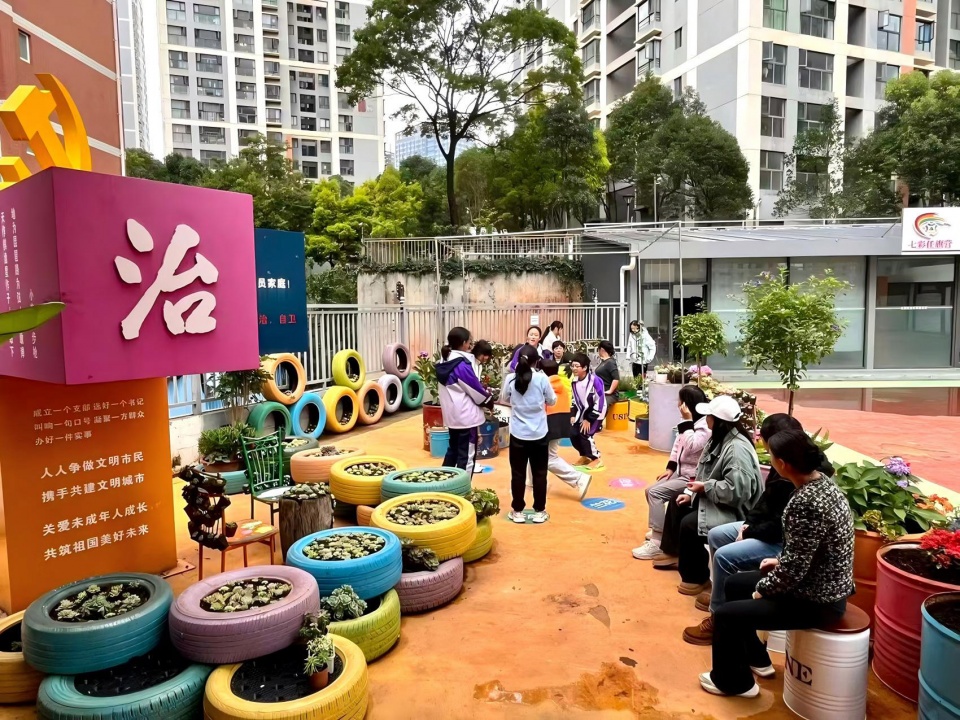
评委评语:该小组以鲜明大胆的色彩与层次丰富的植物配置,结合废旧轮胎、油桶等材料的创新利用,打造出兼具视觉冲击与生态理念的社区花园。项目通过四方协作实现深度共建,从幼儿园到社区居民全员参与,花园命名亦由居民共议,体现了全方位的社区动员与治理创新。为项目注入了可持续的生命力,使其成为兼具环境价值与社群温度的微更新典范。建议后续进一步完善长期运维机制,并在视觉表达与细节控制上强化主题呈现,以增强持续发展的潜力。
Judge’s Comment: With vibrant and bold colors and richly layered plant arrangements, combined with the innovative use of discarded materials like tires and oil drums, this group created a community garden combining visual impact and ecological concepts. The project achieved deep co-construction through quadripartite collaboration, with participation from kindergarten to community residents. The garden’s name was also decided through resident discussion, reflecting comprehensive community mobilization and governance innovation. Infused sustainable vitality into the project, making it a micro-renewal model combining environmental value and community warmth. It is suggested that follow-up efforts further improve the long-term operation and maintenance mechanism, and strengthen the theme presentation in visual expression and detail control to enhance the potential for sustainable development.
▼场地照片及活动过程,Site photos and activity process © 全国社区花园设计营造竞赛与社区参与行动参与团队
山形记-竹丝篾影花园
Bamboo Filament and Strip Shadow Garden
地点:南宁
Location: Nanning
指导老师:林雪琼-广西艺术学院、黄思成-广西艺术学院、莫敷建-广西艺术学院
Instructors: Lin Xueqiong – Guangxi Arts University, Huang Sicheng – Guangxi Arts University, Mo Fujian – Guangxi Arts University
华南-07小组:以丽旭(组长)罗舒涵、梁丽萍、高晓阳、李晓杨、罗雅馨、韦鸿初、涂浩飞、刘聪颖、李琴、崔志强、钟国娟
South China-07 Team: Yi Lixu (Leader), Luo Shuhan, Liang Liping, Gao Xiaoyang, Li Xiaoyang, Luo Yaxin, Wei Hongchu, Tu Haofei, Liu Congying, Li Qin, Cui Zhiqiang, Zhong Guojuan
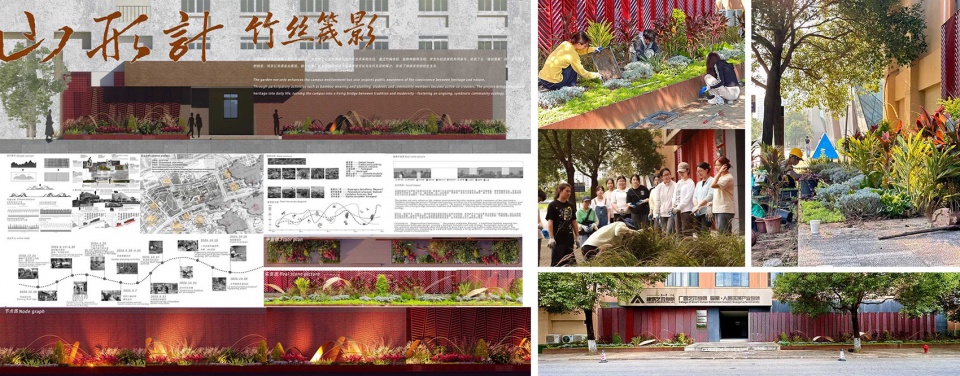
竹丝篾影:校园花园的非遗新生
Bamboo Filament and Strip Shadow: New Life for Intangible Cultural Heritage in a Campus Garden
花园位于人居环境产业学院入口处,既美化了校园环境,也成为专业教学的“活教材”,帮助学生直观学习植物配置与景观营造。它不仅是传递校园生态理念的窗口,也营造了富有生机的校园文化氛围。
The garden is located at the entrance of the College of Human Settlements Industry. It not only beautifies the campus environment but also serves as “living teaching material” for professional instruction, helping students intuitively learn plant arrangement and landscape construction. It is not only a window for transmitting campus ecological concepts but also creates a vibrant campus cultural atmosphere.
▼行动理念,Action concept © 全国社区花园设计营造竞赛与社区参与行动参与团队
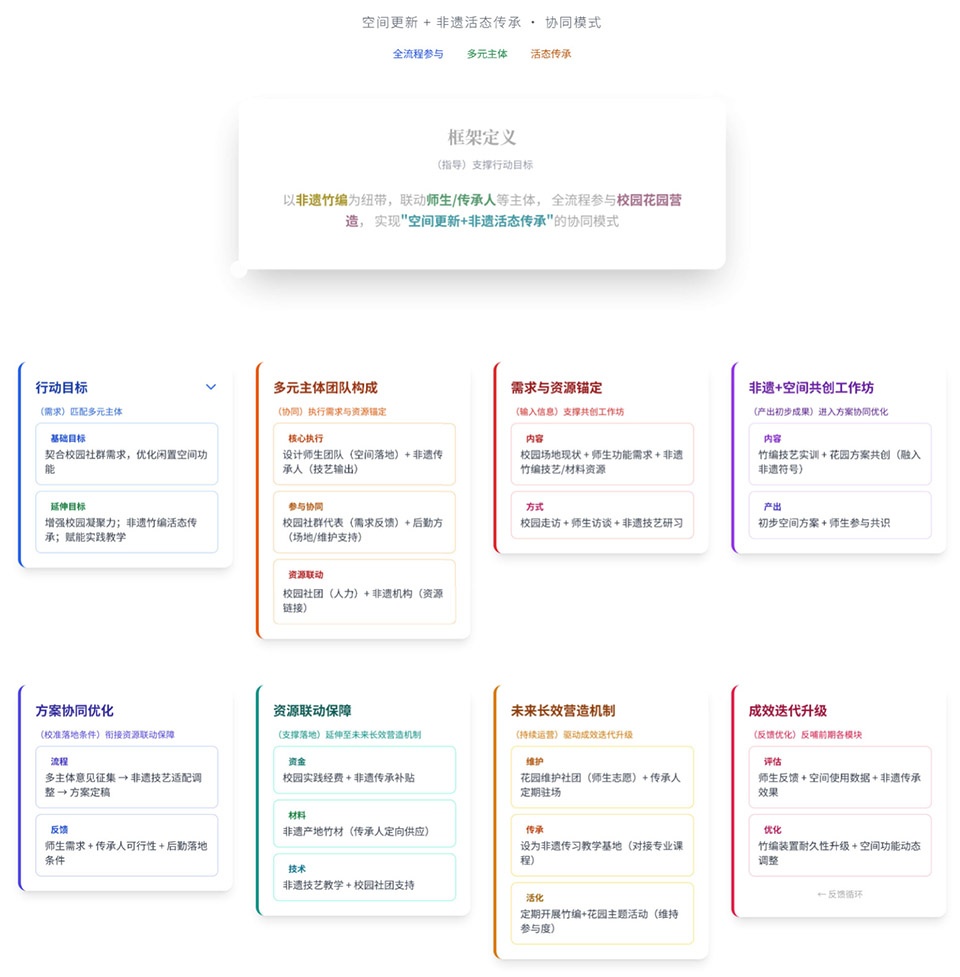
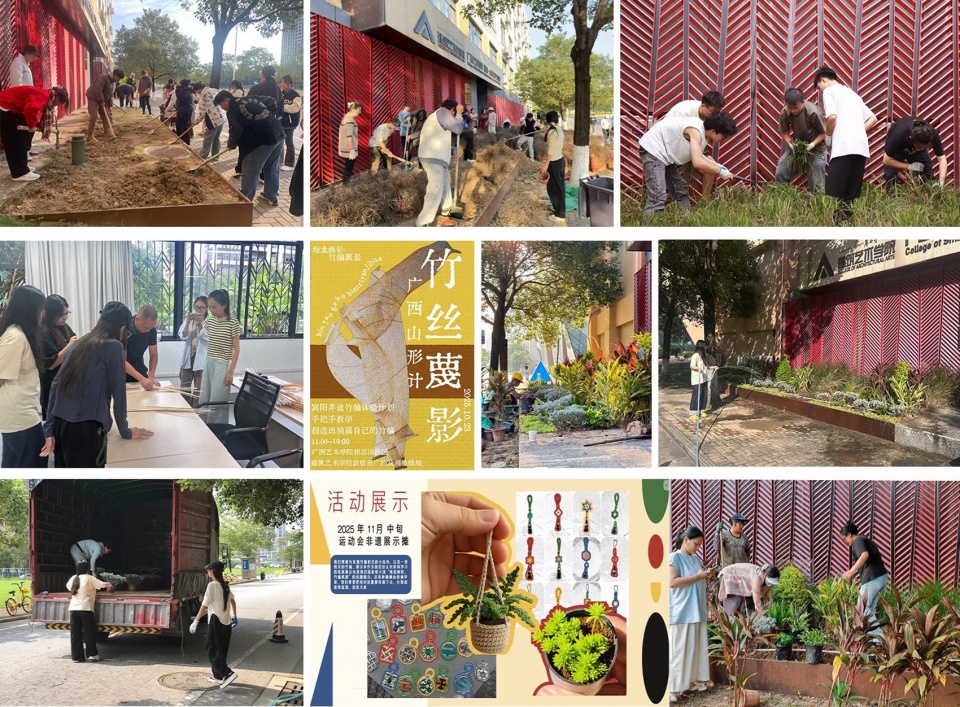
当前校园部分绿地存在植被老化、层次单一、利用不足等问题,缺乏可参与、可感知的生态体验空间,师生对景观的认同与参与度也有待提升。本项目尝试将非遗文化与园林景观相融合,在花园中引入宾阳竹编工艺小品,把传统竹编的纹理与技艺融入现代设计,既展现非遗魅力,也为花园注入独特的人文气息。这一实践为传统手艺提供了新的展示平台,有助于吸引年轻一代关注并传承竹编文化。改造过程中,团队在植物搭配、工期协调等方面遇到挑战,也反映出实践经验不足的问题。但小花园的最终落成,离不开参与共建的学生、老师与社区居民的共同努力,这正是项目得以实现的关键。我们希望通过这次“小花园营造”,以“再生”方式激活闲置绿地,让自然教育与文化传承在微小空间中相遇。项目也呼应“百姓园林·共生发展”的主题,探索人与自然、传统与现代之间的共生路径。
At present, some green spaces on campus suffer from aging vegetation, single-layer structure, and underutilization. They lack participatory and perceptible ecological experience spaces, and teachers and students’ recognition and participation in the landscape need to be improved. This project attempts to integrate intangible cultural heritage with landscape architecture. It introduces Binyang bamboo weaving artworks into the garden, integrating traditional bamboo weaving textures and techniques into modern design. It not only shows the charm of intangible cultural heritage but also injects unique humanistic atmosphere into the garden. This practice provides a new display platform for traditional crafts and helps attract the younger generation to pay attention to and inherit bamboo weaving culture. During the renovation, the team encountered challenges in plant collocation and construction period coordination, which also reflected insufficient practical experience. However, the final completion of the small garden is inseparable from the joint efforts of students, teachers and community residents who participated in the co-construction, which is the key to the project’s realization. We hope to activate idle green spaces in a “regenerative” way through this “small garden construction”, letting nature education and cultural inheritance meet in a tiny space. The project also echoes the theme of “Gardens for the People, Development for Symbiosis”, exploring the path of symbiosis between humans and nature, tradition and modernity.
▼设计方案及活动过程,Design plans and activity process © 全国社区花园设计营造竞赛与社区参与行动参与团队
评委评语:该小组以非遗竹编为特色,结合完善的灌溉系统,打造出植物栽植与竹构高度呼应的校园花园,完成度与自然美感俱佳。项目融合文化传承与生态营造,联结非遗传承人开展生动活动,师生共建深入温馨,有效激活闲置空间,是文化传承与生态营造融合的优质典范。
建议后续重点完善长期运维机制,整理活动系统化经验,并补充废弃物改造设计与量化数据,以增强可持续性。整体是一个具有文化特色的社区花园优秀案例。
The team features intangible cultural heritage bamboo weaving and combines a complete irrigation system to create a campus garden where plant planting and bamboo structure are highly consistent, with excellent completion and natural beauty. The project integrates cultural inheritance and ecological construction, connects inheritors of intangible cultural heritage to carry out vivid activities, and the co-construction between teachers and students is in-depth and warm, effectively activating idle space. It is a high-quality model of the integration of cultural inheritance and ecological construction.
It is recommended to focus on improving the long-term operation mechanism in the future, sort out systematic experience of activities, and supplement waste transformation design and quantitative data to enhance sustainability. Overall, it is an excellent case of a community garden with cultural characteristics.
▼设计方案及活动过程,Design plans and activity process © 全国社区花园设计营造竞赛与社区参与行动参与团队
一坪之外-YaYa花园
Beyond One Ping – YaYa Garden
地点:上海
Location: Shanghai
指导老师:王磊姝-上海师范大学天华学院、张英-上海师范大学天华学院、李晓-上海奉贤区天华幼儿园园长
Instructors: Wang Leishu – Shanghai Normal University Tianhua College, Zhang Ying – Shanghai Normal University Tianhua College, Li Xiao – Principal of Shanghai Fengxian District Tianhua Kindergarten
华东-40小组:汤吟(组长)、陈姝尹、季天宇、王雨淳、方筱颖、雷明昊、潘骏哲、辛宗轩、顾辰超、何文华、张悦洋、彭红胜、田师傅、邹浩楠、白清雪
East China-40 Team: Tang Yin (Leader), Chen Shuyin, Ji Tianyu, Wang Yuchun, Fang Xiaoying, Lei Minghao, Pan Junzhe, Xin Zongxuan, Gu Chenchao, He Wenhua, Zhang Yueyang, Peng Hongsheng, Tian Shifu, Zou Haonan, Bai Qingxue
15平米的疗愈与共生
Healing and Symbiosis in 15 Square Meters
在上海市奉贤区天华幼儿园的角落,一处仅15平方米、曾堆满杂物的闲置地,如今已成为师生共同的疗愈空间——YaYa花园。创新的起点始于一个开放的命名。它可以是惊叹的“呀!”,是象征新生的“芽芽”,是记录成长的“牙牙”,或是花园里可爱的“鸭鸭”。这个开放式IP将空间转化为一本“故事书”,邀请每位参与者成为作者,奠定情感共创的基石。设计采用了“生长共创”的动态框架,由高校师生、幼儿园师生及家长志愿者协同推进。空间引入芳香植物、多彩花卉与不同质感的材料,为幼儿提供丰富的五感刺激;弯曲小径与低矮种植床取代了传统布局,鼓励孩子们自主探索。
In the corner of Tianhua Kindergarten in Fengxian District, Shanghai, an idle land of only 15 square meters once full of debris has now become a healing space for teachers and students – YaYa Garden. The innovation starts with an open naming. It can be the exclamation “Ya!”, the “YaYa” symbolizing new life, the “Yaya” recording growth, or the cute “Yaya” duck in the garden. This open IP turns the space into a “storybook”, inviting every participant to be the author and laying the foundation for emotional co-creation. The design adopts a dynamic framework of “growth and co-creation”, promoted by university teachers and students, kindergarten teachers and students, and parent volunteers. The space introduces aromatic plants, colorful flowers and materials with different textures to provide rich five-sense stimulation for young children. Curved paths and low planting beds replace the traditional layout, encouraging children to explore independently.
▼行动框架,Action framework © 全国社区花园设计营造竞赛与社区参与行动参与团队
春季,团队搭建花园骨架;夏季,转为观察者,记录孩子们自发的游戏与发现;秋季,依据真实反馈再次发起共创。这一动态机制让花园如同生命体般呼吸与生长。花园也成为深层联结的载体。沉默的孩子在这里通过共享画笔、观察昆虫建立社交;家长蹲下身,聆听孩子讲述自然发现。它促进了社交、亲子与教育者自身的多重疗愈,织就了一张紧密的情感网络。
In spring, the team builds the framework of the garden; in summer, it turns into observers, recording children’s spontaneous games and discoveries; in autumn, it launches co-creation again based on real feedback. This dynamic mechanism allows the garden to breathe and grow like a living body. The garden has also become a carrier of deep connection. Quiet children build social connections here by sharing paintbrushes and observing insects; parents squat down to listen to children talk about their natural discoveries. It promotes multiple healing of social, parent-child and educators themselves, weaving a tight emotional network.
▼场地照片及活动过程,Site photos and activity process © 全国社区花园设计营造竞赛与社区参与行动参与团队
项目践行“低成本焕新”与“儿童作为共创者”的理念:引入厨余堆肥实现土壤自养护;开发“种子成长记”等自然课程;将废旧轮胎、塑料瓶改造为创意种植容器。这探索了“生态、资源、课程”三共生的未来模式。我们的设计并非交付一个完美成品,而是构建一个可生长的共生框架。通过“大手牵小手”,专业设计转化为幼儿可参与的涂鸦与播种。这证明即使是最局促的方寸之地,也能生长出温暖、生机与无限可能。
The project practices the concepts of “low-cost renewal” and “children as co-creators”: introducing kitchen waste composting to realize soil self-maintenance; developing natural courses such as “Seed Growth Story”; transforming waste tires and plastic bottles into creative planting containers. This explores the future model of “ecology, resources, courses” tripartite symbiosis. Our design is not to deliver a perfect finished product, but to build a growable symbiotic framework. Through “big hands holding small hands”, professional design is transformed into graffiti and sowing that young children can participate in. This proves that even the most cramped square inch can grow warmth, vitality and infinite possibilities.
▼场地照片及活动过程,Site photos and activity process © 全国社区花园设计营造竞赛与社区参与行动参与团队
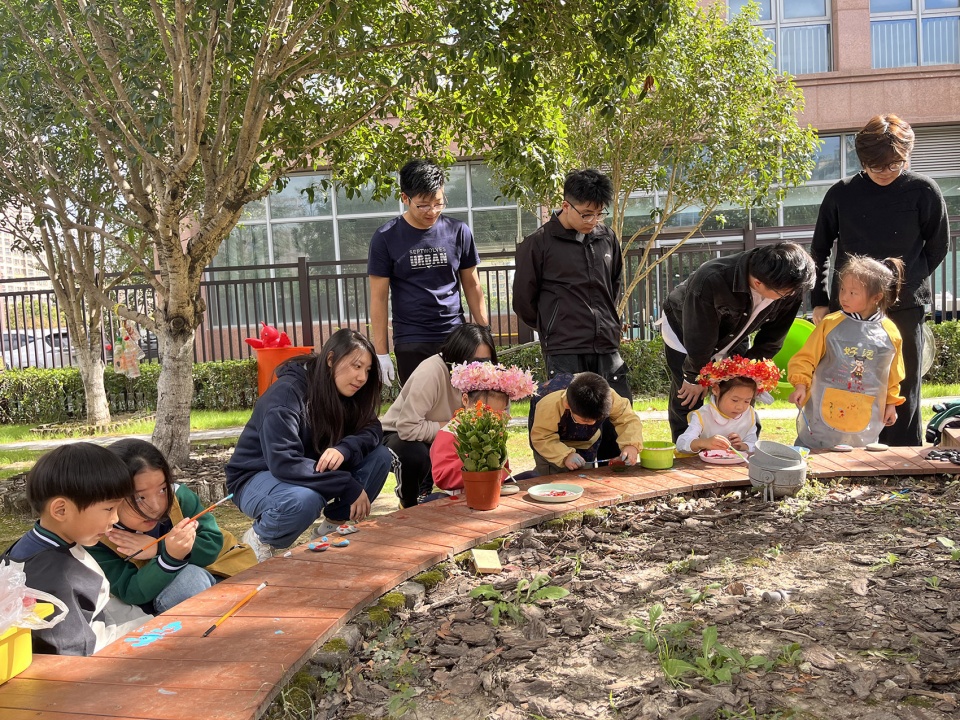
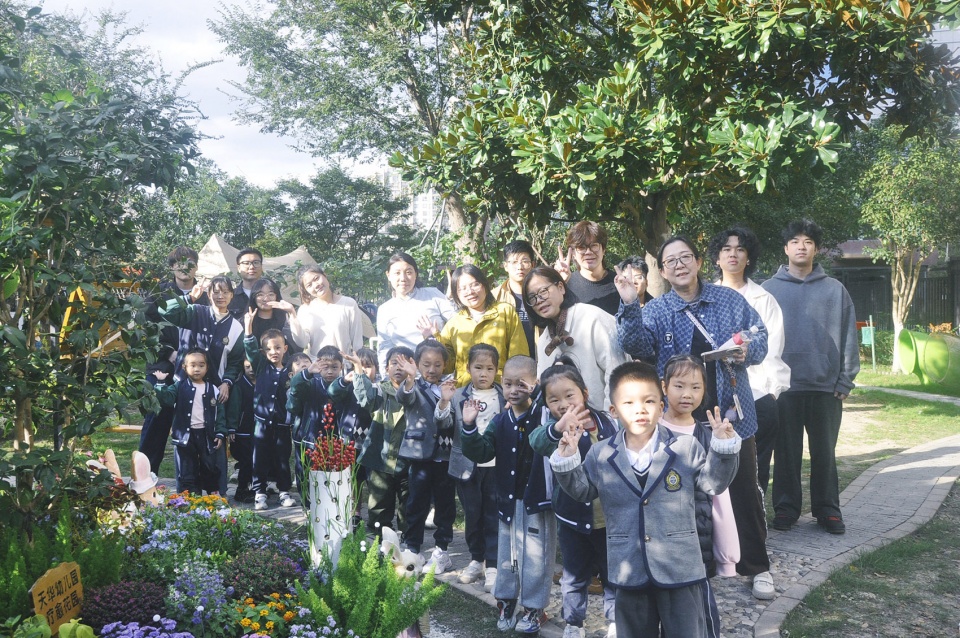
评委评语:该小组的幼儿园花园项目是一次充满童趣与生命力的优秀实践。项目以儿童深度参与为核心,将“五感疗愈”理念巧妙转化为趣味性的自然探索活动,极大激发了孩子们的好奇心。花园营造时间线清晰,活动设计顺应植物生长规律,在极小空间内实现了儿童与自然的共生共长。团队以低成本实现了安全友好的空间设计。尤为难得的是,项目以自闭症儿童干预的实证研究为支撑,将专业疗愈机制融入阳光明媚的校园角落,为儿童友好空间建设树立了专业标杆。
未来可进一步挖掘场地在地叙事,增强主题的感染力,并加强与社区的互动联动,让花园的生态与教育价值惠及更广泛人群。
Judge’s Comment: The kindergarten garden project of this team is an excellent practice full of childlike fun and vitality. Centering on children’s in-depth participation, the project skillfully transforms the “five-sense healing” concept into interesting natural exploration activities, greatly stimulating children’s curiosity. The garden construction timeline is clear, and the activity design conforms to the law of plant growth, realizing the symbiotic growth of children and nature in a very small space. The team achieves a safe and friendly space design at a low cost. What is particularly rare is that the project is supported by empirical research on autism intervention, integrating professional healing mechanisms into the sunny campus corner, setting a professional benchmark for the construction of child-friendly spaces. In the future, the local narrative of the site can be further explored to enhance the appeal of the theme, and the interaction and linkage with the community can be strengthened to benefit a wider population with the ecological and educational value of the garden.
▼场地照片及活动过程,Site photos and activity process © 全国社区花园设计营造竞赛与社区参与行动参与团队
WE Garden
地点:苏州
Location: Suzhou
指导老师:常莹-西交利物浦大学、袁惠燕-苏州大学、孟琳-苏州大学
Instructors: Chang Ying – Xi’an Jiaotong-Liverpool University, Yuan Huiyan – Soochow University, Meng Lin – Soochow University
华东-30小组:季琳(组长)、罗永杰、贾可意、郑壬庚、DES005社区花园创新实验室全体学生
East China-30 Team: Ji Lin (Leader), Luo Yongjie, Jia Keyi, Zheng Rengeng, All students of DES005 Community Garden Innovation Lab
校园实验场:西浦“WE Garden”社区花园的零废弃营造与教育重构
Campus Laboratory: Zero-Waste Construction and Educational Reconstruction of XJTLU’s “WE Garden” Community Garden
在城市规划行业转型的背景下,西交利物浦大学设计学院开设了全国首门社区花园专题选修课《社区花园创新实验室》。课程以“重返自然,重建附近”为理念,引导100名跨专业学生通过6周实践,在校园内建成了19个微型花园。项目核心策略在于融合“零废弃”与模块化设计,创新性地以中国传统“金、木、水、火、土”五行哲学为指导,将废弃物转化为生态景观:金:回收废弃自行车改造为立体种植装置。木:利用废弃树枝搭建“昆虫旅馆”,促进生物多样性。水:制作雨水收集与太阳能水景,调节微气候。火:用废弃材料制作太阳能灯,提供零能耗照明。土:引入“锁孔花园”与蚯蚓塔,实现土壤改良与节水。
Against the background of the transformation of the urban planning industry, the School of Design of Xi’an Jiaotong-Liverpool University has offered the first national elective course on community gardens – Community Garden Innovation Laboratory. With the concept of “Return to Nature, Rebuild the Neighborhood”, the course guides 100 interdisciplinary students to build 19 miniature gardens on campus through 6 weeks of practice. The core strategy of the project is to integrate “zero waste” and modular design, innovatively guided by the traditional Chinese philosophy of five elements (Metal, Wood, Water, Fire, Earth), turning waste into ecological landscape: Metal: Recycled waste bicycles are transformed into three-dimensional planting devices. Wood: Waste branches are used to build “insect hotels” to promote biodiversity. Water: Rainwater collection and solar water features are made to adjust the microclimate. Fire: Waste materials are used to make solar lamps to provide zero-energy lighting. Earth: “Keyhole gardens” and earthworm towers are introduced to realize soil improvement and water saving.
▼行动框架,Action framework © 全国社区花园设计营造竞赛与社区参与行动参与团队
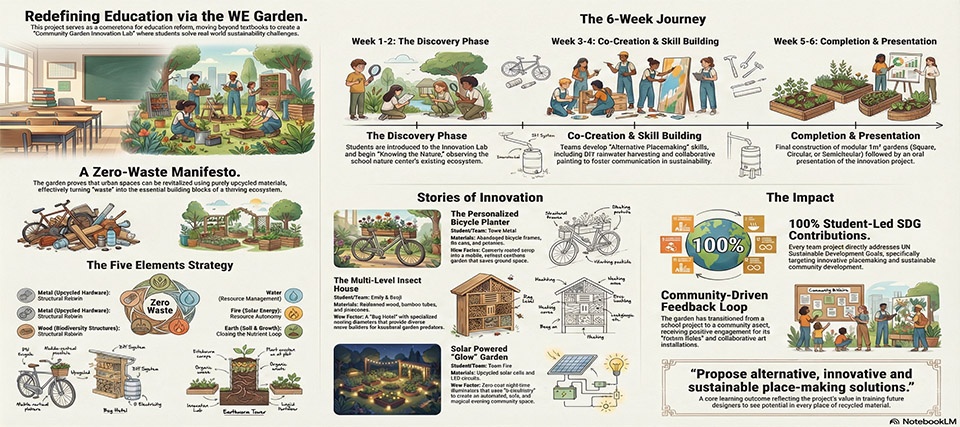
项目实施遵循“学习-创新-服务”的框架:从同济大学“飞羽轻舟”装置的引入预热,到系列工作坊的技能培养,最终完成花园落地,并由师生共同命名为“WE Garden”。
The project implementation follows the framework of “Learning – Innovation – Service”: from the introduction and preheating of the “Flying Feather Light Boat” installation of Tongji University to the skill training of a series of workshops, and finally the completion of the garden, which was jointly named “WE Garden” by teachers and students.
▼场地照片及活动过程,Site photos and activity process © 全国社区花园设计营造竞赛与社区参与行动参与团队
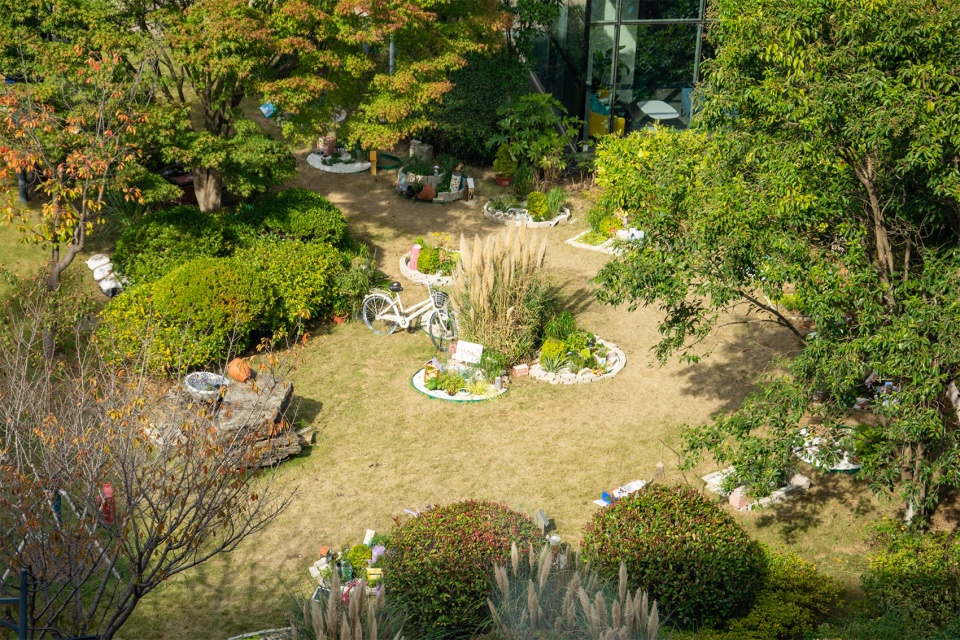
该项目成功实践了“跨校协同-政校联动-社区实践”的三维育人模式。课程联合多学科师资与校外专家,并与苏州市园林部门、街道社区深度合作,使学生能将所学直接应用于沧浪街道、斜塘街道等多个社区的“同心微花园”共建中,实现教学成果向城市服务的转化。WE Garden证明,在微小尺度上,通过跨学科协作与创造性实践,能够激发显著的社会与生态价值,为规划教育在行业变革期的创新路径提供了生动范本。
The project has successfully practiced the three-dimensional education model of “Inter-university Collaboration – Government-university Linkage – Community Practice”. The course unites multidisciplinary teachers and off-campus experts, and cooperates deeply with Suzhou Landscape Department and street communities, enabling students to directly apply what they have learned to the co-construction of “Tongxin Micro Gardens” in many communities such as Canglang Street and Xietang Street, realizing the transformation of teaching achievements into urban services. WE Garden proves that on a tiny scale, interdisciplinary collaboration and creative practice can stimulate significant social and ecological values, providing a vivid model for the innovative path of planning education in the period of industry transformation.
▼场地照片及活动过程,Site photos and activity process © 全国社区花园设计营造竞赛与社区参与行动参与团队
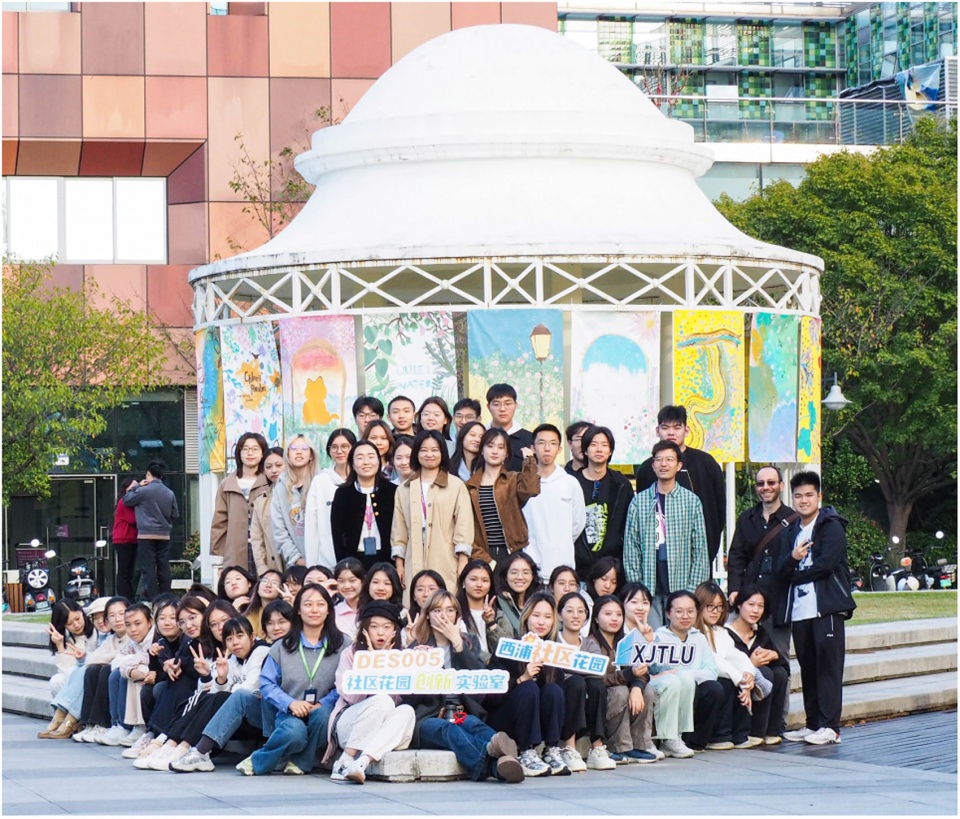
评委评语:该小组以课程创新驱动社区实践,将高校教学与社区营造深度融合,成功构建了“跨校协同-政企联动-社区实践”的三维育人模式。项目以零废弃模块化设计为核心,引导学生全流程参与创意微花园落地,建成效果美观,构筑物设计深刻,植物配置富有生态逻辑。活动宣传影响力高,让学生在真实场景中学习协作与责任,是高校赋能社区更新的可复制范本,展现了教育创新的前瞻性与行动力。建议后续加强多元主体共建,深化运维机制,并在材料选择上增加本地化元素,以增强花园的功能复合性与社区共生感。
Judge’s Comment: The team drives community practice with curriculum innovation, deeply integrates university teaching and community construction, and successfully builds a three-dimensional education model of “Inter-university Collaboration – Government-enterprise Linkage – Community Practice”. Centering on zero-waste modular design, the project guides students to participate in the whole process of creative micro-garden implementation, with beautiful completion effect, profound structure design and ecological logic in plant configuration. The activity has high publicity influence, allowing students to learn collaboration and responsibility in real scenarios. It is a replicable model for universities to empower community renewal, showing the foresight and action of educational innovation. It is recommended to strengthen multi-stakeholder co-construction, deepen the operation mechanism, and add localized elements in material selection in the future to enhance the functional compound and community symbiosis of the garden.
▼场地照片及活动过程,Site photos and activity process © 全国社区花园设计营造竞赛与社区参与行动参与团队
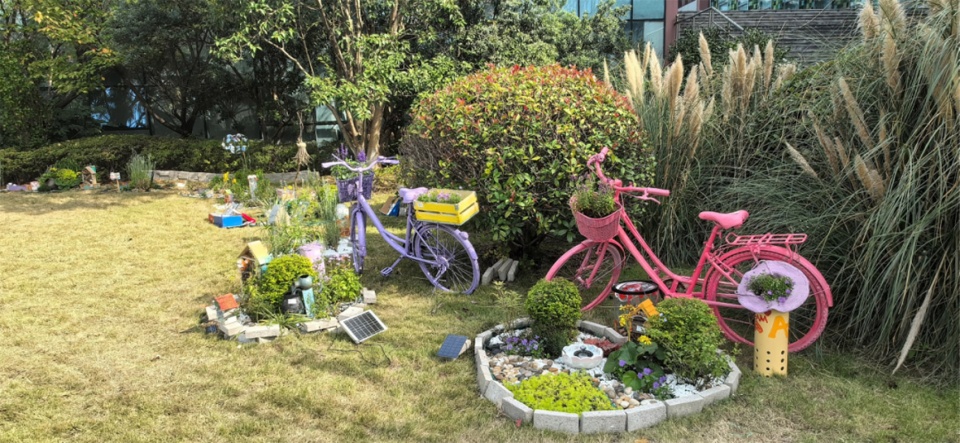
过去的一年,我们共同见证了社区花园从图纸走向生活,从愿景变为触手可及的绿意。每一处花园,都是大家用双手与真心共建的风景;每一次协作,都是人与人、人与自然之间温暖的回响。你们用设计与行动证明了:园林不只属于专业,更属于每一位热爱生活的人。无论是孩子手中的一粒种子,还是长者分享的一段经验;无论是校园角落的微更新,还是老旧社区的再焕活——每一份参与,都在书写着“百姓园林”的真正含义。未来,愿这样的花园不止生长在土地里,更生长在社区的脉络中、城市的记忆里。愿我们继续携手,让共建成为一种习惯,让共生成为一种日常,让每一处平凡的空间,都能承载笑语、激发创造、连接你我。感谢所有为之付出努力的你们。下一季,让我们继续播种,继续生长,继续在土地上写下属于所有人的故事。
In the past year, we have witnessed community gardens moving from blueprints to life, from visions to tangible greenery. Every garden is a landscape built by everyone with hands and sincerity; every collaboration is a warm echo between people and between humans and nature. You have proved with design and action: gardens belong not only to professionals, but to everyone who loves life. Whether it is a seed in a child’s hand, an experience shared by the elderly, a micro-renewal in a campus corner, or a renewal of an old community – every participation is writing the true meaning of “People’s Landscapes.” In the future, may such gardens grow not only in the soil, but also in the veins of communities and the memories of cities. May we continue to work hand in hand, making co-construction a habit, symbiosis a daily routine, and let every ordinary space carry laughter, inspire creation, and connect you and me. Thank you to everyone who has worked hard for this. Next season, let’s continue to sow, continue to grow, and continue to write stories for all on the land.
【2026年全国社区花园设计营造竞赛与社区参与行动主题征集】
【Call for Theme: 2026 National Community Garden Design Competition and Community Engagement Action】
https://v.wjx.cn/vm/Y9WXcR6.aspx
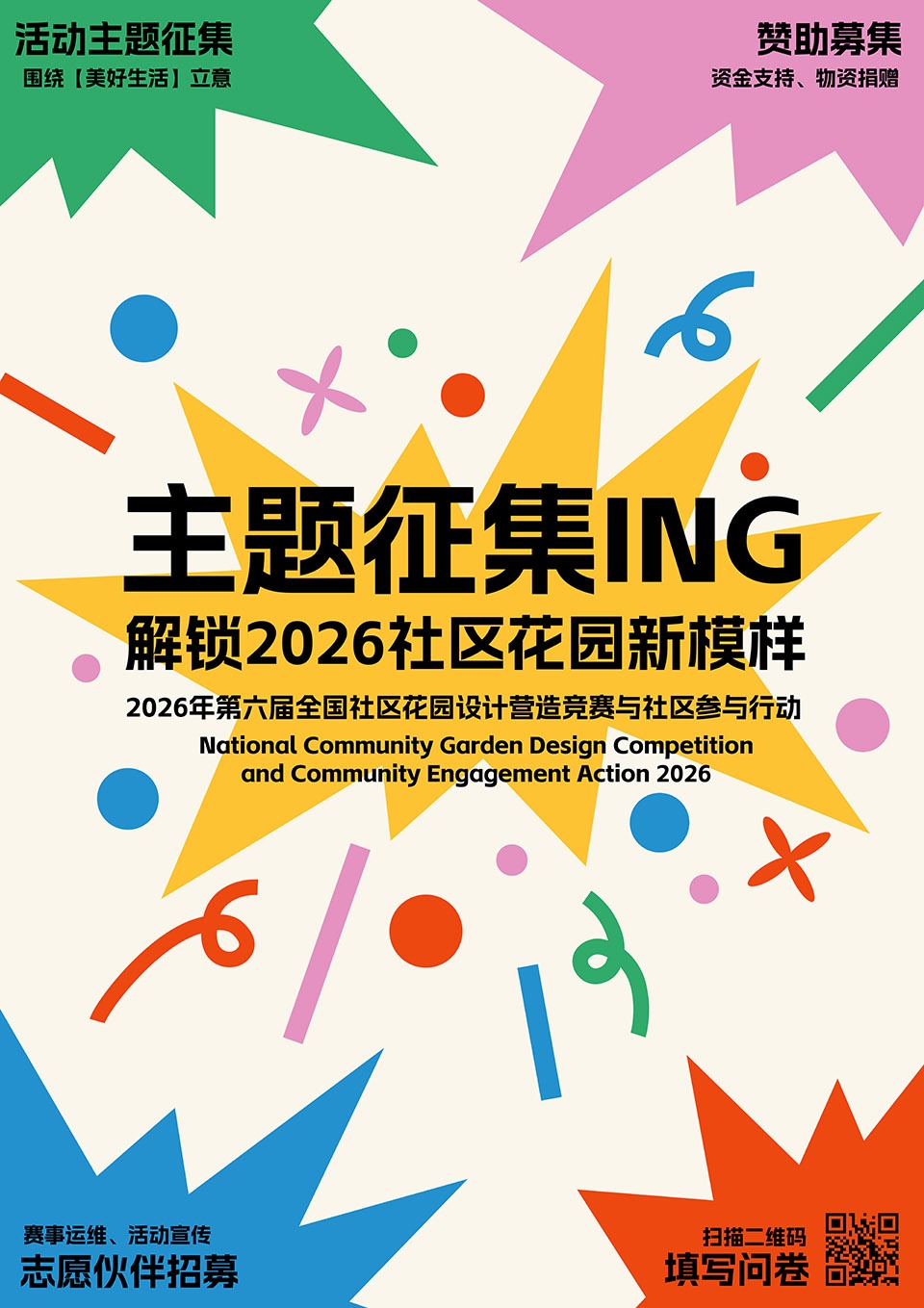
指导单位:中国风景园林学会、上海市风景园林学会
Guidance Units: Chinese Society of Landscape Architecture (CHSLA), Shanghai Landscape Architecture Society
主办单位:同济大学建筑与城市规划学院景观学系、《中国园林》杂志社
Organizers: Department of Landscape Architecture, College of Architecture and Urban Planning, Tongji University; Chinese Landscape Architecture Journal
共同协办:《风景园林》杂志社、安徽建筑大学、北京大学建筑与景观设计学院、北京林业大学、长沙理工大学、重庆大学、东南大学、福建农林大学、广西艺术学院、哈尔滨工业大学、湖南农业大学、华东理工大学、华南理工大学、华南农业大学、华侨大学、华中科技大学、华中农业大学、南京林业大学、南京农业大学、清华大学、上海第二工业大学、上海交通大学、上海应用技术大学、苏州大学、苏州科技大学、天津大学、同济大学、西安建筑科技大学、西北农林科技大学、西交利物浦大学、西南大学、西南交通大学、浙江农林大学、中国地质大学(武汉)、中央美术学院等(以上排序根据学校首字母拼音)
Co-organizers: Landscape Architecture Journal, Anhui Jianzhu University, Peking University College of Architecture and Landscape Architecture, Beijing Forestry University, Changsha University of Science and Technology, Chongqing University, Southeast University, Fujian Agriculture and Forestry University, Guangxi Arts University, Harbin Institute of Technology, Hunan Agricultural University, East China University of Science and Technology, South China University of Technology, South China Agricultural University, Huaqiao University, Huazhong University of Science and Technology, Huazhong Agricultural University, Nanjing Forestry University, Nanjing Agricultural University, Tsinghua University, Shanghai Polytechnic University, Shanghai Jiao Tong University, Shanghai Institute of Technology, Soochow University, Suzhou University of Science and Technology, Tianjin University, Tongji University, Xi’an University of Architecture and Technology, Northwest A&F University, Xi’an Jiaotong-Liverpool University, Southwest University, Southwest Jiaotong University, Zhejiang A&F University, China University of Geosciences (Wuhan), Central Academy of Fine Arts, etc.
承办单位:上海市城市更新及其空间技术优化重点实验室社区花园与社区营造实验中心、四叶草堂
Executing Units: Lab of Community Garden &Community Empowerment, Shanghai Key Laboratory of Urban Renewal and Spatial Optimization Technology; Clover Nature School
共建单位:东明路街道、花木街道社区自治办、徐家汇街道办事处
Co-construction Units: Dongming Road Subdistrict, Huamu Subdistrict Community Autonomy Office, Xujiahui Subdistrict Office
联合传播:gooood(谷德设计网)、mooool(木藕设计网)、小红书设计周等
Joint Media Partners: gooood, mooool, PRDC Design Week, etc.
联合共建伙伴:LandscapeIn-Lab、同济大学教育部生态化城市设计国际合作实验室-景观空间分实验中心、乌龟营造、上海市植物学会景观植物与健康专委会、新疆建设职业技术学院、新疆农业大学林学与风景园林学院、新疆艺术学院、云南农业大学国际学院、云南艺术学院艺术管理学院、织微在地(昆明)文化科技有限公司
Joint Co-construction Partners: LandscapeIn-Lab, Tongji University Ministry of Education International Joint Lab of Eco-urban Design – Landscape Space Sub-lab, Turtle Community Building, Landscape Plants and Health Committee of Shanghai Botanical Society, Xinjiang Construction Vocational and Technical College, College of Forestry and Landscape Architecture Xinjiang Agricultural University, Xinjiang Arts University, International College Yunnan Agricultural University, School of Art Management Yunnan Arts University, Zhiweizaidi (Kunming) Cultural Technology Co., Ltd.
More: 同济大学建筑设计研究院。更多关于:TJAD on gooood




让人心动的活动
DK
不错