非常感谢设计方Giuseppe Randazzo 将项目介绍和项目图片授权gooood发行。更多请至:Giuseppe Randazzo on gooood
Appreciation towardsGiuseppe Randazzo for providing the following description:


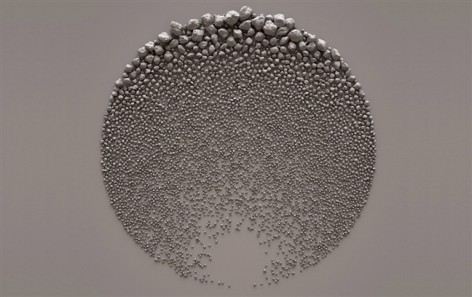
This project has started from a search for a 3d-objects optimal packing algorithm over a surface, but evolved in something rather different. The basic inspiration has been the work by Richard Long and the way he fills lonely landscapes with arcaic stones patterns. That eroic artistic practice, in his monumental vision is in strong contrast with this computational approach that – ironically – allows virtual stones creation and sorting in a non phisical, mental way, a ‘lazy’ version, so to speak. Anyway a kind of link with Land Art may be seen in the process that starting from a unordered set of ‘natural’ debris (real rocks / virtual rocks), and acting on it, you (the author / the software), in your environment (the reality / a map of bits), may become nature. The virtual stones created by several fractal subdivision strategies, find their proper position within a circle, with a trial and error hierarchical algorythm. A mix of attractors and scalar fields (some with Perlin noise) drives the density and size of the stones. The code is a C++ console application that outputs a OBJ 3d file. The final rendering, on purpose, doesn’t try to be completely realistic, the stones have a flat constant color, in an ambigous condition between real and abstract representation.

艺术家Giuseppe Randazzo利用算法生成演变型三维对象,而后再对其进行渲染得成的作品。结果是迷人的,富有静谧感的石头景观。通过这种艺术手段和方式得到一个具有极大反差的富有永恒感的作品,这有些讽刺意味。或许这是一种“偷懒”的方式,创作排列这些虚拟的石材,并赋予精神的力量,同时在此过程中出现了与大地景观的一种联系,从开始无序的“自然”碎片(真正岩石/虚拟岩石)影响(作者/软件)到你的环境(真实/位图),这也许已变成真正自然。
用细分策略将这些虚拟石头在圆圈中排布到适合位置,用混合代码驱动以促成石块的大小与密度。这是一个C++代码,输出的是OBJ3d文件。最后的渲染,其目的不是让这些石块看起来有多真实,而是让他们具有一个稳定的色彩,介于真实与抽象之间。


MORE: Giuseppe Randazzo,更多请至:Giuseppe Randazzo on gooood




视力测试?哈哈哈(开玩笑),,,,感觉这真的是艺术的味道呀!
密恐的看着会不舒服
7点钟方向有点不圆,难受。
本来没觉得
很有感觉