
非常感谢 VRAP未来乡土实践与研究工作室 予gooood分享以下内容。设计师邮箱:vrapdesign@qq.com。更多请至:VRAP on gooood
Appreciations towards VRAP for providing the following description:
中国是一个一百年前农业人口还占97%的国家,一个实质上被农民经营了四千年的国家。中国民间的建造智慧更多的隐藏在一些听上去“旁门左道”的书中,类似《管子. 地员篇》、《葬经》、《农书》、《天工开物》等等。中国传统乡土聚落的发展史是一部农业技术的发展史,传统乡土建造则是一项由小农经济主导,多领域、跨尺度的营造工程,将地理,水利,农业等多学科完美地结合在一起。我们关注这种生产复合型建造方式,将其称为“农构”(agri-tectonic)。
China, a country where farmers accounted for 97 percent of its total population one hundred years ago, has been run by farmers for four thousand years. Chinese folk wisdom about construction is, more often than not, hidden in some seemingly “heretical” ancient books including Guanzi. Diyuan Chapter, The Book of Burial, The Book on Agriculture and Exploitation of the Works of Nature. The history of traditional rural settlements in China demonstrates how Chinese agricultural techniques have evolved. These traditional rural construction works, led by small-scale peasant economies, are multi-field and trans-scale projects that have admirably integrated geography, irrigation works and agriculture. This type of production-promoting compound construction has captured our attention and we have dubbed it “agri-tectonic”.
▼与聚落结合的天空农场,urban village integrate with the local settlements
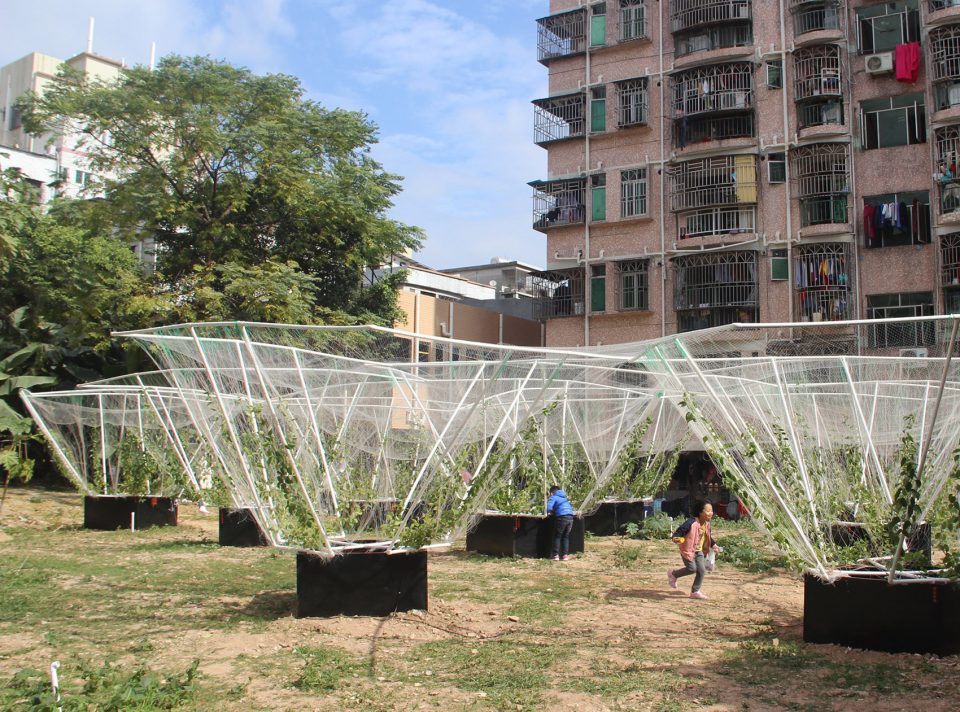
从2015年底,我们开始将“农构”的理念运用于一些微型的项目上,“农业包容城市”(agriculture inclusive urbanism)——作为城市更新的一种手段——我们试图通过实验型设计找到农业反哺城市的基因片段。深圳南头城中村的“天空农场“便是这样一个项目:城中村的生产复合型公共空间。
一万元在北京市中心可以买到一个立足之处,一万元在河北沧州可以买到一平米,一万元我们在深圳南头村搭建了一个400平米的天空农场。天空农场是一个集雨水收集、都市农业及社区营造与一身的“农构装置”,对场地最小干预的同时挖掘“城中村农业”潜在的生态意义和生产潜力,提供新的大众集会空间和社区营造方式。
In late 2015, Vernacular Research and Practice (VRAP) began to apply the concept of agri-tectonic to a number of micro-projects. With “agriculture inclusive urbanism”, a means to realize urban renewal, we try to find the possibility of agriculture feeding cities by designing an experimental model. “Sky Farm”, located in a village in Nantou in Shenzhen, is one of these projects that emphasizes production-promoting compound public space in an urban village.
With ten thousand yuan, one could only buy an inch of land in the center area of Beijing or one square meter of space in Cangzhou, Hebei province, while with the same capital our team was able to build Sky Farm in an area of 400 square meters in Nantou village in Shenzhen. Sky Farm is an “agri-tectonic device” that functions simultaneously as a rain collector, an urban agriculture promotion and a community builder. Aiming to discover the potential ecological significance and productivity of “urban villages”, Sky Farm, with minimal land occupation, manages to provide extra space for social gatherings as well as a brand new way to run a community.
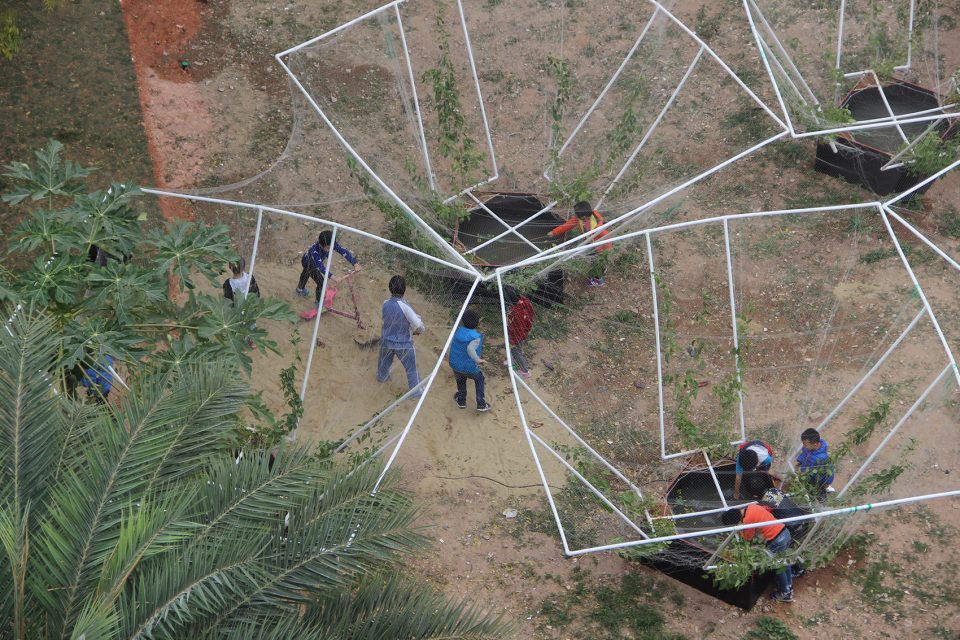
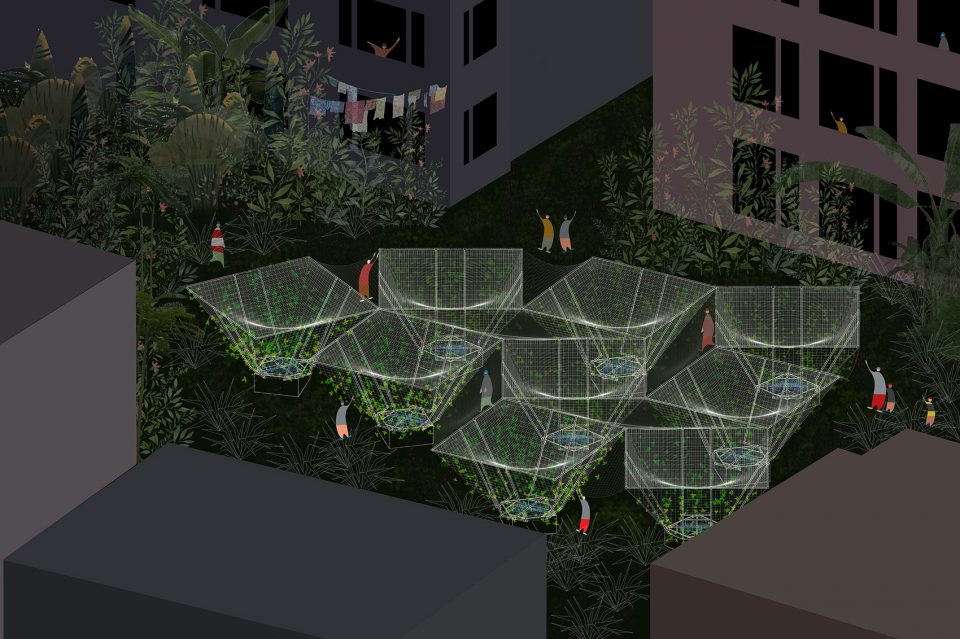
▼天空农场鸟瞰,bird view of the sky farm
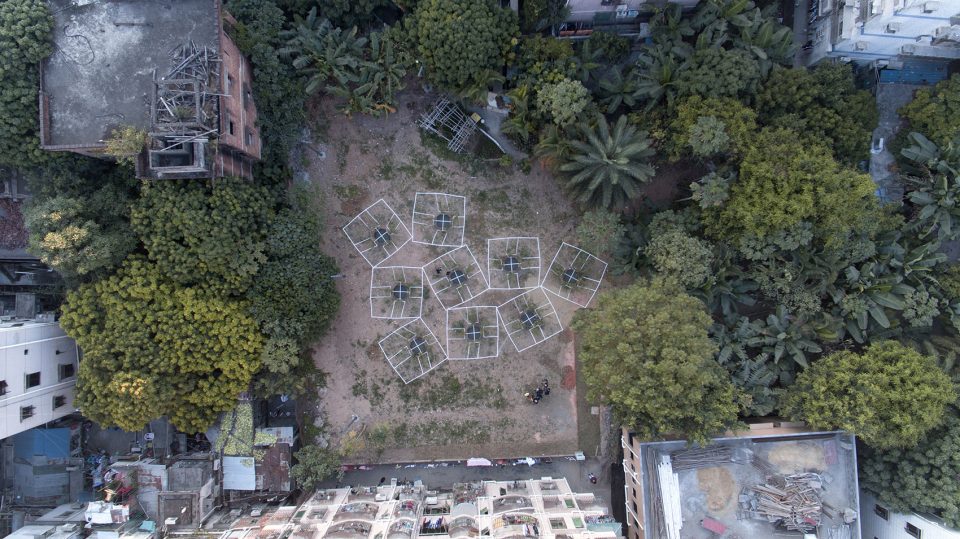
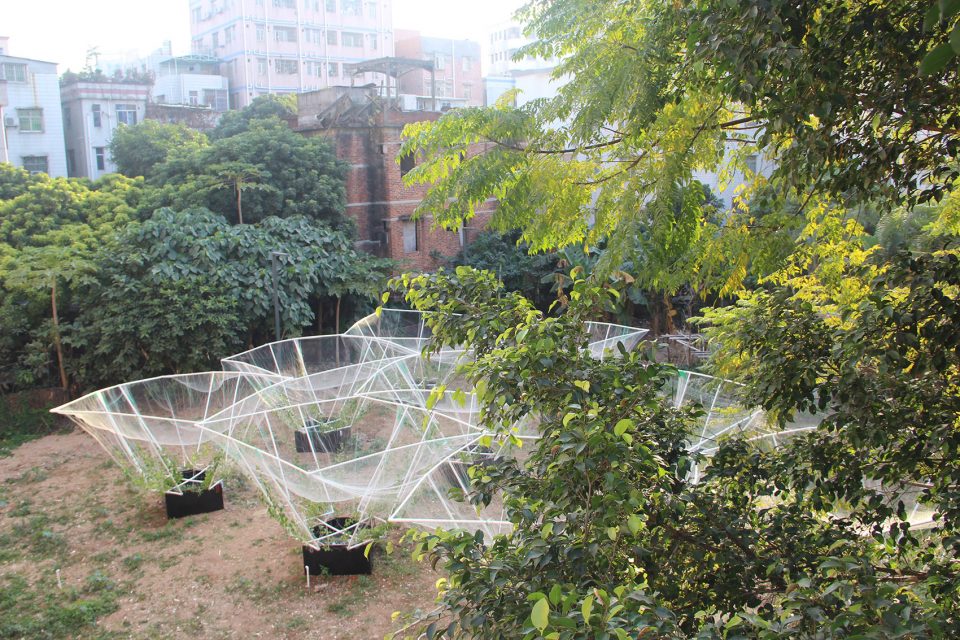
深圳城市大约10%的面积是城中村,却容纳了将近50%的城市人口。城中村在深圳,是城市空间的另外一种形式,但同时它饱含着小农经济混合小工业的生产生活方式,以及一种潜在的与聚落紧密结合的构筑方式。在缺乏公共空间的城中村,天空农场是新城中村经济的迭代产品,廉价的寄居空间可以成为肥沃的生产空间和独特的消费空间。
In Shenzhen, around 10 percent of the land is covered by urban villages that accommodate nearly 50 percent of the city’s population. These urban villages exist as a special form in urban space where small-scale peasant economy is mixed with small-scale industries and where constructions are designed to potentially be integrated closely with local settlements. For urban villages that lack public space, Sky Farm is an iterative product that can transform cheap residential space into effective production space and unique consumer space, which is why Sky Farm is so suitable for the new urban village economy.
▼生产复合型的公共空间,a prototype of productive public space
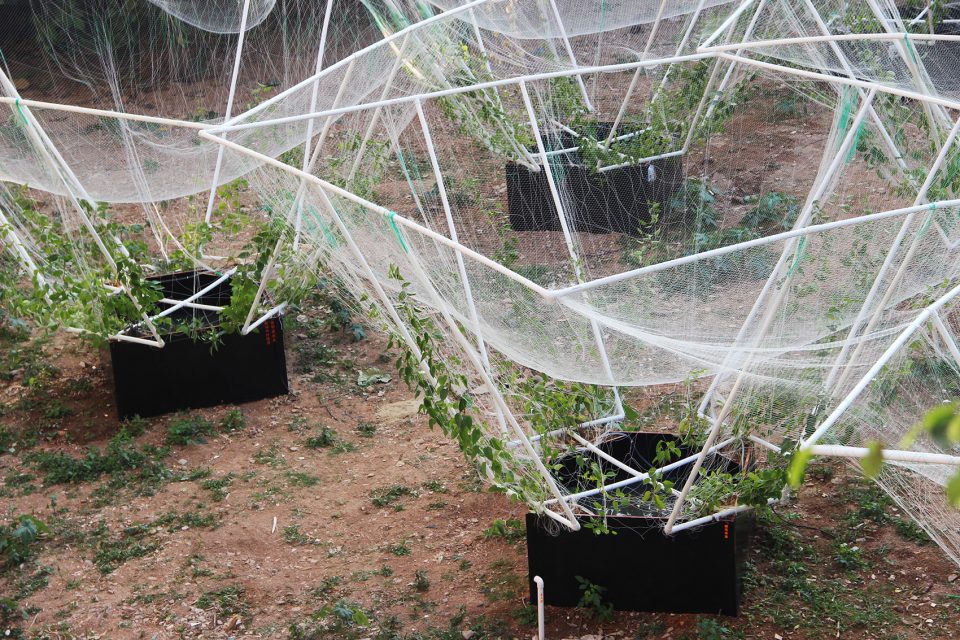
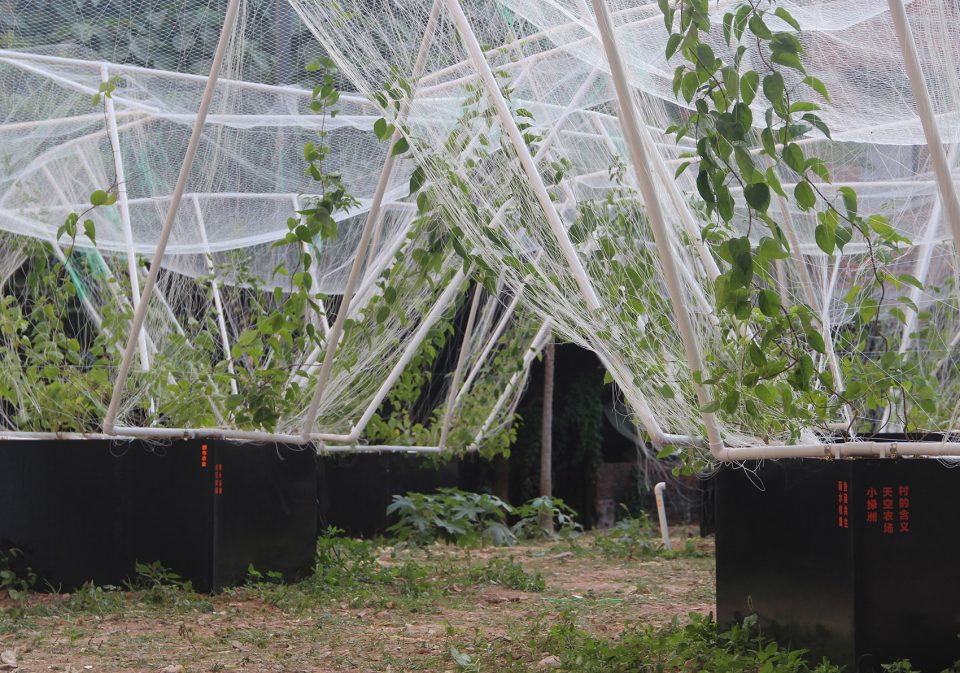
天空农场以平民的价格创造最有效的生产空间,达到尽可能大的推广效应:我们选用城中村随处可见的建材PVC作为装置的主材料,设计老百姓自己就能加工的标准化结构,便于拆卸和运输。侧网采用的是农用地爬藤网,空洞较大,方便植物瓜果垂挂,顶网采用的是防鸟网,保护瓜果的同时又便于雨水收集。
At a reasonable cost, Sky Farm can provide a highly productive space and thus help achieve the maximum promotion effect possible. PVC, easy to obtain in urban villages, has been chosen as the main material. Also, a standardized structure featuring convenient dismantling and transportation processes has been applied so that the device can be built even by ordinary people. On four sides of the device are farming nets for climbing vines with relatively large meshes to make space for plants and fruits while an anti-bird net is placed on the top for fruit protection and rain water collection.
▼标准化构件,居民可以自己加工,standardized structure that ordinary people could build
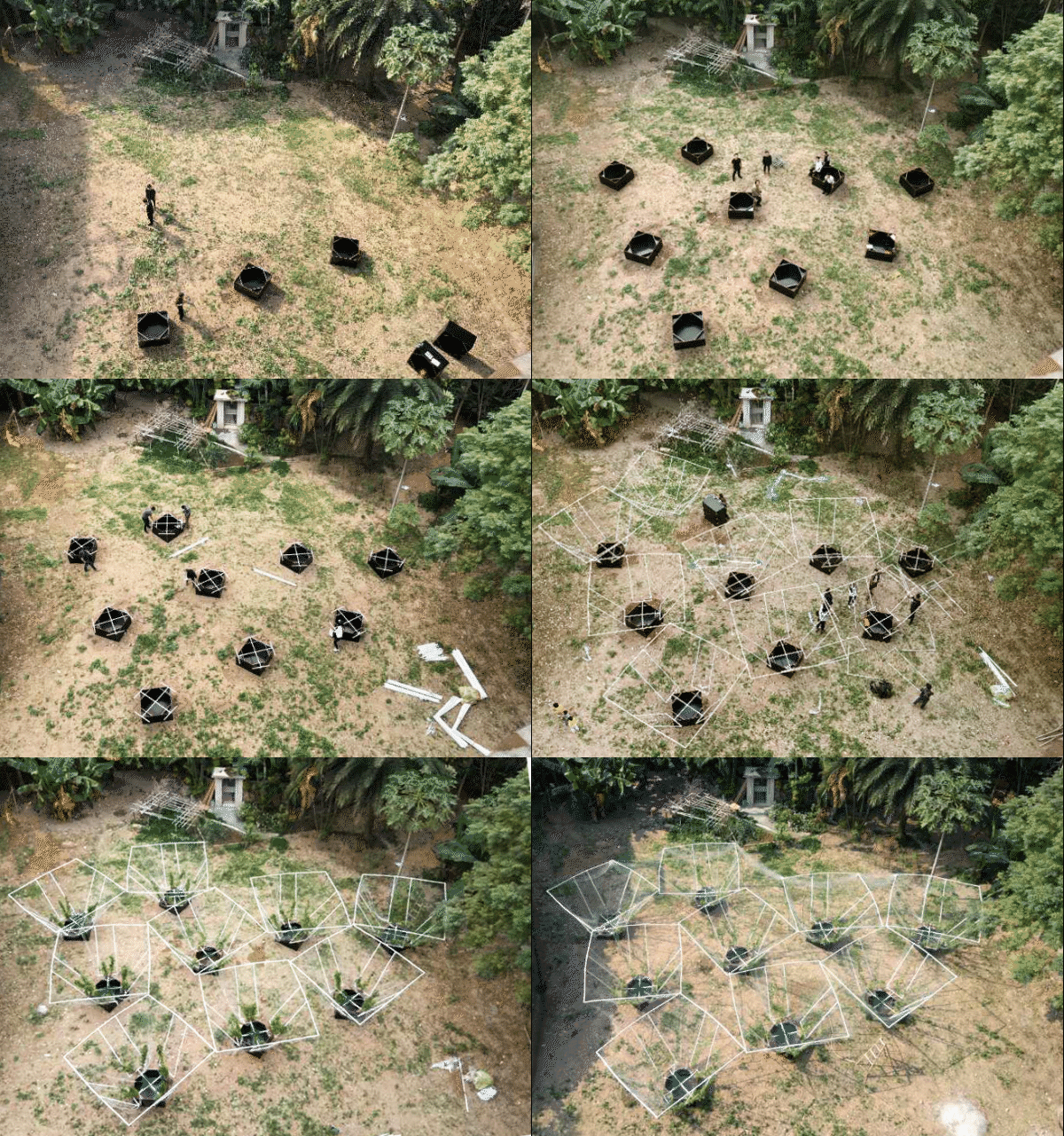
▼建造过程,construction process
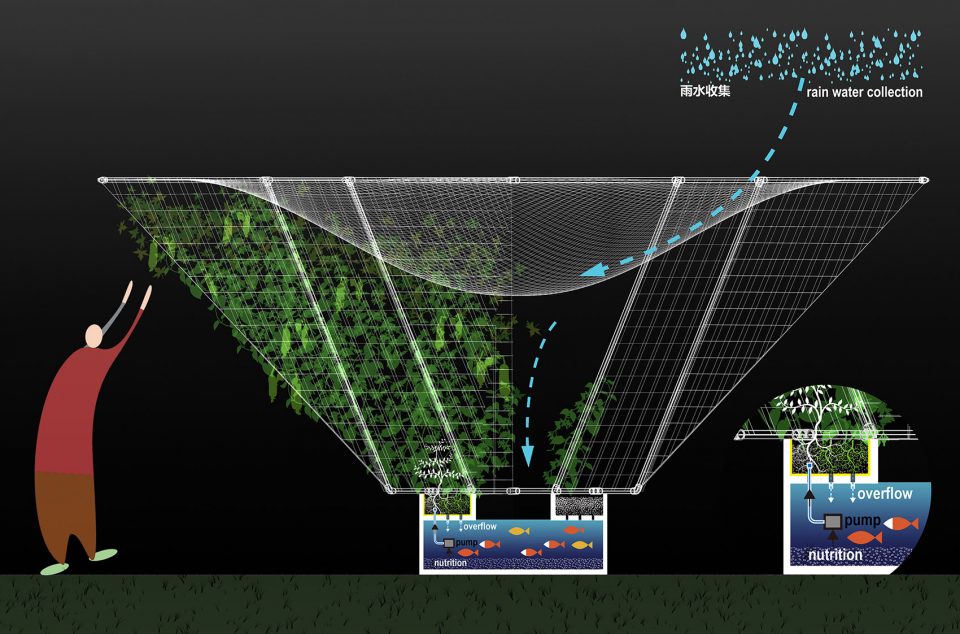
场地原来是一个建筑垃圾堆场,为了利于植物的生长以及日后潜在的场地功能变更,我们采用了“鱼菜共生“的方法来培养天空农场的植栽。场地最初没有水源,放置的九个”黑匣子“利用雨水收集得来的水饲养着几百条鱼,每个黑匣子里的”鱼粪营养水“通过一个低压水泵循环供给植物。最低的成本,最小的干预,最少的维护,支撑起了400平方米的天空农场。据估算,一个夏天,天空农产可收集利用300吨的雨水,饲养200多条鱼,培育200多斤瓜果(以黄瓜为例)。
Since the site where Sky Farm was built used to be filled with construction waste, an aquaponic system has been applied in Sky Farm for better plant growth as well as a means for possible alterations to the functions of the site in the future. With no water resource at the chosen site, nine “black boxes” have been set to collect rain water in which hundreds of fish are bred. Through a low-pressure water pump, “nutrient water with fish excrement” from those black boxes can be recycled to water and fertilize the plants. In this manner, a Sky Farm covering 400 square meters operates with extremely low cost, land occupation and maintenance. It is estimated that in a summer, Sky Farm is able to collect 300 tons of rain water, breed more than 200 fish and produce more than 200 jin (400 kilograms) of vegetables or fruits (cucumber has been taken as a test example).
▼鱼菜共生与雨水收集系统,aquaponic system and rainwater collection
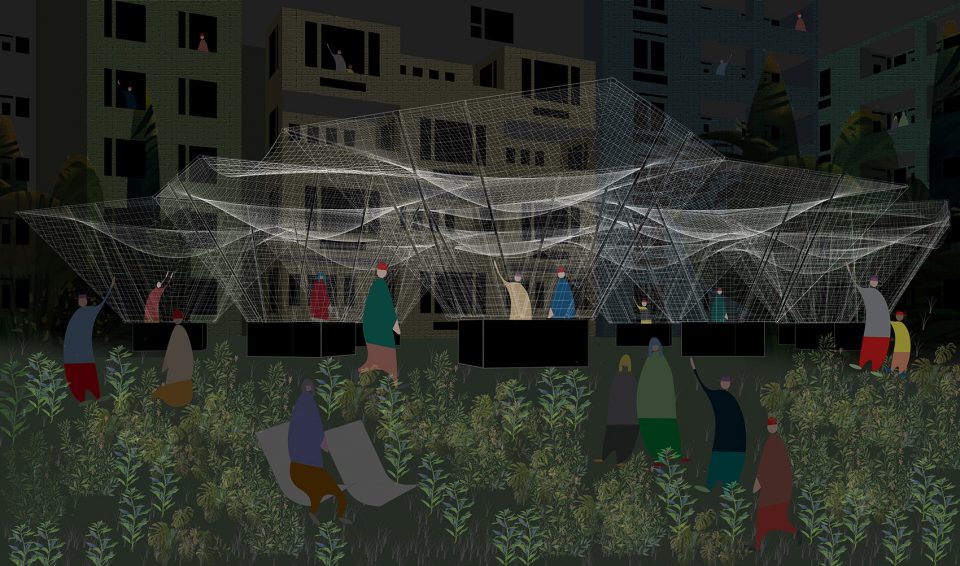
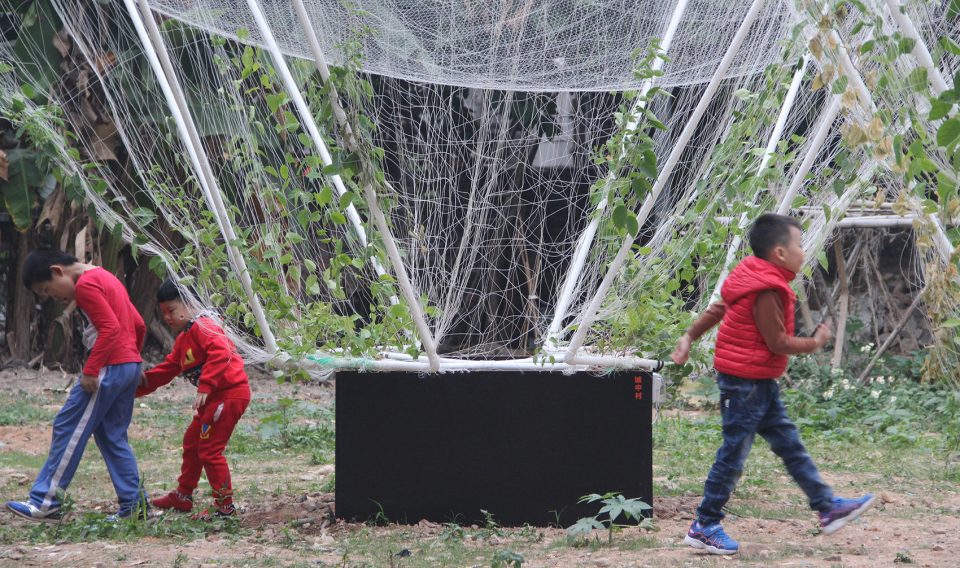
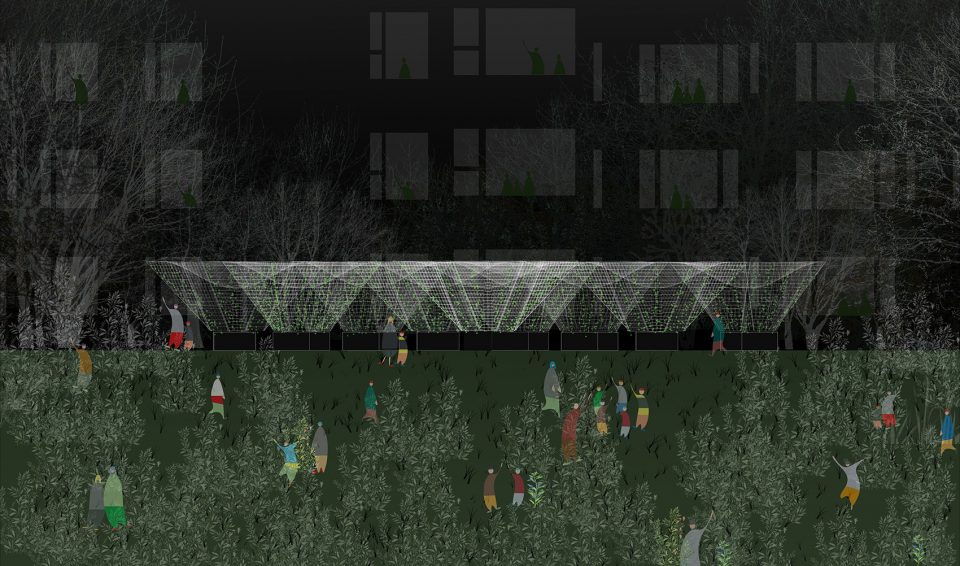
天空农场是城中村里的“移动农业”,它可以出现在屋顶平台,可以出现在街头或者任何一个1.5平方米的闲置空间,网架可以根据实际情况调整大小。下部最大化的留给公共空间,上部最大化的留给植物。
Sky farm, with its treillage capable of resizing as required, can be built on rooftops, in streets or in any available space that’s larger than 1.5 square meters, making it a veritable “mobile farm”. As for the structure of this device, its lower part is designed to leave maximum space for public use while its upper part opens maximum space for plant proliferation.
▼上部留给植物,下部为公共空间,the upper part for plants while the lower part for public use
▼立面图,elevation
▼轴测图,axonometric drawing
设计事务所:VRAP未来乡土实践与研究工作室
合作机构:北京建筑大学、星空农场
项目地点:中国广东省深圳市南头村
主持设计师:司敏劼,杨磊,王江
施工总负责:周繁
设计团队:江炜雄、杜靖宜、洪蕴璐、张桓、马俊、郭新飞、马驰
建筑摄影师:王江、杨磊、司敏劼
面积:400平方米
竣工时间:2018
搭建志愿者团队:
深圳大学建筑系:许早欢、徐畅、韩理、葛帅、李东敏、周慧星、王瑞龙、乔勇
深圳大学服装设计与工程系:陈炳亮、吴霖滨、凌中瀚、林子华
北京大学深圳分校建筑系:胡兆昕、董亚晖
特别鸣谢北京建筑大学金秋野教授对项目的支持和指导。
撰文:司敏劼
Architects: VRAP (Vernacular Research and Practice)
Collaborators: Beijing University of Civil Engineering and Architecture, xfarm
Location: Nantou Village, Shenzhen, Guangdong Province, China
Principal Architects: Si Minjie,Yang Lei,Wang Jiang
General superintendent of construction:Zhou Fan
Members of design team:Jiang Weixiong, Du Jingyi, Hong Yunlu, Zhang Huan, Ma Jun, Guo Xinfei, Ma Chi
Photographer:Wang Jiang,Yang Lei,Si Minjie
Area:400.0 m2
Project year:2018
Volunteers that helped with the project:
Department of Architecture of Shenzhen University:
Xu Zaohuan, Xu Chang, Han Li, Ge Shuai, Li Dongmin, Zhou Huixing, Wang Ruilong, Qiao Yong
Department of Garment Design and Engineering Specialty of Shenzhen University:
Chen Bingliang, Wu Linbin, Ling Zhonghan, Li Zihua
School of Urban Planning and Design of Peking University Shenzhen Graduate School:
Hu Zhaoxin, Dong Yahui
Special thanks to Professor Jin Qiuye from Beijing University of Civil Engineering and Architecture for his support and guidance for the project.
Text: Si Minjie
More: you could contact the designer through vrapdesign@qq.com,更多请至:VRAP on gooood

可悲的土地利用率跟生产效率,从头到尾处处都是槽点跟反自然规律,白左看了都摇头。总有城里的天龙人觉得自己比农民伯伯更懂种地。
且不提这种生产形式是否真的可行。从项目落地到现在,鱼枉死了多少呢?被这个锋利难缠的网伤害的鸟类和昆虫又有多少呢?看完只感受到了设计团队对生产和生命的傲慢
我种过青瓜也种过荷兰豆和百香果,无论是搭棚还是搭架子,都完全不需要这种塑料网,对植物的生长完全没有好处
我想知道这个项目和在我家阳台种一些瓜果蔬菜姜葱蒜有什么本质区别?
项目出发点好,但我想这样的空间能否结合其他的活动功能,提高受众率与更多人的参与性?
农业项目需要请建筑系的老师作指导?为什么不与农大或者有经验的农民或对养殖有兴趣的当地市民合作?
其实这种项目应该做一季下来再宣传是最好的,那是就可以把据估算几个字给去了,直接收了多少瓜,收了多少鱼,投入产出比。。。
网状物体,鸟会不会被卡在上面而导致死亡?
这种捕鸟网是违法的!
当然会,而且会死的非常惨!居然用了防鸟网,太不道德了,这种网准确的说是鸟盗分子常用的捕鸟网,鸟撞上了九死一生都很难
《天工开物》听上去“旁门左道”?麻烦小编出来我们谈一谈!