感谢 栖城设计 予gooood分享以下内容。更多关于:GN Architects on gooood
Appreciation towards GN Architects for providing the following description:
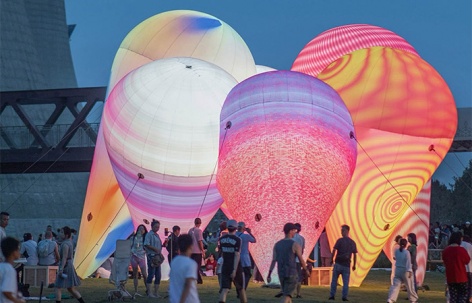
GN栖城设计在首钢园做了一个装置——《七支筒》。受邀2026永定河集艺术季“永定河岸艺术生长”,作品于9月7日同步2026服贸会亮相。“设计前我们是去看:这个公园已经有什么?人们为什么来?他们怎样停留、穿过、消费、游戏和见面?当有一个新东西介入以后,会促成什么?能形成什么样的新关系?”设计从一开始就不是要建立一个新物种,而是将它放进一个已经非常丰富的公园系统里去看:观察那里已经存在的生活,然后做一个很小的介入。
GN Architects has completed a new art installation, Seven Cones, at Yongding River Market in Beijing’s Shougang Park. Commissioned for the 2026 Yongding River Market Art Season, themed “By the Yongding River, Art Grows,” the installation was unveiled on September 7 alongside the 2026 China International Fair for Trade in Services (CIFTIS). “Before we started designing, we went to look at what was already there: What does this park already have? Why do people come here? How do they linger, move through it, shop, play and meet? When something new enters this setting, what might it set in motion? What kinds of new relationships might emerge?” From the outset, the intention was not to introduce an entirely new “species.” Instead, the project was considered as a small intervention within an already rich and active park system — observing the everyday life that was already taking place there, and then deciding how little needed to be added.
▼装置与首钢园,Installation and Shougang Park © GN栖城设计,摄影:梁文军
01 | 理解正在发生什么,再决定介入什么
Understanding What Is Already Happening Before Deciding How to Intervene
永定河集已经有很多内容:草坪、市集、餐饮、游乐、活动,以及大量人流。我们先用AI智能体对社交媒体上大量的帖子和评论进行分析,然后再对场地业态进行了分析,以此去试着理解这个公园大致是怎样运行的。
我们发现这个大公园并不缺少一个新的“内容”,但是它需要一个公共坐标:远远的就能够被看见,很容易被识别,也能用一句话来描述。
比如:“我们就在那七个大甜筒下面见”
这句话其实已经解释了设计的一部分。
Yongding River Market already contains a great deal: lawns, markets, food and beverage venues, recreational facilities, events and a constant flow of visitors. The design team first used AI agents to analyse a large volume of posts and comments on social media, and then examined the existing mix of programmes and activities on site. Together, these observations offered a way of understanding, in broad terms, how the park actually operates.
What became clear was that this large park did not necessarily need another piece of “content.” What it needed was a shared public point of reference — something visible from afar, immediately recognisable and simple enough to describe in a single sentence.
For example: “Let’s meet under those seven giant ice-cream cones.”
In a way, that sentence already explains part of the design.
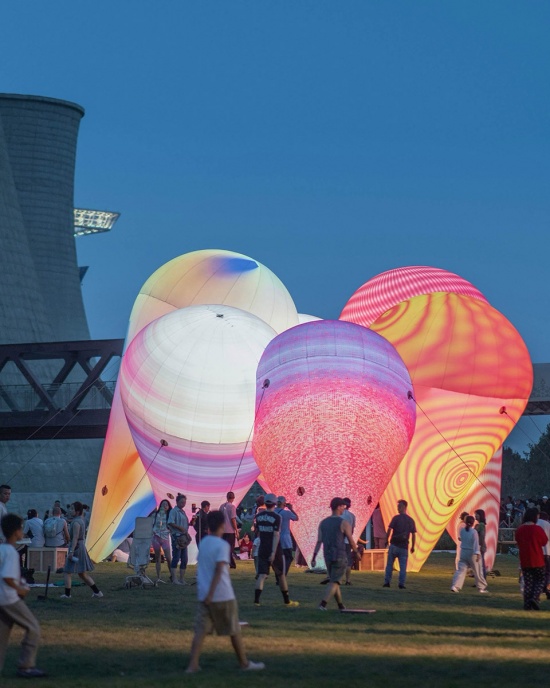
▼傍晚的七支筒,Seven Cones at dusk © GN栖城设计,摄影:梁文军
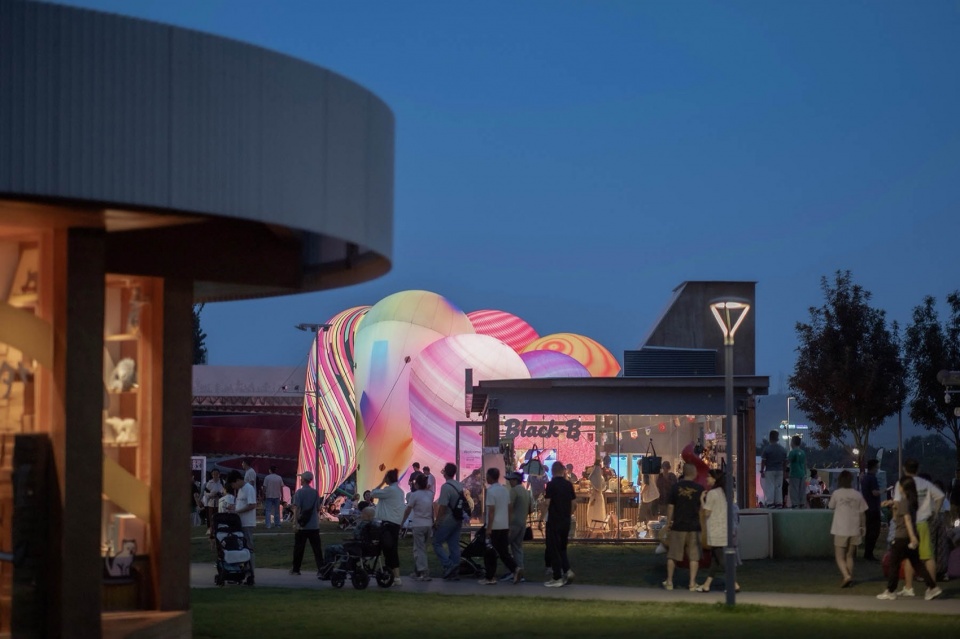
所以,在《七支筒》的形体还没有产生之前,我们大致已经知道它需要成为什么:它应该有足够明确的识别度,让人在很远的地方就知道那里有一个东西;也应该是开放的,让人愿意走过去;到了以后,还能够停留、穿过,或者发生一些别的事情。
Before the form of Seven Cones had even emerged, we already had a fairly clear sense of what it needed to become. It had to be distinctive enough that people could recognise it from a distance, but also open enough to draw them towards it. Once they arrived, it needed to allow them to stop, pass through, or simply leave room for something else to happen.
▼鸟瞰,Aerial view © GN栖城设计,摄影:梁文军
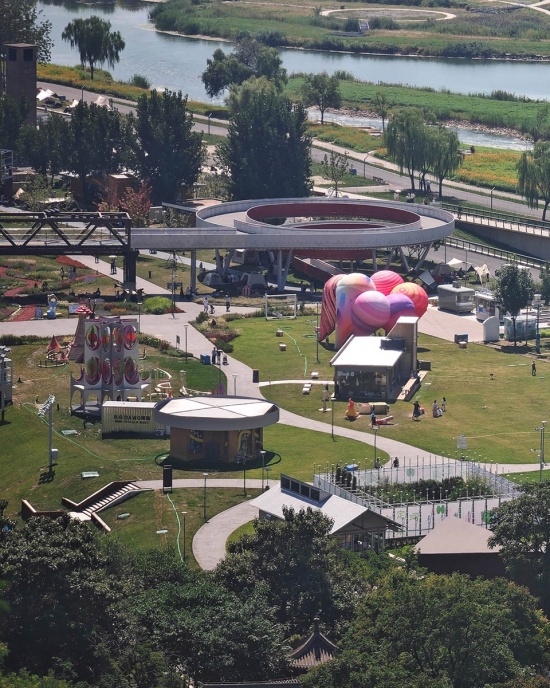
我们从一开始就很清楚,它没有必要去模拟一个永久建筑,也不适合把太多价值放在复杂的建造和材料上。它需要在很短的时间里建立起和这个地方的关系。我们先确定它在这个公园里的作用,再去寻找它的形体。
From the beginning, we were also clear that the installation did not need to imitate a permanent building, nor should its value depend on complex construction or elaborate materials. What mattered was its ability to establish a relationship with the site within a very short period of time. We therefore began by defining what role it should play within the park, and only then searched for its form.
▼装置与首钢园,Installation and Shougang Park © 池伟
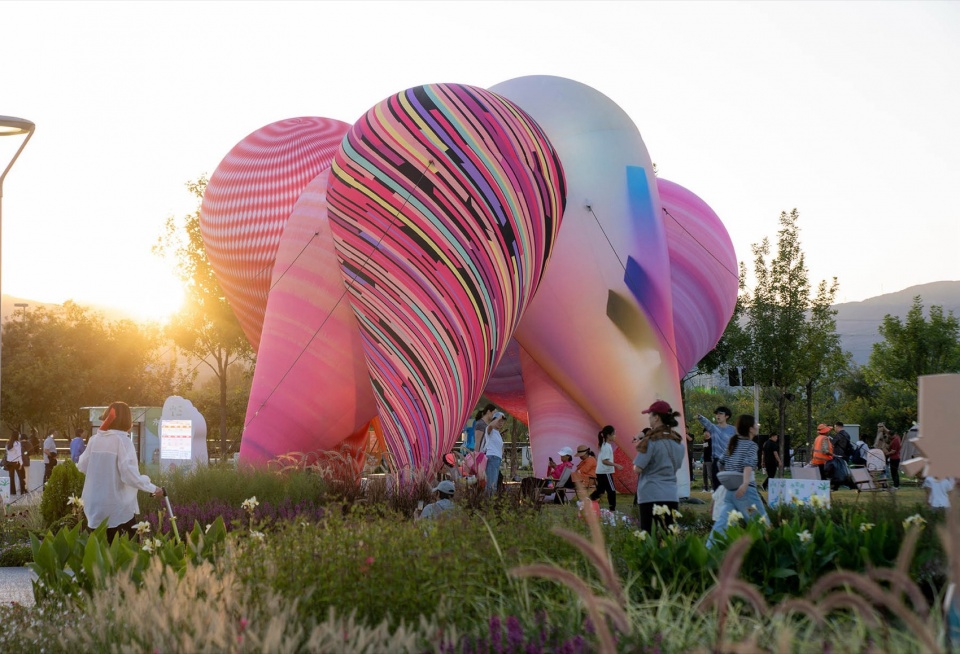
▼孩子们在气膜旁玩耍,Children playing alongside the inflatable membranes © 池伟
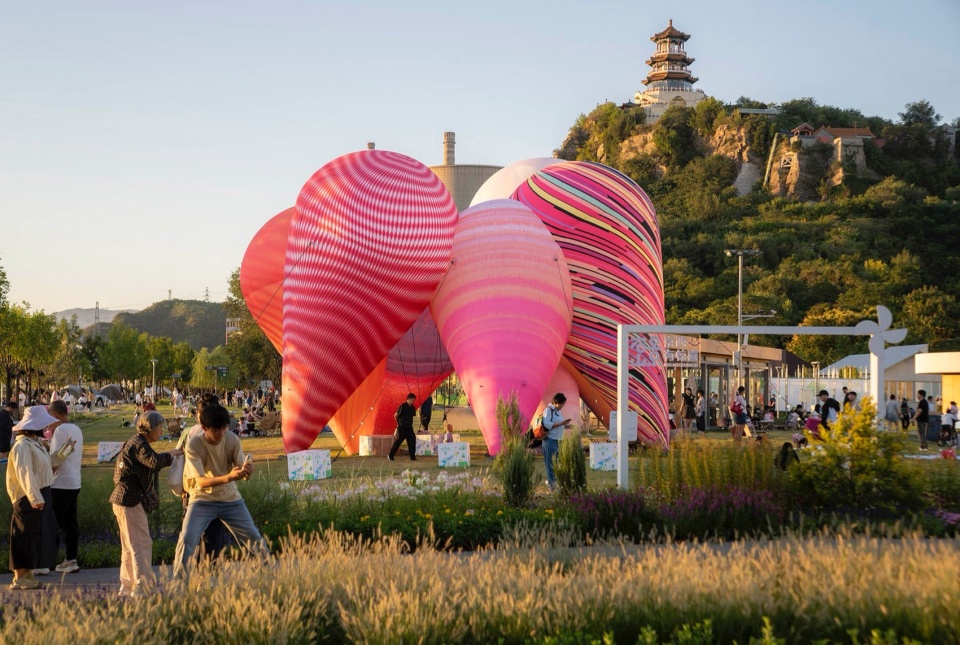
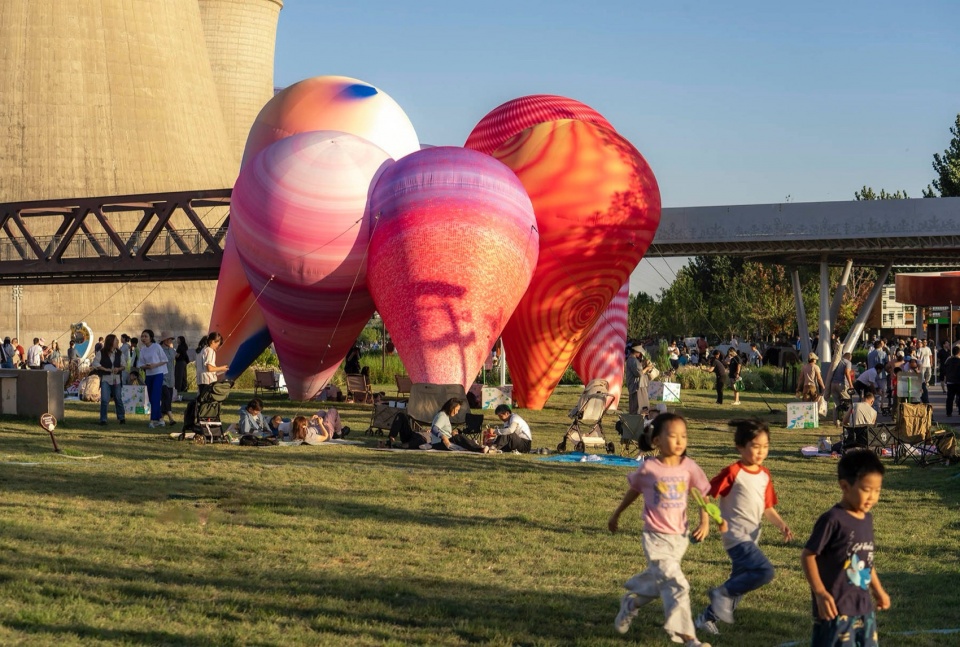
02 | 先,让人愿意靠近
First, Make People Want to Come Closer
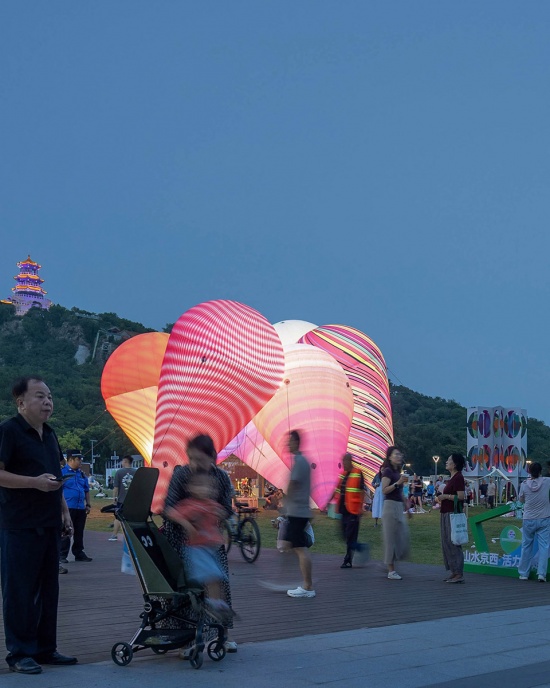
《七支筒》需要有吸引力,表现为能被看见,愿意靠近。七个八米多高的巨大筒体聚集在草坪上,粉色图案和大体积让它从很远的地方就可以被看到,成为一个心理上预设的目的地。
Seven Cones needed to be attractive in a very direct sense: it had to be visible, and it had to make people want to approach. Seven monumental conical forms, each more than eight metres high, gather together on the lawn. Their large scale and vivid pink graphics make the installation visible from a considerable distance, allowing it to register in the mind as a destination before one even reaches it.
▼傍晚的七支筒,Seven Cones at dusk © GN栖城设计,摄影:梁文军
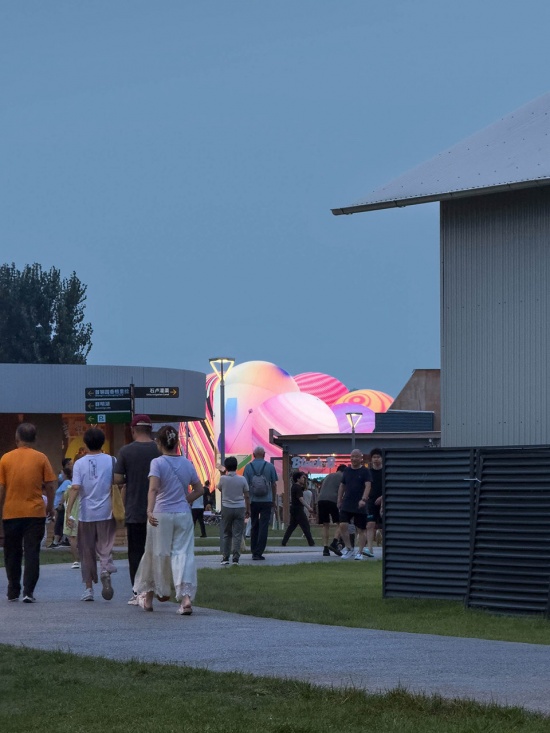
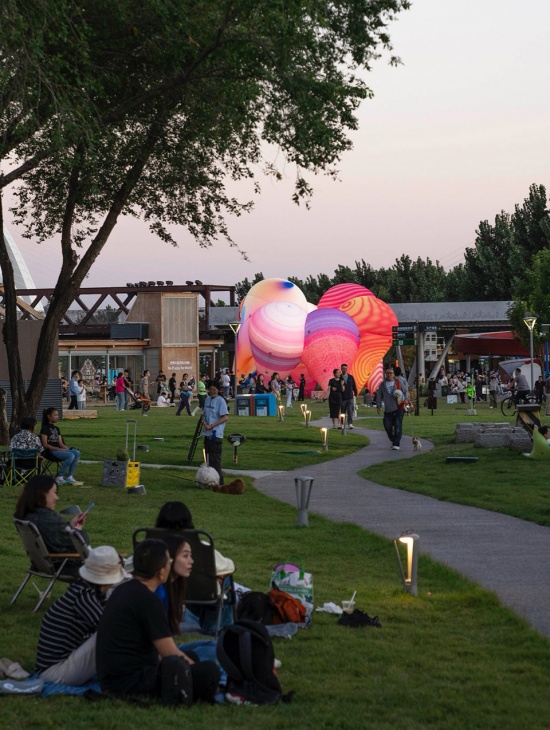
在远处被色彩吸引,走近以后会看到类似星系、震荡和波纹的图像;再靠近,才会发现这些色彩是由大量毫米级的高精度粒子构成的,这是质感层次。丰富的图形在曲面撞击中产生了许多观看视角,它和周边的塔,周边的其他装置,树林,冷却塔,蓝天等都形成了丰富的图底关系。公共空间里的吸引力是一件正向的事情,它本身不是目的,只是让人与一个场所建立关系的开始。
From afar, visitors are first drawn by colour. As they come closer, imagery resembling galaxies, oscillations and ripples begins to appear. Only at close range does another layer reveal itself: the fields of colour are composed of large numbers of precisely rendered, millimetre-scale particles, giving the surfaces a finer degree of texture and depth. As these dense graphics wrap around and collide across the curved surfaces of the cones, they generate constantly changing perspectives. The installation forms shifting figure-ground relationships with the towers nearby, other installations, trees, industrial cooling towers and the open sky. In public space, attraction can be a positive force. It is not an end in itself, but the beginning of a relationship between people and a place.
▼远处的七支筒,Seven Cones seen from afar © GN栖城设计,摄影:梁文军
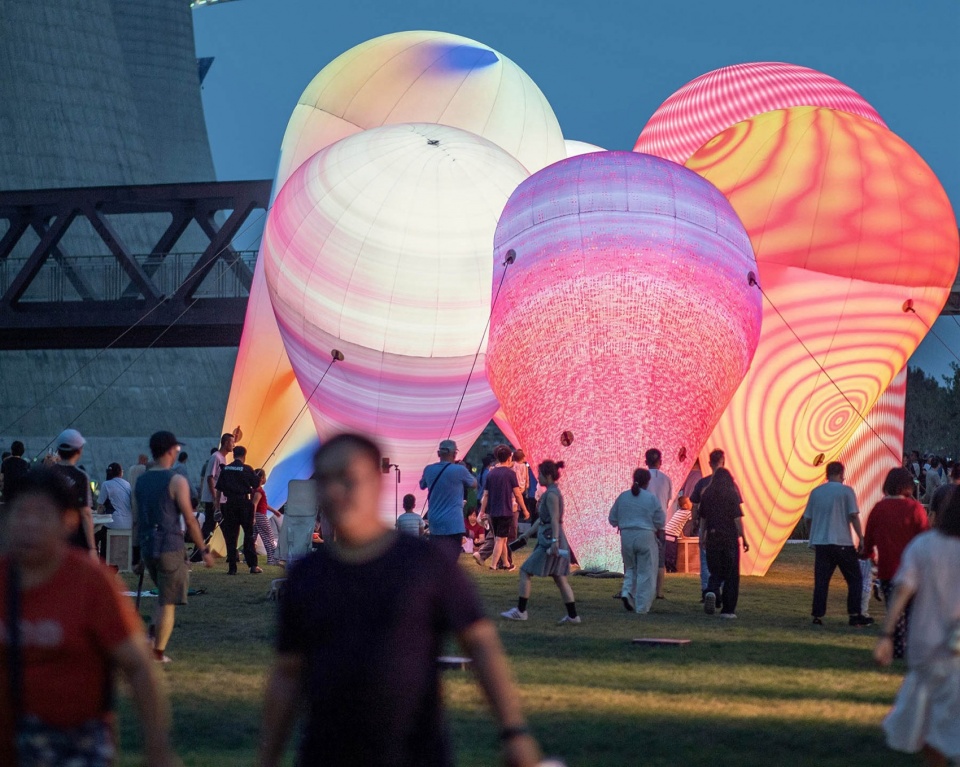
03 | 快速构建一个空间,而不只是一个物体
Building a Space Quickly, Rather Than Simply Making an Object
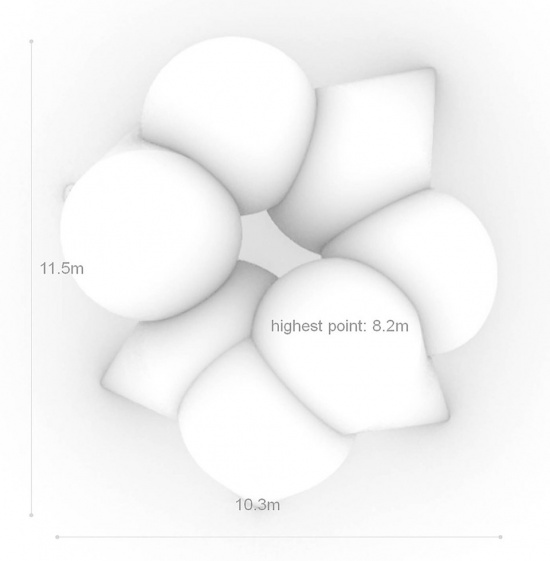
我们最后选择充气构筑物,是因为它足够快、成本低,技术也比较成熟,很适合这样一个临时项目。但通常的气膜大多是一个完整的充气体,落在地上,人与它的关系基本还是站在外面观看。我们希望把这个关系改变一下。七个筒彼此挤压、连接,通过内部钢架撑起来,下面只留下七个很细的支点。于是一个10米左右宽、8米多高的气膜,下面出现了三四米高的净空,也产生了很多可以进入、穿越和停留的缝隙。从外面看它还是一个情绪很强烈的物体,但走近以后,它已经开始成为空间。我们是把气膜当成一种很轻、很快的建造方式,用它形成一个场所,而不是一个广告牌。
We ultimately chose an inflatable structure because it could be constructed quickly, at relatively low cost, using a technically mature system — qualities that made it particularly suited to a temporary project of this kind. Conventional inflatable structures, however, are often conceived as complete inflated volumes placed directly on the ground. People remain outside them, and the relationship is largely one of looking. We wanted to change that relationship. The seven inverted conical volumes press into and connect with one another. Supported by internal steel frames, the entire structure meets the ground at only seven slender points. This lifts the approximately ten-metre-wide, more than eight-metre-high inflatable structure above the lawn, creating three to four metres of clear height underneath. A series of openings and gaps emerges between the cones, allowing people to enter, move through and stay. From a distance, it remains a visually emphatic object. As one approaches, however, it begins to become space. We treated the inflatable membrane as a lightweight and rapid means of construction — using it to create a place rather than simply an object or a billboard.
▼筒体下的空间与支点,Space and support points beneath the cones © 池伟
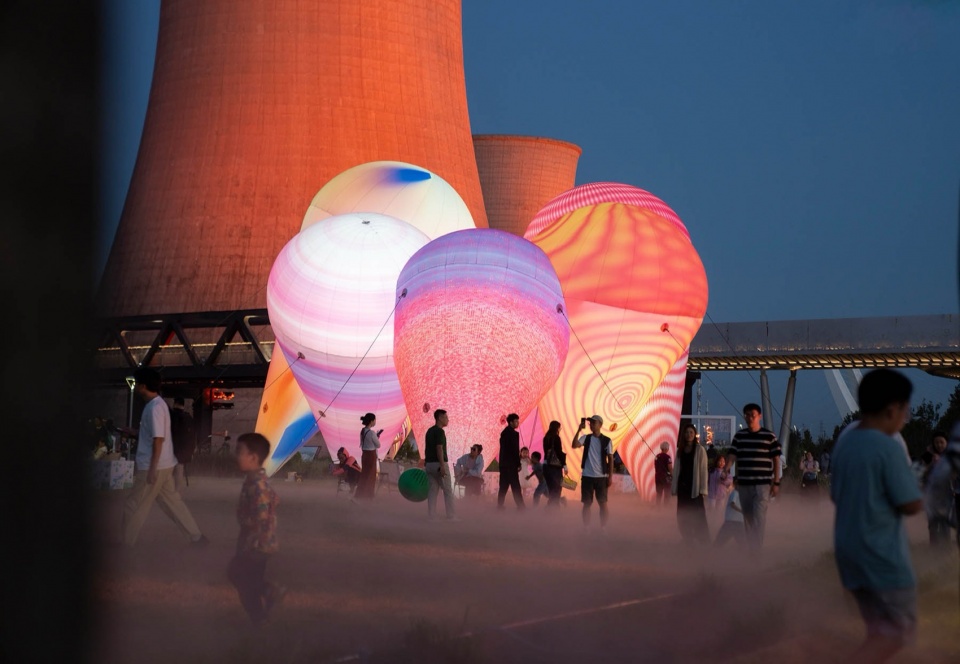
04 | 人们把它用成了一座“亭子”
People Turned It into a Pavilion
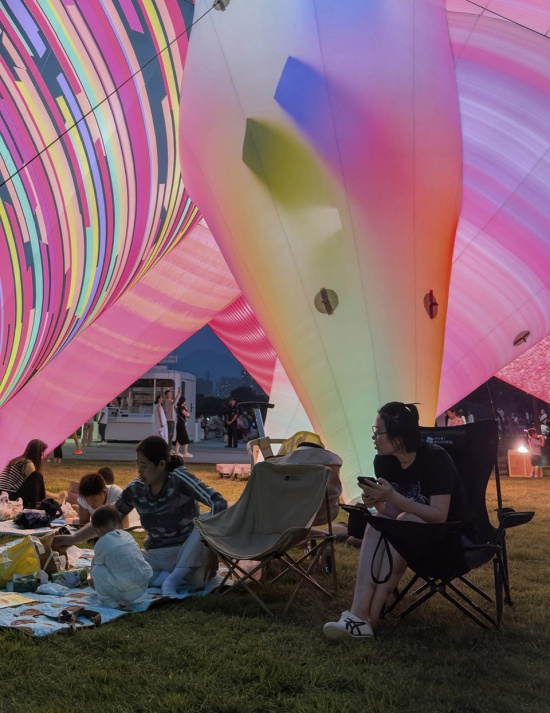
《七支筒》出现以后,草坪周围慢慢形成了一些新的驻留方式。北京夏天的草坪很晒,人本来不太愿意长时间待着。七个筒架起来以后,八九十平方米左右的范围有了遮阴。有人把地垫铺在旁边,有人坐在筒体下面,还有小朋友喜欢贴着气膜玩。
Once Seven Cones appeared on the lawn, new patterns of occupation gradually began to form around it. Beijing lawns can be intensely exposed during summer, and people would not normally choose to stay on them for long. Once the seven cones were raised above the ground, however, they created approximately 80 to 90 square metres of shade. Some visitors spread picnic mats nearby. Others sat beneath the suspended forms. Children began playing alongside the installation, pressing themselves against the soft inflatable membranes.
▼人们在筒下停留,
People lingering beneath the cones © GN栖城设计,摄影:梁文军
它被大家用成了一座亭子。“亭子”并不是我们开始设计时给它设定的功能,我们只是让形体和色彩去吸引人靠近,把气膜架起来让它下面有空间,可以走进去;气膜本身又是柔软的,身体靠近它没有什么距离感。最后遮阴、围合、尺度、柔软的触感碰到一起,人自己找到了使用它的方法。设计并没有规定这些事情,只是给它们提供了发生的条件。这和我们最初希望这个装置能够“促成一些事情”的想法,正好形成了一种回应。
People effectively turned it into a pavilion. A “pavilion” was not a function we had assigned to the project at the beginning of the design process. We simply used form and colour to attract people towards it, then lifted the inflatable cones to create a space underneath that people could enter. Because the membrane itself is soft, the body can approach and touch it without the sense of distance often created by a rigid architectural boundary. In the end, shade, enclosure, scale and softness came together, and people discovered their own ways of using the installation. The design did not prescribe these activities. It simply provided the conditions for them to occur. In this sense, what happened on site became a direct response to our original hope that the installation might enable something to happen.
▼人们在筒下停留,
People lingering beneath the cones © GN栖城设计,摄影:梁文军
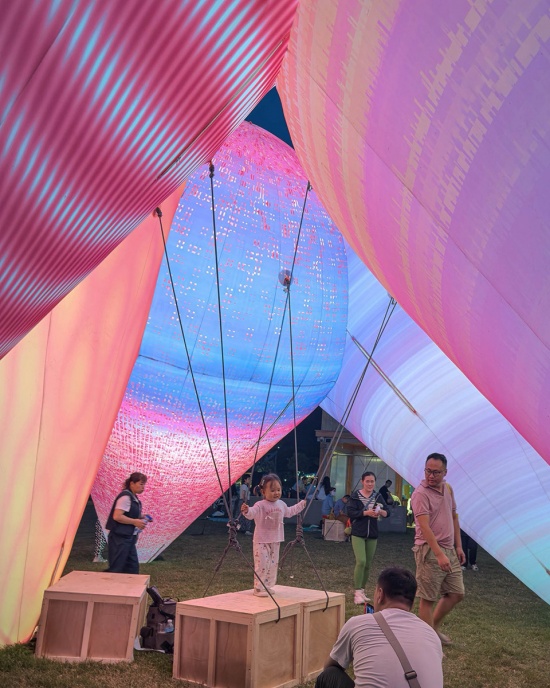
▼人们在筒下停留,People lingering beneath the cones © GN栖城设计,摄影:梁文军
05 | 好设计,不一定是创造什么,也可以是促成什么
Good Design Does Not Always Have to Create Something; It Can Also Enable Something
社会转型的时代,我们一直在重新思考一个问题:今天,什么是好设计?城市和社会究竟还需要什么样的建筑学?形式、原型、结构、材料当然仍然重要。但更多是建筑学内部的专业判断。把尺度向外推一步,我们开始更在意另一个问题:一个建筑进入真实社会以后,因为它的存在,有没有让某些原本可能发生的事情,更容易发生?
At a time of social transition, we have continued to reconsider a question: What constitutes good design today? What kind of architecture do cities and society actually need? Form, prototype, structure and material remain important, of course. But these are, to a large extent, professional judgments internal to the discipline of architecture. If we widen the frame, another question begins to matter more: When a work of architecture enters real social life, does its presence make certain things that might otherwise have happened more likely to occur?
▼装置与人群,Installation and crowds © GN栖城设计,摄影:梁文军
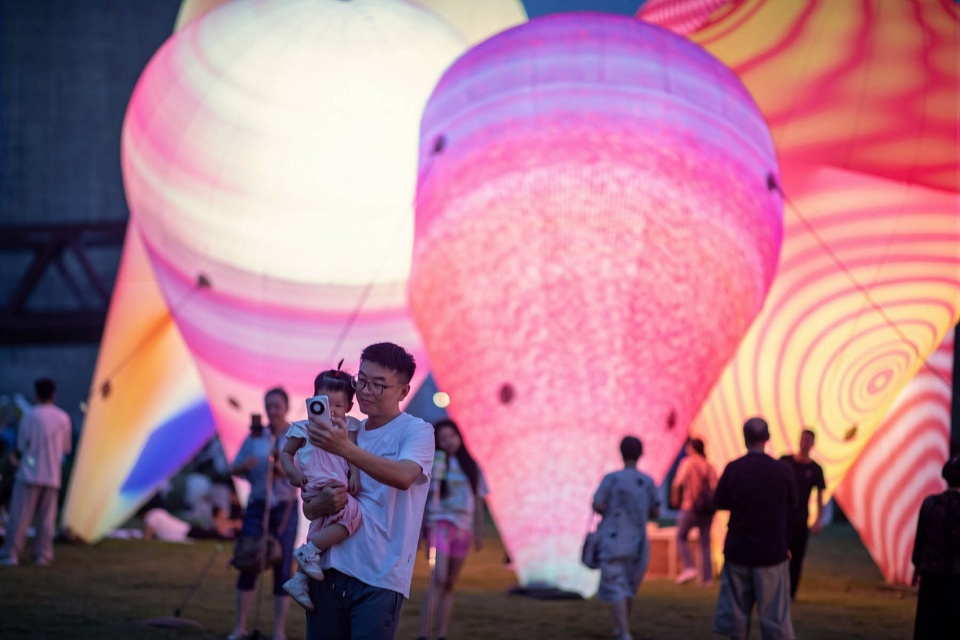
《七支筒》并没有发明野餐,没有发明儿童游戏,也没有创造人与人的见面。它只是让一些事情发生的概率提高了一点。远处的形象让人改变路线;阴影让人愿意停下来;可以穿越的空间让孩子进入;柔软的边界让身体愿意靠近;一个足够清楚的形象,又让陌生的人拥有了共同的坐标。这些作用都很小。但也许,今天的建筑学并不总是需要以巨大的动作改变城市。它也可以更敏感地理解一个已经存在的社会系统,然后选择一个恰当的位置介入,以尽可能少的建造,促成尽可能多的关系。
Seven Cones did not invent picnics. It did not invent children’s play. Nor did it create the act of people meeting one another. It simply made these things slightly more likely to happen. Its image from afar encourages people to alter their route. Its shade gives them a reason to stop. Its permeable spaces invite children to enter. Its soft boundaries encourage the body to come closer. And its clearly recognisable form gives strangers a shared point of reference. Each of these effects is small. But perhaps architecture today does not always need to transform the city through grand gestures. It can instead read an existing social system with greater sensitivity, identify an appropriate point of intervention and, through as little construction as possible, enable as many relationships as possible.
▼装置与人群夜景,Installation and crowds at night © GN栖城设计,摄影:梁文军
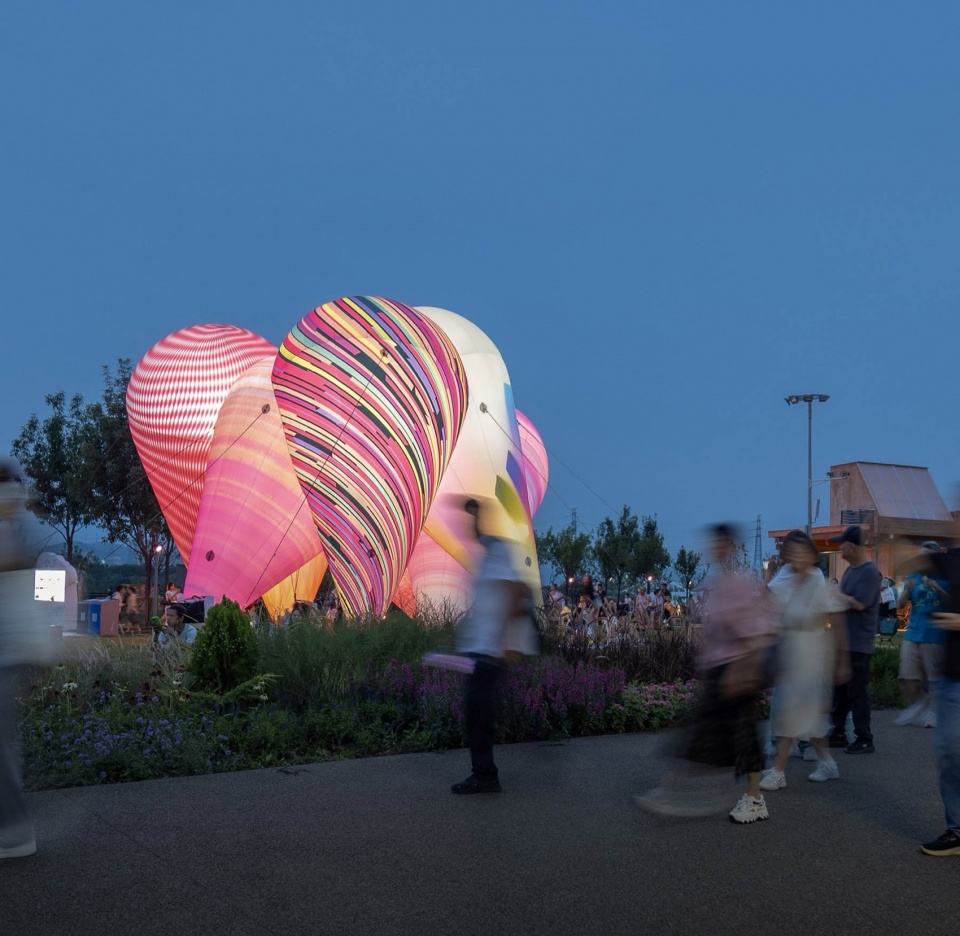
《七支筒》几个月以后会消失。但这次很小的实践,让我们更加确信:好的设计未必在于创造了多少事情,而在于它是否为尚未发生的事情,创造了发生的可能。
Seven Cones will disappear after several months. Yet this small experiment has reinforced something we increasingly believe: Good design may not be about how much it creates, but whether it creates the possibility for what has not yet happened to take place.
▼孩子们在气膜旁玩耍,
Children playing alongside the inflatable membranes © 池伟
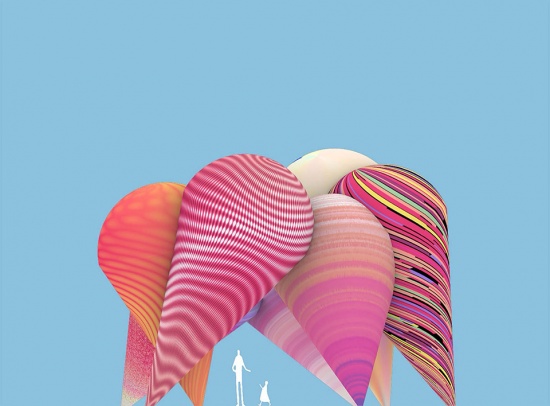
▼草图,Sketch © GN栖城设计
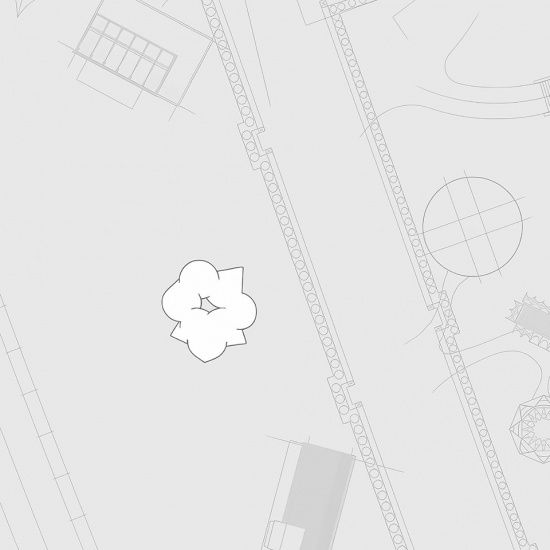
▼平面图,Plan © GN栖城设计
▼俯视图,Top-view drawing © GN栖城设计
项目名称:七支筒·看得见的拥抱
项目类型:艺术装置
设计方:GN栖城设计
公司网站:http://www.gnarchitects.cn/
联系邮箱:press@gn-int.com
项目设计:2026年
完成年份:2026年9月
设计团队:沈利江,刘通,EXIT
项目地址:永定河集·北京石景山区
建筑面积:80 ㎡
摄影版权:GN栖城设计(摄影师:梁文军);独立摄影师:池伟
客户:永定河集
Project name: Seven Cones — A Visible Embrace
Project type: Art Installation
Design: GN Architects
Website: http://www.gnarchitects.cn/
Contact e-mail: press@gn-int.com
Design year: 2026
Completion Year: Sept. 2026
Leader designer & Team: Shen Lijiang, Liu Tong, EXIT
Project location: Yongding River Market, Shijingshan District, Beijing, China
Gross built area: 80 ㎡
Photo credit: GN Architects (Photographer: Liang Wenjun); Independent photographer: Chi Wei
Clients: Yongding River Market
More: 栖城设计。更多关于:GN Architects on gooood

发表评论
你需要先 才能发表评论
社交登录