感谢 朱小地工作室 予gooood分享以下内容。更多关于:ZXD ARCHITECTS on gooood
Appreciations towards ZXD ARCHITECTS for providing the following description:
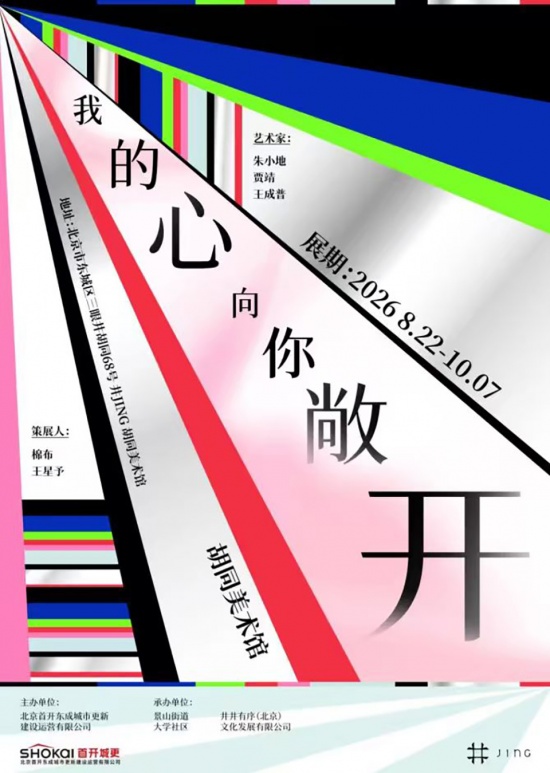
由建筑师、艺术家朱小地创作的建筑装置《影壁》,于2026年8月22日在胡同美术馆夏季新展中展出。
▼影壁·全过程记录,Yingbi · Full Process Record © 朱小地工作室
The architectural installation Yingbi, created by architect and artist Xiaodi Zhu, was presented on August 22, 2026, as part of the summer exhibition at JINGxHutong Museum.
▼开幕宣传海报,Opening Exhibition Poster © 井JING胡同美术馆
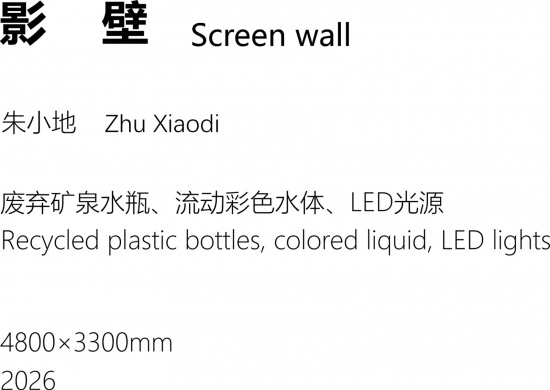
▼展签,Exhibition Label © 朱小地工作室
在中国传统建筑中,影壁既是空间的界面,也是观看的起点。它通过重组人的行进路径,使“进入”不再是直线式的穿越,而成为一种被延宕、被引导、被重新分配视线的空间经验。在这一意义上,影壁并非在简单界定内外、调节视线,更成为了一种关于“观看如何发生”的装置。《影壁》试图在当代语境中重新激活这一空间原型,并将其置入当代艺术关于“物、观看与空间生产”的长期讨论之中。
In traditional Chinese architecture, a yingbi, or screen wall, is both a spatial interface and the starting point of viewing. By reorganizing the route of entry, it turns “entering” from a direct act of passage into a spatial experience of delay, guidance, and redistributed sightline. In this sense, the screen wall does not merely define inside and outside or regulate visibility; it becomes a device through which the act of viewing itself is formed. Yingbi(screen wall) attempts to reactivate this architectural prototype in a contemporary context, placing it within the broader discourse of contemporary art around objects, perception, and the production of space.
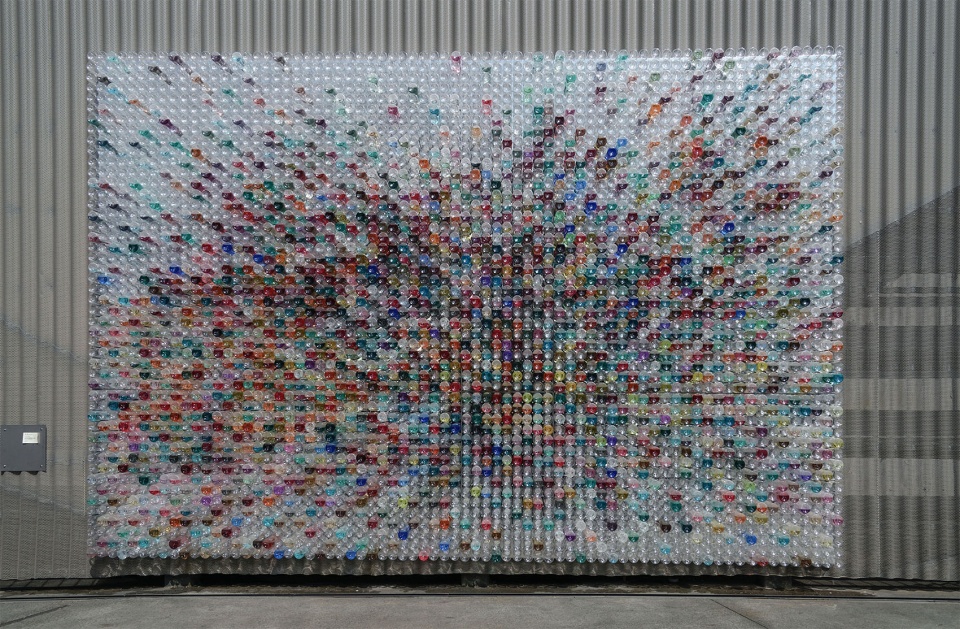
▼影壁完整画面,Full View of Yingbi © 金燕
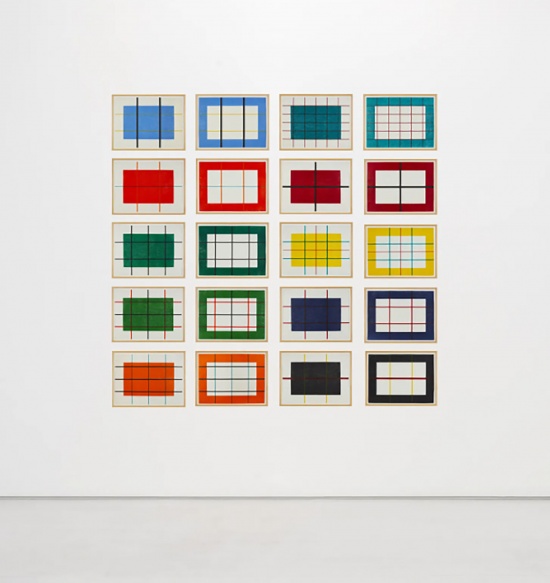
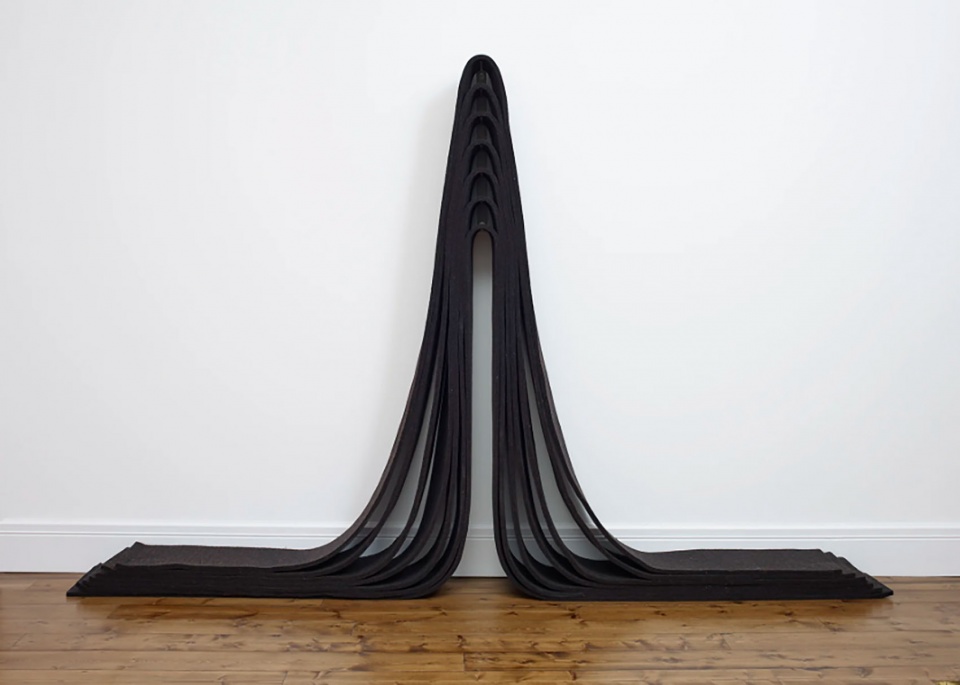
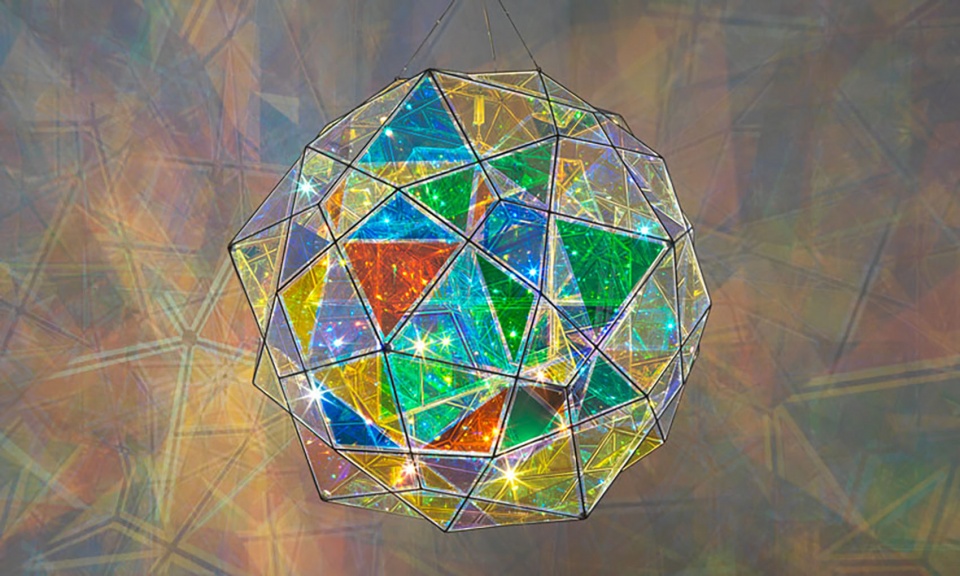
自20世纪60年代以来,当代艺术逐渐从对象转向关系,从物的呈现转向感知机制的建构。极简主义艺术家如唐纳·贾德(Donald Judd)与罗伯特·莫里斯(Robert Morris)通过“特定对象”(Specific objects)削弱象征性叙事,使作品回到空间、尺度与身体经验本身;观念艺术则进一步将作品从物质实体中抽离,强调语言、结构与观看条件的生成;而从理查德·塞拉(Richard Serra)到奥拉夫·埃利亚松(Olafur Eliasson)的装置实践,则不断将空间本身转化为可被进入、被扰动、被重新组织的感知场域。
Since the 1960s, contemporary art has gradually shifted from object to relation, and from the presentation of things to the construction of perceptual mechanisms. Minimalist artists such as Donald Judd and Robert Morris, through the idea of “specific objects,” weakened symbolic narrative and returned the artwork to space, scale, and bodily experience. Conceptual art further detached the work from the material object, emphasizing language, structure, and the conditions of viewing. Installation practices, from Richard Serra to Olafur Eliasson, have continuously transformed space itself into a perceptual field that can be entered, disturbed, and reorganized.
▼唐纳德·贾德《无题》,
Untitled work of Donald Judd © Thaddaeus Ropac
▼罗伯特·莫里斯1971年作品《Fountain》,Fountain,
1971 by Robert Morris during Crossroads, Kauffman, Judd and Morris © Spruth Magers
▼奥拉夫·埃利亚松《Dimmable firefly double polyhedron sphere experiment》,
Olafur-Eliasson_Dimmable-firefly-double-polyhedron-sphere-experiment © Palazzo Strozzi
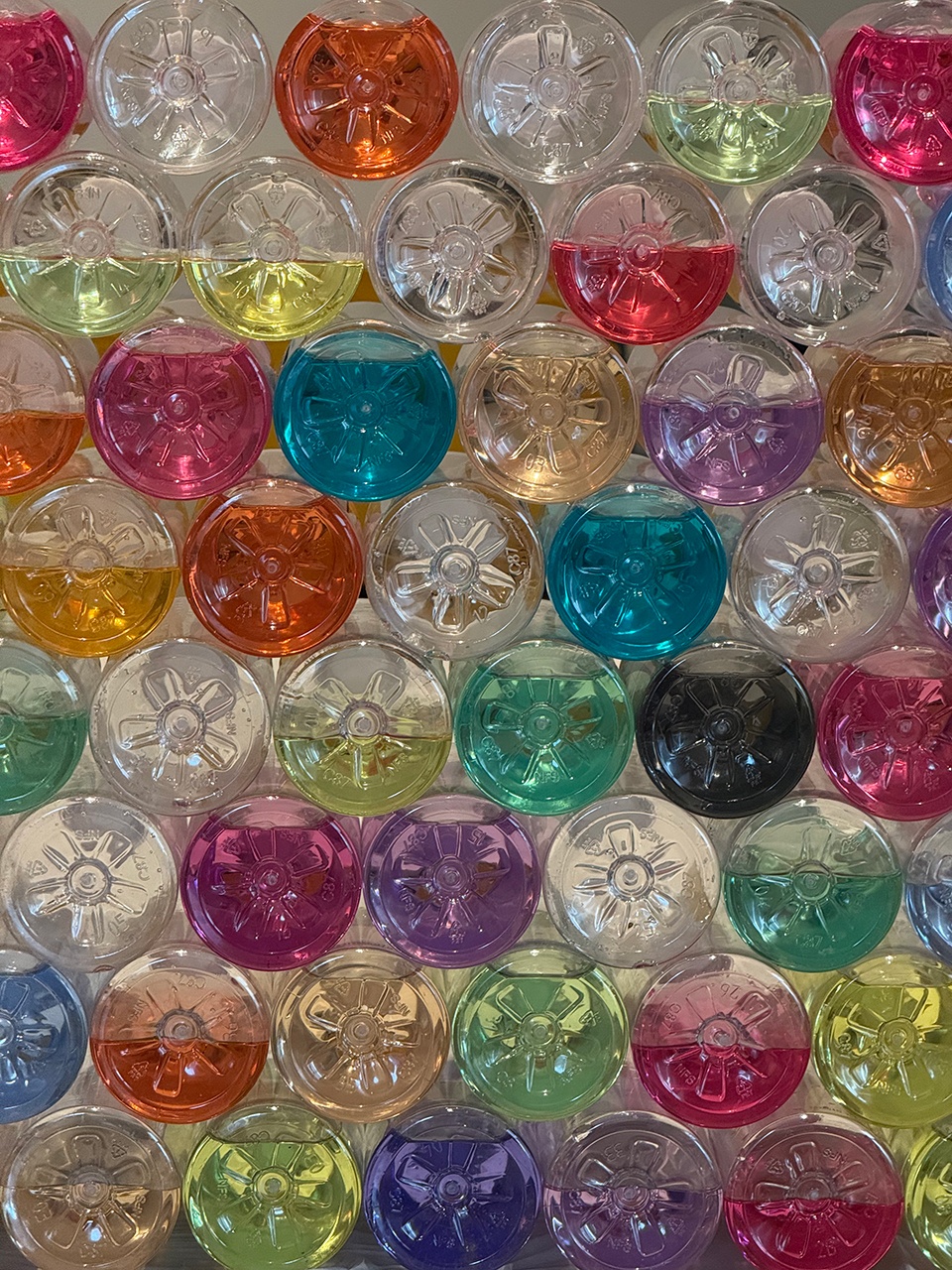
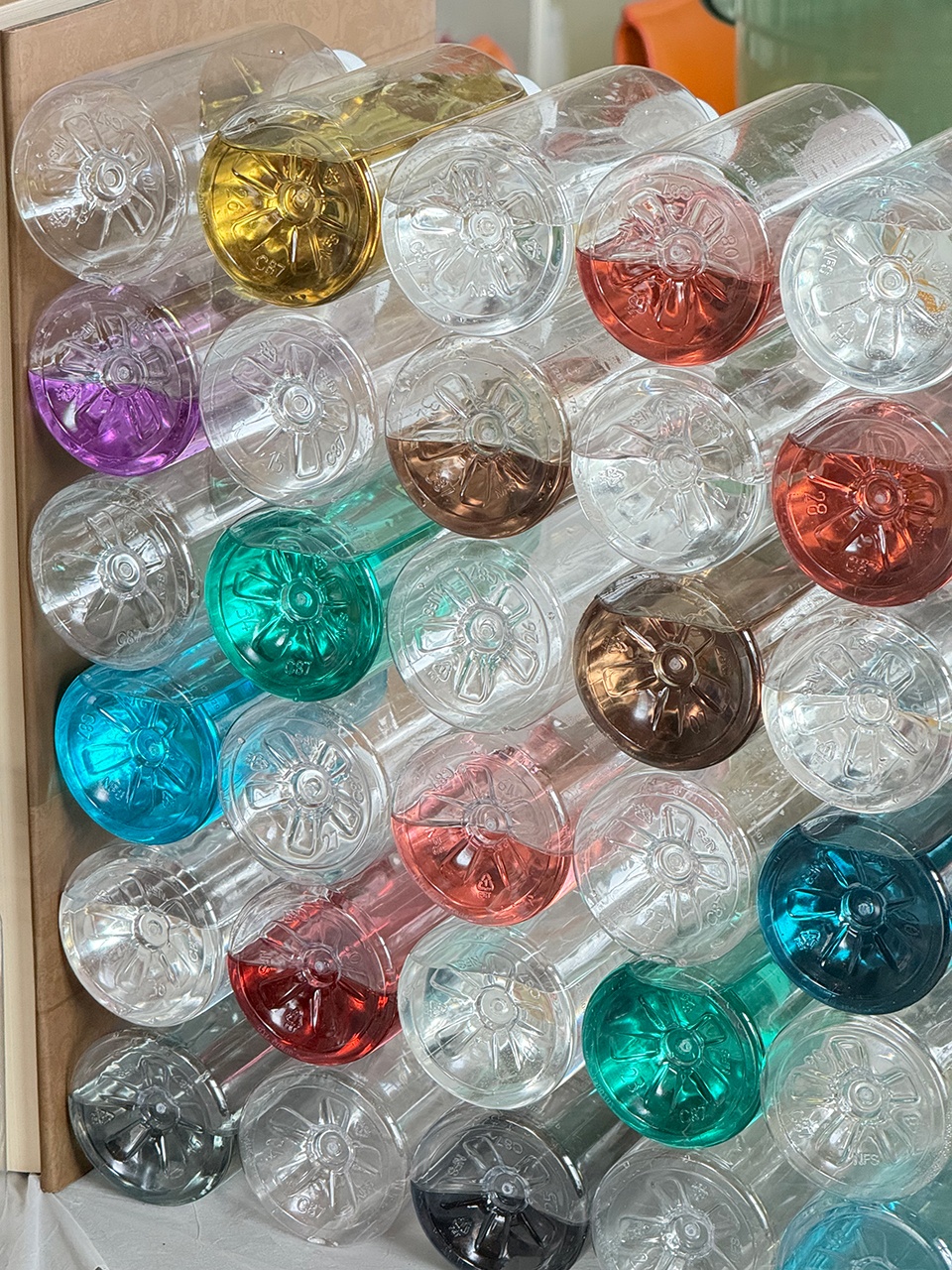
在这一谱系中,《影壁》并非试图再现某种形式,而是延续一种问题意识:作品如何成为观看关系的生成机制,而非被观看的对象?一只350ml的塑料瓶,它出现在会议桌上、快递驿站旁、健身房饮水机边、孩子的书包侧袋里。没有人会专门去看它。它被握过、拧开、喝掉、捏扁、投入回收箱,然后迅速退出人们的视线。作品选取矿泉水瓶作为基本材料,这一选择并非出于对“废弃物”的考量,而是基于其在当代消费结构中的典型:它是高度标准化、瞬时使用、快速流通的工业容器,也是最缺乏“被观看价值”的日常物之一。当这些被忽略的物被重新收集、排列,并在其中注入不同浓度的色彩之后,它们不再作为“物品”存在,而开始转化为一种空间组织的单元。
Within this lineage, Yingbi(screen wall) does not seek to reproduce a fixed form. Instead, it extends a question: how can an artwork become a mechanism for generating relations of viewing, rather than merely an object to be looked at? A 350ml plastic bottle appears everywhere: on meeting tables, beside parcel stations, near water dispensers in gyms, or in the side pocket of a child’s schoolbag. No one looks at it deliberately. It is held, opened, emptied, crushed, thrown into a bin, and then quickly disappears from sight. The work takes mineral water bottles as its basic material. This choice is not simply based on the idea of “waste”, but on the bottle’s representative position within contemporary consummation culture. It is a highly standardized, transparent, instantly consumed, and rapidly distributing industrial container, and also one of the most overlooked everyday objects, almost devoid of any conventional “viewing value.” When these neglected objects are collected, arranged, and filled with different densities of color, they no longer exist merely as objects. Instead, they begin to transform into units of spatial organization.
▼大画幅色彩位置关系,Large-Scale Color Relationships © 金燕
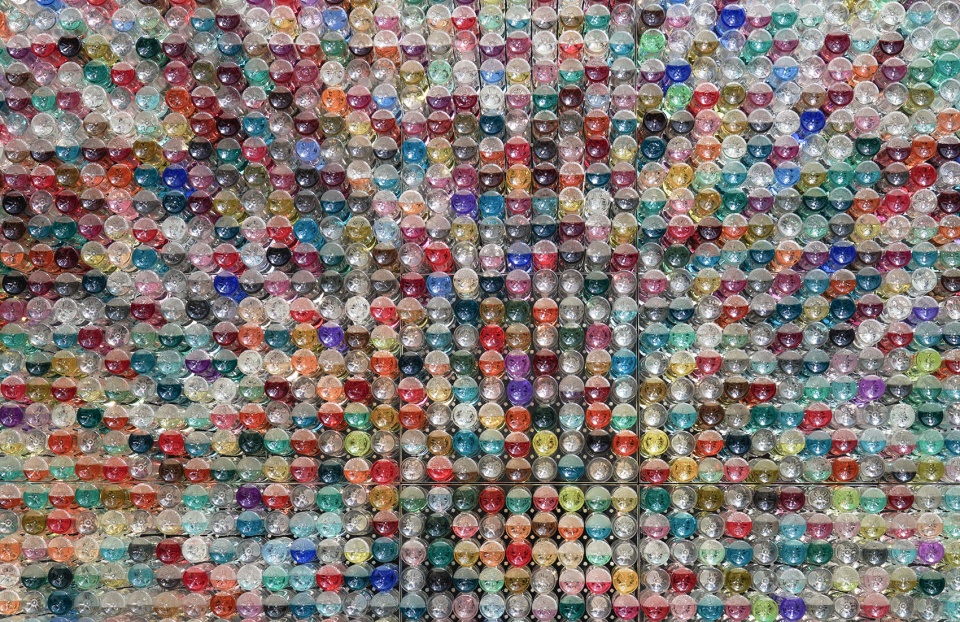
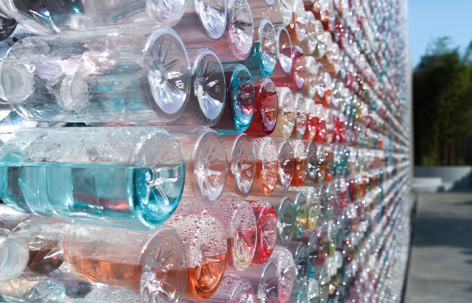
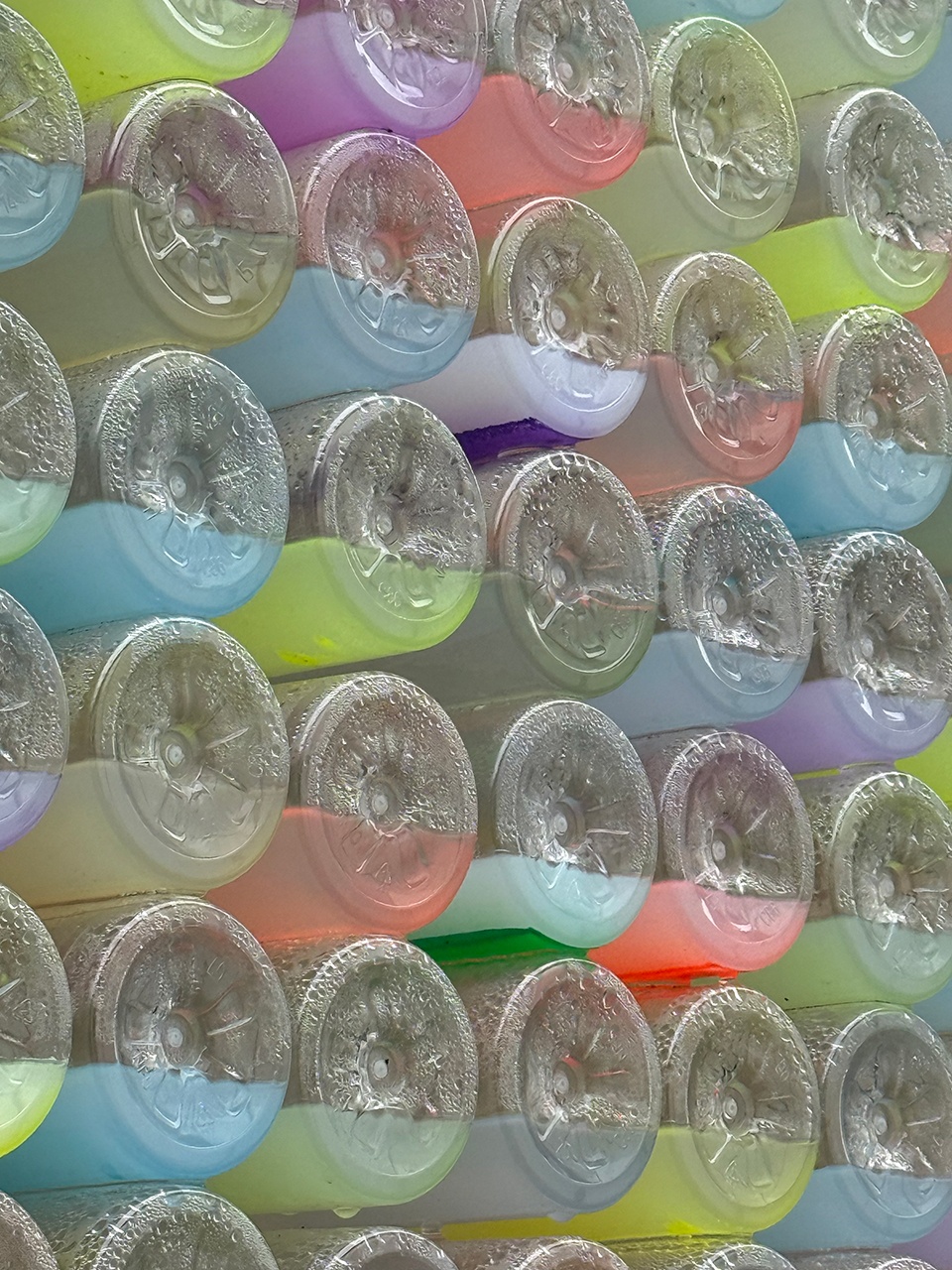
▼侧面观察影壁时瓶体、水体、色彩的半重叠视觉,
Overlapping Bottles, Water and Color in Side View © 金燕
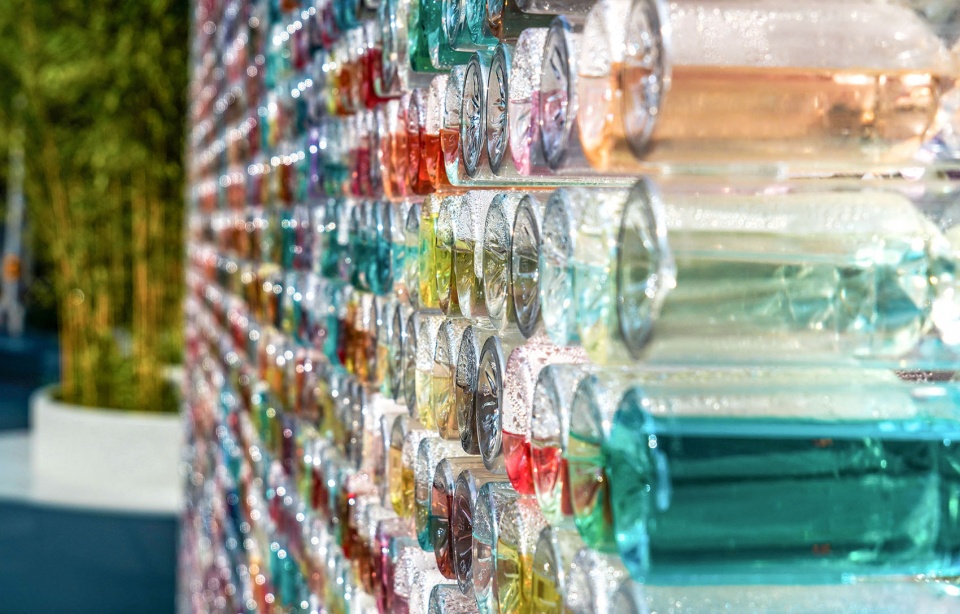
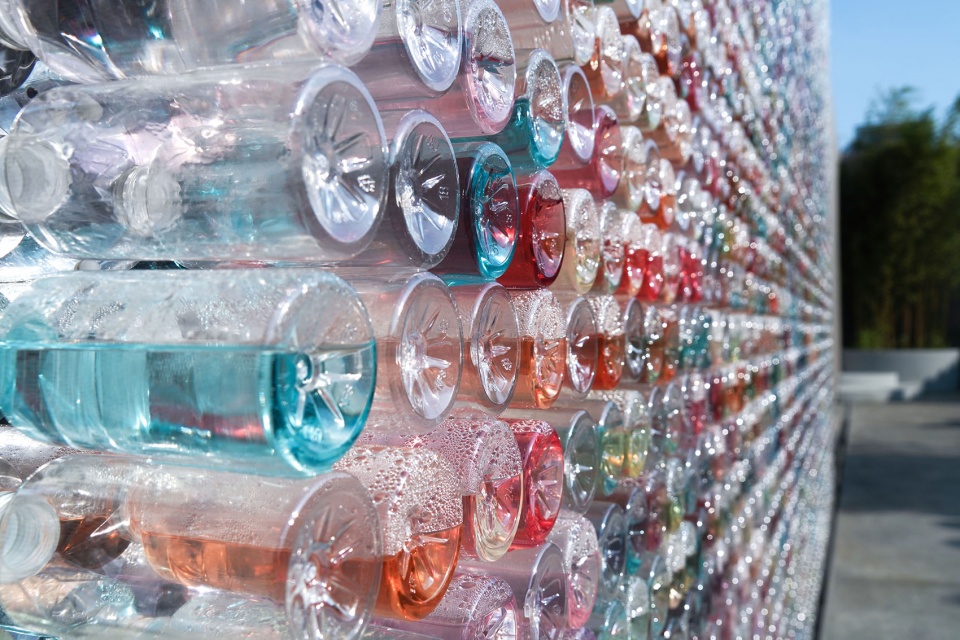
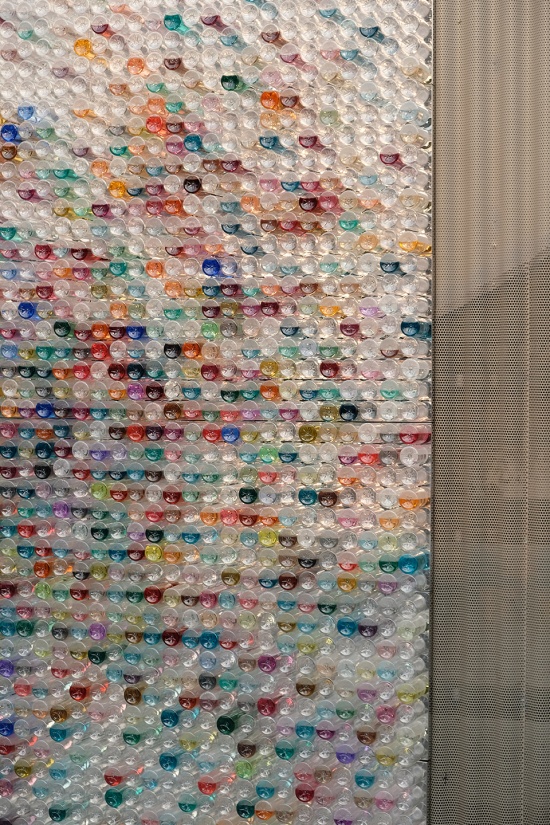
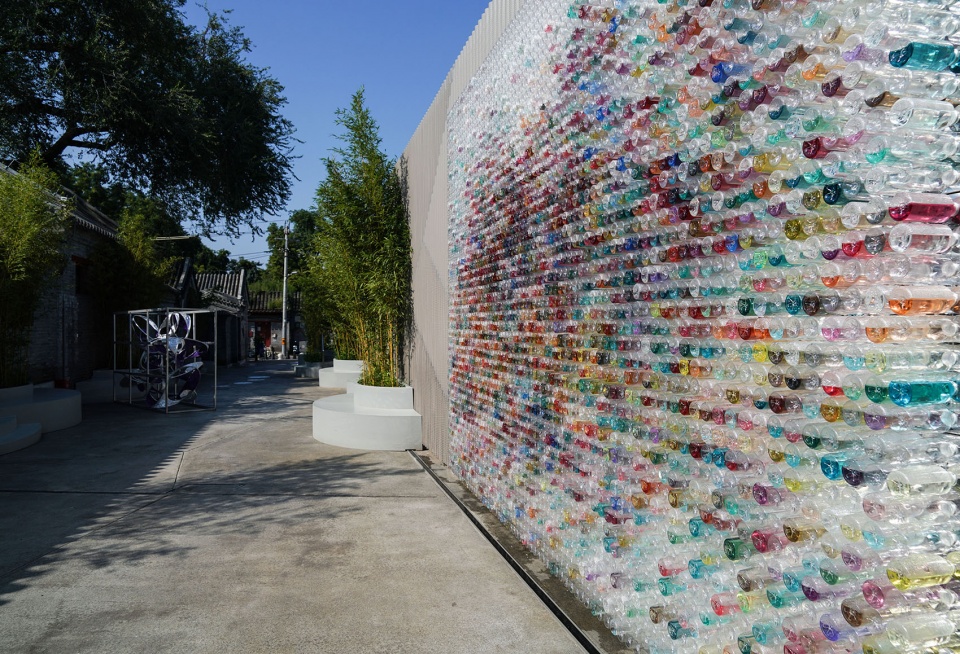
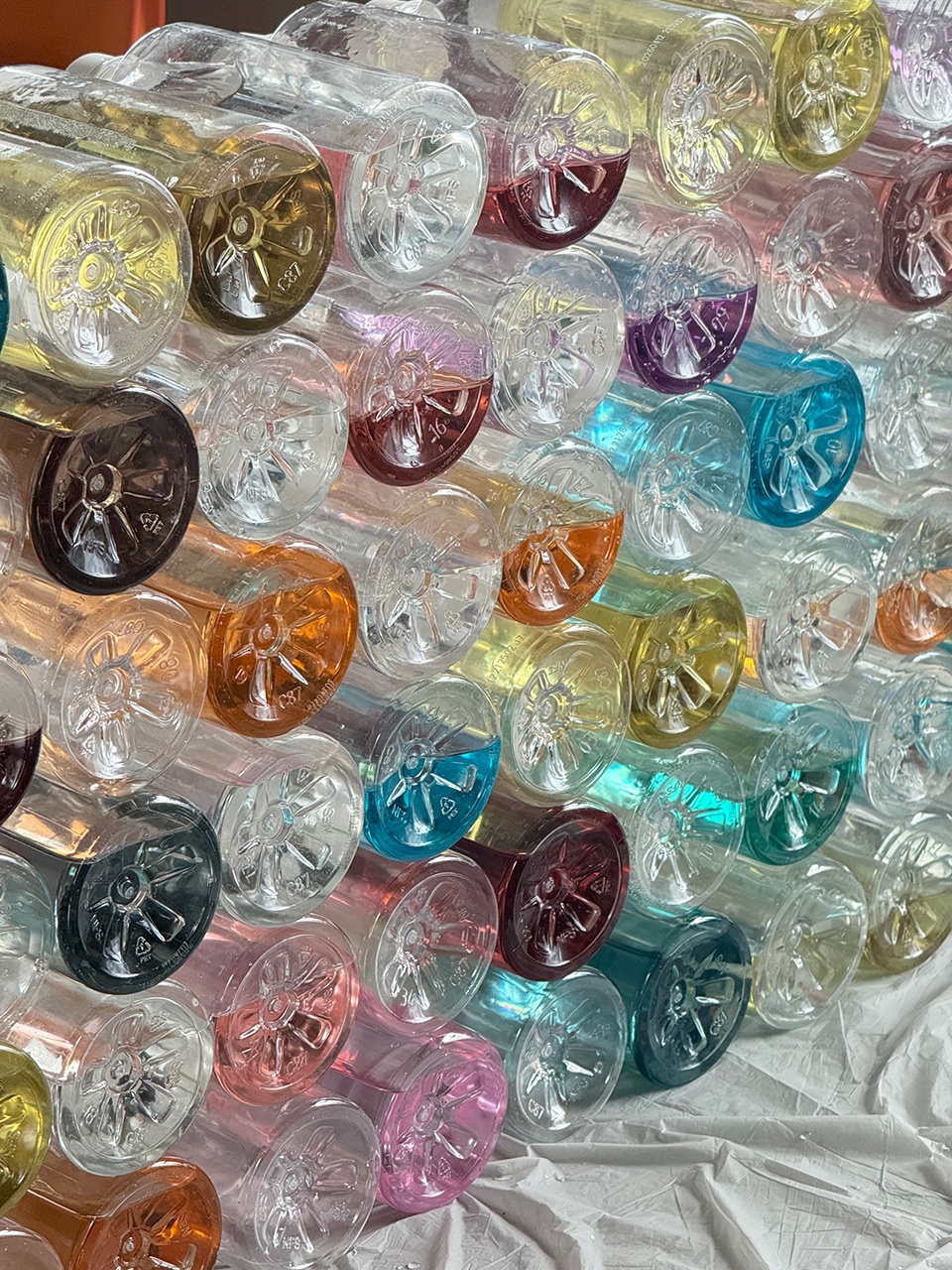
从远处观看,它呈现为一面连续的界面;而当观者接近时,这一界面不断被拆解为瓶身、液体、空气与光的叠加结构。作品的视觉完整性并不来自材料本身,而来自观看距离与身体移动所生成的临时秩序。在这一点上,它与装置艺术中“去中心化观看”(Decentralized view)的传统形成呼应,也与里克力·提拉瓦尼(Rirkrit Tiravanija)所代表的关系美学(Relational aesthetics)所强调的“作品作为关系发生的场所”构成隐性关联。
Seen from afar, the installation appears as a continuous surface. As the viewer approaches, however, this surface is gradually dismantled into a layered structure of bottle, liquid, air, and light. The visual integrity of the work does not come from the material itself, but from the temporary order produced by viewing distance and bodily movement. In this regard, it echoes the tradition of the “decentralized view” in installation art, while also forming an implicit connection with the relational aesthetics represented by Rirkrit Tiravanija, in which the artwork is understood as a site where relationships take place.
▼光影加持下影壁的强烈纵深感呈现,Strong Spatial Depth Enhanced by Light © 金燕
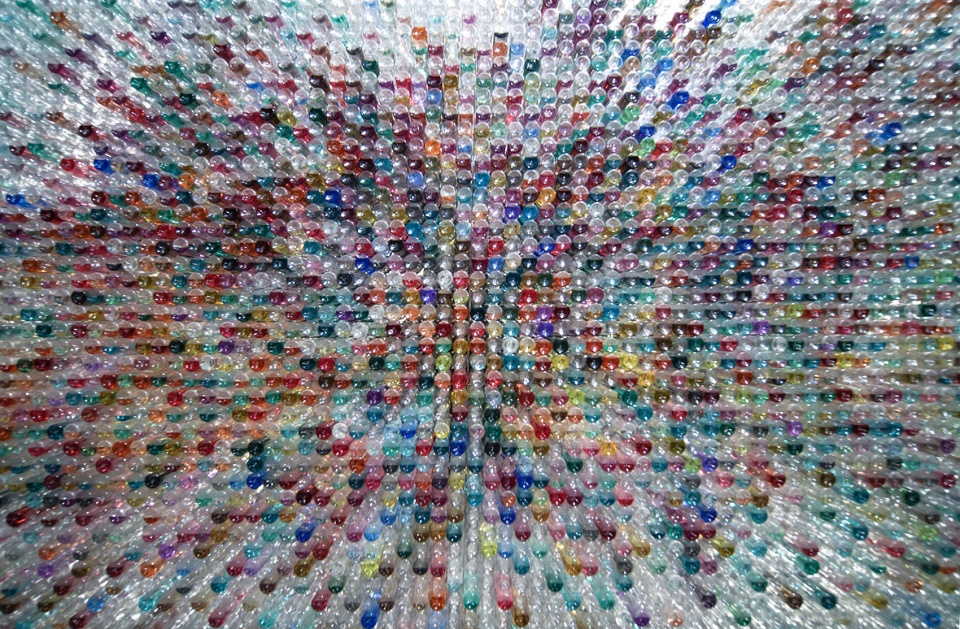
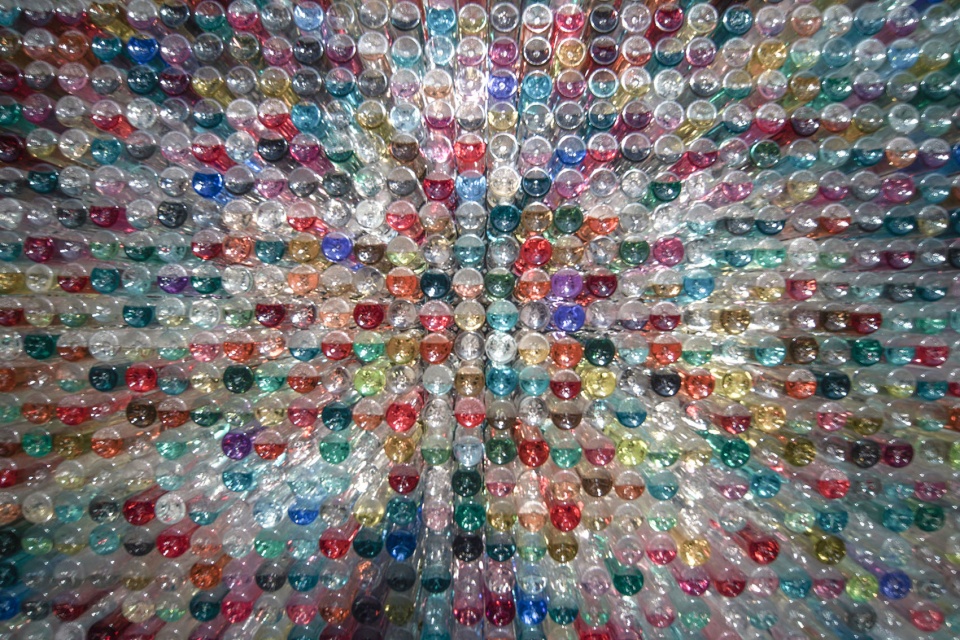
▼影壁视觉纵深感与背后冲孔板的对比,
Visual Depth and Perforated Panel Behind © 朱小地工作室
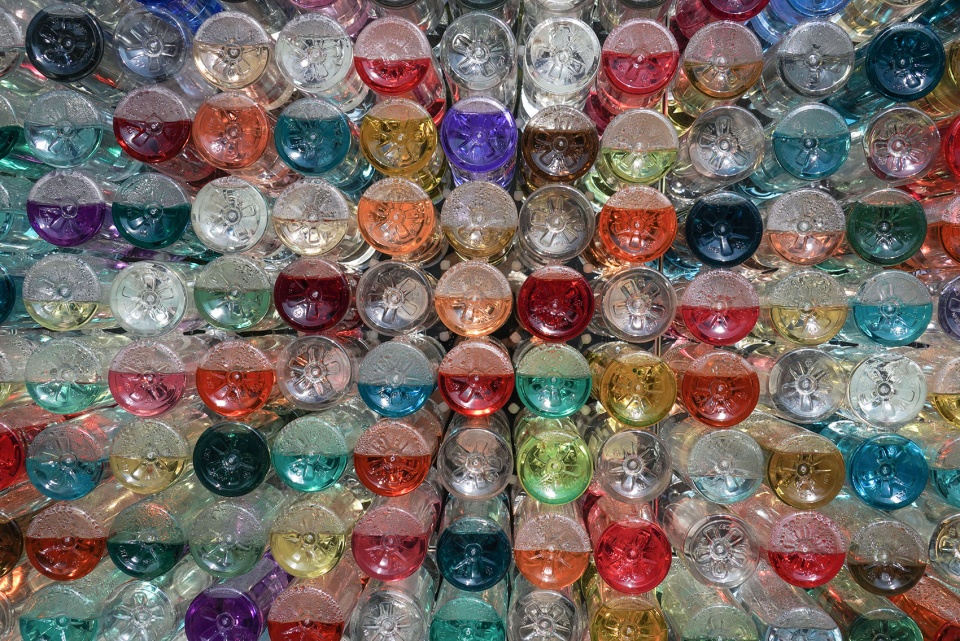
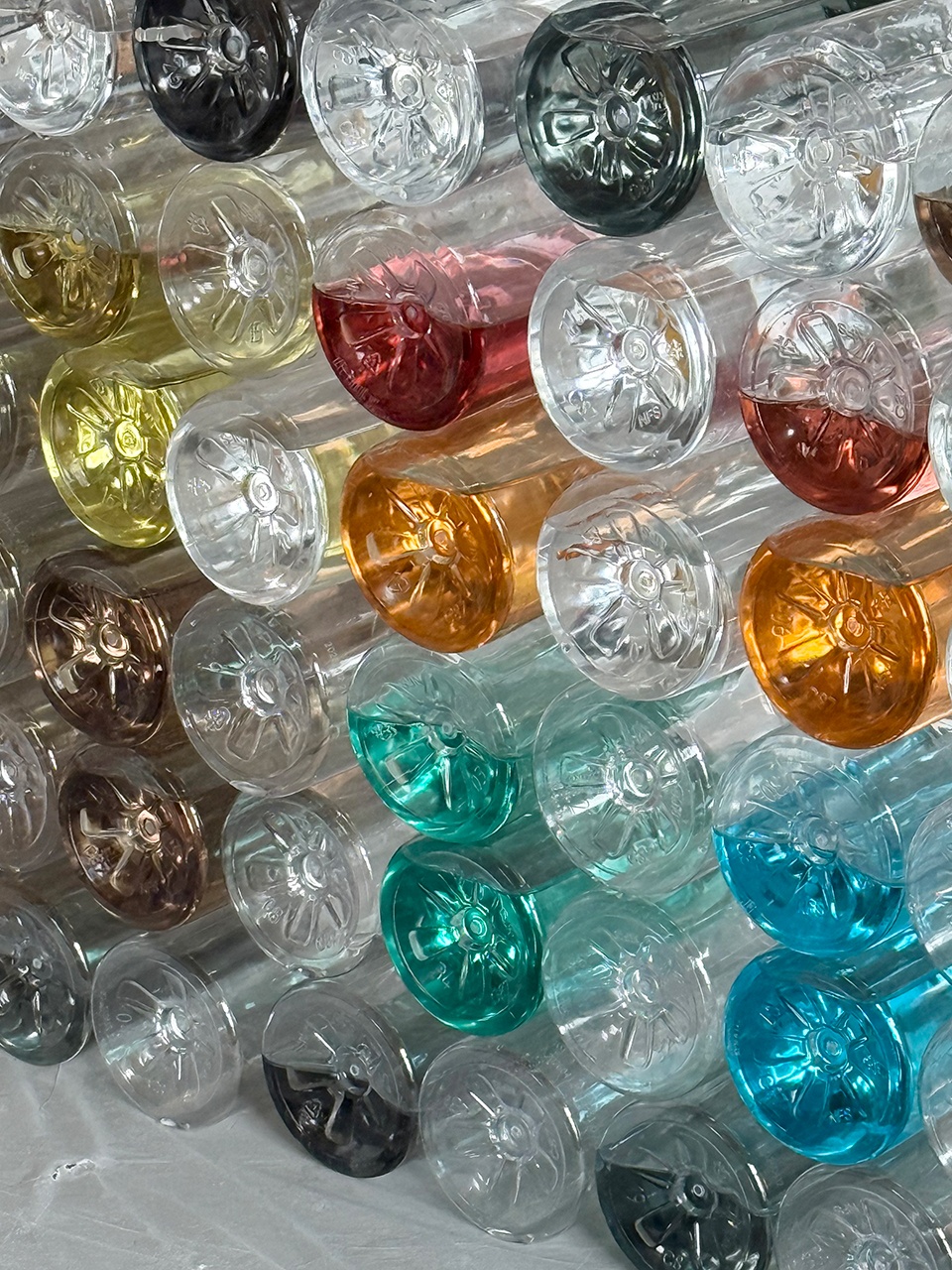
▼凑近时单元瓶体、色彩纵深关系,Depth of Bottles and Color at Close Range © 金燕
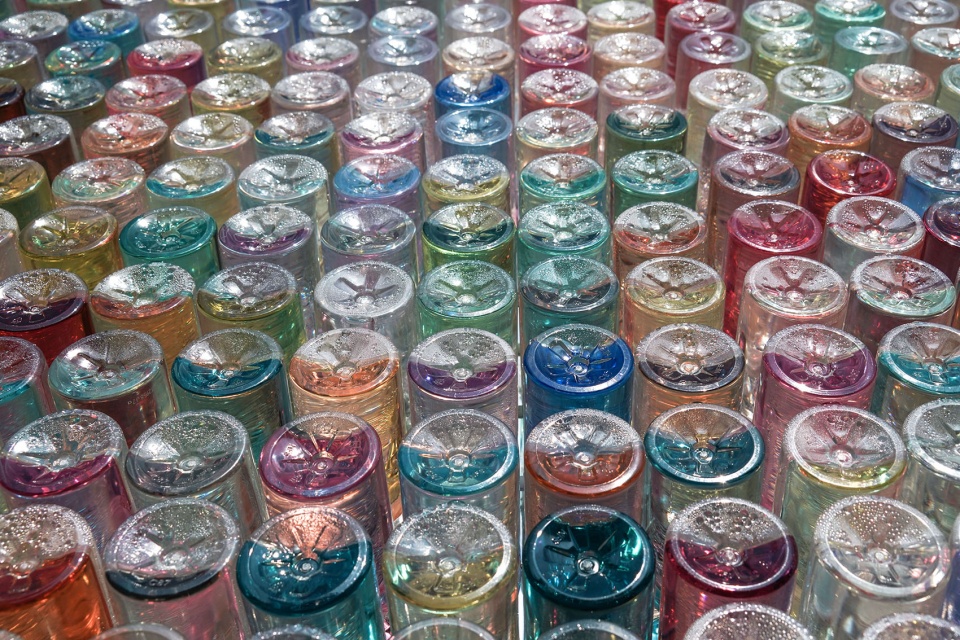
▼瓶底在阳光下的光线矩阵,Light Matrix through Bottle Bases © 金燕
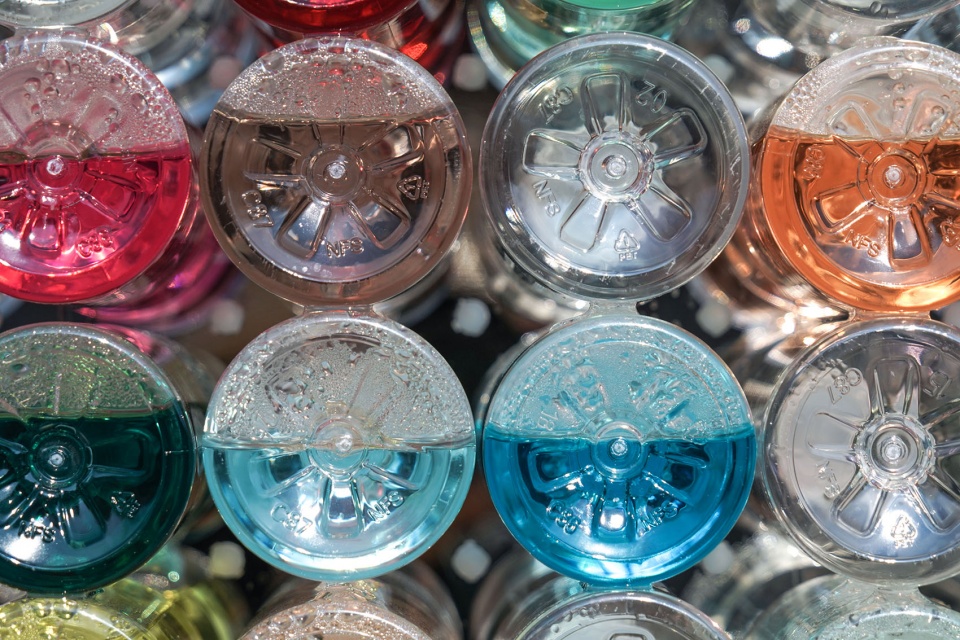
▼凝结的水珠、半灌的彩色水体与光影,Condensation, Colored Water and Light © 金燕
在色彩上,《影壁》参照了中国传统的五方色——青、赤、黄、白、黑。这五种色彩在中国古代不仅是视觉符号,更是宇宙秩序的象征:青色对应东方与木,赤色对应南方与火,白色对应西方与金,黑色对应北方与水,黄色对应中央与土。这种色彩体系贯穿于宫殿、庙宇与民居的建筑装饰中,尤其在瓦当、斗拱与彩画等构件上形成了经年累月沉淀下来的独特色层。
In terms of color, Yingbi(screen wall) refers to the traditional Chinese palette of the Five Directional Colors: blue-green, red, yellow, white, and black. In ancient China, these colors were not only visual symbols, but also representations of cosmic order: blue-green corresponds to the East and Wood, red to the South and Fire, white to the West and Metal, black to the North and Water, and yellow to the Center and Earth. This chromatic system runs through the decorative traditions of palaces, temples, and vernacular dwellings, forming distinctive layers of color over time, especially in architectural components such as eave tiles, bracket sets, and painted ornamentation.
▼与蓝天相接的影壁-古典五方色,Yingbi against the Blue Sky – Five Directional Colors © 金燕
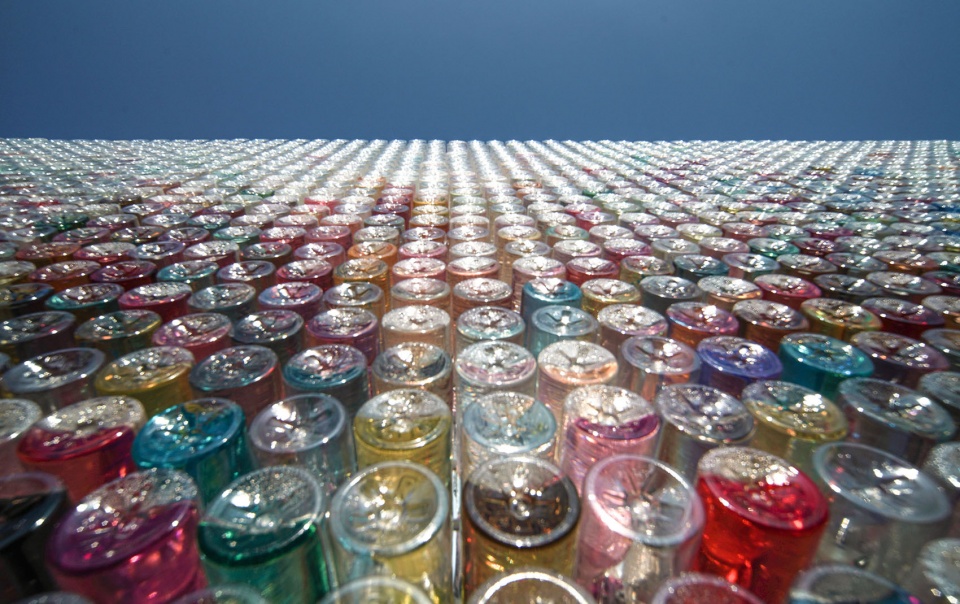
《影壁》并未简单复制这些历史色彩,而是将其视为一种“时间性视觉结构”:那些因风化、氧化与使用而变得温润、斑驳的色调,恰恰承载了材料自身的生命历程。在透明塑料瓶体与彩色液体的介质中,色彩被重新折射、分解并流动化,脱离了原有的静态属性与象征意义,转而成为空间中可被穿透、混合与重组的视觉。观者在不同角度和光线下看到的,并非固定的色块,而是五色相互渗透、彼此映照的动态光谱。
Yingbi(screen wall) does not simply replicate these traditional colors. Instead, it treats them as a temporal visual structure. Tones softened, mottled, and altered by weathering, oxidation, and use carry within them the life process of the material itself. Through the medium of transparent plastic bottles and colored liquid, color is refracted, decomposed, and made fluid again. It moves away from static symbolism and becomes a kind of visuality that can be penetrated, mixed, and reorganized within space. What viewers encounter from different angles and under changing light is not a fixed color field, but a dynamic spectrum in which the five colors permeate and reflect one another.
▼有色水体、镜面反射加持下的光影效果,
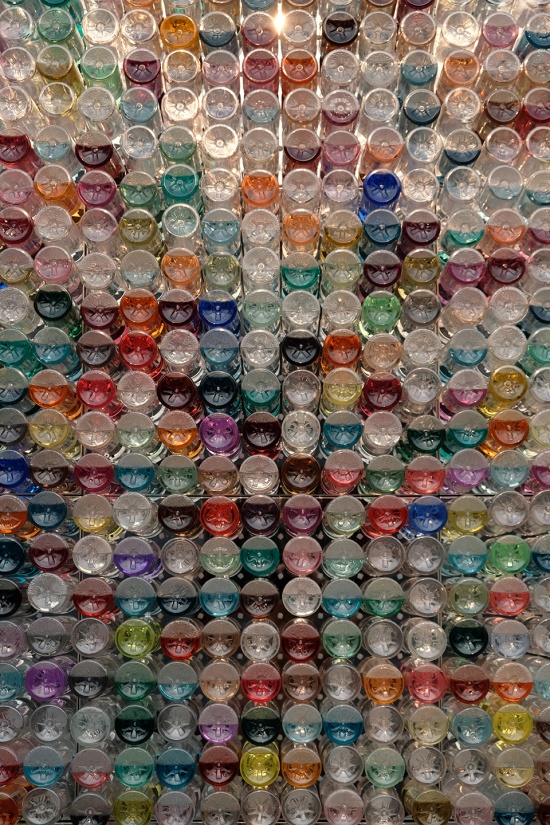
Light Effects through Colored Water and Reflections © 朱小地工作室
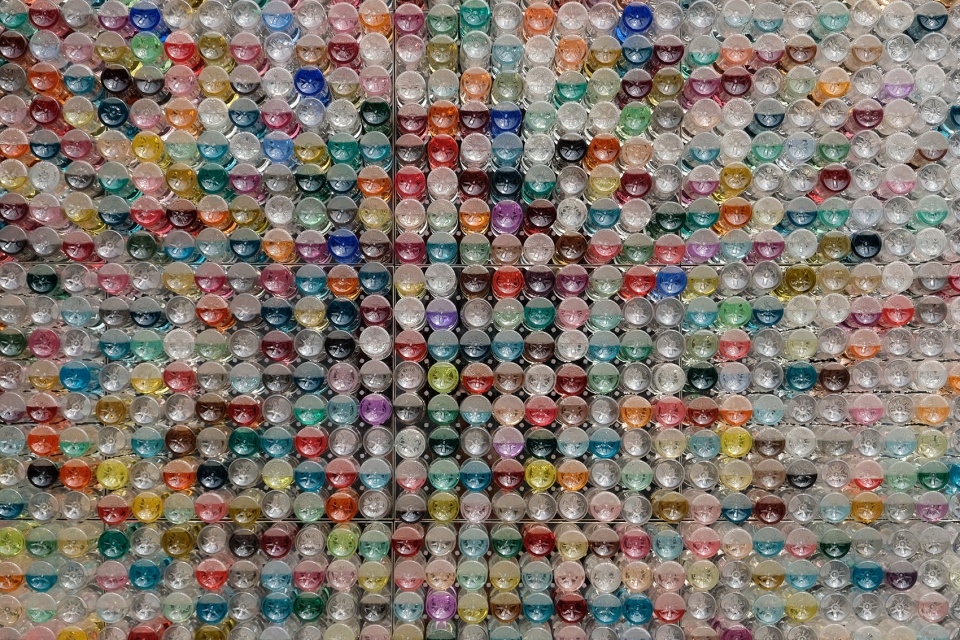
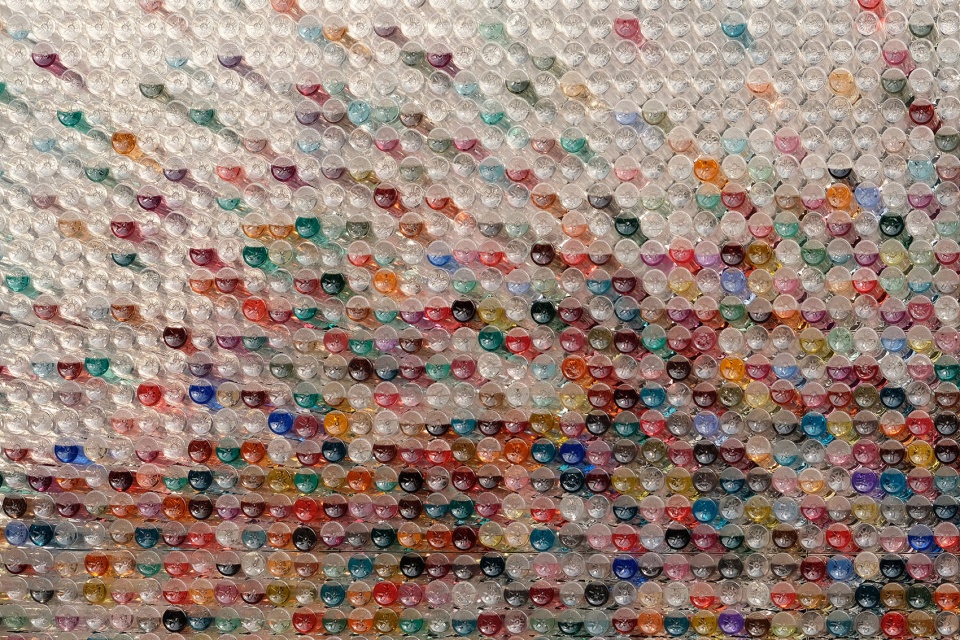
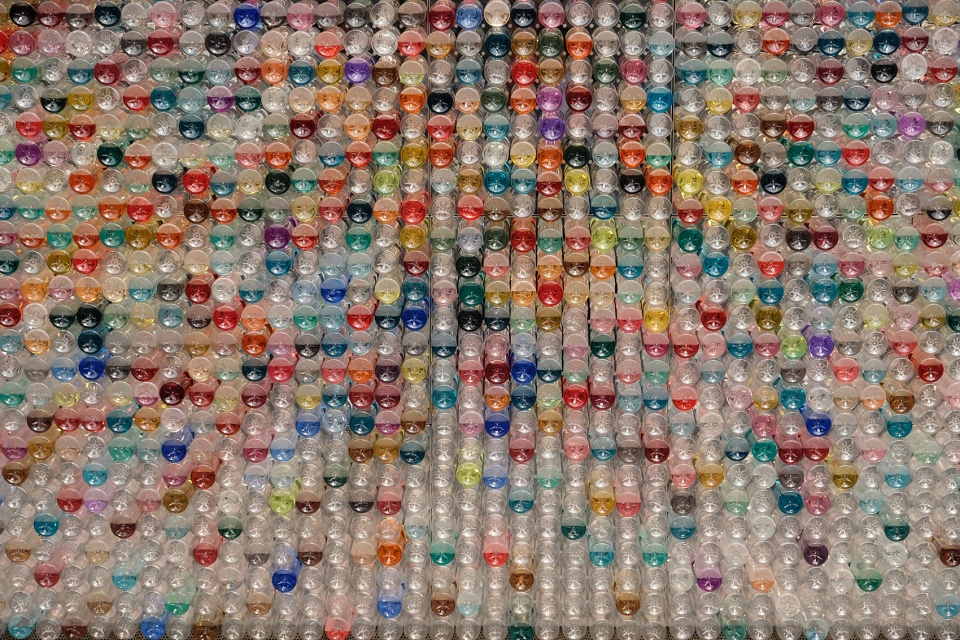
▼装置光影效果局部,Installation Light Effects Partial View © 朱小地工作室
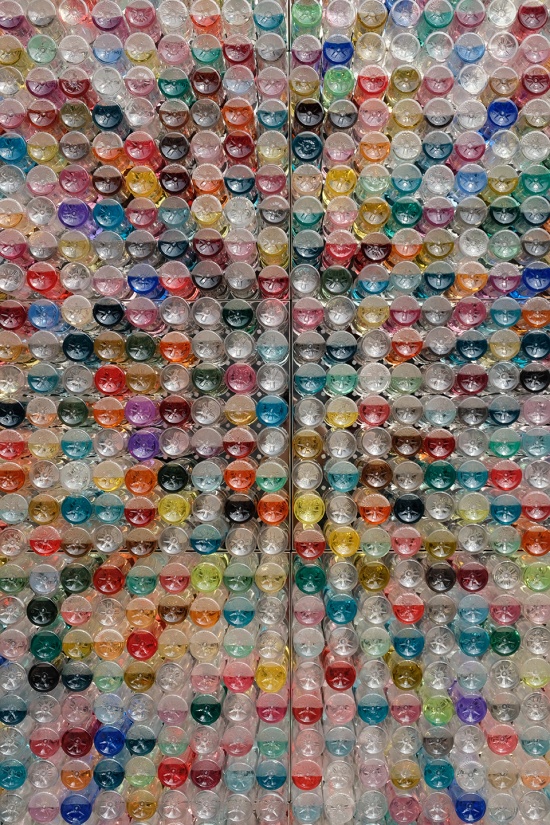
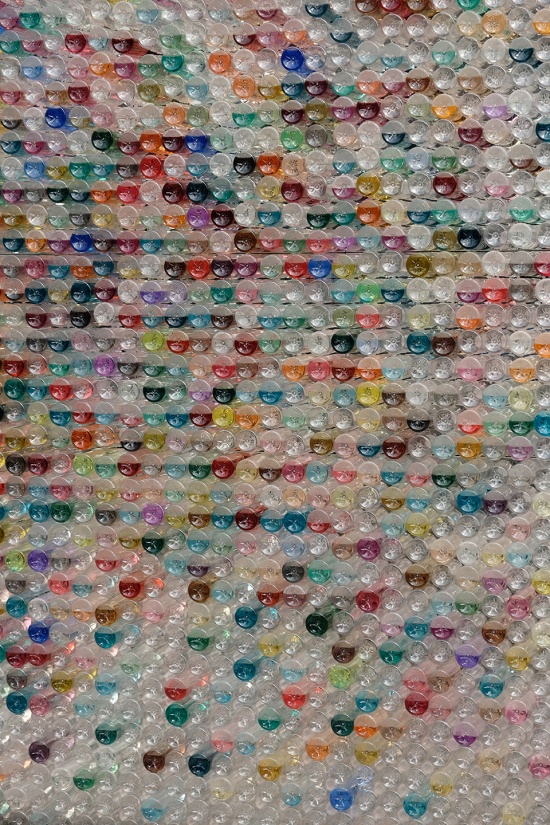
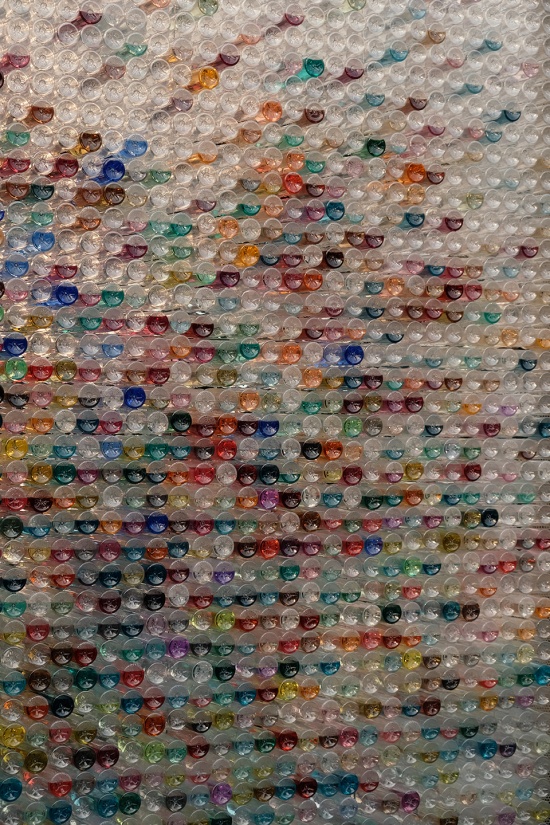
▼装置光影效果近景,Installation Light Effects Close View © 朱小地工作室
因此,《影壁》并非试图在“传统”与“当代”之间建立简单的对照关系,而是将二者置入同一空间机制之中:传统不再作为形式来源,而作为一种关于空间如何被组织的方法;当代材料也不再只是工业产物,而成为可以重新参与空间生产的媒介。五方色在此既非怀旧的装饰,亦非学术的引用,而是一种让色彩回归到身体感知与空间层面的策略。当这样的作品进入胡同,它所面对的不再是一个简单的白盒子空间(White Cube),而是正在不断更新的城市肌理。《影壁》进一步成为一种关于公共空间生成机制的实验。它并不以完成的形态出现,而是在光线、时间与人的经过中持续变化。观众的移动本身成为作品的一部分,观看不再是对对象的确认,而是对空间关系的不断重组。
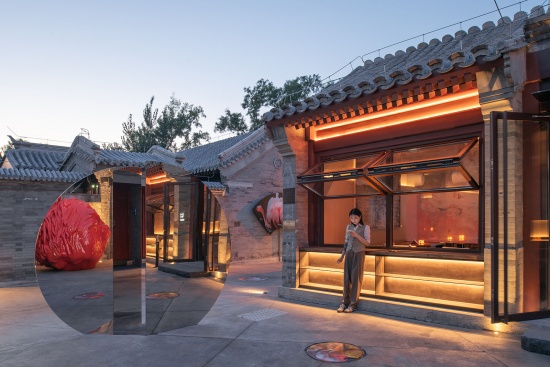
▼井JING 胡同美术馆 · 庭院空间,JINGxHutong Museum · Courtyard Space © 张哲鹏
▼井JING 胡同美术馆 · 咖啡空间,JINGxHutong Museum · Café Space © 张哲鹏
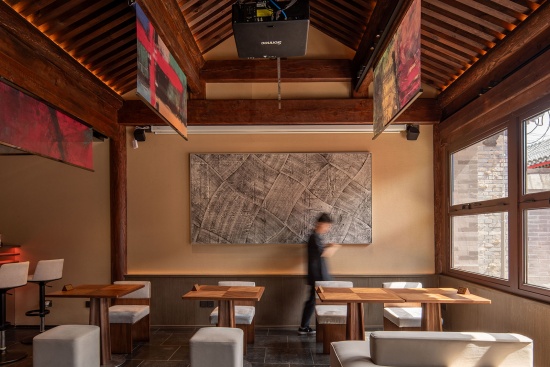
Therefore, Yingbi(screen wall) does not attempt to establish a simple contrast between “tradition” and “the contemporary” . Rather, it places the two within the same spatial mechanism. Tradition does not serve as a source of formulation reference, but becomes a method for thinking about how space can be organized. Contemporary material goes beyond an industrial product, turns into a medium capable of participating again in the production of space. Here, the Five Directional Colors are neither nostalgic decoration nor academic citation; they become a strategy through which color returns to bodily perception and spatial experience. When the work enters the public open space in hutong, it is not limited a neutral white cube, but is adapted into an urban fabric that is constantly being renewed. Yingbi(screen wall) becomes an experiment in the generation of public space. It does not appear as a finished and fixed form, but continues to change through light, time, and the movement of people passing by. The viewer’s movement becomes part of the work itself. Looking is no longer the confirmation of an object, but a continuous reorganization of spatial relations.
▼影壁与老胡同的自然景观相辅相成,Yingbi within the Hutong Landscape © 金燕
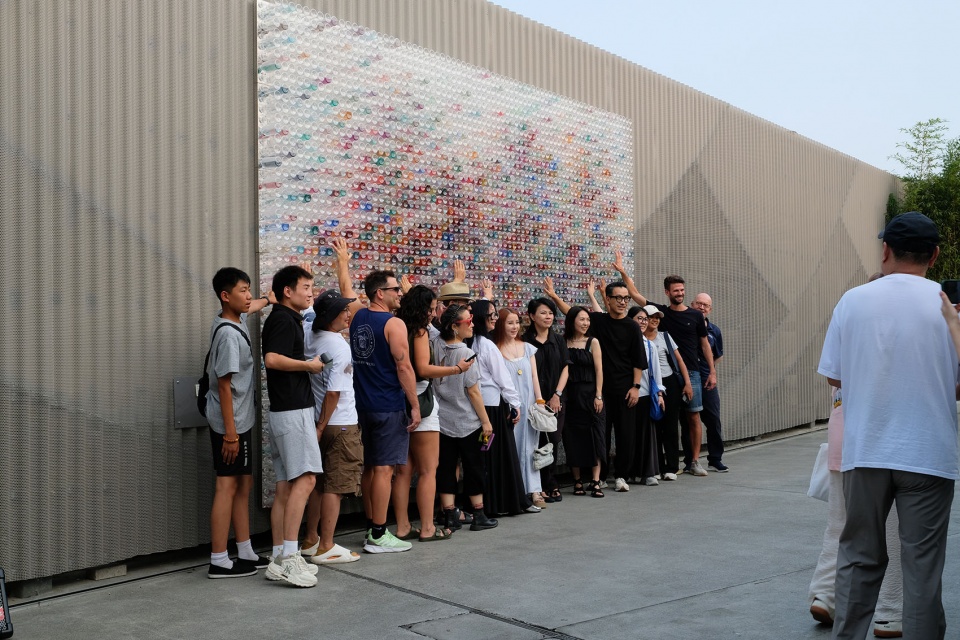
▼外国游客与影壁合影,International Visitors with Yingbi © 朱小地工作室
▼观众凑近观察影壁,Visitors Observing Yingbi Up Close © 朱小地工作室
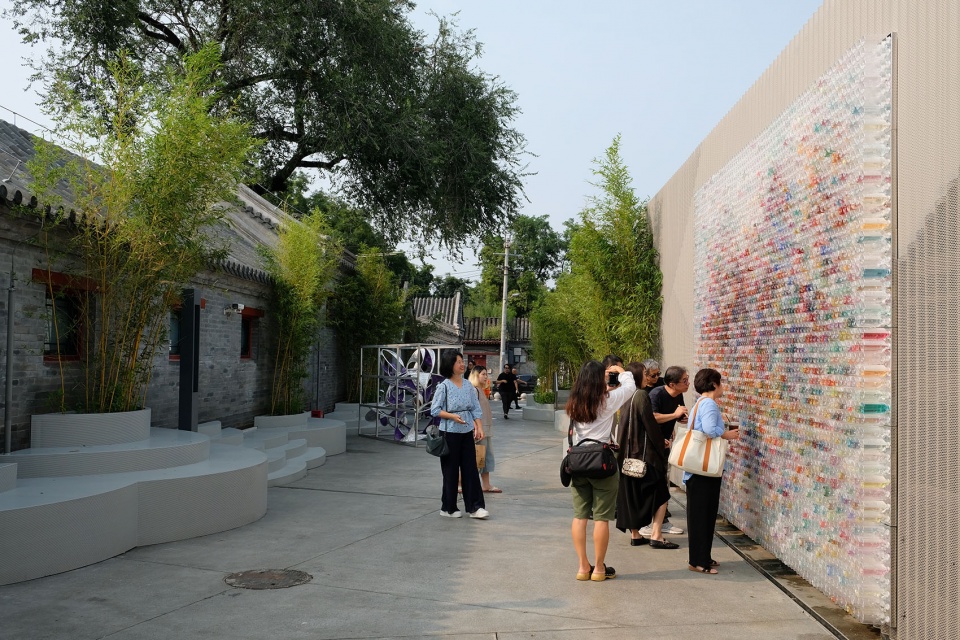
▼观众观察影壁近景,Visitors Observing Yingbi Close View © 朱小地工作室
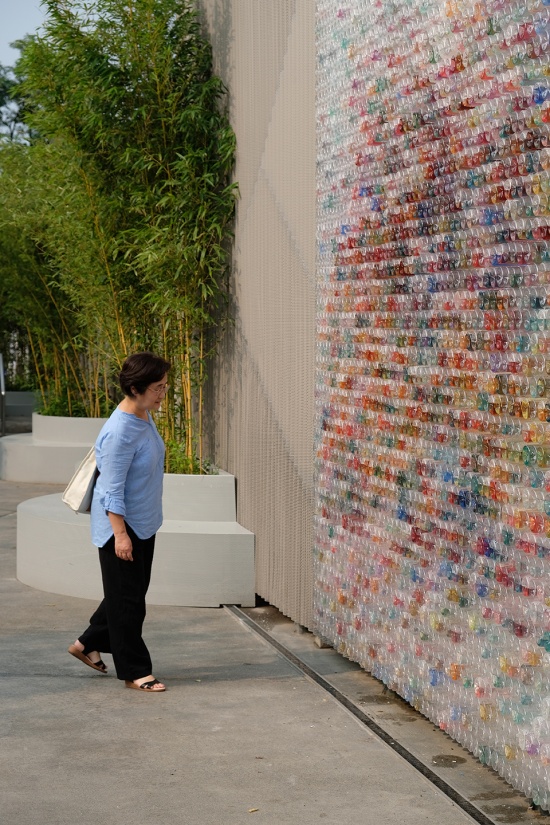
▼观众研究影壁固定方式,Visitors Examining the Installation Method © 朱小地工作室
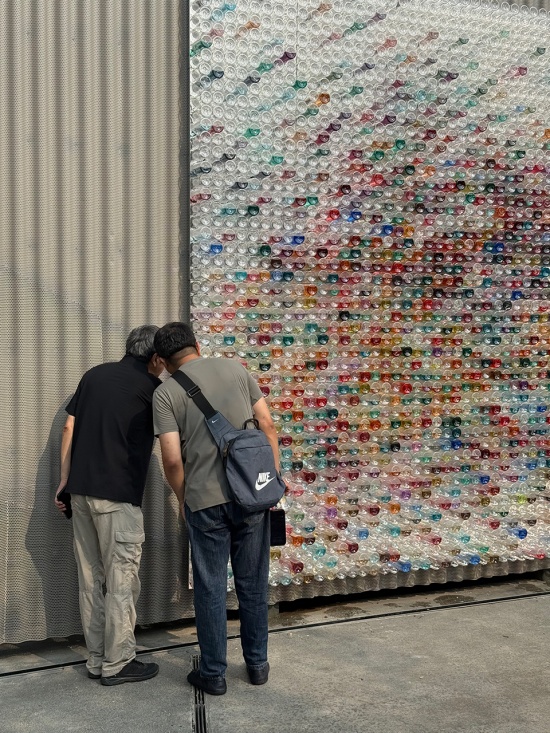
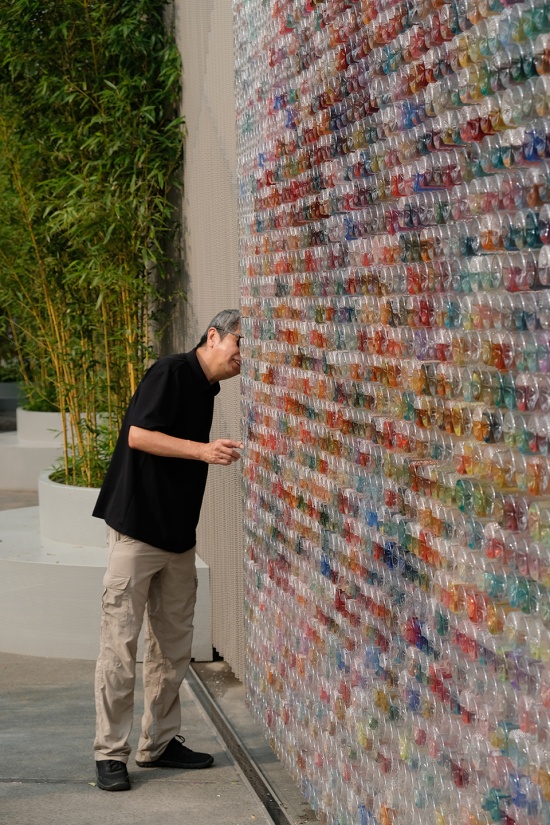
其实这种重组从作品搭建之初便已开始:由于每个水瓶均需手动拧上墙,艺术家邀请每一个路过的人,无论是游客还是胡同居民,亲手参与“拧瓶子”的安装过程。每一次旋转,既是在调整色彩密度,也是在把个人的力度、节奏与观看角度写入墙面之中。由此,《影壁》不再只是被安置在社区中的一件完成品,而是在生成过程中呈现了公共空间被共同改善、共同使用的可能:路人的手势成为作品的一部分,社区的边界也在参与中被重新感知。
▼实验过程:上色,Experiment Process: Coloring © 朱小地工作室
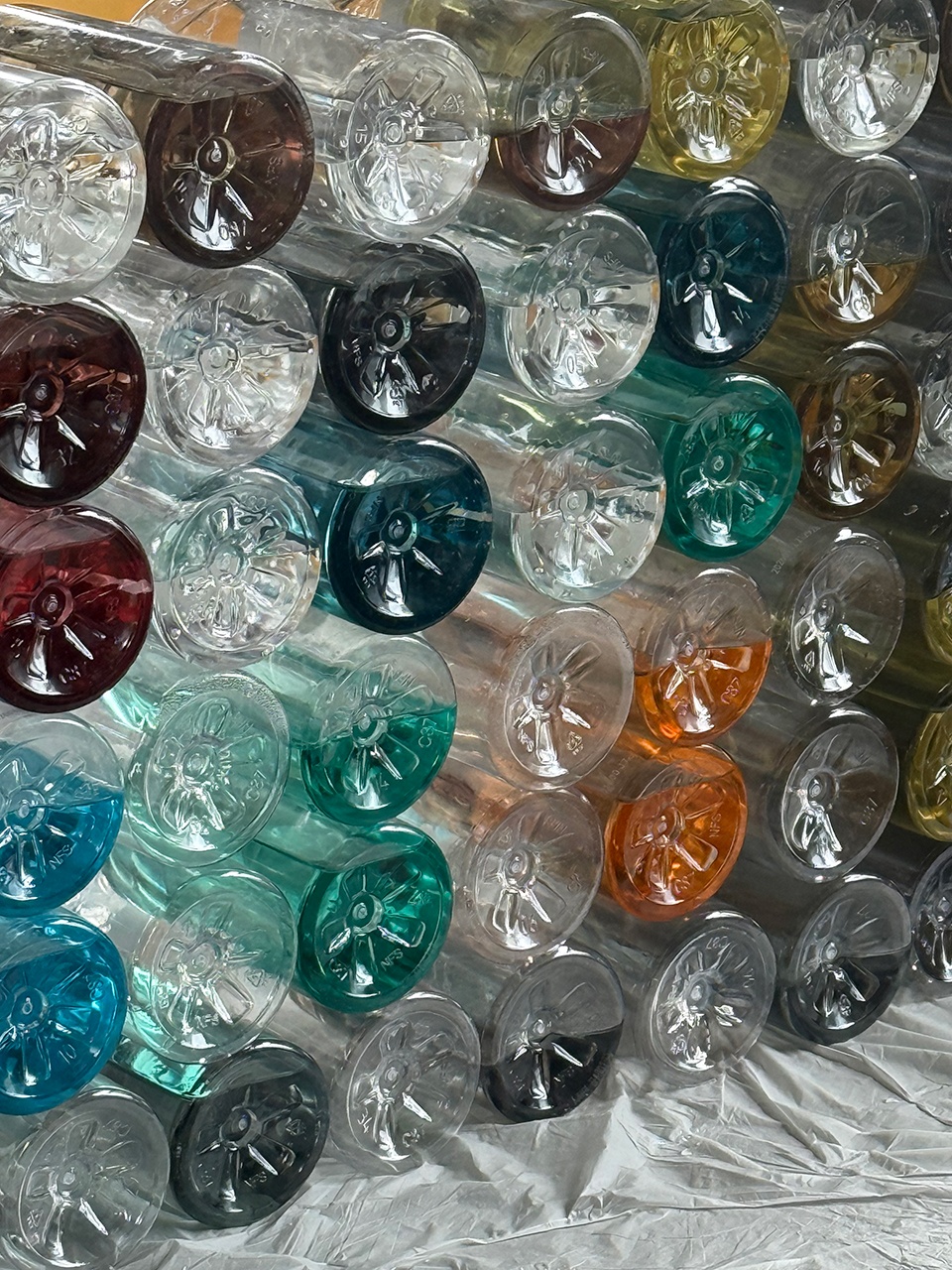
In fact, this process of reorganization began during the installation itself. Since each bottle had to be manually screwed onto the wall, the artist invited passersby, whether visitors or hutong residents, to participate in the process of “assembling the bottles” by hand. Each rotation adjusted the position of color, while also inscribing an individual’s strength, rhythm, and viewing angle into the wall. As a result, Yingbi(screen wall) is more than simply a completed object placed within a community. During its making, it reveals the possibility of public space being collectively improved and collectively used. The gestures of passersby become part of the artwork, while the boundary of the community is newly perceived through participation.
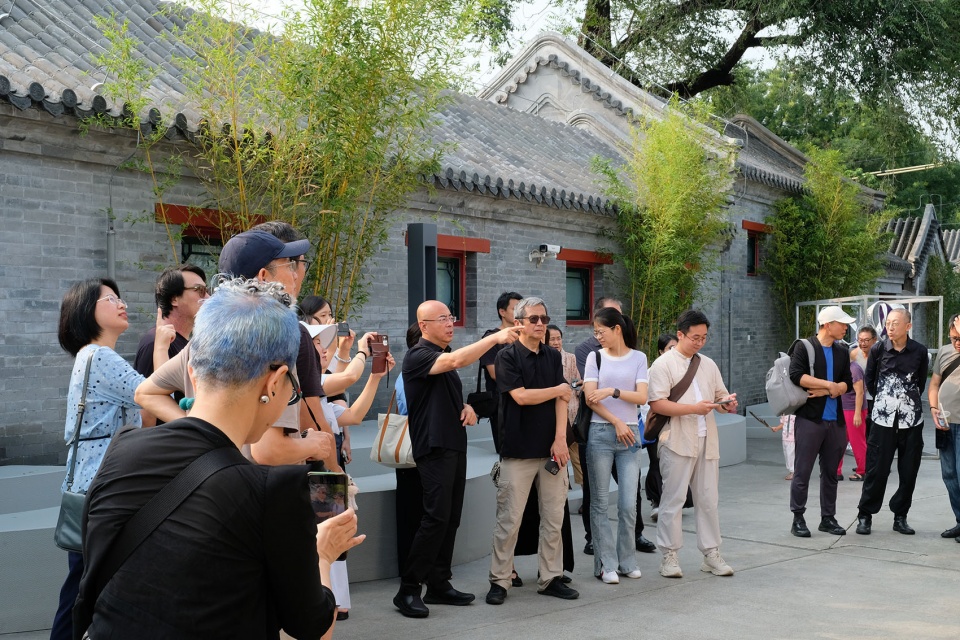
▼艺术家朱小地向嘉宾介绍影壁,Artist Xiaodi Zhu Introducing Yingbi to Guests © 朱小地工作室
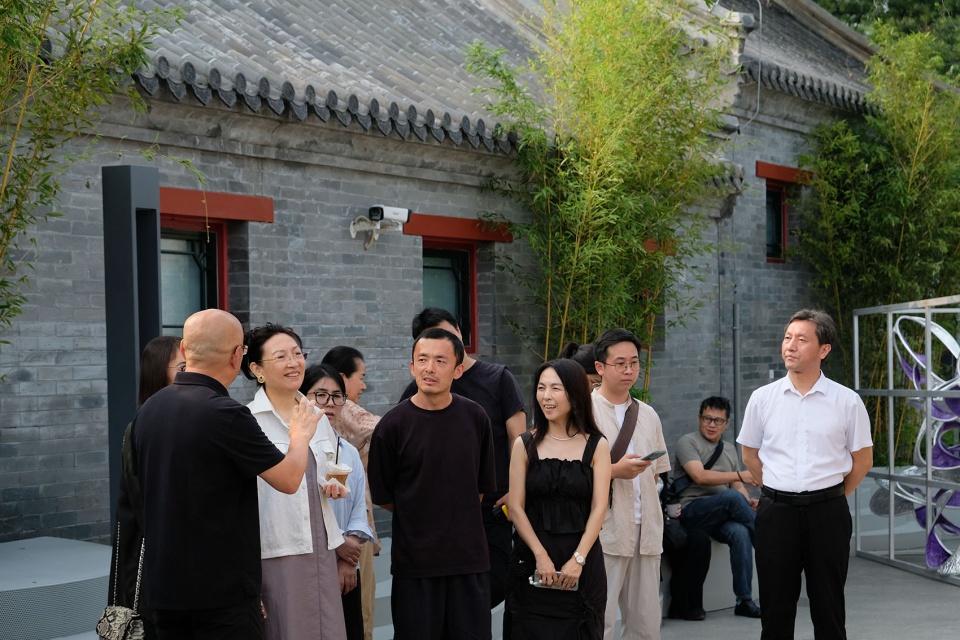
▼艺术家朱小地与嘉宾共同观察影壁,Artist Xiaodi Zhu and Guests Observing Yingbi © 朱小地工作室
▼艺术家朱小地上前检查瓶子,Artist Xiaodi Zhu Checking the Bottles © 朱小地工作室
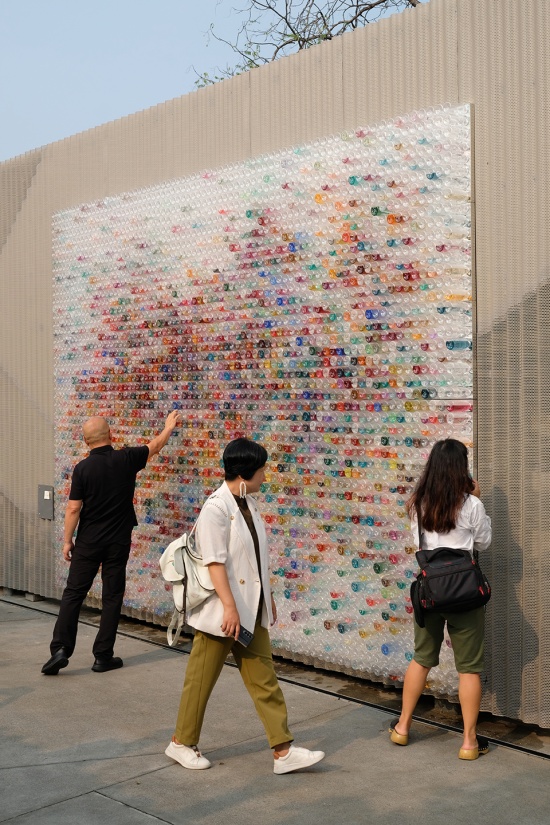
如此可触碰、可介入的过程,进一步拉近了人与艺术之间的距离,消解了传统展览中艺术与公众之间的间隔。艺术不再被放置在日常生活之外,而是在街道、社区与人的身体动作之间发生;《影壁》因此从一面装置墙,转化为一场关于公共参与和社区更新的空间事件。从这一意义上说,《影壁》所讨论的并非“墙”,而是“界面如何成为经验”;并非“材料如何被使用”,而是“物如何进入观看结构”。《影壁》在胡同美术馆的实践,恰好提供了这样一种可能:艺术不必把日常生活隔绝在外,而可以成为社区、街巷与城市记忆之间重新建立联系的一种方式。
This tactile and participatory process further narrows the distance between people and art, dissolving the separation between artwork and public often found in conventional exhibition settings. Art is brought back into the rhythms of everyday life. Instead, it takes place between the street, the community, and bodily action. In this way, Yingbi(screen wall) transforms from an installation wall into a spatial event about public participation and community renewal. In this sense, what Yingbi(screen wall) discusses is not simply “the wall” , but how an interface becomes an experience. It is not merely about how materials are used, but how objects enter a structure of viewing. The practice of Yingbi(screen wall) at JINGxHutong Museum offers one possible answer: art does not have to separate itself from everyday life. It can become a way of rebuilding connections among community, street, and urban memory.
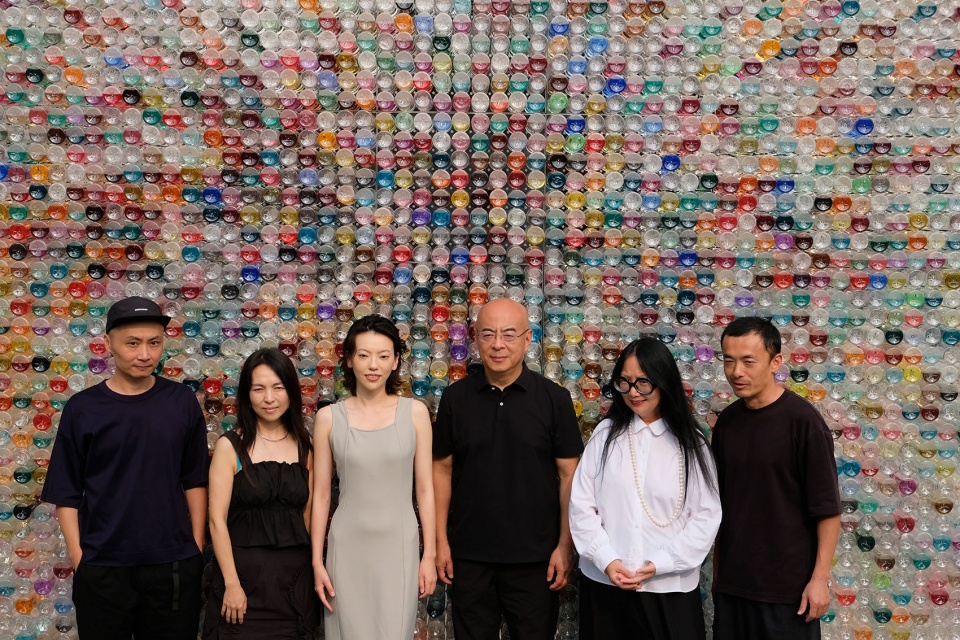
▼艺术家朱小地、贾靖、王成普与胡同美术馆馆长娄西、策展人棉布、王星予合影,
Xiaodi Zhu, Jia Jing, Wang Chengpu, Lou Xi, Mianbu and Wang Xingyu © 朱小地工作室
创作团队:朱小地、黎玥含、朱亦萱、王兴华、赵广华
特别鸣谢:潘少东、胡芳、邱泽湖、孙江平、卢振新、石林、李春峰、棉布、娄西
项目名称:影壁
设计方:朱小地工作室
公司网站:https://www.zxdarchitects.com/zh
联系邮箱:zxdarchitects@zxdarchitects.com
项目设计 & 完成年份:2026年7月~8月
主创及设计团队:朱小地工作室
项目地址:北京三眼井胡同,井JING胡同美术馆
建筑面积:15.84㎡
品牌:回收矿泉水瓶,镜面不锈钢板,高分子色精,LED光源
Creative Team: Xiaodi ZHU, Yuehan LI, Yixuan ZHU, Xinghua WANG, Guanghua ZHAO
Special Thanks: Shaodong PAN, Fang HU, Zehu QIU, Jiangping SUN, Zhenxin LU, Lin SHI, Chunfeng LI, Mianbu, Lou XI
Project name:Screen wall
Design:ZXD Architects
Website:https://www.zxdarchitects.com/zh
Contact e-mail:zxdarchitects@zxdarchitects.com
Design year & Completion Year:From July to August, 2026
Leader designer & Team:ZXD Architects
Project location:Beijing, JINGxArt museum
Gross Built Area (square meters):15.84㎡
Brands / Products used in the project:Recycled plastic bottles, colored liquid, LED lights
More: 朱小地工作室。更多关于:ZXD ARCHITECTS on gooood


想去看展