非常感谢 Tony Orrico 将英文介绍和项目图片授权gooood发行。更多请至:Tony Orrico on gooood
Appreciation towards Tony Orricofor providing the following description:
淋漓尽致,以舞生画,笔歌墨欢。
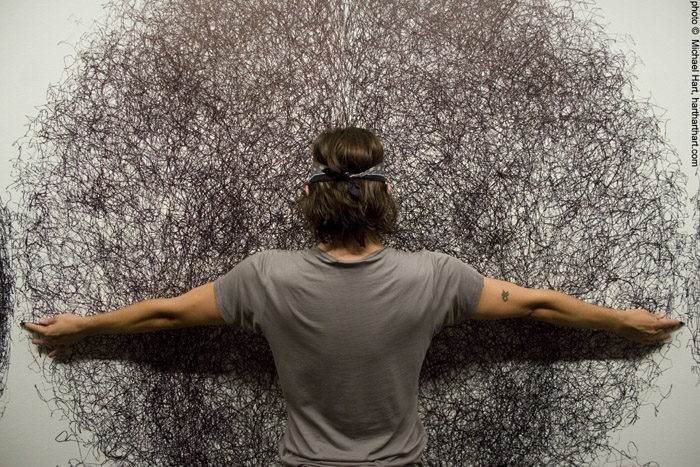
这无疑是让人过目不忘的艺术创作,在纸前挥动双臂,或匍匐或站立,可静止可旋转,即成一幅幅精妙绝伦的对称画作,速度之快,让人眼花缭乱,结果之趣,让人叹为观止。还等什么,赶紧点击链接看video视频。
YouTube video 1
YouTube video 2
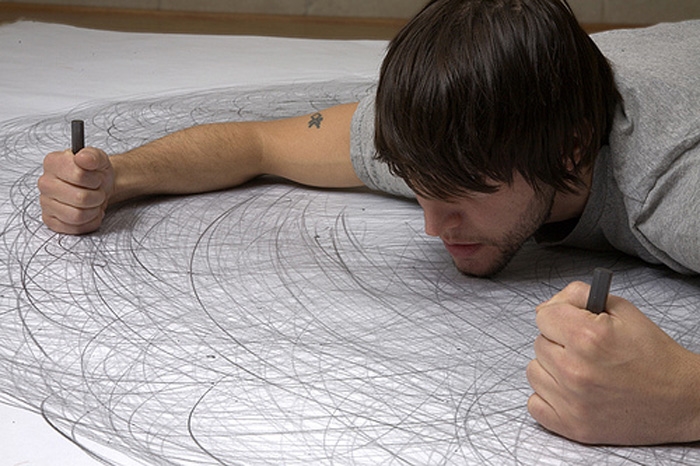
Tony Orrico就是达芬奇的维特鲁威人的现代版。从手臂的舞动中幻化出数不清的繁复黑线。双臂伸展,画出对称的图像,画作的轨迹不同让手臂呈现不同的舞姿,当Tony Orrico停止时,他张开手臂的姿势宛如一只自由翱翔的鸟。Tony Orrico前段时间在现场表演了让观众记忆犹新的以舞生画之创作。
Tony Orrico生于1979年,是一位与舞蹈艺术密切相关的年轻艺术家。
Tony Orrico说:
1 我的爷爷是画家,他94岁高龄同时患有老年痴呆。当我很小的时候,他就教我画花,持续几个星期,不断的,激烈的画。虽然我要他画花,但他实际画的是山。爷爷是我生命中的第一个艺术家,之后我在父母留下的工作间里面像我的爷爷那样去创作。
2 我在芝加哥长大,在纽约生活了8年,最近我搬到LA的West Branch。街道只有一侧有房屋,邻居们满头白发,视野外是安静的大豆和玉米田。这里的时间和空间都能让我专注的创作。但是我想念纽约。
3 我有自己的一套即兴运动画作方式,我的对称性和本能感在其中得到释放。我对这个过程中的创作和表演很着迷。工作的这一套进程是一个完整的体系。同时在视觉感官和观众之间建立起交流。充满感性和想象的氛围。
4 虽然我专注于视觉实践,但是我暗暗希望我能唱歌还有玩乐器。我期望更为自由和拓展,通过音乐和节奏让人们的体验得到满足。
Tony Orrico并没有刻意去挑战艺术形式,他只是从他的思想起源进行创新。这一潜力一直没有被激发,直到在大学学习了舞蹈后,舞蹈与绘画交融在一起。Tony Orrico淋漓尽致的组织着这些自由,清晰的线条。他用自己的方式理解着空间和时间,并以自我为媒介向外展示,独特无法无视,一位真正的艺术家。
更多信息请参见下方英文,艺术家提供了两篇文章,一篇评论和一篇访谈。
Drawn Into His Web
By ROBERT GRESKOVIC
New York
The casually lettered sign on the sidewalk in front of Dance Theater Workshop says “Live Drawing Tonight 5–9 p.m.” Passersby shouldn’t take this to mean a lottery of any sort.
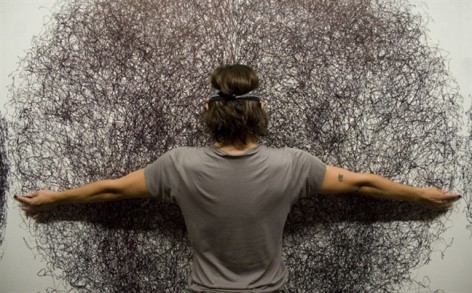
Behind the glass front of the theater’s lobby, they’ll find something far more unusual and intriguingly artful. Think, perhaps, of Leonardo da Vinci’s Vitruvian Man in contemporary, casual clothing, seen from the back, extending his arms in the act of conjuring a vaporous circle out of continuously scrawling black lines.
To kick off its current fall season, DTW is presenting visual artist and performer Tony Orrico, working in a series of on-site drawing sessions that he calls “Penwald Drawings.” “Penwald: 4: unison symmetry standing” began on Tuesday and is planned for four uninterrupted hours on three consecutive evenings. To date, this is the longest sustained time Mr. Orrico has devoted to drawing.
For an organization that prides itself on stressing the contemporary and experimental in the performing arts, DTW’s choice of Mr. Orrico’s edgy work, somewhere between movement theater and visual-art making, is apt. Situated on the edge of DTW’s actual theater area—the gallery wall marks the border between the lobby and theater space—his “live drawing” event amounts to an installation and performance.
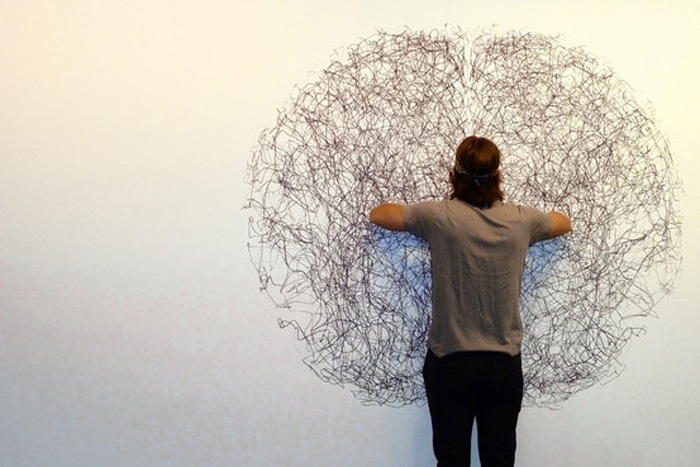
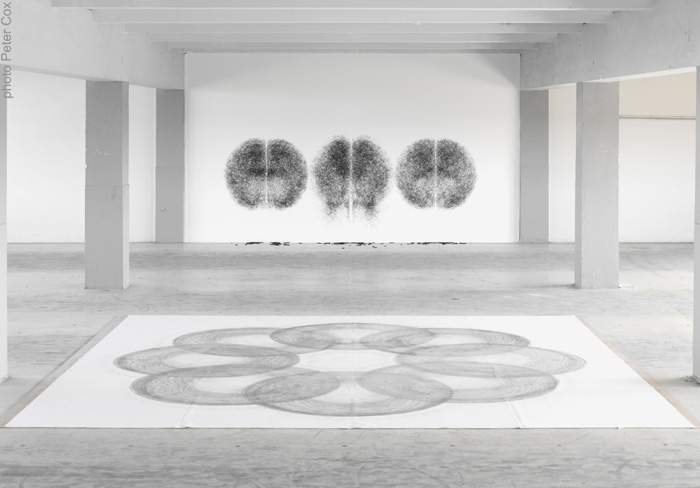
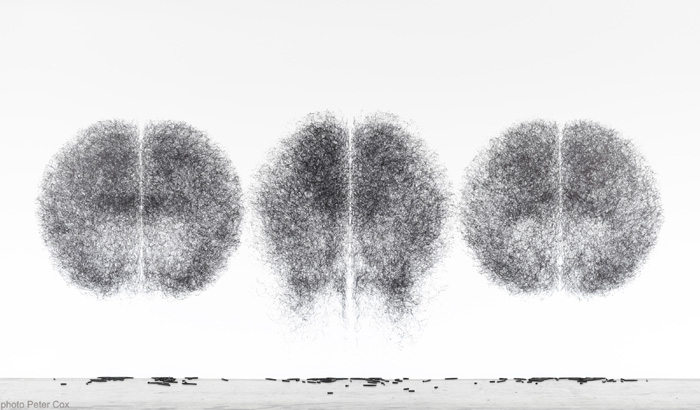
What you’ll see at the free event is Mr. Orrico, neatly dressed in gray and black, almost meditatively facing the space’s pristine, white wall. Depending on the point at which you observe what is happening, you’ll either find the Illinois-born 31-year-old inscribing a delicate mesh of fine black lines—I was partly put in mind of foliage-like configurations reminiscent of Ellsworth Kelly— or you’ll observe a dense build-up of overlapping lines, suggesting a thickening web or bubble of blacks and grays that tell of sooty smoke or charred membranes. The lines at the perimeter appear like animated solar eruptions captured by high- powered telescopes.
Similar to Leonardo’s iconic, classically proportioned Vitruvian Man—with his arms outstretched to each side, drawn in duplicate to suggest motion—Mr. Orrico works symmetrically from a central, vertical axis. When you pause to study his activity in his fixed stance, you note that his center-parted hair, spine and straight, parallel legs define a kind of stem to his constantly moving arms. Eventually the amassed array of angling, discursive and moving lines define what might be two halves of an intricately crimped brain or the tangled filaments of a dandelion seed head.
Casual ambient sounds give Mr. Orrico’s drawing performance extra dimensions. When, at the start, he removes the tops from the felt-tipped pens that are his chosen implement and lets the caps clatter to the floor, they sound like discarded shell casings from, say, plastic bullets. And as he wears out a succession of these markers, one hears sounds related to their function. When they are fresh with ink, they pass over the wall slickly, almost caressingly.
Eventually, as they get depleted, Mr. Orrico tends to press them harder and harder onto the wall, where they variously squeak and scrape their lines in place.
For body language, Mr. Orrico—who has danced with Shen Wei Dance Arts and with the Trisha Brown Dance Company—displays moves that express different characteristics of his varied line-making. While remaining in his stationary position, he can seem free as a bird, extending his arms like outstretched wings. He can also suggest an almost demonic intensity, his elbows, shoulder blades and tightly gripping fingers seeming to grind their joints, as if he is aiming to dig his lines deeply into the wall’s surface.
For those unable to take in this project on site, DTW provides a live-stream webcast that documents the full four hours of each session (www.ustream.tv/channel/dance-theater-workshop). A somewhat edited version of the individual days’ footage will remain on the site. Once all three drawings are in place on the lobby’s wall, they’ll be displayed there through the winter.
Mr. Orrico will also return to New York after traveling for a stint in the Netherlands to create a similar project. Back at Dance Theater Workshop, there will be a special reception on Nov. 4, when he will create another kind of “Penwald,” one he calls “circle on knees” and is done in graphite on paper. It sounds softer and more restful in character, but its creation will likely be just as fascinating to ponder as Mr. Orrico’s standing, indelible ink efforts.
Mr. Greskovic writes about dance for the Journal.
- 1979, Hinsdale, IL. Orrico is working within a series of bilateral contour drawingstitled Penwald Drawings. His work has recently been collected by the National Academy ofSciences in Washington D.C. and commissioned by Flux/S at Strijp-S in Eindhoven, Netherlands and Dance Theater Workshop in New York City. Orrico is currently creating a visual design for choreographer John Jasperse’s Canyon, to premiere at the Brooklyn Academy of Music (September, 2011). A solo exhibition of his Penwald Drawings will take place at Shoshana Wayne Gallery in Santa Monica, CA (May, 2011). Orrico is a former member of Trisha Brown Dance Company (06-09) and Shen Wei Dance Arts (03-06), and he was a Re-performer in Marina Abramovic’s retrospective at the Museum of Modern Art in New York City last Spring.
T.O.: Four things:1. My grandfather is a painter. He is 94 and living with Alzheimer’s. He taught me how to paint flowers when I was very young, and a few weeks ago we painted together (for only the second time in our lives). He kept asking me what we were painting but he never calmed his brush activity. I just kept telling him flowers, and he painted mountains. He is my first model of an artist in my life. My parents set aside studio space for me after that moment, and I began a dedicated practice, just as my grandfather had.
- I grew up in Chicago. I’ve lived in New York City for 8 years, but I recently moved toWest Branch, IA. There are only a hand full of houses on the street, most of my neighborsare white haired and completely generous, and there are quiet soy and corn fields in every direction. It’s time for me to focus on my creativity and have unrestricted amounts of space and time. I do miss New York.
- I have my own somatic techniques that I use in both movement improvisation and mydrawings; they activate my sense of symmetry and proprioception. I am interested in workingwith this level of awareness during process, creation and performance. It is my belief that the refinement of a completed work comes from the integrity of the performed process. I work to maintain clarity in my intention, focus and sustain. This can also amplify the exchange of energy between the visual experience and the audience. There is a vicariousness in the air, shared sensitivity and imagination.
- Although I am versed in many visual practices, I secretly wish I could sing and playmusical instruments. I imagine the freedom and range to express your experiences or ideasthrough voice and rhythm would be so satisfying.
By reading texts and watching videos at the web, I can see at your work that there is a concern in how visual arts and dance can dialogue. The Penwald series is an example of how to find an common space where these “disciplines” can interact… I use very poor words to explain this (disciplines, interact, dialogue…) Would you be able to explain a little bit how this works in your head and your work?
I am not attempting to challenge or fuse these art forms. Creating has always been a necessity for me, and the origin of my ideas seem to stem from what I can only describe as a way of seeing that comes before doing. I did not begin dancing until college, and my approach has always been informed by my practices of painting and drawing. My ability to both improvise freely and produce clean lines, shapes, and qualities seemed intrinsic, but I attribute most of my progress to my sense of time, space, and composition that was all ready in development. The modality of how I desire to investigate and actualize my ideas is becoming less concerning to me. I grant myself the flexibility of wavering between mediums and gradations of existing forms. What is in common here, would be how I see and interpret space, what I would deem true for any artist. We have a unique and inescapable existence (with heaps of influences, aversions, attractions, etc) that determine our creative perception. I am inventing possibilities by limiting conditions that involve my body, a plane, and the trace of the experience.
Will you tell us something about works like “Importal” and “Raised Relief”, from 2008. I think there is a work with the matter and the landscape that has also a relation with the painting…
I developed a practice during this period, documenting solos through a technique I callreciting space. It could be understood as transcribing the architecture of my surroundings while following detours into internal landscapes. I was also managing layers of awareness, considering compositional elements along side the abandon, weaving and following instantaneously. I began making these videos during my last year of touring with Trisha Brown. They are slightly egocentric, I’d say. The gaze was at myself. What choices might I make while surviving course? How do I look when I am believing me? Where was my curiosity hiding? What comes after a trained body?
I read in a critique publlish at the Ballet-dance Magazine, linked in your web, this about Penwald: This performance probably did not appear on DC dance calendars because it was classified as “performance art” rather than dance, and it was organized by CulturalPrograms of the National Academy of Sciences. Their programming explores relationships among the arts and sciences, engineering, and medicine, and their performances are free to the public How the works that have a hybrid format are understood in NY? Are there real problems for them to be exhibited and understood? Do you have spaces to work and show which understands an protect this kind of works?
I have not encountered any real criticisms about my work or how I am organizing it. I am aware of the different ways to categorize my drawings and the difficulty is exciting. I really consider the synergy of each component to what I am presenting/yielding in a sense that I want the resonance of the sum to shadow the act of differentiating the parts. I trust there is enough challenge in the arena here all ready, and that I will not feel obliged to defend my place in it. Rather, I can cash my jealousies of other fruitful generations in, and have gratitude to be living amongst discussions concerning art, performance, exhibition, presentation, collection and preservation.
Last one, difficult one: It seems there is a movement in NY: Faye Driscoll Dance Group, Jack Ferver… Do you feel yourself, in an artistic sense, accompained or instead alone? wuold you try to describe a little bit the scene in NY wich you are interested in (if there is one)?
I worked with Faye and Jack on some projects in the past few years. I was interested in work that would scramble my previous experiences and really challenge me as a performer. I wanted to release anxieties I had surrounding my throat and voice, and both of these choreographers work with intense language, action, and characterization. My visual work seems separate from these experiences, yet I do not feel isolated by choice nor circumstance, especially not living in New York City. I am just distinct with my energies- what is community, what is education, what is exercise, what is work, what is creation, what is play… and I seek out opportunities that provide contrast. I wouldn’t dare describe the creative scene in New York City. Although the circles are mostly intertwined or degrees removed, I am always humbled when I cross paths with a fellow artist or performer who is living and breathing in a whole other genre of art making than I understand for myself. I do not sense that I am a member of any current movements/agendas/trends, and not by pride, but because my visual work is introspective.
MORE: Tony Orrico YouTube video 1 YouTube video 2,更多请至:Tony Orrico on gooood








下次也尝试一下这样作画看看效果
同感