来自 COLLECTIVE HABITAT 对gooood的分享。
Appreciation towards COLLECTIVE HABITAT for providing the following description:
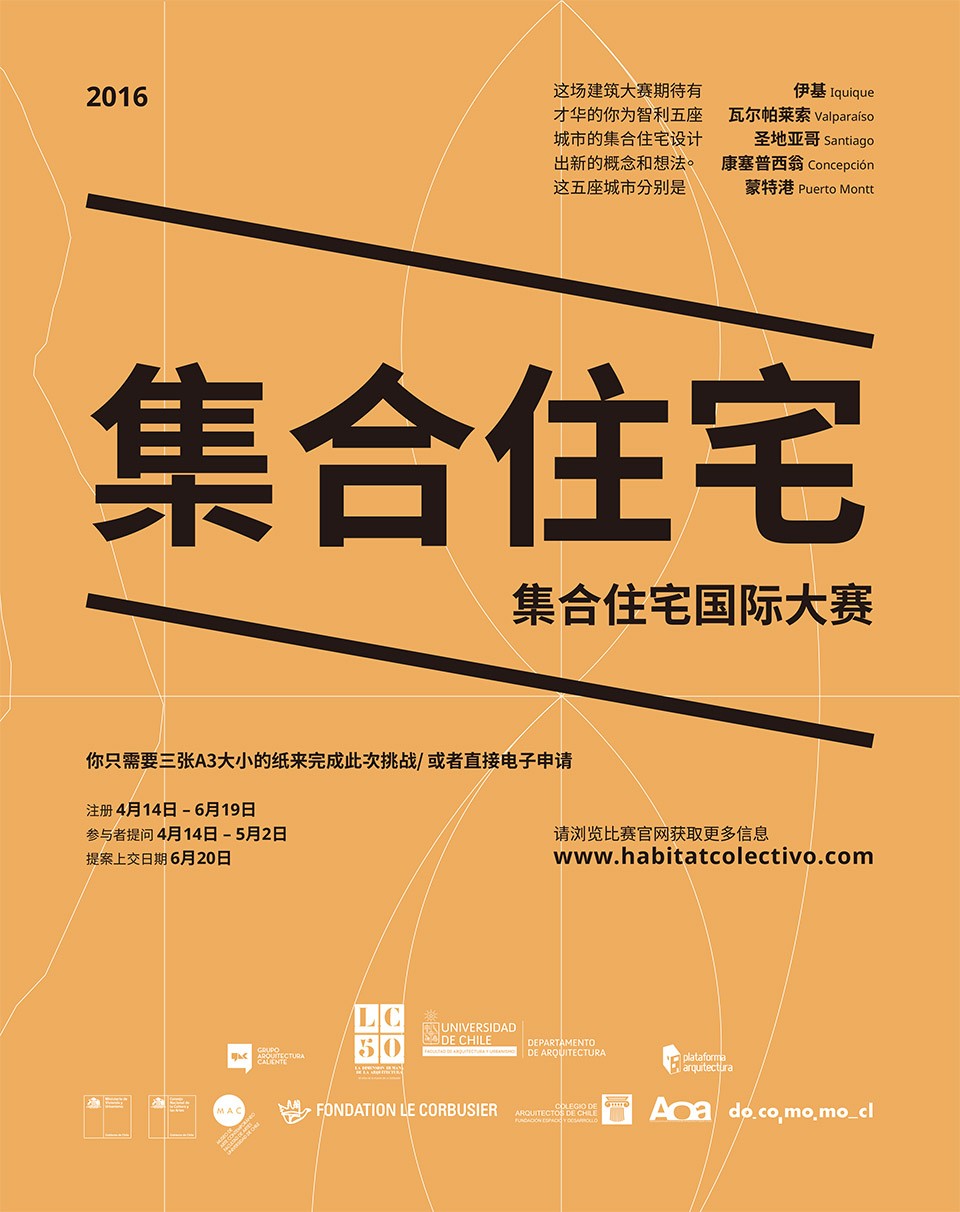
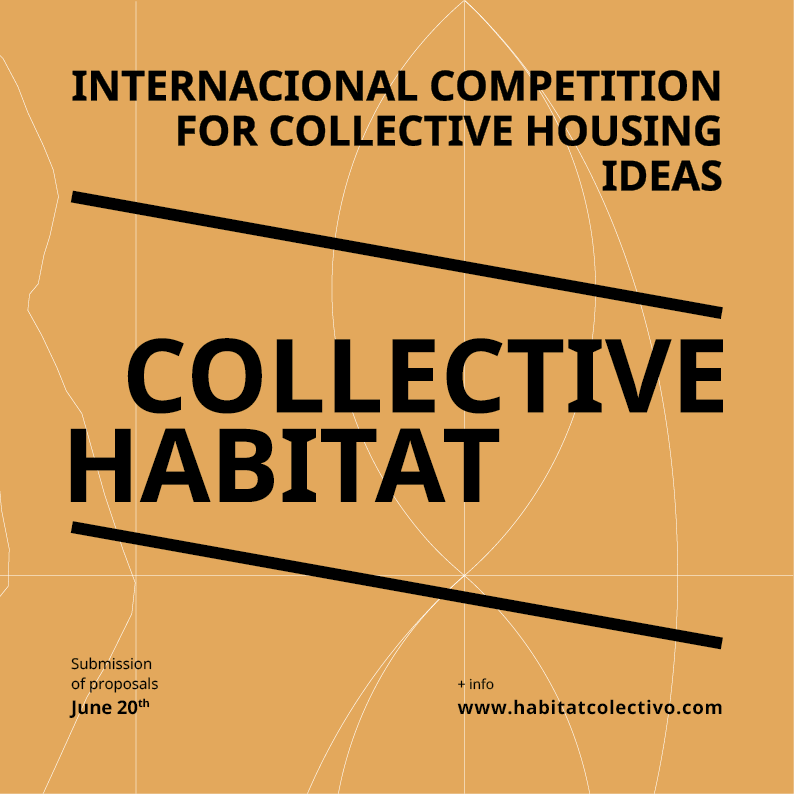
智利大学举办的国际竞赛,6月20报名提交截止,更多请看英文信息。
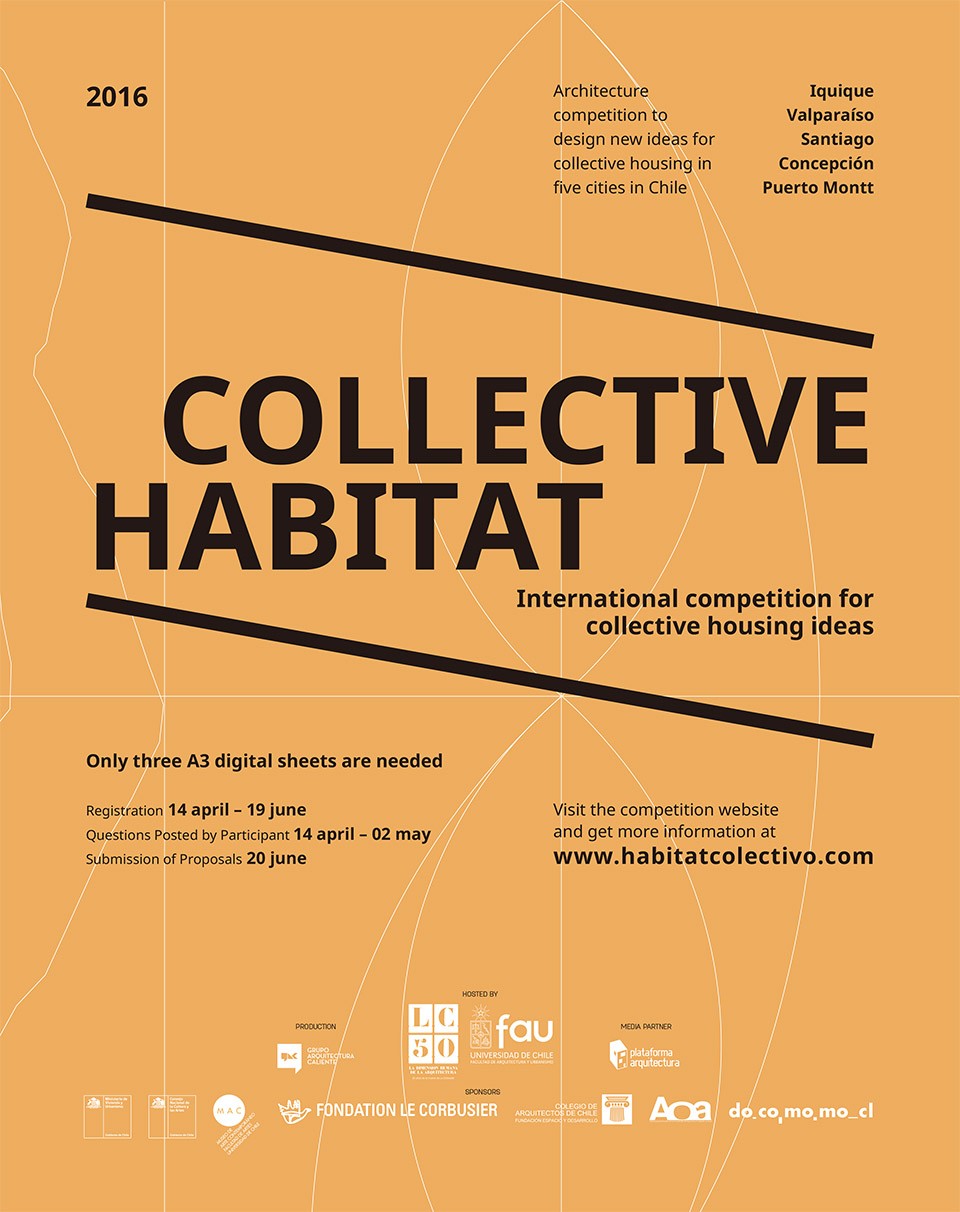
The international competition COLLECTIVE HABITAT seeks to produce ideas to densify areas in or near the centers of 5 Chilean cities with collective housing. The goal is collect innovative architecture proposals that offer access to housing for middle and lower class families in well-served urban areas of Iquique, Valparaíso, Santiago, Concepción or Puerto Montt.
The competition is open to students and professionals of architecture or related disciplines, without limits to age, nationality nor country of residence.
To take part in the competition participants have to present a collective housing proposal for one of the five cities in this competition sending a project summary of 200 words plus three A3 digital sheets.
The winner will receive a two week tour to the Netherlands, Belgium and The Venice Biennale 2016. In addition the best 50 projects will be recognized in a book of the competition results and an exhibition at the Contemporary Arts Museum of Santiago (MAC).
Participants must register themselves until June 19th by paying the competition fee (25 USD through the Pay Pal system) and filling out the registration form at the competition web site. Submission of proposals until June 20th. Get more information at www.habitatcolectivo.com
BRIEF
1 PRESENTATION
The competition seeks to produce ideas to densify areas in or near the centers of 5 Chilean cities with collective housing.
The goal is collect innovative architecture proposals that offer access to housing for middle and lower class families in well-served urban areas of Iquique, Valparaíso, Santiago, Concepción and Puerto Montt.
The competition aims to have an impact on future designs of public policies to densify central areas.
1.1 Organization
The competition is hosted by the Department of Architecture of the University of Chile and it is part of LC50: The Human Dimension of Architecture, a series of activities which commemorates the 50th anniversary of Le Corbusier death.
The competition has been organized by Grupo Arquitectura Caliente with the help of sponsorship from the Ministry of Housing and Urbanism (MINVU), the National Council of Culture and Arts (CNCA), the Fondation Le Corbusier, the Contemporary Arts Museum of Santiago (MAC), the Architects Association of Chile, the Architects Offices Association of Chile (AOA), Docomomo Chile, and Plataforma Arquitectura and ArchDaily as media partner.
Director
The architect Humberto Eliash leads the competition and will coordinate the procedures established in these briefs and the organization of the jury. He is also responsible for responding to participants’ questions and communicating them to the jury.
During the evaluation process the director will guarantee participants’ anonymity participating as well as a jury.
Executive Director
The architect Juan Pablo Urrutia is responsible for coordinating all the procedures established in these briefs alongside the director. He also will ensure the correct procedures in the registration and proposal reception processes. The Executive Director will be the curator of the subsequent exhibition and editor of the book of competition results.
1.2 Jury
The jury comprises 11 notable professionals: The competition Director who will chair the jury; The Ministry of Housing and Urbanism, The President of The Architects Association of Chile, The President of AOA, a National Architecture Award, and 6 representatives from cities considered in this competition.
The list below:
Humberto Eliash Competition Director
Paulina Saball Ministry of Housing and Urbanism
Teodoro Fernández National Architecture Award 2015 (Chile)
Pilar Urrejola President of Architects Association of Chile
Pablo Larraín President of Architects Offices Association of Chile
Vespa Obilinovic Professor of Arturo Prat University
Gonzalo Undurraga President Plan Cerro
Alberto Fernández Head of Architecture Career of University of Chile
Emilio de la Cerda Director of Architecture School of Catholic University of Chile
Giuliano Pastorelli Professor of University of Bío-Bío
Drago Vodanovic Director of Architecture School of San Sebastian University at Puerto Montt
1.3 Participants
The competition is open to students and professionals of architecture or related disciplines, without limits to age, nationality nor country of residence.
Group proposals are permitted provided that one member of the group is nominated as responsible for representing the group.
Those involved in the organization of the competition are prohibited from participating, as are individuals who are direct relatives to them or the jury.
Those who do not meet the conditions established in this brief will be declared as unacceptable proposals.
1.4 Prizes
Winner
Two week tour to the Netherlands, Belgium and The Venice Biennale 2016 for one person. This travel is organized by the AOA every year and includes visits to highlight buildings, museums, and notable architecture companies among other related activities.
Also the winner project will be published in several magazines and digital media associated the competition as Plataforma Arquitectura.
50 best proposals
The best 50 projects will be recognized in a book of the competition results and an exhibition with projects and interviews with the designers at the Contemporary Arts Museum of Santiago (MAC).
Authors of the 50 best proposals also will receive the competition book and an official selection certificate.
1.5 Publishing and Information Use
The organization is free to disseminate proposals once the competition results are published. Each project will be properly cited.
1.6 Anonymity
Proposals will be anonymous throughout the process until results are published.
All information provided by participants will be free of signatures, names, or marks that facilitate recognition of the authors.
The only way to identify authors will be through the code delivered by the organization to each participant just after the subscription to the competition as outlined in section 2.3 of this document.
1.7 Acceptance of the Brief
Participation in the competition implies acceptance of all conditions in these document without the need for explicit declaration.
1.8 Disquali cation
Participants will be disquali ed if their projects include information which allows identification of the project’s authors, if false information is presented, if deadlines are not met, and if projects do not meet the formats established in these briefs.
1.9 Schedule 2016
14 April Registration opens
02 May Close to questions posted by participants
09 May Publication of answers to questions
19 June Close of registration
20 June Deadline for submission of proposals
25 July Publication of competition results
2 TECHNICAL BRIEFS
2.1 General considerations
Proposals must be collective housing projects for middle and lower class families; they also could incorporate additional uses if the participant wants.
There is no restriction in scale or materials, or location except to be located in one of the 5 cities in this competition (Iquique, Valparaíso, Santiago, Concepción or Puerto Montt) in or near to the center of the city.
Participants can develop the site they want for their projects.
2.2 Registration
Participants must register themselves at www.habitatcolectivo.com between April 14th and June 19th 2016 by paying the competition fee and filling out the registration form.
The registration fee is $25 USD per proposal presented.
That fee must be paid by credit or debit card only through the Pay Pal system in www.habitatcolectivo.com
The participant or team leader will receive a confirmation e-mail with an identification code provided by the organization within 48 hours of submitting their registration.
2.3 Project Presentation
After registration and receiving the identi cation code the participant must:
a) Send a project summary with a maximum of 200 words in .doc or .docx formats to the email address outlined in section 2.4 (Eg.123.doc, 123.docx)
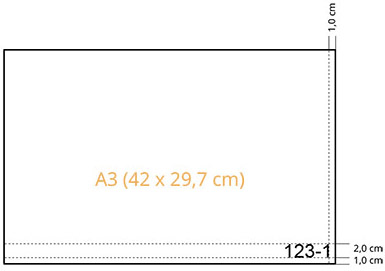
b) Send three A3 (horizontal) digital sheets in PDF with 300dpi resolution to the email address outlined in section 2.4. Each sheet must indicate the identification code and the sheet number (Eg. 123-1.pdf, 123-2.pdf, 123-3.pdf) in Arial font (no Italic no bold), as it is show:
All information must be presented in Spanish or English only.
2.4 Project submission
The project summary and the three sheets must be sent in a zip file named with the identification code only (Eg. 123.zip). This file must be no larger than 25MB and it must be sent by e-mail to concurso@habitatcolectivo.com before June 20th 2016 at 23:59 Santiago de Chile Time.
2.5 Questions and Answers
Participants are allowed to enquire about any doubts related to this document. Questions should be sent via e-mail to preguntas@habitatcolectivo.com from April 14th to May 2nd 2016 at 23:59 Santiago de Chile time.
Answers to these questions will be published on May 9th 2016 at www.habitatcolectivo.com and they will be part of the competition record.
The names of the authors of the questions will not be published.
2.6 Summary of participation steps
1. Download competition brief at www.habitatcolectivo.com from April 14th 2016.
2. Pay registration and ll out registration form at www.habitatcolectivo.com from April 14th until June 19th 2016.
3. Send questions to preguntas@habitatcolectivo.com from April 14th until May 2nd 2016.
4. Check answers at www.habitatcolectivo.com from May 9th 2016.
5. Send the project (Summary + 3 PDF sheets) to concurso@habitatcolectivo.com before June 20th 2016 at 23:59 Santiago de Chile time.
6. Results release July 25th 2016.
Competition brief answers
Below are publicly the answers to questions received between April 14th and May 2nd 2016. Please note that these answers have been provided to all participants and teams.
The original questions have been edited to facilitate understanding and to ensure the anonymity of the authors.
Please note that all the answers given in this document form part of the original competition brief and should be read in conjunction with the original brief.
1 Please explain how the concept of collective housing is understood in this competition?
As the brief says “The competition aims to have an impact on future designs of public policies to densify central areas”, the participant or team is free to present any kind of grouping of houses. In this sense, the concept of collective housing should be de ned by each participant or team in their proposals.
2 The competition brief indicates that collective housing proposals will be accepted. Is this understood as groups of houses or apartments in a tower?
It could be either alternative of grouping, a combination of them or other forms. As stated in the answer to Question 1, each participant or team should present their strategy for the generation of collective housing in their proposal.
3 Do I have to select one of the ve cities to design a project or I have to design a project for each city?
Yes, participants or teams are required to to select one of the 5 cities to design a project.
4 Should the project work on those 5 cities being able to tackle such diverse aspects such as weather diversity, salinity and soil environment, etc.?
As stated in the answer for Question 3, a collective housing project for any one of the 5 cities is required, it is not necessary for the project to cover all 5 cities. This does not mean that you cannot develop a proposal that fits and works in 5 cities.
5 Will more detailed information on the location of the proposals will be published at the website www.habitatcolectivo.com or are participants free to choose the areas of intervention?
Participants are free to choose the intervention area, so additional information will not be given on the sites.
6 The competition brief referred to “located in one of the 5 cities in this competition (Iquique, Valparaíso, Santiago, Concepción or Puerto Montt) in or near to the center of the city” as places to locate the project proposals, What are the precise areas of intervention?
As stated in the answer to Question 5 the participant or team are free to choose the land where the project will be located. The intervention areas are those central and pericentral to each city, this means that they are at any point of the city other than the suburbs or the periphery.
7 Should the selected site be empty or can the site be a place that has a construction on it which could bebe demolished to allow for the development of the proposal?
The selected site to develop the project may be empty or have any construction that could be maintained or demolished. Intervention strategies are to be provided as part of the proposal of each participant or team.
8 How do we choose a site for our proposal of collective housing? Do we choose a land that is free through google maps? And what if that area is outdated and already has construction on it built?
Please see the answer to Question 7. Each participant or team must choose an empty or built site in the city where they wish to develop their proposal. How to choose it will depend on participants using, for example, google maps as a tool.
9 Is there more precise information on the size of the intervention area, the functional program, quantitative project data (number of dwellings, area, density, etc.)?
No, quantitative variables should be de ned by the participant or team. The competition sets only the minimum requirements for the qualitative variables, ie collective housing proposals in any form.
10 What is the minimum scope of site that we can develop?
The size of the intervention area is not prescribed. It is for each participant or team to determine the size of the intervention area on which to base their proposal; Keep in mind as stated in the Competition Brief a proposal for collective housing should consider a site surface su cient to place at least two dwellings.
11 Is there a program of minimum requirements for proposals?
Yes. The minimum program requirements are basic needs of housing (eg. Space for sleeping, eating, toilet use and rest), and which generates a housing complex (eg. Meeting spaces, circulations, and common access). Equipment or supplementary programs are optional and each participant or team should determine whether to include them in their proposal.
12 Could the user not be a family, broadening the spectrum to another style of living group in a series of cores?
There is full freedom to de ne the user of the housing, so as an example only the proposal could consist of single person dwellings, traditional ones or multinuclear housing. However, it is for each participant or team to determine the appropriate con guration on which to base their proposal.
13 Being homes for families of medium and low income, is there a maximum amount of housing construction budget for the Project?
There are no construction budget limits; each participant or team must determine the appropriate budget on which to base their proposal.
14 Does the proposal have to be only a study of the architectural complex with a focus on housing construction techniques?
No, the proposal must be an architectural collective housing project (in any of its types) with the approach that the participant or team deemed necessary for the city chosen.
15 Should we make a proposal housing only or should it also cover the urban context?
Proposals are not required to be limited to only housing, participants and teams can, if they wish, also consider interventions of public space, equipment and urban design, but this is not a mandatory requirement.
16 Can you provide information on urban planning guidelines in the area (maximum height, percentage of land use, distancing, etc.)?
Participants or teams do not need to use existing information for urban planning guidelines in each city since the competition aims to generate new ideas for collective housing in all its dimensions. Besides “the competition aims to have an impact on future designs of public policies to densify central areas”, for which a proposal could even call into question the current rules, however this does not prevent the participant or team researching the current regulations in order to develop their idea.
17 If I have already designed a collective housing project for one of the 5 cities could I present it to the competition?
Yes, as long as it meets the minimum conditions required by the competition.
18 Is there a maximum number of members per team?
No. There is no maximum number of members for a team.
19 Is participation in the contest unrestricted? Even with regard to the formation of project groups?
Yes. Participation is unrestricted, meaning that there are no restrictions on age, nationality, residence and number of members in a team.
20 What happens if a group wins rst place, given that only a member can access the prize?
The group must decide how the prize internally will be distributed. Which it will be for one person only.
21 Do the sheets have to meet some content requirements?, ie can we decide if we include blueprints or not?
The content of the sheets is not prescribed and each participant or team should determine what to include in their proposal in order for it to be understood.
22 What is the language of the competition?
As noted in the brief, the language of the information submitted by each participant or team must be in either Spanish or English.
23 Can a participant register twice to submit two different proposals, in different cities?
Yes. A participant or team can register as many times as they want, either to submit proposals in different cities or to submit more than one project per city. The presentation of each project must have a different identi cation code, which must be paid for each registration.
MORE: COLLECTIVE HABITAT








这是赚钱的吧