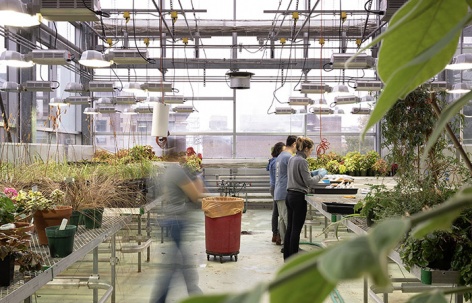
“这项计划的目标是开发一种可在大小城市推广的工艺。所有这些城市都具有现成的玻璃和餐厨垃圾供应,以及对于砂石的需求。评审团指出,以低碳的方式生产更多的土壤将成为人类生存的关键,基于材料的研究方法也将对相关实践做出重大的贡献。”
– 2022年评审委员会“The initiative has a goal of developing a replicable process scalable to small towns or big cities—all of which have a ready supply of glass and food waste and a demand for sand and gravel. The jury noted that producing more soil in a low-carbon manner will become critical to human survival and lauded this significant contribution to practice and materials-based research methods.”
– 2022 Awards Jury
来自 ASLA 对gooood的分享。
Soilless Soils: Investigation of Recycled Color-Mixed Glass in Engineered Soils | OLIN
项目陈述
Project Statement
该研究提出了以下问题:为绿色雨水基础设施而设计的工程土壤,是否可以包含回收的碎玻璃而非原砂,从而减少对破坏环境的材料的依赖,并为主要的废物流提供一条可持续的出路?这项以实践为基础的应用研究正试图回答这一问题,并致力于为创造绿色就业机会和循环经济建立一个可扩展、可复制的平台。
与垃圾填埋相比,玻璃等固体废弃物的回收利用成本较高,这对于城市而言仍具有挑战性。如今,美国的大多数城市会对所有玻璃垃圾进行填埋。与此同时,全世界的建筑用砂正在走向枯竭。因此,开发一种将本地固体废弃物有效转化为本地可用基础设施的实用解决方案至关重要。景观设计公司正在与市政机构以及由小型企业和非营利组织组成的网络进行合作,通过生产土壤来大幅减少玻璃和餐厨垃圾的填埋量。这项由美国环保局(EPA)资助的应用研究将与全国各地的市政部门公开共享,以推动本土性的回收利用,并降低建筑环境的生命周期成本。
Can engineered soils, designed for green stormwater infrastructure, include recycled pulverized glass rather than virgin sand to simultaneously reduce reliance on environmentally damaging materials and provide a sustainable outlet for a major waste stream? This practice-based applied research project seeks to answer this question, while also creating a scalable and replicable platform for green job creation and circular economics.
Recycling of solid waste materials, like glass, remains challenging to cities due to costs of recycling compared to landfill disposal. Today most American cities landfill all glass waste. Meanwhile, the world is running out of construction-grade sand. A practical solution for converting local solid waste to local usable infrastructure effectively is therefore critical. One landscape architecture firm is partnering with municipal agencies and a network of small businesses and nonprofits to significantly reduce the landfilling of glass and food waste through soil production. This applied research, funded by the US EPA, will be openly shared with municipalities across the country, to move the needle on domestic recycling and life cycle cost reduction in the built environment.
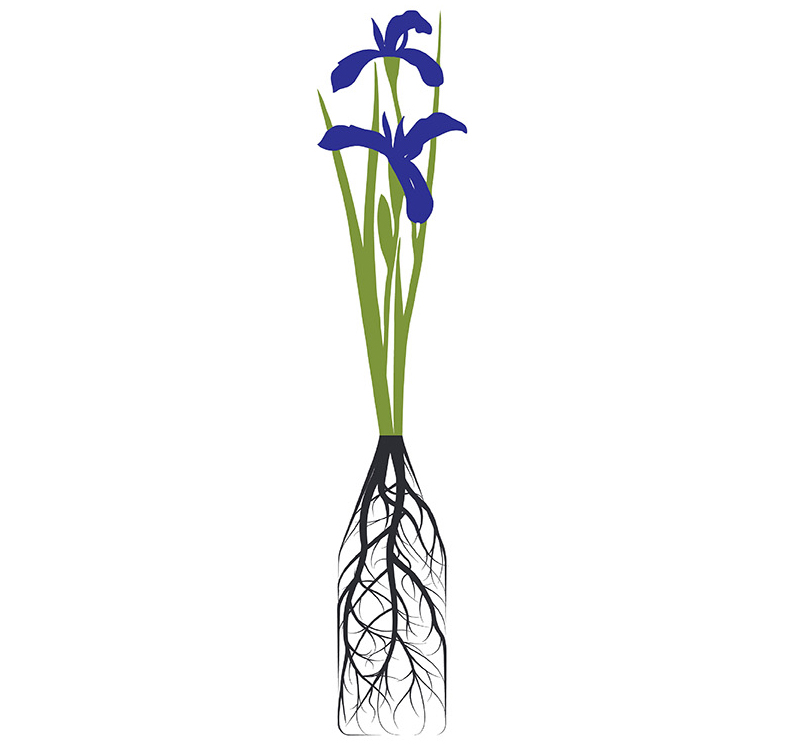
▲无土土壤研究计划:从玻璃到生长。无土土壤计划旨在对玻璃和厨余这两种成本昂贵的城市废弃物进行循环利用,并大幅减少城市绿化所需要的原生材料。The Soilless Soil Initiative: From Glass to Growth. The Soilless Soil initiative seeks to close the loop on two costly urban waste streams–glass and food–and dramatically reduce the volumes of virgin materials procured for urban greening. © OLIN
项目说明
Project Narrative
研究背景和目标
砂和骨料是地球上开采量最大的材料群组,高于生物质和化石燃料。这些材料在景观设计,尤其是绿色基础设施应用中无处不在。在世界上许多地方,工程用砂正在走向枯竭,而在美国东部,沿海平原的采砂活动对敏感的生态系统造成了破坏。
与此同时,美国的玻璃回收也面临着危机。虽然理论上玻璃是非常容易回收利用的,但事实上,大多数城市都不具备从单流收集中清洗和分拣混合颜色玻璃的技术能力,也没有玻璃渣的市场销路。由于这些原因,美国绝大多数的废玻璃,包括费城(本项倡议的重点城市)收集的玻璃,100% 都作为“不可回收的残渣”被送往垃圾填埋场。仅在费城,每年就有超过9万吨的玻璃被处理掉,城市、居民和企业需要为之支付140美元/吨的花费。
景观设计师群体如今越来越关注项目的周期成本,但其工作却很难从根本上解决开采和浪费的问题,这一点尤其体现在利用天然成分(沙子、开采的表层土、泥炭等)制造用于城市的工程土壤的过程中。无土土壤倡议旨在直接性地解决这一问题,通过对两种昂贵的城市废物流(玻璃和厨余)进行循环利用,来大幅减少城市绿化所需要的原始材料。美国环保局目前提供的研究资金为当地小企业和市政合作伙伴提供了支持,帮助其在费城创建玻璃和餐厨垃圾的闭环经济,从而促进城市生态和经济的可持续性和恢复能力。
连接研究与实践
无土土壤计划最初是为了解决现实中的景观设计项目与私人实践中产生的各种问题,以产出可以自由分享的研究成果,并将其融入到景观设计实践当中。
自2017年研究计划启动以来,洛杉矶的牵头公司已与两所大学、费城市政机构、循环经济非营利组织、土壤科学家、绿色雨水基础设施专家以及从事玻璃回收、堆肥和土壤混合的公司建立了合作关系。该团队同时开展了两项研究:(1)为含有回收玻璃砂和餐厨垃圾堆肥的玻璃基混合土壤(GBS)制定生产工序和材料规格;(2)制定技术和商业规划,为在当地生产和使用拟定的GBS混合土壤开发经济可行的系统。两项研究均由洛杉矶的牵头公司率领。
过去的研究成果
研究团队在2019年完成的生命周期比较评估(LCA)表明,与原生砂相比,回收玻璃砂可减少67%的温室气体排放。2019年的试点温室试验表明,玻璃基土壤对植物生长的支持效果与作为对照的矿砂混合土相同。2020-21年进行的材料分析和围隔实验研究,对材料的渗透性和沥滤液进行了测试——它们对于保持城市绿色雨水基础设施(GSI)的水质至关重要——并发现了玻璃基土壤是传统GSI土壤的可行替代品。
美国环保局第一阶段研究:完成于2021年
团队于2021年获得了美国环保局小型企业创新与研究 (SBIR) 第一阶段的奖励,以支持进一步的研究,并实现材料的商业化。研究团队致力于设计玻璃基土壤 (GBS) 原型材料和可扩展的制造工艺(玻璃粉末化和土壤混合),使市政当局能够将废玻璃转化为本地生产的玻璃基土壤。
该项目以四年前的研究为基础,采用最有效的混合土壤,在试点生长试验中将其作为种植介质进行测试,并设计出了一种生产工艺,能够以最低的经济和环境成本生产出这种土壤。第一阶段的研究包括:
任务 1: 使用玻璃粉碎设备和城市混合色玻璃碎屑,生产出温室种植试验中使用的玻璃砂。
任务 2:进行温室种植试验,比较各种混合比例。
任务 3:制定一套材料规格,与制造商和市政合作伙伴共享。
任务 4:向费城的各城市机构提供技术规划包。
利用研究小组成员研发和操作的设备,三种原型GBS混合料被设计和生产出来(任务 1)。这些混合物被用于为期12周的温室种植研究,由砂子(玻璃沙或矿砂)、天然壤土和厨余堆肥组成(任务 2)。试验结果表明,试验用土和对照用土在植物生长方面并无差异。
在进行温室生长试验的同时,研究小组还与费城公园和休闲部门以及当地的私人和非营利实体网络进行合作,制定了技术计划和制造商工作规范,以促进玻璃基土壤在该地区的生产和商业化。
美国环保局第二阶段:进行中(2022-23 年)
在第一阶段研发的基础上,项目第二阶段将把玻璃基土壤混合物 (GBS) 纳入大规模绿色雨水基础设施 (GSI) 的现场实验,并将启动玻璃基土壤制造中心试点。通过与费城水务局 (PWD) 和费城公园与休闲娱乐部门 (PPR) 合作,现有的雨水生物蓄水池(在Ida飓风期间因洪水受损)将采用玻璃基混合土壤进行改造,并对植物健康和水力性能进行为期一年的监测。在12-18个月的监测期内,将对五个生物滞留池的以下几个指标进行持续监测:水质、土壤湿度/保水性、土壤渗透、土壤压实、流速、植物蒸腾作用以及植物健康。
第二阶段将促进当地材料加工企业之间的合作,开始在当地试生产GBS原型。项目资金将用于购买一套新的玻璃粉碎系统,并为当地一家非营利性玻璃回收企业(研究小组成员)提供加工场地。这将使他们能够建立一个玻璃砂中心以支持未来市政对该材料的需求。研究小组将在城市范围内(从商业实体)采购和加工玻璃砂,并将其送至公共工程部预先批准的土壤混合器,为试点项目生产GBS原型。
影响与未来方向
无土土壤研究项目的目标是设计并推广一种可持续的工艺,将城市垃圾转化为高性能的基础设施,同时创造绿色就业机会并支持循环经济。为此,所有研究成果都将免费向公众开放,以便任何城市都可以复制和推广这一过程。该提议的优势在于,建立玻璃加工设施的技术和经济要求很低,可以在小城镇或大城市推广。此外,每个城市都有现成的玻璃和餐厨垃圾供应和砂石需求。正如研究和试点项目所显示的那样,将这些部分彼此连接起来是一个可实现的目标。
无土土壤研究计划提供了一个以实践为基础的合作研究模式,通过景观设计专业的核心工具和技术,有效地弥合了理论与实践(或纯粹研究与应用研究)之间的差距。它展示了设计专业人员发起和领导可持续材料实证研究的潜力,同时还汇集了专家和倡导者团队,能够将研究成果实时应用于现实世界。据研究团队了解,该项目是有史以来第一个由景观设计师主导并获得美国环保局SBIR第一阶段+第二阶段资助的项目。研究团队希望,该项目能够为其领域的实践提供路线指导,通过认可本行业所提供的跨学科设计思维和专业知识来推进此类具有突破性意义的研究。
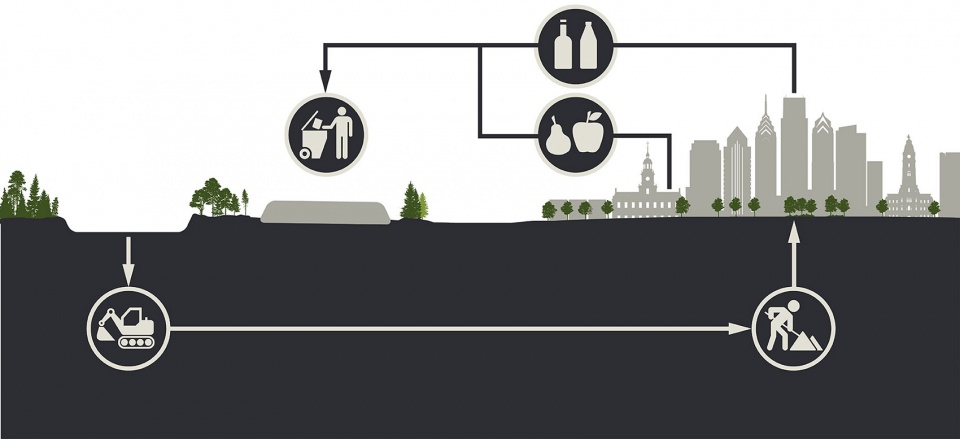
▲失去的机会:在美国,两类影响最严重的的城市垃圾(玻璃和厨余)占据了垃圾填埋量的绝大部分。同时,市政当局每年要为公共工程采购数千吨天然砂。Lost Opportunities. Across the nation, the two heaviest urban waste streams (glass and food) make up the majority of landfill volume. Meanwhile, municipalities procure thousands of tons of natural sand annually for public works. © OLIN
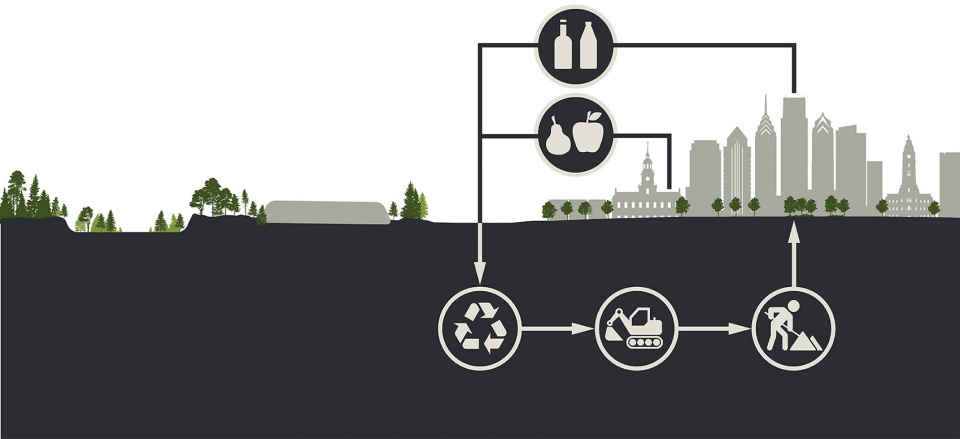
▲闭环:用于城市绿化的玻璃和厨余。闭环式的循环经济可以将城市垃圾转化为绿色基础设施,为城市节省资金,降低生命周期成本,并创造绿色就业机会。Closing the Loop: Glass and Food for Urban Greening. A closed-loop circular economy will transform urban waste into green infrastructure, saving the city money, reducing life cycle costs, and creating green jobs. © OLIN
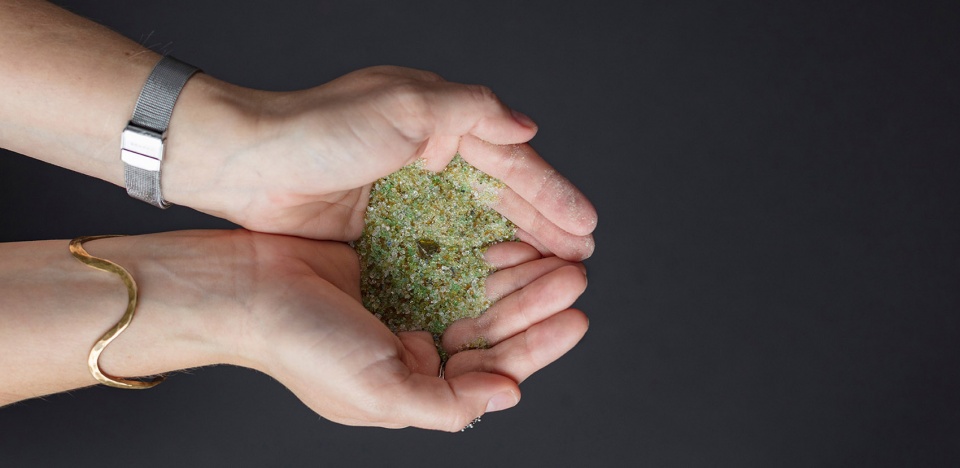
▲玻璃砂:项目团队在2019年完成的生命周期比较评估(LCA)表明,与原生砂相比,回收的玻璃砂可减少67%的温室气体排放。Glass-Sand. The comparative life cycle assessment (LCA) that our team completed in 2019 demonstrated that recycled glass-sand may reduce greenhouse emissions by 67% compared to virgin sand. © Sahar Coston-Hardy
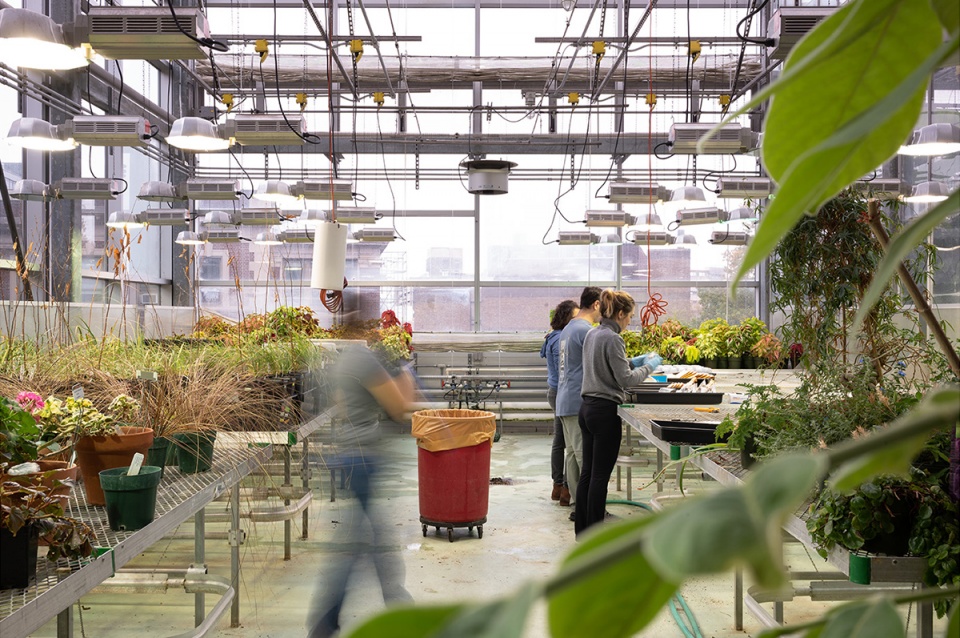
▲试点计划:2019年实施的一项温室试点实验表明,玻璃基土壤对植物生长的支持效果与对照组的矿砂混合土相同。Pilot Program. A 2019 pilot greenhouse trial showed that glass-based soils supported plant growth as well as a control mined-sand mix. © OLIN
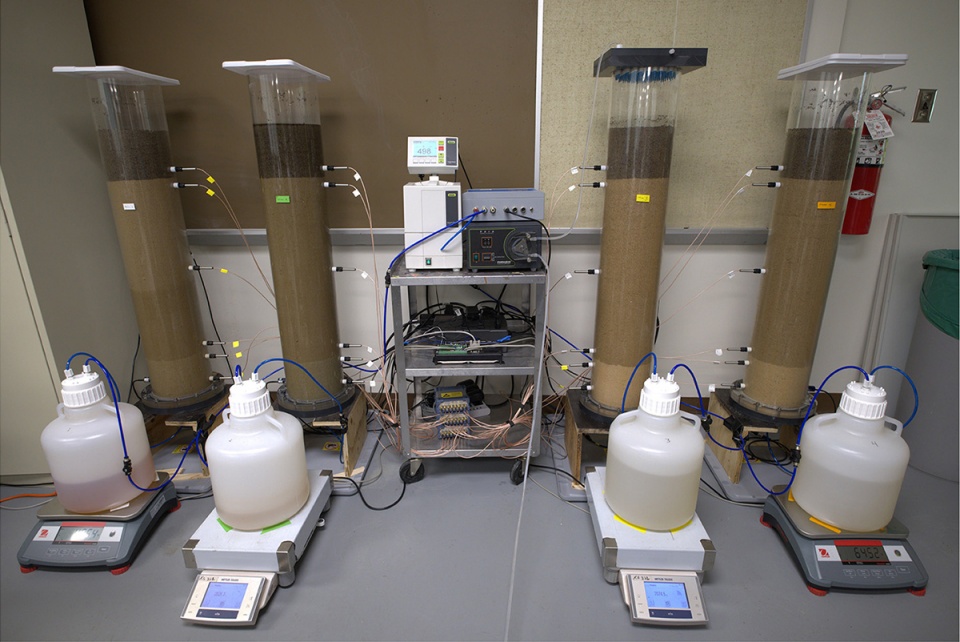
▲围隔实验研究:水流和沥滤液分析:2020-21年实施的材料分析和围隔实验研究测试了材料的渗透性能和沥滤液——它们对于保持城市绿色雨水基础设施(GSI)的水质至关重要——并发现了玻璃基土壤是传统GSI土壤的可行替代品。Mesocosm Study: Water Flow and Leachate Analysis. Our 2020-21 material analysis, and mesocosm study tested the material’s infiltration performance and leachate, critical to maintaining water quality in urban green stormwater infrastructure (GSI) and found glass-based soil to be a feasible alternative to conventional GSI soil. © OLIN
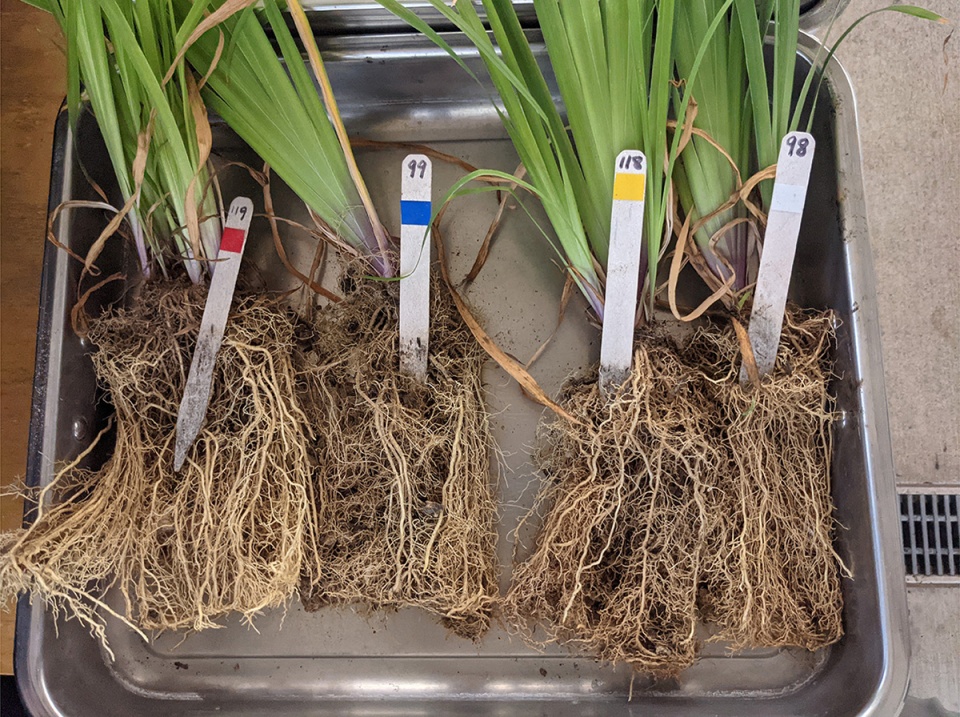
▲种植试验:根与芽。该项目基于四年前的研究,选取了最有效的混合土壤,在试点生长实验中奖期作为种植介质进行测试,并设计了一种生产工艺,以最低的经济和环境成本生产这些土壤。Planting Trial: Roots and Shoots. The project built on four years of previous research by taking the most effective soil blends, testing them as planting media in a pilot growth trial, and designing a manufacturing process to produce them at minimal economic and environmental cost. © OLIN
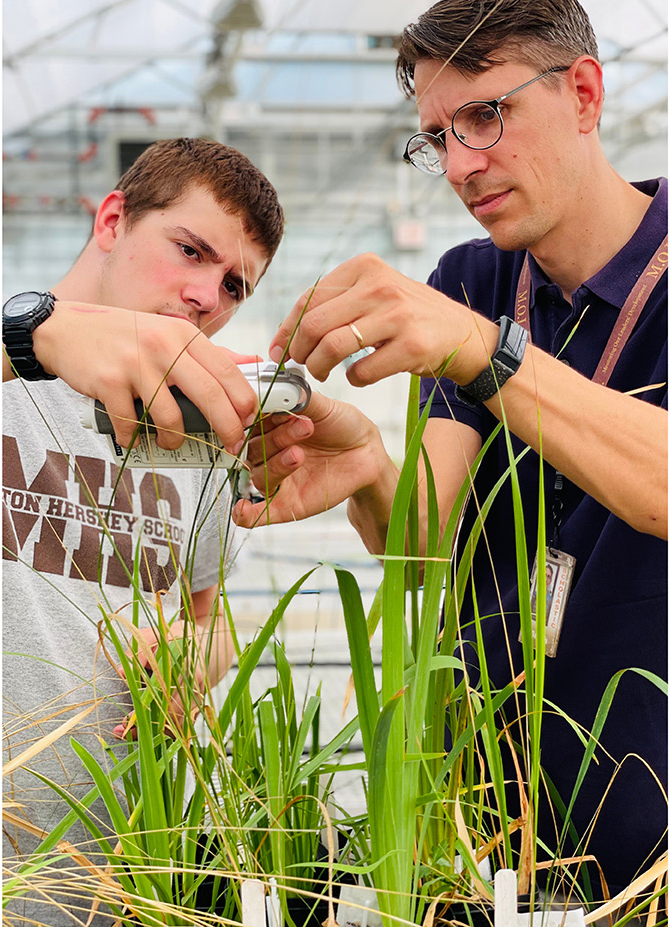
▲种植试验:吸引学生和研究人员参与。第一阶段的种植试验在当地的一所高中进行,得到了教师和高中学生们的支持。Planting Trial: Engaging Student-Researchers. Phase I planting trials took place at a high school in the local region, with the support of faculty and high school students. © Milton Hershey School
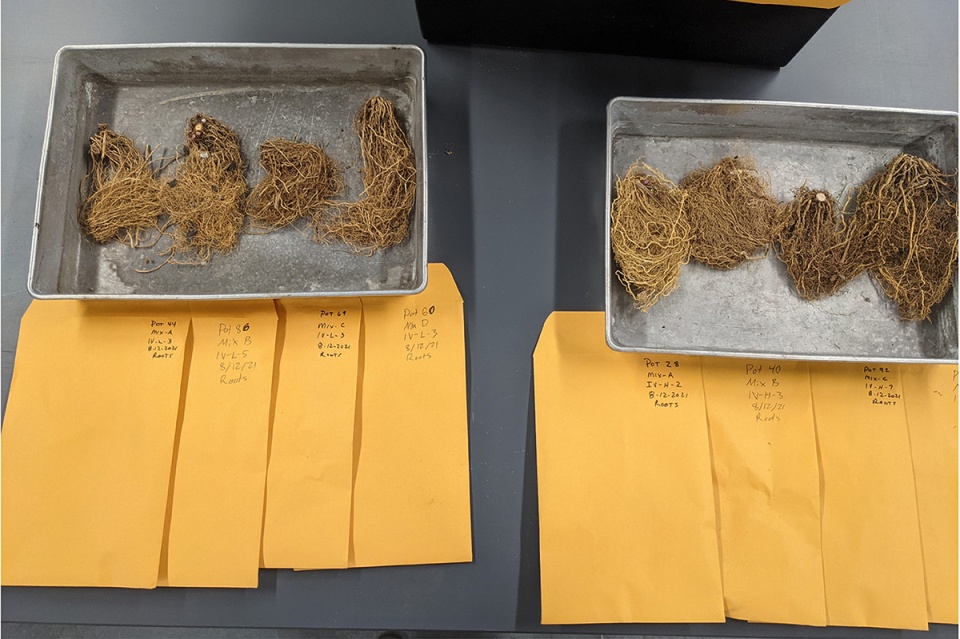
▲种植试验: 干根质量。在为期12周的生长试验结束时,对植物进行收割和干燥,以测量干根生物量(如图)和干芽生物量。在不同的浇水处理中,玻璃基土壤的表现优于砂质土壤。Planting Trial: Dry Root Mass. At the end of the 12-week growth trial, plants were harvested and dried, to measure dry root biomass (pictured) and dry shoot biomass. Across watering treatments, glass-based soils compared favorably with sand-based soils. © OLIN
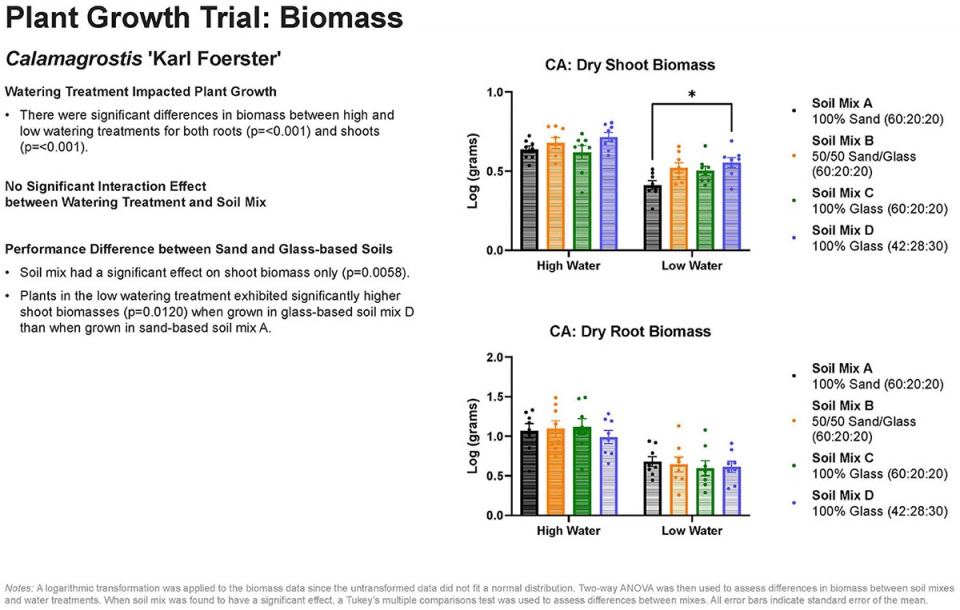
▲植物生长试验: 生物量结果。在不同的浇水处理中,玻璃基土壤的生物量均优于砂质土壤。Plant Growth Trial: Biomass Results. Across watering treatments, glass-based soils compared favorably with sand-based soils. © OLIN
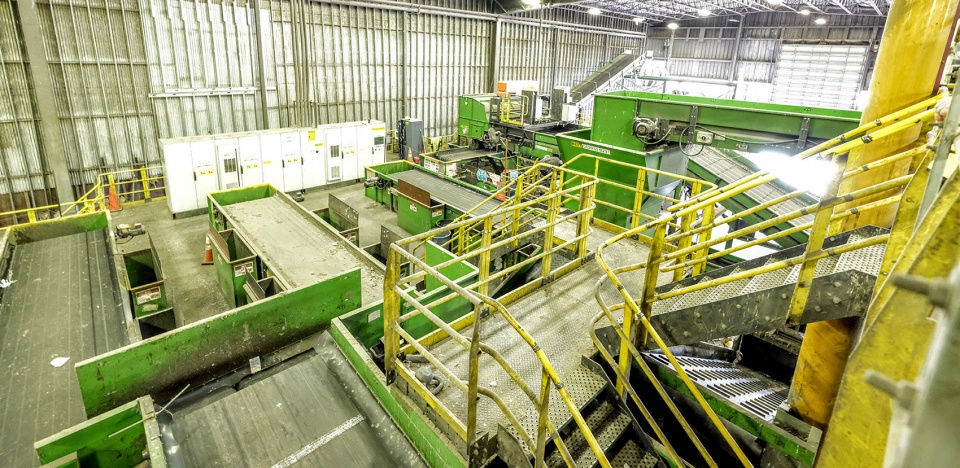
▲现状: 费城的玻璃回收。研究团队与市政机构和废物处理行业专家合作,了解了费城玻璃回收的现状,包括数量、流程和成本等。Status Quo: Glass Recycling in Philadelphia. The research team worked with city agencies and waste industry experts to understand the status quo of glass recycling in Philadelphia, including volumes, processes and costs to the city. © OLIN
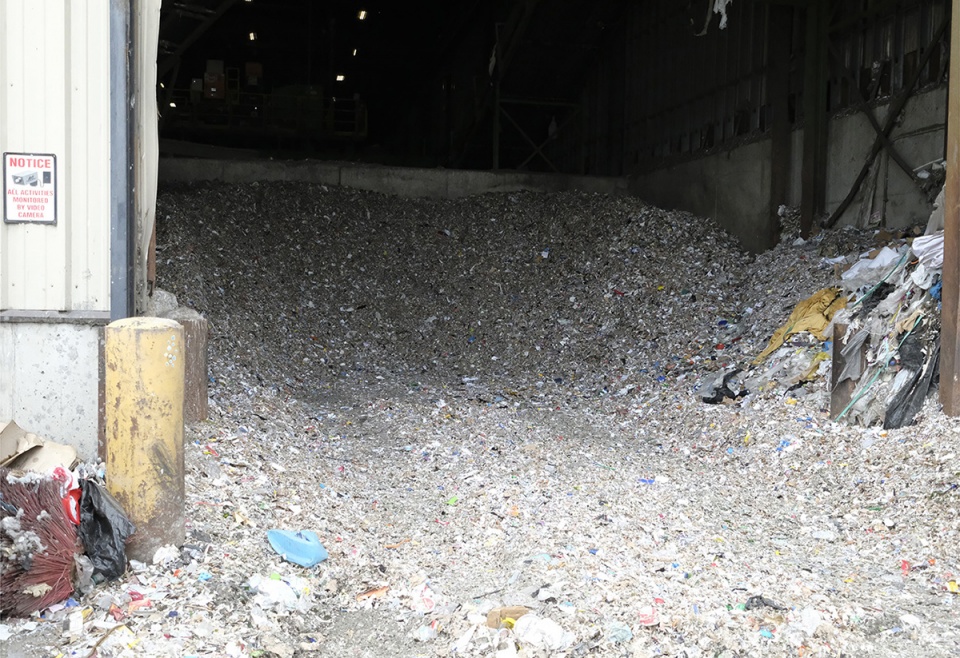
▲玻璃垃圾:费城每年生产约9万吨玻璃。目前,该市收集的所有玻璃都与其他“不可回收残渣”一起被丢弃在垃圾填埋场。Glass Waste. Philadelphia produces approximately 90,000 tons of glass per year. Currently all glass collected by the city is disposed of in landfills, along with other “non-recyclable residue.” © OLIN
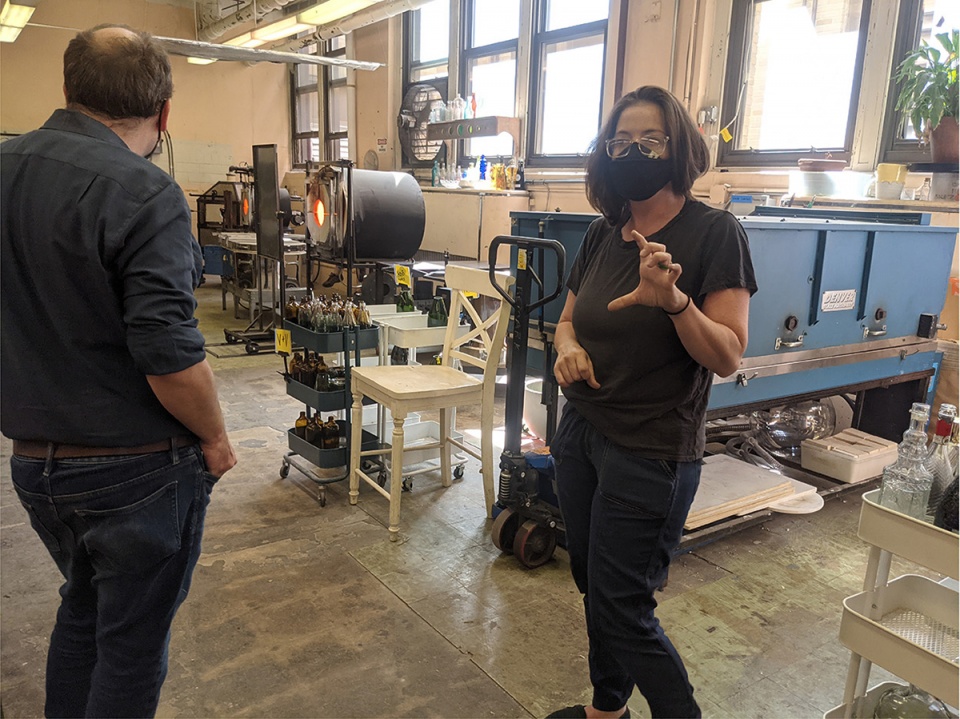
▲支持费城玻璃砂加工试点中心的公私合作伙伴关系:第二阶段将促进当地材料加工企业和市政机构之间的合作,在当地开始试生产玻璃砂加工中心原型。项目资金将用于为当地一家玻璃回收非营利组织购买新的玻璃粉碎系统。Public-Private Partnerships in Support of a Pilot Glass-Sand Processing Hub in Philadelphia. Phase II will facilitate collaboration among local material processing businesses and city agencies to begin pilot production of the GBS prototype locally. Project funds will be used to purchase a new glass-pulverizing system for a local glass recycling nonprofit. © OLIN
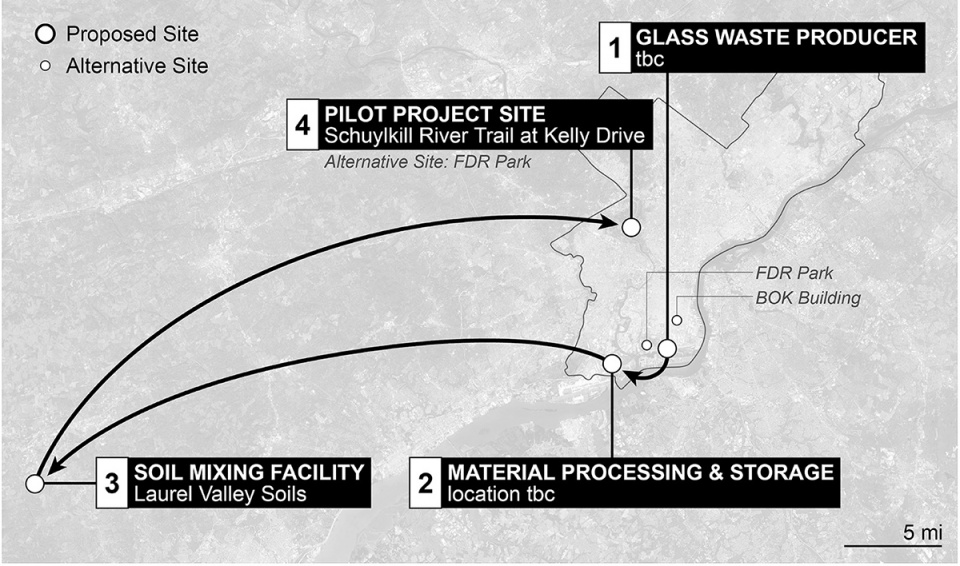
▲玻璃基土壤 (GBS) 加工和安装试点。团队将在城市范围内(从商业实体)采购和加工玻璃砂,并将其送往城市预先批准的土壤混合器之一,以生产试点项目的玻璃基土壤原型。Pilot Glass-Based Soil (GBS) Processing and Installation. The team will source (from commercial entities) and process glass-sand within city limits and send it to one of the city’s pre-approved soil blenders to produce the GBS prototype for the Pilot Project. © OLIN
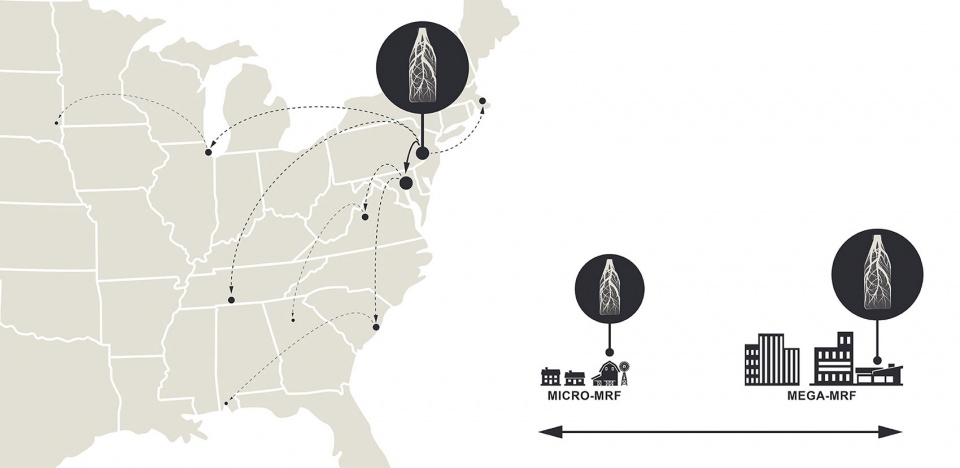
▲开源: 可扩展性、可负担性和可复制性。本项研究旨在设计并免费推广一种将城市垃圾转化为高性能基础设施的可持续流程,同时创造绿色就业机会并支持循环经济。该系统成本低廉,可以迅速实现扩展和复制。Open Source: Scalability, Affordability and Replicability. The research aims to design and freely disseminate a sustainable process for turning urban waste into high-performing infrastructure, while creating green jobs and supporting a circular economy. The system is inexpensive and imminently scalable and replicable. © OLIN
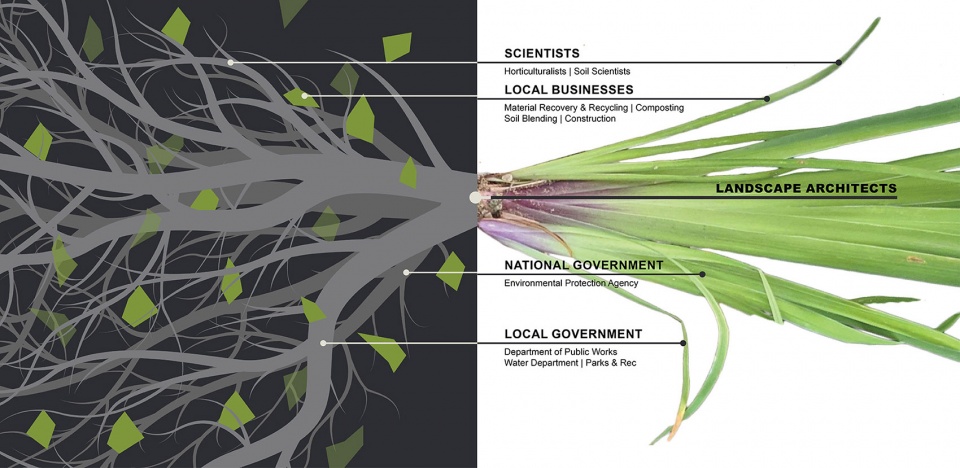
▲连接理论与应用的实践型研究:本项研究计划为基于实践的合作研究提供了一种模式,有效地弥合了理论与实践之间的差距,展示了景观设计师发起和领导实证研究的潜力,同时也凝聚了专家团队与转型倡导者。Practice-Based Research Bridging Theory and Application. This research initiative provides a model for practice-based, collaborative research that effectively bridges the gap between theory and practice, demonstrating the potential for landscape architects to initiate and lead empirical research while constellating teams of experts and advocates for transformation. © OLIN
Project Narrative
Research Context and Aims
Sand and aggregate make up the most heavily extracted material group on the planet: above biomass and fossil fuels. These materials are ubiquitous in landscape architecture, particularly in green infrastructure applications. In many parts of the world, construction-grade sand is running out, and in the eastern US, Coastal Plain sand extraction disrupts sensitive ecosystems.
Meanwhile, glass recycling in the U.S. is in a state of crisis. While glass is theoretically highly recyclable, in practice, most cities don’t have the technical capacity to clean and sort mixed color glass from single stream collection, nor do they have market outlets for glass cullet. For these reasons, the vast majority of waste glass in the U.S., including 100% of the glass collected in Philadelphia (where this initiative is focused) is sent to the landfill as “non-recyclable residue.” In Philadelphia alone, this means that over 90,000 tons of glass is disposed of annually at a cost of approximately $140/ton to the city and its residents and businesses.
Landscape architects (LAs) have become increasingly concerned with the life cycle costs of our projects, but LA practices struggle to address aspects of our work that are fundamentally extractive and wasteful. Nowhere is this more evident than in the manufacturing of engineered soils from natural components (sand, mined topsoil, peat, etc) for use in cities. The Soilless Soil initiative seeks to address this issue directly, by closing the loop on two costly urban waste streams–glass and food–and dramatically reducing the volumes of virgin materials procured for urban greening. Current research funding from the US EPA supports a constellation of local small businesses and municipal partners, to create a closed loop economy for glass and food waste in Philadelphia, contributing to the city’s ecological and economic sustainability and resilience.
Connecting Research & Practice
The Soilless Soil initiative originated from questions arising from real-world landscape architecture projects, within private practice, and aims to generate findings that can be shared freely and integrated back into the practice of landscape architecture.
Since the start of the research initiative in 2017, the lead LA firm has collaborated with two universities, Philadelphia city agencies, circular economy nonprofits, soil scientists, green stormwater infrastructure experts, and companies engaged in glass recycling, composting, and soil blending. This team is pursuing two simultaneous research tracks: (1) developing a manufacturing process and material specification for a glass-based soil blend (GBS) that contains recycled glass-sand and food waste compost; and (2) technical and commercial planning to develop economically feasible systems for manufacturing and utilizing the proposed GBS blend locally. The lead LA firm is leading both research tracks.
Past Research Findings
The comparative life cycle assessment (LCA) that our team completed in 2019 demonstrated that recycled glass-sand may reduce greenhouse emissions by 67% compared to virgin sand. A 2019 pilot greenhouse trial showed that glass-based soils supported plant growth as well as a control mined-sand mix. Our 2020-21 material analysis, and mesocosm study tested the material’s infiltration performance and leachate, critical to maintaining water quality in urban green stormwater infrastructure (GSI) and found glass-based soil to be a feasible alternative to conventional GSI soil.
US EPA Phase I Study: Completed 2021
The Research Team was awarded an EPA Small Business Innovation and Research (SBIR Phase I) award in 2021, to support further research and to bring the material to commercialization. The Research Team addressed the design of a glass-based soil (GBS) prototype material and a scalable manufacturing (glass pulverizing and soil blending) process that will allow municipalities to divert waste glass into locally manufactured GBS.
The project built on four years of previous research by taking the most effective soil blends, testing them as planting media in a pilot growth trial, and designing a manufacturing process that will produce them at minimal economic and environmental cost. This Phase I study included:
Task 1: Use glass pulverizing equipment and municipal mixed-color glass cullet to produce the glass-sand used in the greenhouse planting trials.
Task 2: Perform greenhouse planting trial comparing various mix ratios.
Task 3: Develop a set of material specifications to be shared with manufacturers and municipal partners.
Task 4: Provide a technical planning package to Philadelphia city agencies.
We designed and produced three prototypical GBS mixes, using equipment produced and operated by Research Team members (Task 1). These mixes were used in a 12-week greenhouse planting study and consisted of sand (either glass-sand or mined sand), natural loam, and food waste compost (Task 2). The trial showed no difference in plant growth between test and control soil mixes.
In parallel to the greenhouse growth trial, the Research Team worked with Philadelphia Parks and Recreation and a network of private and nonprofit entities locally, to produce a technical plan and manufacturer specification that will facilitate the production and commercialization of glass-based soil in the region.
US EPA Phase II: Underway (2022-23)
Building upon Phase I research and development initiatives, Phase II of the project will incorporate glass-based soil mixes (GBS) into a full-scale green stormwater infrastructure (GSI) field experiment and will launch a pilot glass-based soil manufacturing hub. In collaboration with the Philadelphia Water Department (PWD) and Philadelphia Parks & Recreation (PPR), existing stormwater bioretention basins (which were damaged by flooding during Hurricane Ida) will be retrofitted with the glass-based soil mixes and monitored over one year for plant health and hydraulic performance. The following metrics will be continuously monitored in the five bioretention basins throughout the 12-18-month monitoring period; water quality, soil moisture/retention, soil infiltration, soil compaction, flow rate, plant transpiration, and plant health.
Phase II will facilitate collaboration among local material processing businesses to begin pilot production of the GBS prototype locally. Project funds will be used to purchase a new glass-pulverizing system and secure a processing site for a local glass recycling nonprofit (and member of the Research Team). This will allow them to establish a glass-sand hub that will support future municipal demand for the material. The Team will source (from commercial entities) and process glass-sand within city limits and send it to PWD’s pre-approved soil blender to produce the GBS prototype for the Pilot Project.
Impact & Future Directions
The goal of the Soilless Soils project is to design and disseminate a sustainable process for turning urban waste into high-performing infrastructure, while creating green jobs and supporting a circular economy. To this end, all research findings will be made free and open to the public, so that the process can be replicated and scaled in any municipality. The strength of this proposition is that the technical and economic requirements for setting up a glass-processing facility is quite low, and can be scaled to small towns or big cities. Furthermore, every city has a ready supply of glass and food waste and a demand for sand and gravel. Connecting these dots, as our research and pilots have shown, is an attainable goal.
The Soilless Soils research initiative provides a model for practice-based, collaborative research that effectively bridges the gap between theory and practice (or between pure and applied research) through tools and skills that are central to the landscape architecture profession. It demonstrates the potential for design professionals to initiate and lead empirical research into sustainable materials, while constellating teams of experts and advocates that can bring research findings into real-world application in real time. As far as we have been able to ascertain, this project is the first landscape-architect-led project ever that has received Phase I+II SBIR funding from the US EPA. We hope that it will provide a roadmap for practices in our field to take on this type of barrier-breaking research by recognizing the cross-disciplinary design thinking expertise that the profession has to offer.


有意思有意义
降解是漫长的
可是玻璃的主要组成成分是二氧化硅,和沙子基本上一样,还有一些氧化钙氧化纳之类的都属于金属无机物,并没有不可降解的有机污染物和无机污染物呀?