
“景观设计师的设计过程并不总是线性的。这本书展示了Michael Van Valkenburgh对于一个被遗弃的、缺乏活力的花园所进行的精彩改造:在1901年的旧建筑与2012年的新建筑之间,他借助一系列蜿蜒的路线营造了一场令人愉快的过渡体验。书中收录了大量信件、草图和逐步完善的图纸——所有这些均被穿插在Van Valkenburgh对花园设计和建造的第一手叙述中。《设计花园》不仅仅是摆放在博物馆商店里的一本书,它更为我们带来了一场大师课,详细地讲述了景观设计师如何提出构思、苦心钻研并最终得出与场地完美契合的解决方案——仿佛它们一直存在于那里。”
– 2020年评审委员会“A landscape architect’s design process isn’t always linear, and this book illustrates the many meanders Michael Van Valkenburgh took on his journey to transform a leftover and lackluster side garden into a delightful transition between the original 1901 building and its 2012 addition. Documented in correspondence, sketches, and gradually more refined drawings—all interspersed with Van Valkenburgh’s first- hand account of their development—Monk’s Garden becomes not just another book for the museum’s gift shop, but a master class offering the full insight of how landscape architects approach, agonize over, and finally arrive at solutions that fit their sites so precisely that they feel like they’ve been there all along.”
– 2020 Awards Jury
来自 ASLA 对gooood的分享。
Designing a Garden: Monk’s Garden at the Isabella Stewart Gardner Museum | Michael Van Valkenburgh Associates, Inc.
项目陈述
PROJECT STATEMENT
和花园有关的书籍不胜枚举,却只有很少的一部分能帮我们逐步地厘清花园的形成过程。《设计花园》一书提供了一个前所未有的窗口,使我们得以细致地了解到营造花园的过程中将会遇到的各种复杂事项。该书通过草图、模拟图、实体模型、平面图、照片、施工图和一些往来信件,以完全透明的方式详细介绍了僧侣花园的设计进程。本书是基于另一部著作《僧侣花园》而写就,后者最初是为配合伊莎贝拉嘉纳艺术博物馆的展览而创作,并于2014年获得ASLA荣誉奖项(https://www.asla.org/2014awards/129.html)。《设计花园》将充满诗意的文章和新颖的平面设计相结合,为景观的形成过程提供了一个清晰的案例,同时鼓励年轻一代景观设计师将花园的建造视为一种学习和磨练技艺的方式。
There are many books about gardens, but few trace the entire process of figuring out what a garden will be. Designing a Garden offers an unprecedented window onto the hard to describe considerations that go into making a garden. It presents the progression of the design for the Monk’s Garden in an entirely transparent way, through sketches, models, mock-ups, plans, photographs, construction drawings, and correspondence. The book builds on Monk’s Garden, a visual record of the design process initially compiled to accompany an exhibition at the Isabella Stewart Gardner Museum, which won an ASLA Honor Award in 2014. Designing a Garden’s virtuosic essays and innovative graphic design combine to give a clear example of how a landscape comes together and to encourage younger landscape architects to make gardens as a way to learn more about their craft.
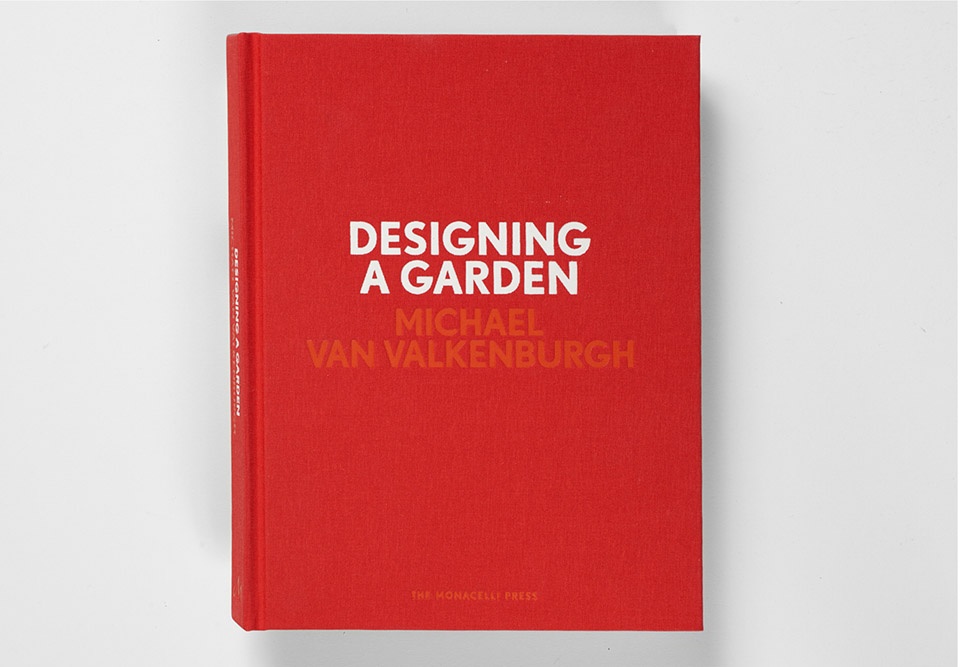
▲《设计花园》的鲜艳封面令它在满是绿色景观照片的书架上显得特别突出。清晰的排版是整个书籍设计的首要任务。Designing a Garden, Book Cover. The book is designed to stand out on a shelf full of glossy covers with green landscape photographs. Clarity in typography was the priority. ©Photograph of the book by Charles Mayer.
项目说明
PROJECT NARRATIVE
设计花园:伊莎贝拉嘉纳艺术博物馆的僧侣花园
在《设计花园》一书中,Michael Van Valkenburgh带领读者走完了波士顿伊莎贝拉嘉纳艺术博物馆僧侣花园的设计旅程。在这个过程中,Michael揭示了他的设计实践的内部运作方式,并对其从数十年景观设计实践中获得的知识和经验进行了总结。本书摒弃了那种针对设计展示而严格编排的线性设计过程,以一种自然的方式记录了营造景观时所需经历的尝试、检验、否定以及回头重做等一系列预料之外的情境。文章中阐释了作者在设计过程中探索过的各种方向——虽然其中有不少想法很快就遭到了否决,但它们依然为得出更加有效的结论提供了参考。这些考量因素也包含了Michael本人的经验和想法,有助于读者从更深层次去理解景观的建造形式。
《设计花园》是基于曾经的一本出版物《僧侣花园》而著就,后者原先是为伊莎贝拉嘉纳艺术博物馆的展览而创作,并于2014年获得ASLA荣誉奖项。在展览结束后,《僧侣花园》成为了Michael Van Valkenburgh Associates(MVVA)事务所在景观设计实践方面的有效工具,并将书中的方法频繁地应用到其实际的项目当中。这也向人们证明了这份宝贵资料对于一般的设计过程而言有多么宝贵的借鉴意义,并且它还可以大量扩展以面向更广泛的受众。
设计和组织
《设计花园》一书围绕着5篇文章展开,包括“设计花园”、“路径”、“植物”、“建造花园”和“收获花园”,优美详实的文字与设计过程中的视觉资料相辅相成,草图、模型和施工过程照片将读者一路引向花园制造之旅的终点。在MVVA项目主管Matt Girard撰写的文章“建造花园”之后附带有完整的植物清单。最后一篇文章的作者是著名景观设计师Laurie Olin,他在文中讲述了自己在完工后不久的花园中散步时的感受。书本最后以一篇摄影故事收尾,邀请读者沉浸于充满自然气息的花园美景,享受“劳动”带来的成果。
该书的设计者是图书设计师兼景观设计师Cara Walsh,她希望以一种让富有经验的景观设计师和新手设计师都能接受的形式来呈现营造花园的复杂过程。本书的设计目标是用丰富的图片来支持和加强设计过程的文字表述,使这本书不仅作为一个保罗万象的资料库而存在,更是作为一个考虑周全、循序渐进的营造花园的案例而存在。无边距打印的图像使读者沉浸在葱郁的花园景观中,一些来自沟通邮件中的文字与过程图片形成巧妙的对应,揭示出一个项目是如何一步步被塑造成型。《设计花园》一书的结构在阐明建造僧侣花园的具体细节的同时,将设计决策与创意过程背后的一系列信息和想法编织在一起,形成一场富有节奏感的叙事。读者们不仅能够从书面文字中得到思考,同时也将从富有感染力的配图中收获乐趣。在呈现设计成果之外,本书还试图阐述一个花园是如何以及为何被建造。它为与建造花园的过程持续相关的事物提供了案例,旨在向读者传达:花园不仅仅是一个欣赏的对象,它还是一个可以被人所享受的场所,以及一个人类创造的产物,它激发了一种持续的学习、测验、重试和看护的过程。
志向
本书有两个主要的目的。第一是向新的设计者提供案例,阐明景观设计是如何在清晰而又详细的形式下得以实现。Michael Van Valkenburgh认为,最好的方法并非从其作品中总结出某种普遍性的方法,而是通过从头到尾地跟随一个具体的项目,让读者去亲自感受一个尚未完成的花园所带来的充满灵感而又不可预测的世界。在所有的景观项目类型中,花园具有最易于管理的规模和最明确的意图,而僧侣花园通过其路径和植物所展现出的明确而有力的目的性则使其成为了一项完美的研究案例。
《设计花园》的第二个目的是激发年轻的景观设计师将花园作为一种学习和磨练自身技艺的方式。实践是学习景观设计的最佳方法,而由于许多项目类型的复杂性,以及成本、空间和时间上的高要求,许多年轻设计师很难有机会从头至尾地去了解一个项目的设计过程。本书试图强调为设计和建造项目而努力实践的重要意义——不论它是一个多小的项目。
受众和传播
年轻设计师和景观专业的学生是激发本书创作的最初受众,但该书的行文和排版方式使其适合所有对设计和景观感兴趣的人士阅读。《设计花园》在多数以艺术和设计为导向的书店都可以买到,同时也通过网站销售,使书本的影响力得以最大程度地发挥(初版共发行4000册)。
花园
在伊莎贝拉嘉纳艺术博物馆实施扩建(面积增至原先的两倍多)之后,MVVA于2011年9月被委托设计一个新的僧侣花园。该花园三面围合以高大的砖墙,南面开敞于伦佐·皮亚诺为博物馆设计的新楼。自Isabella Stewart Gardner在1903年创建博物馆以来,僧侣花园的位置一直未变,但却呈现出完全不同的形式。时任博物馆馆长的Ann Hawley希望将这个花园作为一份为游客准备的礼物:一个能够吸引他们进入并为之带来惊喜的场所。设计师Michael用了一个上午的时间参观博物馆,随后产生了将僧侣花园打造为博物馆对应物的想法——它与专注思考的内部空间相反,是一个可以尽情迷失和放松的地方。
借助密集的绿植和蜿蜒的路径,僧侣花园的设计在有限的外围场地中创造出沉浸式的体验。本书在两个独立的章节中对“植物”和“路径”这两个方面进行了详细的研究,同时又在考量其中一者时对另一者予以充分尊重,使二者贯穿了整个设计过程。花园的围墙意味着它无法从街道被望见;相互交织的路径和植物营造出一种强烈的室内感,使游览者在沿蜿蜒路径漫游时情不自禁地陷入沉思。
评价
《设计花园》被列入了各大年度榜单,并得到了大量媒体的积极评价,包括《芝加哥论坛报》《大都会》和ASLA的《The Dirt》期刊。
Aaron King在《The Dirt》中写道:“Michael Van Valkenburgh所著的这本《设计花园》对一个完整项目——波士顿伊莎贝拉嘉纳艺术博物馆的僧侣花园——的设计和建造过程进行了清晰而又直白的审视。”
在Garden Design Online网站上,Jane Berger写道:“如果你还未去过伊莎贝拉嘉纳艺术博物馆的僧侣花园,请务必制定旅行计划,去亲自体验一下这项神秘的杰作,因为它将在接下来的几个月里启发你对设计的思考。在《设计花园》一书中,景观设计师Michael Van Valkenburgh会带领你去了解设计过程中的每一个细节——这将是一场使你受益无穷的课程。”
《芝加哥论坛报》的Blair Kamin写道:“在这本令人感到愉快的小书中,Michael Van Valkenburgh详尽地记录了伊莎贝拉嘉纳艺术博物馆僧侣花园的发展过程……你将以前所未有的方式看到一系列或曲或直的路径,甚至于那些存在于枝叶间的空气。”
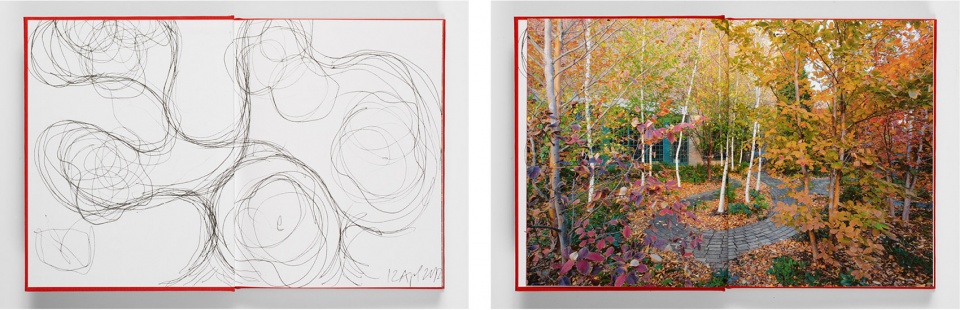
▲扉页:从打开书时,读者便能了解到这是一本揭示“从概念到实现”的过程的书。完成后的花园照片与Michael初期的草图相互呼应,从前一页的草图中可以看见蜿蜒的小路和树丛。Opening Pages. At the outset, the book establishes the idea of revealing the design process from concept through construction. An image of the completed garden echoes Michael’s early sketch showing winding paths and clumps of trees on the preceding spread. ©Left: Sketch, Michael Van Valkenburgh, Courtesy of the Cooper Hewitt, Smithsonian Design Museum; Right: Photograph by Scott Shigley. Photographs of the book by Charles Mayer.
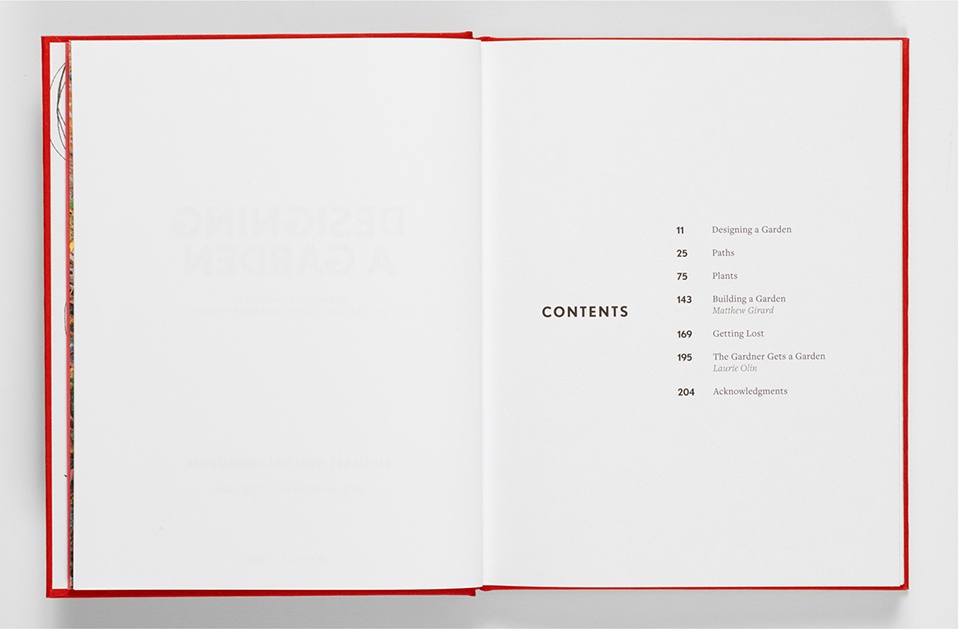
▲内容目录:《设计花园》分为7部分内容。书籍的设计揭示出本书探讨的简单基本元素:路径、植物以及构成花园的其他部分。Table of Contents. Designing a Garden is divided into seven sections. Here, the book design illustrates simplicity in essential elements: paths, plants, and other building blocks of the garden. ©Photograph of the book by Charles Mayer.
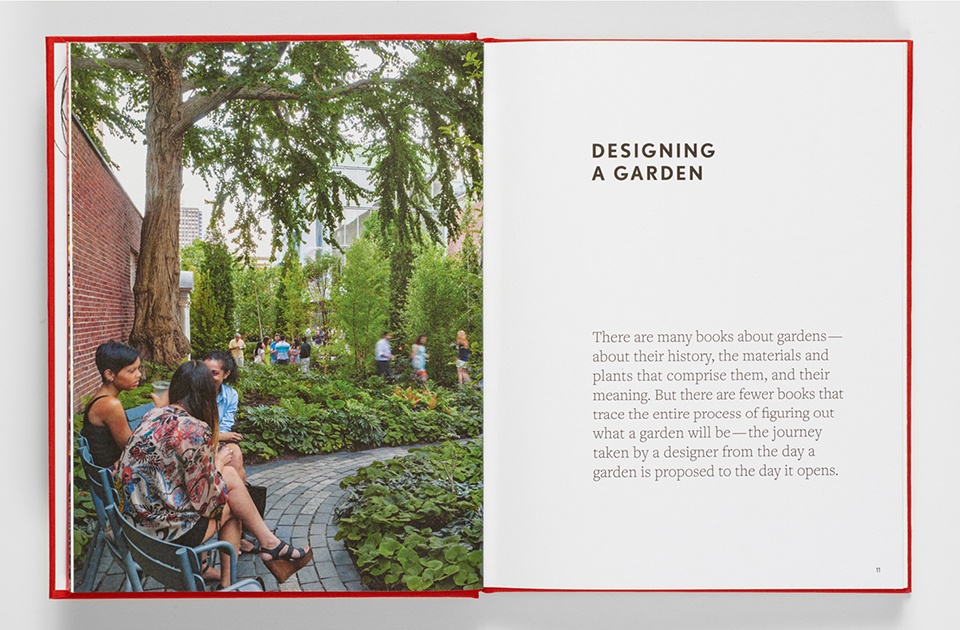
▲设计花园:书中的每个章节都将花园的生动照片与易读而又详实的文字结合起来。引言部分展示了该书的主旨:阐述花园的设计过程,同时对其成品背后的旅程进行公证的评价。Designing a Garden. Each chapter pairs vivid imagery of the garden with highly legible and thoughtfully written text. The introduction proclaims the book’s thesis: to lay out the process of designing a garden while doing justice to the journey behind its final product. ©Photograph by Elizabeth Felicella. Photograph of the book by Charles Mayer.
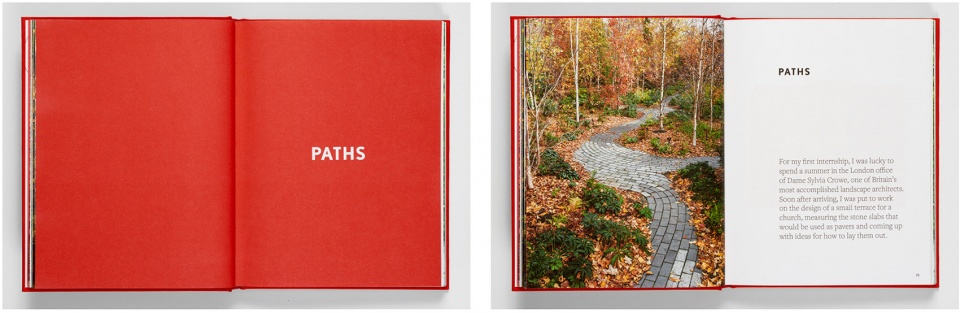
▲“路径”章节:鲜红的展示页标志着每个章节的开设,并预示着文字和图像之间的过渡。紧跟着的一页展示了一张无边距的照片,奠定出整个章节的基调。“Paths” Chapter. Bright red spreads mark the start of each section, signaling a transition in the text and imagery. The spread that follows jumps into the section with a full-bleed image that sets the tone of the chapter. ©Photograph by Scott Shigley. Photographs of the book by Charles Mayer.
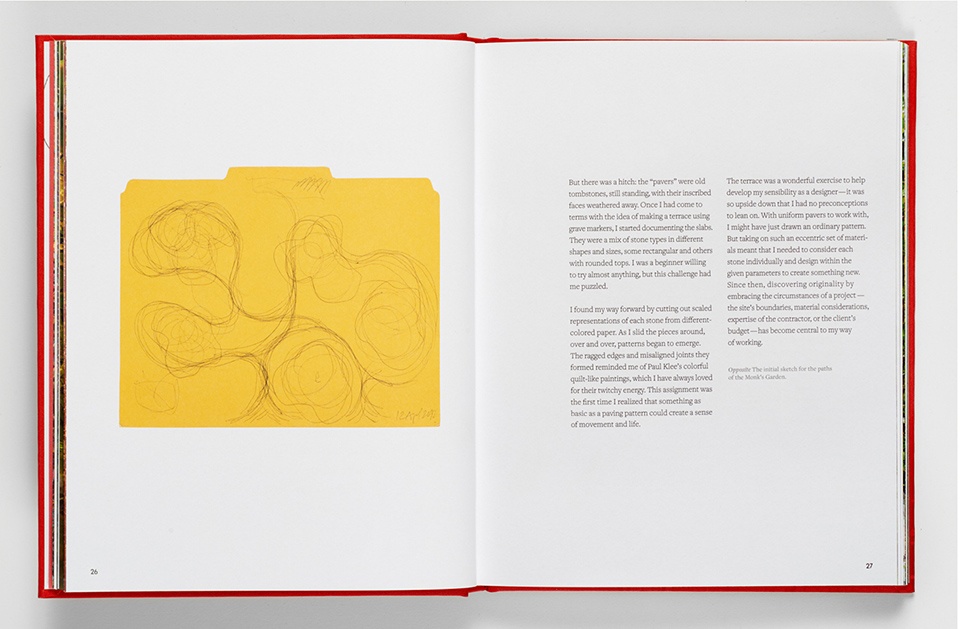
▲文件夹上的初始草图:当最初的灵感涌现时,Michael随手在一个黄色的文件夹上绘制了基础性的草图:让道路蜿蜒穿过一片微型的森林。Initial Folder Sketch. Michael drew the foundational sketch on a yellow file folder that was close at hand when the initial idea for the garden struck; to have its paths meander through a miniature forest. ©Image courtesy of the Cooper Hewitt, Smithsonian Design Museum. Photograph copyright: Smithsonian Museum. Photograph of the book by Charles Mayer.
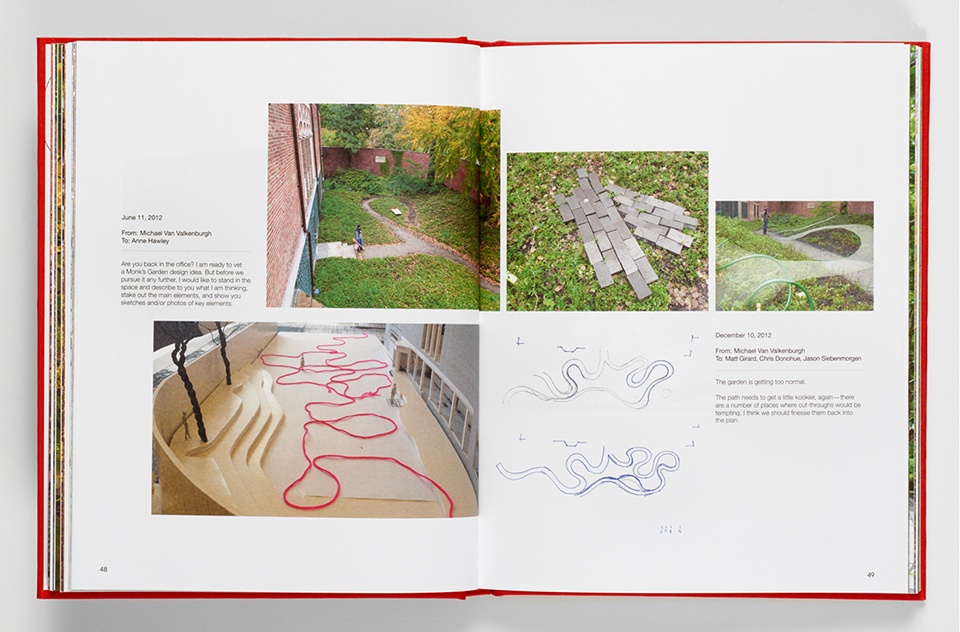
▲现场、工作室和线上测试:拼贴画式的内页在书中频繁出现,以强调设计过程的递进关系。这些图像包括模型研究、实体模型以及团队之间的电子邮件往来,为设计理念的测试和交流提供了窗口。Testing Paths on Site, in the Studio, through Correspondence. Collage-like spreads repeat throughout the book to expand on the iterative nature of the design process. They include model studies, mockups, and email correspondence among the team, opening a window into the ways design ideas are tested and communicated. ©Michael Van Valkenburgh Associates, Inc. Photograph of the book by Charles Mayer.
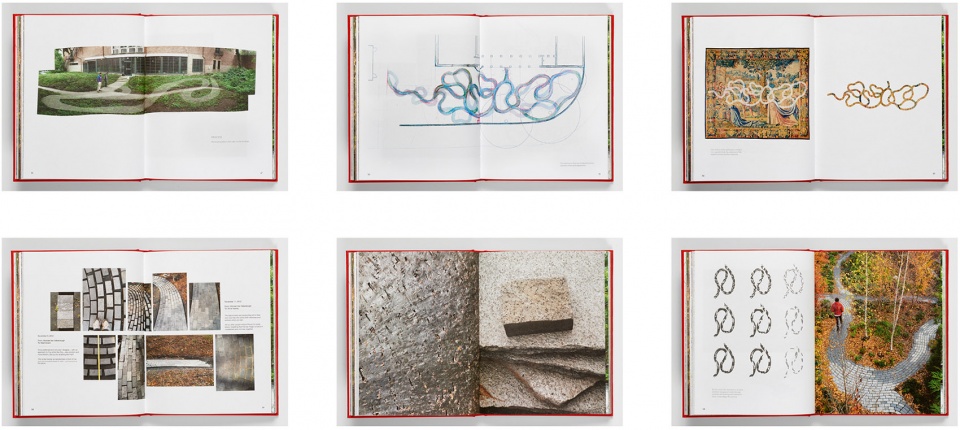
▲路径的设计过程:每个章节都包含了丰富的记录过程的图像,例如现场调研的的记录、材料和布局研究、现场模型建造和引向最终设计的过程拼贴。Paths Design Process. Each section includes a rich array of process imagery: documentation of site visits, material and layout studies, on-site mock-ups, and process collages that ultimately led to the final design. © Michael Van Valkenburgh Associates, Inc. Photographs of the book by Charles Mayer.
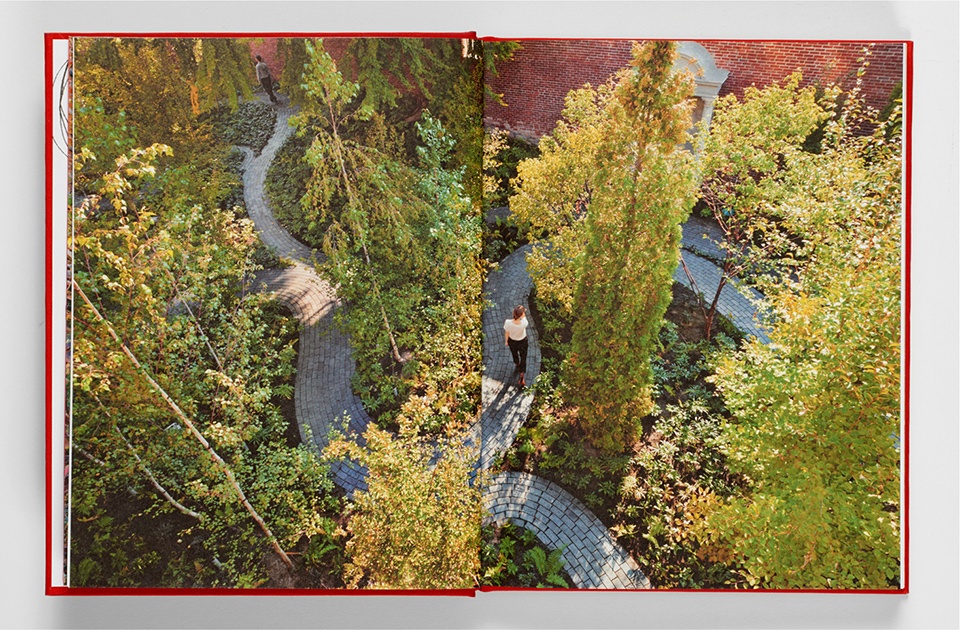
▲僧侣花园:本页位于书的中间部分,展示了僧侣花园的鸟瞰图。虽然有时会在建成后的照片中被忽略,但无数次的研究和测试在这座花园里是显而易见的。The Monk’s Garden. This spread, midway through the book, shows an aerial view of Monk’s Garden. Although sometimes lost in photographs of the built space, the myriad studies and tests are evident here in the finished garden. ©Photograph by Elizabeth Felicella. Photograph of the book by Charles Mayer.
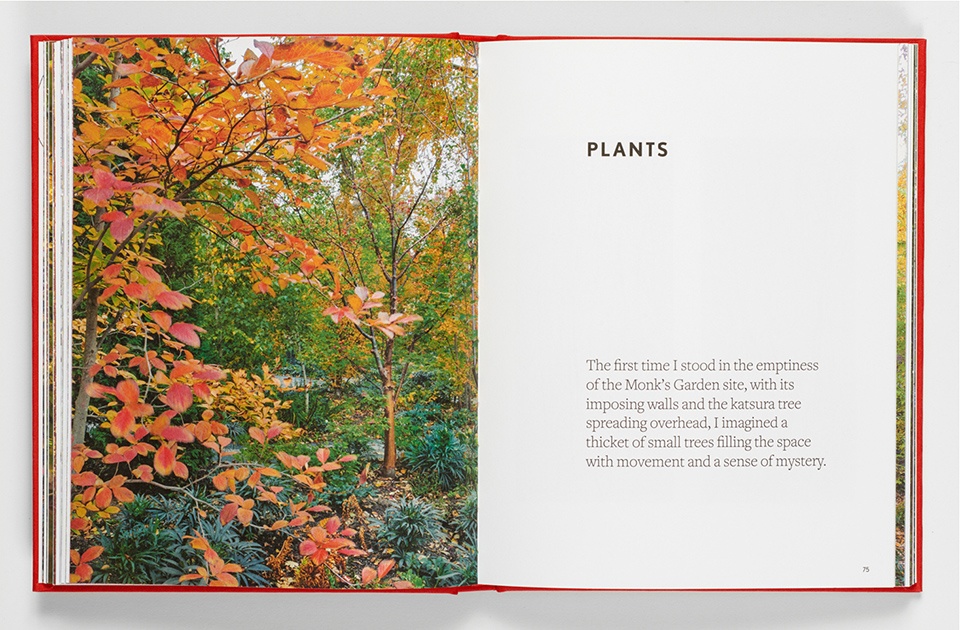
▲“植物”章节。在“植物”一文中, Michael与读者分享了他对植物的深刻认知和天生的热爱。分章包括“营造树林”、“了解树木”、“树与空间”、“为地面而生的树木”、“季节性”和“作为活体媒介的植物”“Plants” Chapter. In Michael’s “Plants” essay, he shares his deep knowledge and innate love of plants with the reader. Subchapters include “Making a Grove,” “Getting to Know Trees,” “Trees and Space,” “Plants for the Ground,” “Seasonality,” and “Plants as a Living Medium.” ©Photograph by Elizabeth Felicella. Photograph of the book by Charles Mayer.
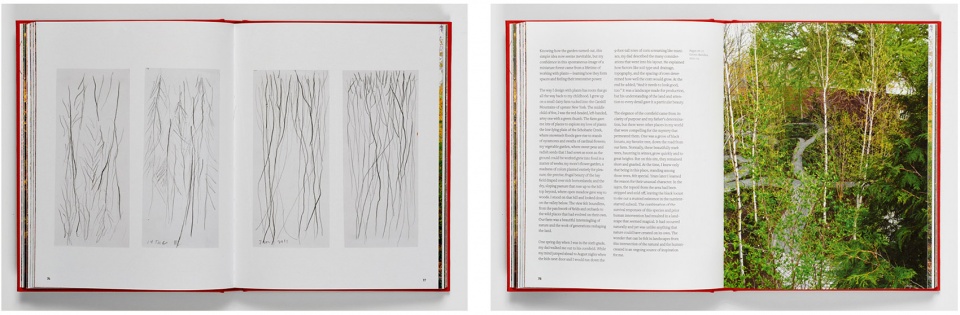
▲植物图像:左图是Michael绘制的初期草图,构想了一个微观的森林。右图展示了实际种植的小树林,为现在的僧侣花园注入了活力。Plant Imagery. At left, Michael’s early sketches imagined a miniature forest. At right, the planted grove now enlivens Monk’s Garden. ©Left, sketches by Michael Van Valkenburgh; Right, photograph by Izabela Riano-Levy. Photographs of the book by Charles Mayer.
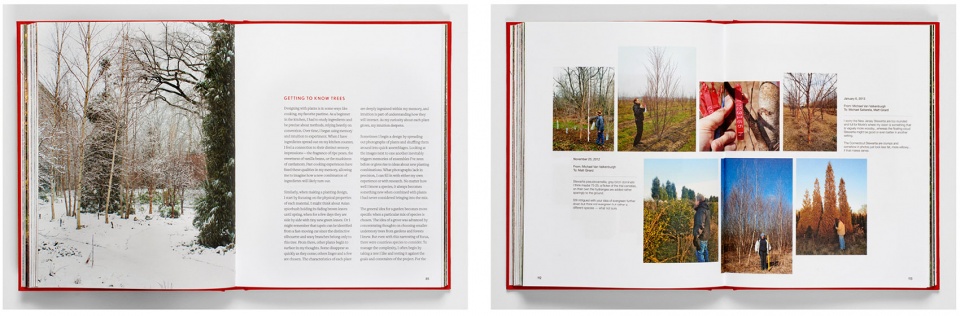
▲“了解树木”是“植物”章节中的一部分,体现了Michael在树木选择上的洞察力。挑选植物是一个需要依靠个人经验、持久记忆以及知识积累去完成的过程。右图的拼贴画讲述了设计团队从整个新英格兰地区的苗圃中寻找完美植物样本的历程。“Getting to Know Trees”—a subsection of the “Plants” essay—provides insight into Michael’s process of tree selection, one that is based on personal experiences, enduring memories, and accumulated knowledge. On the right, a collage recounts the design team’s far-reaching search for the perfect specimens in nurseries throughout New England. ©Left, Neil Budzinski. Right: Michael Van Valkenburgh Associates, Inc. Photographs of the book by Charles Mayer.
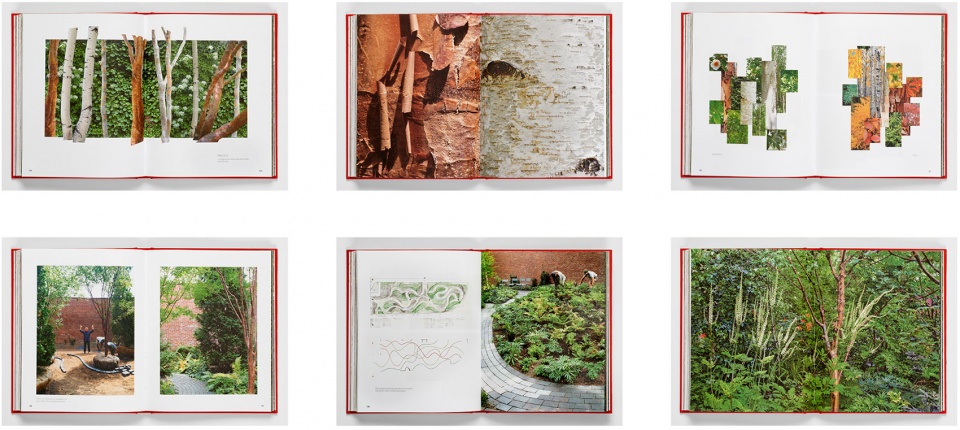
▲植物与过程。从左上图起按顺时针方向分别是:种植概念拼贴、树皮纹理配对、植物季节性搭配拼贴、Plants and Process. Clockwise from top left: concept collage for the planting, tree bark texture pairings, plant palette seasonality collages, the lushly planted garden, groundcover studies and installation, and a planting before-and-after juxtaposition. ©Bottom right image, Elizabeth Felicella. All others: Michael Van Valkenburgh Associates, Inc. Photographs of the book by Charles Mayer.
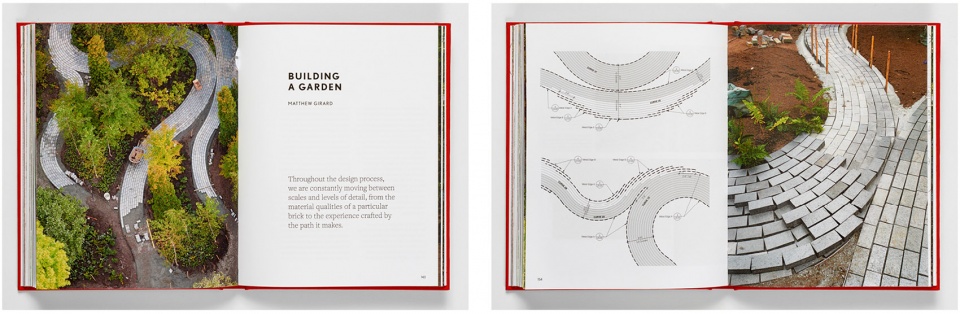
▲建造花园:由项目主管Matthew Girard撰写的“建造花园”一文阐释了如何将设计理念和技术图纸转化为现实。借助施工图、手绘草图和安装过程照片, Girard探讨了尺度的作用和手工艺的美。“Building a Garden”.“Building a Garden,” written by project manager Matthew Girard, explains how design ideas and technical drawings translated into physical reality. Supplemented by construction drawings, hand sketches, and installation photographs, Girard discusses the role of scale and the beauty of craftsmanship. ©Left, Alex Maclean; Right: Michael Van Valkenburgh Associates, Inc. Photographs of the book by Charles Mayer.
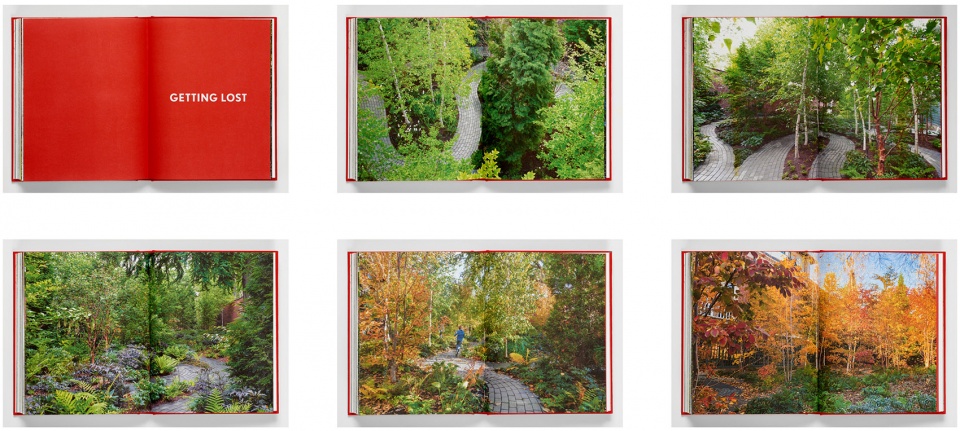
▲“迷失”章节通过一篇摄影故事向读者介绍了僧侣花园植物的丰富性和四季不同的美景。这些照片采用无边距排版,展示了花园建成后的样貌。“Getting Lost”. The “Getting Lost” section presents the rich planting and seasonality of Monk’s Garden with a photographic essay of full-bleed images taken since the garden’s completion. ©Clockwise from top middle: Izabela Riano-Levy, Elizabeth Felicella, Michael Van Valkenburgh, Elizabeth Felicella, Elizabeth Felicella. Photographs of the book by Charles Mayer.
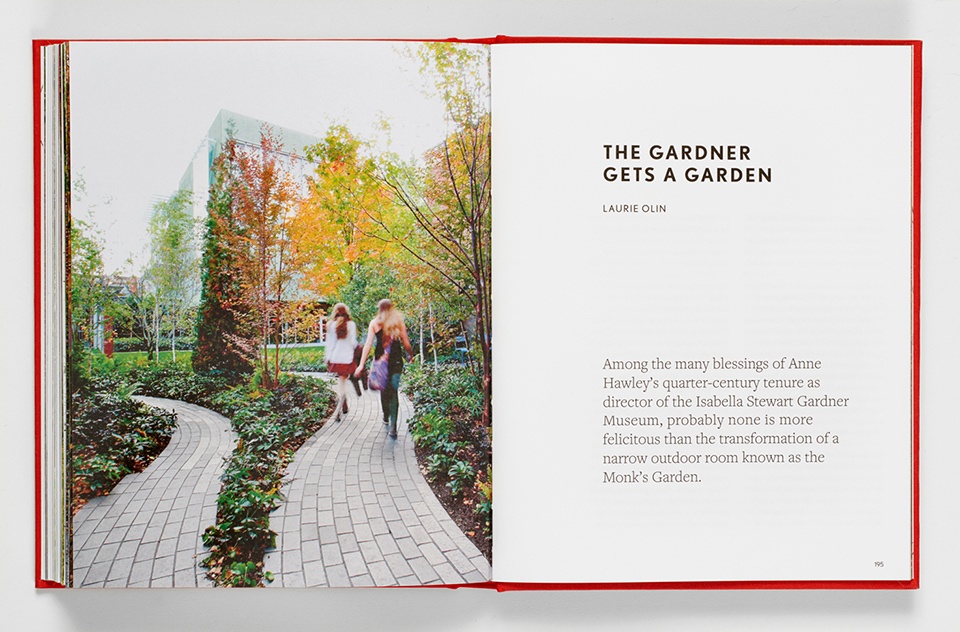
▲最末章的“收获花园”一文由Laurie Olin撰写。作者从花园的路径开始讲述,一方面让读者感受到花园设计的成功,另一方面也将整个项目置于更加宽泛的景观学科之中。“The Gardner Gets a Garden”by Laurie Olin. Starting adjacent to an image of paths exiting the garden, the concluding essay by Laurie Olin reflects on the success of Monk’s Garden while contextualizing the project within the wider discipline of landscape architecture. ©Photograph by Lexi Van Valkenburgh. Photograph of the book by Charles Mayer.
PROJECT NARRATIVE
Designing a Garden: Monk’s Garden at the Isabella Stewart Gardner Museum
In Designing a Garden, Michael Van Valkenburgh takes the reader along the journey of designing the Monk’s Garden at the Isabella Stewart Gardner Museum in Boston. In the process, Michael reveals the inner workings of his design practice and draws upon knowledge gained over decades of landscape-making. The book dispels notions of the strictly linear design process that is sometimes crafted specifically for design presentations, providing glimpses of the unexpected turns and ideas that are tried, tested, rejected, and reworked over the course of making a landscape. The essays examine the many design directions explored during the design process. Many of these ideas were quickly rejected, but they informed more fruitful decisions. These considerations also include Michael’s personal experiences which contribute to the depth of the landscape’s built form.
Designing a Garden developed from an earlier publication, titled Monk’s Garden, that won an ASLA Honor Award in 2014 for the Communication category. Monk’s Garden was initially made to accompany an exhibition at the Gardner Museum. After the exhibition, the book became a useful tool within the MVVA office as an example of how to advance a landscape design. MVVA used it so much that it became evident that this document had valuable lessons to teach about the design process in general and that it could be expanded in a way that would be accessible to an even wider audience.
Design and Organization
Designing a Garden is organized around five essays: “Designing a Garden,” “Paths,” “Plants,” “Building a Garden,” and “The Gardner Gets a Garden.” These essays complement visual artifacts of the design process. Images of sketches, mock-ups, and construction progress photos lead the reader along the way. A full plant list follows the essay title “Building a Garden,” written by MVVA project manager Matt Girard. The closing essay is written by acclaimed landscape architect Laurie Olin, who describes his impressions of a walk through the garden shortly after its completion. The book closes with a photo essay of the finished garden that immerses the reader in the paths, plants, and space of the garden. The book invites the reader to feel engaged in the highly specific and sometimes personal process of making a garden, and to enjoy the finished product.
Cara Walsh, a book and landscape designer, designed the book to present the messy process of making a garden in a format that is accessible to experienced landscape architects and novice designers alike. The goal of the book design was to support and enhance the written text with rich images that reveal the design process, not just as a repository for everything that took place, but as a thoroughly considered step-by-step example of how a garden is made. Full-bleed images immerse the reader in the garden’s lushness, while cleverly formatted spreads pair process images with text from emails exchanged throughout the building of the garden to pull back the curtain on how the project took shape. The structure of Designing a Garden illustrates the nuts and bolts of making the Monk’s Garden and weaves in information about the thinking behind the design decisions and the creative process. The book is paced to achieve a rhythm that allows readers to contemplate the written words and delight in the powerful images. It seeks to illuminate how and why gardens are made, in addition to celebrating the finished product. In the process, the book mounts a case for the ongoing relevance of garden-making—not just as objects of admiration or status, but as places to be enjoyed and as human creations that have inspired a continuous process of learning, testing, retrying, and caretaking.
Aspirations
The book has two primary purposes. The first is to provide an example for new designers of how a landscape design comes together in a clear and detailed format. Rather than drawing general lessons from his body of work, Michael Van Valkenburgh felt that the best way to do this would be to follow a single project from inception to completion, allowing the reader to inhabit the inspiring and unpredictable world of a garden yet to be realized. A garden presents the most manageable scale and clear intention out of all landscape project types, and the Monk’s Garden’s powerful clarity of purpose embodied within its paths and plants made it the perfect case study to examine.
The second purpose of Designing a Garden is to inspire young landscape architects to make gardens as a way to learn about their craft. The best way to learn landscape design is by doing, but because of the complexity, cost, space, and time requirements for many project types, it can be difficult for young designers to find opportunities to see the design process through from start to finish. This book argues for the importance of fighting to design and build projects, however small they may be.
Audience and distribution
The audience that inspired the creation of this book is young designers and landscape students, but the book’s writing and format makes it accessible to all people interested in design and landscape. Designing a Garden is widely available in art and design-oriented bookstores as well as online, maximizing the book’s reach. This first edition includes 4000 printed copies.
The Garden
MVVA was hired in September 2011 to design a new Monk’s Garden, following an expansion that more than doubled the size of the Isabella Stewart Gardner Museum. Surrounded by tall, brick walls on three sides and open to the Renzo Piano-designed new wing to the south, the garden has existed in the same location but in a variety of forms since Isabella Stewart Gardner founded the museum in 1903. Ann Hawley, the museum director at the time, wanted the garden to be a gift to visitors: a place that would lure them in and surprise them. After spending the morning touring the museum, Michael began to think of the Monk’s Garden as a counterpoint to the focused thought inside; a place to get lost and relax.
The design of the Monk’s Garden offers an immersive experience within the narrow, peripheral site through dense planting and winding paths. The book examines these two aspects specifically within two separate sections, but always considers one in respect to the other, just as they were throughout the design process. The garden’s walled enclosure means it is not visible from the street. Its intertwining paths and plants generate an intense feeling of interiority that leads to contemplation while wandering along its winding route.
Reception
Designing a Garden has been included on year-end lists and received positive reviews from a number of media outlets, including the Chicago Tribune, Metropolis, and ASLA’s The Dirt.
Aaron King wrote in The Dirt, “Designing a Garden, the new book written by Michael Van Valkenburgh, FASLA, is a lucid and candid examination of the process of designing and constructing a single project: the Monk’s Garden at the Isabella Stewart Gardner Museum in Boston.”
On Garden Design Online, Jane Berger wrote, “If you haven’t seen the Monk’s Garden at the Isabella Stewart Gardner Museum in Boston, you need to plan a trip there to experience a masterpiece of mystery that will spur you to contemplate the design for months to come. In Designing a Garden: Monk’s Garden at the Isabella Stewart Gardner Museum, Landscape Architect Michael Van Valkenburgh takes you through every detail of the design process — a lesson you’ll refer to time and time again.”
Blair Kamin, of the Chicago Tribune wrote, “In this delightful little book, [Michael Van Valkenburgh] chronicles the development of…the so-called “Monk’s Garden” at the Isabella Stewart Gardner Museum, in Boston…You’ll never see straight and curved paths — or the “air” between a tree’s branches or leaves — in the same way.”









这个花园太狭义了
设计终将回归自然,简单美!