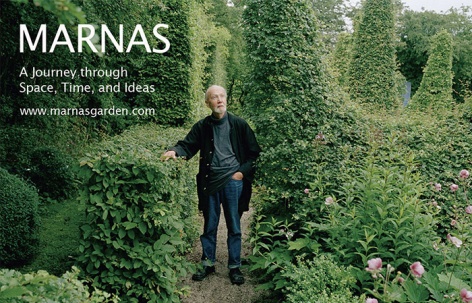
“他们充分利用了Marnas花园的非凡档案,并将其转变为生动的现实。”
– 2018年评审委员会“They took advantage of this amazing archive Marnas had and brought it to life.”
– 2018 Awards Jury
来自 ASLA 对gooood的分享。
Marnas: A Journey through Space, Time, and Ideas by Anne Whiston Spirn
项目概述
PROJECT STATEMENT
Marnas(www.marnasgarden.com)首次为公众提供了访问规划师和理论家安德松(Sven-Ingvar Andersson, 1927-2007)的花园实验室的途径。借助数千张照片,Andersson在这座花园中记录了他为期50年的研究实验。该项目将数字档案和交互式多媒体网站进行结合,提供了沉浸式的3D和4D体验,使访问者能够游历和感受花园在五十年间产生的时空变化。网站充分彰显了Marnas的魅力,同时为塑造它的事物赋予了生命。网站主页以垂直滚动的形式呈现出多个入口,引导观者进入花园探索,或与景观设计师见面并阅读他的作品。创建网站的目的是为人们提供参观Andersson投入毕生精力的Marnas花园的机会,以展现理论与实践的相互作用,同时为景观设计(作为一种时间性的艺术)提供全新的体验和理解。
Marnas (www.marnasgarden.com) provides the first public access to the garden laboratory of master designer/theorist, Sven-Ingvar Andersson (1927-2007), who recorded his experiments there, over the course of 50 years, in thousands of photographs. This extraordinary documentation made possible the digital archive and interactive multimedia website, designed as an immersive, three- and four-dimensional experience, which enables the visitor to journey through the garden in space and time across five decades. The website evokes the magical quality of Marnas and brings alive the ideas that shaped it. The homepage unfolds in a vertical scroll through a series of gateways. One gateway invites you to take a guided tour of the garden, others, to explore on your own or to meet the designer and read his work. The goal was to create a visit to Marnas as it existed throughout Andersson’s lifetime, to convey the interplay of theory and practice embodied in the garden. This multimedia project breaks new ground, enabling a new experience and understanding of landscape design as a temporal art.
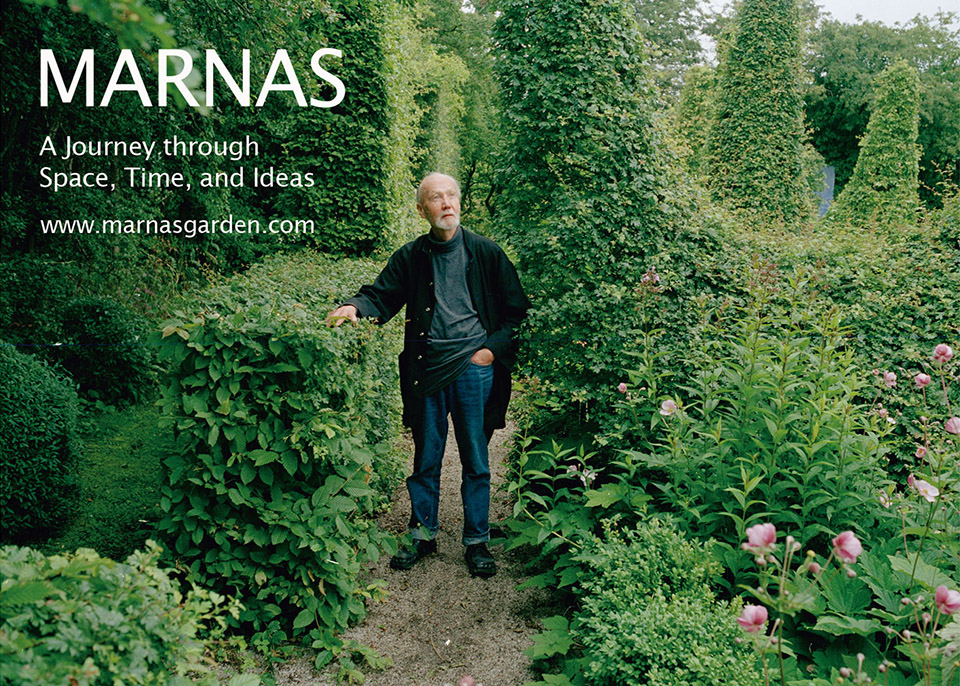
▲Marnas (www.marnasgarden.com)首次为公众提供了访问规划师和理论家安德松(Sven-Ingvar Andersson, 1927-2007)的花园实验室的途径。借助数千张照片,Andersson在这座花园中记录了他为期50年的研究实验。Marnas (www.marnasgarden.com) provides the first public access to the garden laboratory of master designer/theorist, Sven-Ingvar Andersson (1927-2007). This innovative, interactive website employs film, photography, and a digital archive, enabling visitors to journey through the garden in space and time across five decades.
项目说明
PROJECT NARRATIVE
安德松(Sven-Ingvar Andersson, 1927-2007)是一位实践家和理论家,也是斯堪的那维亚最重要的景观设计师之一。Marnas是安德松位于瑞典南部的私人花园及避暑别墅,作为一个地标式的存在,它巧妙地展现和表达了时间与理论之间的相互作用。
1965年,安德松对原始的花园进行了扩建,增加了一组房间和步道,并使其被修剪过的山楂树篱环绕。在面积最大的花园房里,他种植了13颗山楂树“蛋”,它们最终会长成12英尺高的灌木“母鸡”。1967年,安德松发表了《一封来自鸡场的信》,在这份宣言中,他批评了设计师在作品细节上的一成不变的做法。相反,他鼓励在一个设定好的框架中,根据不断变化的环境、需求和愿望来使细节得到调整和优化。
40年间,Marnas一直作为实验室使用,安德松在这里探索了存续和更新、随时间不断发生变化的设计,以及各种偶然性和即兴发挥所产生的作用。在其于1967年发表的论文结尾,安德松将自己想象为一位老者:过于虚弱的身体使其无法爬上梯子挥舞剪刀,他只能坐在已经变成山楂树林的花园里。从1960年代到2007年,他用数千张照片记录了修剪整齐的树篱自由地生长为树林的过程,并从中反思了他从景观和城市设计理论书籍中学到的知识。
1967年,安德松在文章中写道:“我对’鸡场’的如何终结有着明确的认知,但在那之前,一切都还没有定数……在’鸡场’变成树林之前可能会发生各种事情。”不过我们最终知道发生了哪些事,这要归功于安德松在1950年代至2000年代间为Marnas花园拍摄的大量照片,它们记录了同一地点在不同季节和时间里的不同景象,以及那些新改变和新添加的事物。这些照片需要按照时间的顺序来观看:从山楂树“蛋”孵化出小鸟;到“花园房”内的功能产生变化;再到篱笆墙不断长高,最终成为茂密的树林。
该项目的雏形是安德松拍摄的Marnas花园照片的数字档案,但在筛选了数千张照片之后,我意识到了做出新尝试的可能。如果将成百上千张图像串连成一条穿越花园的路径,是否就可以使Marnas花园五十年的历史得到虚拟的重现?基于花园的平面图和个人的记忆,我挑选出了一些照片用以构成这些路径,同时借助我在1990年至2012年拍摄的照片对空缺的地方进行了补充。为了传达这种无形的事物——花园独特的魅力及其形式背后的思路——我制作了一个短视频系列,探讨了实践、理论、形式和功能之间的相互作用。视频的脚本来源于安德松本人说过的话。我挑选、翻译和整理了一些文本,安德松在其中对Marnas的先例、起源、元素、构成、植物及其含义进行了思考。
Marnas网站邀请访客进入一系列旅程。主页以垂直滚动的形式呈现出多个入口,引导观者(通过多媒体视频)进入花园探索,或与安德松本人“见面”并阅读他的作品,或访问数字档案馆。创建网站的目的是激发访问者的探索和互动,使其从被动的观察者转变为积极的参与者。
景观设计是一门时间性的艺术,它由不断生长和衰退的材料构成,会随着需求和潮流而发生变化,因而无法在时间的流逝中冻结。那么,如何才能使其得到保存,如何才能通过设计使它们适应变化?这些难题正是安德松投入毕生精力所要解答的。在他的整个职业生涯中,安德松通过著书立论和实践来探索这些问题,而在Marnas花园中的工作则占据了尤其重要的地位。
数字档案、电影和网站:目标与受众
在安德松去世之后,Marnas花园面临着不可避免的改变。该项目的目标分为以下几点:1)传递一种与安德松在世时尽可能接近的Marnas花园的参观体验;2)展示花园的转变过程;3)展示创意如何在花园中体现;4)扩大公众对景观作为时间性艺术的认知。“Marnas:穿越空间、时间和想法的旅程”旨在激发学者和学生的兴趣、启发景观设计师的灵感,同时吸引和愉悦大众。
价值
该项目首次为重要的景观设计作品提供了公开的访问渠道。它将Marnas花园以实验室的方式展示出来,在这里,各种想法与实际的设计和园艺行为产生对话并取得发展。它描绘的是一种能够对变化做出响应的设计理论,同时提供了一种模型,以展示多媒体视频和网站如何为观者创造穿行于时空的虚拟体验,使其探索其中的变化,以及想法与场所相互塑造的过程。
“Marnas:穿越空间、时间和想法的旅程”作为网站和电影(2017年10月在哥本哈根首映)均获得了广泛认可,同时还收到了Routledge Companion学术出版社的邀请,将其编撰为论文《Marnas数字档案:探索实践、理论以及时空中的场所》,收录于景观设计学分类。
展示的成果
我的初衷是写一本关于Marnas花园的书,但这本书最终成为了一个多层次的网站,并提供了一种只有数字媒体能带来的花园自助旅程。多媒体视频将图像、文字和声音融合为一种富有生命力的表现方式,将安德松的想法和实践巧妙地展现出来。语言能够表达思想;图像能够说明这些思想如何在Marnas的特征和空间体验中得到体现;声音则能够营造出临场感和亲密氛围。
景观设计师的创新和任务
Marnas是一项涉及摄影、多媒体和网站设计等多个领域的研究工作。这一多媒体项目在开辟新景象的同时也为景观设计作为时间性的艺术提供了新的体验和理解。
正如一位评论家所写:“在MarnasGarden.com网站中,图像、文字和声音将我们带往一场精妙绝伦的旅程,并直接切入了21世纪景观实践的问题核心——基于景观的动态性质,我们该如何为无可避免的变化而设计?我们该如何存续那些必须改变的事物?” [删除的名称]的杰出作品连接了不同的时间点、连接了理论与实践,同时以一种别开生面的方式进行了具有启发意义的实践(Phoebe Lickwar, FORGE Landscape Architecture)。
景观设计师的任务包括:
1.对1990-2017年间的Marnas花园进行实地考察和拍摄
2.从数千张Marnas花园的照片中挑选出600多张照片并进行整理
3.对丹麦馆藏的照片进行高清扫描,并将其导入麻省理工学院图书馆和SAHARA(建筑史学家协会建筑资源档案馆)的在线馆藏。
4.对安德松用瑞典语和丹麦语写成的文章进行检查和翻译。
5.制作多媒体视屏,包括剧本构成以及照片的挑选和排序
6.设计自助旅程
7.设计网站,使其成为视频展示和自助旅行的平台
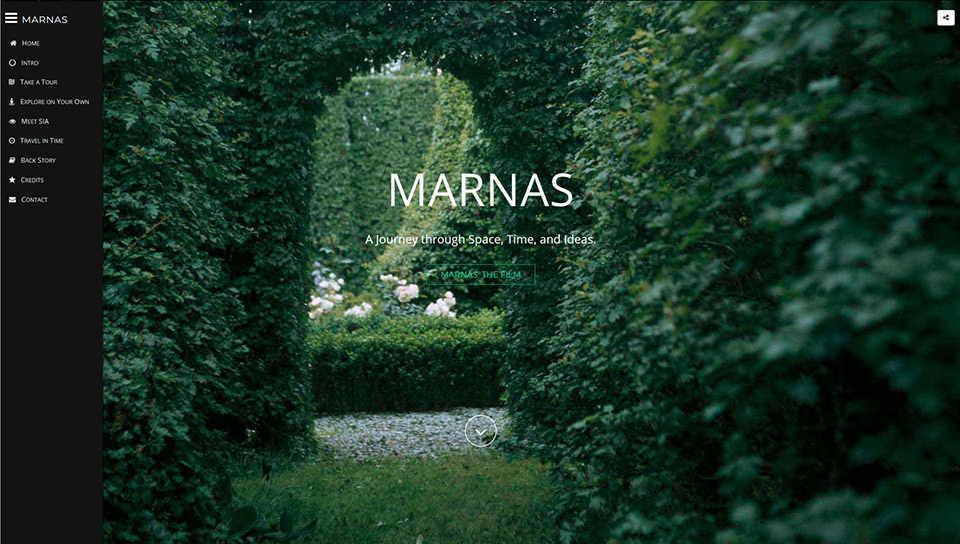
▲主页以垂直滚动的形式呈现出多个入口。界面设计十分简洁,照片占据了整个屏幕。点击左上角的图标可跳出导航栏,再次点击则导航栏消失。The homepage unfolds in a vertical scroll through a series of gateways. The interface design is minimalist and unobtrusive so that images fill the screen. A navigation bar opens with a click on the icon at upper left; click again, and it disappears.
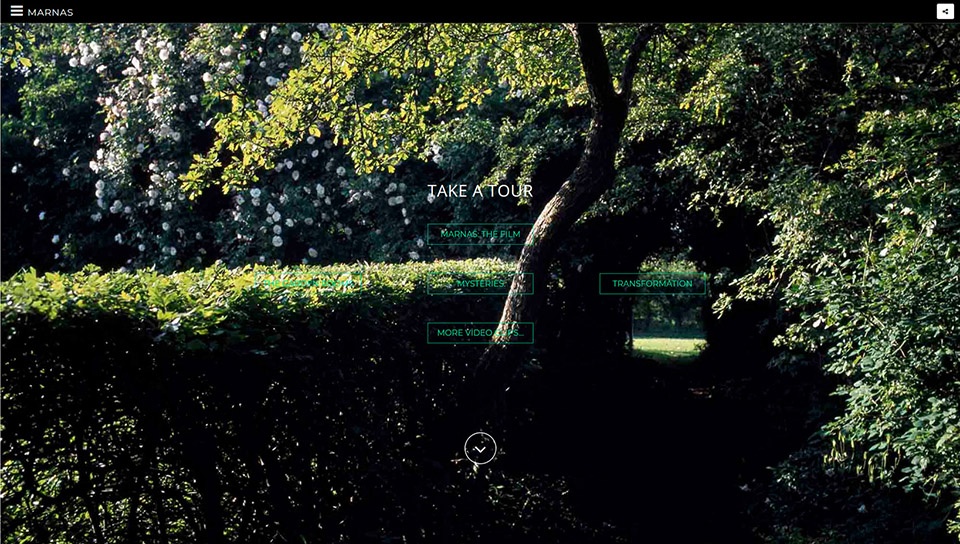
▲“Take a Tour”带来了一场以安德松为向导的Marnas花园之旅。听听他的故事,或者观察花园随着季节和时间流逝而产生的变化。您可以随意挑选17个短视频进行观看,或者直接观看20分钟的完整电影。Take a Tour provides the opportunity to visit Marnas with Andersson as guide. Hear his stories. Watch the garden change through seasons and years. Follow the ideas that drive the form. You can choose among seventeen short videos or view the full-length film (20 minutes).
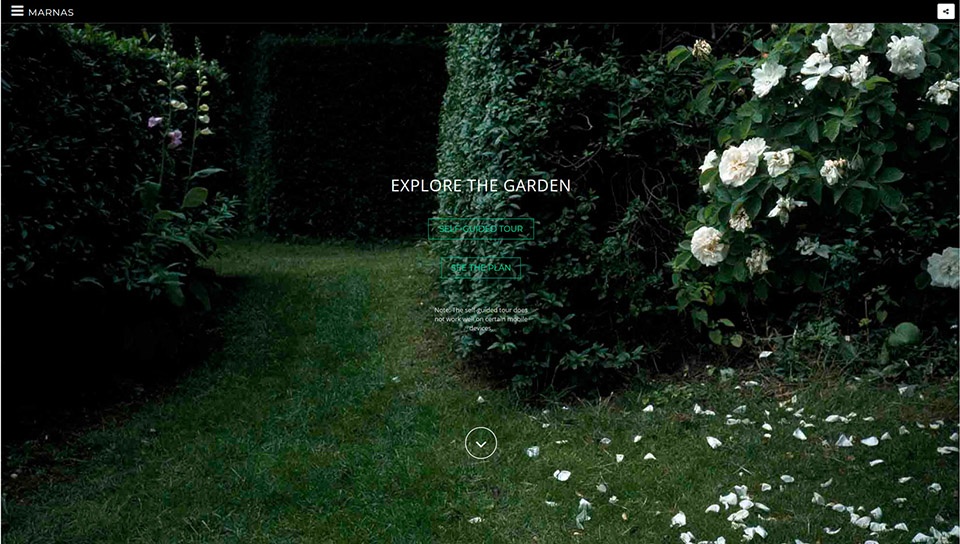
▲“Explore the Garden”邀请访问者在花园中自由漫步,并提供了数百种可能的路线。网站是基于一系列照片而构成的,它们共同将花园的各个部分连接起来。Explore the Garden is an invitation to wander around the garden on your own. There are hundreds of possible paths to choose from. This network was created by linking series of photographs, which connect all parts of the garden.
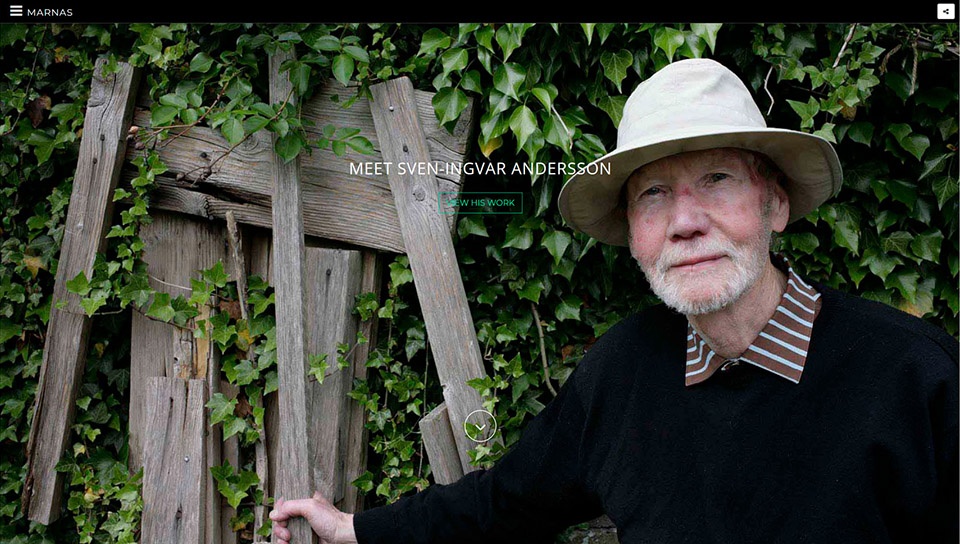
▲“Meet SIA”提供了参观安德松作品的路径,包括其著作、图纸和专业项目的网站链接。安德松关于Marnas花园的理论著述和实践为想法和场所提供了新的对话窗口。Meet SIA is a gateway to Andersson’s work, with links to selected writings, drawings, and professional projects. Andersson’s writings on theory and practice and on Marnas are another window into the dialogue between ideas and place.
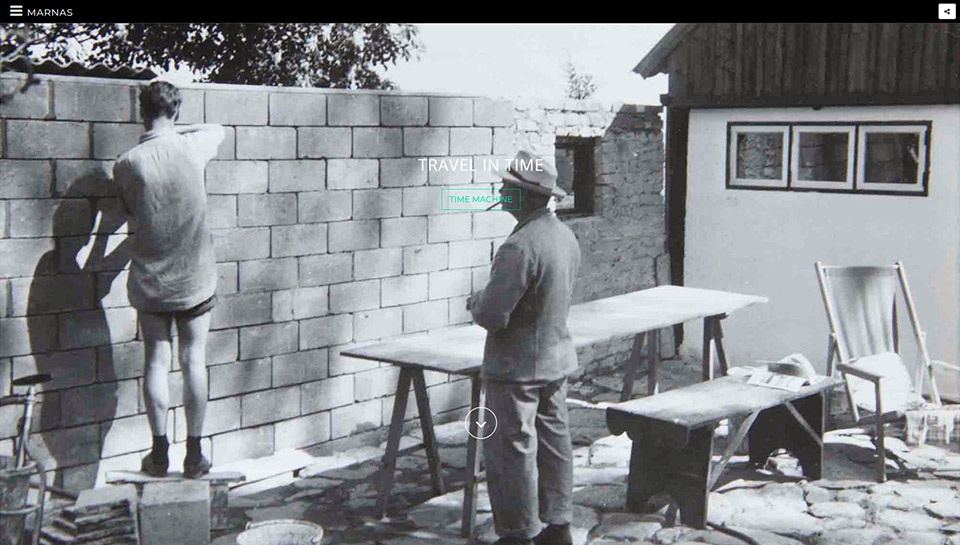
▲针对希望系统地研究花园发展过程的来访者,该章节按照时间顺序呈现了从1950年代至2000年代间的照片,并提供了麻省理工学院图书馆收藏的超过600张照片的链接。For those who want to study the garden’s development systematically, this section groups photographs chronologically from 1950s to 2000s. A link also takes you to the digital archive of more than 600 photographs in MIT Libraries, which I curated, selecting them from among thousands.
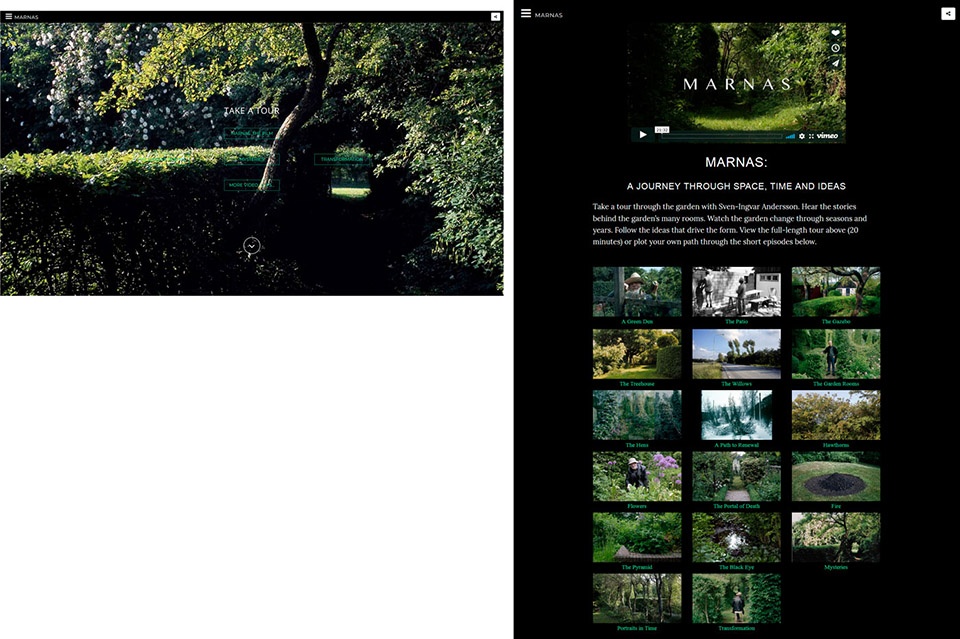
▲视频的脚本来源于安德松本人说过的话。我挑选、翻译和整理了一些文本,安德松在其中对Marnas的先例、起源、元素、构成、植物及其含义进行了思考。观者将体验到由安德松亲自引导和解说的感觉。The scripts for the videos are in Andersson’s own words. I selected and translated texts where he reflects on Marnas, its precedents, origins, elements, composition, plants, and meanings. The viewer should feel like SIA is showing them around his garden.
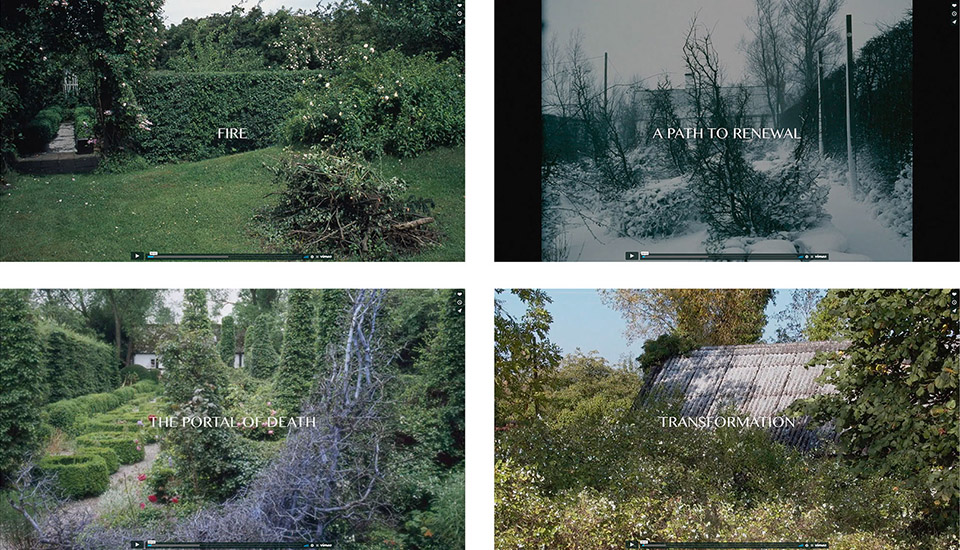
▲多媒体视频将图像、文字和声音融合为一种富有生命力的表现方式,将安德松的想法和实践巧妙地展现出来。视频的长度较短,不需要花费太多精力去观看。图片顶部: “火” (00:40) 和“复兴之路,” (01:03). 底部: “死亡之门” (01:25)和 “转变” (02:35). Multimedia affords the opportunity to bring image, word, and sound together to animate the text and bring to life Andersson’s dialogues between ideas and place. Videos are short to hold attention. Top: “Fire,” (00:40), “A Path to Renewal,” (01:03). Bottom: “The Portal of Death,” (01:25), “Transformation” (02:35).
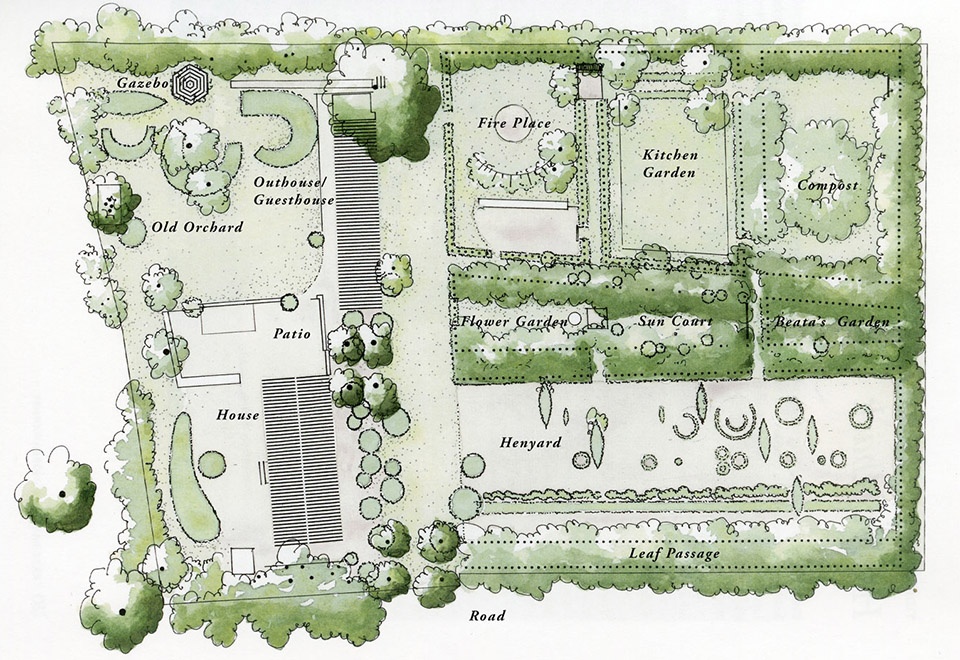
▲Marnas花园场地平面图。车道将花园划分为不同的区域:老花园及其建筑物、果园以及左边(南边)经过修剪的灌木丛。右边(北边)是1965年新修的绿篱花园路径和空地。Plan of Marnas. The driveway divides Marnas: the old garden with its buildings, orchard and clipped privet to the left (south); to the right (north), the hedged garden passages and rooms, planted in 1965.
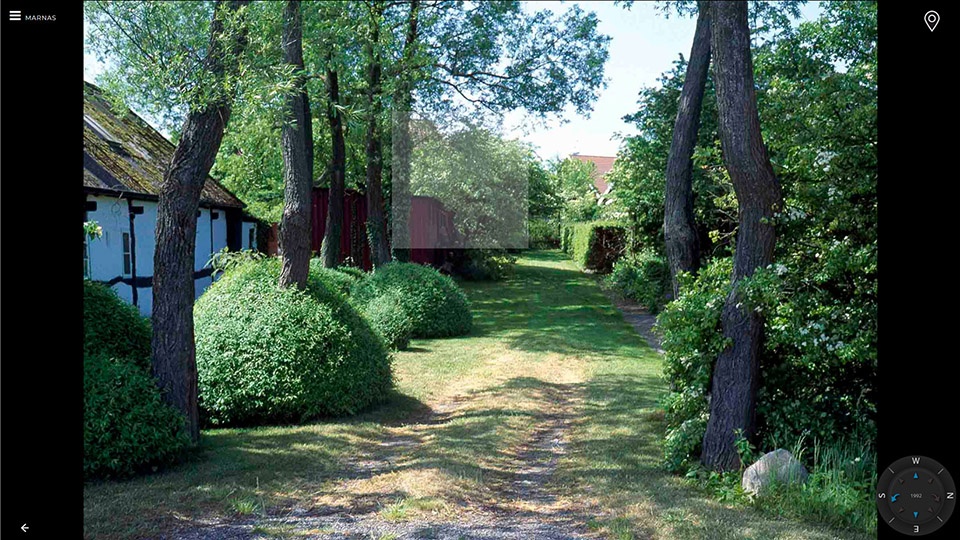
▲轻触右下角指南针上的箭头可以在花园中前进、后退或转向。在花园中漫步时,指南针有时会提供多个路径,有时只显示一个。在该图中,指南针指明了年份是1992年。点击屏幕中央跳动的方块可以进入该地点在1979年时的场景。Touch an arrow on the compass at lower right to move forward, step back, or turn. As you wander around the garden, sometimes the compass offers many ways ahead, at others, only one. Here, the compass tells you the year is 1992. Touch the pulsating square at center screen to see the same view in 1979.
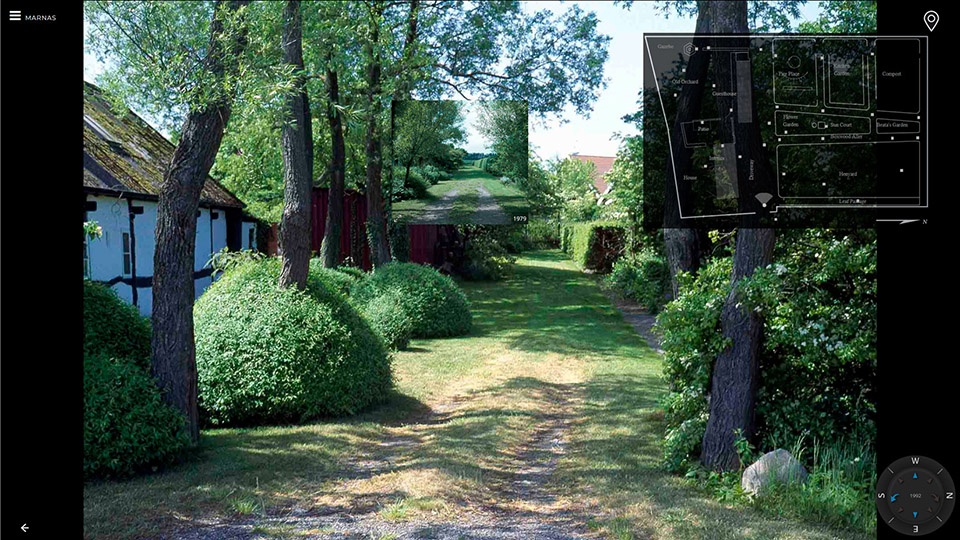
▲轻触右上角的符号可现实花园的平面图,其中可以看到访客的所在位置及其面对的方向。平面图上的小方块标记了不同的位置,可通过点击直接到达。Touch the symbol at the upper right to reveal a plan of the garden, which notes your position and the direction you are facing. Small squares on the plan mark different locations; touch one to move there directly.
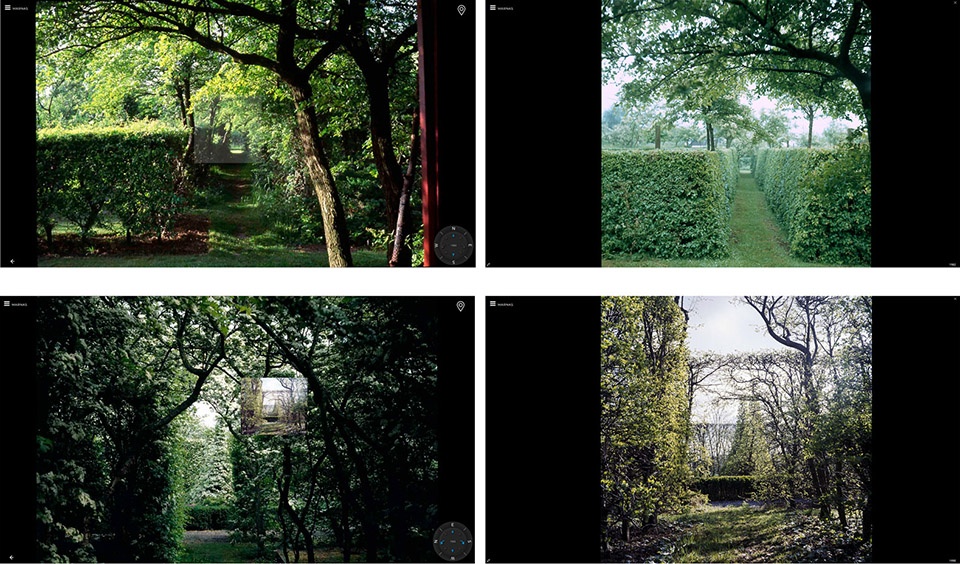
▲在花园中漫步时,您会经历不同的时间变化,具体的年份会一直出现在指南针中央。当页面跳出跳动的方块时,则意味着您可以进入同一地点在不同时间和不同季节里的视图。As you wander around the garden, you slip in time, backward and forward across years, the year noted at the center of the compass. Whenever you encounter a pulsating square, click on it to see the same view at an earlier time or different season.
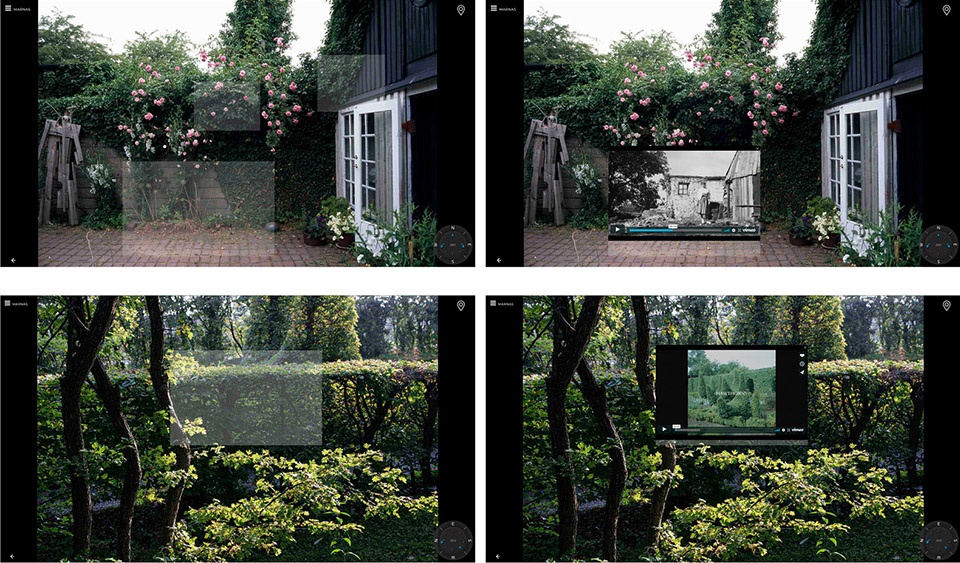
▲屏幕中有时会出现一个跳动的长方形。点击这个长方形即可观看一段介绍场所背后故事的短视频。图片顶部:露台如何从旧谷仓的废墟中产生。底部:遗传结构带来的适应性和限制。Occasionally, you encounter a pulsating rectangle. Click to watch a short video about ideas behind the place where you find yourself. Top: how the patio emerged from the ruins of an old barn. Bottom: on adaptation and the limits imposed by genetic structure.
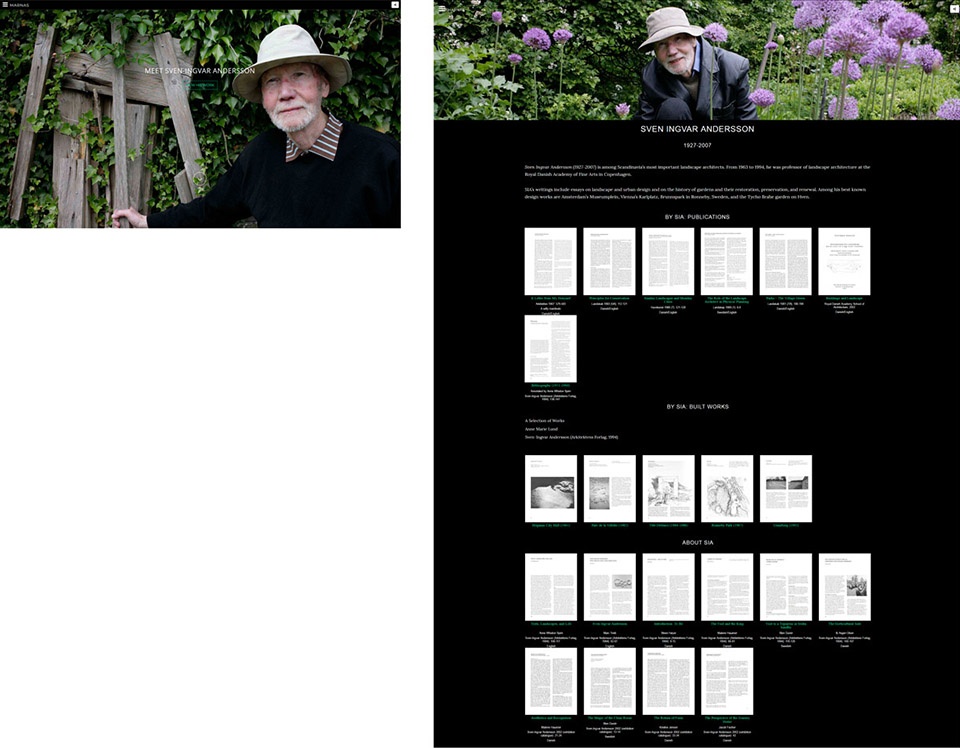
▲安德松著有数百篇文章和专题论文,它们在斯堪的纳维亚以外的地区很难找到。在这里,来访者可以阅读其中一些翻译过的文章,以及他人撰写的与其作品相关的文章。Sven-Ingvar Andersson wrote hundreds of articles and monographs, which are difficult to find outside Scandinavia. You can read some of them here in translation, along with essays on his work by others.
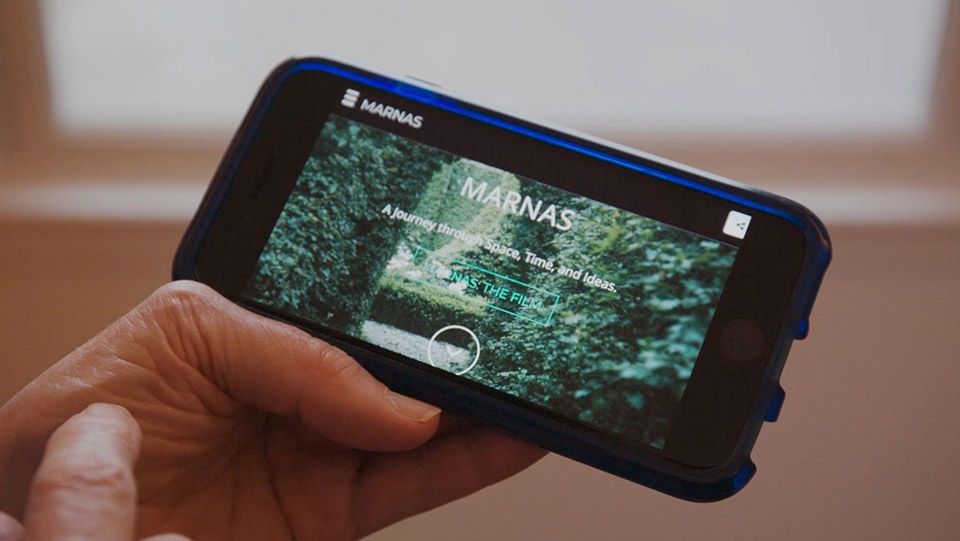
▲网站还能够很好地适应智能手机的浏览模式。除了自助旅行之外(不适用于小尺寸屏幕),所有的功能(包括视频和文字)都可以在手机平台上完整运行。When accessed on a smart phone, the website assumes a mobile-friendly format. All features (including videos and texts) are fully operational on mobile platforms except for the self-guided tour, which does not work well on mobile devices with a small screen.
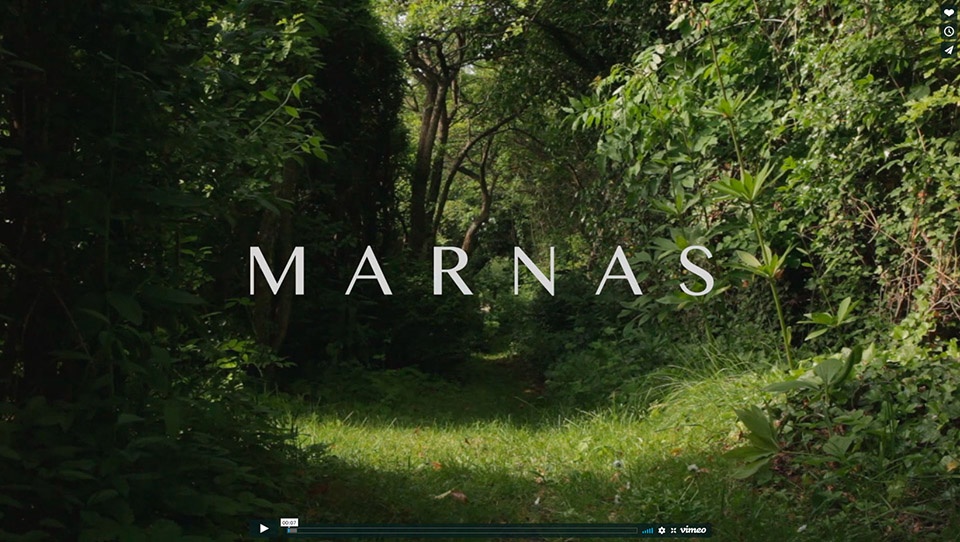
▲网站中嵌入了长度为20分钟的电影《Marnas:空间、时间和想法之旅》。该电影于2017年10月在哥本哈根首映,并在多种场合放映。电影可在教室或其他地点免费下载。The 20-minute film, Marnas: A Journey in Space, Time, and Ideas,” embedded in the website, also has a life of its own. It premiered in Copenhagen in October 2017 and has been screened in multiple venues. It can be downloaded free of charge for use in classrooms and elsewhere.
PROJECT NARRATIVE
Sven Ingvar Andersson (1927-2007), practitioner and theorist, was among Scandinavia’s most important landscape architects. Marnas, his own garden and summer house in southern Sweden, is a landmark design and a masterful expression of the interplay between practice and theory.
In 1965, Andersson expanded the original garden with the addition of a complex of rooms and passages bounded by clipped hedges of hawthorn. In the largest garden room, he planted fourteen hawthorn “eggs,” which would eventually grow into 12-foot-high topiary “hens.” In 1967, he published “A Letter from My Henyard,” a manifesto in which he criticized designers for conceiving finished works with fixed details. Instead, he advocated the design of a framework within which details could evolve in response to changing circumstances, needs, and desires. For forty years, Marnas was a laboratory where Andersson explored ideas about preservation and renewal, the design of change over time, and the roles of circumstance, serendipity, and improvisation. At the end of the 1967 essay, Andersson imagines himself as an old man. Too weak to clamber up ladders and wield clippers, he sits in a garden that has transformed into a grove of hawthorns. From the 1960s to 2007, he documented this transition from clipped hedges into a freely growing grove in thousands of photographs and reflected on what he learned from this process in publications about landscape and urban design theory.
“I have a definite idea of how my henyard will end,” Andersson wrote in 1967, “but that which lies between now and then is an open plan…. A lot can happen before the henyard becomes a hawthorn grove.” But we know what happened, thanks to the thousands of photographs that Andersson made of Marnas from the 1950s to the 2000s: photographic sequences of passage through the garden and diverse views from the same locations in different seasons and across the years; photographs of new decisions and additions. To view these images in chronological order is to be propelled through time: to see the hawthorn “eggs” hatch into birds and then grow long necks; to see the functions of the garden “rooms” change; to watch the hedge walls grow higher, transforming into a grove.
The current project began as a digital archive of Andersson’s photographs of Marnas, but, after sifting through thousands of images, I realized that there was the potential to try something new. Might it be possible, by linking hundreds of images, to chart paths through the garden, a virtual re-creation of Marnas across fifty years? Working from a plan of the garden and from memory, I selected images to create those paths and filled gaps with my own photographs from 1990-2012. To convey the intangible–the garden’s magical qualities and the ideas behind the forms–I composed a series of short multimedia videos that explore the interplay among practice, theory, form, and function. The scripts for the videos are in Andersson’s own words. I selected, translated, and arranged texts where he reflects on Marnas, its precedents, origins, elements, composition, plants, and ideas.
The Marnas website (www.marnasgarden.com) invites the visitor to embark on a series of journeys. The homepage unfolds via a vertical scroll through a series of gateways. One gateway invites you to take a guided tour of the garden (via multimedia videos), others, to explore on your own, meet Sven-Ingvar Andersson and read his work, or visit the digital archive. The goal was to stimulate exploration and interaction, the viewer an active participant, not a passive observer.
Landscape design is a temporal art. Composed of materials that grow and decay, subject to changing needs and fashion, landscapes cannot be frozen in time. How then, can they be preserved? How can they be designed to accommodate change? These conundrums were a preoccupation of Sven-Ingvar Andersson, which he explored in writing and built work throughout his career, particularly at Marnas.
The Digital Archive, Film and Website: Purpose and Audience
After Andersson’s death, change at Marnas was inevitable. The goals of the project are 1) to convey an experience that is as close as possible to visiting Marnas as it existed during its designer’s lifetime; 2) to show how the garden evolved; 3) to demonstrate how ideas are embodied in the garden; 4) to broaden public understanding of landscape design as a temporal art. “Marnas: A Journey through Space, Time, and Ideas” aspires to stimulate scholars and students, to inspire landscape architects, and to attract and delight the general public.
Value
The project provides the first public access to an important work of landscape architecture for which there are few published photographs and sparse documentation in English. It presents Marnas as a laboratory where ideas evolved in dialogue with acts of design and gardening. It describes a theory of design that is responsive to change. It provides a model for how multimedia video and the Web can create for the viewer a virtual experience of moving through a place in space and time, exploring change and the mutual shaping of ideas and place.
“Marnas: A Journey through Space, Time, and Ideas,” the website and the film, premiered in Copenhagen in October 2017 and already have received significant recognition, including the invitation to contribute an essay, “The Marnas Digital Archive: Exploring Practice, Theory, and Place in Space and Time,” to the Routledge Companion to Landscape Architecture.
Effectiveness of Presentation
My original intention was to write a book about Marnas, but the book became instead a multi-layered website. The self-guided tour permits a glimpse of gardens that once were, an experience afforded only through digital media. Multimedia videos afford the opportunity to bring image, word, and sound together in ways that animate the text and bring to life SIA’s dialogues between ideas and place. Words convey ideas, images show how those ideas are embodied in the features and spatial experiences he created at Marnas. Sounds lend immediacy and intimacy.
Innovations and Role of Landscape Architect
Marnas is a work of scholarship and an exploration of photography, multimedia, and website design as media of inquiry and expression. This multimedia project breaks new ground and enables a new experience and understanding of landscape design as a temporal art.
As one reviewer wrote: “In MarnasGarden.com, image, text, and sound take us on an exquisite journey that cuts to the heart of dilemmas driving twenty-first century practice – given the dynamic nature of landscapes, how do we design for inevitable adaptation? How do we preserve that which must necessarily change? [name deleted]’s masterful work connects points in time, linking theory and practice in a provocative living expression that breaks new ground” (Phoebe Lickwar, FORGE Landscape Architecture).
The role of the landscape architect included:
1.Fieldwork and photography at Marnas from 1990-2017
2.Selection and curation of more than 600 photographs of Marnas from among thousands
3.Arranging for production of high resolution scans of photographs in Danish collections and their accession into an online collection at MIT Libraries and SAHARA (Society of Architectural Historians Architecture Resource Archive)
4.Review and translation of texts in Swedish and Danish by Sven-Ingvar Andersson
5.Production of multimedia videos, including composition of scripts, selection and sequencing of photographs
6.Design of the self-guided tour
7.Design of the website as a platform for the videos and self-guided tour
More:ASLA;Marnas;Anne Whiston Spirn






退休人士自己搞搞园艺啦
为往圣继绝学