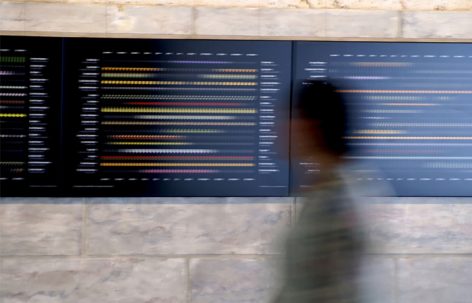
“生态地图项目揭示了部分与整体间的关系——鸟类、植物、昆虫和土壤;它是一个完整的系统。”
-2017年评审委员会“It shows how all the parts fit in—the birds, the plants, the insects, the soil types; it offers a synthesis.”
– 2017 Awards Jury
来自 ASLA 对gooood的分享。
Abstracting Morphology by Studio Roberto Rovira,更多请至:Studio Roberto Rovira on gooood
Appreciation towards ASLA for providing the following description:
项目陈述
PROJECT STATEMENT
尽管景观设计师们能够从网络和书刊中获得大量与动植物有关的信息,但很少有资料能够以全盘性的视角来解读生态系统,而能够提供具体解读方法的资源更是少之又少。生态地图项目以艺术、科学和技术相结合的形式为我们绘制了一幅自然世界的图纸,包括开花的时间、落叶规律、植物的季节特征、动物迁徙等等以时间变化为依据的自然现象,从而促使人们以可持续的方式进行建造。生态素养的建立离不开科学的技术与工具,正如正确的设计决策离不开大量的分析与研究。生态地图项目为景观学科的研究和实践提供了一种可量化的工具,同时强化了景观建筑学在各类项目中的作用和价值。
While extensive information on individual plants and animals is available to landscape architects in print and online, few resources give a holistic sense of ecological systems and fewer still provide a way of understanding their changes over time. The Ecological Atlas Project works at the intersection of art, science and technology. By developing intuitive mappings of natural patterns such as bloom times, deciduous patterns, vegetative seasonality, animal migrations, and other time-dependent phenomena, the Ecological Atlas enables understanding and building in sustainable and resilient ways. Tools that embrace technology and facilitate the transfer of landscape architectural knowledge in simpler and more elegant ways are essential to building ecological literacy, as much as they are critical to making informed design decisions that rest on extensive research. The Ecological Atlas Project builds a scalable technology that advances the methods and techniques of landscape architectural research and practice, and strengthens the value of landscape architecture to any project.
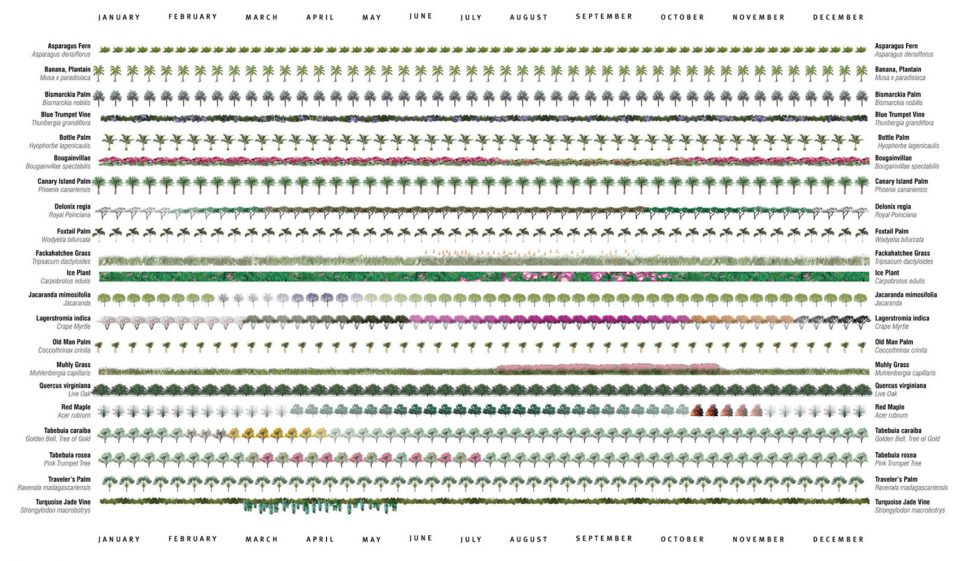
▲南弗罗里达的植物矩阵:物种地图直观地阐明了植物随时间发生的变化。SOUTH FLORIDA PLANT MATRIX:Visual mappings of South Florida species intuitively interprets research on plant data and vegetative transformations over time.
项目说明
PROJECT NARRATIVE
理解生物和人造环境的复杂关系是实现有价值的可持续设计的必要前提。尽管景观设计师们能够从网络和书刊中获得大量与动植物有关的信息,但很少有资料能够以全盘性的视角来解读生态系统,而能够提供具体解读方法的资源更是少之又少。生态地图项目以艺术、科学和技术相结合的形式为我们绘制了一幅自然世界的图纸,包括开花的时间、落叶规律、植物的季节特征、动物迁徙等等以时间变化为依据的自然现象,从而促使人们以可持续的方式进行建造。如同人类的基因图示一般,该项目所提供的阐释性设计工具能够被应用在各种与自然规律相关的设计和建造活动之中。
作为一项融合艺术、科学与技术的学科,景观建筑学向来以全局性的观点为依据。尽管书刊和网络资源能够提供大量且详尽的资料,却很难阐释这些物种之间存在怎样的关联,它们如何随着时间发展进化,或者如何使其融入一个统一而完整的微观和宏观尺度当中。生态地图项目不仅建立了庞大的动植物资料库,更以全面而直观的方式阐明了不同物种之间的关联。它并非某种简单的信息工具,其目的是将网络、专业书籍、苗圃分类目录和环境数据库中的资料以大众化的形式呈现出来。在进行整理的过程中,技术起到了重要的作用,但仅仅获得知识和数据是远远不够的,还应当能够轻松自如地对资料进行分类和总结,最终做出正确合理的设计决策。
优秀的研究工具对于景观设计而言有着极为重要的作用。生态地图项目建立了可量化的数据库和研究方法,有效提升了景观研究及实践的技巧。举例来说,生态地图能够对成千上万种可能性进行分类和整理,迅速地识别出不同的物种,还能够在完全陌生的环境中鉴定出植物的花期等;更进一步地,它还能提供关于植物的耐盐度、养护需求和需水量等信息,并生成一幅直观的地图;在知道具体月份和地理位置的情况下,生态地图能够迅速地识别出当季生长的果树和蔬菜品种;除此之外,它还能够迅速地阐明某种具体的植物如何为当地的鸟类和蝴蝶提供最大化的栖居价值。尽管咨询当地经验丰富的专家有着无比重要的意义,生态地图所提供的是一种综合性更强的资源体系,它使知识结构变得更加精炼,从而帮助景观建筑师做出更符合时间和语境的设计决策。
这一直观的地图工具以与艺术和设计相关的方式呈现了不同生命系统之间的关联,同时细致地展示了美洲地区大量品种的植物图鉴,最大程度地激发了使用者的想象力,同时再次强调了景观建筑学在设计规划和实际执行中的重要作用。生态地图将精美的植物和鸟类图解与先进的技术相结合,构建了一个详尽的关于自然世界的动态模型。
生态地图项目的直接目的是建立一种形象化的语言,继而对生态系统基于不同时间所呈现出的规则和变化进行理解、对照和联系。而从长远的眼光来看,它致力于创造一种具有扩展性的数字技术,以促进人们对于生态系统关系的认知,同时发掘出更多平常不易获得的研究方法及资料。生态地图背后的研究方法能够被运用于设计、规划以及自然和人造环境的互补发展等多重领域。
如今,生态地图项目已经被广泛地应用到博物馆展览、会议以及如美国公共园林协会、科勒尔盖布尔斯博物馆、Arte Americas、Art Wynwood以及Art Miami等多处艺术场馆。生态地图项目期望在今后扩展至全球不同地区,以美学的观点来完善人们对于自然环境的认知。
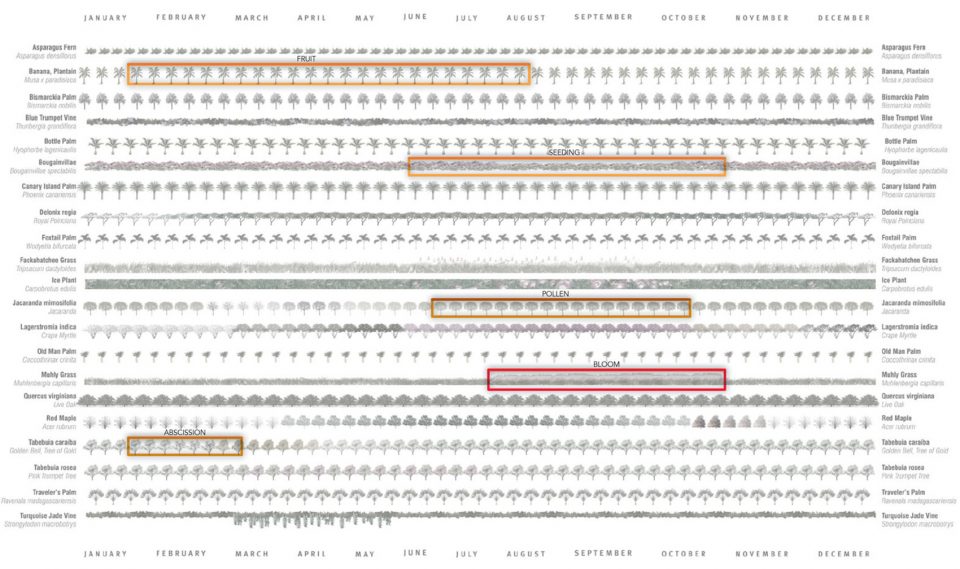
▲细分的研究参数和典型的物种选择策略。地图呈现出一种动态的全局性视角,而非单独对某个特定样本进行研究。Breakdown of research components and typical strategies for mapping flora and fauna as they relate to seasonality. The mapping overcomes the challenge of presenting a holistic sense of landscape changes as a system rather than an individual instances.
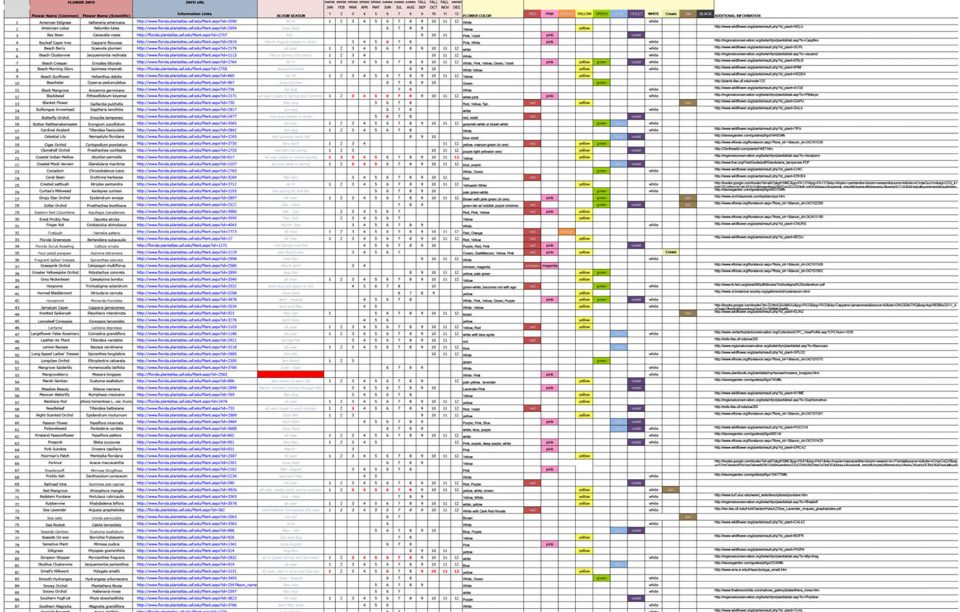
▲颜色、花期、耐旱度等物种属性以元数据的形式被进行编录,最终呈现为以特定参数为依据的直观地图。Research about species seasonality is indexed by metadata ranging from color to bloom time, drought tolerance, and other attributes. These are translated into a visual mapping and sorted according to predetermined criteria.
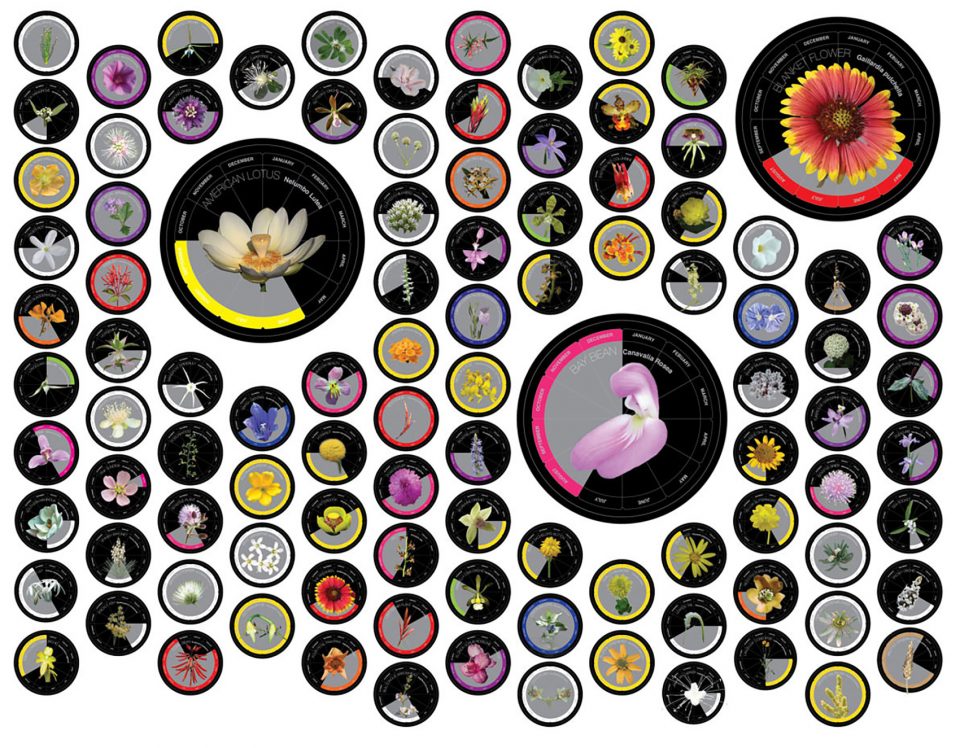
▲每个物种都配有独立的图解,使数据的收集和查找变得更加简单易行。Each species is featured in an individual graphic easing the task of indexing research findings and characteristics.
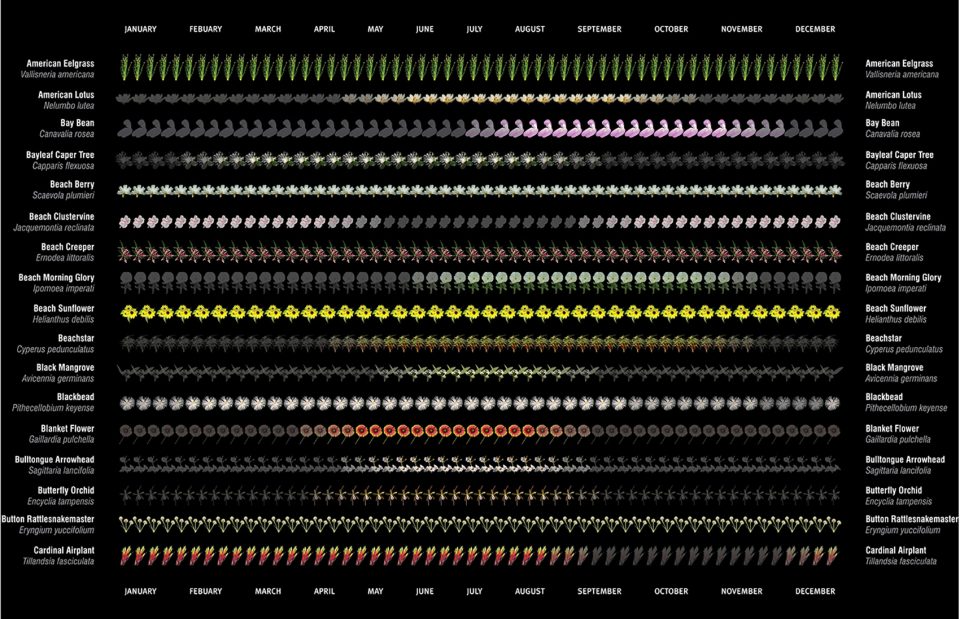
▲超过110种野花被编入地图系统。地图中阐明了特定季节中出现概率较大的植物种类。Over 110 wildflowers were indexed to show prominent patterns and to illustrate what species would more likely be visible in local landscapes for any given season.
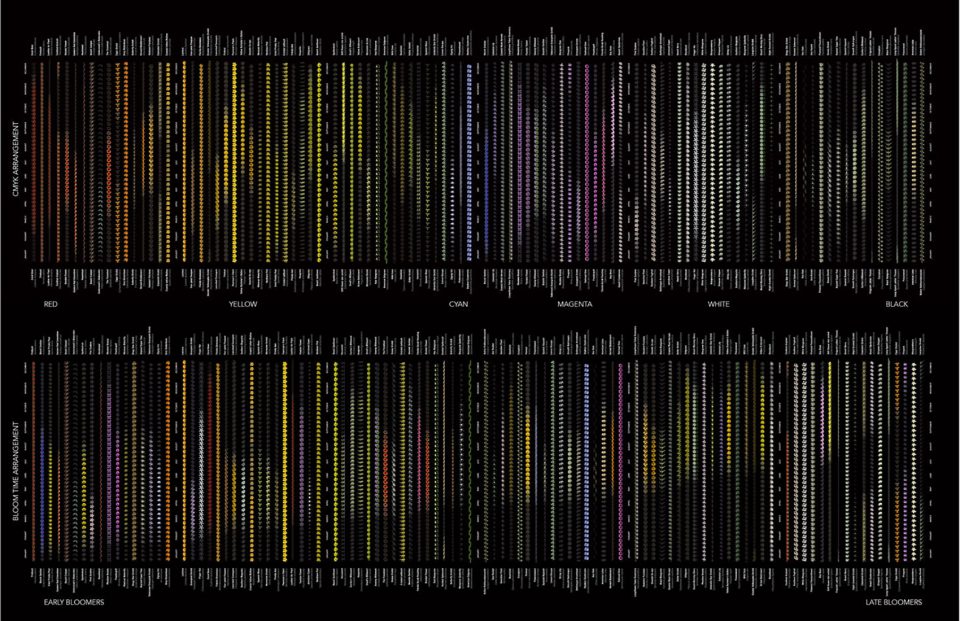
▲生态地图能够基于耐旱度、耐盐度、气味特征、养护需要等参数生成视觉化的图解,为研究者提供了直观且强大的工具。Having the ability to control the visual mappings according to predetermined criteria such as drought tolerance, salt tolerance, olfactory qualities, maintenance needs, etc., beyond alphabetical, color or bloom time, becomes a powerful and intuitive research tool.
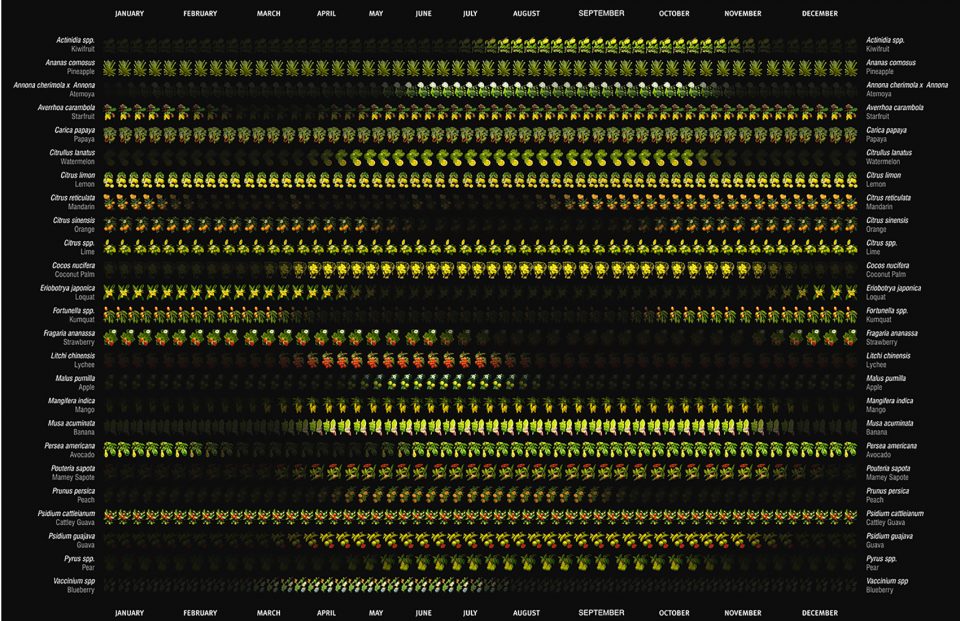
▲南弗罗里达不同季节的果树品种图解,能够有效地促进当季农产品的消费。Illustrates the various seasons that fruits are in season in South Florida, which can be used to promote consuming agricultural products that are in season.
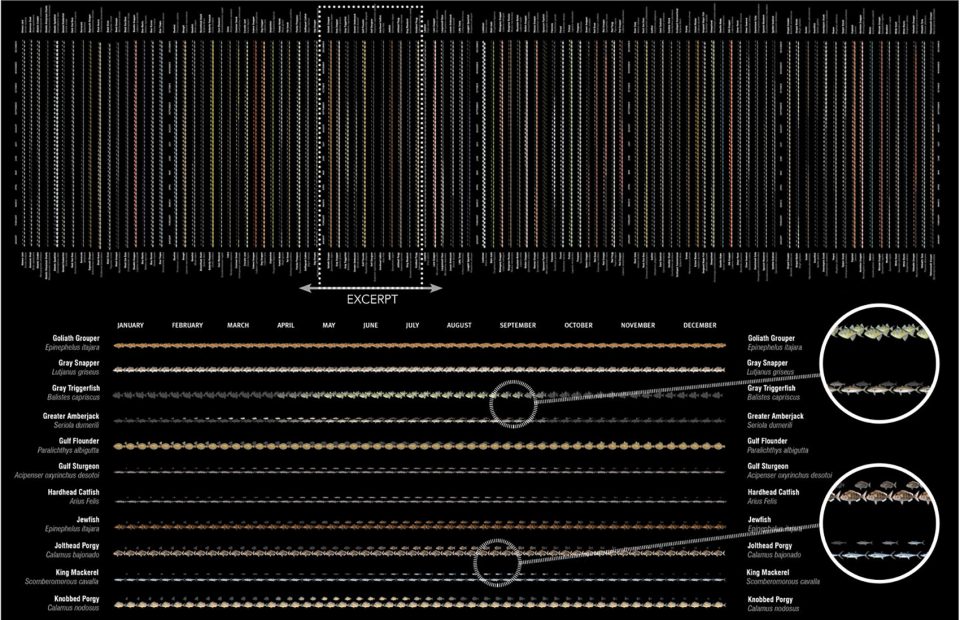
▲按字母顺序排列的南弗罗里达的海洋鱼类品种,能够帮助提高渔业的可持续性和物种的多样性。Alphabetical listing of marine fish species in South Florida, which can be used to promote sustainable fishing and its relationship with species’ abundance.
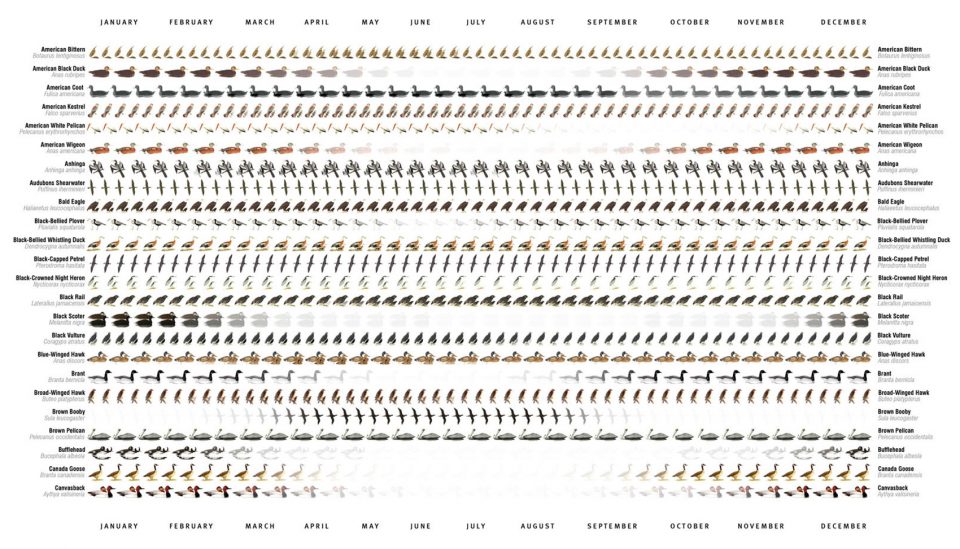
▲350多种鸟类的图解,阐释了特定区域的鸟类的迁徙规律和交配季节。Over 350 birds were indexed to show migratory patterns and mating seasons within a given geographic region.
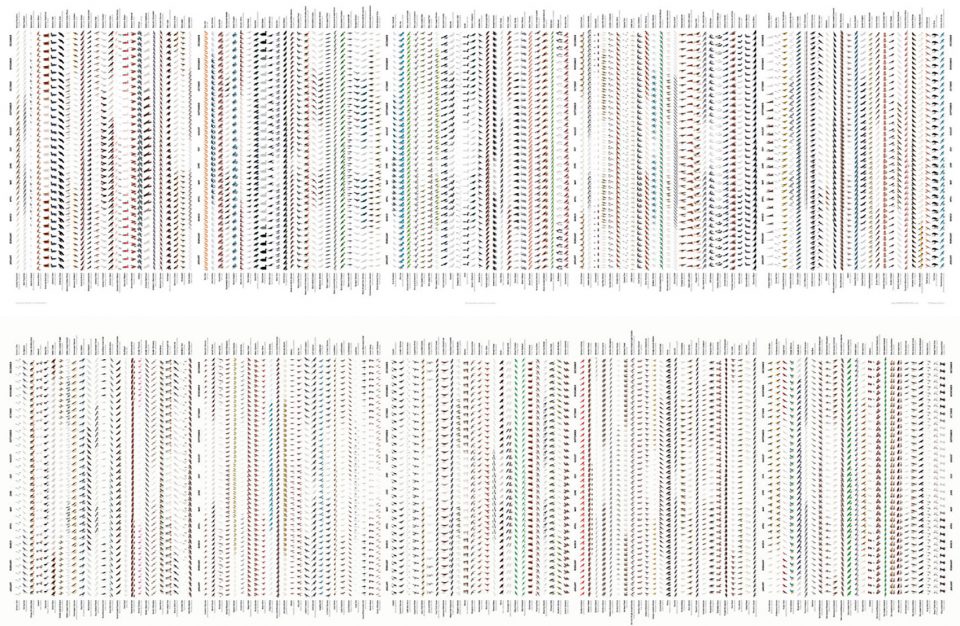
▲按字母顺序纵向排列的鸟类数据,能够直观地对迁徙规律和交配季节进行对比。This alphabetical listing of birds in a vertical format allows for easy comparisons among species migrations and mating seasons.
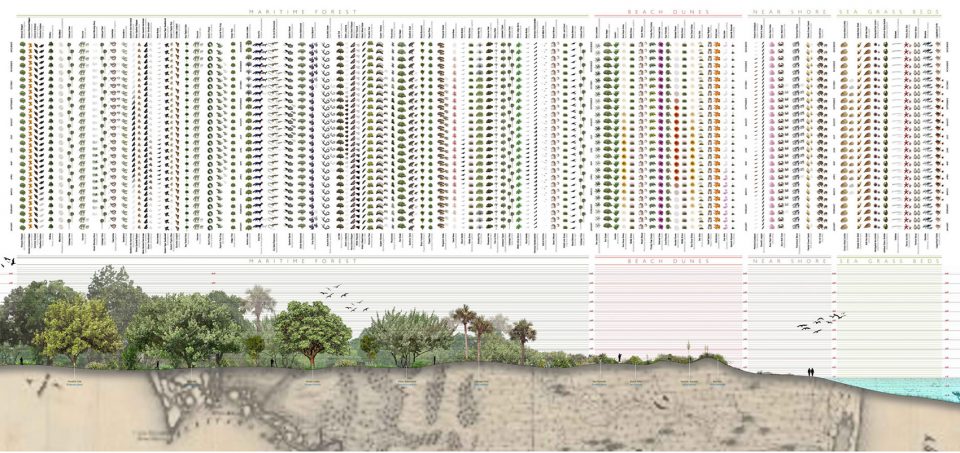
▲南佛罗里达沿海地区的物种研究,展示了植物群落的特性。植物和动物的季节性关联展示于纵向的轴线。Research on a typical section of this South Florida coastline is assembled to understand species activity as a function of plant community. Plant and animal seasonality is shown on the vertical axis.
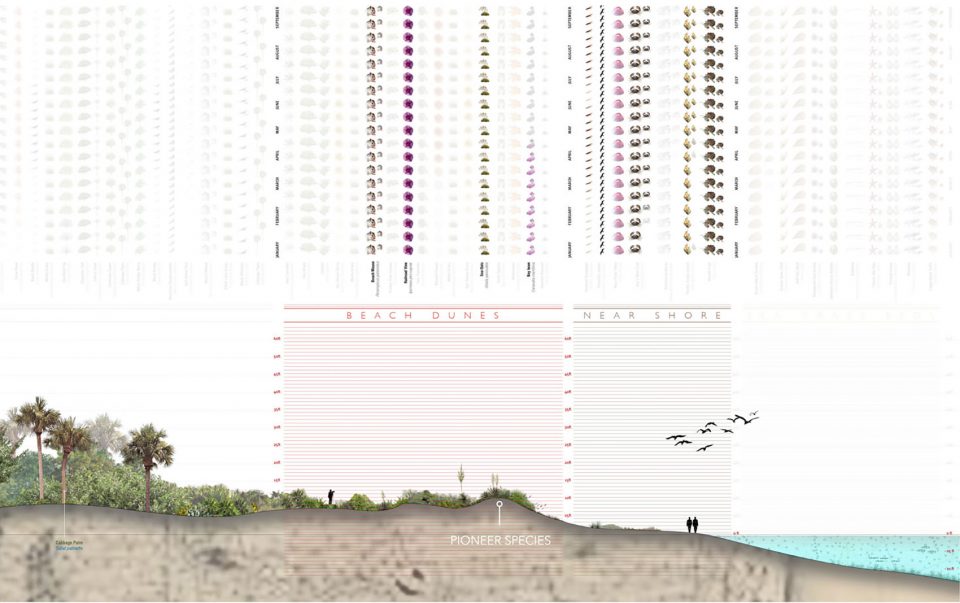
▲生态地图能够呈现先锋树种的习性改变与海拔高度等环境因素之间的关系。The Ecological Atlas Project can provide a means to understand pioneering species and changes in ecological habitat for fauna as it relates to environmental disturbances, which may include sea-level rise, development, and secession.
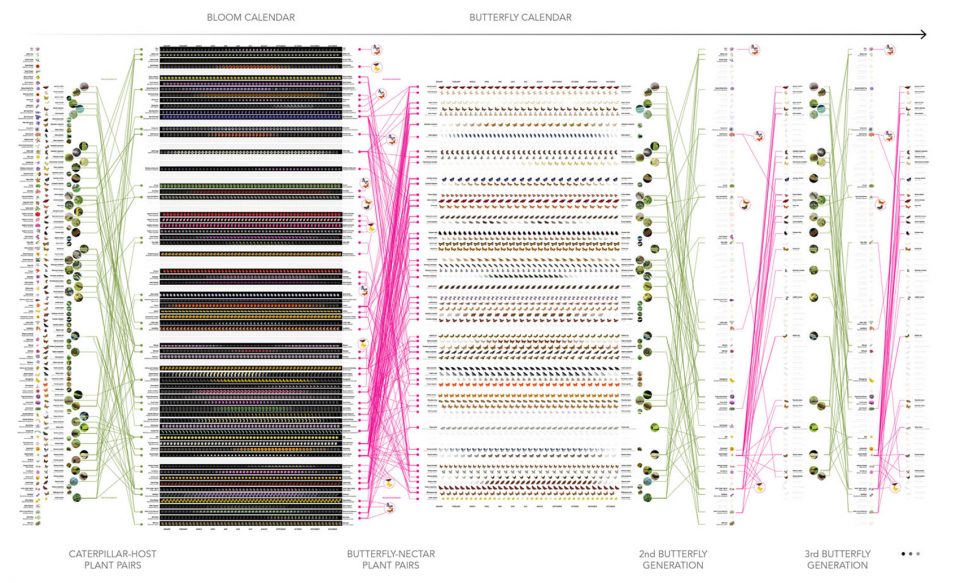
▲该研究图表利用生态地图中的数据展示了有利于毛毛虫和蝴蝶生存的蜜源植物。This research diagram adapts Ecological Atlas data to show the inter-connected web of caterpillars, larvae and butterflies alongside their favored host and nectar plants.
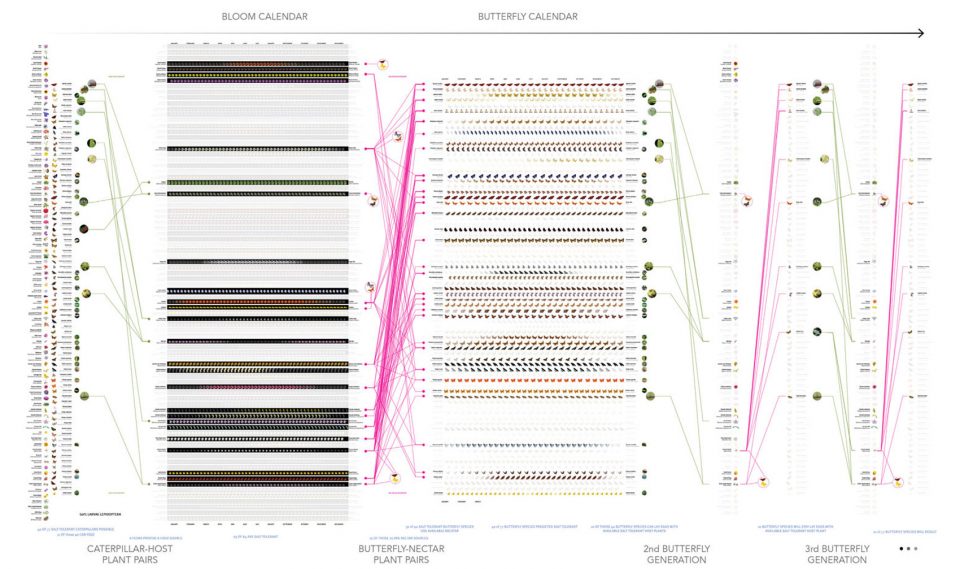
▲生态地图被用于研究海平面上升对于蝴蝶习性的影响。The Ecological Atlas data is further refined to study the impact on butterfly habitat as a result of rising sea levels that are projected to disrupt and shift the core surviving species.
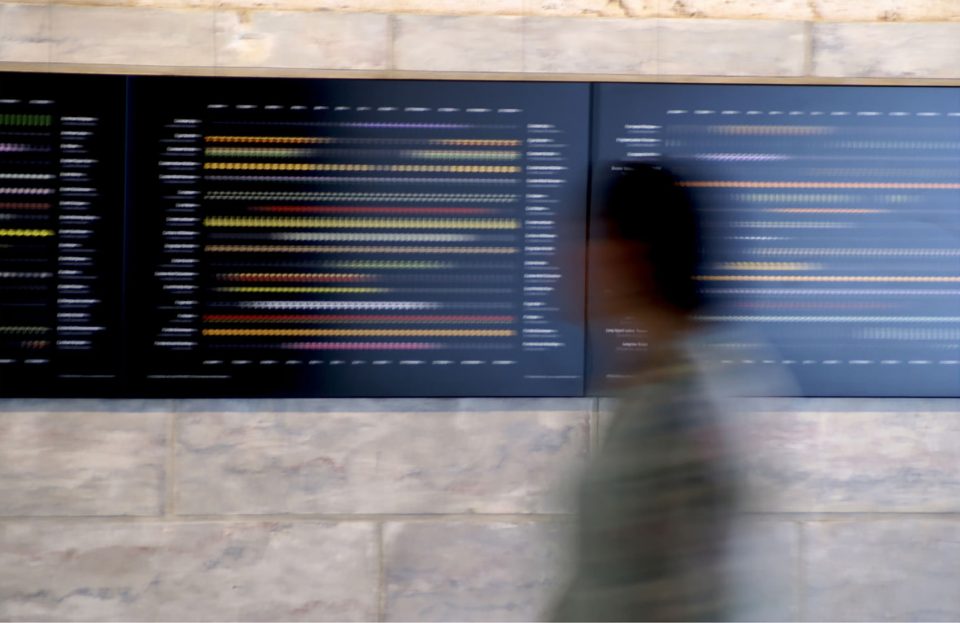
▲生态地图的潜力在于它能够将二维的艺术转化为数字性的阐释工具,并且适用于全球任何景观中的动植物群落。The potential of the EcoAtlas research lies in its ability to transcend from two dimensional art into a digital design and interpretive software that can be used to communicate and visualize any landscape’s flora and fauna, globally.
PROJECT NARRATIVE
Understanding the complex relationship between living and built systems is fundamental to their meaningful and sustainable transformation and design. While extensive information on individual plants and animals is available to landscape architects in print and online, few resources give a holistic sense of ecological systems and fewer still provide a way of understanding their changes over time. The Ecological Atlas Project works at the intersection of art, science and technology. By developing intuitive mappings of natural patterns such as bloom times, deciduous patterns, vegetative seasonality, animal migrations and other time-dependent phenomena, the Ecological Atlas research project enables understanding and building in sustainable and resilient ways. Like mappings of the human genome, the Ecological Atlas Project provides an interpretive design tool that can be used to design and build in ways that work in tandem with the natural patterns of a site.
As a discipline that is capable of bridging art, science, and technology, landscape architecture has historically relied on holistic thinking to carry out the design process. While many publications and online resources provide inventories of plants and animals, many of these focus on creating an archive of individual species without giving a sense of how they relate to one another, how they evolve over time, or how they could be integrated into a cohesive design strategy that operates successfully in both micro and macro scales. While the Ecological Atlas research builds on extensive inventories and databases of plants and animals, it addresses the challenge of comprehensively understanding the relationships among individual species, intuitively. Beyond merely being a communication tool, the Ecological Atlas research aims to democratize the overwhelming complexity of information found in websites, horticultural books, plant nursery catalogs, and environmental databases. Technology has an important role to play in sorting through the myriad options, but having information and data alone falls short of building a useful knowledge base that can be easily accessed, sorted, and leveraged to arrive at valuable insights and appropriate design decisions.
Tools that embrace technology and facilitate the transfer of landscape architectural knowledge in simpler and more elegant ways are essential to building ecological literacy. Better research tools are critical to making informed design decisions that strengthen the value of landscape architecture to any project. The Ecological Atlas Project builds a scalable research database and technology that advances the methods and techniques of landscape architectural research and practice. Some examples of how the Ecological Atlas Project could add value to a project include: sorting through thousands of possibilities and immediately identify the appropriate species, narrowed down and arranged to illustrate bloom times when working in an unfamiliar region; further narrowing the selection by design criteria such as salt tolerance, maintenance requirements, or water needs and generating a visual map that could be expanded digitally to communicate detailed information about each species; immediately identifying fruit trees and vegetables that will be in season in any given month based on geographic location; quickly understanding how a particular set of plants will maximize habitat value for native birds and butterflies. While it is certainly invaluable to consult regional experts who have an intimate understanding of local conditions, the Ecological Atlas Project aims to create a comprehensive resource that streamlines extensive bodies of knowledge and empowers landscape architects to design and make informed design decisions that consider context and time as essential to any design.
The visually intuitive mapping method of the EcoAtlas draws from art and design and provides a means with which to understand the evolving relationships of living systems. In the same way that carefully illustrated botanical prints captured the vast biodiversity of the Americas and expanded explorers’ and colonizers’ imaginations, so too can technology like the Ecological Atlas Project capture the imagination of the public and reaffirm landscape architecture’s value and relevance in design planning and execution. As seductive as botanical and ornithological illustrations have been over the centuries, we have yet to leverage state of the art technology to dynamically model the natural world’s staggering amounts of data upon which landscape architects base many design decisions.
The immediate objective of the Ecological Atlas Project is to develop a graphic language for understanding, comparing, and relating the transformation and activities of living systems over time by using pattern recognition to sort through massive amounts of information. The long term objective, however, is to create a scalable and digital technology that promotes a better understanding and awareness of ecosystem relationships and leverages vast research troves that are otherwise unintuitive to use and access. The research behind the the Ecological Atlas can therefore be used for designing, planning and engaging the natural and built environments complementarily.
To date, the Ecological Atlas Project has been featured and disseminated through museum exhibits, conferences, and arts venues like the American Public Garden Association, the Coral Gables Museum, Arte Americas, Art Wynwood, and Art Miami during the international art fair event known as Art Basel. While effective when displayed as art, the Ecological Atlas Project is meant to work as a research and design tool that can be deployed in any region. It strives to appeal aesthetically in order to fulfill an agenda of awareness about the natural environment as much it aspires to become an essential tool for understanding and designing it.
More: ASLA. Studio Roberto Rovira,更多请至:Studio Roberto Rovira on gooood









请完善下列表单以完成注册(带*号为必填项)
*数据源:
*营利或非营利项目:
*研究者:
*访问渠道: