
“我们都看过太多项目试图将水流还原至自然状态,但该项目看上去具有出乎意料的可信度。”
– 2015年评审委员会“We’ve all seen projects that aspire to return water to its natural condition. This seems remarkably believable.”
– 2015 Awards Jury
来自ASLA对gooood的分享
Mill River Park and Greenway by OLIN,更多请至:OLIN on gooood
Appreciation towards ASLA for providing the following description:
项目陈述
PROJECT STATEMENT
位于美国康涅狄格州斯坦福市的弥尔河公园曾经是被人为开挖、污染严重的河岸地区,而今却是一个郁郁葱葱的、非常有活力的城市空间,并彻底改善了城市生态和社会结构。景观设计团队同工程师和生态学家密切合作,通过重塑河道和引进数百种原生植物,打造出一个一举两得的景观项目:一方面复苏了水陆栖息地的活力,另一方面降低了城市洪水风险。公园取得的变革性效果将生态的可持续性融入到社会可持续性及公共正义之中。一个世纪以来,沿河步行道第一次打通了前往河岸的通道,将富有生命力的景观和周围街区重新联系在一起。这一设计为迫切需要公园空间的人们提供娱乐场所,多功能的“大草坪和观景平台”为大型公共活动提供场地。作为定义活跃的城市生活的典范,弥尔河公园是住宅、企业、商业开发项目增长的催化剂,为经济的可持续性发展创造条件。
Formerly a polluted, derelict riverfront, Mill River Park and Greenway is now a verdant, animated civic space that mends the ecological and social fabric of downtown Stamford, Connecticut. Working closely with engineers and ecologists, the team conceived of a landscape designed to revitalize aquatic and terrestrial habitats and reduce flooding by restoring the channelized river’s edge and introducing hundreds of new native plants. The transformative effect of this park builds on ecological sustainability into social sustainability and social justice. A series of walking paths along the river reconnect neighborhoods to this vibrant landscape, granting access to the river’s edge for the first time in a century. The design provides much needed park space for active and passive recreation and a flexible “Great Lawn and Overlook” for large programmed events. A model for redefining active urban life, the park is a catalyst for residential, corporate and commercial growth and economic sustainability.
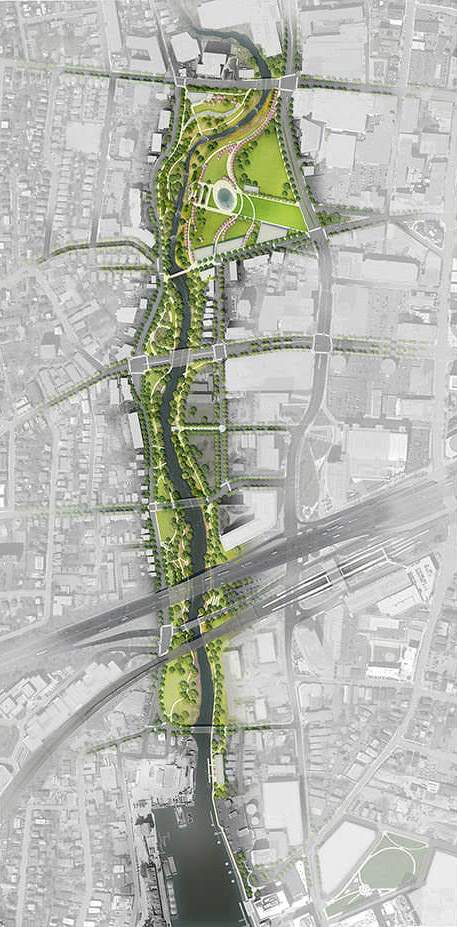
△ 总平面图——弥尔河公园曾经是被人为开挖、污染严重的河岸地区。景观设计团队同工程师、生态学家密切合作,重塑河道,复苏了水陆栖息地的活力。ILLUSTRATIVE SITE PLAN – Formerly a polluted and channelized riverfront, Mill River Park is now a vibrant and verdant community space in downtown Stamford, Connecticut. Working closely with engineers and ecologists, the design team rebuilt the river and revitalized aquatic and terrestrial habitats. Photo Credit: © OLIN
项目说明
PROJECT NARRATIVE
康涅狄格州斯坦福市内的弥尔河在筑坝、河渠开挖、杂物堆放、淤泥堆积等等恶性作用下,大大增加了市区洪水的风险。为了降低这一风险,美军陆军工程部和斯坦福市执行了一项景观工程:移除两侧的混凝土堤坝,让弥尔河自17世纪以来第一次得以自由地流淌。这一绿色基建工程不仅恢复了沿河的栖息地,降低了城市洪水风险,还借机开发出周边的公园空间,将市区同河岸结为一体,实现了区块的整体复兴。
近100年来,斯坦福市一直梦想在市区打造一座中央公园,并沿着历史悠久的弥尔河河岸建设一条绿色的廊道。在联邦政府、州政府、市政府联手的财政支持下,设计团队得以为该地区制定总体规划,并对一座28英亩的公园和一条3英里长的绿色廊道进行景观设计。景观设计团队同陆军工程部紧密合作,负责该区域总体规划的设计和实施,这一规划将持续性地促进栖息地的生长,经过近十年的时间重新连接起城市与自然。这一工程的实现要感谢传奇的城市规划师Herbert Swan。在1929年,Swan追随Fredrick Law Olmsted的愿景,“设计出大都市中的郊野”,将目光投注到在城市环境中塑造公园空间的重要性上。
弥尔河绿色廊道总体规划的生态组成要素之一是增加该地区的生物多样性,即通过移除大坝,引入多样化的栖息物种为原生的野生动物群体提供支持。与生物栖息生态学家紧密合作,设计师通过塑造河滩、集水区和蜿蜒的河道来模拟自然的河流形态。原生树木、灌木、草类构成的稳定的植被组合,被用以固定河岸土壤,同时为野生动物提供食物、栖息地和筑巢的场所。被重新引入的洪泛区在城市的中心创造出重要的盐沼栖息地,为从盐水迁徙到淡水中溯河产卵的鱼类提供前往集水区的通道;360年来,1200条河水青鱼第一次回到这里产卵;潮水交换效应为陆地和水域带来惊人的生物多样性。得益于多样化的河岸形态和河水深度的设计,其他物种得以在此栖息。
如今,重新分级的河岸与自然的、防护性的洪泛平原相类似,能够消除雨水对周边街道和街区带来的损害。这条曾经给附近街区带去持续性洪水威胁的河流,如今已经能够自行处理暴风雨带来的水量波动。事实上,在最近的两次飓风中,洪水对公园和周边地区并未造成严重影响。今天,蜿蜒的河流在步行道、休息区和公园设施中穿行而过,为人类和野生动物营造出平和而生机勃勃的环境。
种植的第一阶段移栽了超过400株原生树木和灌木。原生野花和草类的种子也散播在潮湿区、半潮湿区和城市高地三个不同的区域。播种后的春天,强烈的暴风雨冲走了一部分,但绝大多数种子就地生根、发芽。更重要的是,新洪泛区的效果跟设计预想的一样,对小路和河岸没有损害和侵蚀。同年第二次播种下的五颜六色的野花的种子让种植设计的效果更加丰富。野花、草类、灌木和树木的组合为陆居物种创造出全新的栖息环境。当地社区也积极融入到公园的维护中来,经过培训的志愿者在除去偶尔出现的入侵物种方面给予了很大的帮助。学生团体在这里获得原生植物的知识,并加深了对植被看护工作的理解。公园的访客将他们拍摄到的野生动物,如水獭和在地面筑巢的鸟类的照片上传到弥尔河公共网站上,这些野生动物出现在与市中心如此接近的地区是非常罕见的。从这些图片中,可以辨认出超过50余个独立的植物物种,它们在此生根生长,为野生动物提供食物和栖息地。
景观中的设计元素首先要尊重基地的历史,其次要经久耐用。摆放得当的长凳和大块的回收来的卵石,沿着小路和观景平台,为访客提供就坐休息的场所。地面铺装材料具有很好的抗洪水腐蚀性能。设计师保留了历史悠久的石墙,并将从建筑工地中挖掘出来的石头放置在景观之中,用以昭示当地的历史和地理特质。作为公园与市区相连接的典例,美洲香槐列队组成的林荫大道从城市的入口延续进来,通向为举办大型活动和沿河娱乐项目提供开放性空间的“大草坪和观景平台”。此外,设计团队还考虑到当地社区民众对樱桃树的喜爱,尽可能地将原有树木保留下来,并在施工期间倍加看护,之后将所有的老樱桃树和新树的一起,移植到通往大草坪和观景平台的小路旁。
设计还为将于未来出现的设施预留了空间,包括Steven & Alexandra Cohen喷泉和溜冰场、Brownstein / Selkowitz纪念亭、Nissen转盘、弥尔河公园凉亭以及中心公园探索园等。
自开放使用以来,社区居民常年到访弥尔河公园和绿廊,带来了几百个节目,也带来了志愿者。水路的清理和设计减少了污染和杂物堆放,更改变了人们之前随意抛扔垃圾的习惯。当地居民持续的清理工作让公园自然的美感得以维持。
关于总体规划未来阶段的实施,人们更加强烈地认识到城市与生态共生的必要性,它能让市区和周边环境成为互惠互利的存在。这一项目将成为一个永不停歇地自我再生式的景观。原生的植物和野生动物会不断地回到这里。景观设计将可持续性、娱乐性、公民参与、文化教育融入到郁郁葱葱的、具有生态多样性的环境中,使之成为为子孙后代服务的城市绿色基础设施。
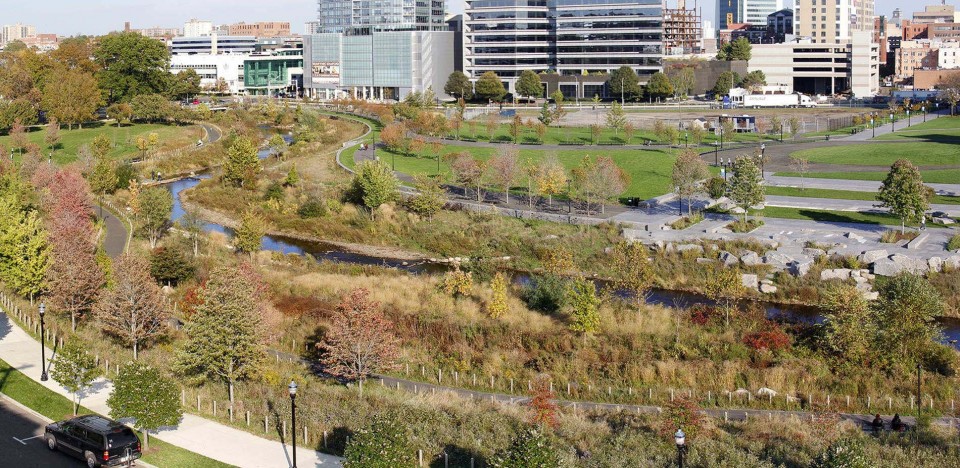
△ 基地曾经是一片河边的蓄水池,如今被重塑的蜿蜒河道和曲折的小径所替代。原生的植被,从水生植物到湿地植物再到土生植物,从河边向堤岸缓缓过渡。MILL RIVER PARK AND GREENWAY – The site of a former millpond has been replaced by the rebuilt and gracefully meandering Mill River paralleled by sinuous paths. A native vegetation palette follows the contours rising up the embankments from hydric to mesic to urban upland. Photo Credit: © OLIN / SaharCoston-Hardy
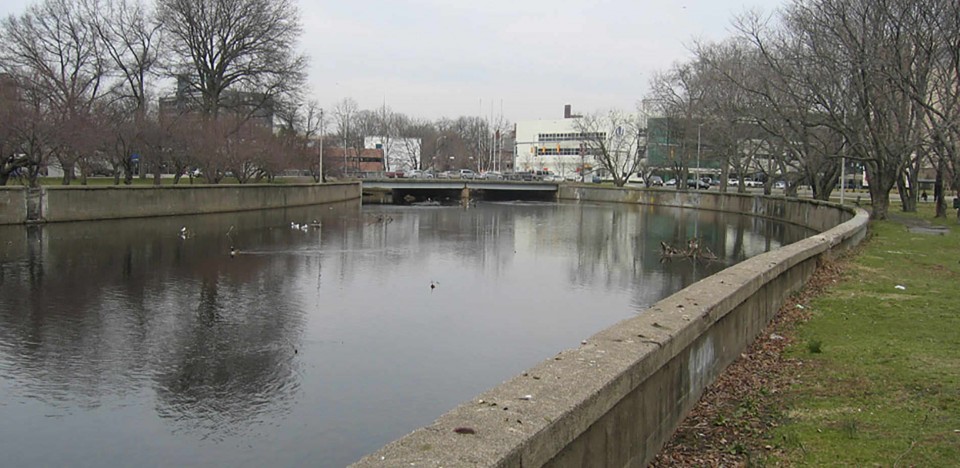
△ 一度弥尔河被废弃,建于1922年的河堤将城市和居民同河流隔离开来。随着城市化的进程,沟渠化的河流成为主要的市区洪水的发源地。MILL RIVER PARK AND GREENWAY – Once the mill was abandoned, the remnant walls–built in 1922–severed the city and residents from the river. With increased urbanization, the channelized river became the source of major flooding throughout the downtown. Photo Credit: Courtesy of Mill River Collaborative
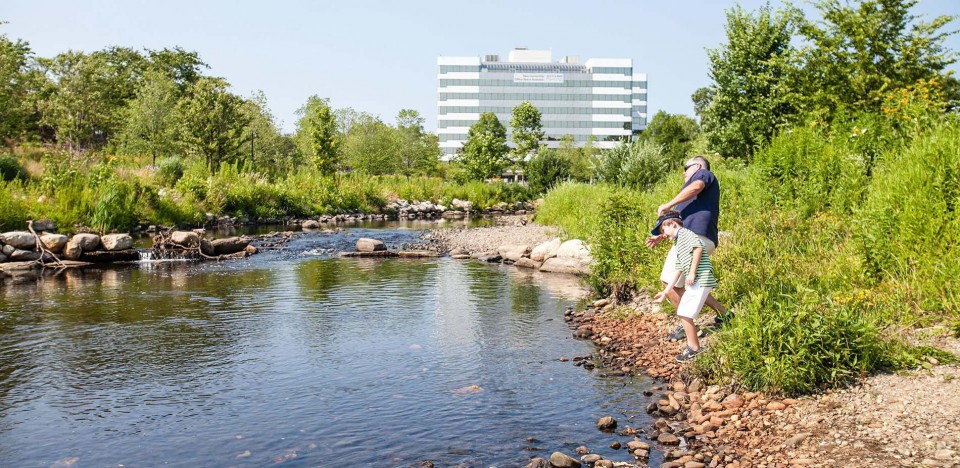
△ 如今一切都改变了,铺装的小径将人流引向石头随意铺就的走道,卵石河堤似乎在邀请人们前往河边。MILL RIVER PARK AND GREENWAY – Today that has all changed. Paved paths lead to informal stone walkways that become gravel banks inviting access to the river’s edge. Photo Credit: © Olivier Kpognon
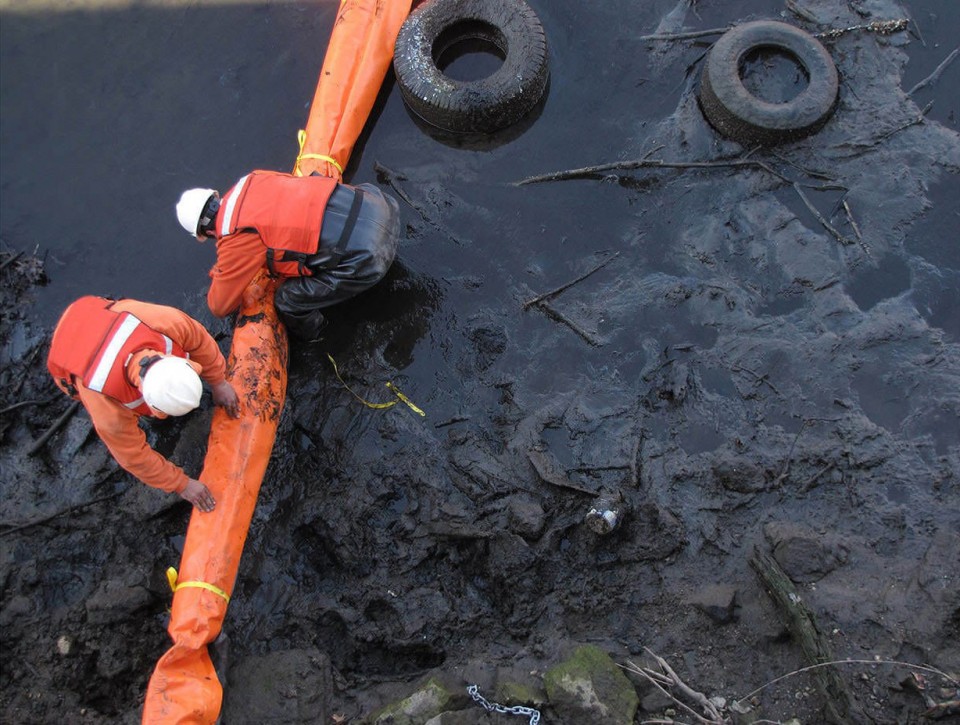
△ 2000年,陆军工程部提交了一份提案,提案中由一个新的认识,即恢复河岸的自然属性,移除所有障碍物和蓄水设施,能防止因城市化造成的洪水。MILL RIVER PARK AND GREENWAY – In 2000, The Army Corps of Engineers developed a proposal to naturalize the river corridor with a new understanding that restoring the river’s edge would prevent flooding due to urbanization. This included the removal of all obstructions and impoundments. Photo Credit: Sue Sweeney
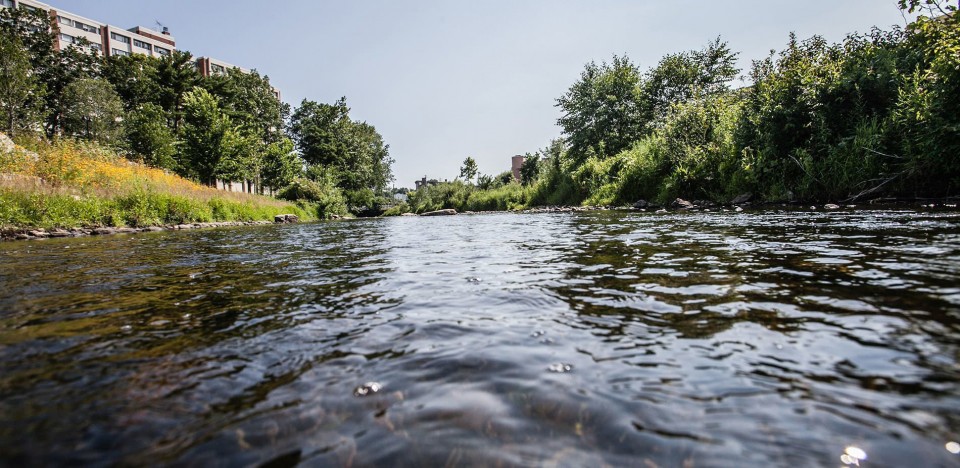
△ 复原工程使得弥尔河得以自由地流淌,像其17世纪发源时一样。它恢复了原始朴素的外观,从斯坦福的市中心一路流向长岛。MILL RIVER PARK AND GREENWAY – The restoration allowed Mill River to flow freely for the first time since the 1600s. The river is now pristine as it flows through downtown Stamford on its way to Long Island Sound. Photo Credit: © Olivier Kpognon
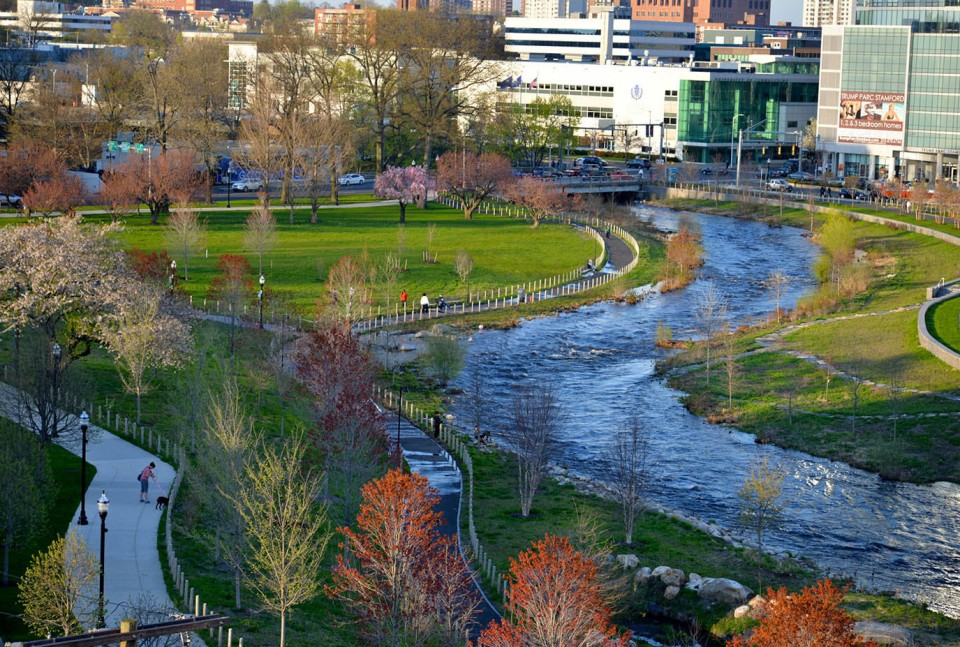
△ 在春季丰沛的降水过后,河流的流量有所增加,但不会为围边城市带来洪水威胁。MILL RIVER PARK AND GREENWAY – After copious spring rains, the river flows high on its banks but poses no risk of flooding to the surrounding city. Photo Credit: © KJ Klopstock
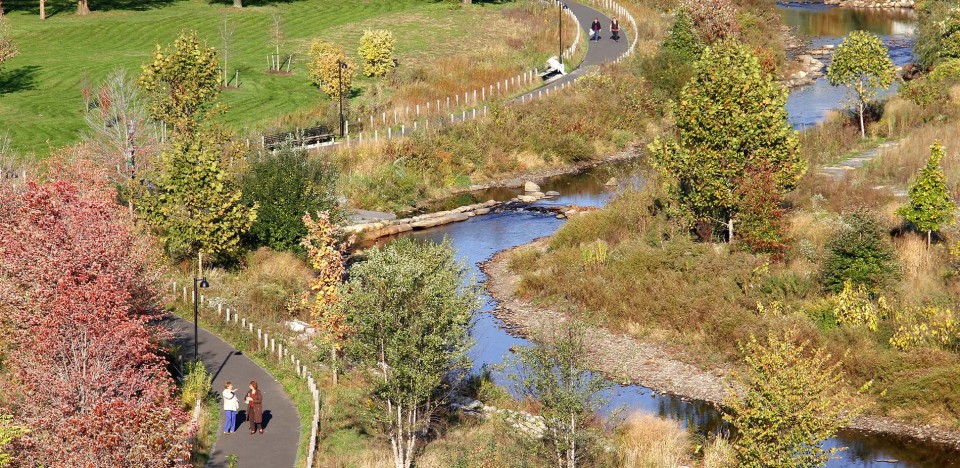
△ 植群的设计将自然的河岸走廊同城市公园的需求结合起来。多样性、可持续的生态系统与城市性相结合。植群被用于提供动植物栖息地,保持可见性,营造空间丰富且方便维护的公园。MILL RIVER PARK AND GREENWAY – Planting blends the needs of a natural riparian corridor with the demands of an urban park. Diversity and sustainable ecosystems are balanced with urbanity. Vegetation is used to provide habitat, maintain visibility, and provide a spatially rich and maintainable park. Photo Credit: © OLIN / SaharCoston-Hardy
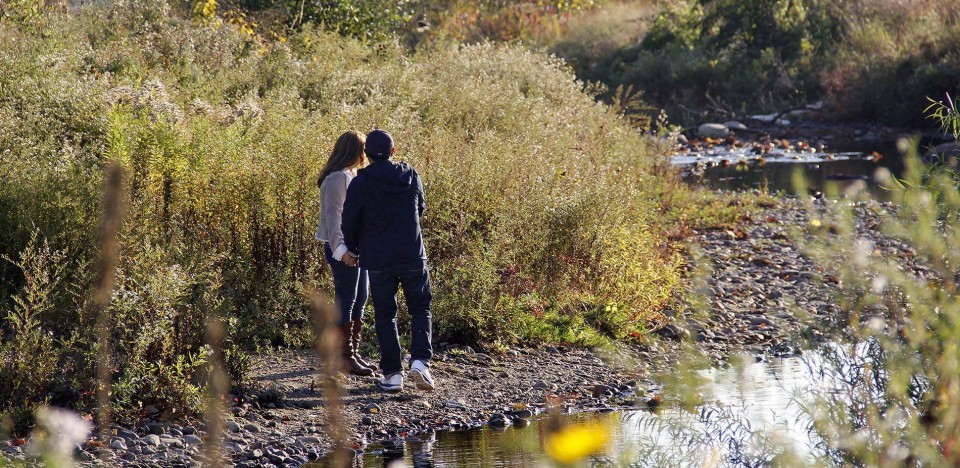
△ 人们重新回到河岸。这里离市区一步之遥,能让人暂时远离尘世的喧嚣,得以喘息。街道的轰鸣消失了,取而代之的是鸟的啼叫、昆虫的嗡鸣以及潺潺的水声。MILL RIVER PARK AND GREENWAY – Residents reunite with the waterfront and are offered respite from the commotion of a city only steps away. The hum of the street succumbs to chirping birds, noisy insects and rippling water.Photo Credit: © OLIN / SaharCoston-Hardy
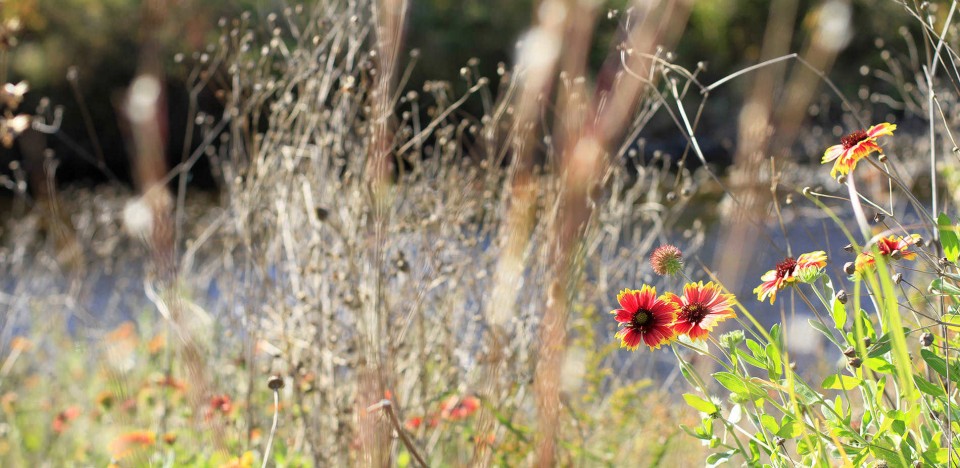
△ 野草、野花、灌木和高低的树木构成的原生植群被设计师精心排布,以恢复退化的水陆栖息地的活力。MILL RIVER PARK AND GREENWAY – The native plants, including grasses, wildflowers, shrubs, understory trees and canopy trees, were carefully coordinated to revitalize degraded aquatic and terrestrial habitats. Photo Credit: © OLIN / SaharCoston-Hardy
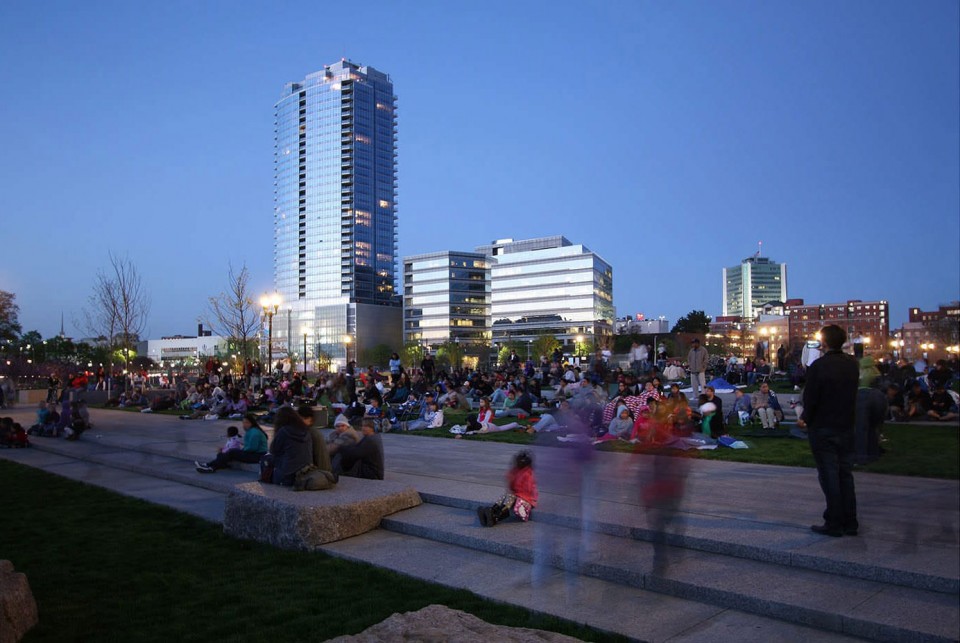
△ 到了夏季,坐在公园草坪前的大台阶上,人们可以俯瞰河流,聚集在一起看一场露天电影或者进行其他活动。MILL RIVER PARK AND GREENWAY – Along the steps in front of the “Great Lawn” people overlook the river and gather for movie nights and other events during the summer. Photo Credit: © OLIN / Will Belcher
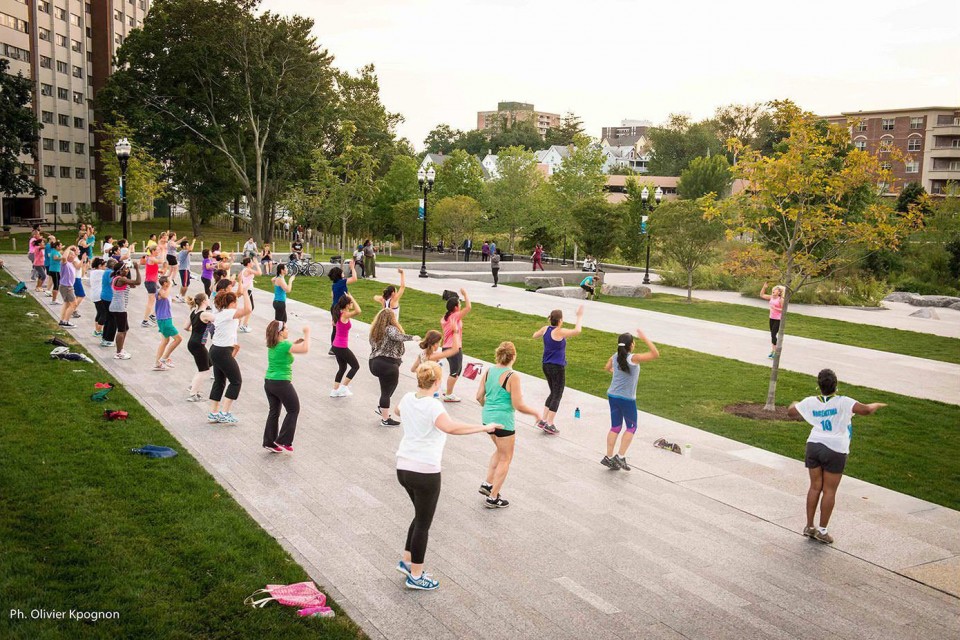
△ 紧挨着大草坪,喀里多尼亚花岗岩铺地呈阶梯状向河岸延伸,为市民活动提供场地。MILL RIVER PARK AND GREENWAY – Caledonia granite paving adjacent to the “Great Lawn” and stepping down toward the river provides space for a variety of programmed activities. Photo Credit: © Olivier Kpognon
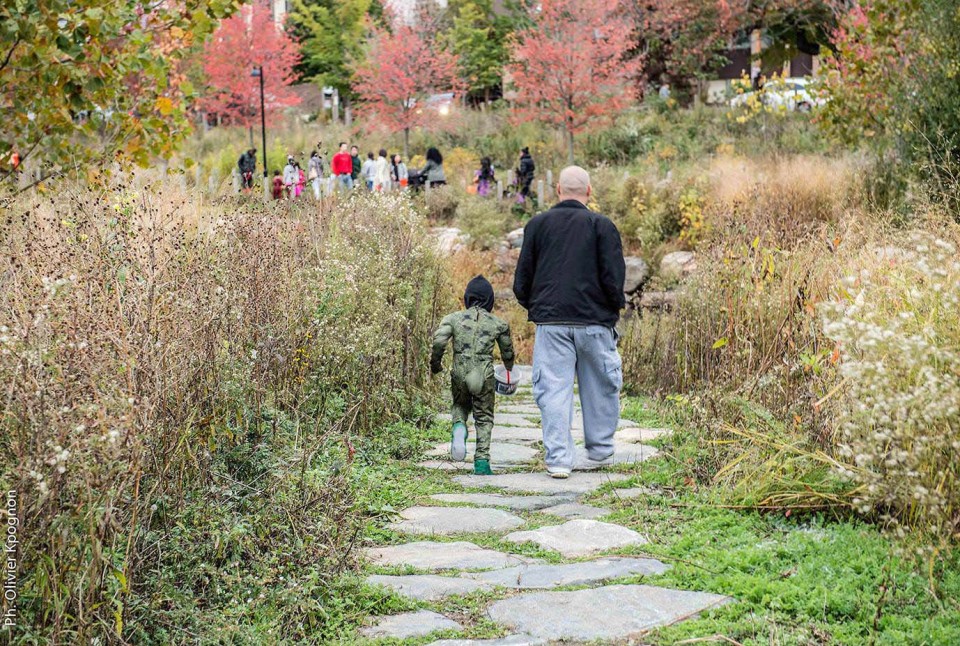
△ 周围的居民已经全身心地投入到公园的怀抱中。图片上的儿童正在前往公园里庆祝万圣节活动的路上。MILL RIVER PARK AND GREENWAY – The community has whole-heartedly embraced its new park. Here children are on their way to a Halloween celebration in the park. Photo Credit: © Olivier Kpognon
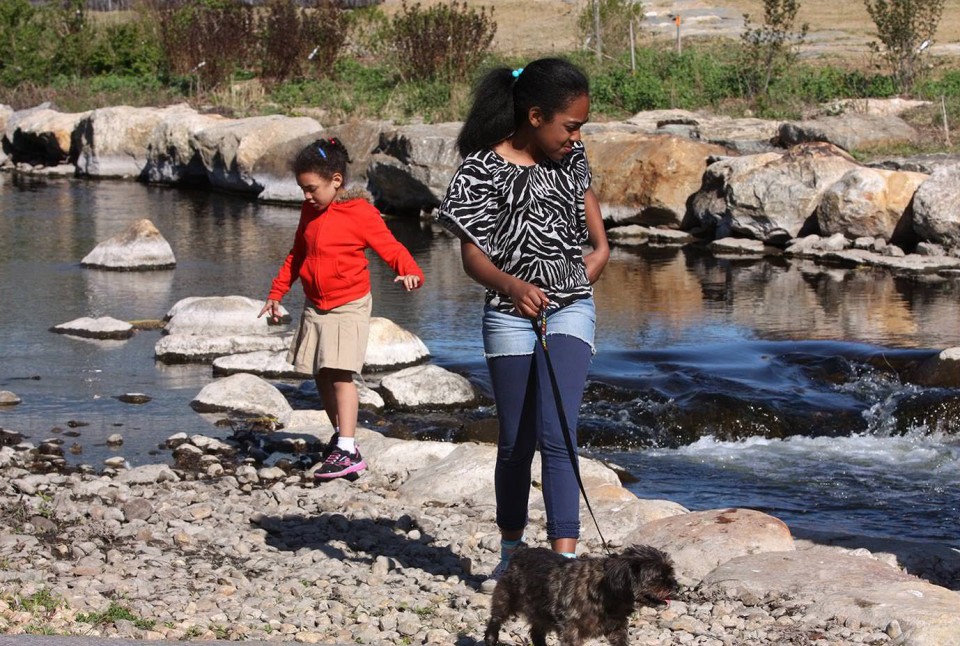
△ 精心布置的石块营造出水系、河滩、瀑布和水池。每一个元素都有各自的功能:减缓流速,为河流层级的变更创造空间,以及为两栖动物和产卵的鱼类提供平缓的水域。这些区域也成为寓教于乐的嬉戏场所。MILL RIVER PARK AND GREENWAY – Careful placement of rocks create veins, riffles, falls, and pools. Each element has a function: slowing water flow, accommodating grade change, and creating still areas for spawning fish and amphibians. These hardworking features also double as an active learning playground. Photo Credit: © OLIN / Will Belcher
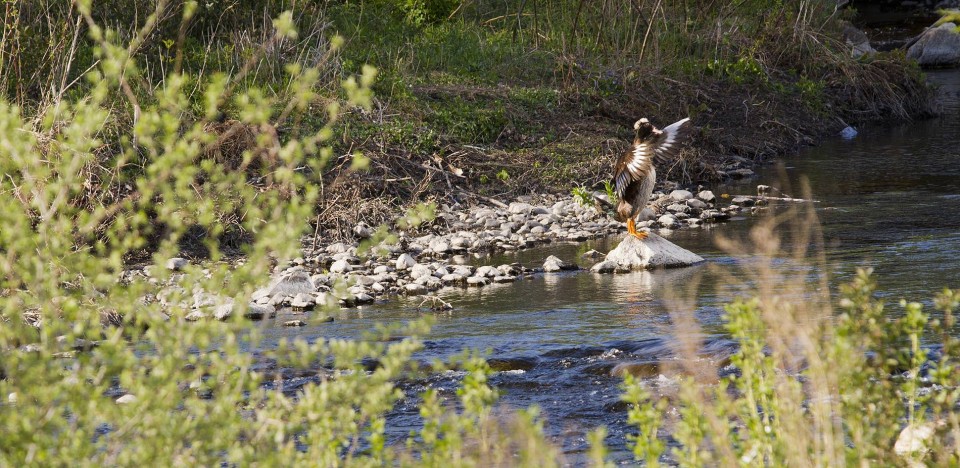
△ 这一设计有效消除了废墟和污染,使得野生动植物迅速聚集到这里。野鸭、水獭和在地面筑巢的鸟类只是在这里了栖息的物种的一部分,它们现在已经完全适应了这块多样性的城市区域。MILL RIVER PARK AND GREENWAY – The design led to a significant drop in pollution and debris resulting in an immediate influx of indigenous wildlife. The mallard, river otter and ground nesting birds are just some of the animal species now integrated into this diverse urban setting. Photo Credit: © OLIN / SaharCoston-Hardy
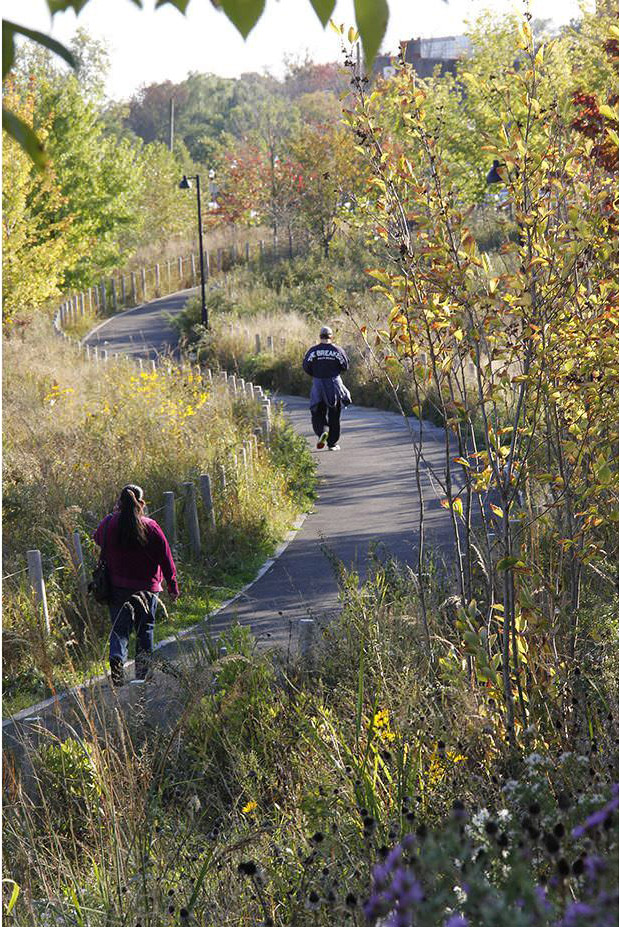
△ 蜿蜒的小路与河流相平行,为散步、慢跑和骑自行车等活动划分空间,同时也提供休憩和观景的场所。MILL RIVER PARK AND GREENWAY – Sinuous paths parallel the river and allocate space for walking, jogging, and bicycling as well as providing opportunities for resting and viewing. Photo Credit: © OLIN / SaharCoston-Hardy
Obstructed by damming, channeling, pollution debris and silt buildup, the tidal and partially brackish Mill River posed a significant flood risk to downtown Stamford, Connecticut. To mitigate this threat, the U.S. Army Corps of Engineers and the City of Stamford executed a project resulting in the removal of two concrete dams, allowing the river to flow freely for the first time since the 1600s. This green infrastructure project not only provided habitat rehabilitation and reduced risk of flooding, but an opportunity to develop surrounding park space and unite the downtown with the waterfront, offering revitalization to the area as a whole.
For nearly 100 years, Stamford had dreamed of a Central Park in the heart of its downtown and a greenway along the banks of the historic Mill River. Thanks to the funding efforts of a community collaborative of city, state, and the federal government, along with local corporations and private citizens, a design team was hired to envision a master plan and create a landscape design for a 28-acre park and 3-mile greenway. Collaborating closely with the Army Corps of Engineers, the design team was tasked with designing and implementing a master plan that would facilitate sustained habitat growth and work towards the project’s nearly decade-long mission to reconnect the city to nature. The realization of this project is a tribute to the legacy of city planner Herbert Swan who in 1929 was inspired to follow the vision of Fredrick Law Olmsted to “Plan a Metropolitan Suburb,” focusing on the importance of park space in the urban environment.
One of the ecological components of the Mill River Greenway Master Plan was to capitalize on the potential for increased biodiversity that would result from the removal of the dam, helping to create a variety of habitats to support native wildlife communities. Working closely with bio-habitat ecologists, riffles, pools and meanders were recreated to mimic the natural morphology of the river. A robust palette of native trees, shrubs, grasses, and forbs were planted to stabilize the river’s edge and to provide food, habitat and nesting places for wildlife. The reintroduced floodplain offers crucial salt marsh habitat in the heart of an urban metropolis—anadromous fish, migrating from salt to fresh water, have been granted passage to the watershed; 1,200 river herring have returned to spawn for the first time in 360 years; an open tidal exchange welcomes amazing diversity on land as well as in water. A refuge for other species resulted from the design of a variety of riparian edge conditions and water depths.
Today, the regraded river’s edge resembles a natural, protective floodplain thereby eliminating the damaging effects of stormwater in the surrounding streets and neighborhood. The river that once posed a continual threat of flooding to nearby streets, is now capable of handling the fluctuation of water volume in storm events. In fact, there was no significant damage to the park or surrounding area due to flooding during the two most recent hurricanes. Today, the meandering flow of the river winds its way through walking paths, rest areas and park amenities creating a peaceful and stimulating environment for humans and for wildlife.
In the first phase of planting, more than 400 native trees and shrubs were installed. In addition, seed mixes comprising native grasses and wildflowers were sown in three distinct zones: hydric, mesic and urban upland. The spring following seeding brought unusually strong storms that washed away some seed, but the majority of the seed germinated. More importantly, the new floodplain performed exactly as it was designed to with no damage to paths or erosion of grading. A second planned over-seeding of color blended wildflower swaths was added that year to complete the planting design. A composition of wildflowers, grasses, shrubs and trees bring an entirely new habitat environment to terrestrial species. The community is actively involved in maintaining the park and volunteers are trained to remove invasive species that pop up occasionally. Student groups are introduced to native plants and gain a critical understanding of stewardship. Visitors to the park have posted pictures of wildlife on the Mill River Collaborative’s website, such as river otters and ground nesting birds that are rarely seen this close to a bustling city center. The Mill River Collaborative has identified images of over 50 individual plant species that have germinated and continue to provide food and habitat in the park.
Elements of the design pay homage to the history of the site, and were selected for their durability. Well placed benches and large reclaimed boulders create rest areas along pathways and overlooks on the site. Paving materials were selected for their ability to withstand flooding events. Historic stone walls were restored, and local stone boulders were unearthed from a nearby construction and incorporated into the project as a celebration of local history and regional geology. A Grand Allee of yellowwood trees now proceeds from the city entrance and is an example of the park’s link to the adjacent downtown. The corridor leads to the “Great Lawn and Overlook,” a flexible open space for large events and waterfront entertainment. The design team also responded to the community’s love of historic cherry trees by saving as many as possible in a holding nursery during construction. Afterward, all were replanted along with new cherry trees lining the paths leading to the Great Lawn and Overlook.
The design holds place for future amenities that will include the Steven & Alexandra Cohen Skating Center & Fountain, Brownstein/Selkowitz Pavilion, Nissen Carousel, Mill River Park Pergola, and the Discovery Center Park Building.
Since its opening, the community has embraced Mill River Park and Greenway with year-round visitation, in addition to hundreds of programs and volunteer efforts. The design and clearance to the waterway has resulted in a drop in pollution and debris, altering previous littering habits. The community cleanup efforts continue to maintain the site’s natural beauty.
Plans to implement future phases of the master plan confirm the recognition that urban and ecological cohabitation is necessary to provide mutual benefits for the city and surrounding environment. This is a self-regenerating landscape. Native plants and wildlife continue to return to this downtown area. With a design that emphasizes sustainability, recreation, civic engagement, culture and education within an ecologically diverse and lush environment, the green infrastructure will serve the city for generations to come.
MORE: OLIN,更多请至:OLIN on gooood


真是个伟大的设计
非常亲切自然的感觉
国内的领导,有这样意识的太少
感动
要恢复这样肯定花了不少时间吧。
好喜欢!!难以想象这是在市中心的样子!
舒服
和小时候夏天老家的河流差不多,真心不错。
因为这只野鸭,这方案能给101分,多出的1分拿去骄傲
有一种设计,叫外国的设计
回归自然很融洽的设计
景观设计的多学科协同工作,用植物为动物创造生存环境,增加场地活力与亲切感。 用当地材料昭示场地特色。 每种材料都有其作用与意义。 都是值得学习的地方。
看到全图的时候都惊呆了。
很棒,值得学习
平面方案线条棒,多学科的交叉合作更棒!
真厉害!
这个太棒了!
多部门多学科支持协作的结果