感谢 造园建筑工作室(联系邮箱:info@gardeningarchitects.com)予gooood分享以下内容。更多关于他们:Gardening Architects on gooood
Appreciation towards Gardening Architects (contact: info@gardeningarchitects.com) for providing the following description:
我们在拥抱公路、高铁、航空组建的“快经济”同时,更需要重建一种基于传统水网的“慢经济”,城乡需要高速的联络,也需要一种“园林化的联络”。经济与文化,不该是此消彼长的两极,而应彼此滋养、共融共生。藉此,以促进当代人与自然的融合,促进城乡的融合。
While embracing the “fast economy” built by highways, high-speed rail, and aviation, we also need to rebuild a “slow economy” based on the traditional water network. Urban and rural areas need high-speed connections, but they also need a kind of “gardenised connection.” Economy and culture should not be two poles pulling against each other; they should nourish each other and co-exist in symbiosis. In this way, we can promote the integration of contemporary humanity with nature, and the integration of urban and rural areas.
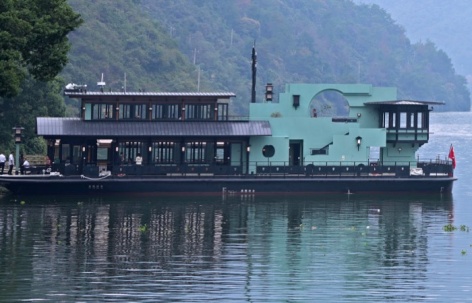
▼三种尺度的画舫,设计总览,Painting boats at three scales, design overview © 造园建筑
基于传统江南的水网架构,我们提出“文艺水网”的计划:
1.重新激活江南“水基因”,建立一个水上的江南,重新发现传统水网之于当代的文化价值与经济价值。
2.建设文艺慢经济,复兴水网沿线城镇与乡村,再次带动水网视野下的城乡融合。
3.画舫系统建立了水上的文旅与教育系统:船行的酒店,船行的研学,船行的论坛,船行的大学,船行的美术馆。打通地域隔阂,形成经济、文化、教育研学的无界融通。
Based on the traditional water network structure of Jiangnan, we propose the “Cultural Water Network” plan:
1. Reactivate the “water gene” of Jiangnan, establish a Jiangnan on water, and rediscover the cultural and economic value of the traditional water network for the contemporary era.
2. Build a cultural slow economy, revive the towns and villages along the water network, and once again drive urban-rural integration from the perspective of the water network.
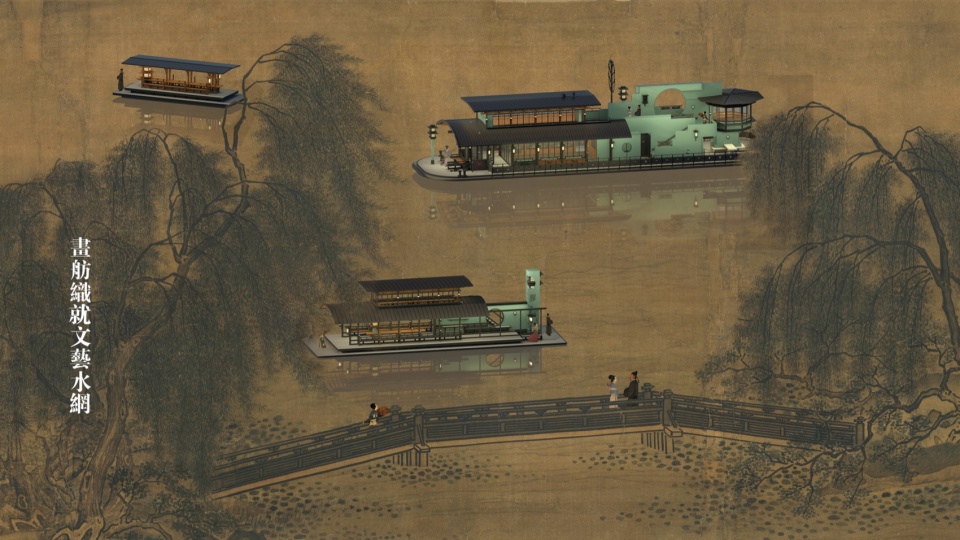
3. The painting boat system establishes a cultural tourism and education system on water: floating hotels, floating study tours, floating forums, floating universities, floating art museums. It breaks down regional barriers, forming a borderless integration of economy, culture, and educational study tours.
▼画框翦淞,设计意象,A framing boat in a painted landscape, design imagery © 造园建筑
我们为此实验了三种尺度的宋韵画舫,探索一种水上移动的园林的可能。新画舫,作为重建水网的美学支点与互联点,是第一步需要着手开拓的:
小:公望号
中:湘湖号
大:钓台号(书院号)
To this end, we have experimented with three scales of Song-style painting boats, exploring the possibility of a mobile garden on water. The new painting boat, as the aesthetic fulcrum and interconnection point for rebuilding the water network, is the first step that needs to be pioneered:
Small: Gongwang Hao.
Medium: Xianghu Hao.
Large: Diaotai Hao (Shuyuan Hao).
▼视频,video © 造园建筑
一,小:公望号。
I. Small: Gongwang Hao.
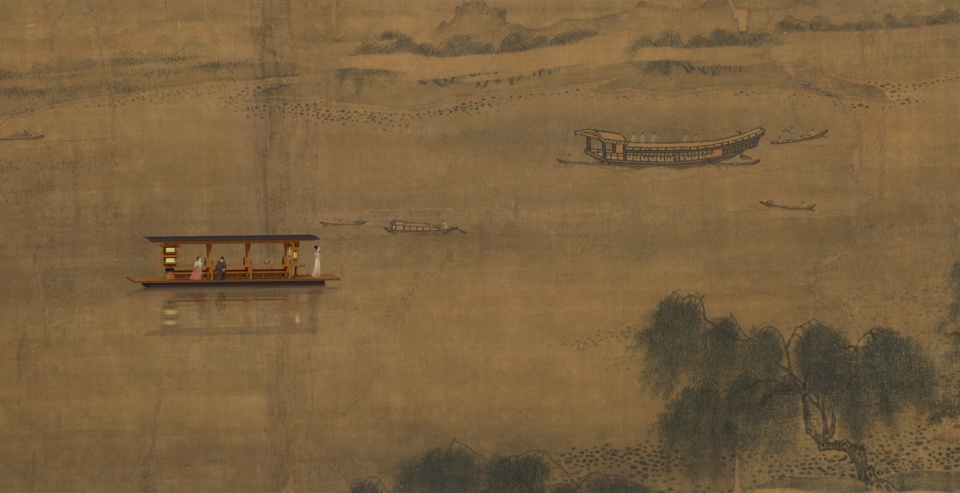
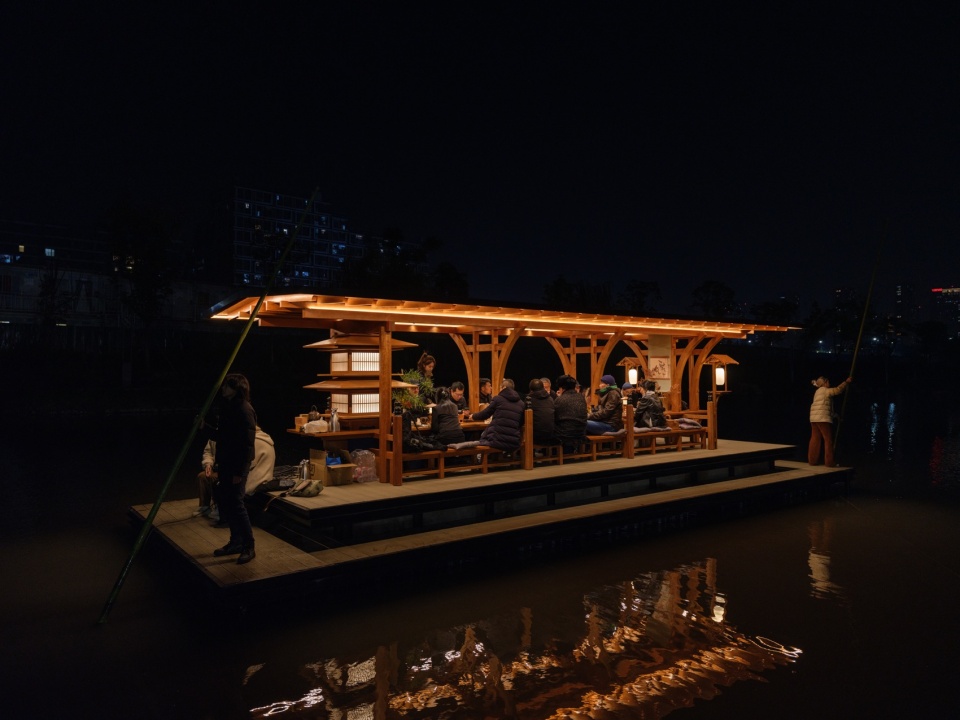
公望号是文艺水网体系中的最小单元,是一座以茶席为核心、以茶为活动载体的湖上课堂。容纳十六人,正好是一个教学单元。它是一个开放的教室,划到哪里,哪里就可以下课,也随时能接引上课的学生上船,加入课堂,学生的边界是流动的,授课群体的边界亦是流动的——谁上船,谁即为学生;谁开口,谁即可为老师。这也是一场上课的接力,一站接着一站,无界的教室,船行何处,何处即为课堂。
▼柳荫间泊,设计意象,A framing boat in a painted landscape, design imagery © 造园建筑
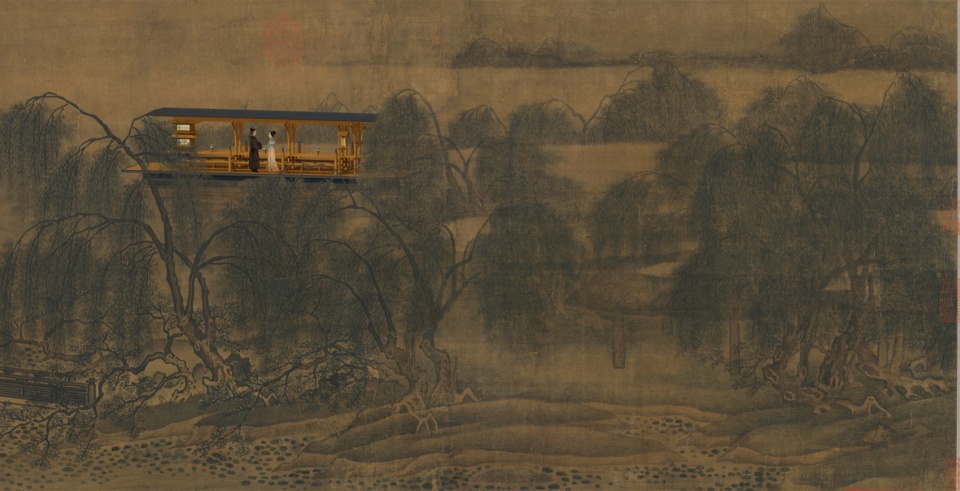
The Gongwang Hao is the smallest unit in the Cultural Water Network system—a lake-based classroom centred on a tea mat, with tea as its medium of activity. It accommodates sixteen people, precisely one teaching unit. It is an open classroom: wherever it rows, class can end there; and students ready to join can board at any time. The boundary of the student body is fluid, and so is the boundary of the teaching group—whoever boards is a student; whoever speaks may be a teacher. This is also a relay of classes, one stop after another, a borderless classroom: wherever the boat goes, there is the classroom.
▼公望号,Gongwang Hao © 造园建筑
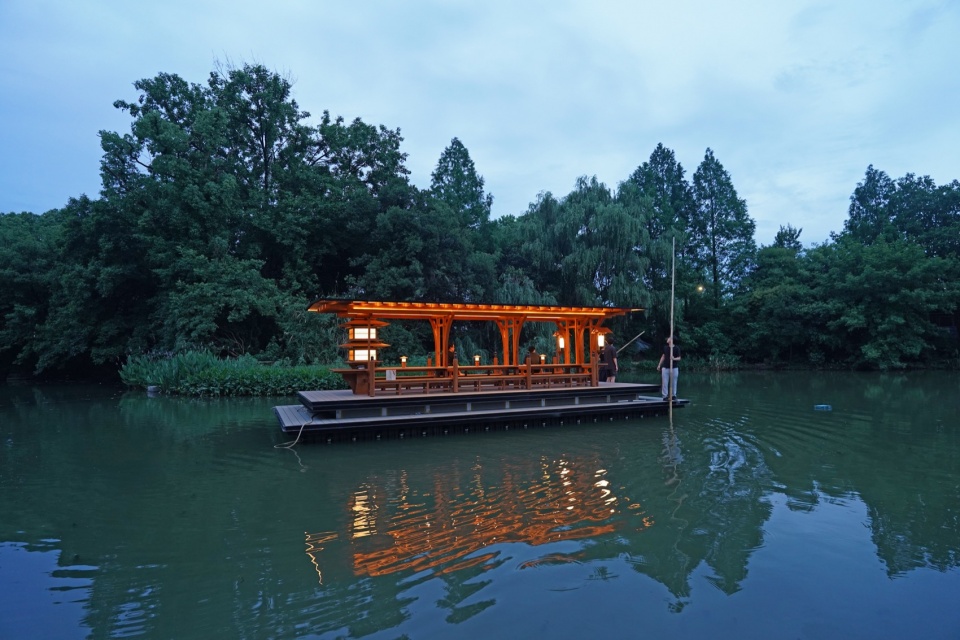
▼公望号的开放课堂,The open classroom aboard Gongwang Hao © 造园建筑
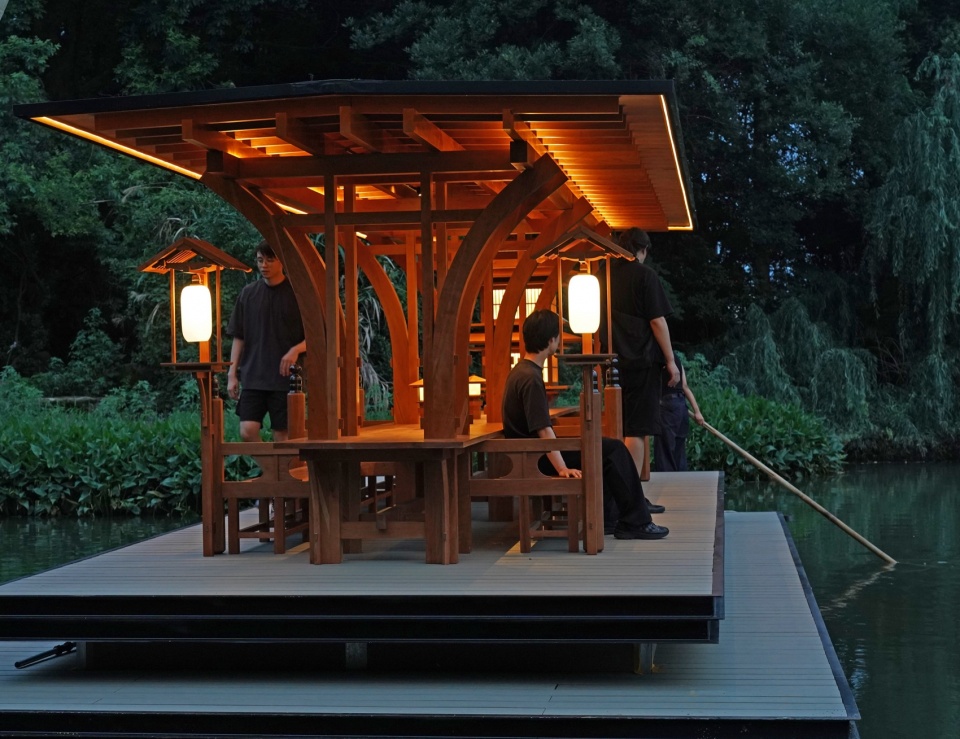
公望号也是一架移动的画框。船行于湖上,随船行框定随遇之风景,有感而发,知识以风景为背景,风景成为讨论的引子,也是随机的分岔。课堂的方向如船行的方向,不知所往,不知所归,这才是上课应该有的样子。教室在此并非封闭的容器,而是一种开放的全景装置,不安四壁怕遮山水。
The Gongwang Hao is also a moving picture frame. As the boat travels on the lake, the frame it carries frames whatever scenery is encountered. Inspiration arises in response, knowledge takes scenery as its background, and scenery becomes the trigger for discussion—and also a random fork in the road. The direction of the class is like the direction of the boat: no knowing where it goes, no knowing where it returns. This is what a class should be like. The classroom here is not a closed container, but an open panoramic installation—restless with four walls, afraid of blocking the landscape.
▼移动的画框,篙转景旋,A moving frame with a changing landscape © 造园建筑
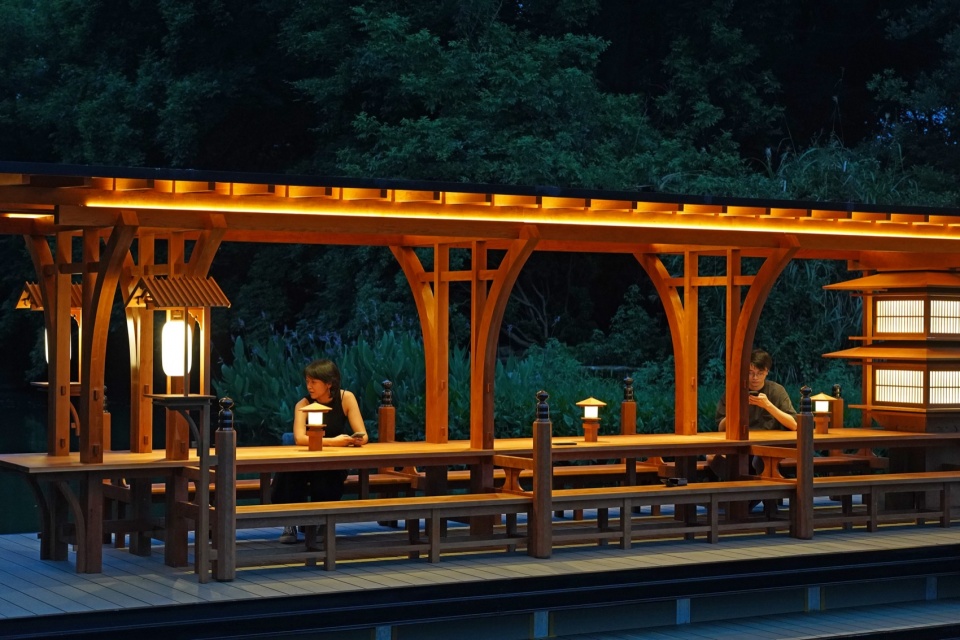
▼由茶案升腾的木构,Timber structure rising from the tea table © 造园建筑
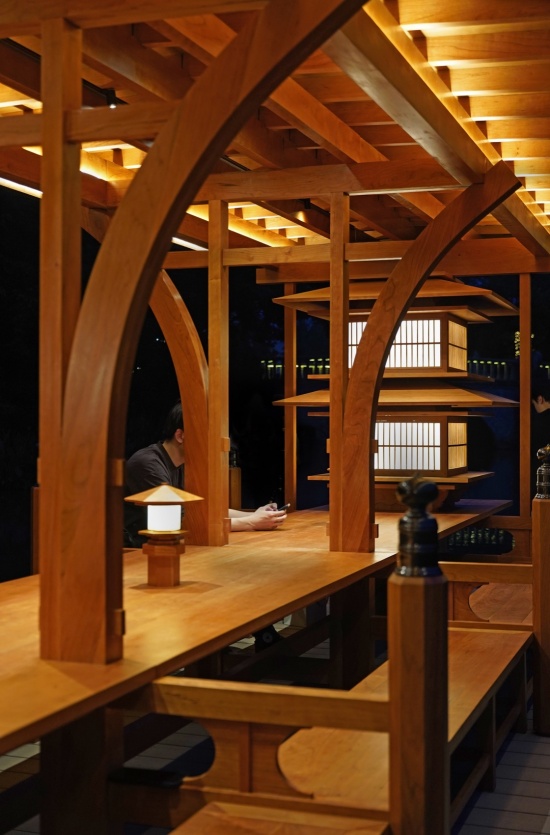
▼木构茶席与灯柱,Timber tea setting and lantern columns © 造园建筑
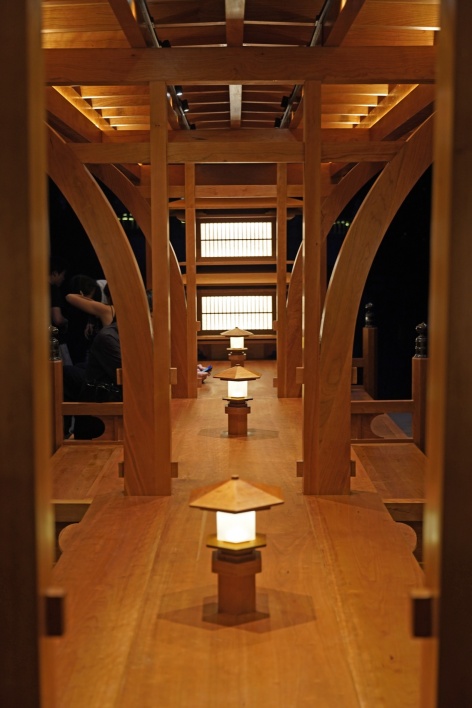
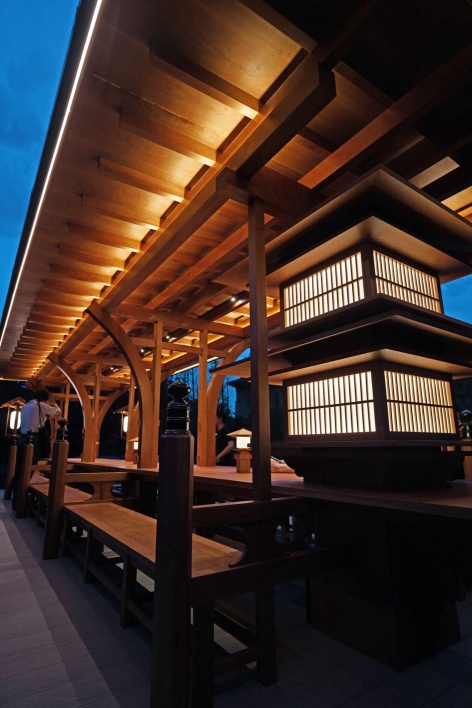
入夜,公望号在湖上亮着,几人还在漫谈,如灯一般,课堂不就是一盏不灭的灯吗?
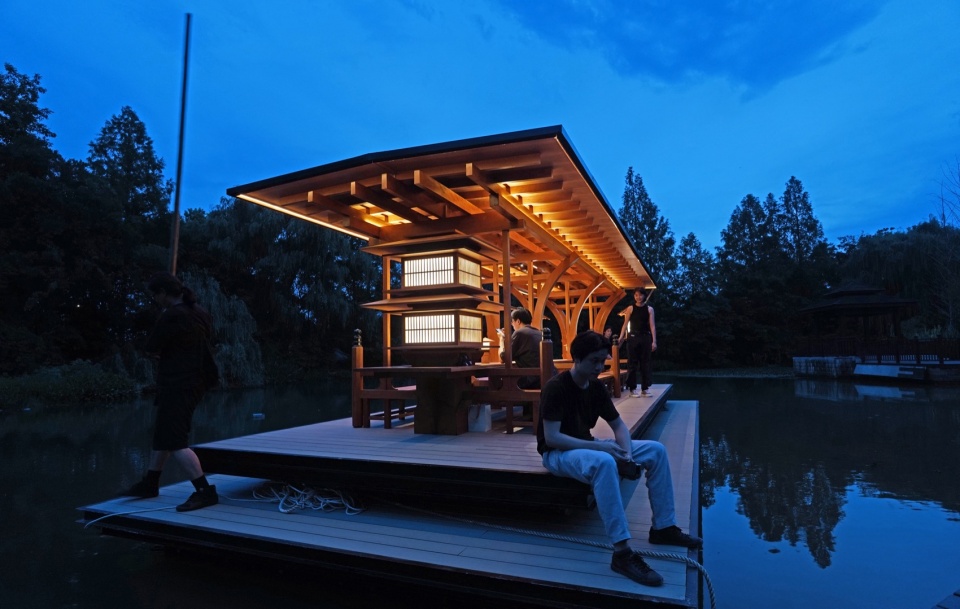
At night, the Gongwang Hao glows on the lake. A few people are still chatting idly, like a lamp. Is not the classroom itself an unextinguishable lamp?
▼入夜,画舫如湖灯,The painting boat glows like a lantern on the lake © 造园建筑
(公望号之后有两个延伸版本,为浙美号、良渚号。)
(There are two extended versions of the Gongwang Hao: the Zhemei Hao and the Liangzhu Hao.)
▼浙美号:宋韵书法展的入口,Zhemei Hao: entrance to the Song-style calligraphy exhibition © 造园建筑
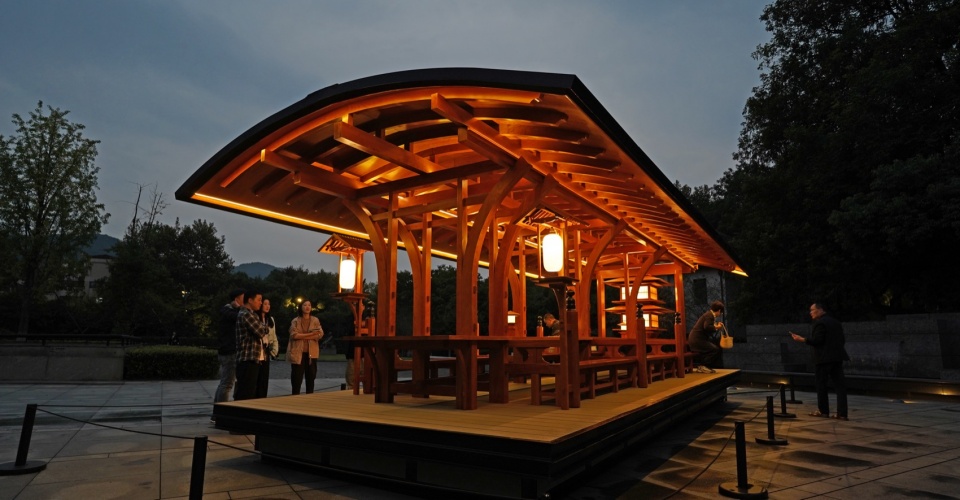
▼良渚号:船上论坛,Liangzhu Hao: a forum on board © 造园建筑
中:湘湖号。
II. Medium: Xianghu Hao.
湘湖号缘起于中国美院湘湖校区的启动,为呼应湖山胜景,遂决意造一艘“湖上公共书房”。其构想的核心,在于“湖山邀泛”,书房从封闭的私人空间转为面向公众的公共场域。譬如张岱的“夜航船”,但湘湖号所追求的,是夜航船的扩大化与明朗化,天下文艺者皆可在此:举举杯,掌掌眼,伸伸腿。
▼如画的取色,设计意象,The picturesque color selection, design imagery © 造园建筑
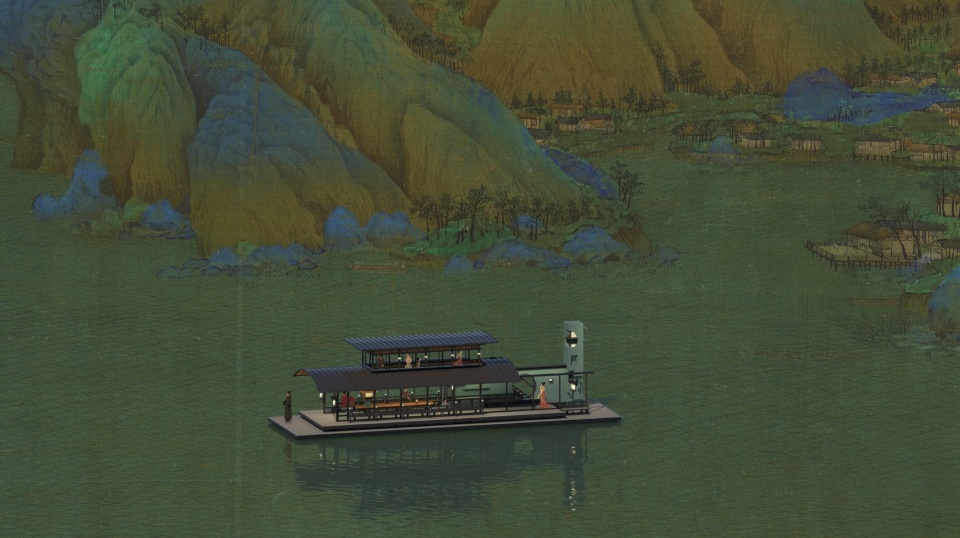
The Xianghu Hao originated with the launch of the China Academy of Art’s Xianghu Campus. To echo the splendid scenery of lake and mountain, we resolved to build a “public study on the lake.” The core of its conception lies in “an invitation to drift on lake and mountain”—transforming the study from a closed private space into a public field open to all. It is akin to Zhang Dai’s “Night-Sailing Boat,” but what the Xianghu Hao pursues is an expanded and clarified version of the night-sailing boat, where all cultural figures under heaven may gather: raise a cup, cast an eye, stretch a leg.
▼湘湖号模型:公共书房与琴台,Xianghu Hao model: public study and upper platform © 造园建筑
▼湘湖号模型细部,Detail of the Xianghu Hao model © 造园建筑
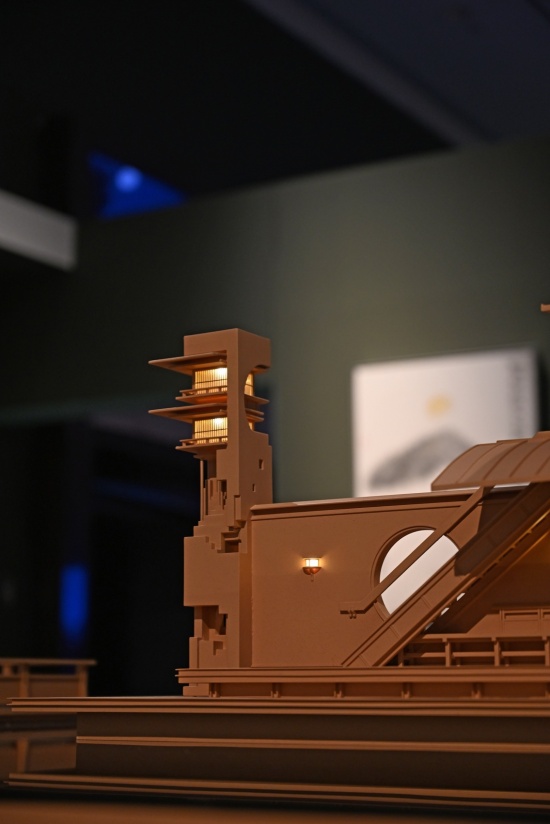
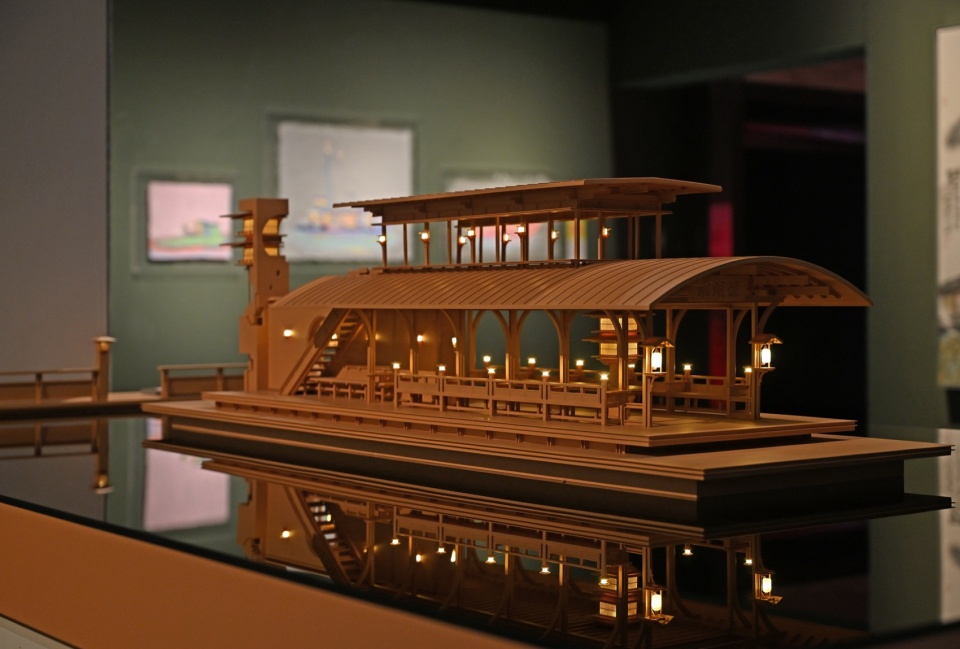
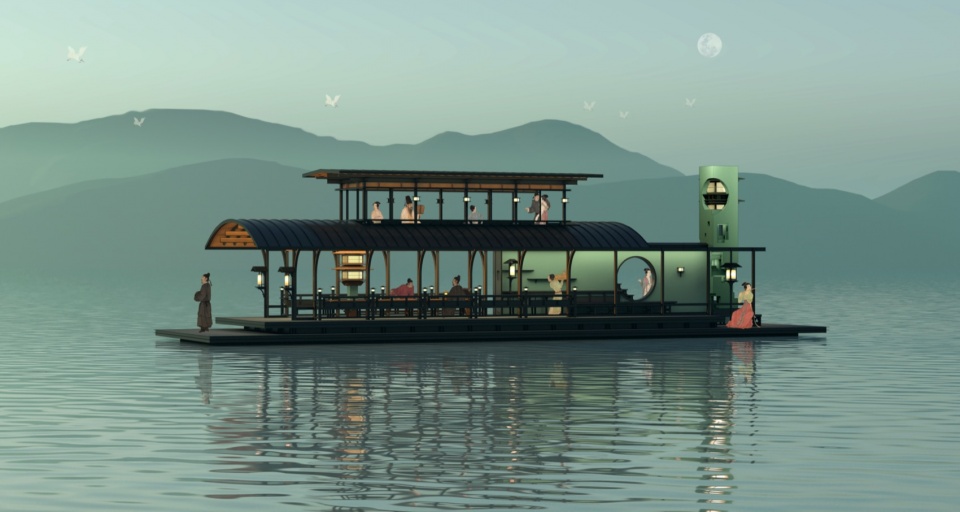
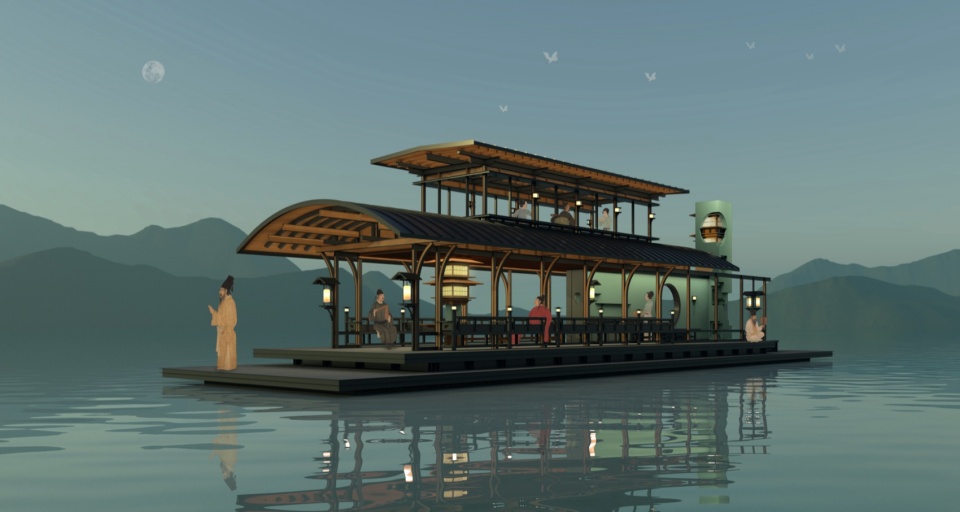
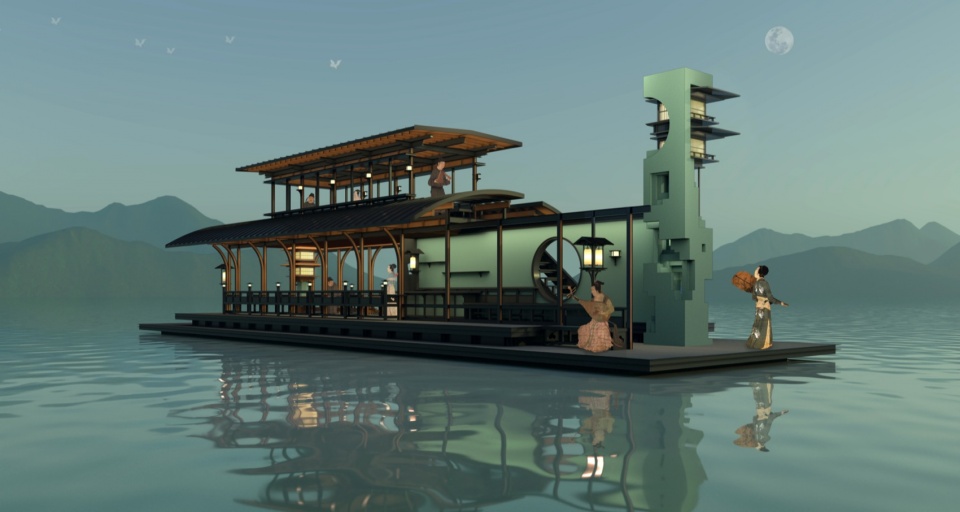
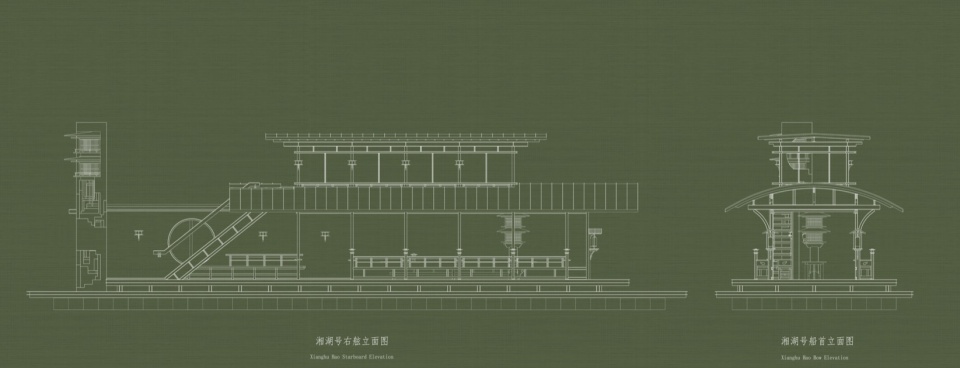
湘湖号可被理解为《文会图》的物化与船化,功能涵盖雅集、论坛、笔会、鉴赏等。船分二层,一层为雅集区与点茶区,是品茗、比艺、论道的场所;二层为琴台,可吟咏、可远眺。船尾以马远《踏歌图》中的天柱峰为意象,设一盏天柱尾灯,湖上具有可辨识的轮廓与方向。明代,杭州西湖上曾有黄汝亨创制“浮梅槛”,即为一种交游论艺的水上移动平台,诗酒联欢,技艺互通,每逢花期月夜或澄雪山阴,徜徉诸岛六桥,观者如堵。湘湖号继承了这一传统,雅集应当成为一种公共文艺舞台。
The Xianghu Hao can be understood as the materialisation and boatification of the Literary Gathering painting. Its functions encompass elegant gatherings, forums, brush meetings, and connoisseurship. The boat has two levels: the first level contains the gathering area and the tea-whisking area, where people taste tea, compare skills, and discuss the Way; the second level is a qin terrace, for chanting and distant viewing. At the stern, taking the Tianzhu Peak from Ma Yuan’s Song of Treading on Green as its imagery, a Tianzhu stern lamp is installed, giving the boat a recognisable silhouette and direction on the lake. In the Ming dynasty, Huang Ruheng created the “Floating Plum Railing” on West Lake in Hangzhou—a floating platform for socialising and discussing art, with poetry, wine, and exchange of skills. Whenever the flowering season or a moonlit night came, or when snow cleared on the hills, it would drift among the islands and six bridges, with onlookers crowding like a wall. The Xianghu Hao inherits this tradition: the elegant gathering should become a public stage for culture and art.
▼湘湖号侧面,设计效果图,Xianghu Hao side view, rendering © 造园建筑
▼湘湖号船首,设计效果图,Xianghu Hao bow, rendering © 造园建筑
中国人产生新知识与新感知的方式,从来就不必局限于封闭的黑盒子中发明理论与公式。黑盒子里的知识是蒸馏过的、提纯过的,精确,却也可能干枯。中国人更熟悉的方式,是在山水之间,在舟船之上,在杯盏往来之中,让知识自然生长出来。羲之的兰亭,苏轼的西园,张岱的夜航船,都不是先有理论再找地方宣讲,而是在山水行旅中慢慢发酵感知与体悟。风景不仅是背景,风景是方法;泛游不是消遣,泛游更是认知。
The Chinese way of generating new knowledge and new perception has never been confined to inventing theories and formulas in a closed black box. Knowledge in a black box is distilled and purified—precise, but perhaps also desiccated. The Chinese are more familiar with a way that unfolds naturally amid mountains and waters, on boats and ships, in the passing of cups and vessels. Xi Zhi’s Orchid Pavilion, Su Shi’s Western Garden, Zhang Dai’s Night-Sailing Boat—none of them first established a theory and then found a place to lecture. Rather, perception and realisation fermented slowly amid travel through landscape. Scenery is not merely background; scenery is method. Drifting is not mere pastime; drifting is cognition.
▼湘湖号船尾,设计效果图,Xianghu Hao stern, rendering © 造园建筑
大:钓台号(书院号)
III. Large: Diaotai Hao (Shuyuan Hao)
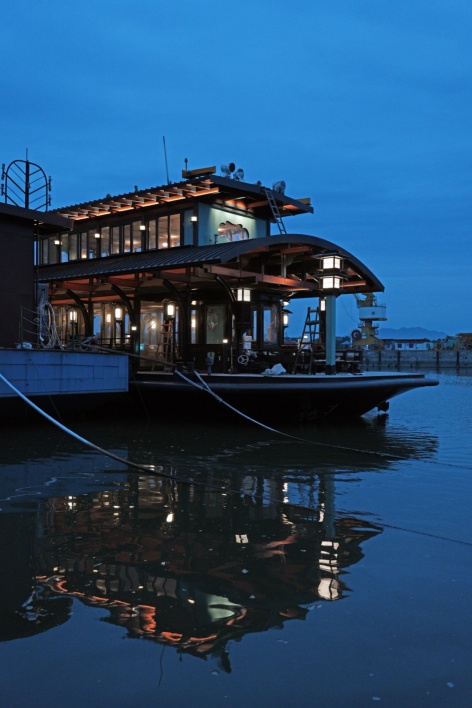
钓台号(书院号)是一座江上的书院与美术馆。它是三种画舫中最大的,也是最具制度想象力的。公望号是“风景课堂”,湘湖号是“公共书房”,钓台号是“移动的机构”。它是一座江上的书院,一座水上的美术馆,一个流动的论坛,一个无界的大学。
The Diaotai Hao (Shuyuan Hao) is an academy and art museum on the river. It is the largest of the three painting boats, and the one with the greatest institutional imagination. The Gongwang Hao is a “scenery classroom,” the Xianghu Hao a “public study,” and the Diaotai Hao a “mobile institution”—an academy on the river, an art museum on water, a floating forum, a borderless university.
▼钓台号停泊严子陵码头,Diaotai Hao moored at the Yan Ziling pier © 造园建筑
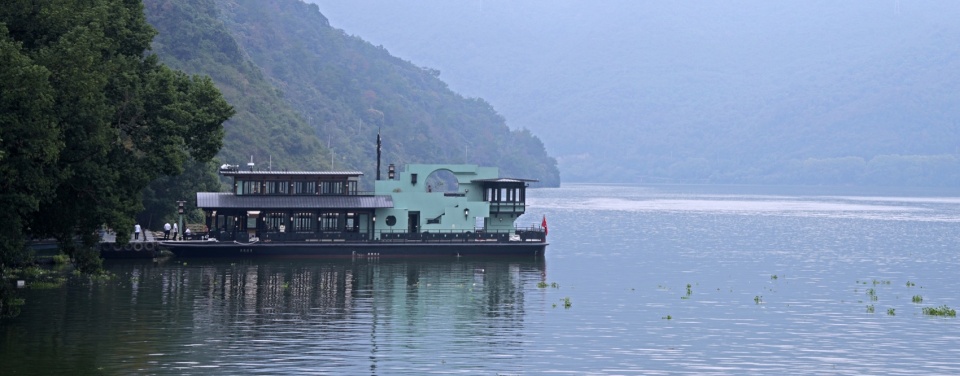
▼夜系江岸柳汀,Moored beside a willow-lined riverbank at night © 造园建筑
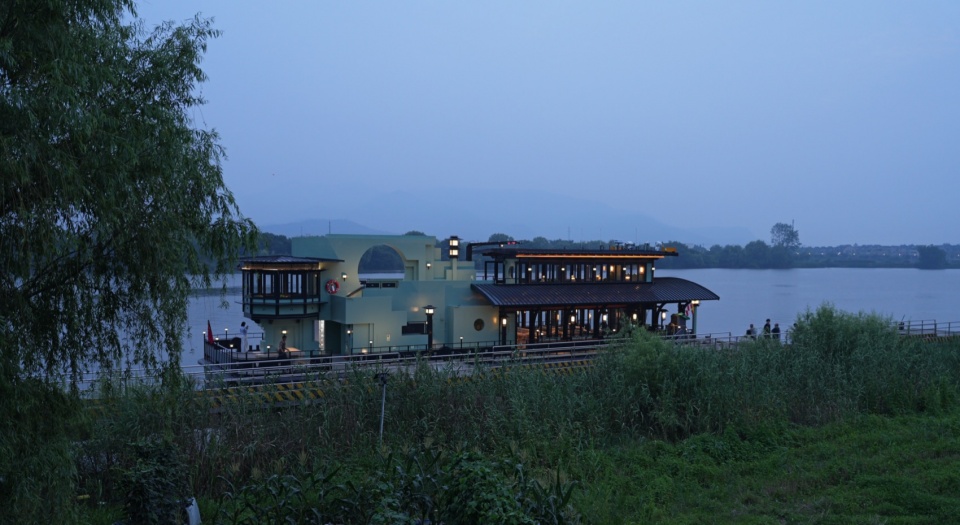
江上论坛,案头六尺,窗含千里,论道与游访一体。流动的风景,流动的思想,讨论不是抽象的思辨,而是与行走、观看、印证紧密结合的实践。知识与行动,理论与体验,在这里不再分离。
A forum on the river: a six-foot desk, a window framing a thousand miles, the discussion of the Way and the visitation of sites as one. Flowing scenery, flowing thought—discussion is not abstract speculation, but a practice tightly bound to walking, seeing, and verifying. Knowledge and action, theory and experience, are no longer separated here.
▼钓台号夜景,Diaotai Hao at night © 造园建筑
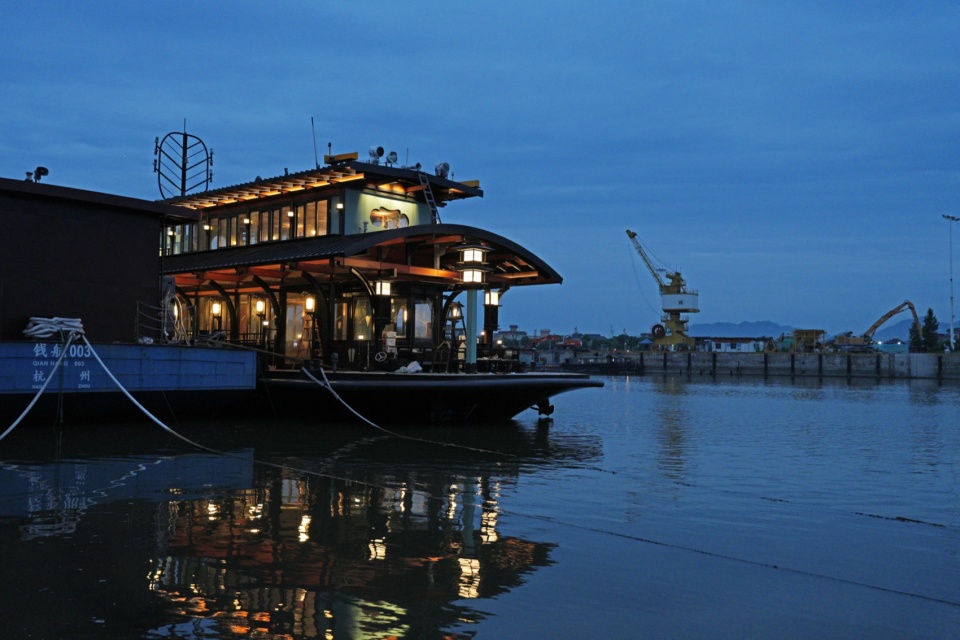
▼钓台号沿岸外观,Diaotai Hao viewed from the riverbank © 造园建筑
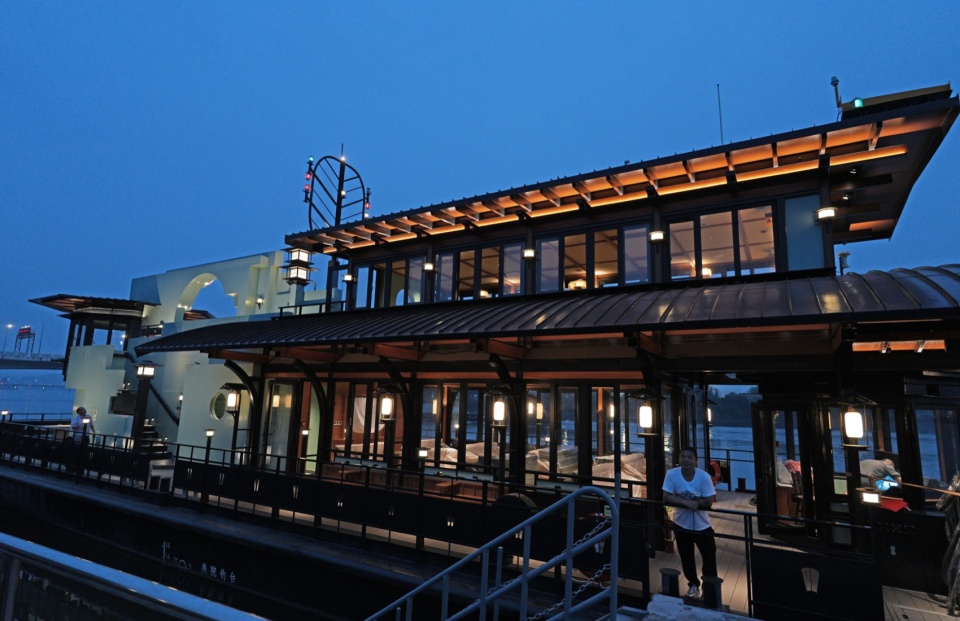
▼钓台号的月洞与木构,The moon gate and timber framing of Diaotai Hao © 造园建筑
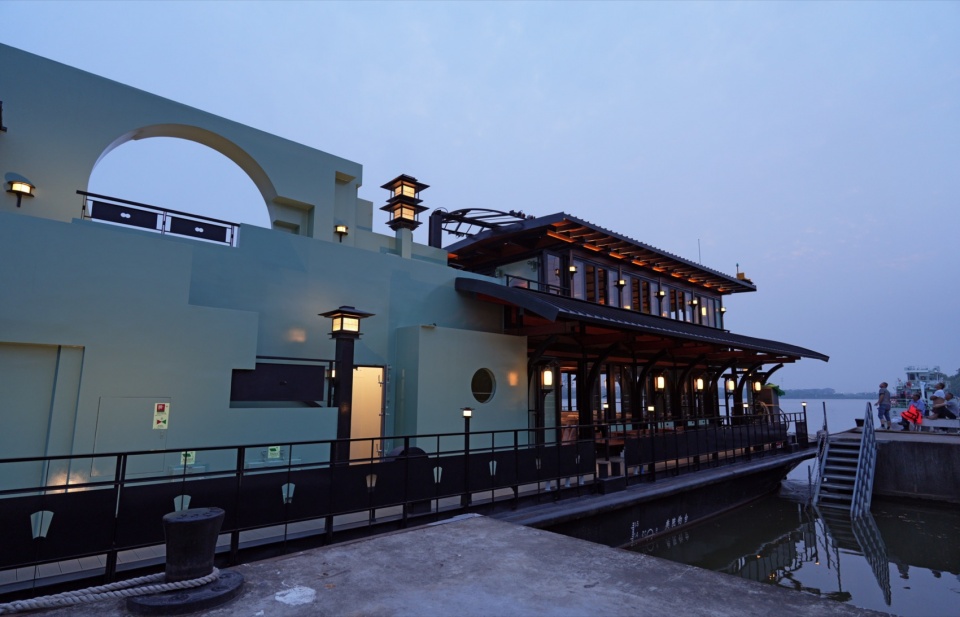
它将书院、美术馆、论坛、游学融为一体。书院是教育的制度,美术馆是艺术的制度,论坛是交流的制度,游学是实践的制度。书院号把这四种制度整合到一艘船上,创造了一种全新的“水上机构”。它让“沿江湖修学”成为可能——学生不再局限于校园,而是沿着江湖行走,在行走中学习,在江湖中成长。它让艺术展览沿着水网送到上海、南京、北京……艺术品不再被固定在美术馆的墙上,而是沿着水网流动,送到更远的地方,送到更多的人面前。钓台号以严子陵钓台命名,期延续这样的精神:追求江湖之远,追求思想自由。
It integrates academy, art museum, forum, and study tour into one. The academy is the institution of education, the art museum the institution of art, the forum the institution of exchange, and the study tour the institution of practice. The Shuyuan Hao integrates these four institutions onto a single boat, creating an entirely new “institution on water.” It makes “study along rivers and lakes” possible—students are no longer confined to campus, but travel along rivers and lakes, learning as they go, growing amid the rivers and lakes. It allows art exhibitions to travel along the water network to Shanghai, Nanjing, Beijing… Artworks are no longer fixed on the walls of a museum, but flow along the water network, delivered to farther places, to more people. The Diaotai Hao is named after Yan Ziling’s fishing terrace, in the hope of continuing this spirit: the pursuit of distance from court and marketplace, the pursuit of intellectual freedom.
▼钓台号临水空间,Waterside spaces aboard Diaotai Hao © 造园建筑
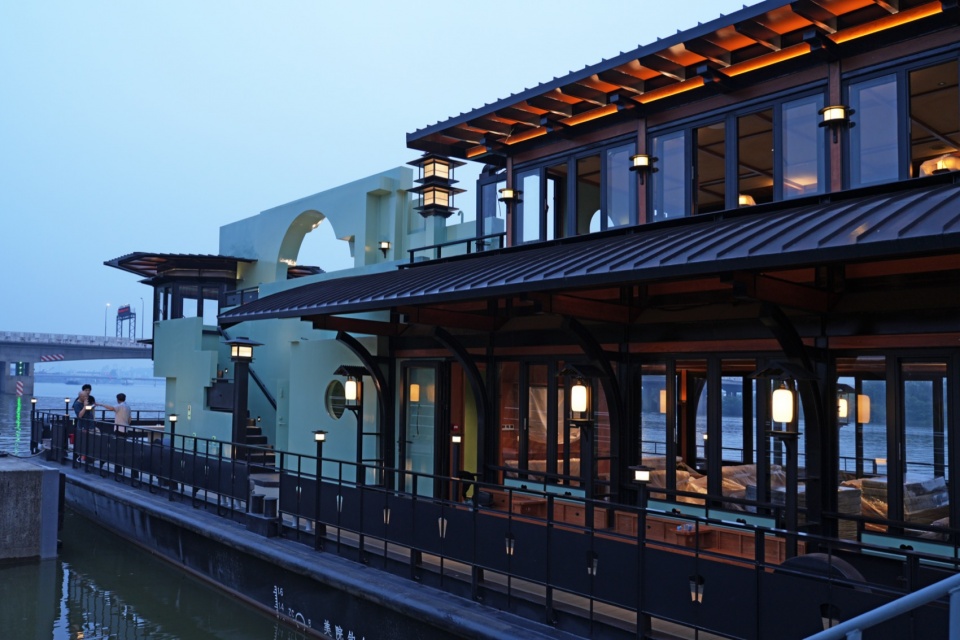
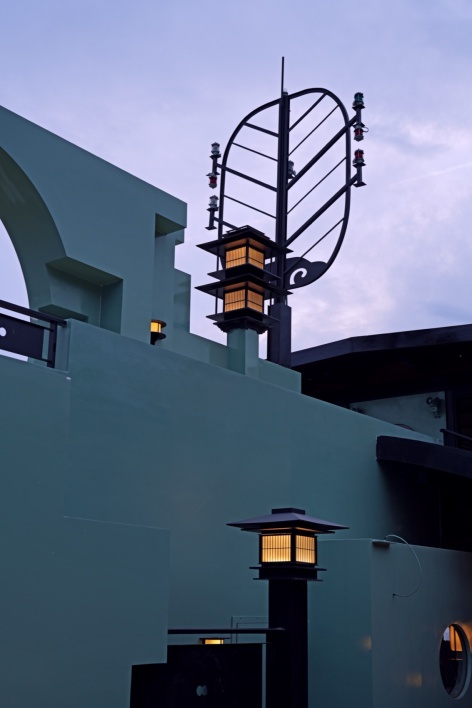
▼钓台号船头与蕉叶桅杆,Diaotai Hao bow and banana-leaf mast © 造园建筑
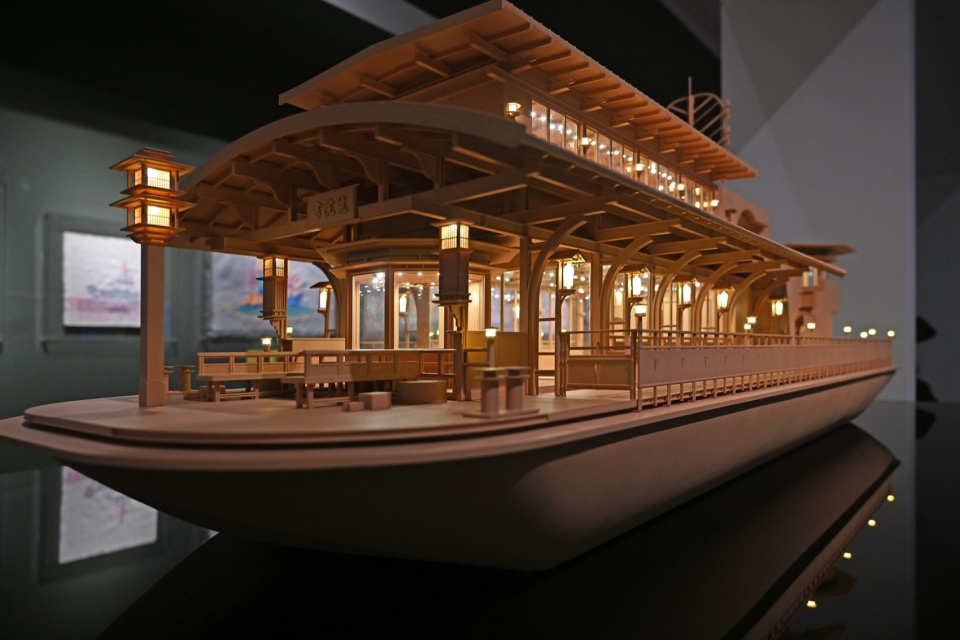
▼钓台号模型:船头小剧场,Diaotai Hao model: small theatre at the bow © 造园建筑
▼船头小剧场,设计效果图,A small theatre at the bow, rendering © 造园建筑
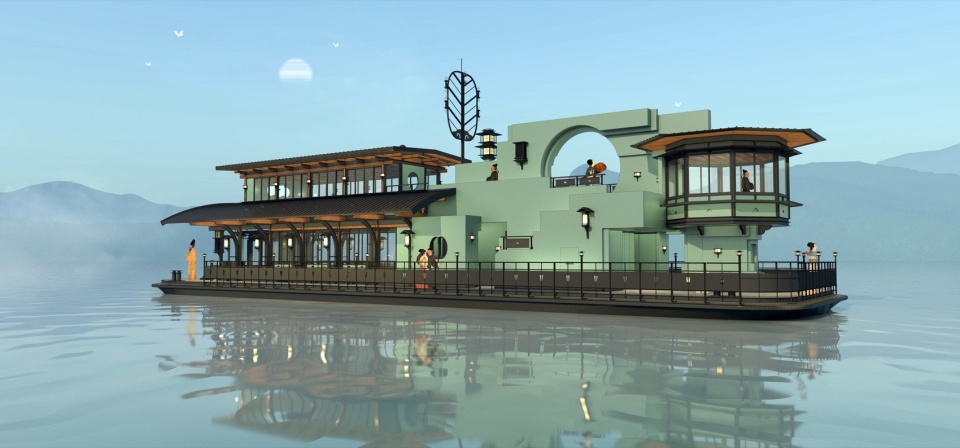
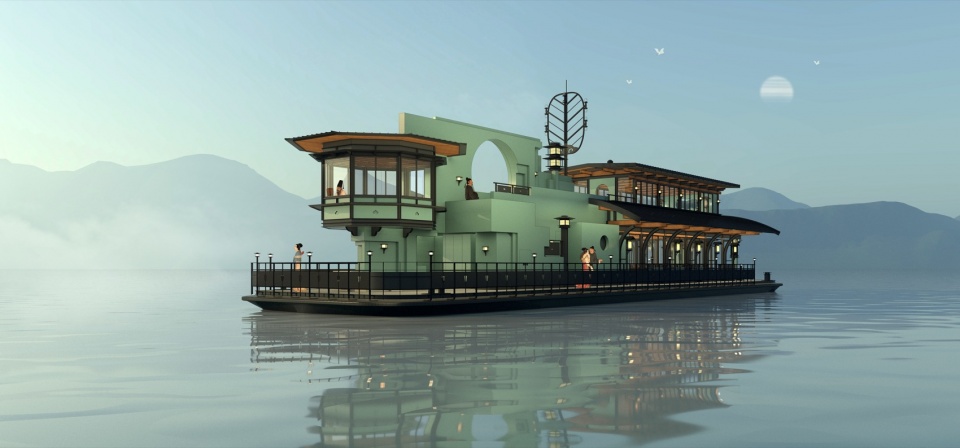
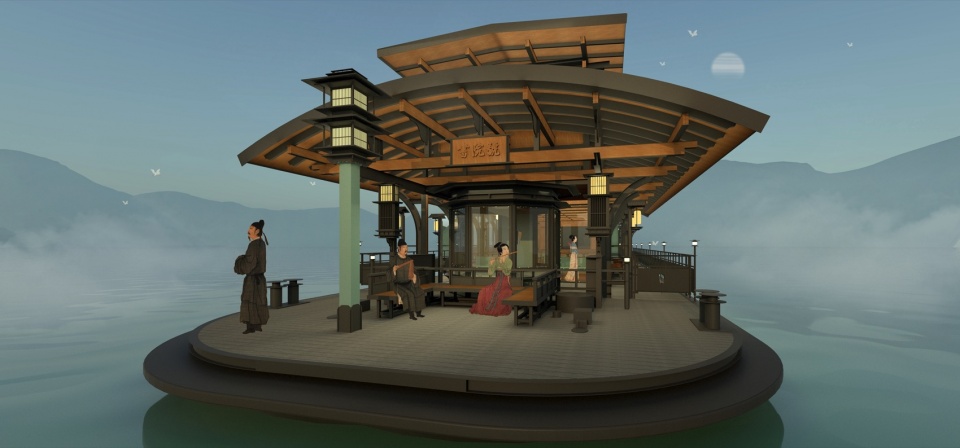
当代的画舫,将传统水网转化为文艺与教育的互联网,以实现大学的无墙与艺术的无界。
The contemporary painting boat transforms the traditional water network into an internet of culture, art, and education, realising a university without walls and art without borders.
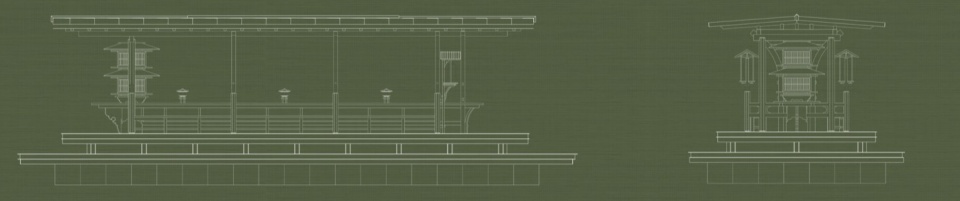
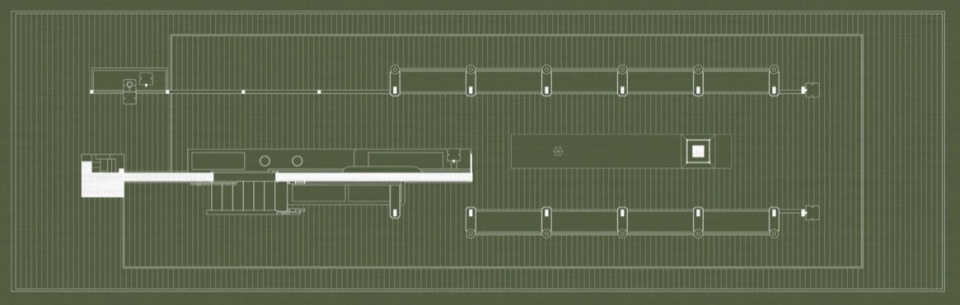
▼公望号平面图,Gongwang Hao plan © 造园建筑
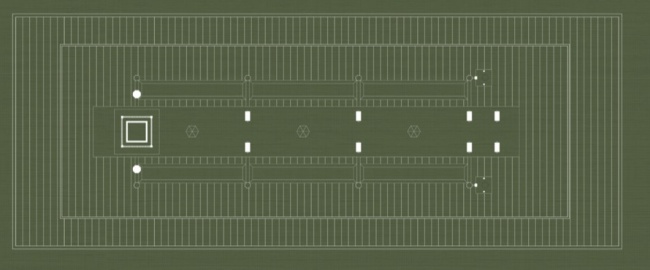
▼公望号右舷与船尾立面图,Gongwang Hao, starboard and stern elevations © 造园建筑
▼湘湖号一层平面图,Xianghu Hao, first-floor plan © 造园建筑
▼湘湖号右舷与船首立面图,Xianghu Hao, starboard and bow elevations © 造园建筑
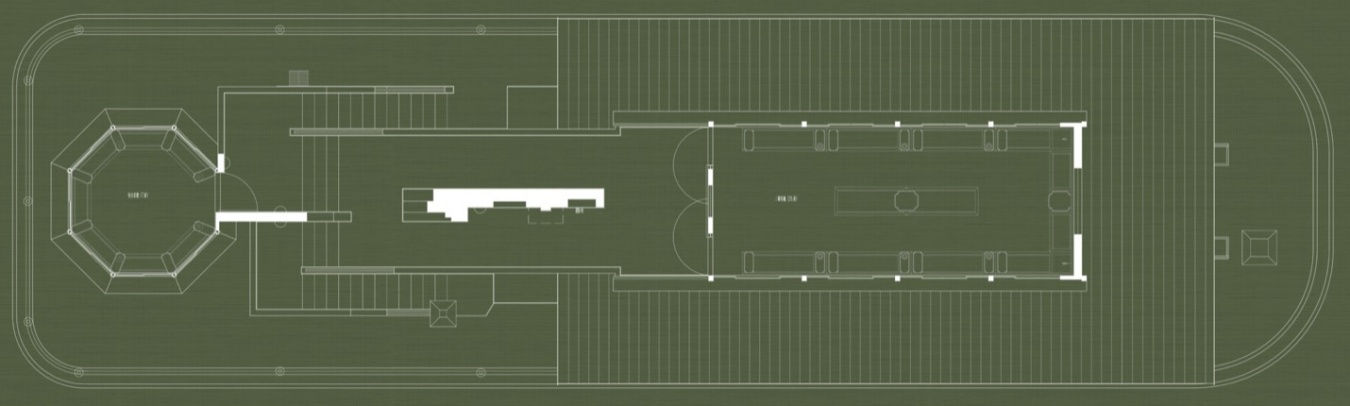
▼钓台号(书院号)一层平面图,Diaotai Hao (Shuyuan Hao), first-floor plan © 造园建筑
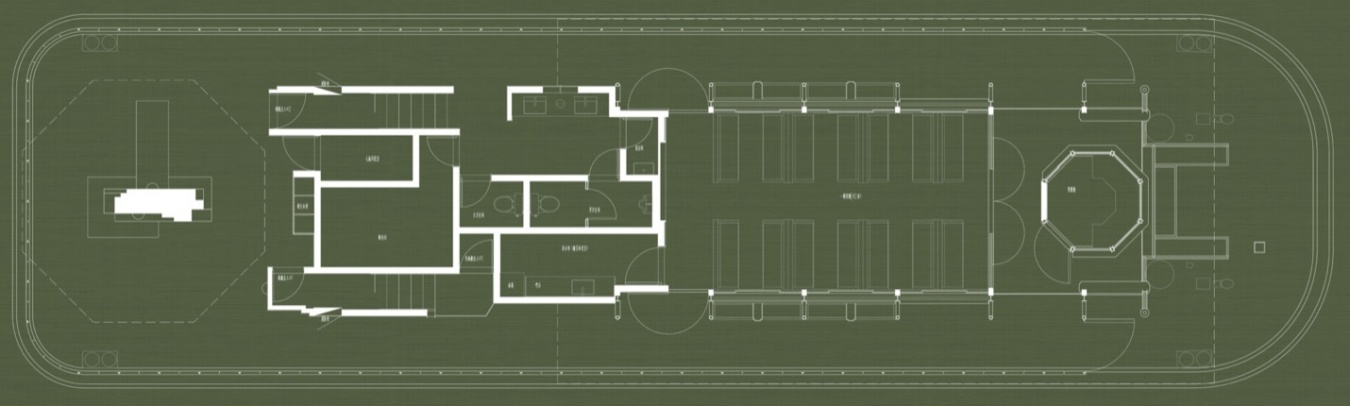
▼钓台号(书院号)二层平面图,Diaotai Hao (Shuyuan Hao), second-floor plan © 造园建筑
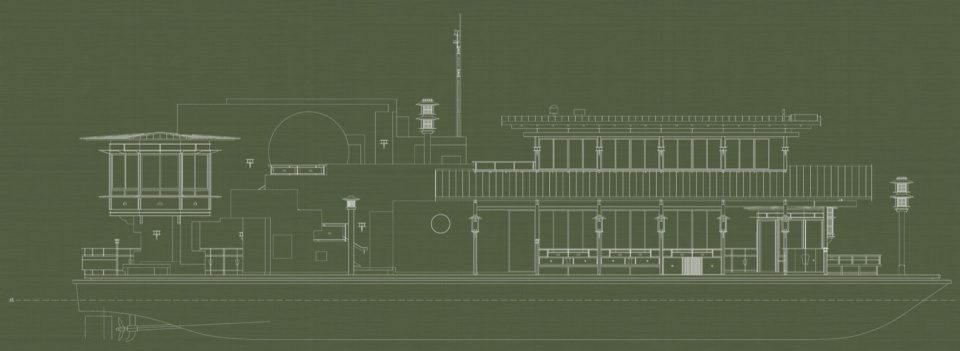
▼钓台号(书院号)右舷立面图,Diaotai Hao (Shuyuan Hao), starboard elevation © 造园建筑
项目名称:重建江南水网画舫慢经济
项目类型:船舶设计与策划
项目地点:杭州
建成状态:建成
设计时间:2020年—2026年
建设时间:2026年
策划:高世名、姜珺、舒羽、刘益红
作品从属展览:
边角空间新生计划2023
青山行不尽——唐诗之路艺术展第五回:大运河诗路艺术展 2025
“大地之歌·2025美丽中国纪事”星群展 2025
第四届良渚论坛配套活动3—源浚者流⻓·中国⽂化遗产元素创新设计特展2026
设计单位:造园建筑工作室 中国美术学院建筑艺术学院
设计单位联系方式:info@gardeningarchitects.com
主创建筑师:王欣、孙昱、姚汉青、王徐超、谢庭苇
业主:桐庐文旅集团、中国美术学院、杭州万科、浙江美术馆
施工图与机电:杭州江海船舶技术有限公司
船体建造:杭州钱航船舶修造有限公司
木作道具:杭州日兴圆艺术家居有限公司
照明:杭州荣熙照明工程有限公司
内装:杭州方奕建筑有限公司
摄影师:造园建筑
Project Name: Rebuilding the Jiangnan Water Network Painting Boat Slow Economy
Project Type: Boat Design and Curation
Project Location: Hangzhou
Completion Status: Built
Design Period: 2020–2026
Construction Period: 2026
Curatorial Planning: Gao Shiming, Jiang Jun, Shu Yu, Liu Yihong
Affiliated Exhibitions:
Urban Micro-Space Regeneration Plan 2023
Endless Mountains—An Exhibition of Art and the Tang Poetry Road, Fifth Edition: Grand Canal Poetry Road Art Exhibition 2025
“Songs of the Earth: Artistic Documentary for a Better China” 2025 Constellation Exhibition 2025
Supporting Activity 3 of the 4th Liangzhu Forum — Innovation Design Exhibition of Chinese Cultural Heritage Elements, 2026
Design Firm: Gardening Architects, School of Architecture Art, China Academy of Art
Design Firm Contact: info@gardeningarchitects.com
Principal Architects: Wang Xin, Sun Yu, Yao Hanqing, Wang Xuchao, Xie Tingwei
Clients: Tonglu Culture & Tourism Group, China Academy of Art, Hangzhou Vanke, Zhejiang Art Museum
Construction Drawings and MEP: Hangzhou Jianghai Marine Technology Co., Ltd.
Hull Construction: Hangzhou Qianhang Ship Repair and Building Co., Ltd.
Woodwork and Props: Hangzhou Rixing Gardening Artist Furniture Co., Ltd.
Lighting: Hangzhou Rongxi Lighting Engineering Co., Ltd.
Interior Fit-out: Hangzhou Fangyi Construction Co., Ltd.
Photography: Gardening Architects
More:造园建筑工作室。更多关于他们:Gardening Architects on gooood

发表评论
你需要先 才能发表评论
社交登录