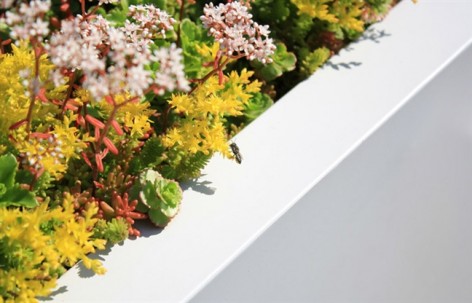
这是目前为止最严格也最为全面的屋顶测试研究。事实上,它也许是唯一一个对屋顶绿化的实证研究。特别值得注意的是研究基于北方气候环境。
——2013专业奖评审团“This is by far the most rigorous and comprehensive of all the test-roof research out there. In fact, it may be the only empirical study of a green
roof. It’s particularly notable that it’s in a Northern climate.”
—2013 Professional Awards Jury
来自ASLA对gooood的分享。更多请至:University of Toronto on gooood
Appreciation towards ASLA for providing the following description:
项目概述
PROJECT STATEMENT
绿色屋顶创新测试实验室(GRIT实验室)拥有最先进的研究设施,也是北美唯一一所研究屋顶绿化效果最优化的实验室。GRIT实验室包括实时数据监
测和持续的的实地观测,研究与“绿色”技术相关的指标,空前地、全面地、动态地和具有实践性的解释了水-能源-生态三者在特定地域和背景下的关系。
The Green Roof Innovation Testing Laboratory (GRIT Lab) is a state-of-the-art research facility and the only one of its kind in North America
that studies the optimization of green roof performance. GRIT Lab includes real time data monitoring and ongoing field observation to study the
metrics associated with ‘green’ technologies in order to provide an unprecedented, comprehensive, dynamic and hands-on understanding of
the water–energy–biology nexus in context of regional and climate specific priorities.
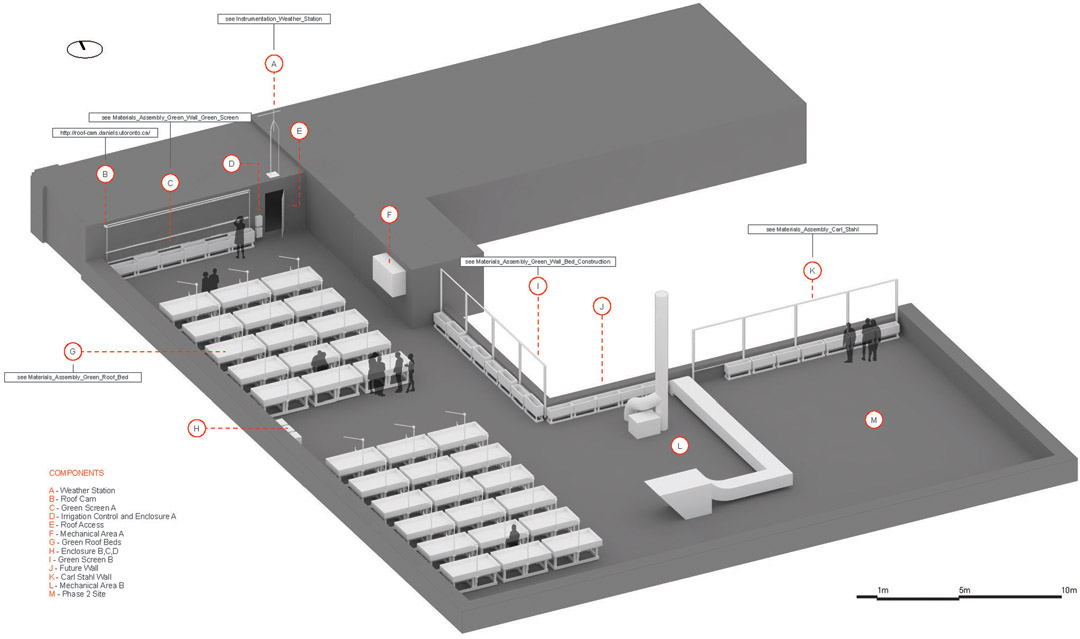
△ A 4,000 sq. ft. roof area is arranged so that thirty-three raised rectangular modules (4 ft. x 8 ft.) can fit within a block formation exposed to sun
and wind on all four sides. 在4000平方英尺的屋顶上布置了33个凸起的矩形模块(4英尺x8英尺),中间有一块矩形的镂空,阳光和风可以从四周进入。
问题研究
在2009年多伦多市为屋顶绿化细则立法后,屋顶绿化方面还是出现了一些技术性问题,这些技术问题有关于绿化屋顶及与其相关的环保成效,即降
水管理、蒸发冷却和生物多样性。造成这些技术问题的原因在于缺乏在安大略省南部的气候环境下对建设标准的测试。尽管现在已经有大量的研究
和测试,但多年来规范屋顶绿化业的标准是在欧洲气候区环境下发展起来的,与多伦多更为极端的特点不尽相同。
现在的多伦多市已经别无选择,只能依靠模拟模式和从其他气候区获取的指标以确定其屋顶绿化建设的成功标准。部分原因在于不能将以监控屋顶绿
化的持续性以及量化环保成效为目的而进入别人私有财产的行为合法化。在无法验证环保成效的情况下,越来越多的屋顶绿化项目在没有提供使用
后的定量评价的情况下就申报成功了。
GRIT实验室致力于解决以下几个问题:如何做屋顶绿化?建设标准的制定、教学和实践有效吗?建设标准仅适用于特定的气候区域吗,还是需要过
段时间才能体现出优化的作用?
关系调查
研究机构首先对4个测试参数进行评估——1)培养介质类型 (无机/高有机),2)培养机制深度(4英寸 / 6英寸),3)植物类别(非本地景天属植物/当地天
然草和非禾本草本植物),和4)灌溉方法(无/定时/土壤传感器控制),还有4种主要环境标准——1)雨水滞留、2)蒸发冷却、3)生物多样性,和4)寿命
周期成本。
假设是:高有机培养介质能提供比无机培养介质更高的保水性,且土壤的有效性能促进植物持续茁壮生长,在土壤水分蒸发损失量增加的情况下,
能保持相对较低的环境温度。
还假设加大深度能在安大略省南部漫长而寒冷的冬季里为植物提供热质量,以确保一年生植物能在春天复苏。最后, 认为与景天属植物相比,草地
和非禾本草本植物种植会产生较高的蒸散率;且随着时间的推移,相较于景天属植物的单一功能,本地草和非禾本草本植物因其功能生物多样性而
具有更强的韧性。
与过去研究的对比
屋顶绿化研究的领域通常是生物学、水文学、建筑科学,并倾向于关注与特定研究领域相关的单个成分或功能。GRIT实验室方法独特,采用多学科
合作结构并同步检测植物生长、土壤学、水文学和能源之间相互影响蒸散能力和减少热岛效应的能力;调节水流并减少径流和灌溉需求;随着时间
推移保持植物茁壮生长。因此,研究小组的成员包括景观设计学、工程-水文学和能源建模与生物部门的全体教师和研究生。
调查方法
研究地点在一个面积为4000平方英尺的屋顶上。33个模块(4英尺×8英尺)用以比较上述测试参数。每个模块都安装了8个传感器:土壤水分传感器、
测量径流流量的雨量计测量器、5个沿热剖面垂直轴的热传感器,和一个记录平均表面温度的有三英尺直径圆的红外辐射计。从264个传感器获得的
数据用于分析与植物生长有关和与现场气象站获得的基本气候数据(太阳辐射、温度、降水、相对湿度、风速和风向)有关的问题。
研究结果
该设施的建设和仪器仪表化是从2010年开始的,完成于2012年的冬天。植物生长数据将在其后三年内收集起来。初步结果是基于实地观察植物在
过去两个生长季的生长情况得出的数据,包括植被清单、种类多样性和每个试验台上的植物高度—-反映植物的生长条件。调查结果显示,保持植物
多样的需要补充灌溉,当地草和阔叶杂草数量和生物量在有机培养介质中更大。无机培养介质如果缺乏灌溉会导致当地草和宽叶杂草大量减少;灌
溉和培养介质对景天属植物没有任何影响。
结果的意义
GRIT实验室建立了广泛的伙伴关系,与学术机构、行业合作伙伴和政府机构分别在教育和知识传播、创新和商业化及政策与指导方针方面取得了巨
大的成效。预计研究成果将补充现有的多伦多屋顶绿化建筑标准、行业标准和GRP认证程序。增加城市多伦多的绿色屋顶建筑标准以及行业标准和
GRP认证程序。
交流
GRIT实验室的门户网站对外开放源数据,这些数据目前包括一组原始技术图纸、植物数据表、动画、视频以及一个网络链接,实时提供有关于实验
设计、实验进程和实验室的活动的信息。研究结果、报告和期刊文章也将定期更新。
景观建筑实践与教育的应用
该研究结果是针对安大略省南部地区的,但其研究方法和实验设计可以广泛应用于不同地区。景观建筑师可能更了解该如何因地制宜的根据地域和
气候特定优先顺序定义屋顶绿化系统的环保成效目标,能更好地与材料供应商和下级顾问讨论这些优先顺序。
最后,GRIT实验室的主要目标之一是为景观设计学生提供时间机会,直接在最新的材料和数码科技的环境中工作,还能接触到各领域的行业专家和
学者。不同学科之间的结合能产生新的想法,与工业和政府机构的联系便于工作的实施。
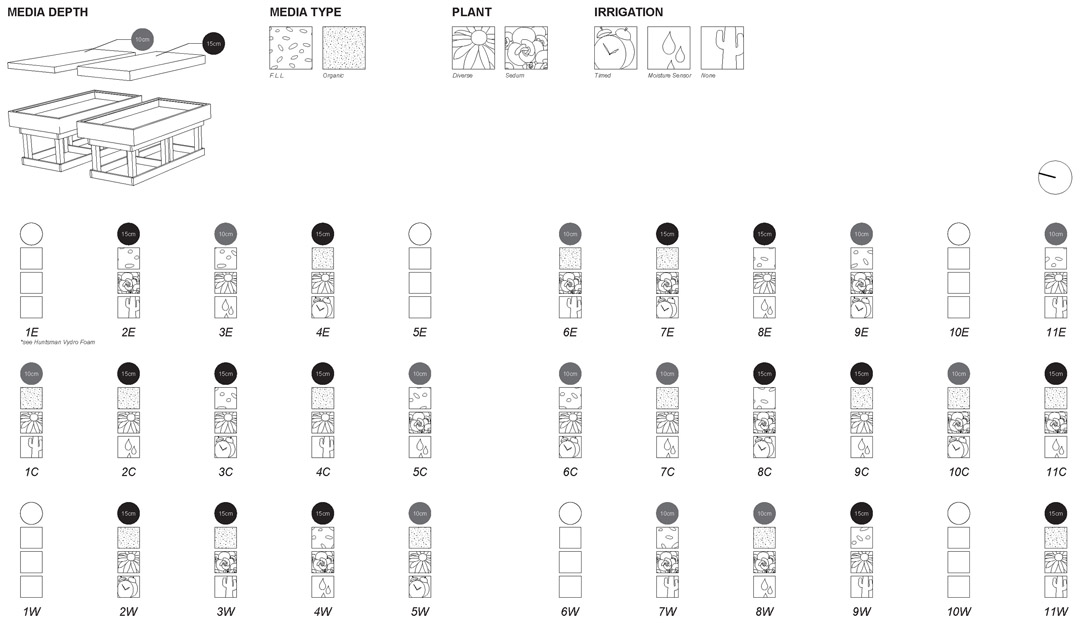
△ Four testing parameters include: 1) growing media type (inorganic/ high organic), 2) growing media depth (4 in./ 6 in.), 3) plant mix (sedum/
grass and forb), and 4) irrigation regimes (none/ timed/ soil-moisture sensor activated) 4个测试参数包括:1)培养介质类型(无机/高有机),2)培养介质深度(4英寸/ 6英寸),3)植物种类(景天科/草及杂类草),和4)灌溉方法
(无/定时/土壤水分传感器控制)。
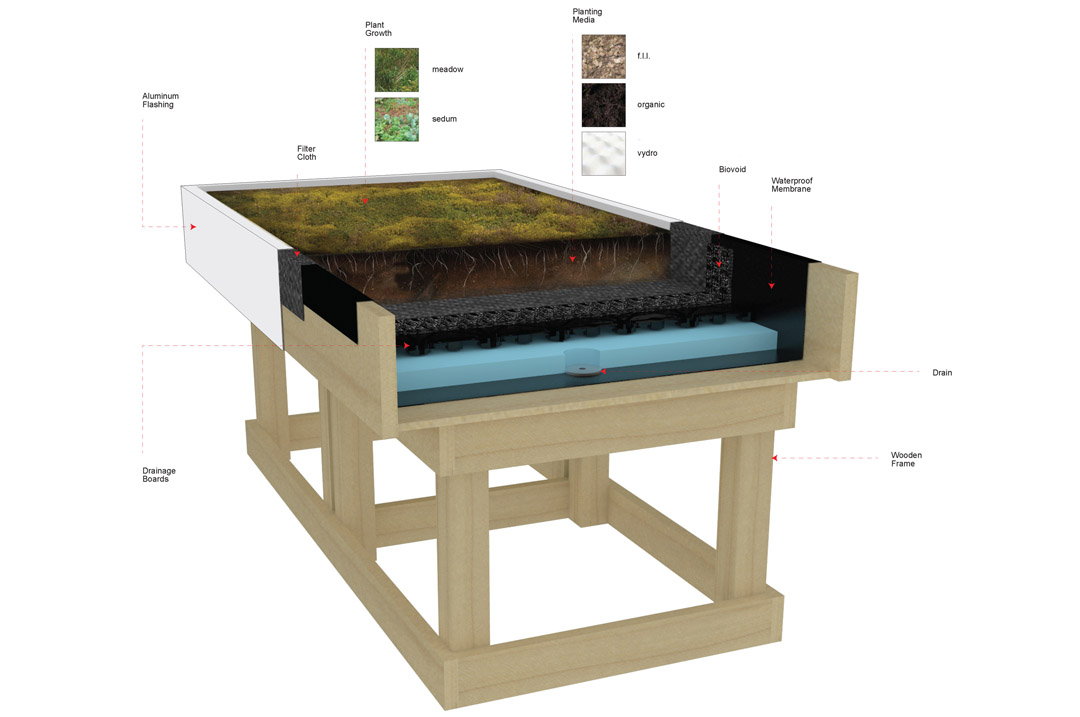
△ Each module simulates green roof construction including roof membrane, foam insulation, parapet and flashing, drainage board, geotextile, filter
cloth, growing media and vegetation. 每个模块模拟了绿化屋顶的建设,包括屋顶膜、泡沫绝缘体、矮围墙、防雨板、排水器、土工布、过滤层、培养介质和植物。
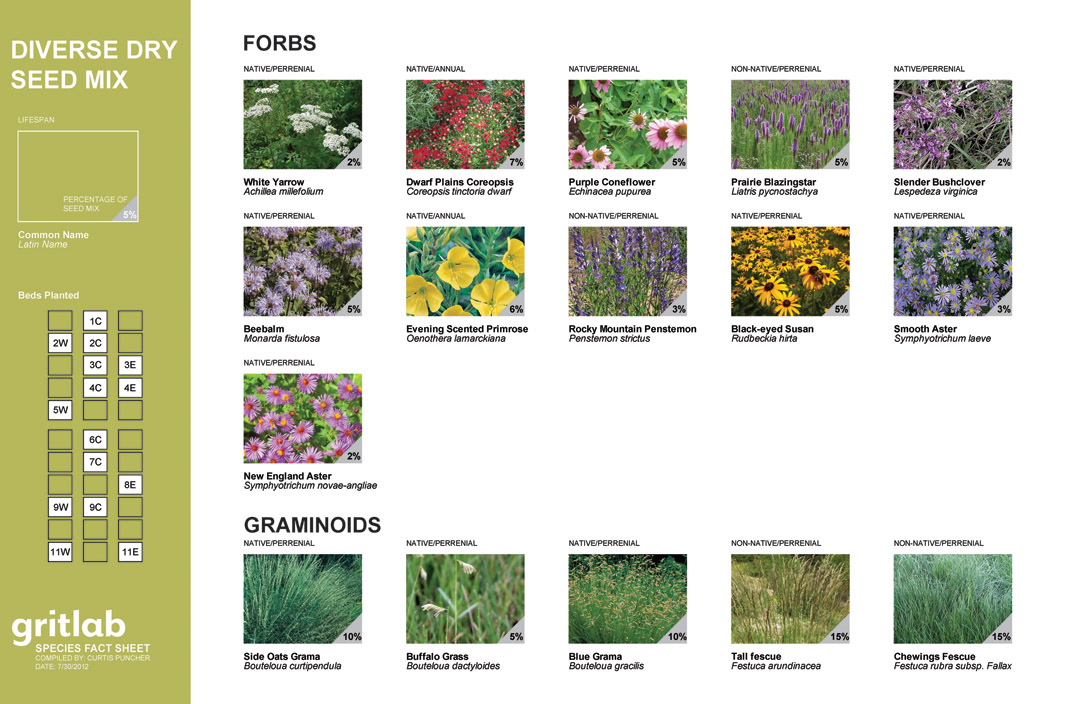
△ Fifteen of the modules are seeded with a grass and forb planting mix which is native to Southern Ontario and thought to generate high
evapotranspiration rates and resilience over time. 模型中有15个栽种安大略省当地的草和宽叶杂草,以期随着时间变化能提高蒸散率和自我调节力。
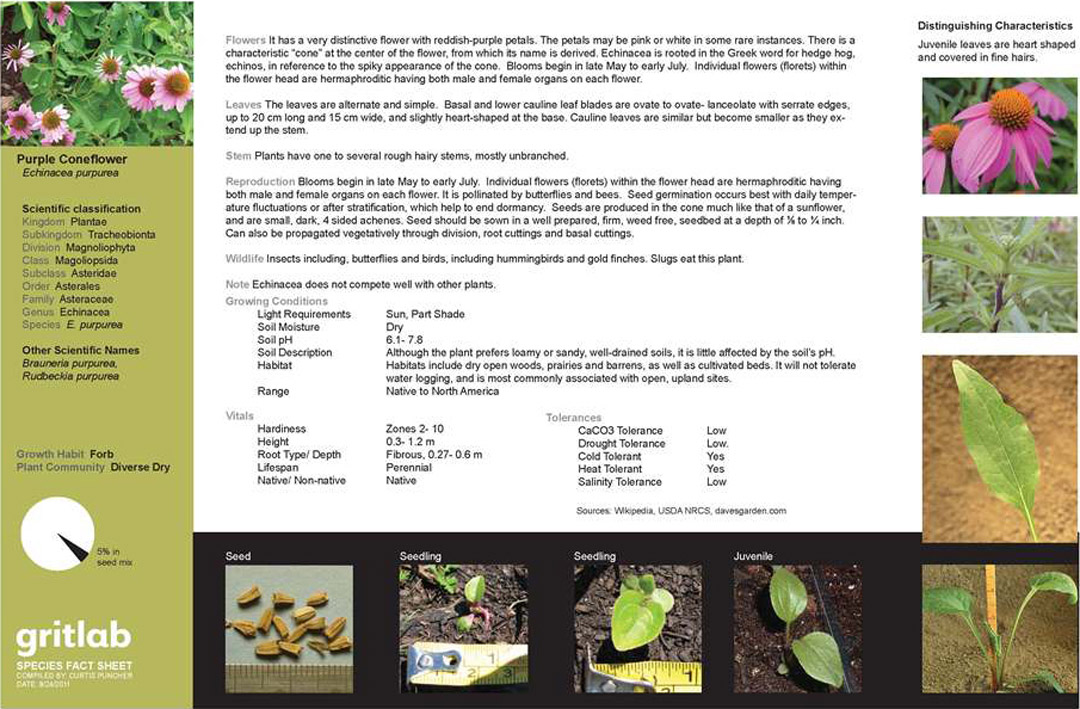
△ Grass and forb plant species fact sheets are made available on the GRIT Lab website. 当地草和杂草的概况介绍都共享在GRIT实验室网站上。
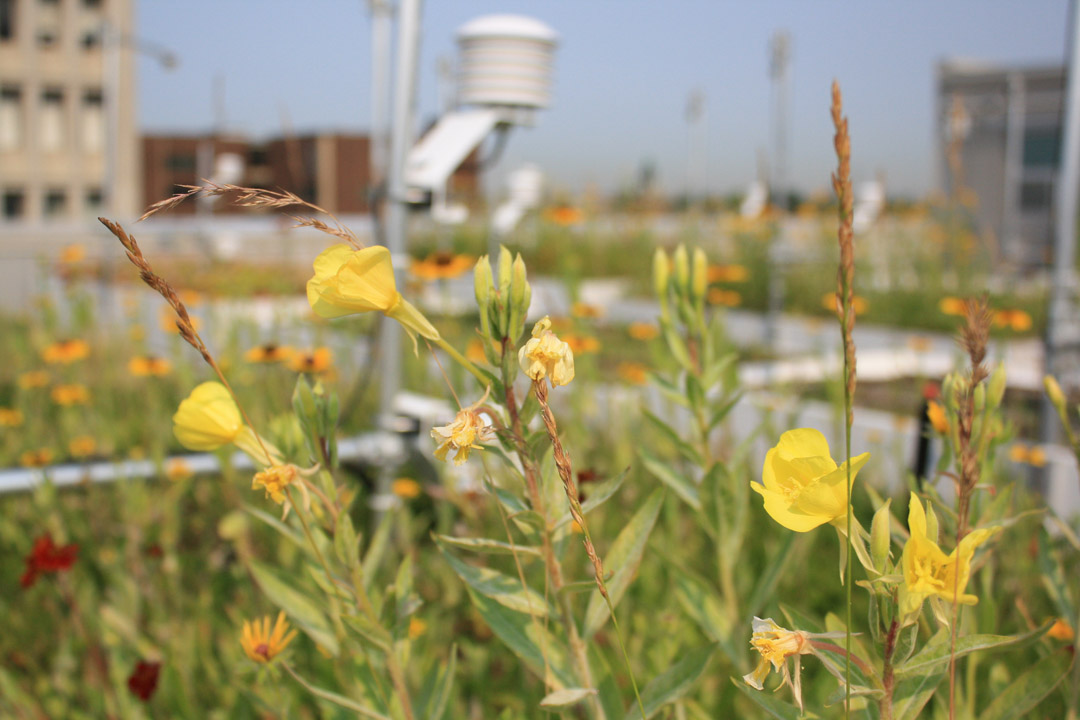
△ A close-up photograph of one of the modules shows the biodiverse grass–forb planting with 6-inch organic growing media and sensor activated
irrigation (summer, 2012). 一个模块的特写照片(2012年夏),展示了杂草类的生物多样性,这是种植在6英尺厚的有机培养介质中,且使用传感器灌溉的模块。
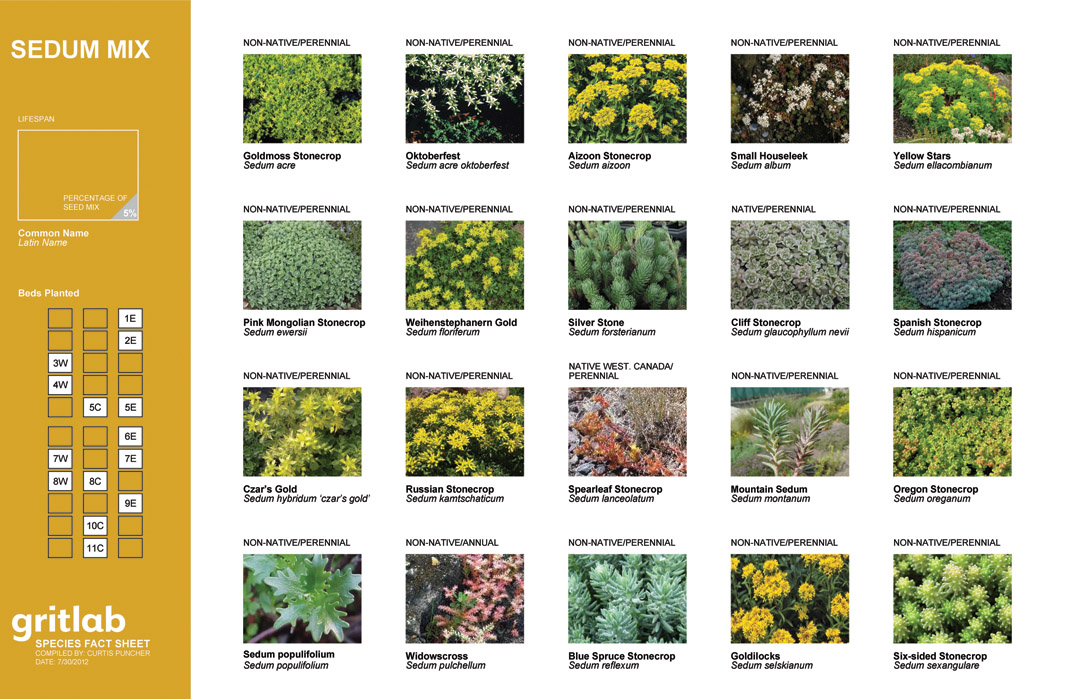
△ Fourteen of the modules are planted with a pre-vegetated sedum mat which represents the current industry standard in North America. 模块中有14个预先种植了景天属植物,代表现今北美的行业标准。
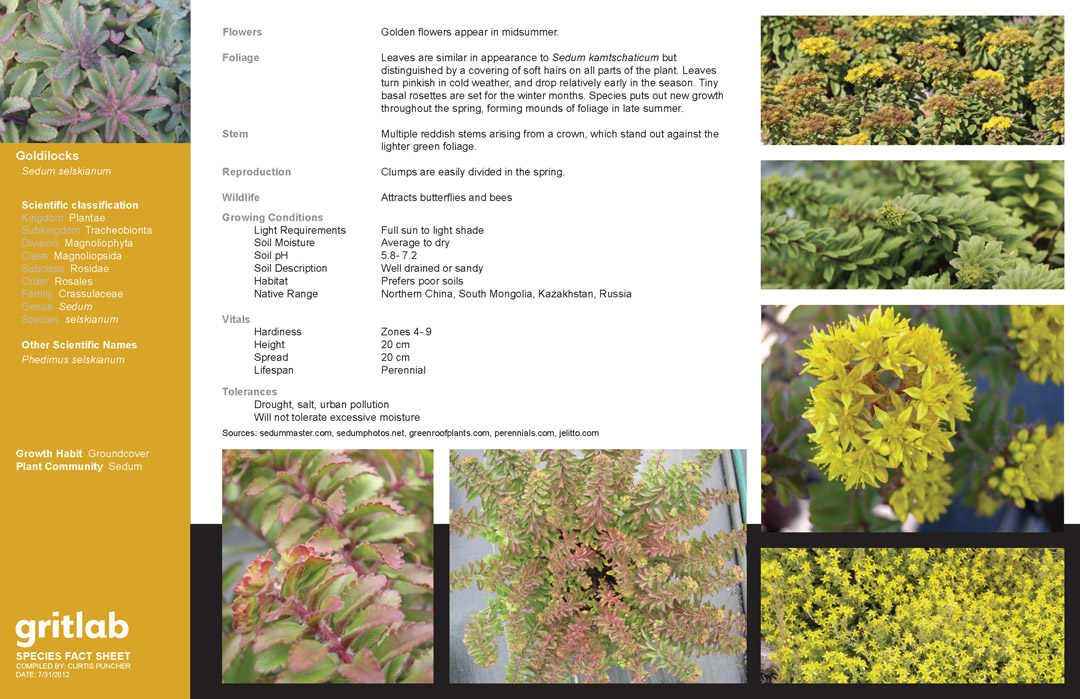
△ Sedum species fact sheets are made available on the GRIT Lab website. 景天属植物概况介绍共享在GRIT实验室网站上。
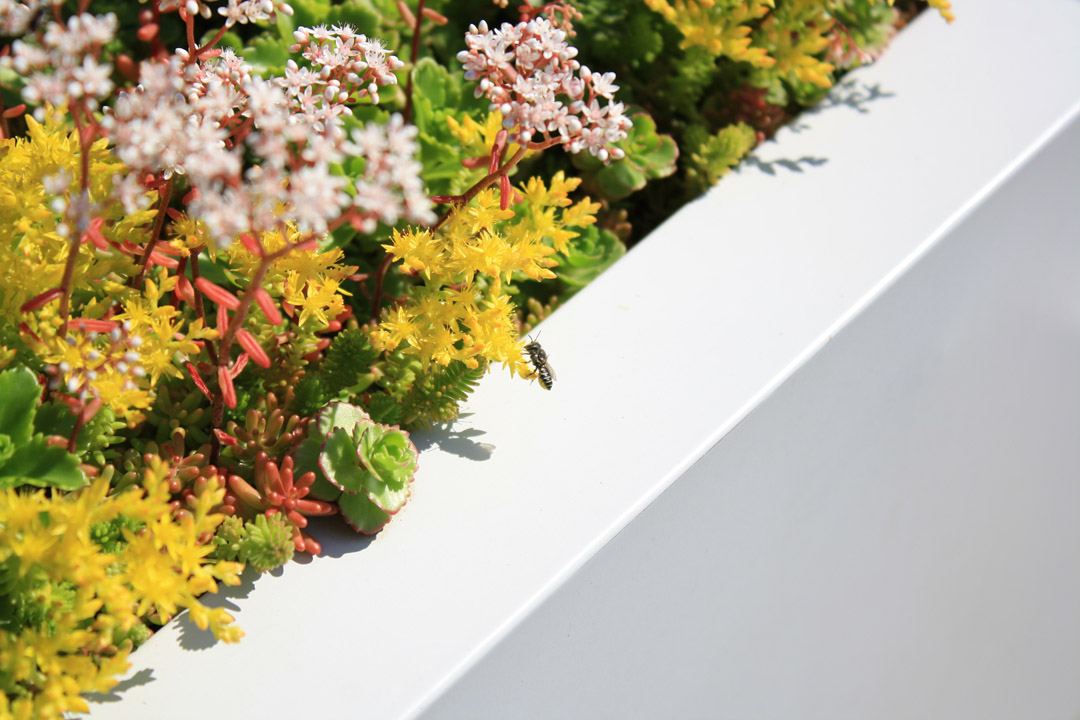
△ A close-up photograph of one of the modules which includes 6-inch organic growing media with sedum planting and timed irrigation (summer, 2012). 一个模块的特写照片(2012年夏),是种在6英尺厚的有机培养介质中定时灌溉的景天属植物。
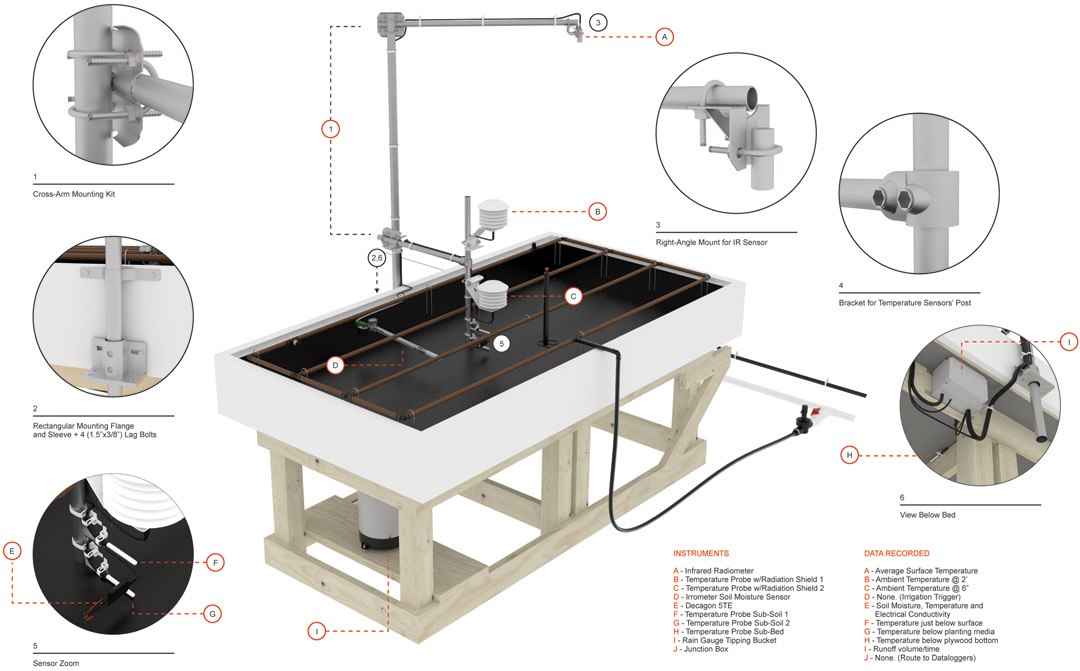
△ Each module is instrumented with a soil moisture sensor, a rain gauge, 5 thermal sensors and an infrared radiometer all of which record
hydrological or thermal data every 5 minutes. 每个模块都安装了8个传感器:土壤水分传感器、雨量计测量器、5个热传感器,和一个红外辐射计,每5分钟记录一次水文和热学数据。
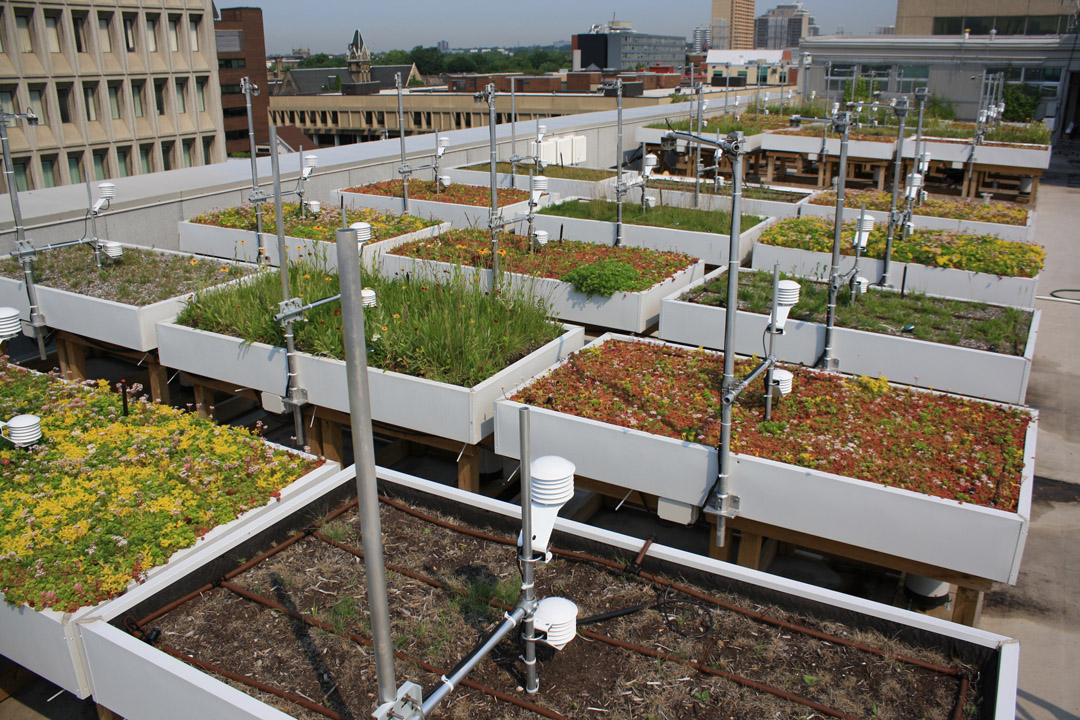
△ A photograph taken in the summer of 2012 shows an apparent difference in plant growth across the various modules and growing conditions. 2012年拍摄的照片,展示了不同模块中不同生长条件导致植物生长的明显差异。
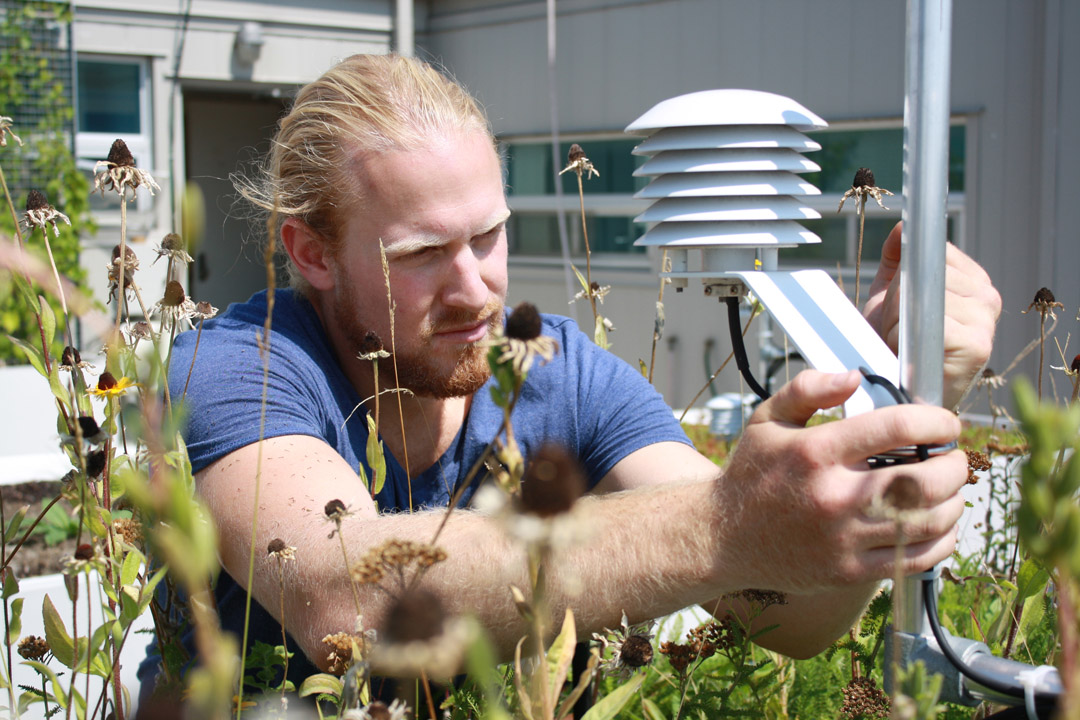
△ Landscape architecture students work directly with the latest material and digital technologies and develop a practical understanding of green
roof technologies. 景观设计学生直接用最细的材料和数码技术工作,对绿化屋顶技术有了实际理解。
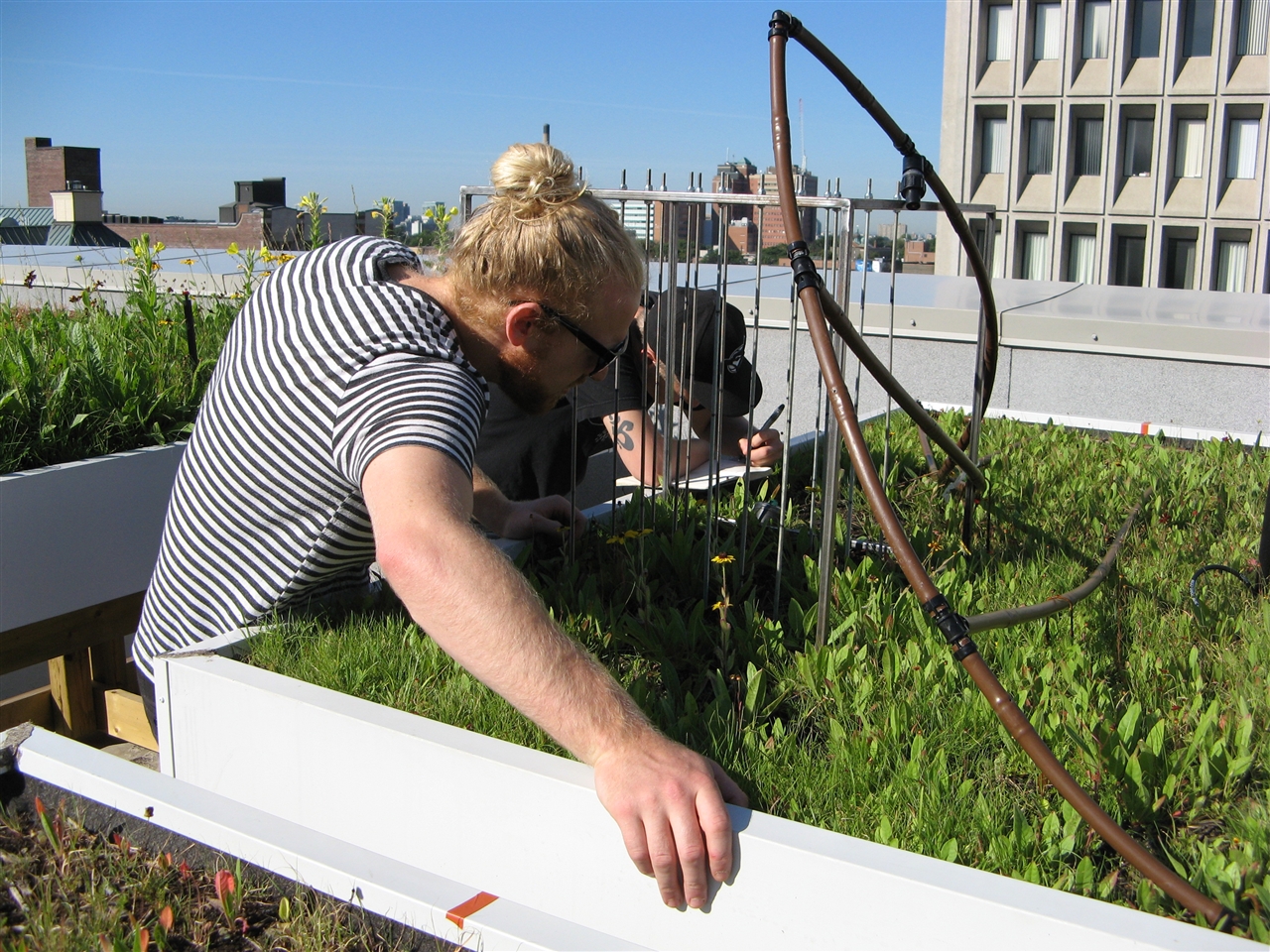
△ A graduate landscape student works together with a biology PhD candidate to conduct a monthly plant cover survey and analysis. 景观学毕业生与生物学博士候选人一同工作,对植被进行月度调查与分析。
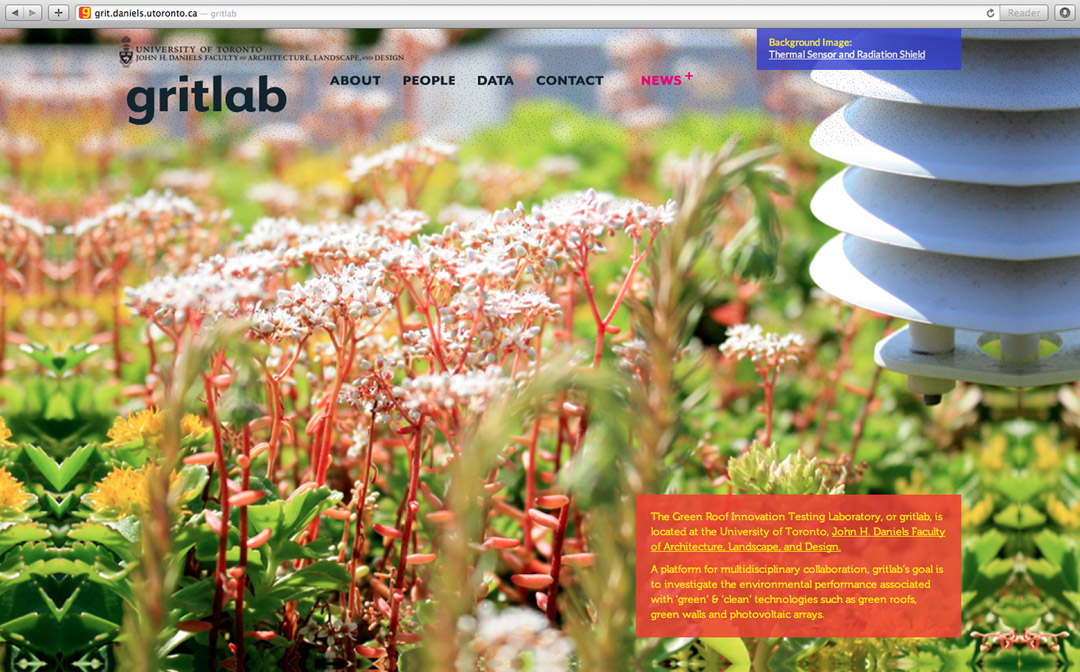
△ The GRIT Lab website is an open source data sharing portal which describes the research objectives and data, academic-industrial-government
collaborative, and ongoing activities. GRIT实验室网站开放源数据共享,提供有关于研究目的和数据、学术-行业-政府合作和实验室正在进行的活动的信息。
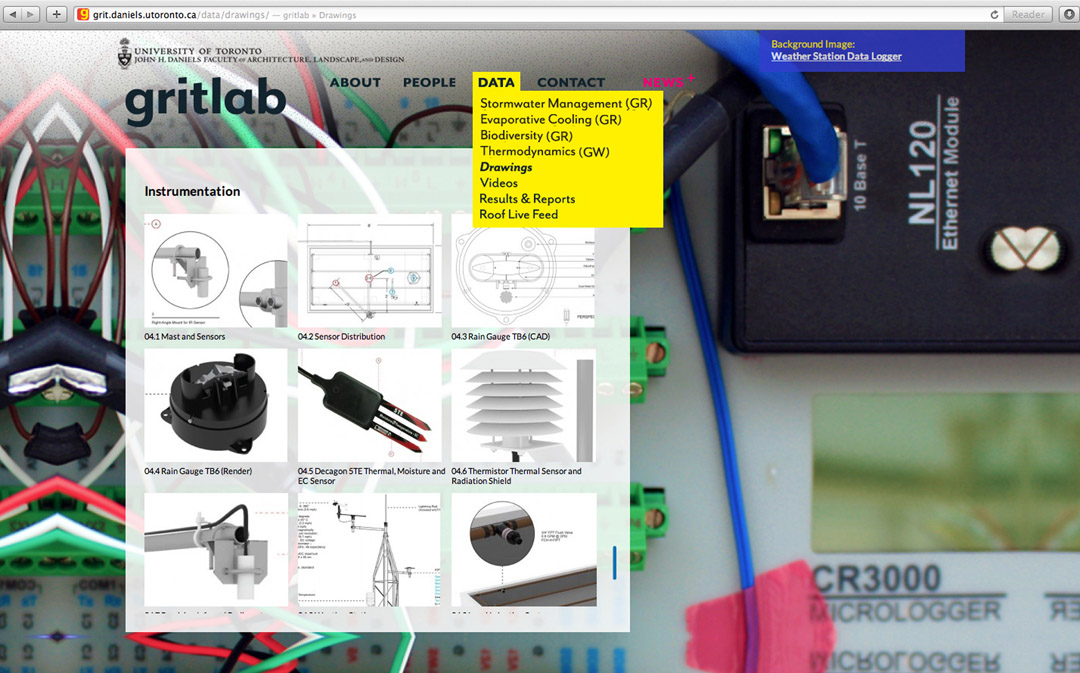
△ The website is updated regularly and include a set of technical drawings, plant data sheets, animations, videos, a link to a live feed, reports, and
journal articles. 网站会定期更新,网站中共享了一组原始技术图、植物数据表、动画、视频以及一个网络链接,实时更新研究报告和期刊文章。
PROJECT NARRATIVE
Problem Researched
Following the legislation of the City of Toronto’s Green Roof Bylaw in 2009, several technical questions emerged regarding the construction
standards of green roofs and their associated environmental performance vis-à-vis stormwater management, evaporative cooling and
biodiversity. The emergence of these questions can be attributed to insufficient testing of the construction standards in context of the Southern
Ontario climate. Despite numerous studies and tests, the standards that have shaped the green roof industry over the years have been
developed primarily in context of European climate regions, as opposed to the more extreme range that characterizes Toronto.
Currently, the City of Toronto has no option but to rely on simulation models and metrics derived from other climate regions to determine the
success of its green roof construction standard. This may be in part a consequence of the incapacity to legally enter private property for the
purpose of monitoring the ongoing maintenance of green roofs and quantifying their environmental performance. In the absence of any means
to validate environmental performance, an increasing number of green roof projects herald their success without providing a post-occupancy
quantitative evaluation.
The GRIT Lab research project focuses on the following questions: How ‘green’ are green roofs? Are the construction standards instituted,
taught and practiced effective? Are they appropriate to a specific climate region and do they operate optimally over time?
Relationships Investigated
The research facility is set up to evaluate four testing parameters––1) growing media type (inorganic / high organic), 2) growing media depth
(4” / 6”), 3) planting (non-native Sedum / native grass and forb), and 4) irrigation regimes (none / timed / soil-moisture sensor activated) ––with
respect to four primary environmental criteria–– 1) Stormwater Retention, 2) Evaporative Cooling, 3) Biodiversity, and 4) Life Cycle Cost.
The hypothesis is that the high organic growing media will provide higher water retention than the inorganic media, and that its nutrient
availability will facilitate a sustained and robust plant growth, which will then maintain a lower ambient temperature due to increased
evapotranspiration.
It is also hypothesized that the greater depth will provide the thermal mass for the prolonged cold winters in Southern Ontario, which will then
ensure annual plant recovery in spring. Lastly, it is thought that the grass and forb planting will yield higher evapotranspiration rates in contrast
to the sedum species and will demonstrate a higher resilience over time due to its functional biodiversity in contrast to the Sedum’s singular
functionality.
Comparison with Past Research
Typically, green roof studies are conducted within the fields of Biology, Hydrology and Building Science and tend to focus on individual
components or functions pertaining to their specialized field of study. The GRIT Lab approach is unique for its multi-disciplinary collaborative
structure and for its simultaneous examination of plant growth, soil science, hydrology and energy for their mutual capacity to evapotranspire
and reduce urban heat island effect; regulate water flow and minimize runoff and irrigation demand; and maintain a robust plant growth over
time. Hence, the research team includes faculty members and graduate students from the landscape architecture, engineering – hydrology
and energy modeling and biology departments.
Method of Inquiry
A 4,000 sq. ft. section of a roof has been dedicated to conducting the experimental aspect of this research. Thirty-three modules (4 ft. x 8 ft.)
have been designed to compare the aforementioned testing parameters. Each module is instrumented with eight sensors: a soil moisture sensor;
a rain gauge measures runoff flow rates; five thermal sensors along a vertical axis generate a thermal profile; and an infrared radiometer
records the average surface temperature of a 3 ft. diameter circle. The data acquired from the 264 sensors is statistically analyzed in relation to
plant growth and in relation to the base-climate data (solar radiance, temperature, precipitation, relative humidity, wind speed and direction)
acquired via a weather station on-site
Results of Research
The facility’s construction and instrumentation began in 2010 and was completed in the winter of 2012. Hydro-energy and plant growth data will
be collected for the next 3 years. Preliminary results to date are based on the field observation of plant growth over the last 2 growing seasons,
which include an inventory of plant cover, species biodiversity and height in relation to growing conditions in each test bed. The findings
demonstrate that supplemental irrigation is required to maintain the plant diversity and that grass and forb vegetative cover and biomass were
significantly greater in organic based growing media. The lack of irrigation in the inorganic growing media resulted in almost a complete loss of
grass and forb plant cover; neither irrigation nor growing media had any effect on the Sedum plant cover.
Significance of the Results
The wide range of partnerships GRIT Lab has established with academic institutions, industry partners and government agencies have far
reaching implications for education and knowledge transfer, innovation and commercialization, as well as policy and guidelines. It is expected
that the research findings will augment the City of Toronto’s Green Roof Constructions Standard as well as industry standards and GRP
accreditation programs.
Communication
The GRIT Lab website presents an open source data sharing portal, which currently includes a set of original technical drawings, plant data
sheets, animations, videos and a link to a live feed all of which are meant to describe the experimental design, process and ongoing activities at
the lab. Research findings, reports and journal articles will be updated regularly.
Applicability to Landscape Architecture Practice and Education
The results of the study are specific to Southern Ontario, however, the study’s approach and experimental design is transferable across regions.
Landscape architects may have a better understanding of how to define the environmental performance objectives of green roof systems in
relation to their own regional and climate specific priorities and become more equipped to discuss these priorities with their material vendors
and sub-consultants.
Finally, one of the primary objectives of GRIT Lab is to develop a unique hands-on opportunity for landscape students to work directly with the
latest material and digital technologies, as well as with both industry experts and academics from a wide range of disciplines. The cross-
pollination among various disciplines is intended to generate new ideas, while the link to industry and government agencies facilitates their
implementation.
Green Roof Innovation Testing (GRIT) Laboratory By
University of Toronto, John H. Daniels Faculty of Architecture, Landscape, and Design, Toronto, Ontario, Canada
更多请至:University of Toronto on gooood




好羡慕这些学校啊·····能有这样的设备···
编辑能处理一下文字吗?不是很通俗易通,很多句子明显是定语从句直译过来的,希望文章能让读者更快更轻松的独到重点。
屋顶绿化实验室