非常感谢Lateral Office将项目介绍和项目图片授权gooood发行。更多请至:Lateral Office on gooood
Appreciation towards Lateral Office for providing the following description:
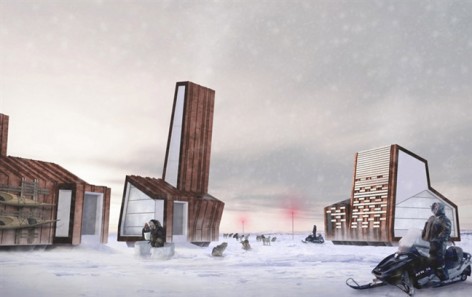
这是一个探索型项目。研究的是加拿大北部北极的因纽特人的食物问题,他们传统的狩猎和采集空间正在消失。这种损失需要得到补救,需要建立北极农场,食物储存空间和运输雪地车共同组成的网络。网络覆盖加拿大努纳武特地区福克斯盆地辽阔的低地,这里有漫长的海岸线以及伴随海岸线的丰富多样的野生动物。这个网络保证食品的供应,安全,以及延续因纽特人的传统。要在这样寸草不深的冰原中建立这个网络,其中就需要特殊的建筑储藏空间。这些建筑将面临不同的环境条件,土地,水面/冰面,临海,同时他们也收集不同的食品。建筑师们开发出了几个建筑原型,适应原则的三个测试站点的的不同情况。有的深埋在地下,有的简单的固定在地面,有的可以轻易被拖走。

The traditional Inuit diet in Northern Canada, which is centered on hunting and gathering, has been compromised by an influx of southern manufactured food products. This has yielded significant health issues as well as the loss of knowledge of country hunting. The Canadian territory of Nunavut in particular is suffering from these recent dramatic changes as well as the ongoing challenges of food security among radically dispersed communities. The Arctic Food Network (AFN) addresses an urgent need for a snowmobile accessed regional network of arctic farms, freezers, and camp hubs. The AFN encircles the large body of the Foxe Basin in Nunavut, Canada, home to a richly diverse wildlife, along the coast of Baffin Island and some 30,000 Nunavummiut.

▼caption: Food Distribution Diagram: 1960 – Present (left) and 2014 – Onward (right)

The Arctic Food Network utilizes the existing skidoo trails, the only form of ground connection amongst the eleven disconnected Inuit communities of Baffin Island. Our regional study on mobility, food security, and health in this region led to the pursuit of a network of small structures that acknowledge the Inuit tradition of temporary enclosure in a cold climate.
▼caption: Arctic Ecologies


▼caption: Calendar
▼caption: Arctic Mobility

▼caption: AFN Trails of Snow and Ice

▼caption: New structure Types


The network is comprised of what we call sheds, meshes, and poles, which refer to a set of uniquely integrated elements merging architecture, landscape, and technology. These integrated elements assist in negotiating the harsh dark winters and treeless landscape of the Canadian north. The AFN project is equal parts regional agriculture, seasonal camps, data transmission centers, and ecological management stations. In addition to providing a secure food and travel network, AFN seeks to merge new technologies with traditional practices to support an emergent 21st-century economy.
▼caption: Hub Section

The AFN is a new model for cold climate survival that would assist to sustain the rapidly increasing (youthful) populations in northern settlements, but also potentially offer a future exportable economy for the North. Each of the hubs along the AFN opportunistically negotiates its local ecosystems, emergent biological potentials, and its proximity to communities. AFN hubs are distributed at 160km intervals. Hubs occupy varied sites: land, water/ice, or coastal conditions. Each of these sitings offers a specific harvestable food product.
▼caption: TYPE A-01 – Pond Inlet

▼caption: Assembly of Parts

▼caption: TYPE A-01 – Interior Rendering

In collaboration with Nunavut’s Department of Culture, Language, Elders, and Youth, we are developing a set of prototypes for this network to be tested in three select sites along the proposed regional network. Each of the selected sites offers a unique ecological, or traditional arctic diet, opportunity – as well as a specific condition in terms of siting relative to aquatic and terrestrial proximities.
▼caption: TYPE B-03 – Outside of Pond Inlet

▼caption: TYPE B-03 – Interior Rendering

▼caption: TYPE C-01 – Between Pond Inlet and Clyde River

▼caption: TYPE C-01 – Interior Rendering

▼caption: Logistics

MORE: Lateral Office,更多请至:Lateral Office on gooood





这个, 出发点很强大。。
这个。。。。手势很给力。。。
这些图都是拿什么软件做的啊