“《空置的基座》以敏锐的洞察与严谨的学术态度,回应了一个复杂且具有现实紧迫性的议题。项目围绕邦联纪念碑的去留问题展开,开启了关于社会公平、多元包容与历史责任的重要公共讨论。其细致而富有层次的研究路径,不仅促进了更具包容性的社会对话,也为公共空间的再思考与重塑提供了新的可能。”
– 2025年评审委员会“Empty Pedestals tackles a complex and timely issue with sensitivity and intellectual rigor. By addressing the fate of Confederate monuments, it opens a critical dialogue on social equity, diversity, and historical accountability. The project stands out for its nuanced approach and its potential to inspire inclusive public discourse and reimagine civic space.”
– 2025 Awards Jury
来自 ASLA 对 gooood的分享。
Empty Pedestals | Kofi Boone FASLA and M. Elen Deming, FASLA
项目陈述
PROJECT STATEMENT
景观叙事可能带来伤害,也能够促进疗愈。在《空置的基座:通过公共设计重构邦联叙事》(LSU出版社,2024)一书中,主编Kofi Boone与M. Elen Deming汇集了14位作者的研究成果,提出了一系列设计、规划及相关策略,旨在通过直面并转化长期承载结构性偏见的空间,增强社区韧性。本书聚焦邦联纪念碑的历史遗存及其所在场所的未来发展,系统整合了历史背景梳理、空间分析、具有代表性的区域案例研究,并提出面向实践的设计行动建议,以推动社会公平、多元与包容。
Landscape narratives can harm. Landscape narratives can heal. In Empty Pedestals: Countering Confederate Narratives Through Public Design (LSU Press, 2024), editors Kofi Boone and M. Elen Deming bring together 14 contributors who present design, planning, and other strategies aimed at building community resilience by confronting and transforming spaces marked by endemic prejudice. The book focuses on the legacies and futures of Confederate monuments and the spaces they inhabit. The book offers a groundbreaking compilation of historical context, spatial analysis, compelling regional case studies, and recommendations for design action to promote social equity, diversity, and inclusion.
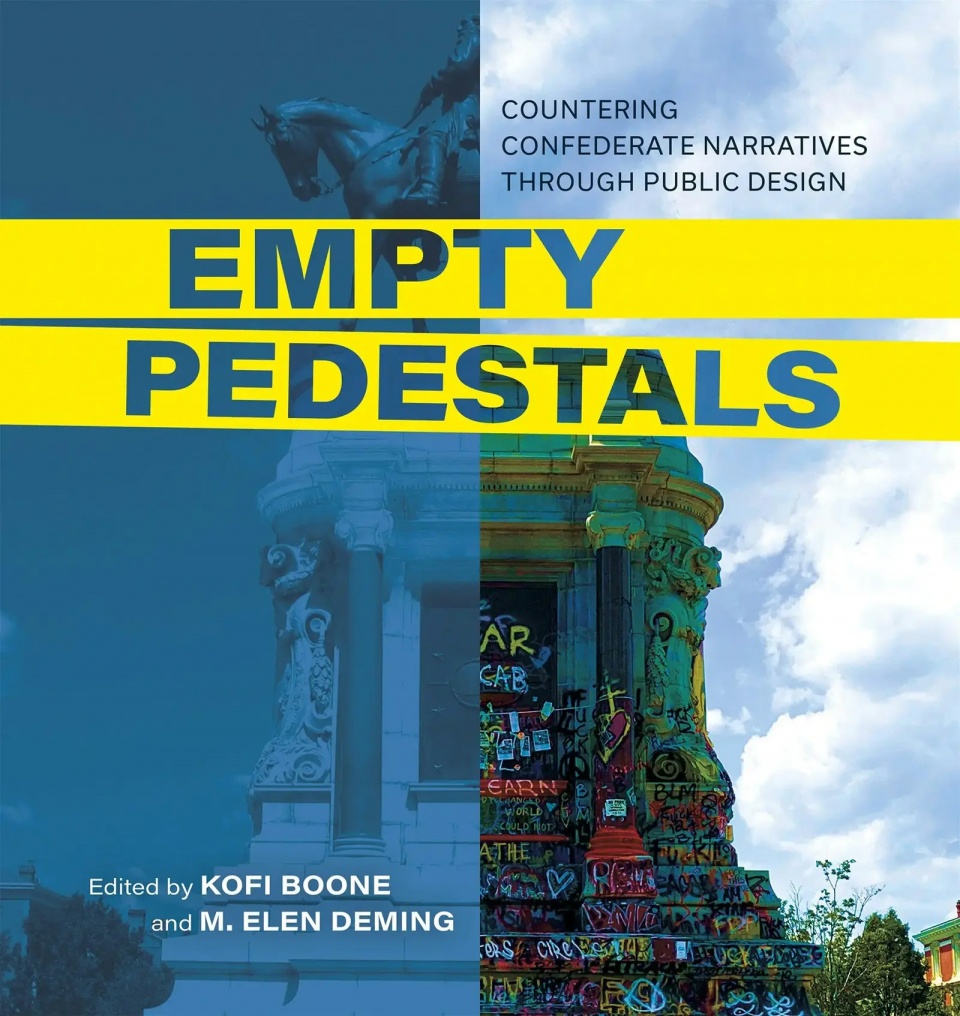
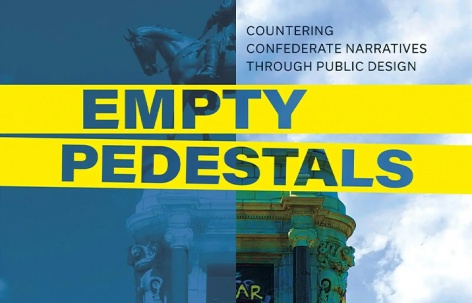
▲封面图片将弗吉尼亚州里士满市罗伯特·E·李纪念碑安装时的影像与拆除后的场景叠合呈现,形成前后对比。The image merges a photo of the Robert E. Lee Monument in Richmond, Virginia at installation and another image after it’s take down. © Samantha Snyder
项目说明
PROJECT NARRATIVE
《空置的基座》以设计视角探讨邦联纪念碑如何折射出地域主义、种族主义政治议程以及集体创伤。Boone与Deming联合14位作者,致力于提出新的分析框架与可共享的解决路径,以回应困扰美国文化景观的深层问题。本书汇集并强化了那些直面仇恨叙事、探索突破传统神话路径的实践者与社区声音。当邦联纪念碑等压迫性象征被永久移除时,书中提出的设计替代方案有望在公共空间中促进社会疗愈、推动更健康的公共对话,并增强社区韧性。
Walter Hood在序言中呼吁设计师正视冲突与不适,并将其视为推动批判性学习与专业成长的重要契机。全书分为三个部分,并穿插视觉论文。Tania Allen与Sara Queen创作了四篇创新性的视觉研究(图版),以数据为基础,分析邦联纪念碑的若干关键现象。
第一部分“语境、经验与视角”收录四篇研究,梳理自重建时期、民权运动直至当代,邦联纪念碑及其公共空间对社区产生的影响。文章通过批判性历史与非白人视角展开,其中部分基于深具情感张力的个人经验,凸显纪念碑所承载的社会感受与历史记忆。
第二部分“叙事、策略与设计”是全书核心,聚焦主要由非裔艺术家与设计师主导的在地干预与公共叙事。各文采用案例研究方法,配以大量当代设计方案、公共艺术装置、地图、效果图及其他可视化材料。八个案例按照不同设计路径的连续谱进行组织,呈现多样化的空间转化策略。
第三部分“行动、反思与疗愈”在前述研究与实践基础上,总结可推广的方法、原则与框架。本部分进一步探讨地方公共空间所嵌入的更广泛系统,包括推动建成环境保护与转型的基层文化、经济与政治力量。这些反思为设计师、规划者、资助机构及相关从业者提供了方向与动力,以推动更加包容且富有活力的公共空间建设。
Elen Deming在本部分的结语《我们讲述的故事:走向历史的疗愈》中,将全书的核心思想整合为面向设计实践的行动框架,强调叙事在塑造社会与空间体系中的关键作用,使全书形成完整闭环。
经新奥尔良前市长Mitch Landrieu授权,书末附录收录了其具有全国影响力的完整演讲文本,阐述其决定拆除城市纪念碑的背景与理由。
《空置的基座》的出版获得Graham Foundation资助,该基金会认可其在批判性学术讨论与推动空间公平方面的价值。自发行以来,本书已荣获路易斯安那州ASLA分会奖项,并受到建筑史学会(SAH)专题推荐,同时成为多场学术与专业交流活动的讨论主题,其中包括由弗吉尼亚大学建筑学院主办的专题研讨会。
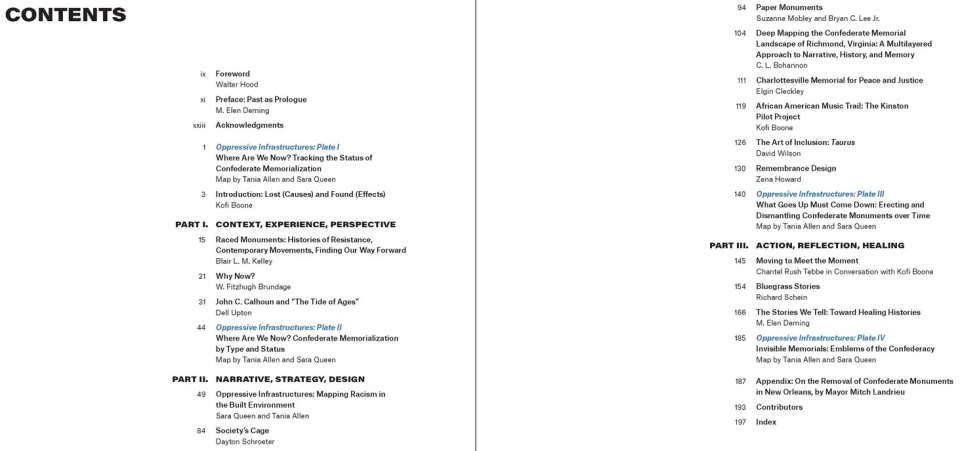
▲本书汇集了14位作者,涵盖景观建筑师、建筑师、历史学者、艺术家以及社区代表等多元背景。The book feature 14 contributors ranging from landscape architects and architects, historians, artists, and community stakeholders. © LSU Press
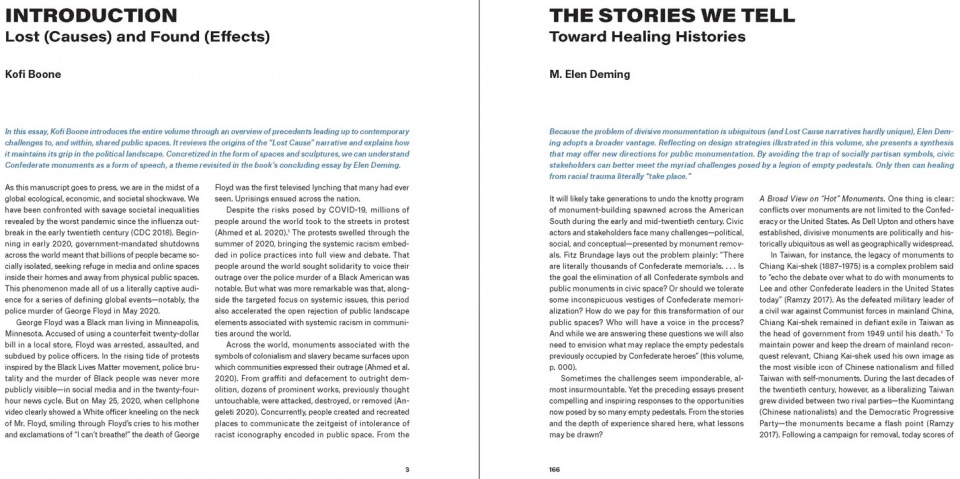
▲示例页面展示了主编撰写的导言与结语文章。Sample pages featuring the editors introduction and closing essays. © LSU Press
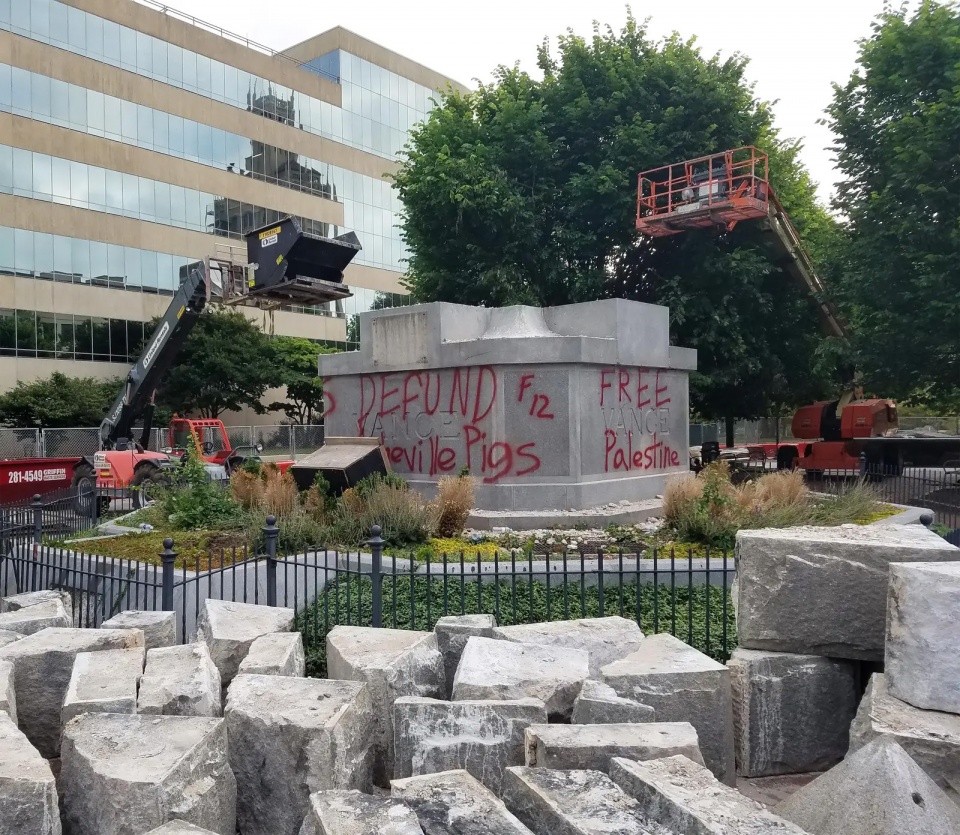
▲北卡罗来纳州阿什维尔的范斯纪念碑在乔治·弗洛伊德遇害事件之后的社会抗议中遭到涂污,并最终被拆除。The Vance monument in Asheville, North Carolina was defaced and removed in the aftermath of the murder of George Floyd. © Fitz Brundage
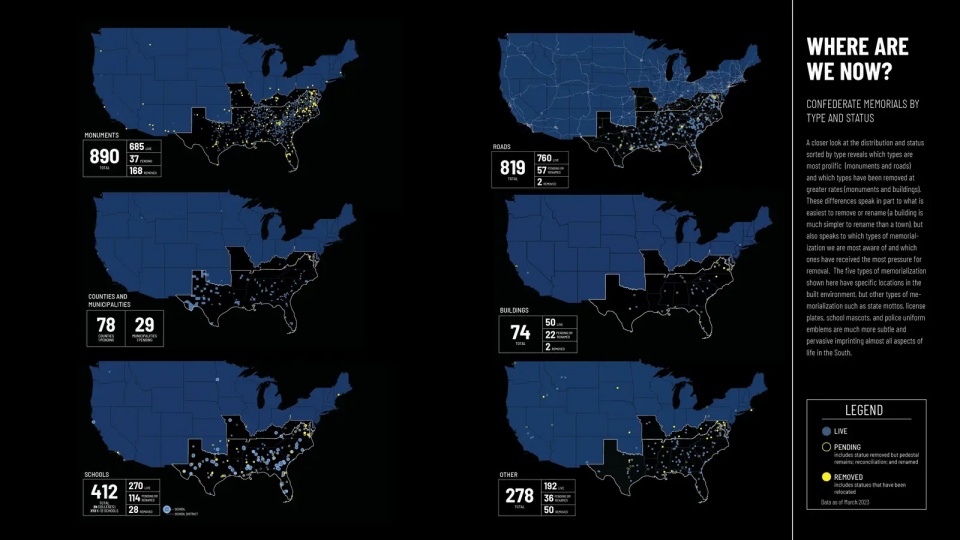
▲Allen与Queen通过地理空间分析,识别并定位除纪念碑之外与邦联叙事相关的基础设施,并以可视化方式呈现这些叙事性空间在不同时期的形成与拆除过程。Allen and Queen use geospatial analysis to locate infrastructure associated with Confederate narratives beyond monuments. They visualize the creation and removal of Confederate narrative infrastructure over time. © Tania Allen and Sara Queen
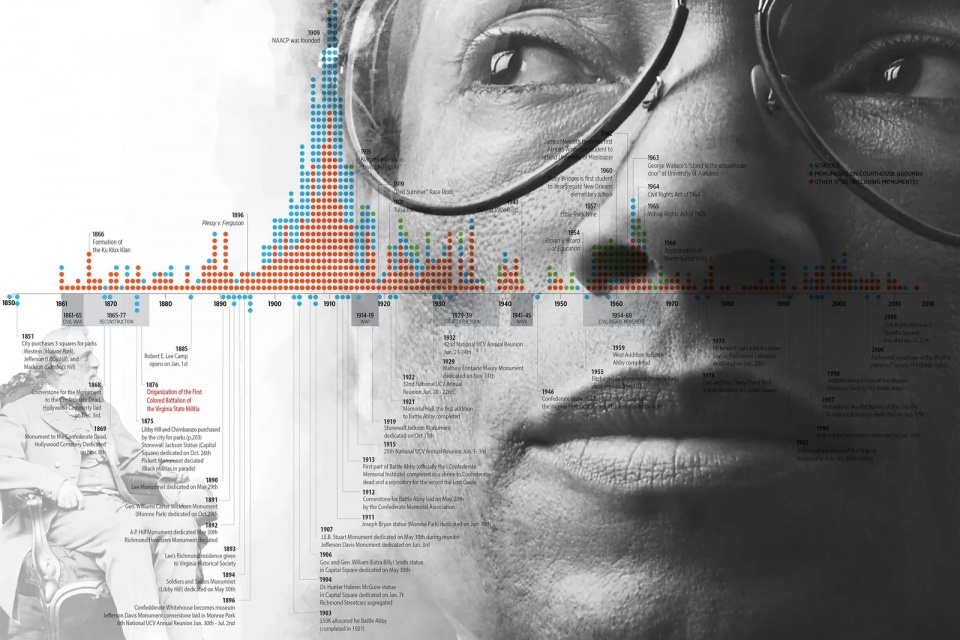
▲CL Bohannon分享了“深度测绘”(Deep Mapping)的研究示例,对弗吉尼亚州里士满纪念大道上的纪念设施进行多维度解读。CL Bohannon shares a sample of Deep Mapping interpreting memorials on Monument Avenue in Richmond, Virginia. © CL Bohannon
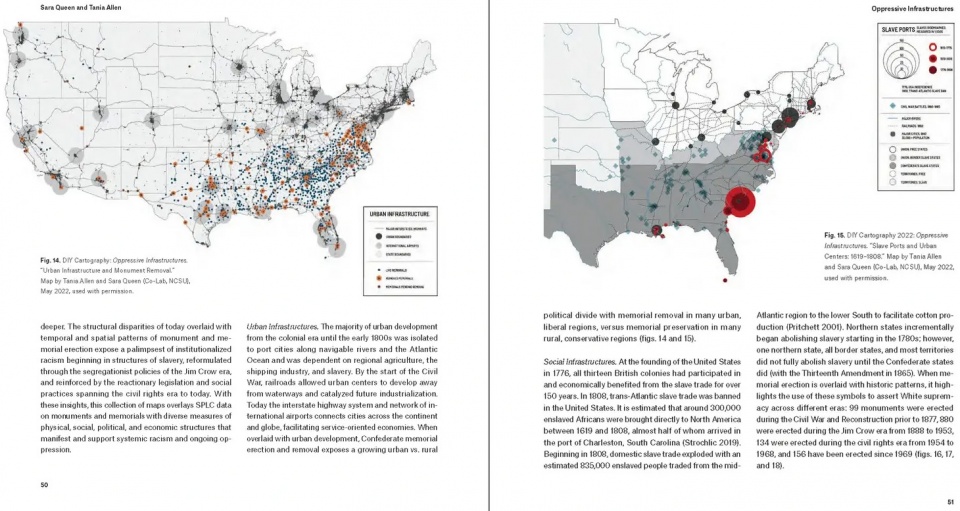
▲Allen与Queen还展示了邦联纪念碑的地理分布,并将其与不同类型的压迫性基础设施进行叠加分析。Allen and Queen present geospatial mapping of Confederate monuments overlaid on different oppressive infrastructures. © Tania Allen and Sara Queen
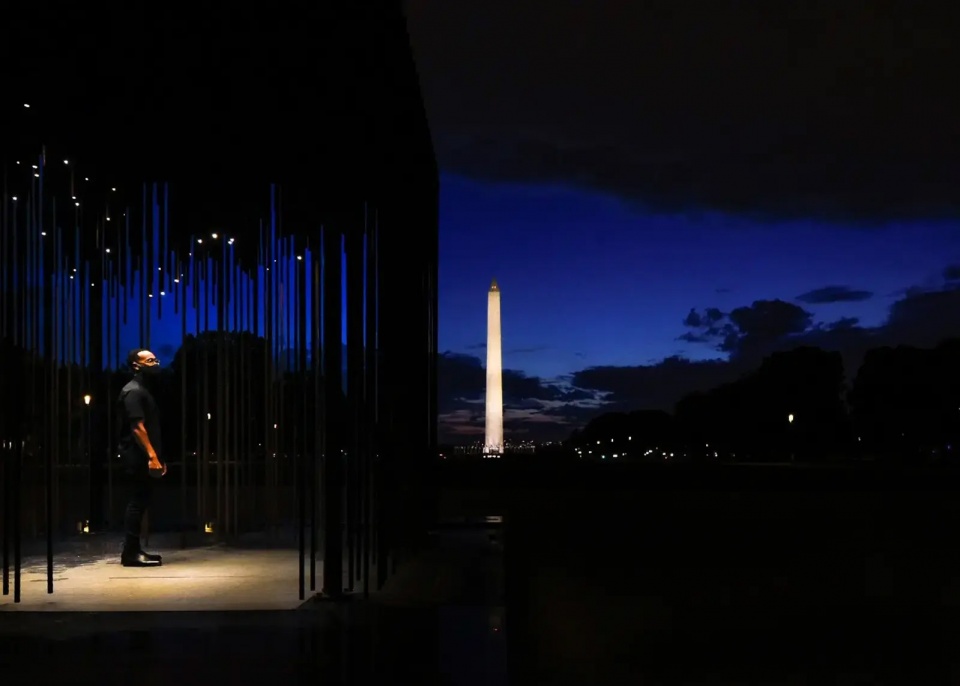
▲Dayton Schroeter设计的《社会之笼》(Society’s Cage)是一座可移动的纪念装置,旨在抗议针对非裔美国人的警察暴力致死事件。Dayton Schroeter designed Society’s Cage. It is a mobile monument protesting the police murder of Black Americans. © Dayton Schroeter
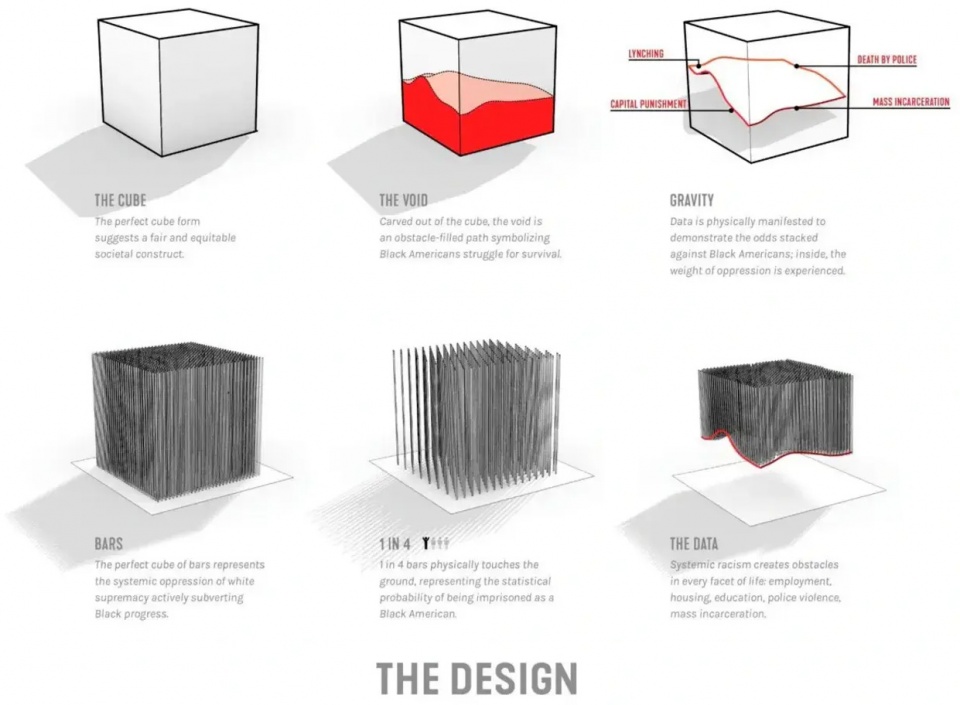
▲Schroeter进一步阐述了如何将警察致死事件的数据转化为具有空间与体量感的三维体验。Dayton Schroeter describes the process of translating data of police killings into a three dimensional experience. © Dayton Schroeter
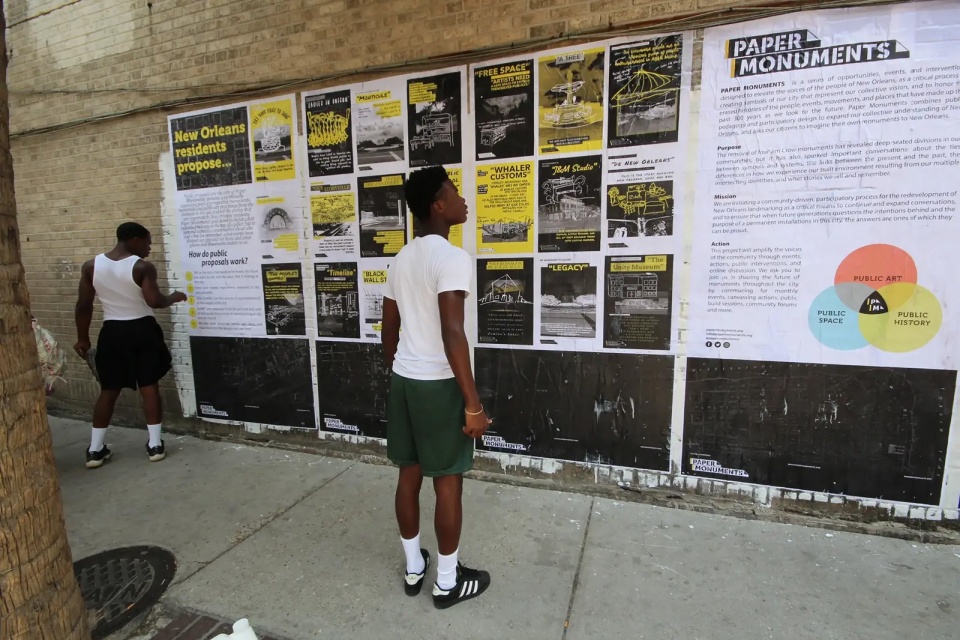
▲Sue Mobley与Bryan C. Lee, Jr.的文章介绍了“纸上纪念”(Paper Monuments)项目:在邦联纪念碑拆除后,通过记录与传播地方故事,重建社区记忆。Sue Mobley and Bryan C. Lee, Jr.’s essay describes Paper Monuments. After removal of confederate monuments, local stories were documented and shared. © Sue Mobley and Bryan C. Lee, Jr.
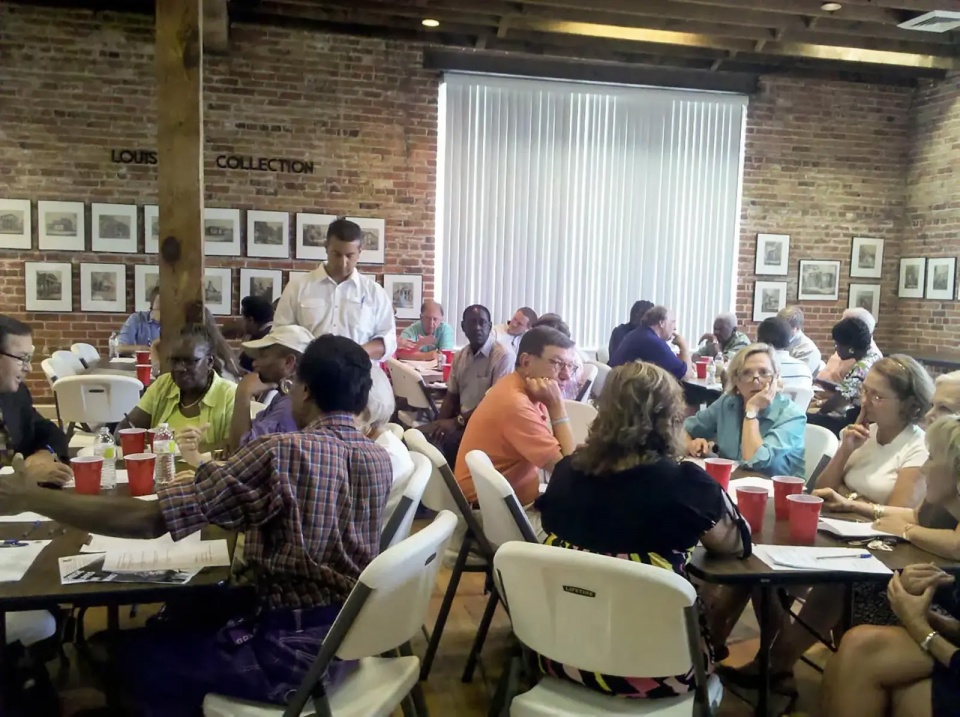
▲Kofi Boone的文章阐述了北卡罗来纳州金斯顿以社区为基础的纪念设施共建过程。Kofi Boone’s essay describes the of community-based memorial development process in Kinston, North Carolina. © Kofi Boone
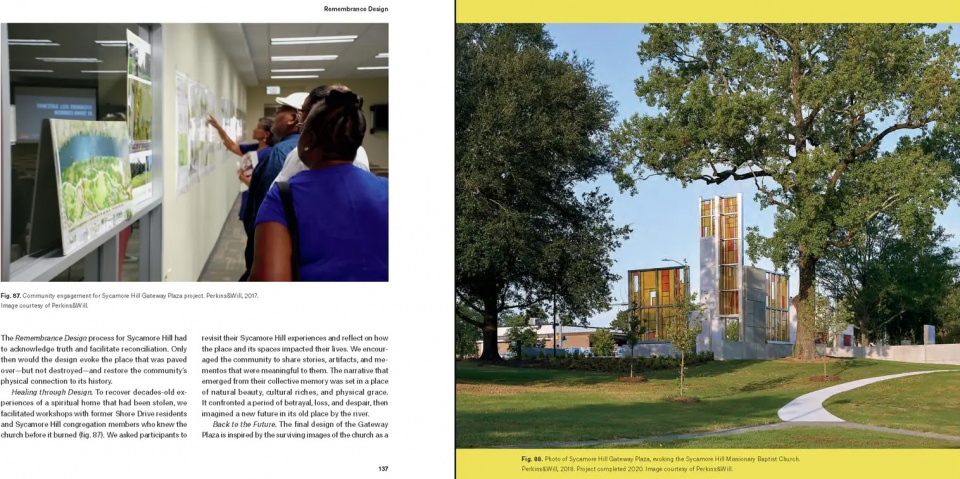
▲Zena Howard的文章以一处纪念广场为例,呈现“记忆性设计”(Remembrance Design),该项目用于纪念在城市更新过程中消失的社区。Zena Howard’s essay presents a memorial plaza to a community lost to urban renewal as an example of Remembrance Design. © Zena Howard
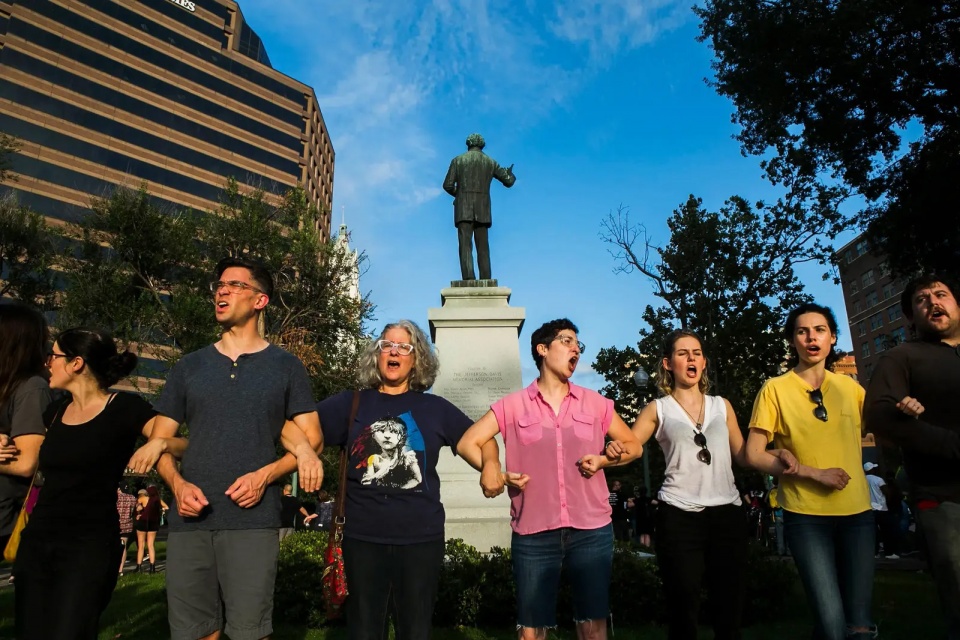
▲Chantal Rush-Tebbe的访谈讨论了公益慈善如何在孟菲斯的抗议活动中支持社区韧性建设。Chantal Rush-Tebbe’s interview describes how philanthropy supported community resilience in Memphis protests. © Yolanda M. James
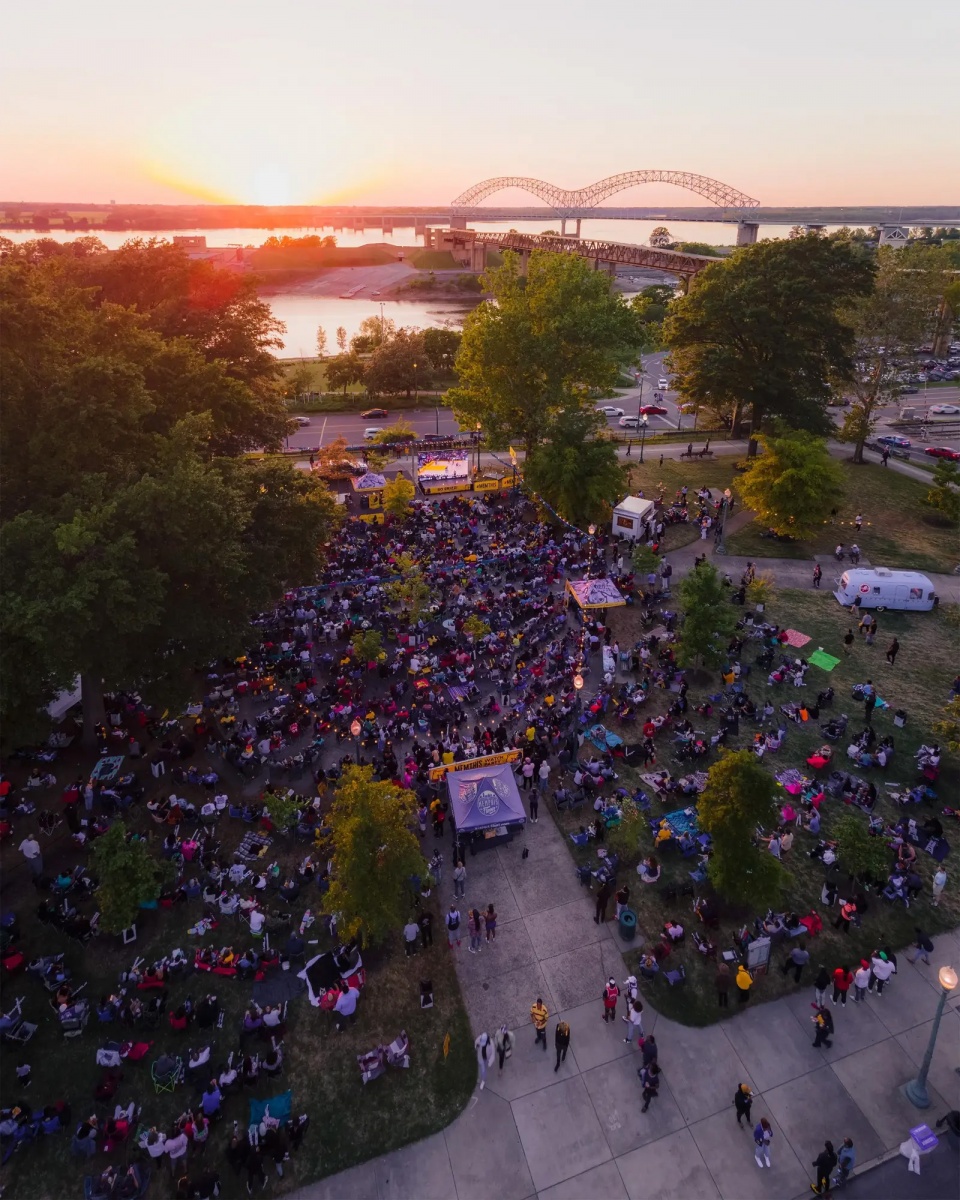
▲在孟菲斯戴维斯纪念碑被拆除后,Rush-Tebbe进一步描述了当地公共空间的复兴及其对社区活力的重塑。After the removal of the Davis monument in Memphis, Rush-Tebbe describes the resurgence of community public space in Memphis. © Conner D. Ryan
PROJECT NARRATIVE
Empty Pedestals uses a design perspective to explore how Confederate monuments reflect regionalism, racist political agendas, and collective pain. Boone and Deming, along with the volume’s 14 contributors, strive to elevate novel frameworks and shared solutions for the issues troubling American cultural landscapes. Empty Pedestals amplifies the voices of those who have confronted hateful narratives and devised strategies that stand apart from old mythologies. If and when oppressive symbols such as Confederate monuments are permanently eliminated, design alternatives presented here may offer healing in shared spaces, healthier social discourse, and stronger community resilience. Walter Hood’s foreword challenges designers to lean into conflict, discomfort, and the critical learning processes those situations afford. The volume is organized into three parts with visual essays interspersed. Tania Allen and Sara Queen provide four innovative visual essays (plates) exploring specific data-driven aspects of Confederate monumentation.
Part I: Context, Experience, Perspective offers four accounts of how Confederate monuments and their public spaces have impacted communities from the Reconstruction Era through the Civil Rights movements to the present. The essays foreground the experience of Confederate monuments seen through critical histories and non-White perspectives, some based on deeply affective personal experiences.
Part II: Narrative, Strategy, Design is the heart of the volume, featuring local interventions and public narratives led mainly by Black artists and designers. Adopting a case study approach, these essays are richly illustrated with contemporary designs, public art installations, maps, renderings, and other visualizations. Eight case studies are arranged along a spectrum of design strategies.
Part III: Action, Reflection, Healing features essays drawing out transferable tactics, principles, and frameworks from previous perspectives and designs. This section considers broader systems within which local public spaces perform, including grassroots cultural, economic, and political entities charged with preserving and effecting changes in the built environment. These reflections provide orientation, impetus, and direction for designers, planners, funders, and others working towards a more inclusive and vibrant local public landscape.
Elen Deming concludes Part III with “Stories We Tell: Toward Healing History(s),” distilling overarching ideas into a framework for action by designers, bringing the book full circle to emphasize the power of narratives in shaping social and spatial systems.
With the permission of former Mayor Mitch Landrieu, the volume concludes with an appendix featuring the full text of his nationally significant speech explaining why he decided to take down monuments in New Orleans.
The completion of Empty Pedestals included a Graham Foundation grant recognizing the book’s value to critical discourse and contributions to equitable spaces. Since its release, Empty Pedestals has received the Louisiana ASLA Chapter Award, been featured by the Society of Architectural Historians (SAH), and been the subject of many presentations, including a convening hosted by the University of Virginia’s School of Architecture.









有点抽象
DK
额。。。。。。