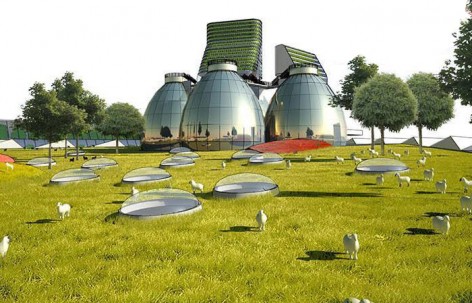
来自ASLA对gooood的分享。
Metamorphous by University of Arkansas Community Design Center,更多请至:University of Arkansas Community Design Center on gooood
Appreciation towards ASLA for providing the following description:
“极具可实现性的方案。准确的选题让每一位观看者都仿佛身处其中,而简单的实施方式也有助于人们的理解。这将会掀起一轮新的讨论,而不是给出一个问题的答案。”
——2015年评审委员会
“It’s a very approachable. The packaging cuts right across the population and everyone is going to get it and be touched by it. All readers will get it. It will start a conversation. Not finish it, but start it.”
– 2015 Awards Jury
项目陈述 PROJECT STATEMENT
什么样的城市基础设施能够满足其居民在食物上自给自足的需求呢?来自University of Arkansas Community Design Center的设计团队意图在全美食物最紧缺的区域,打造一个具有弹性和自我生产能力的未来城市。他们所创立的农业生态模型填补了现代城市农业结构中的空缺- 一个介于个体花园和大规模工业化农场间的中型城市农业空间,诸如绿色基础设施、公共绿地、食品加工和集散地等生态性的市政公共设施都将包括在内。而除了当下临时的生产实践外,下一阶段的城市农业将向大规模养护、土地管理和废物回收再利用方向转变。“Food City”灵活的空间规划手段不仅将高品质的食物生产融入了美国城市空间,同时也展示了城市基础设施在生态系统维护上的潜力。
“食物的真正潜力是如此巨大,而人类只能管中窥豹。但即使如此我们仍然知道,它所拥有的巨大力量不仅能够改变景观,也影响着政治体制、公共空间、社会关系以及城市。” Carolyn Steel《饥饿城市:食物改变生活》
What kind of infrastructure would a city have to develop if it cultivated its own food? Food City envisions a future based upon resilient and recuperative forms of urbanism in a region with the nation’s highest food insecurity. Food City devises a model agroecological vocabulary for reclaiming a missing middle scale of urban agriculture between that of the individual garden and the industrial farm. This missing middle foodshed functions as an ecological municipal utility featuring green infrastructure, public growscapes, and spaces for food processing and distribution. Beyond current ad hoc production practices, the next stage of urban agriculture includes large-scale conservation, accelerated nutrient management, and upcycling of municipal waste. Food City’s transferable set of planning tools not only assists to embed high-quality food production into American urbanism, but shows how urban infrastructure can also deliver important ecosystem services.
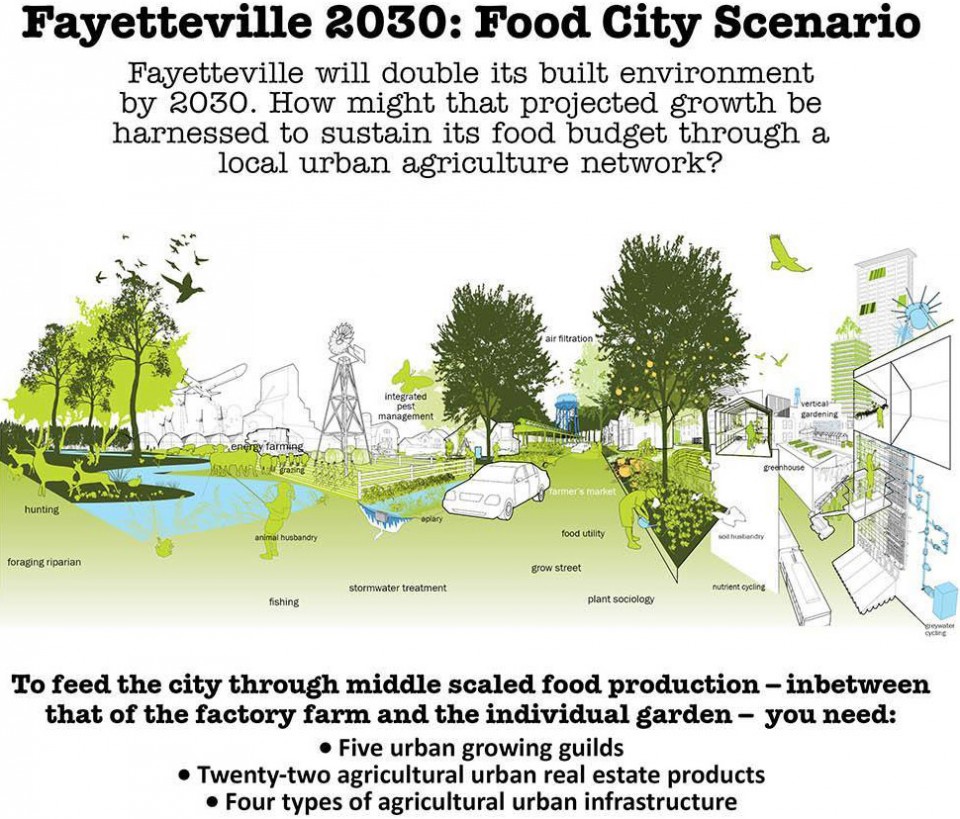
△ Fayetteville的建筑面积在2030年将翻倍。如何利用此次机会,创立城市农业系统,维护食品预算的稳定?
Fayetteville ill double its built environment by 2030. How might that project growth be harnessed to sustain its food budget through a local urban agriculture network? Photo Credit: University of Arkansas Comm
项目说明 PROJECT NARRATIVE
城市农业生产系统真的能够帮助Fayetteville的维持现有食品预算不变的情况下,支撑其发展么?至2030年,居住在Fayetteville的城市人口将会翻倍,达到14万,而超过50%的所需住房用地还尚未落成。在这片将会有超过28%的儿童面临食品安全问题的区域,“Food City”希望建立一个具有弹性和自我恢复能力的未来城市。相较于美国大城市的高密高效,诸如Fayetteville一类中型城市中自然生态系统、基础设施和城市肌理间不断变化的互联关系注定其需要向能够应对食品安全问题的弹性城市方向发展。
目标与现实:拥有强大影响力的情景规划
在克林顿全球计划的支持下,“Food City”创造了一套模范化的设计词汇库,创造了一个介于个体花园和大规模工业化农场间的城市农业生产空间。这个中尺度的农业空间填补了现代城市农业结构中的空缺,将诸如绿色基础设施、公共绿地、食品加工和集散地等生态性的市政公共设施都包括在内。通过堆肥系统、综合废物管理设施,垃圾深埋以及水基农业等等设计手段,实现市域尺度的土壤综合管理,以建构健康的土壤结构和种植媒介,为当地的农业生产打好基础。在未来,城市、当地的非营利社会组织和社区都会参与到这个对固化规划服务具有潜在反抗力的复杂发展系统之中。而将城市食物生产作为评价智能增长管理标准之一的做法也极大的影响了Fayetteville城市发展的方向,其周边一座城市便将建立一个区域食品中心,以配合整个概念的实施。
“Food City”依照农业生态学,制定了5个具有相应功能的城市种植区:1. 由现有多年生林地演变而来的永续/食用景观 2. 需要密集养护的一年生农业景观 3. 由行道果树和庭院农业组成的街道农业 4. 保障城市农业环境安全的污染治理景观 5. 以及利用城市污染水源,变废为宝的集中型农业生产
设计团队所引入的规划手段创造了一个不断发展、演变的城镇乡村新格局,城郊区域将面临一次创新性的改造。“Food City”所衍生出来的22种农业城市地产开发模式补充了原有19种标准模式的不足,也提升了其原有价值。至2080年,“Food City”将形成一个高度网络化的农业城市区域,环绕城市的绿带之中,碎片化的农业场所与城市斑块相互交杂穿插。
可持续:具有生态系统效益的农场
“Food City”创造了一个完整的闭合环路,将原本彼此割裂的能源、食物、水源、生态和经济系统重新连接在一起。除了种植策略以外,“Food City”在能源生产和废物管理中加入了回收利用策略,创立了关于水源和土壤的保护策略,以及居住、生产相互穿插的城市肌理。通过堆肥系统、综合废物管理设施,垃圾深埋以及水基农业等等设计手段,实现市域尺度的土壤综合管理,在一定的时间尺度内建构健康、高产的土壤结构。而相互结合的农业景观和城市肌理则将实现健康生态系统所有的,包括授粉、控制水土流失、水位调节/供给、养分供应、土壤形成在内的17种生态系统的自然调节效果。
基于环境和社会数据的分析方式
在2012年所发布的Fayetteville食品安全初步评估中,生态工程师为基于热量生产能力的当地粮食生产计划给出了两个十分重要的规划参数。
2030年工业化国家中每日人均所需热量将为3500卡路里,其中30%来自动物食品,,70%来自植物食品。而食物类型虽受文化所影响略有不同,但总体来说25%来源自脂肪,25%来源于蛋白质,剩余的50%则来源于碳水化合物。为了达到这一标准,Fayetteville每年需要生产1720亿卡路里,这也意味着其缘由的岩土地质结构面临着不可避免的重大改变。大部分的现状土壤缺乏支持多样农作物生长所需的营养成为,成为了打造弹性城市的一个短板。因此“Food City”所提倡的市域尺度的综合性土壤营养升级将有助于恢复土地在开环系统中所丢失或输出的各类营养。
Fayetteville现有城市范围约35000公顷。若以不能城市化生产的牛肉作为蛋白质的主要来源,则需要另加162,190公顷(人均25公顷)的土地以保证食物的重组。而若以其他蛋白质来源取代牛肉,则仅需35,150公顷(人均0.25公顷)即刻满足总体消耗需求。后者所需的空间尺度恰好与城市现状相吻合,因此“Food City”的概念是建立于后者的数据之上的。
多样化的食物生产方式
“Food City”通过设计手段将食品安全问题形象地展现在居民眼前,也促进、鼓励了在探讨和抉择植物种植种类时居民间的交流。“Food City”的实施并不意味着每个人都要拿起锄头,成为农民。而是希望通过当地的食物种植和生产,重建随着城市发展所逐渐消失的城市与自然、城市与居民的关系。此外,食物生产也促进了区域内经济和生态系统的发展,景观结构与城市结构交错穿插,和谐共处。而五种城市种植区与22种农业城市地产开发模式相辅相成,创建了一个灵活的模范化设计词汇库,无论尺度大小,都能找到相应的解决方式,将农业生产带入城市生活之中。
公众参与与项目的实现
除了Local Food Code Task Force的参与外,设计团队也与当地一些非营利的种植和食品分配组织合作,创建了数个社区农场和食用园地的示范项目,其中两个将陆续完工。而在2013年,设计团队与非营利性组织也与政府合作,确定了城市农业在城市土地利用框架中的相应代码。“Food City”将成为在州域范围内,通过在地的食品生产,纠正食品生产与消费途径间错位的重要手段。此外,这种合作关系也促成了州内重要大学中人文基础食品课程的产生。
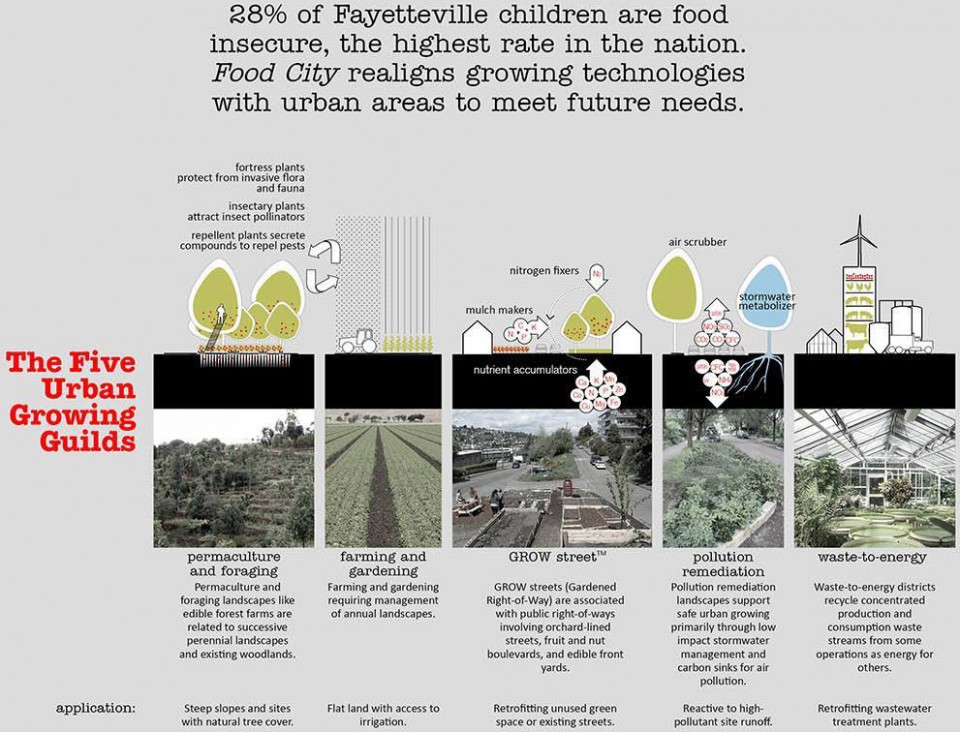
△ Fayetteville 28%的儿童将处于食品得不到保障的情况中,这是全美最高的数据。 “Food City”结合植物种植技术,以满足城市未来的需求。
28% of Fayetteville children are food insecure, the highest rate in the nations. Food City realigns growing technologies with urban areas to meet future needs. Photo Credit: University of Arkansas Community Design Center
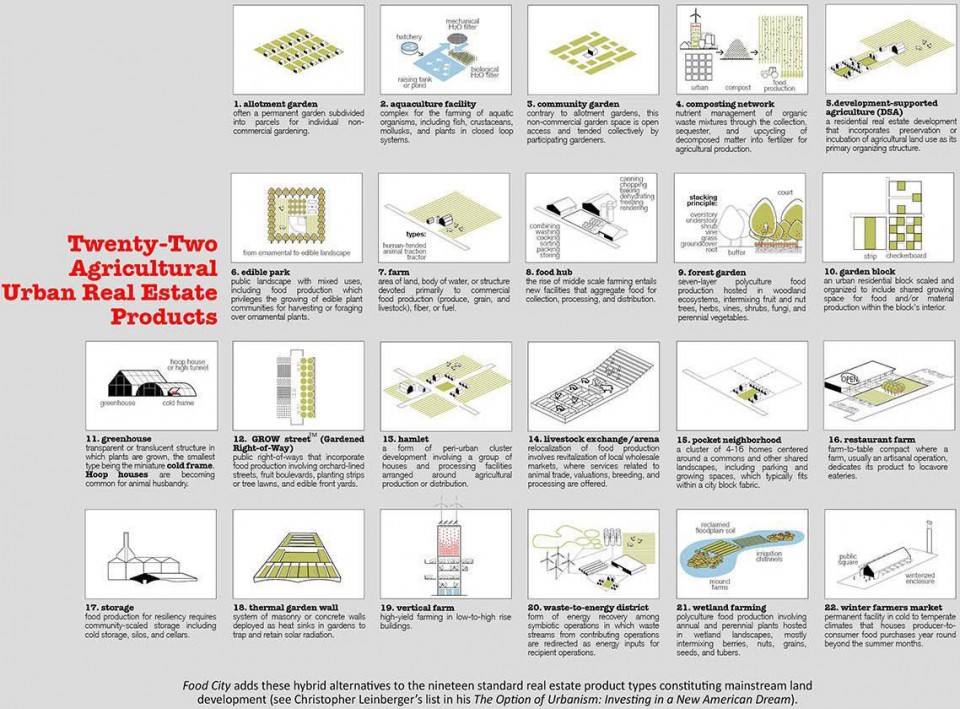
△ 22种农业城市地产开发模式补充了原有19种标准模式的不足。
Twenty-Two Agricultural Urban Real Estate Products. Food City adds these hybrid alternatives to the nineteen standard real estate product types constituting mainstream land development (see Christopher Leinberger’s list in his The Option of Urbanism: Investing in a New American Dream). Photo Credit: University of Arkansas Community Design Center
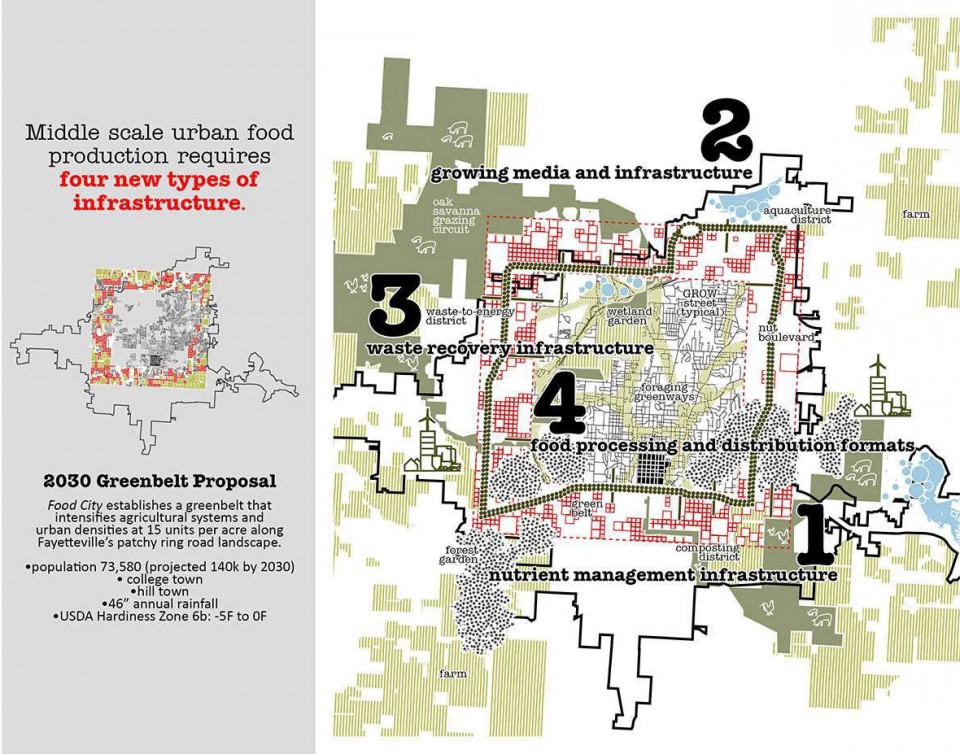
△ 中尺度城市食物生产所需要的四种基础设施。
Middle scale urban food production requires four new types of infrastructure. Photo Credit: University of Arkansas Community Design Center
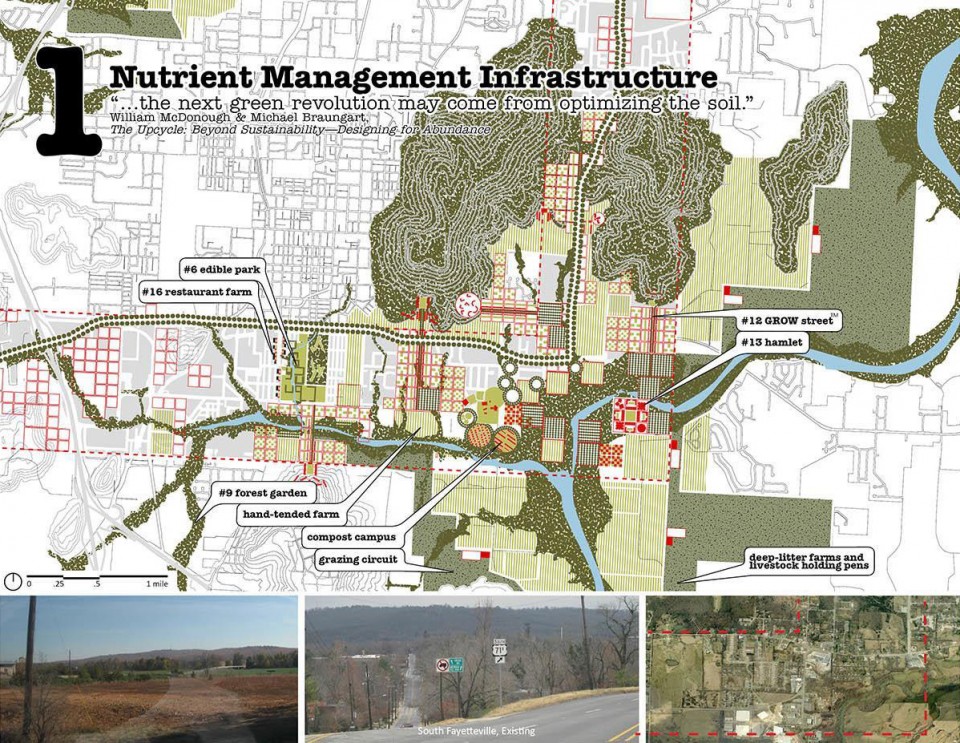
△ 土壤复原与优化,“下一代的农业革命也许将从优化土壤开始”。
1 Nutrient Management Infrastructure “…the next green revolution may come from optimizing the soil. Photo Credit: University of Arkansas Community Design Center
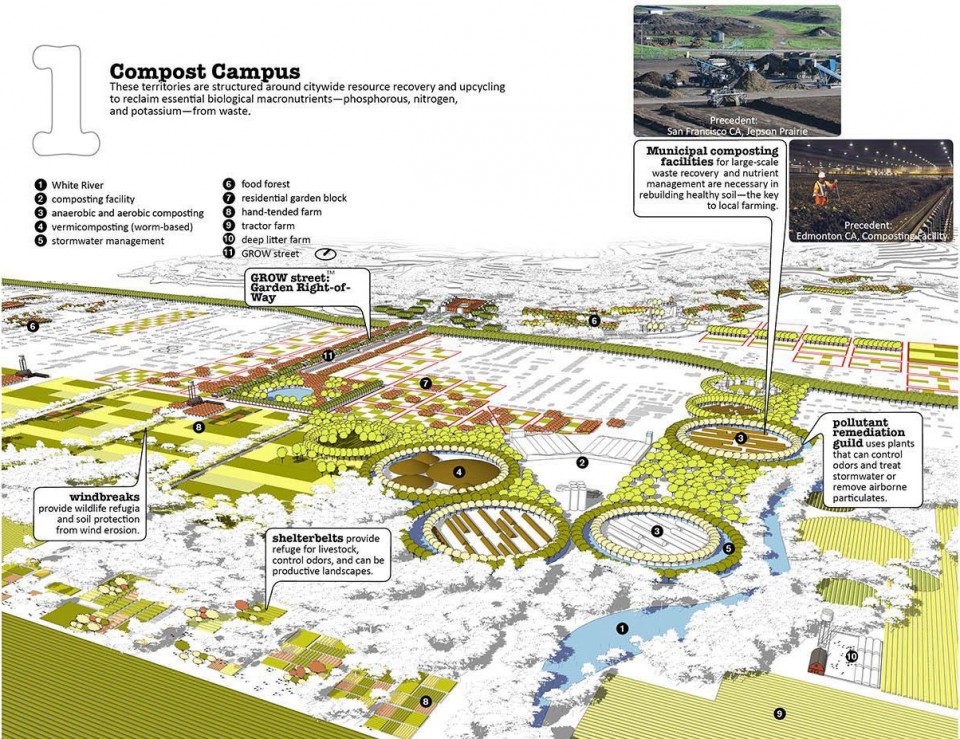
△ 堆肥园区,来自城市的资源回收系统,丛废物中回收磷,氮,钾等基本生物营养素
1 Compost Campus. These territories are structured around citywide resource recovery and upcycling to reclaim essential biological macronutrients – phosphorous, nitrogen, and potassium-from wast Photo Credit: University of Arkansas Community Design Center
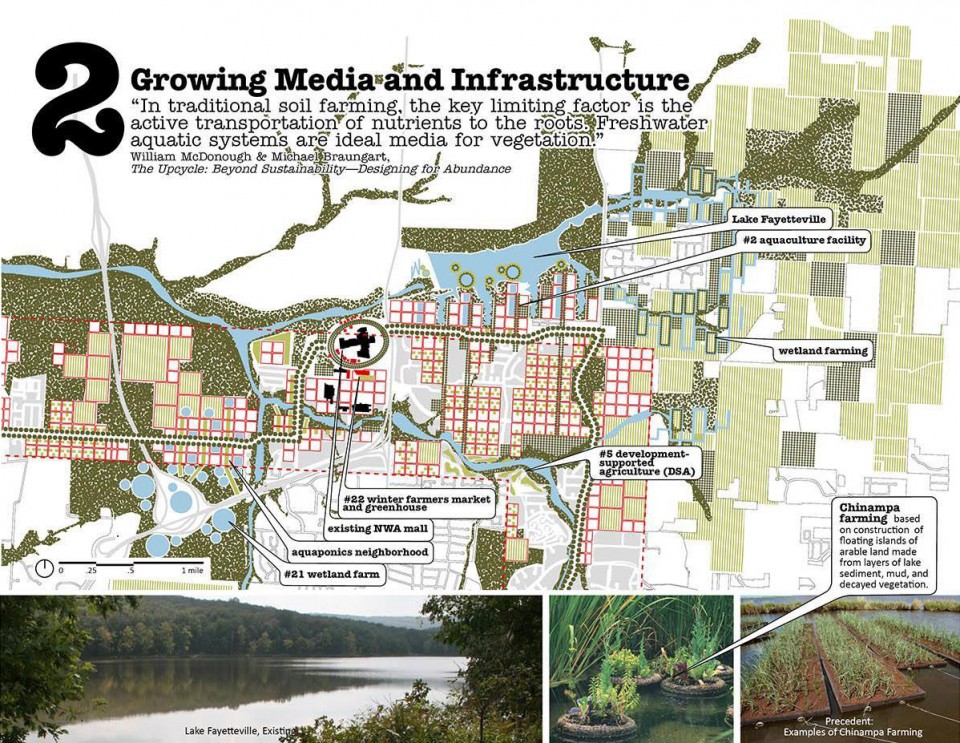
△ 种植区与基础设施,“传统土壤种植园中,营养在传送至根系前经过了重重削弱,而水培植物则避免了这一无谓的消耗过程。”
2 Growing Media and Infrastructure. “In traditional soil farming, the key limiting factor is the active transportation of nutrients to the roots. Freshwater aquatic systems are ideal media for vegetation.” Photo Credit: University of Arkansas Community Design Center
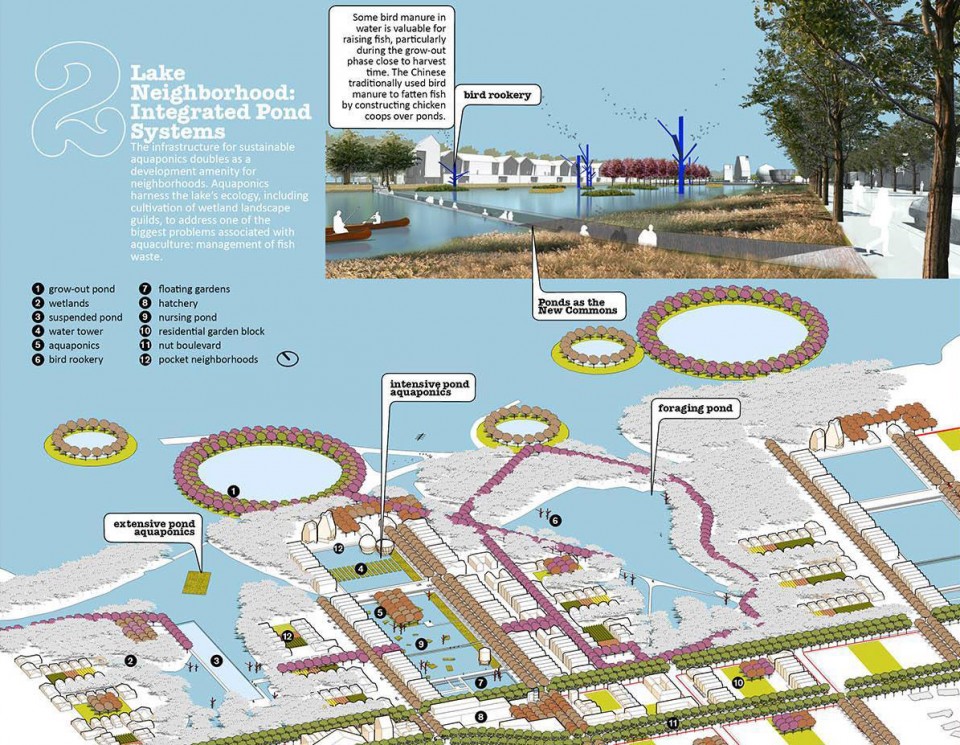
△ 湖边社区与池塘相结合。鱼菜共生的基础设施点缀着社区空间。鱼菜共生的种植手段利用湖区生态环境,解决了水产养殖中最大的问题-鱼类排泄物的管理。a
2 Lake Neighborhood. Integrated Pond Systems. The infrastructure for sustainable aquaponics doubles as a development amenity for neighborhoods. Aquaponics harness the lake’s ecology, including cultivation of wetland landscape guilds, to address one of the biggest problems associated with aquaculture: management of fish waste. Photo Credit: University of Arkansas Community Design Center
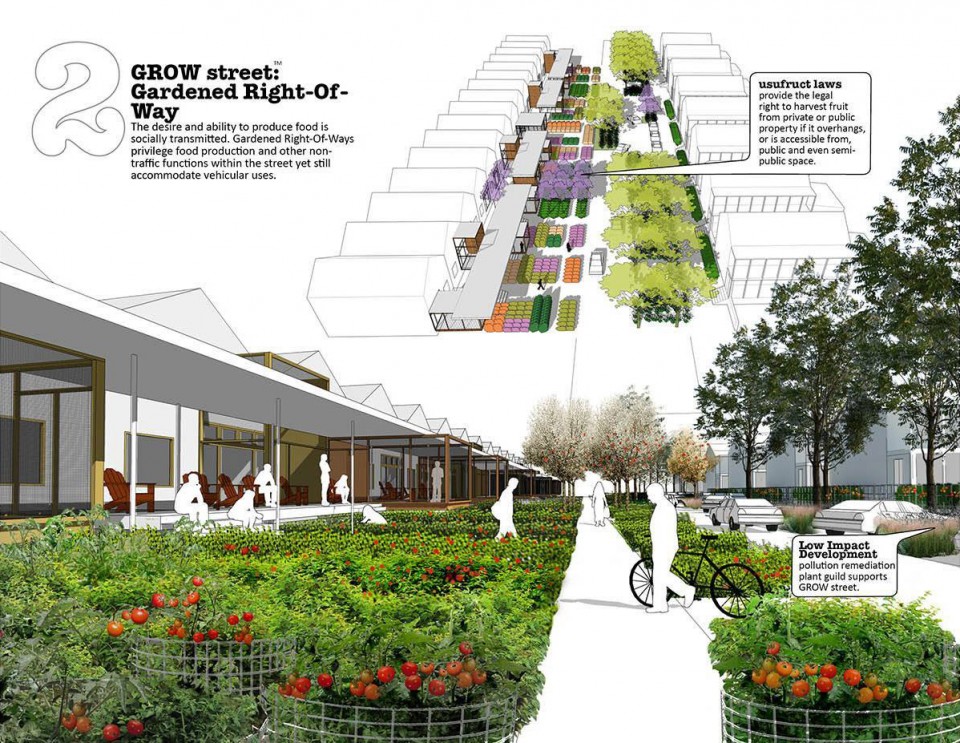
△ 种植街区,花园与道路相伴而生。对于食物生产需求和能力的最好体现。食品生产及非交通用途占据街道空间的同时,保证了交通的畅顺。
2 GROW street: Gardened Right-Of-Way. The desire and ability to produce food is socially transmitted. Gardened Right-Of-Ways privilege food production and other non-traffic functions within the street yet still accommodate vehicular uses. Photo Credit: University of Arkansas Community Design Center
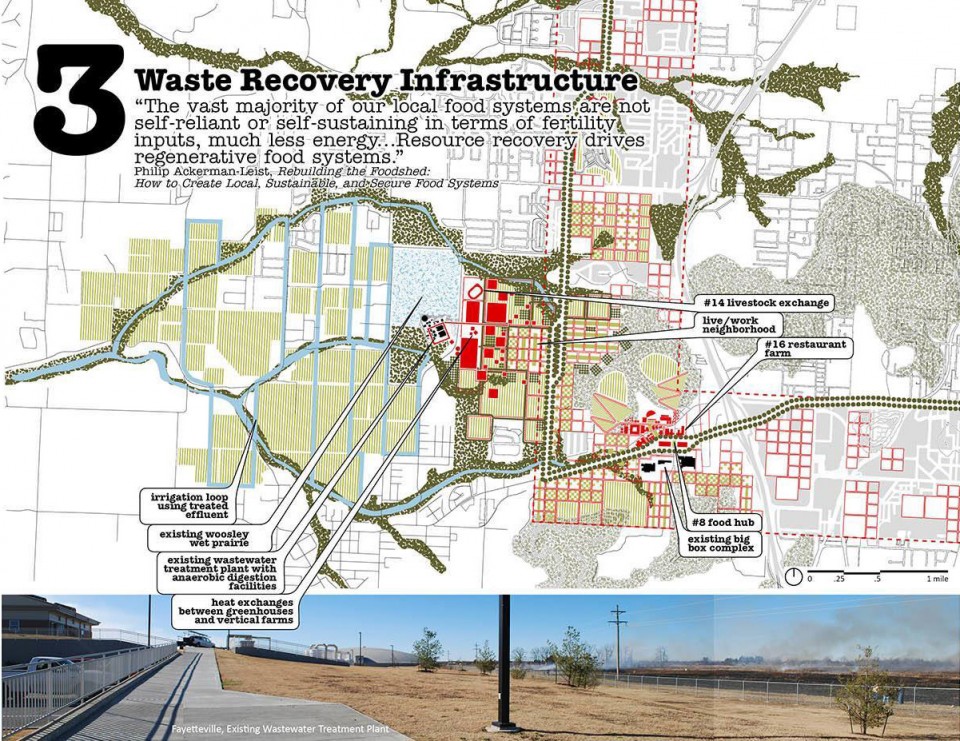
△ 废物回收设施。“当地食物生产系统中一大部分都不能实现在肥料和能源上的自给自足…而资源的回收利用则将改变这一现状。”
3 Waste Recovery Infrastructure. “The vast majority of our local food systems are not self-reliant or self-sustaining in terms of fertility inputs, much less energy…Resources recovery drives regenerative food systems.” Photo Credit: University of Arkansas Community Design Center
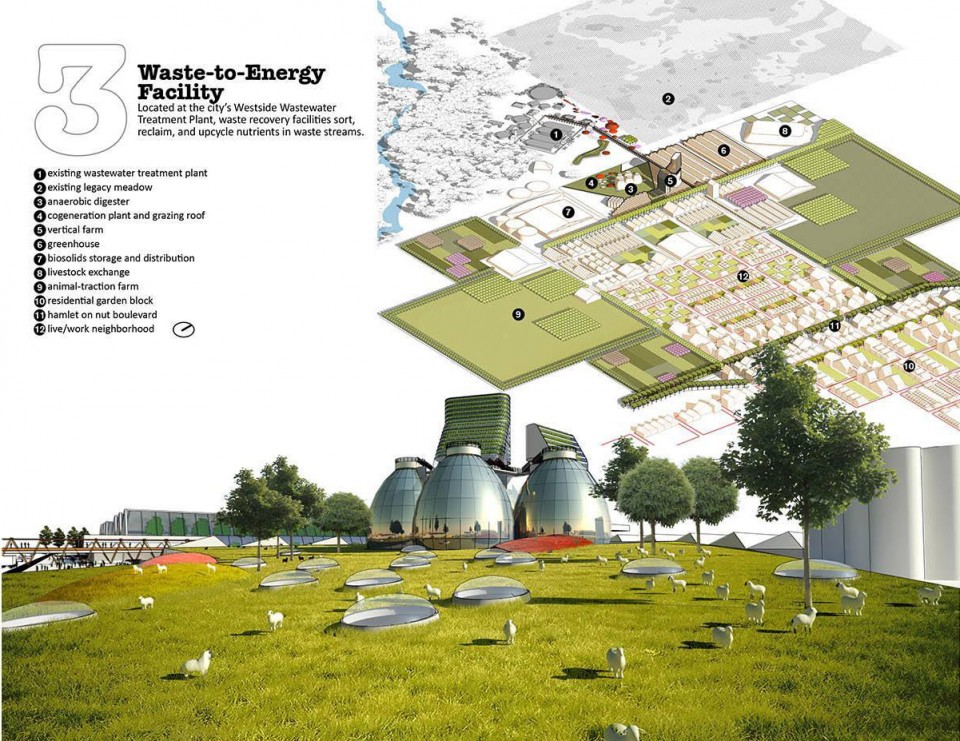
△ 变废为宝。位于城市西部的水源净化基地,分类、净化、回收废水
3 Waste-to-Energy Facility. Located at the city’s Westside Wastewater Treatment Plant, waste recovery facilities sort, reclaim, and upcycle nutrients in waste streams. Photo Credit: University of Arkansas Community Design Center
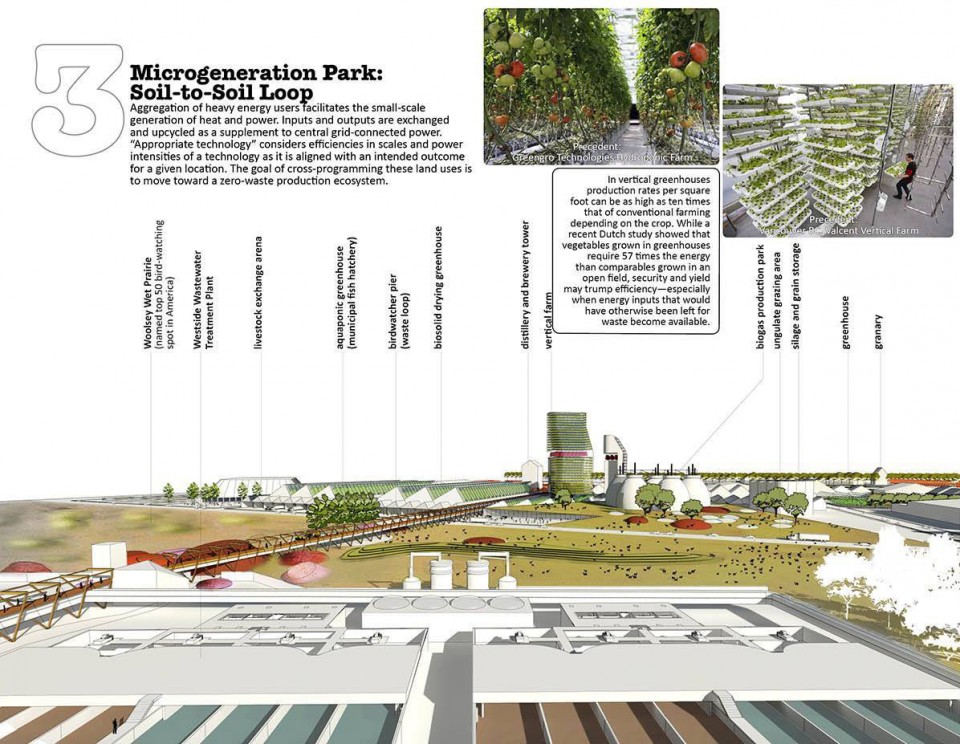
△ 微型发电园:土壤与土壤的环路。利用小规模的发热与能耗作为中央电网的补充。“合适的技术”是建筑在指定的地点中产生了其所需要的足够能量,交错的功能布置使整片区域朝着零污染生产系统发展。
3 Microgeneration Park: Soil-to-Soil Loop. Aggregation of heavy energy users facilitates the small-scale generation of heat and power. Inputs and outputs are exchanged and upcycled as a supplement to central grid-connected power. “Appropriate technology” considers efficiencies in scales and power intensities of a technology as it is aligned with an intended outcome for a given location. The goal of cross-programming these land uses is to move toward a zero-waste productions ecosystem. Photo Credit: University of Arkansas Community Design Center
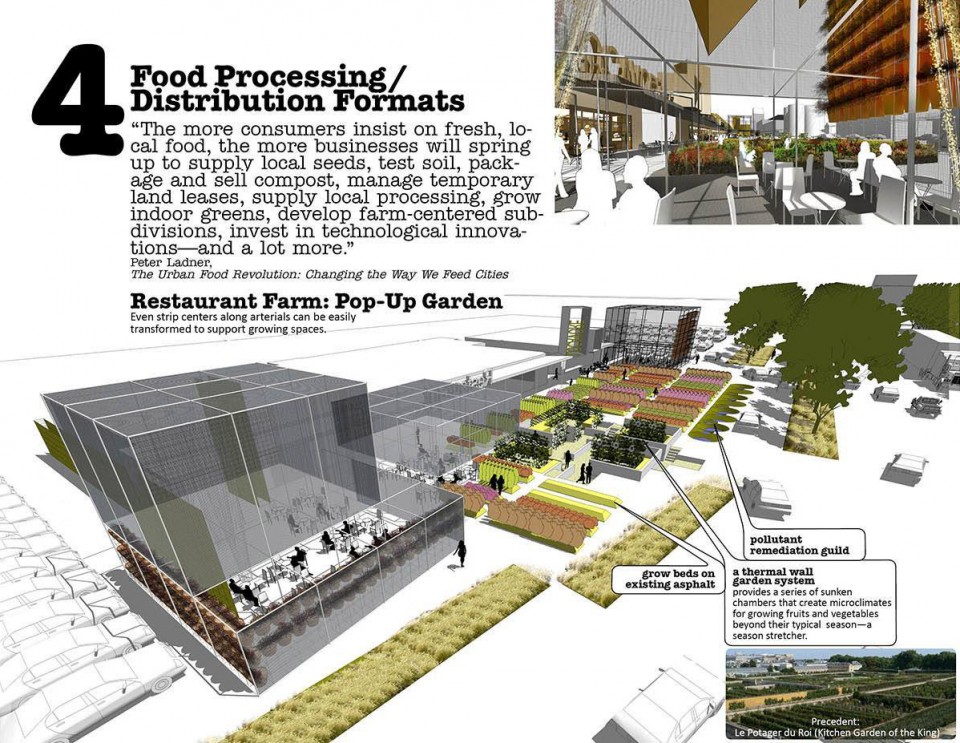
△ 食物的生产与销售。“越来越多的消费者支持新鲜的当地食物,随之出现的是越来越多的生产者,使用当地的种子,测试土壤,包装和销售堆肥,租赁土地,支持当地的加工业,种植室内的植物,创造以农业为中心的园区,投资于技术创新,等等等等。”
4 Food Processing / Distribution Formats. “The more consumers insist on fresh, local food, the more businesses will spring up to supply local seeds, test soil, package and sell compost, manage temporary land leases, supply local processing, grow indoor greens, develop farm-centered sub-divisions, invest in technological innovations-and a lot more.” Photo Credit: University of Arkansas Community Design Center
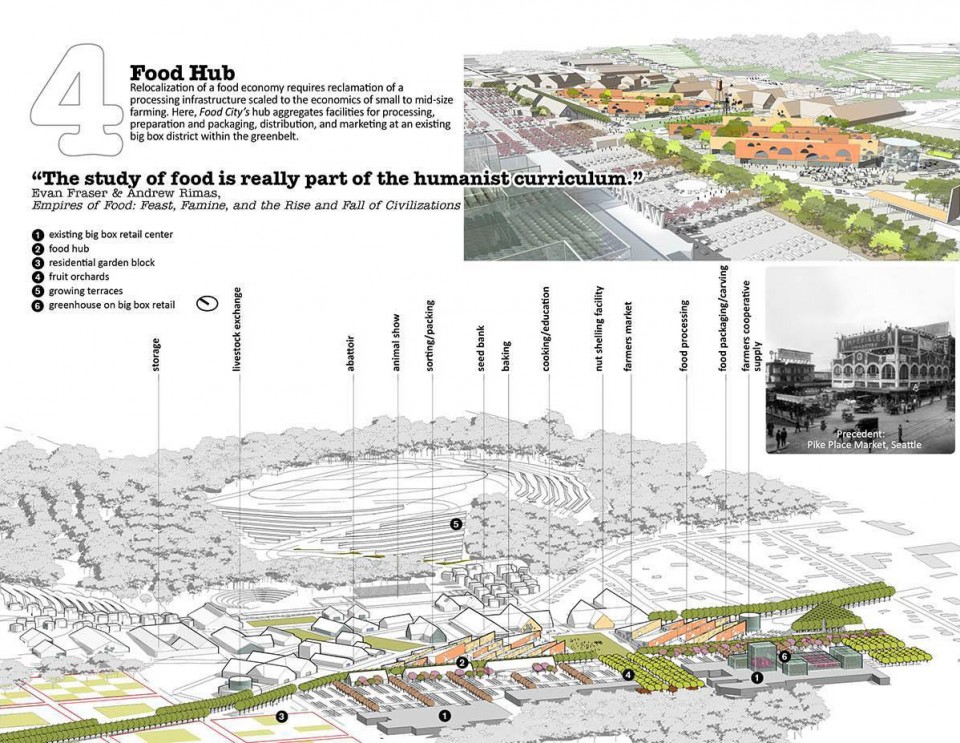
△ 食品枢纽。食品经济的重新定位让加工业缩减至中小型农业。在绿带中的巨大盒子建筑中的食品枢纽将积聚食品处理,准备、包装、配送和销售设施。
4 Food Hub. Relocalization of a food economy requires reclamation of a processing infrastructure scaled to the economics of small to mid-size farming. Here, Food City’s hub aggregates facilities for processing, preparation and packaging, distribution, and marketing at an existing big box district within the greenbelt. Photo Credit: University of Arkansas Community Design Center
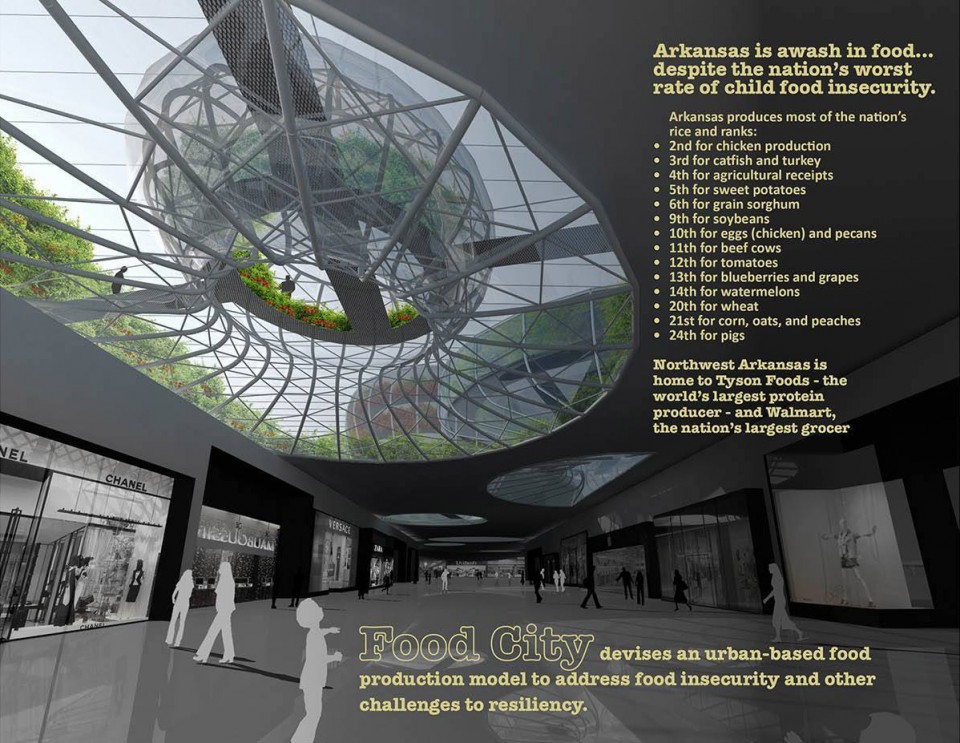
△ Food City希望建立以城市为基础的食品生产模型,以应对食品危机和等等其他挑战。
Food City devises an urban-based food production model to address food insecurity and other challenges to resiliency. Photo Credit: University of Arkansas Community Design Center
We have never seen food’s true potential, because it is too big to see. But viewed laterally it emerges as something with phenomenal power to transform not just landscapes, but political structures, public spaces, social relationships, and cities.” Carolyn Steel, Hungry City: How Food Shapes Our Lives.
Goals and Objectives: Scenario Planning Toward More Robust Decision Making
What if Fayetteville’s projected growth enabled the city to sustain its food budget through a local urban agriculture network? Fifty percent of Fayetteville’s built environment projected to exist by 2030 has not yet been built as the city doubles its population of 73,000. Food City envisions a future based on resilient forms of urbanism where more than 28% of area children are food insecure (vs North Dakota’s 10%, the country’s lowest). While the large metropolis sponsors the most efficient carbon footprint per capita, moderate scale cities like Fayetteville are better equipped to evolve resilient food-secure environments given the interconnectedness and metabolic alignment among their natural ecosystems, infrastructure, and urban fabrics.
Funded by the Clinton Global Initiative, Food City devises a model transition vocabulary for establishing a food producing urbanism between that of the individual garden and the industrial farm. The proposal reclaims a “missing middle” foodshed that functions as an ecological municipal utility featuring green infrastructure, public growscapes, and urban spaces for food processing and distribution. Design solutions address municipal-scaled nutrient management through composting networks, integrated waste management utilities, deep litter farming, and aquaculture—all to build healthy soil structure and growing mediums, the basis of local farming. The scenario plan gives the city, local nonprofits, and the development community license to act on a complex and potentially disruptive development issue not amenable to the market-based process for procuring planning services. Examining urban food production as a driver of smart growth management has created a more robust decision-making culture among Fayetteville’s development interests, including a neighboring city that co-opted the issue to plan a regional food hub.
Food City formulates an agroecology of Five Urban Growing Guilds associated with niche functions: 1) permaculture/foraging landscapes, related to perennial landscapes hosted by existing woodlands; 2) farming and gardening requiring intensive management of annual landscapes; 3) GROW Streets (Gardened Right-of-Way) associated with street orchards and edible front yards; 4) pollution remediation landscapes that support safe urban growing; and 5) waste-to-energy districts that upcycle concentrated agriculture and urban waste streams.
The planning approach creates a successional framework for evolving recombinant forms of town and country, including novel suburban retrofits. Food City devises a set of agricultural urban real estate products value-added to the nineteen standard types financialized by Wall Street. By 2080, Food City will have evolved a highly networked agricultural urban mat seeded from a provisional greenbelt that simultaneously intensified scattered agricultural and urban fabrics.
Sustainability: Agroecology or Farming that Delivers Ecosystem Services
Food City proposes a regenerative urbanism that creates integrated loops from otherwise disconnected flows in energy, food, water, ecological, and financial systems. In addition to growing strategies, Food City integrates upcycling strategies in energy harvesting and waste management, a portfolio of water, soil, and conservation strategies, and hybrid settlement patterns that blend productive landscape systems and urbanism. Design solutions address municipal-scaled nutrient management issues through composting networks, integrated waste recovery utilities, deep litter farming, and aquaculture toward building healthy productive soils, which takes years. Farming and urbanism are recombined to deliver the 17 ecosystem services provided in all healthy ecosystems (per Robert Costanza et al., pollination, erosion control, water regulation/supply, nutrient cycling, disturbance regulation, soil formation, etc.).
Environmental/Social Data and Methods of Analysis
In their Preliminary Assessment of Fayetteville Food Security Measures (2012), ecological engineers characterized the caloric productive capacity of the Fayetteville area identifying two important planning parameters for developing locally based food production.
Per capita food demand in an industrialized nation will be 3500 calories per day in 2030 with 30 percent of the demand for animal products and the remaining 70 percent for plant products. While diet profiles vary culturally, human sustenance requires 25 percent calories from fat, 25 percent calories from protein, and 50 percent calories from carbohydrates. To meet this caloric demand Fayetteville will require 172 billion calories per year, entailing substantial amendments to its rocky soil structure. Most local soils lack robust nutrient compositions to support crop diversity—a primary benchmark of resiliency. Food City, therefore, proposes comprehensive nutrient upcycling at the municipal scale to recover organic nutrients lost or exported in open-loop systems (e.g., waste treatment, soil erosion, groundwater management, food export, etc.).
Fayetteville’s existing land area is 35,000 acres. An additional 162,190 acres or 1.25 acres per person (national average) would be needed to support beef production based on contemporary diets. Not all food production can be urbanized. If beef was removed from the equation and nutritional requirements were met through sources of protein other than beef, then a foodshed of 35,150 acres or 0.25 acres per person would be needed. The urban agricultural footprint necessary to support this scenario then would be equal to the city’s existing footprint of 35,000 acres. Food City assumes the latter scenario.
Role of Design and Consideration of Options: The Option of Local Food Production
Food City as a scenario plan visualizes the question of food security through design exercises that enhance the community’s decision-making processes about its future direction of growth. Food City doesn’t demand that everyone become a farmer. Rather, the intent is to recall urban relationships eliminated from the modern city that are necessary to once again accommodate the option of local food production. Food production constitutes a local economy and a local ecology, requiring a land use system that reconciles urban and landscape systems. The Five Urban Growing Guilds and agricultural urban real estate products constitute a transferable planning vocabulary for embedding agricultural capacity into urban settlement patterns at all scales.
Public Participation and Project Implementation
Besides the city’s Local Food Code Task Force, the project team worked with local growing and food distribution nonprofits (some established by the governor to address food insecurity) to formulate demonstration projects around community farms and edible parks (two starter urban farms have subsequently been built). The design team and nonprofits simultaneously worked with the city in 2013 to create enabling urban agricultural codes within the city’s land use framework. Food City is another tool in the statewide effort to marshal public-private alliances in correcting the misalignment between food production and consumer access by way of local food production. This partnership has also motivated the proposal for a humanities-based food curriculum at the state’s flagship university.
MORE: University of Arkansas Community Design Center,更多请至:University of Arkansas Community Design Center on gooood





谁来管理?谁来养护?
成果又该如何分配?
感觉推导过程展现的不是很充分,不过倒是各种想抄