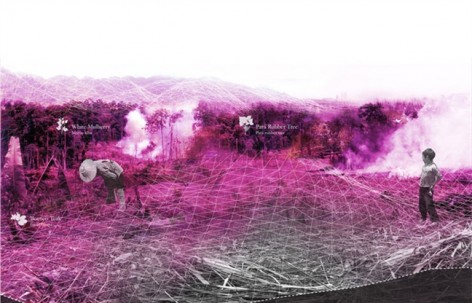
非常感谢陆小璇将项目介绍和项目图片授权gooood发行。更多请至:Xiaoxuan Lu on gooood
Appreciation towards Xiaoxuan Lu for providing the following description:
2012ASLA奖项出炉。
第一期为您带来的是规划设计杰出奖,
来自中国的景观建筑师陆小璇,这是她在哈佛大学GSD学习期间的毕业设计。
“采矿”/ “排雷”
——重新思考老挝战后景观重建中的资源开采过程
Mining as Demining:
Synchronizing the processes of resource extraction in the post-war landscape of Laos
项目地点:老挝沙湾拿吉省
项目类型:战后地区景观重建
The project poses a new linkage between resource extraction and post-war metal cyclingeconomies, strengthening a livelihood that heals a war-scarred landscape. It proposes a strategyof ‘demining bombs through mining gold.’ The bomb-impregnated landscape of Laos, which has 80million unexploded bombs left over from the Vietnam War, is seen as an opportunity to rethink theprocesses of mining. Simultaneously, mineral exploration and excavation processes are used asmechanisms of rehabilitating and reconstructing the hazardous ground.
该设计提出,在老挝战后重建过程中,应在资源开采与遗存金属处理之间建立新的循环经济连接点,以改善生存在被严重破坏的战后景观之上的当地人的生计及生态环境。该项目试图建立一种景观恢复和再造途径,即利用金矿开采过程来排除遗留在老挝境内未爆炸的集束炸弹;将对于从越南战争遗留下来的遍布老挝境内的8000万余枚炸弹的排除过程,作为重新思考矿产开采过程的契机;将矿产勘查及采挖过程视为恢复和重建这片危险之地的重要途径。
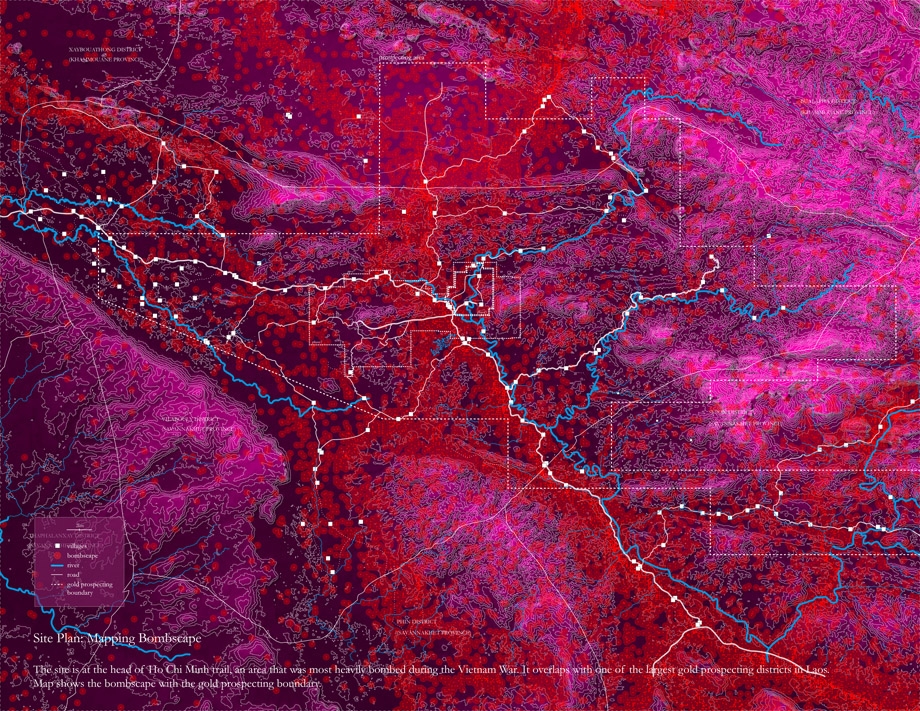
▲场地平面:分析测绘炸弹之地。场地位于越战时被轰炸得最为严重的区域,同时这个区域与老挝最大的黄金储备区之一重叠在一起。地图反应了这两个区域的边界。
项目详情:
老挝是世界上遭受炸弹袭击最严重的国家之一。在越南战争中,美军空投在老挝境内的2.7亿枚集束炸弹中的30%未能引爆,目前,这些集束炸弹仍然影响着老挝50%的农业土地利用。在过去的20年中,只有不到1%的受炸弹影响的土地进行了排雷处理。以这种速度,要清除所有炸弹至少还需要3600年。这里不仅是世界上未爆炸弹的高密度聚集地,同时还蕴藏着丰富的金矿石——老挝是人均金矿石占有率最高的国家。由于该地区遍布炸弹,国际性矿业公司直到近年才开始进驻老挝以进行矿产资源的勘查、勘探与开采。2.7亿枚炸弹在半个世纪之前肆意践踏老挝;今天,采矿公司跃跃欲试地要使用粗旷的开采方式再次践踏这片土地。‘采矿/排雷’方案提出了“利用采矿过程进行排雷”的主张。在这个项目中,如何处理遍布老挝境内的8000万余枚炸弹,成为重新思考矿产开采过程的契机;同时,矿产勘查及采挖过程被视为恢复和重建这片危险之地的有效途径。
战后的排雷过程,以及近年来猛增的探矿、采矿项目,在很大程度上被认为是老挝境内森林砍伐的主要原因。二者都需要从清理地表植被开始进行。通过结合未爆炸弹的地理分散性,以及老挝至今存留的周期性的农耕‘烧荒’过程,‘采矿/排雷’ 将成为一种微尺度操作。周期性变化位置的由农耕‘烧荒’过程所留下的无植被地块,将成为引导‘新采矿’过程的时间及空间结构。通过利用农耕‘烧荒’的周期性,‘采矿/排雷’将拥有土地使用的循环过程,将采矿的负面影响降至最低。采矿过程也因而拥有更多阶段的土地修复周期,使后采矿景观得到重生。
一个新的‘收获’系统将由此产生——炸弹、黄金和食物将被循环收获:为时一年的农耕‘烧荒’过程在进行食物收获之后留下一块无植被地块;紧接着,排雷部队将进行炸弹排测,‘收获’ 炸弹并进行处理,以进行弹壳的收集和循环利用,这一过程将为下一步即将开始的矿产勘测开辟一条‘无弹’的安全通道;以‘烧荒’地块为基本尺度的露天井坑将成为‘收获’ 黄金的场地;后采矿井坑将用于临近采矿区的尾矿储藏。最后,海拔位于洪范区内的矿坑将在污染物清理修复后,成为‘无弹’的水产养殖场地;而海拔高于洪范区的矿坑则被改造为梯田进行复垦过程。与其他各种用于复垦的农作物一起,罂粟,这种在老挝土地上曾经盛开的植物将被用于复垦过程,成为新的后采矿区域复垦经济中的重要一环。
‘采矿/排雷’将黄金开采公司看作’景观设计师’。采矿过程在这里不再是粗放型的、造成环境破坏的罪魁祸首;他们的角色、意义被重新思考。他们不仅仅是排雷的工具和契机,同时,采矿过程将从对环境的破坏转变成‘挖掘和重建’平行共存。采矿过程的副产品,原本被看作废弃物的矿坑、矿渣,将被有效利用,成为重新塑造战后新景观的原材料。与此同时,原本需要3600年的清弹过程被重新思考。废土及矿渣将用于建造隔离带:通过对美军在老挝投弹的历史数据进行分析,极度危险的弹区将被标注为‘高危’地段,被隔离带包围。具有讽刺意味的是,这些战争遗留下的炸弹密集的高危地段,在‘新殖民’时代所面临的由国际采矿集团进驻而带来的一系列困境之下,形成散布在老挝境内的‘不可触碰之地’。它们以‘生物保护区’的形式标志着曾经发生在这片土地上的战争的伤痛。废土及矿渣亦可用于以‘采矿/排雷’为中心的区域基础设施的建造材料。
‘采矿/排雷’将金矿开采看作老挝发展循环经济的契机。如果说,越战中肆虐的炸弹投掷是为了破坏区域基础设施,‘采矿/排雷’模式则成为重建区域基础设施的起点,成为改变战后百姓生计的基础。基础设施的建造,诸如道路、能源站,水利大坝,是矿产开采过程的必备条件,它们提供区域交通连接,创造采矿所需的能源。其他公民建筑,诸如医院和学校也是矿区规划的必备配套设施。黄金不但是清弹的资金来源,而且被用于本地的宗教、文化用途,成为记录‘采矿/排雷’过程的景观标记。小型工业将随着小尺度‘采矿/排雷’中炸弹的排除、金矿的采集过程而涌现。与大型的露天矿井相比,小尺度、多周期的‘采矿/排雷’,将重新定义区域的循环经济过程。譬如,炸弹将被收集、处理,送进炼钢厂获得‘重生’——它们将为当地建设小型水坝和桥梁提供材料。‘采矿/排雷’提出,在老挝的资源开采与战后遗存金属处理之间建立新的循环经济连接点,以改善人们的生计及生态环境。战后景观将得到改善,材料将得到有效循环利用。炸弹获得‘新生’,渣土被重新利用--它们成为战后景观建造的材料。新经济和新型工业随着这变化的‘移动’景观而萌发。安全的土地被逐渐带回曾经满目疮痍的战争之地。‘采矿/排雷’过程促成丰产的、安全的景观建立,而不再是对民生和自然环境的破坏与毁灭。
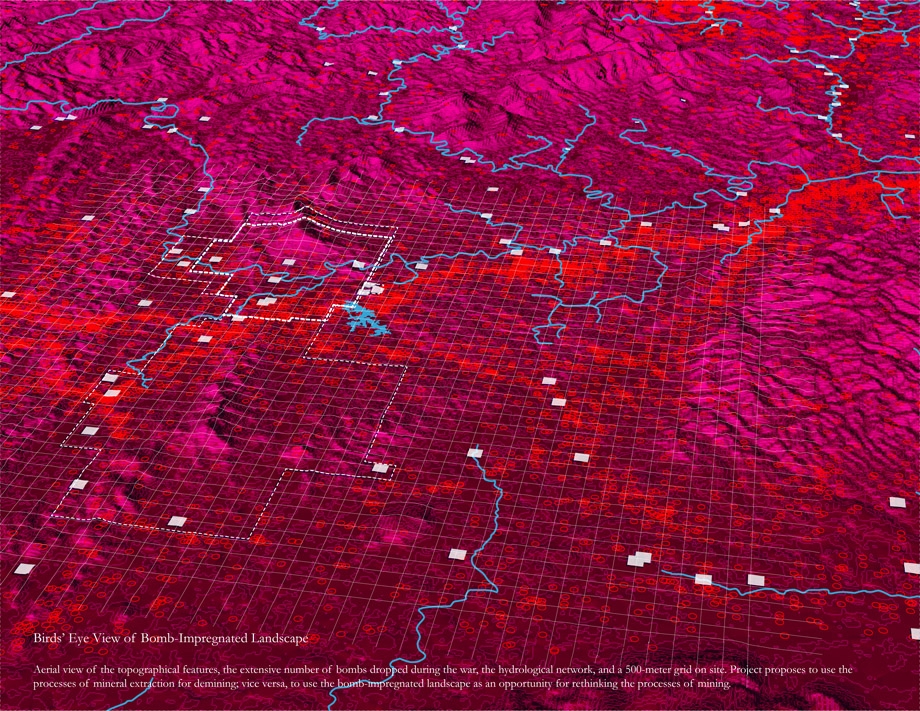
▲鸟瞰遍布炸弹的景观。在500米见方的网格图上反映出场地的地形,水文系统,以及轰炸点。方案提出了“利用采矿过程进行排雷”的主张。在这个项目中,如何处理遍布炸弹,成为重新思考矿产开采过程的契机
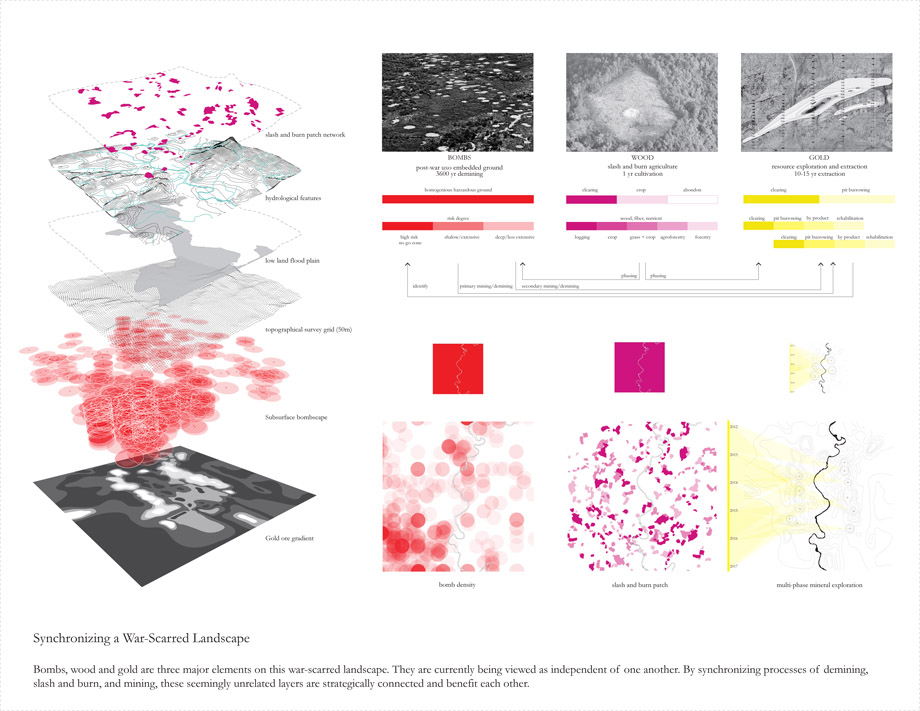
▲整合战后景观元素。炸弹,木材开采,黄金这三大要素是这片土地之殇。他们被认为互不关联,但是从排雷,砍伐,燃烧,开采等步骤审视,它们息息相关。
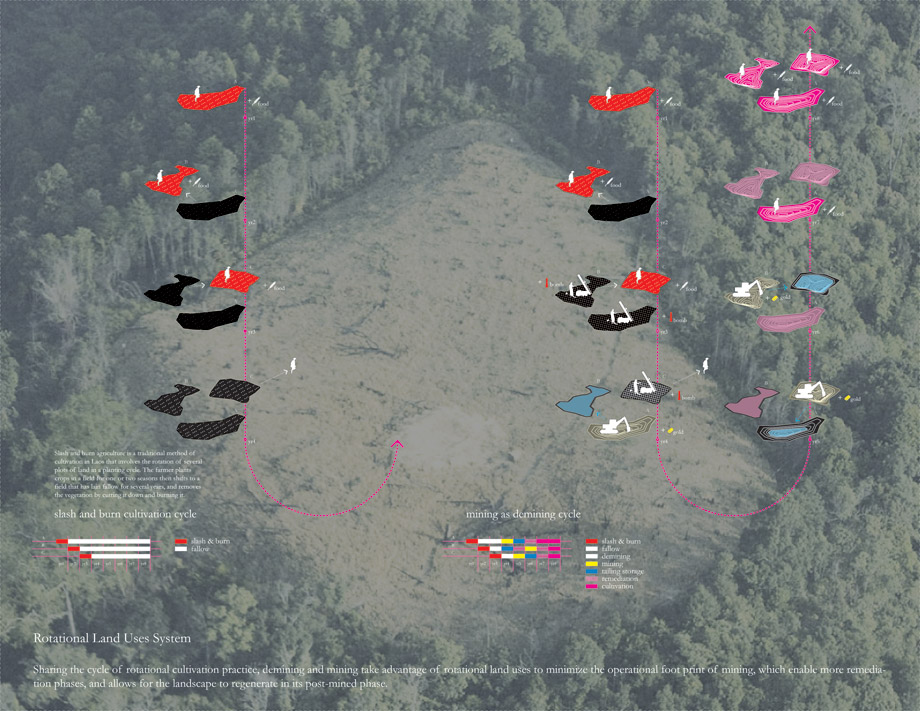
▲食物、炸弹和黄金的循环收获系统。土地被循环共享利用,减少对其的破坏,通过整治让其在后期恢复景观再生。
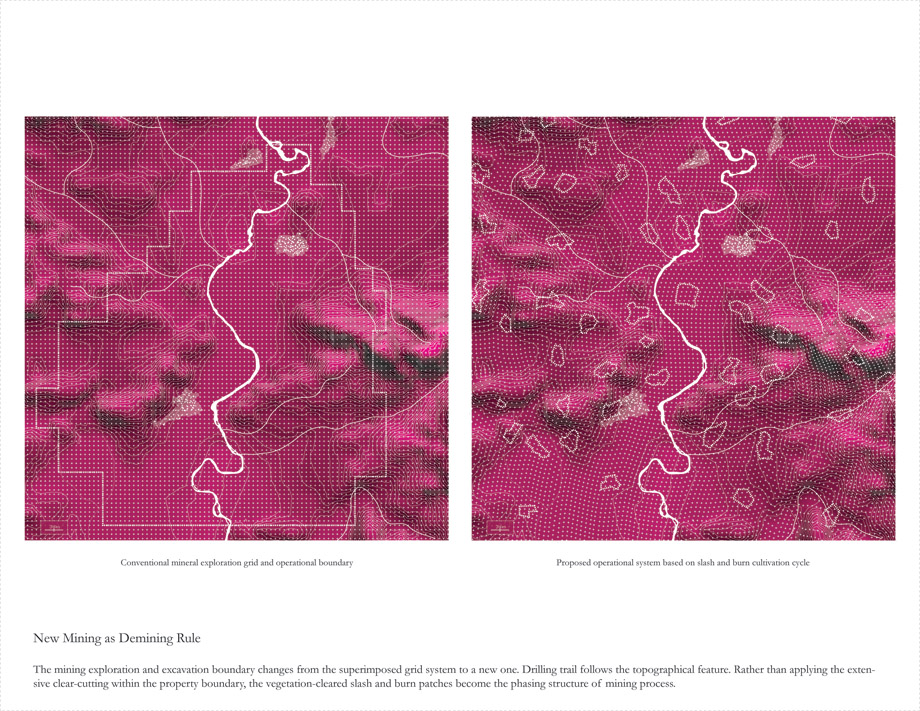
▲新‘采矿/排雷’原则
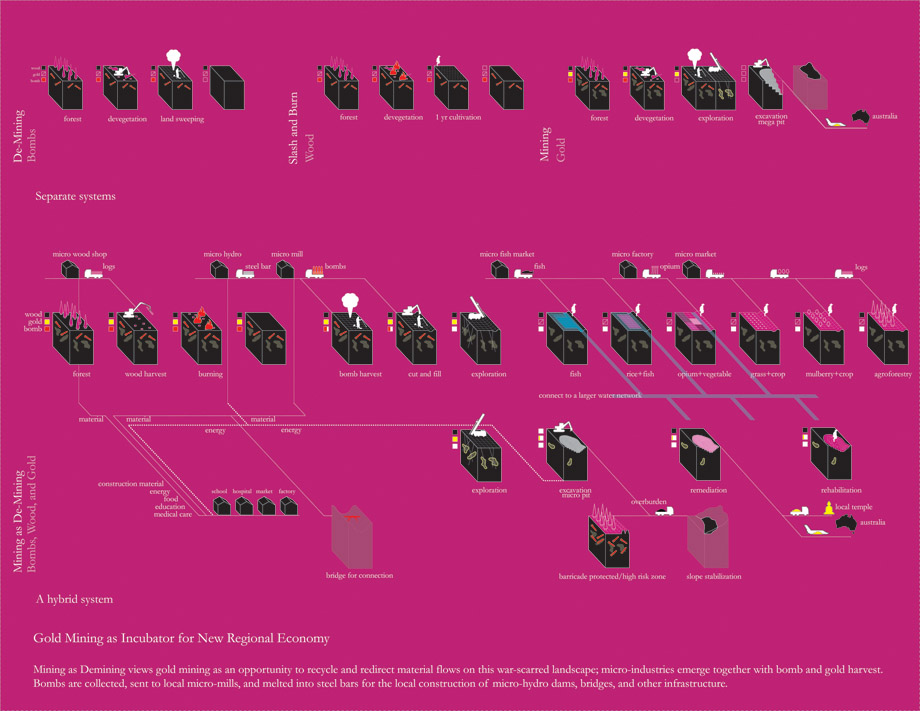
▲金矿采集促进新区域经济的萌发
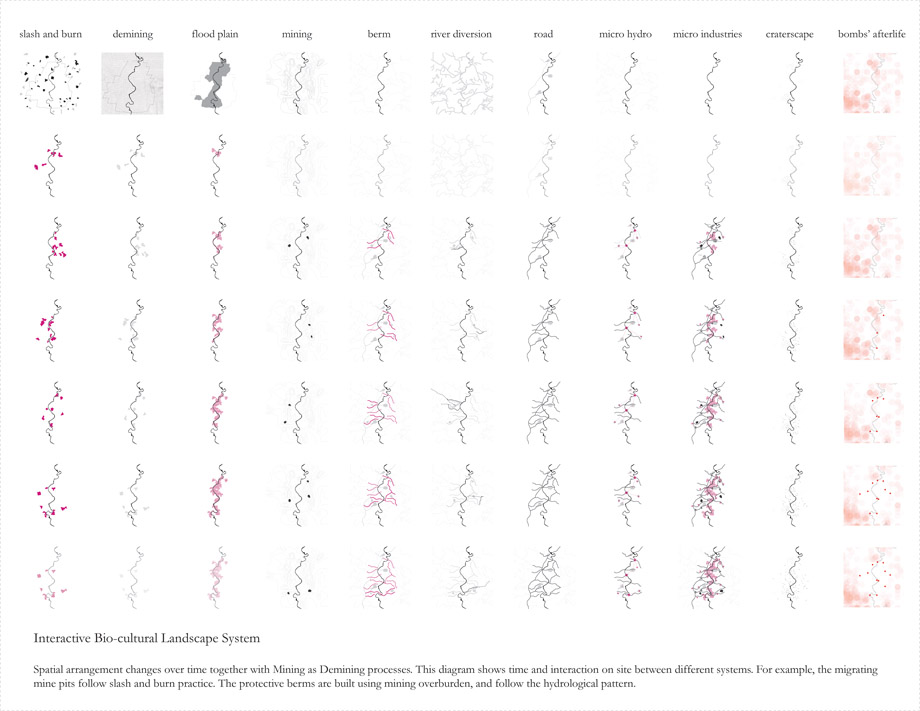
▲相互关联的生态/文化景观系统
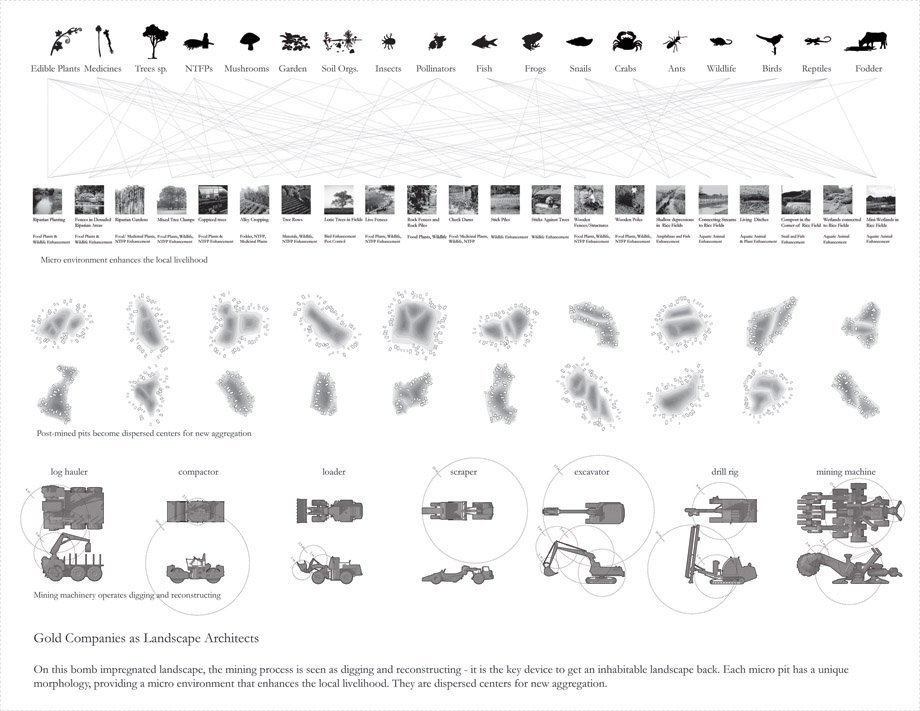
▲做为景观设计师的金矿开采公司
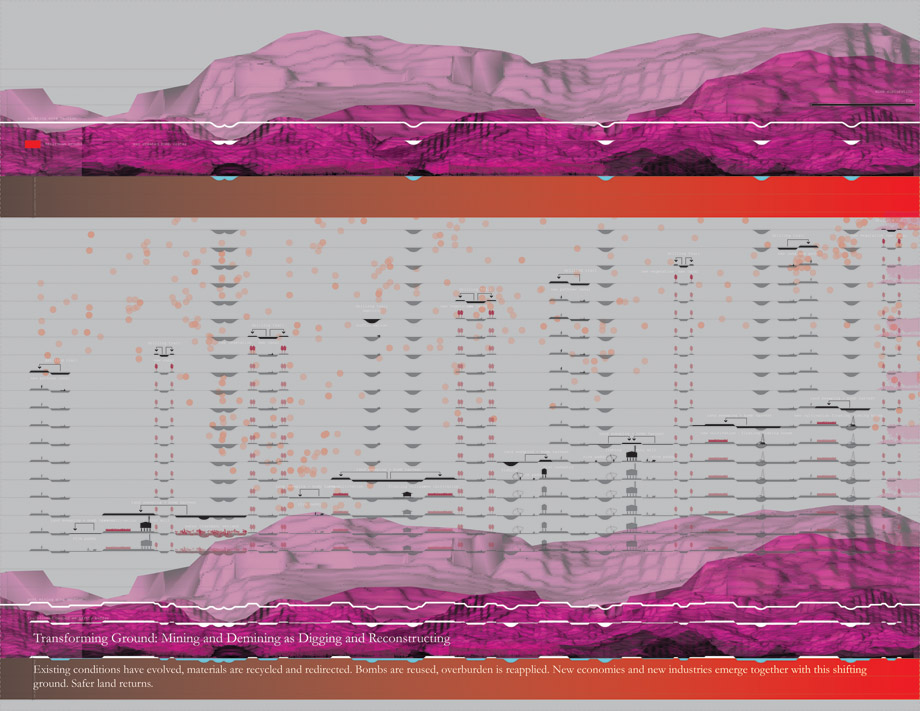
▲战后景观的转变:‘采矿/排雷’的‘挖掘和重建’系统
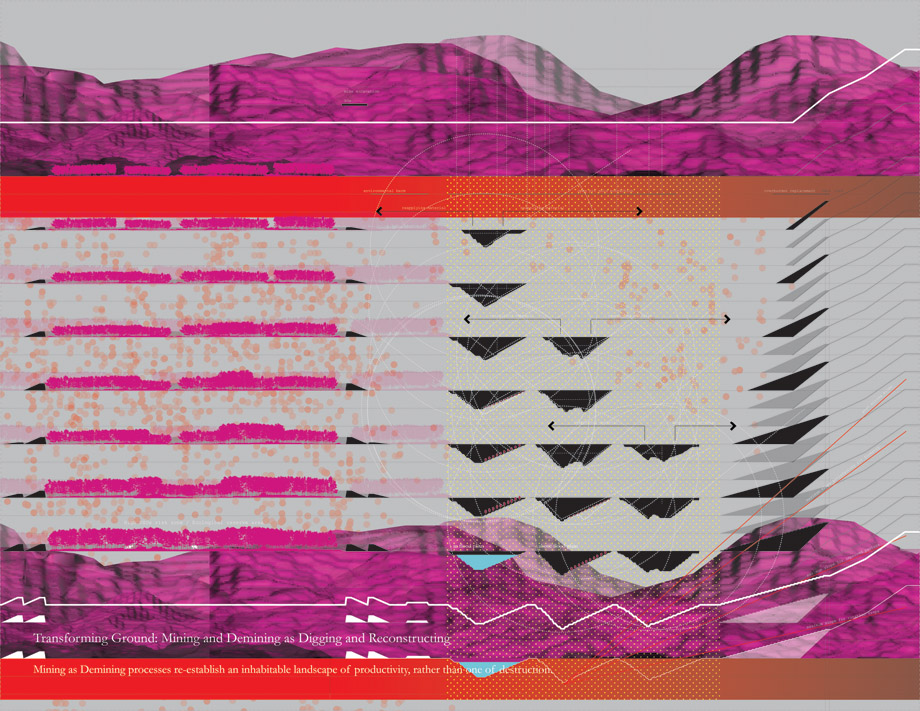
▲战后景观的转变:‘采矿/排雷’的‘挖掘和重建’系统
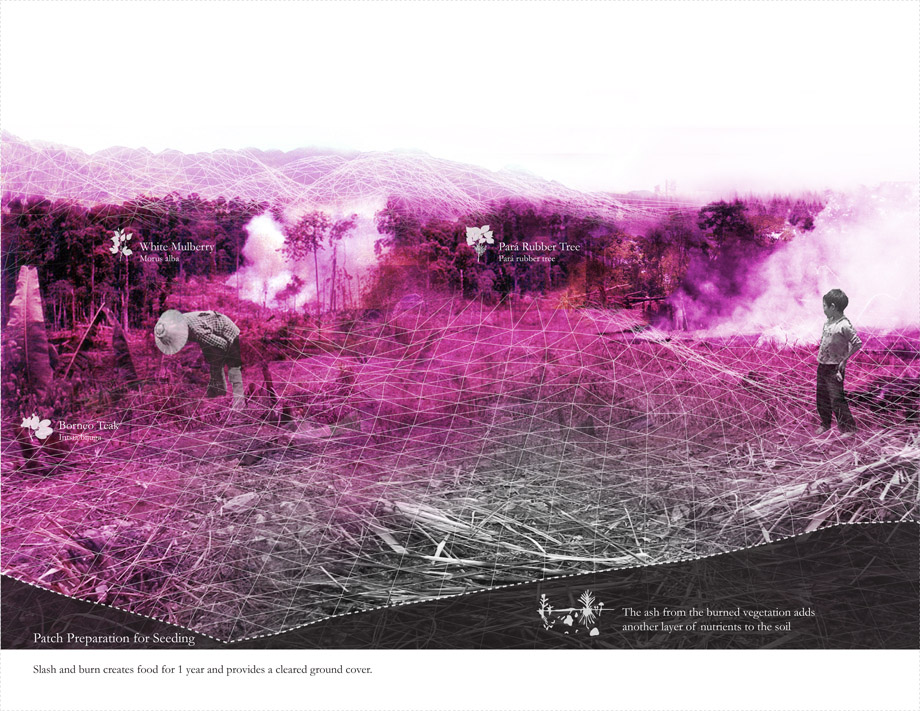
▲为播种做准备的传统‘烧荒’过程
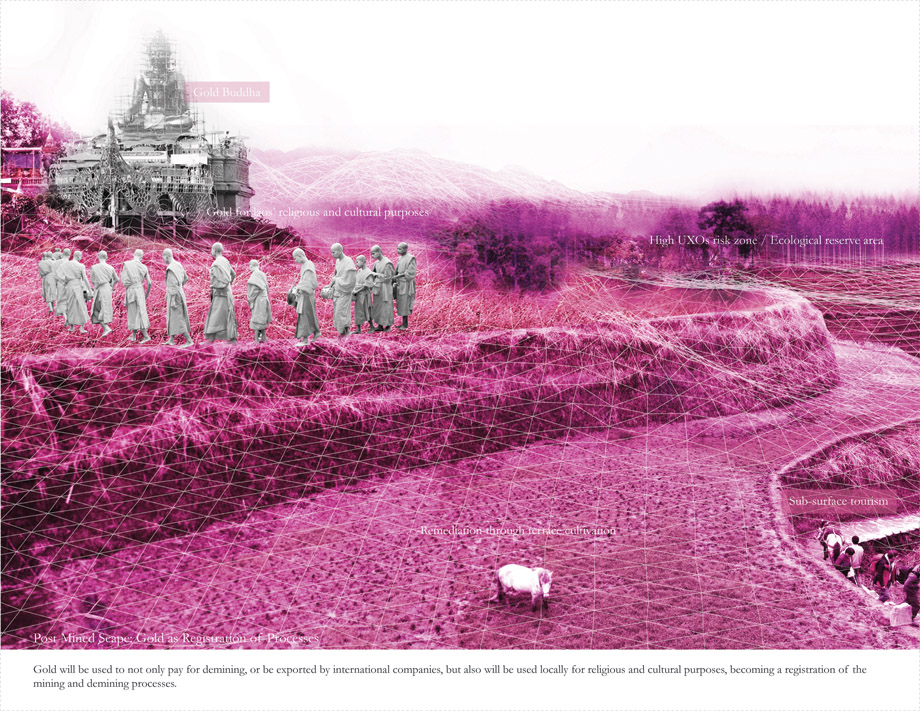
▲后采矿景观:黄金做为‘采矿/排雷’过程的景观标记
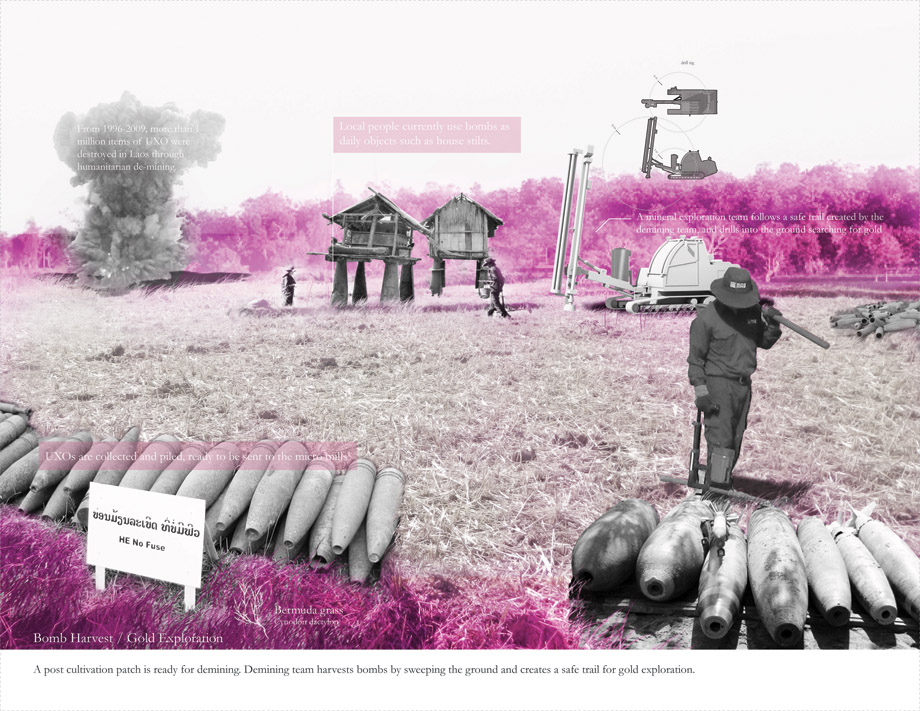
▲炸弹收获/金矿勘探
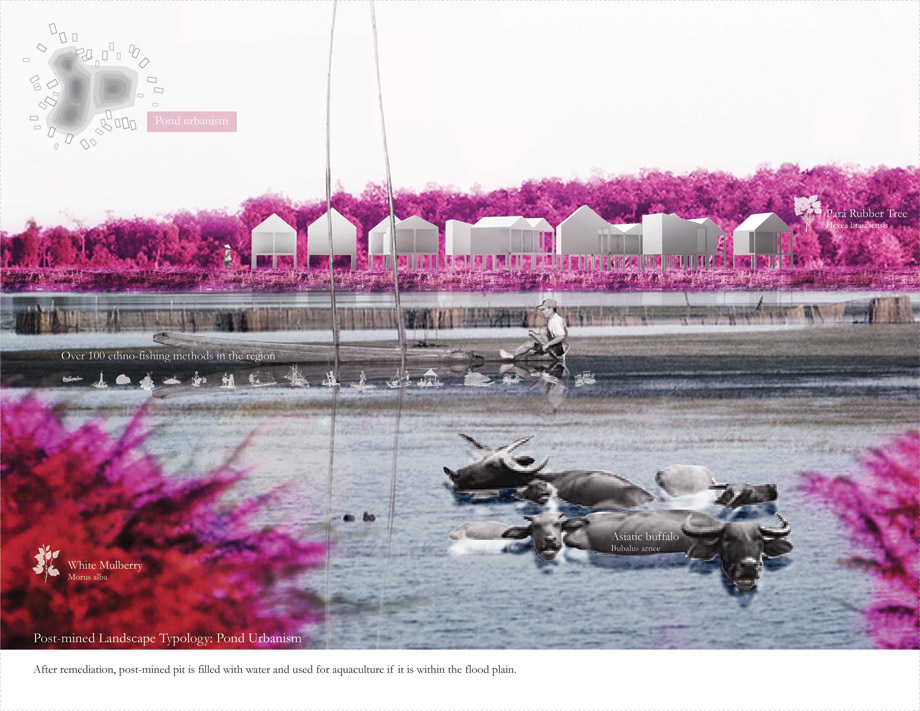
▲后采矿景观类型:鱼塘城市化
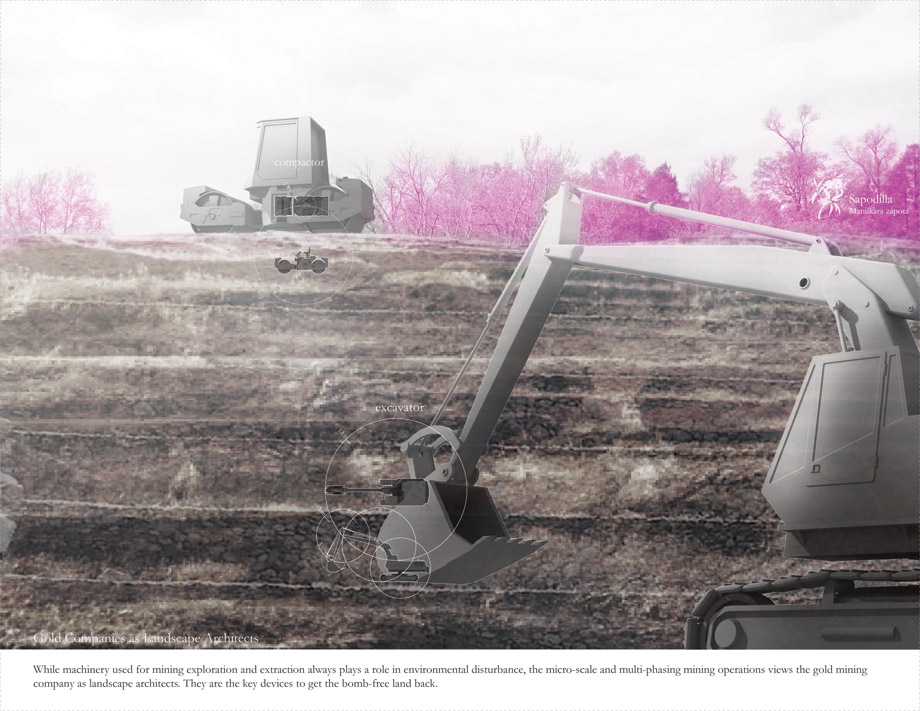
▲做为景观设计师的金矿开采公司

▲后采矿景观类型:罂粟城市化
Here’s some more information from the Xiaoxuan Lu:
Project Narrative
Laos is the most bombed country in the world; 270 million bombs were dropped across its landscape during the Vietnam War, 30% of which failed to detonate, currently affecting 50% of agricultural land. Less than 1% of land affected by UXO has been cleared in the past 20 years. Based on the current clearance speed, it will take more than 3600 years to clean up all the unexploded bombs in Laos.
Not only does its land have the highest concentration of UXOs in the world, but it also has some of the richest gold ore concentrations per capita in the world. Due to the fact that Laos’ landscape is so heavily impregnated with unexploded ordinance, it wasn’t until very recently, that international mining companies began entering Laos to perform operations of mineral prospecting, exploration, and extraction. 270 million bombs trampled the land during the war time. Gold companies are now ready to trample the land again by using raw, unmitigated methods of exploitation. This project proposes the strategy of ‘demining bombs through mining gold.’ The bomb-impregnated landscape is seen as an opportunity to rethink the processes of mining. Simultaneously, gold exploration and excavation processes are used as mechanisms of rehabilitating and reconstructing the hazardous ground.
Demining and mining are largely considered to be a major factor of deforestation in Laos. Both processes require a clearing of ground vegetation for operations to begin. By strategically using the dispersive locations of unexploded bombs, coupled with the existing cycles of slash and burn cultivation, ‘Mining as Demining’ becomes characterized by a decentralized micro-scale operation. The migrating vegetation-cleared patches become the phasing structure of the mining process. Sharing the cycle of rotational cultivation practice, the operations take advantage of rotational land uses to minimize the operational foot print of mining, which enable more remediation phases, and also allows for the landscape to regenerate in its post-mined phase.
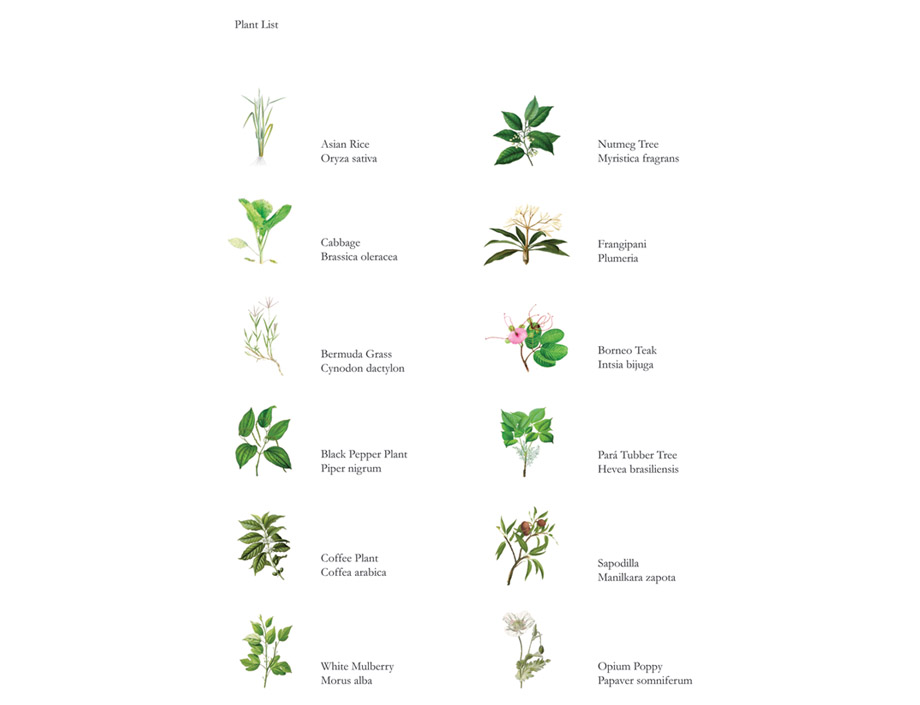
A new harvesting system emerges: bomb, gold, and food. Slash and burn creates food for 1 year and provides a cleared ground cover. After, a demining team harvests bombs by sweeping the ground and creates a safe trail for gold exploration. A micro pit is burrowed for harvesting gold. It is later used as tailing storage area during the operation of mining for a nearby patch. In the post- mining phase, if the patch’s location is within the flood plain, the pit will be flooded after remediation. Similar to those bomb craters created during the war, which have been transformed by local people into fish ponds for food, mining pits will hold water for new aquaculture. In comparison, pits above flood zone will be used for terrace cultivation—these pits will be created either during the mining operation to maximize the south-facing side or by re-sloping after the mining operation. Together with other crops, opium poppy, a major plant which thrives on the land of Laos, is used to create a new remediative regional economy.
‘Mining as Demining’ exploits gold mining companies as landscape architects. Rather than be seen as a major factor of environmental disturbance, mining processes are reconsidered. Not only are they used as bomb clearing devices, but are also re-conceived as ‘digging and reconstructing’, utilizing the by-product of mining processes – pits and overburden materials – as an opportunity to reshape the war-disturbed landscape.
For example, extremely dangerous areas, which are too arduous for bomb removal through humanitarian land sweeping demining processes, are indicated as high risk-dangerous zones by using the overburden to create double berms that barricade it. Ironically, these bomb-protected islands will function as bio-conservation areas, prohibiting any further human intervention. They are untouchable patches dispersed in this migrating landscape, indicating a history in forms of protected zones. The overburden is also used to build roads and berms that set up new aggregations around each micro-pit.
‘Mining as Demining’ re-envisions gold mining as an incubator for new economics. While the bombing operation during the war was an attempt to destroy the regional infrastructure, mining as demining sees gold mining as an incubator for bringing infrastructure back to the region and as a generator of an improved livelihood. Infrastructure, understood as a necessity for the mining operation, is constructed for connectivity and energy production, with amenities such as roads, plants and hydropower dams, as well as other basic civil institutions such as hospitals and schools. Rather than creating a single mega mining pit that requires heavy infrastructure, as typical mining operations have, mining as demining not only creates micro pits within the boundary of slash and burn patches, but it also recycles and redirects material flows; micro-industries emerge together with bomb and gold harvest. Bombs are collected, sent to local micro-mills, and melted into steel bars for the local construction of micro-hydro dams or bridges. Gold is used to not only pay for demining, or be exported by international companies, but is also used locally for religious and cultural purposes, becoming a registration of the mining and demining processes.
The project poses a new linkage between resource extraction and post-war metal cycling economies, strengthening a livelihood that heals the war-scarred landscape. Existing conditions have evolved, materials are recycled and redirected. Bombs are reused, overburden is reapplied. New economies and new industries emerge together with this shifting ground. Safer land returns. These processes re-establish an inhabitable landscape of productivity, rather than one of destruction.
MORE:陆小璇 Xiaoxuan Lu 更多请至:Xiaoxuan Lu on gooood





一席上有设计师的演讲
然而并没看懂
万恶的美帝啊。。。2.7亿枚集束炸弹。。。
将看似无关联的事情联系在一起,从利益的角度寻求安全保障和景观再造。双赢的结果可行性很强,这种广义上的景观设计可以看出设计师的视野和胸襟呢。
祝贺!老董。
很棒。有木有大图
采矿的收入能弥补资本的付出吗,资本能运行下去吗
这也可能是为什么得的是学生奖的原因吧,因为无法考虑资金运作及各方利益,实际能不能通过这个很好的概念对当地的经济生态等起到调节作用目前是无法得知的,但不得不说想法确实很好