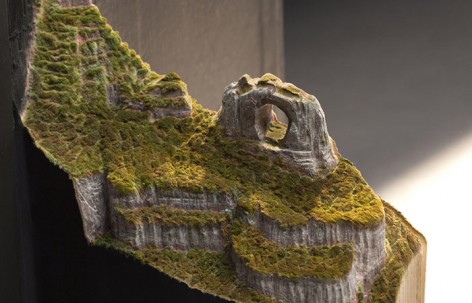
来自Guy Laramée对gooood的分享。(感谢JHB Gallery大力支持)更多请至:Guy Laramée on gooood
Guy Laramée是一位擅长在书上雕刻的艺术家,我们在过去介绍过他的多个作品,请见Guy Laramée on gooood。在这里向大家分享他最新的作品。
Onde Elles Moran (Where They Live)
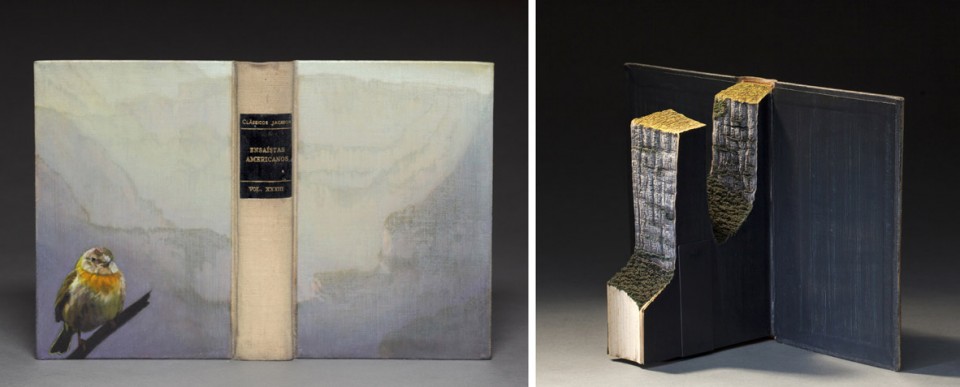
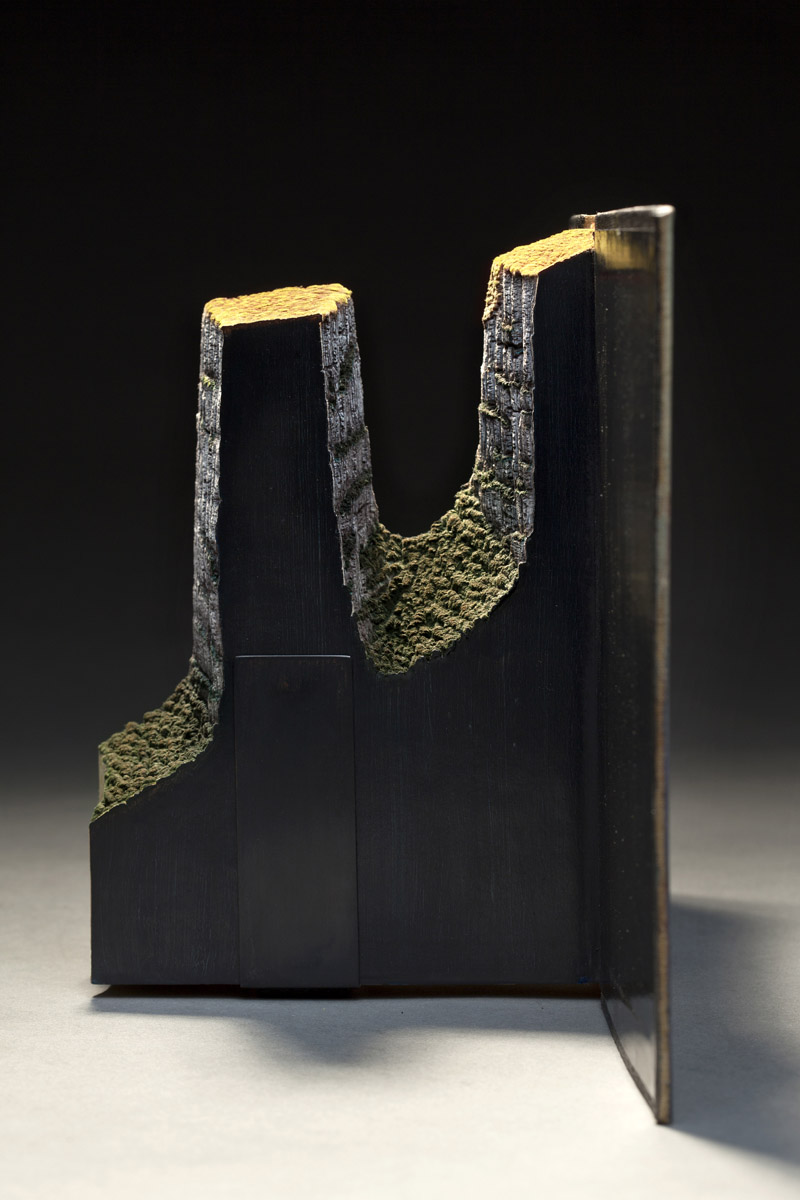
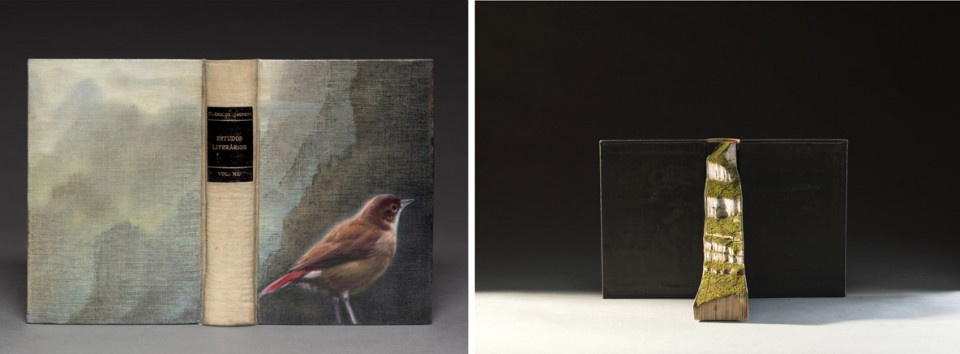
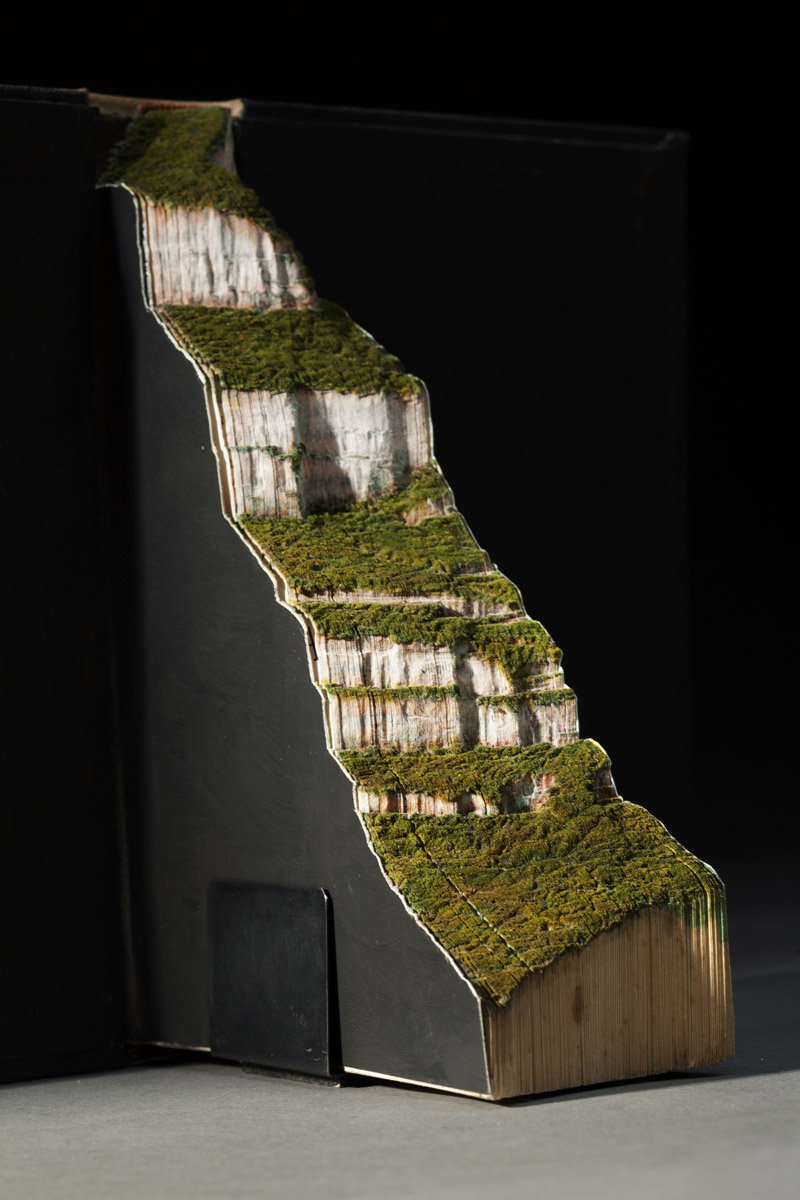
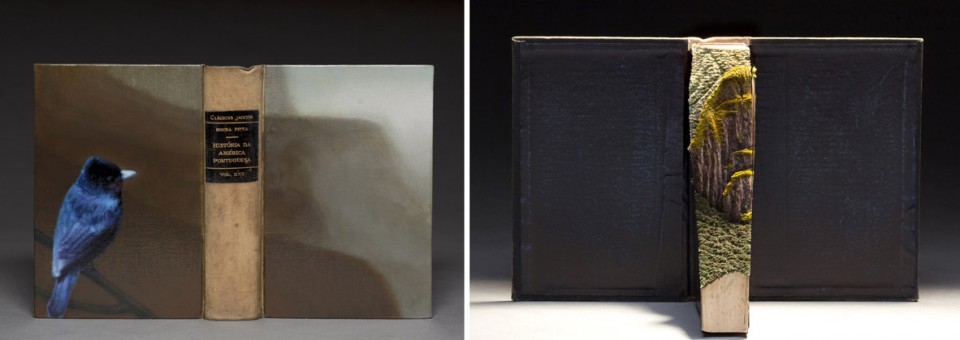
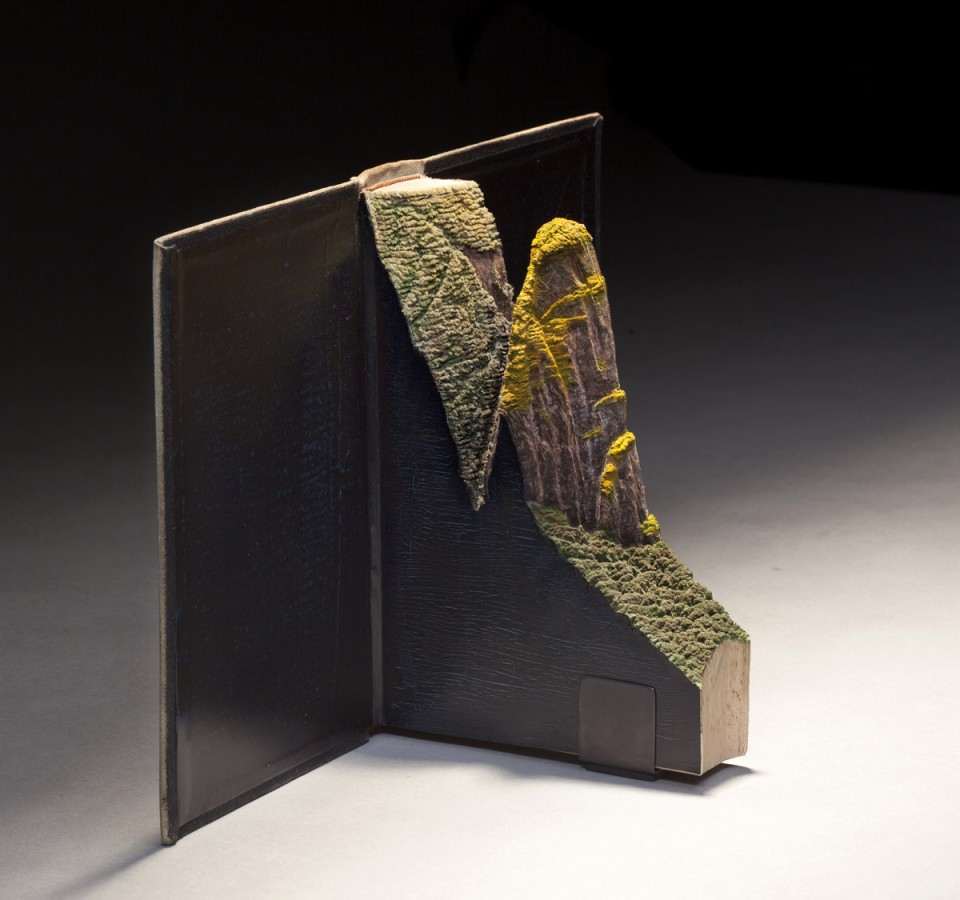
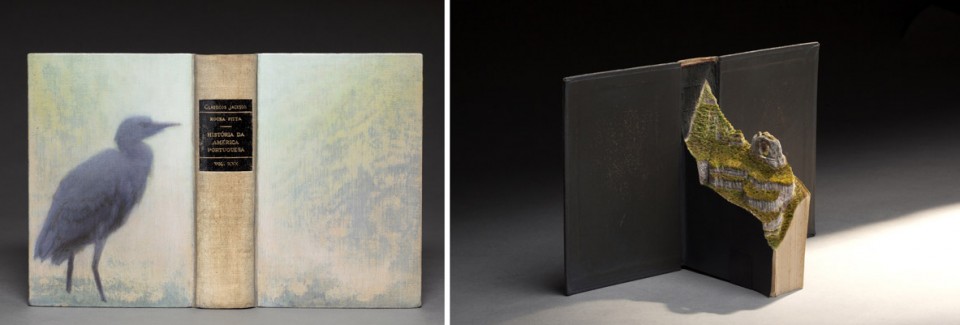
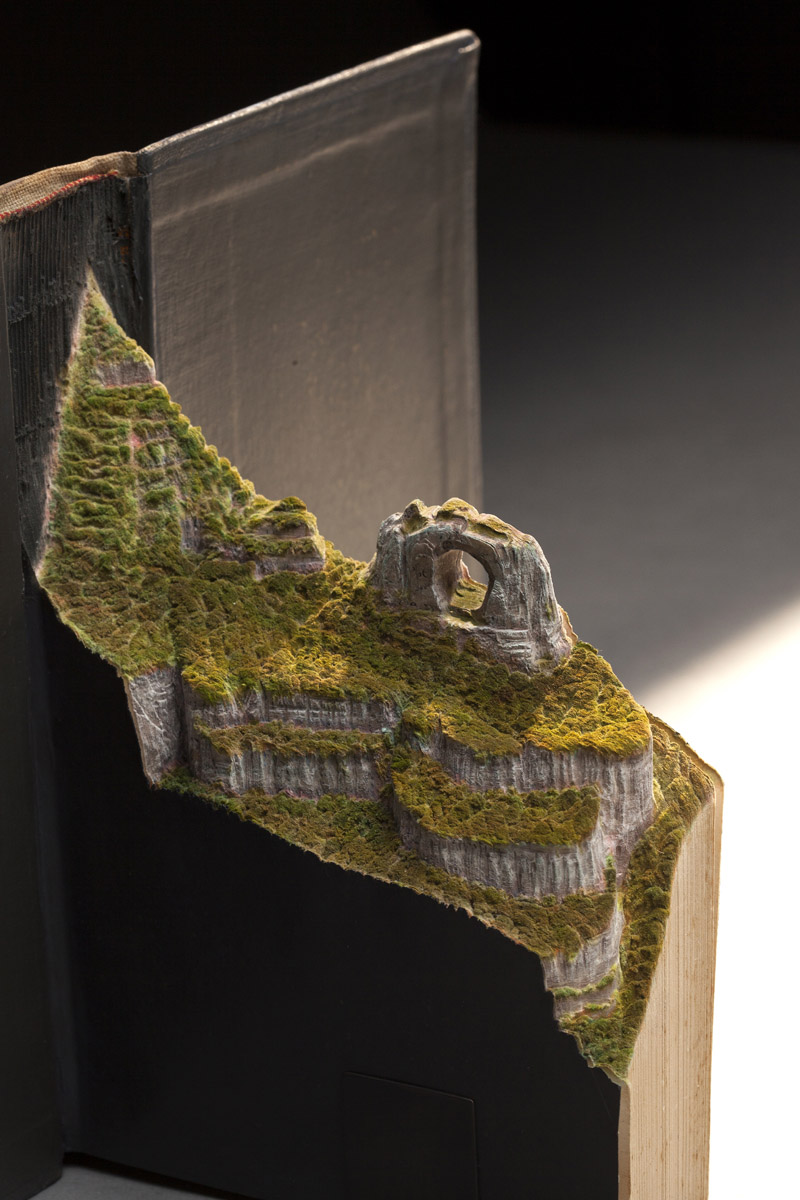
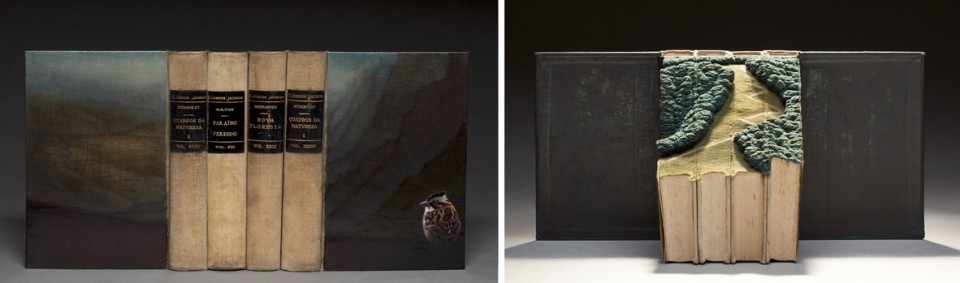
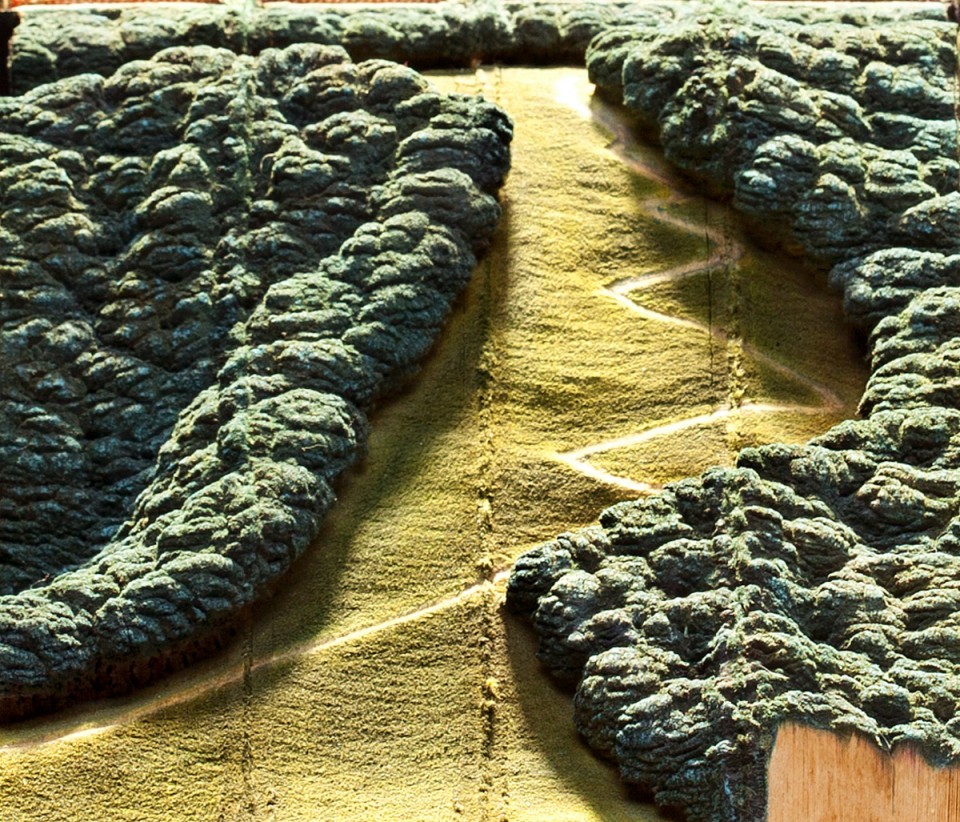
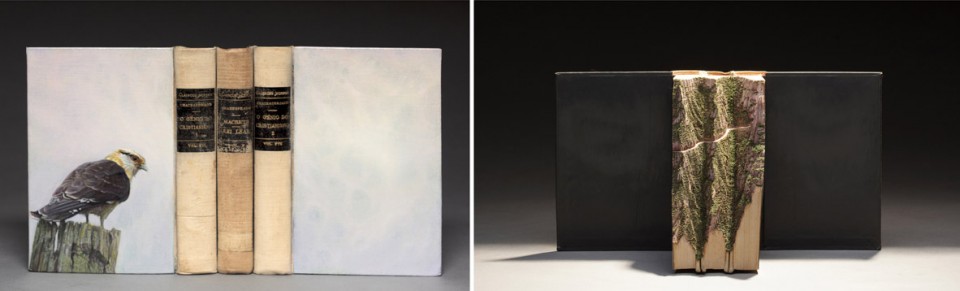
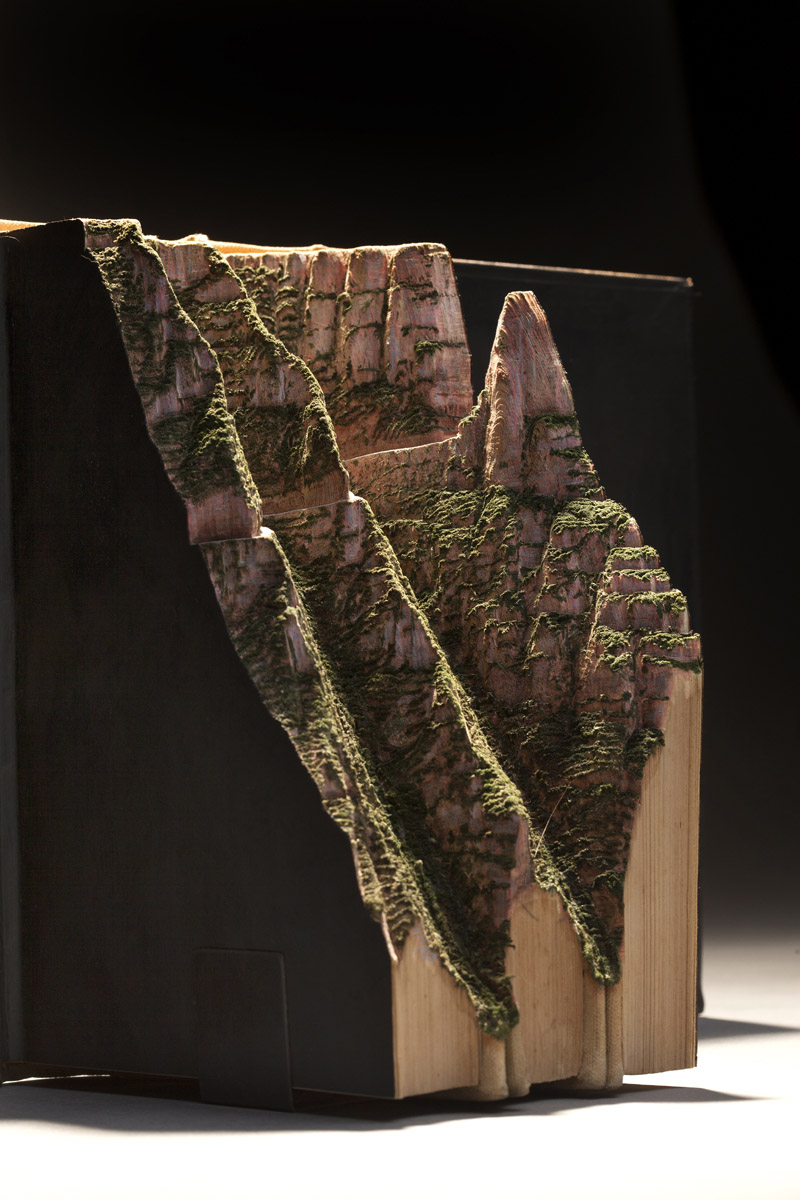
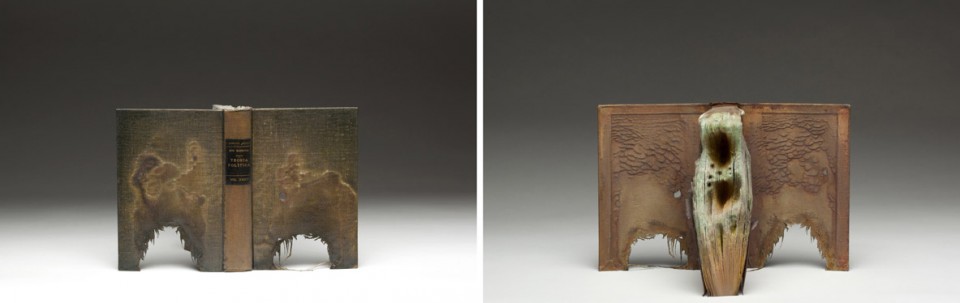
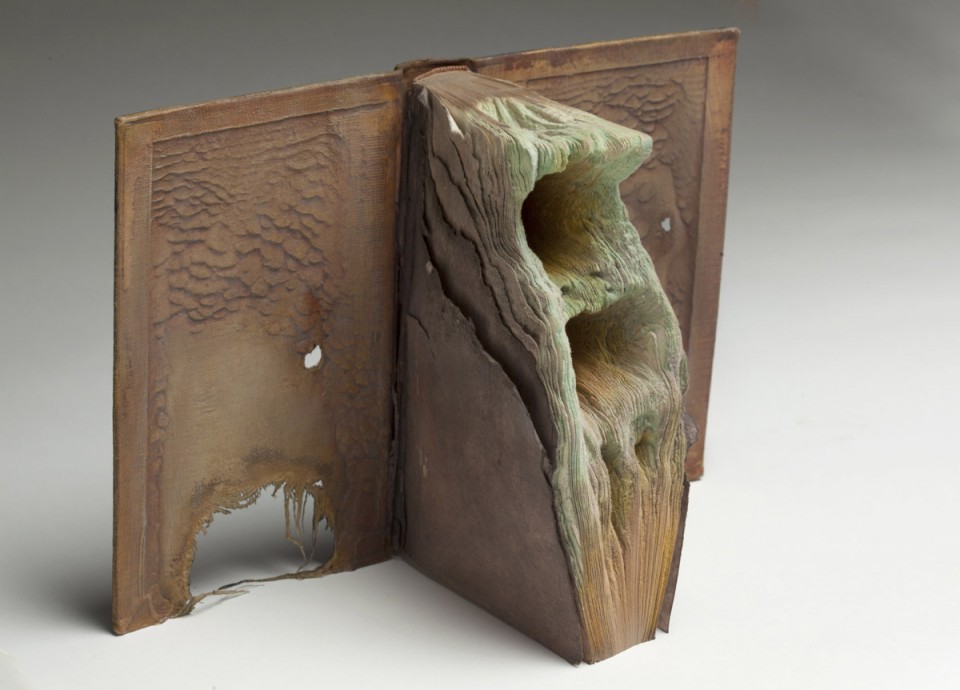
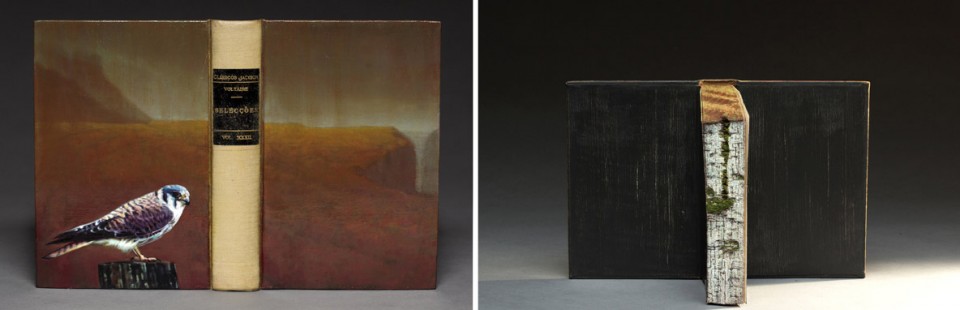
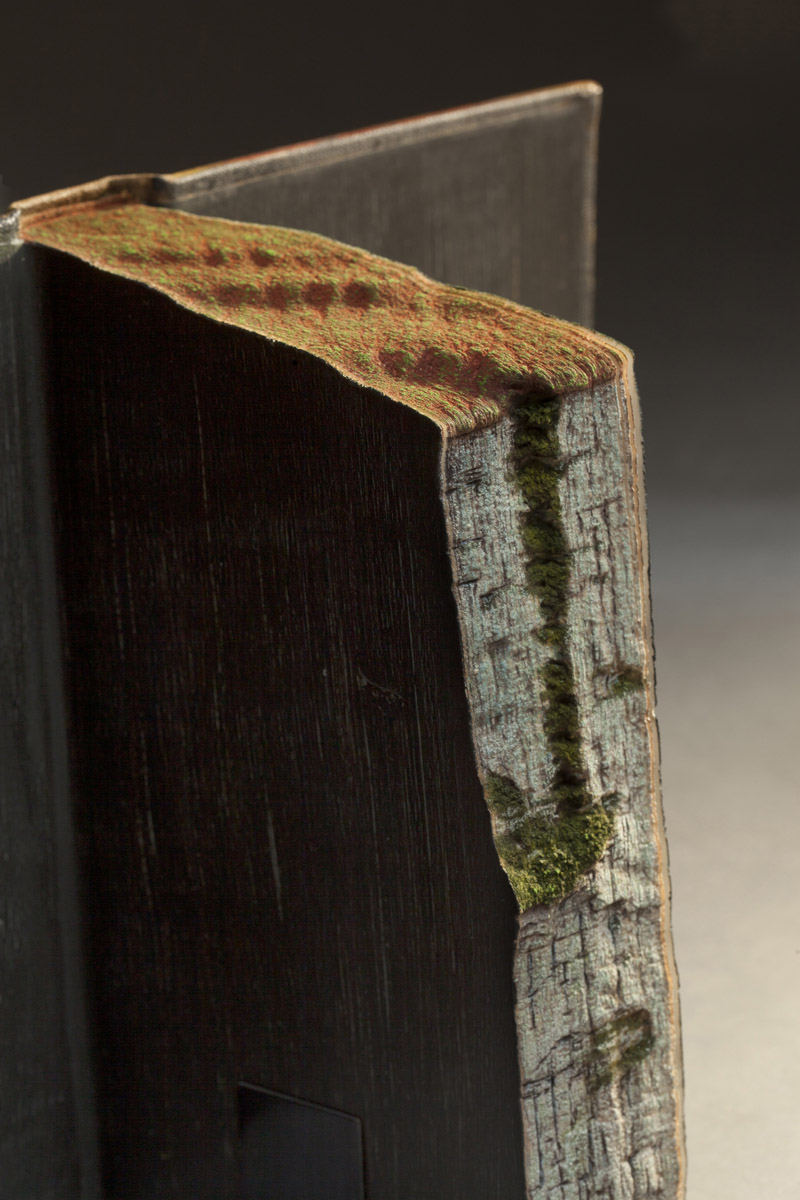
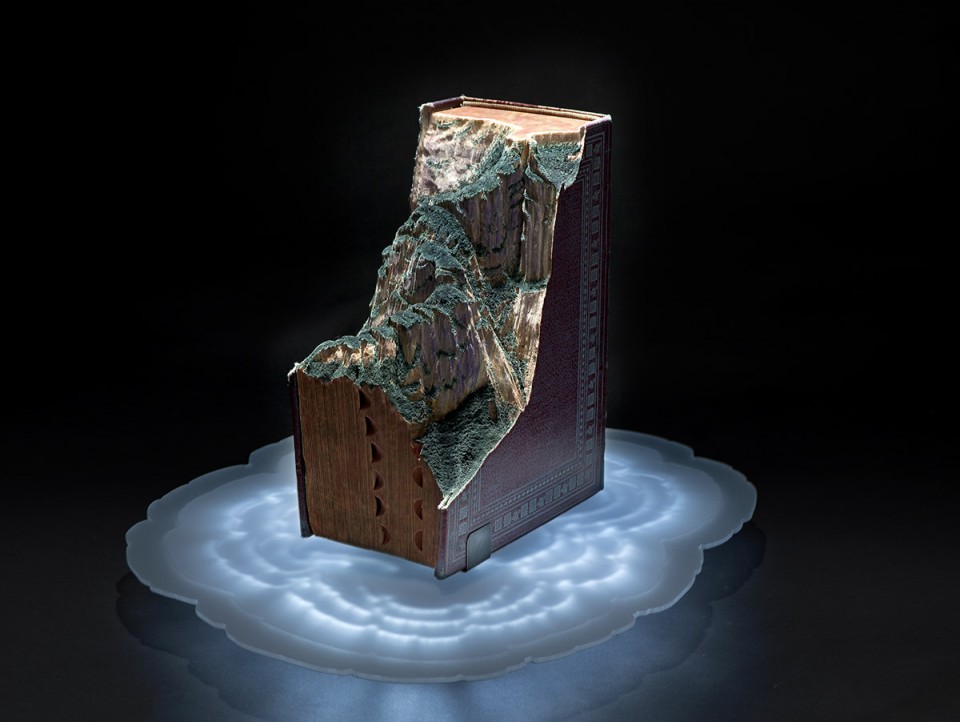
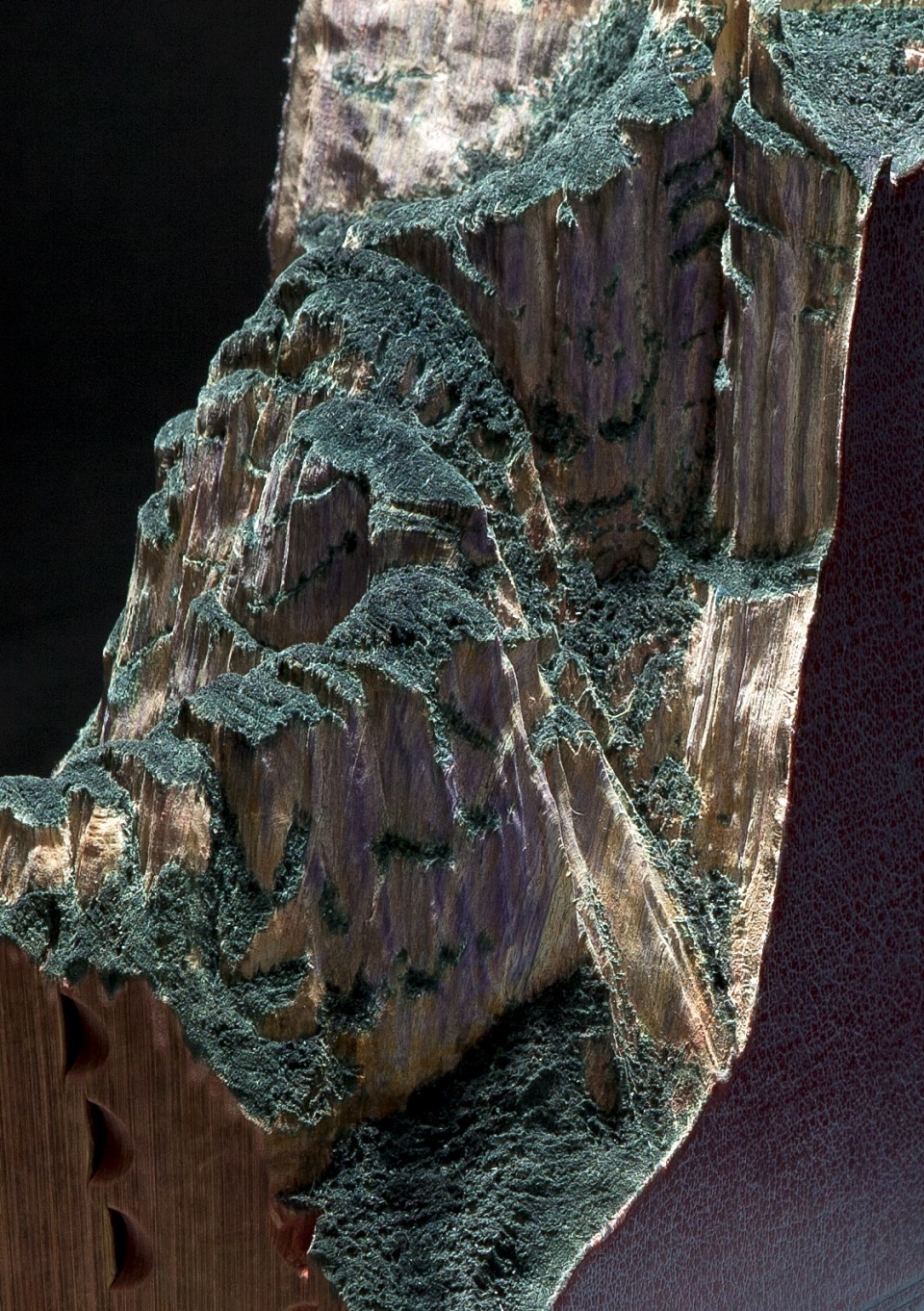
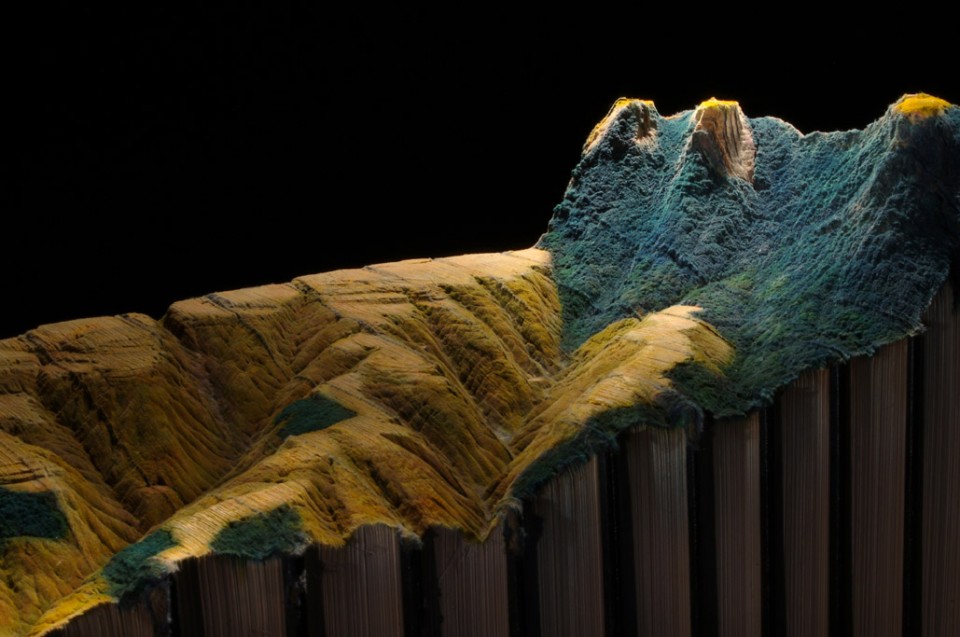
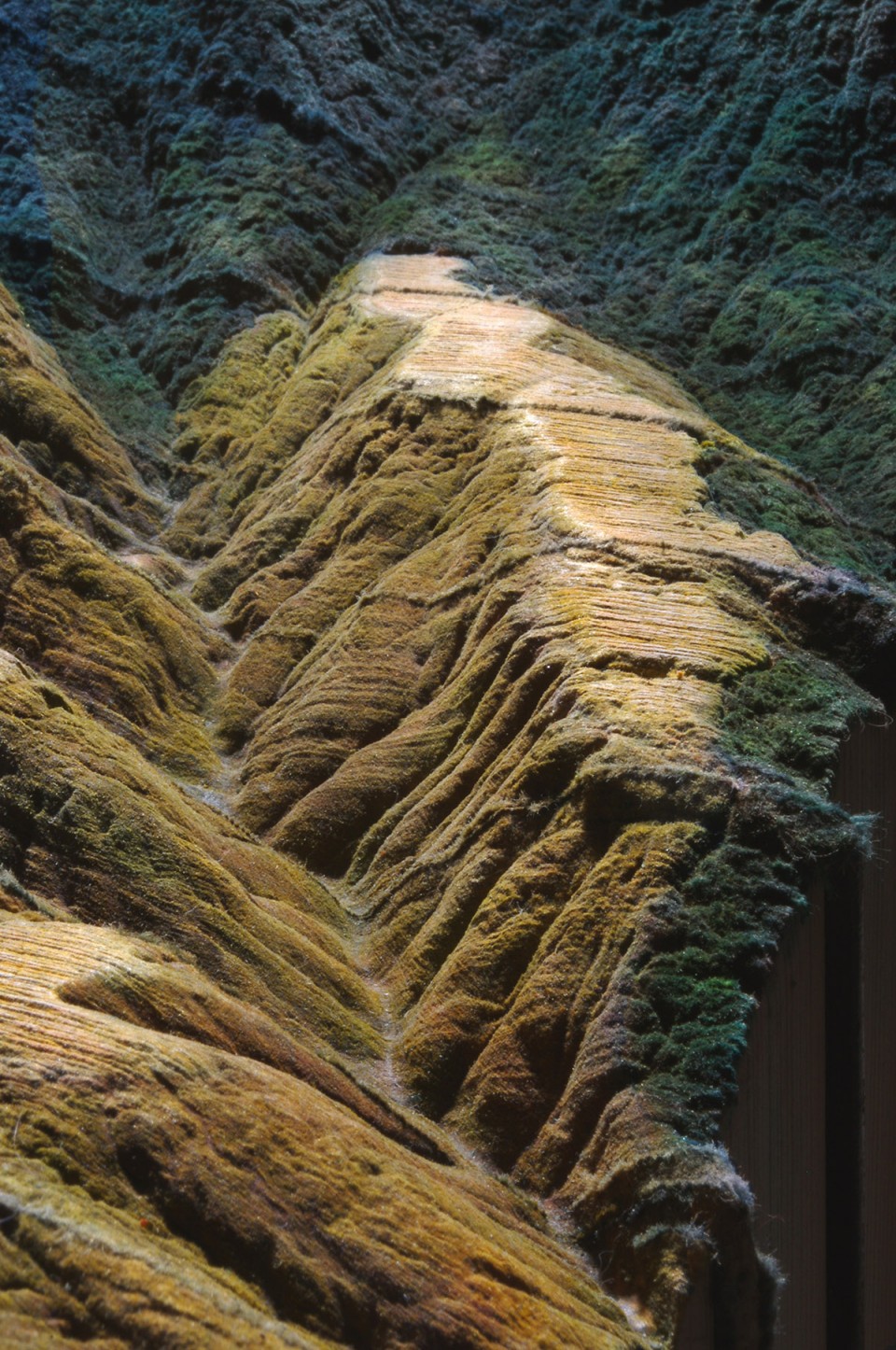
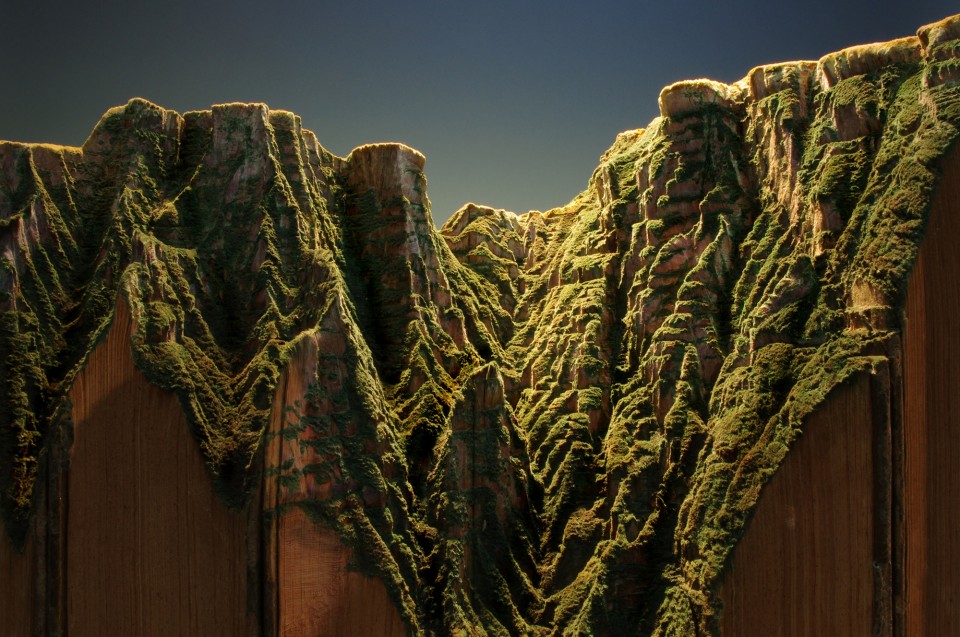
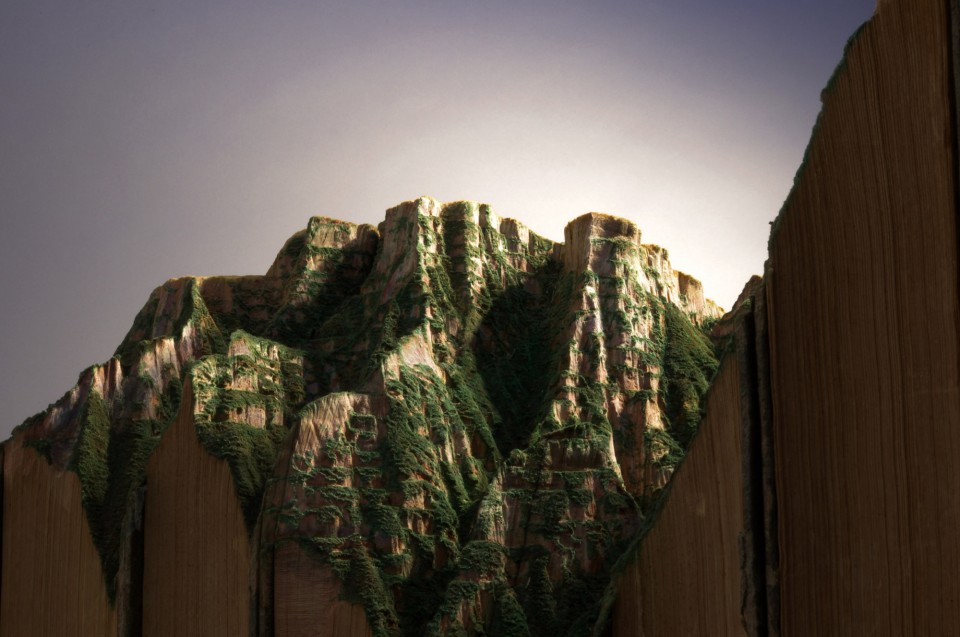
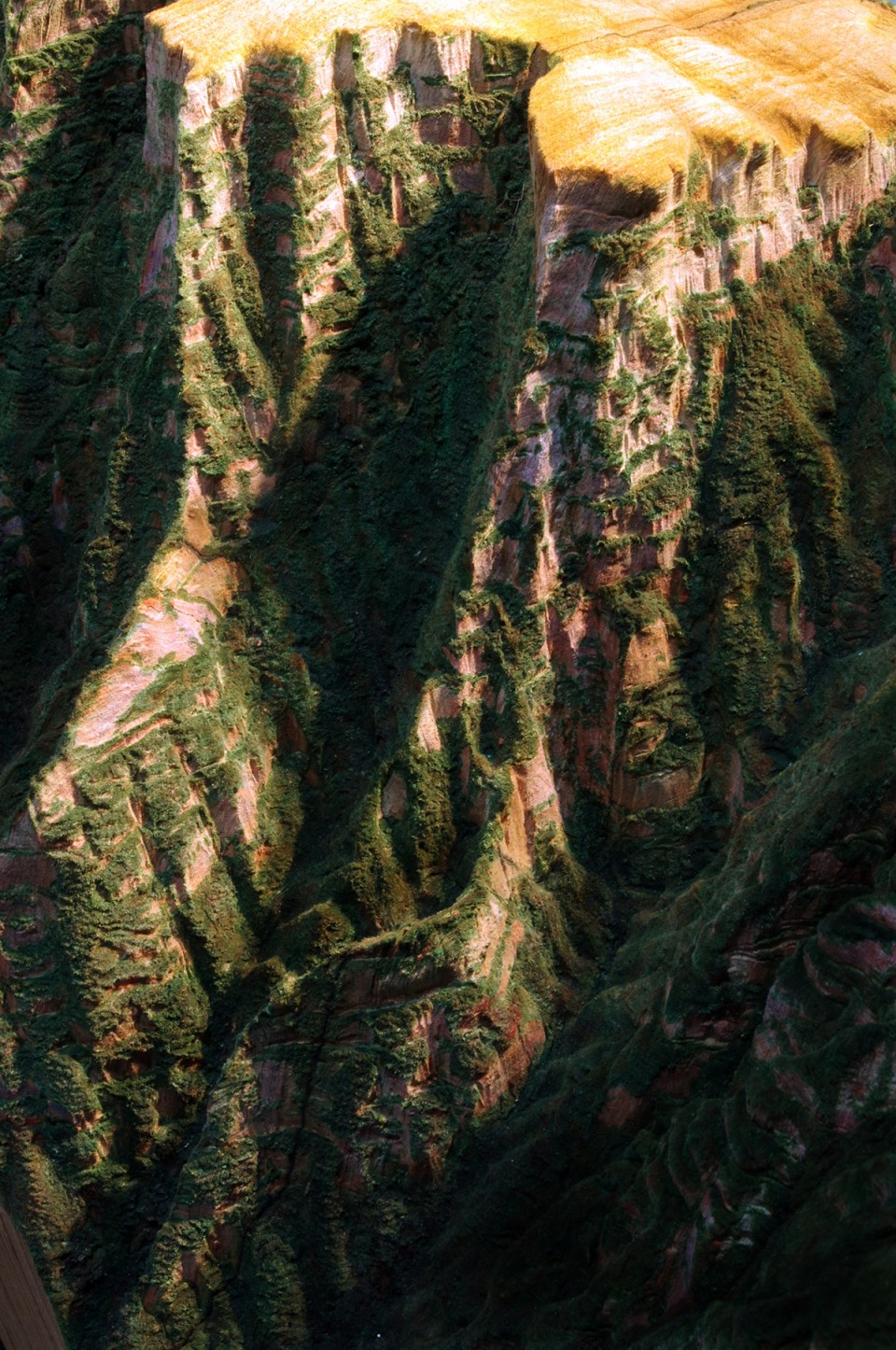
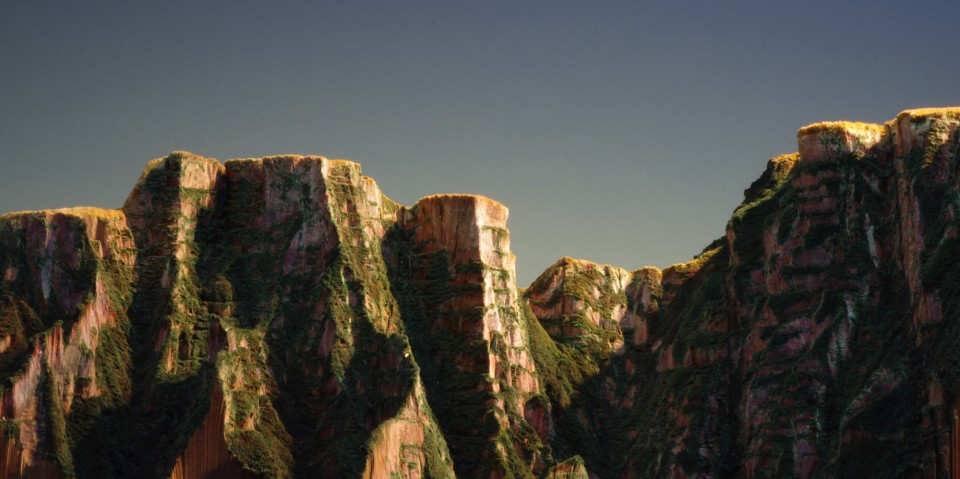
巴西南部的Aparados da Serra峡谷从高原沉向大海,落差达到5000英尺,是非洲和南美洲之间断层线的体现。这里植被茂密,拥有世界上生物多样性最丰富的生态系统。艺术家Guy Laramée到达这里,被当地鸟儿的多样化,啼叫以及活力所吸引。在大峡谷的四个月,他进行了各种各样的实地考察,拍摄了上千张照片,回到工作室后,他花了9个月时间创作了9个关于鸟儿居住地的微观书雕作品。这九个纸雕艺术品都是双面的,背面利用书壳画上鸟儿的形象和他们居住的环境,正面则是鸟儿居住环境的片段纸雕塑。
“当世界是真实的,你是梦想;当你是真实的,世界变成梦。”
通过凝视,通过想象,我们和鸟儿之间的疏远不在。处女地景观人迹罕至,但同样与我们息息相关。一位印度智者说过:“不是我们在世界中,而是世界在我们中。我们就是自然。”
This project is inspired by two trips to a region of southern Brazil called Serra do Corvo Branco (Range of the White Raven). Aparados da Serra is a specific mountain pass that is part of a hundred mile long line of canyons, where the high plateau sinks down near to sea level – a 5000 foot drop over one mile, creating a dramatic topography of crevasses and needles, somewhat covered with the dense vegetation of the Matta Atalantica, the eco system with the highest biodiversity in the world. It is said that this fault line is actually the true topographical divide between Africa and South America.
The Serra do Corvo Branco was named after a magnificent bird that lives there, the Urubu-Rei (King of the Vultures). The first white settlers mistakenly took the Urubu-Rei for a white raven. The true owners/rulers of this region are the birds – which was completely acknowledged by the settlers. Their diversity, songs, and liveliness captivated me. Over four months, I made various field trips to photograph the canyons however each time these damn birds found their way to my lens. At some point I felt that I was becoming one of them. Clearly, they had something to tell me, and this had to do with the absurdity of our tormented human condition.
I decided to dedicate this series to them and the land where they live. Aside from the months of fieldwork as well as the subsequent editing of the thousands of photos, the actual artworks took over nine months to complete.
Being in the company of these lively beings were one thing, painting them was another story. They became like ghosts on a theater backdrop, posing in front of wallpaper, looking at a vanishing scenery. They incorporated our dream, revealing the dreamer. Through their insisting gaze, the working of the miniature landscapes evolved, the magic of the Witness was revealed: no witness, no world.
“When the world is real, you are a dream. When you are real, the world becomes a dream.”
The series is composed of nine book sculptures each of which have as a central feature a two sided work: the front and back covers painted, the inner pages carved. I found the books in various second hand bookstores, in Florianopolis – the capital of Santa Catarina. They are all tomes of the Classicos Jackson, a series of literature classics published in the ‘50s in Brazil. I was greatly seduced by their rich, linen covers. The faded jade tones of the fabric inspired most of my palette for the paintings.
The series could be seen as paraphrasing Utamaro’s Chorus of Birds. In his famous 18th century accordion book, the Japanese artist used birds to portray various aspects of romantic relationships. My project heads in the opposite direction. One to one with their habitat, my birds are more like the solitary wanderers of Caspar Friedrich’s painting, allowing us to meditate upon our existential dilemma. Man and the birds do not live in the same world. One where we have transformed the world into an object, one from which we now feel alienated. True, we also live in canyons, the fault lines of passions, where, like the vegetation of the Aparados, we hold firm to the rocks of our false certainties, not to fall into the abyss of the Unknowable. We live in books. We live in our heads. (We don’t fly that often – do we?) The birds live in the ever freshness of the moment – and nothing else needs to be said about this. That’s it – they live in the place where nothing else needs to be said. And yet they sing. Maybe where they live is where we should live.
In the solitude of virgin landscapes, we might rediscover our intimate relationship to the world. In this intimacy we may see that we were never cut from what we call nature, even when we transform it. We are not in the world, the world is in us – an Indian wise man once said. We are Nature.
Les livres-lumière
ADIEU
BIBLIOS
THE LAST BOOK
Guy Laramée
Translated by Richard Simas
Once upon a time there was a tribe that collected words. They were named « Biblios ». The Biblios had all sorts of words and when some were lacking they made up more. For example, someone woke up one morning and said « software » and presto, a whole family of things appeared, each one with it is own first and family name.
THE BEGINNING In the beginning, the Biblios needed to repeat words incessantly so that they wouldn’t die. You would often see them seated on a corner repeating, « table, table, table… » and so on and so forth for hours on end. Or while walking, because the Biblios walked a great deal. They made long pilgrimages in order to hear their neighbors’ words. When they were lost, they returned to the beginning, sat down and repeated their name like an incantation: « Biblios, Biblios, Biblios… » Then the Biblios put words to song because repeating words while walking around like that is a little ridiculous. One day the magical idea of writing the words appeared. As simple as that, a Biblios said, « Write! » and writing was born. Writing was useful. For example, one could leave notes at home. At least that’s what the Biblios thought at first, but then quickly realized that the words continued to turn in their heads. At any rate, the whole business of leaving things at home started long ago. Of course, it was first necessary to invent the word « home ». Just imagine, before words existed the Biblios didn’t even know they were nomads. They didn’t even know they were Biblios. They just were. No more, no less, and even at that one wonders if they knew. Knowing that you are or being what you know, that’s a huge question. So, the Biblios had found words and started collecting them. The Biblios had the impression that words could capture the spirit in things. The Biblios were animists and believed that a spirit resided in each thing. In fact, for them nothing existed without a spirit: no table without a table-spirit. And so, leaving for a trip or simply on the way to work each morning, one carried along the spirit of things that one was going to need.
LIBRARIES The Biblios stacked their collections on shelves that they named « Libraries », which meant « Biblios shelves ». As the words and strings of words increased, they expanded their collections that grew and grew until they needed another collection, the catalogue. A catalogue is a collection for finding your way in the collections. The Biblios, now passionate about their collecting, realized that the true nature of a collection is to never be complete. That’s what makes collections passionate. It’s what also makes them worrisome.
LIFE WITHIN THE BOOKS As a result of such word collecting, the Biblios had erected imposing libraries and there was little place for anything else. So much so that little by little, life in the books was naturally imposed, like a natural consequence of a natural passion for words. There’s not much to add to that other than that books are good insulation and help for keeping warm during the winter.
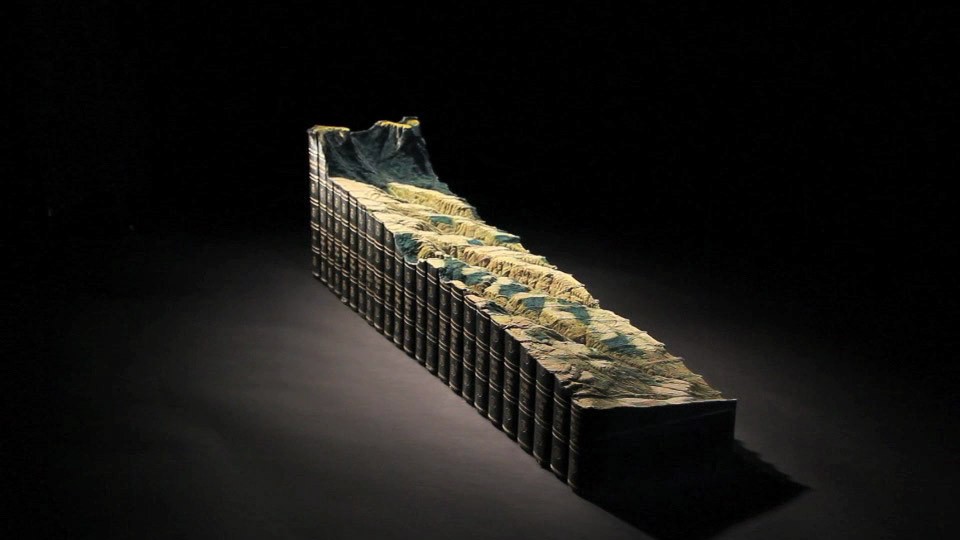
TUNNELS The Biblios were such word fanatics that they took to excavating books in order to connect words from one to the other. In this way, connecting Cyclopes and pedestrian, they invented the word ‘encyclopedia’ which originally meant « walk within, using only one eye ». It’s all because the Biblios walked a great deal. They walked in the tunnels that they dug in books to connect one word to another. Over the years, it was thus that they developed a vast network of passages. However, having dug deeply, the books they lived in threatened to cave in over their heads. One must remember that in Biblios mythology, the head, essentially empty in order to store things as desired, is particularly fragile. In order to protect their heads from the frequent cave-ins, the Biblios had to distance themselves by digging new passages. Digging, which was at first a passion, now became a necessity.
THE HEAD After all the stacking of words on the shelves in their libraries, the Biblios came to believe that the head was also a little portable library in which you could stack words in order to leave things at home. Since the Biblios were not stupid and they knew perfectly well that the head was too small to contain shelves, they dug through the head for several years in order to understand how it could all be contained in such a small space. Most importantly, they wanted to know how it could remain in order, despite the body’s movement and things like foot races. But thanks to forceful research, they found out. They had developed a very sophisticated concept of the head’s interior workings. In that concept, a kind of small box served as a shelf, in fact a tiny apartment called a cell. But the Biblios knew very well that there where cells everywhere in the body. In order to distinguish them they named these head-cells « neurons », a word which originally comes from « nun », a person who lives in a cell. Little by little, it was this vision of their head which led the Biblios to develop a theory of the soul, a word which literally means « interior of the cell». But before opening that door, we must talk about another troubling aspect of the Biblios psychology.
A HEAD Having discovered that words allowed one to leave things at home and that words also allowed you to carry along the essence of things without the burden of their weight, the Biblios started collecting words in order to carry as many things as possible along with them. But oh surprise! As words created new things, the more there were, the more words were necessary! The more words, the more difficult it became to store them in the head. It became necessary to put them in books and put the books on shelves on domesticated altars called libraries. (That’s all been said earlier, but you have to repeat things often for them to exist). Increasingly skilled and passionate about collecting, the Biblios began to worry about their collecting. In fact, a few times curious neighbors dug holes without asking permission and when opening a book, people were found sleeping there. From time to time, it was even possible that someone had stolen undesirable words and left them in the place of words they had eaten, a potentially intolerable situation. At any rate, as years went by, the Biblios became obsessed by death. In fact, what would happen if an important part of the collection just disappeared? And first of all, what did that mean, « disappear »? Even by verifying the etymology and trying to remember what they were thinking when they invented it, the Biblios couldn’t make sense of the word. Originally signifying « cut the apparition in two », the word « disappear» became a well of anxiety. « Disappear, yes, but to go where? », the Biblios asked themselves. Most of them had resolved the problem in thinking that the collections that disappeared went off to another, yet even bigger library somewhere in the earth, possibly in the Center of the Earth. The Biblios believed they lived in a great book and that their personal libraries were only a tiny part of the Great Library. THE Great Library. In fact, the Biblios developed such an obsession for their collection that they began to duplicate the books for fear that losing one copy meant losing the original. Since paper-books, even duplicates, were still too fragile, the Biblios began looking for other formats. And they found something. So, several in the group began to labor at engraving the words in aluminum grooves. These iconoclasts believed that aluminum could protect against unruly digging. However, a sober evaluation was required: even in glass mummies called “coffins for dictates” – (in French Cercueils de Dires – or CD), even in a CD, the words died. Little by little, the Biblios observed that words perished not only because of the digging. Of course some words disappeared because you couldn’t find them anymore on the library shelves. But lots of them died because they aged…! Words were like biological beings: they were born, lived, and died.
DEATH, continued This was all troubling for the Biblios who hoped by their collecting to escape their own death. Big surprise, there was no way around it! Everything died and with them the words that had been the receptacle of their essence. What to do? No choice but to continue. Continue to invent new words. Some of them began thinking that by increasing the birth rate you could outsmart death. By creating new excavating technologies you could improve human destiny and control the aging of culture. In reality, nothing was less sure. The more words they created, the more deaths were numerous. It was obvious that the Biblios were prisoners of a viscous circle: endlessly creating new words to replace the dead ones and, as a consequence of their excavating, destroying their collection forever. The more they created, the more they destroyed and the more they destroyed the more they had to create.
HOPE But the Biblios wouldn’t despair and they kept digging. Each day they discovered lots of things and that gave them the desire to live. Even if excavating meant getting closer and closer to death, the Biblios kept hope. Proof is in the impressive network of passages that are now visible in the Biblios excavations. Where did they find such hope in the face of death? We don’t know yet, but scientists are hoping to discover this in the near future.
GOD The Biblios had a god and that god had a name. One day a Biblios cried « Word! » and pow! God was born. Word: so the Word which contained everything, so the Word amongst all words. Since the beginning of time, the Biblios had been searching for paradise and they looked for it in words. They wouldn’t find it there, but you have to start somewhere. Words, there are so many and how to find the unique one within a pile? They had invented the word « unity » as a symbol of this paradise, but even this word began to multiply: one, union, unique, unify, uniqueness, uniform, unisex ». General vexation amongst the Biblios: there was not one unity, but many! Wow, what a mystery! The Biblios dug deeply in the head for several centuries to resolve the enigma.
MYSTERIES The Biblios’ favorite sport was penetrating mysteries and many a Sunday was spent doing just that. Making a hole in the middle and waiting for them to arrive could easily penetrate mysteries. There are tons of mysteries, starting with this, « What is a mystery? » When one hole is not enough, you just dig another one, and a third and so on and so forth until there is no more space to penetrate. When there is no more space to penetrate it’s like the mystery has disappeared and you go looking for another one.
THE MEANING OF LIFE The Biblios were divided into two groups. There were those who dug horizontally and those who dug vertically. The Horizontals covered a lot of territory but their words lacked depth. The verticals found fewer words, but their words were more penetrating. The Horizontals owned all the land but they knew little about it. The Verticals owned nothing, but that nothing was all theirs. It appeared that the Verticals depended on the Horizontals for their survival. But in truth, the Verticals were extraordinary aesthetes who could nourish a whole life with a single word. One day, a small splinter group tried to dig diagonally, but their tunnel ended up in a cul-de-sac. They had to back up and finally went into exile. They were not made for word games. It is believed they founded a sect called the Softies.
HARD AND SOFT The Biblios invented words because they were less rigid than things, but their words ended up becoming as hard as things. It was such that the Biblios came to take words for the things themselves. And so, when they said « table », they were convinced they were touching a real table. The only way out of this mess was to decorate the words. Thus, « table » became « tabled » then « tabling » then « tablemate » then tablation, tablary, and on and on. But in truth, it solved nothing. To the great despair of the Biblios, words were no longer liquid as before. Sooner or later they would harden and once that occurred they would begin to crumble. The softeners wanted to soften the landscape, some by tromping it with their feet others by kneading it with their hands. Still others started chewing it, and thanks to them that we have a renewed interest in oral traditions.
THE MEANING OF LIFE 2
The Biblios excavated books in search of the meaning of excavating books. It sometimes happened that the Biblios would forget. Right in the middle of a hole they would forget from where they came and where they were going. Then they would sit down in the middle of the hole and wait. Wait for it to come. For what? They didn’t really know what they were waiting for. Sometimes nothing came and they just waited there. It’s believed that some are still waiting.
ART
When they were lost, the Biblios sat and waited for it to come. Once seated, they felt less lost because they could always have a look at the walls. Watching the walls, they sometimes began to see things. As they saw things they sometimes desired to draw them and this is how cave art came about (from cav, which is also the root of cavort, caviar, cavalcade, and caveat.) Once they were seated and waiting for it to come, their tunnel would become a grotto and from that grotto they made a house and then a temple. For a brief moment they were in the middle of the world and one didn’t have to look elsewhere to know if it was true. It is told that a number of Biblios stayed there for the rest of their life, in the same place, contemplating the walls and drawing on them. They lost all desire for sleeping or eating. It’s told that some of them even conquered death because they came to understand that they had never been born. They believed they understood that after all, life and death were just words.
THE HISTORY OF WORDS
The Biblios had found an ingenious and economical system thanks to which they could tell the history of words…with words…!
EXPLANATIONS
The Biblios adored explanations. They collected them with great care. They had explanations for everything: word-length, height, why some words go better together than others, how many words were necessary to make a true statement, etc. As such, one day, it had to happen eventually and in their place you would have done the same thing, the Biblios wanted to EXPLAIN EXPLANATIONS. Before going any farther it’s necessary to explain the word explanation. (Afterwards we will discuss their implications) The Biblios fabricated this word out of two words: « ex », outside, and « plain » which in dialect means to flatten. «Explain » then means « flatten outside ». It’s the opposite of implicate which means « flatten inside » (n.b. the root plain and plica come from essentially the same sources, though surviving consonant transformations for unexplainable reasons. Ed.). The Biblios washed their words indoors, dried and folded them outside. One can immediately see the implications: the Biblios began folding words, one by one, fold after fold, and little by little as in the best of families, the words began to fold into themselves. Words were no longer sweet rosebuds perfuming the fresh morning air. They were no longer windows open onto the world. Words became grumpy, scruffy, and holed up in their own stinky little nasty world.
Be that as it may, it’s important to say one thing. This is only one version of the story. There are people who explain the word explanation in a totally different fashion. They say that the word explanation means the absolute contrary: un-flatten, open. Their explanation isn’t stupid, but it’s still an explanation…
QUESTIONS «What is a question?» is a question that preoccupied the Biblios civilization. In fact, what is a question? That’s the Question of all questions. WHAT As we said earlier, and if we didn’t it is time to do so, the Biblios were searching. What were they searching for? Well, they were searching for What. For example, one day a Biblios cried, « I’ve found it » And his neighbor asked, « You found What? ». Finding What was the only thing that really mattered for the Biblios. Of course they had hobbies, bills to pay, and all sorts of other things. But What was included within all that.
HOW However, if we are going to tell the truth, and we will, it must be mentioned that a group of Biblios were concerned with HOW. How is that? Well, as a matter of fact it is important to say how for them that question came to replace the search for What. How to understand the word « how »? Well, they asked themselves how? If we continue long enough, we will find out. Find out What? Ah! These were the terms responsible for a raging debate that went on for centuries. The What camp thought definitively that the How was a subterfuge that they always ended turning into a What. The what of How, what? The How camp said to the contrary, the true How is the How of How. For them, truth was a verb and not a noun.
WHY So, there was What and How, but there was also Why. The why was a particular class of What. It was the What just before it became a verb. With Why, one had the impression of touching the heart of the matter.
THE HEART OF THE MATTER « The Heart of the Matter » is the dogma that summarizes all of the Biblios philosophy. The Biblios were searching for the What and when they found it, they touched the heart of the matter. It is unknown whether this was a gesture with religious significance, a sign of affection or recognition or simply an ordinary and practical way to keep What from escaping.
TECHNOLOGY There were the Horizontal Biblios who knew everything and yet very little; the Verticals who knew very little but were very specialized. There were also the Biblios obsessed by What and those obsessed by How. And there was Technology. One day, the Biblios realized that they were becoming a little obsessed, in fact very obsessed, with this issue of WHAT, «What, What, What » all the time. It got to be a little obsessive. That’s obsession: when things get to be obsessive. It was thus that certain Biblios switched to How. It’s a complicated story because it gets mixed up in the story of the Horizontals and the Verticals and after a while it all becomes difficult to unscramble. At any rate, a handful of Biblios, very few in the beginning, decided to look for How instead of What. So they took to repeating « How, How, How » incessantly like that. Because as we said, the only way to know How is to know How. Just as a minor detail, because it’s often overlooked, it’s from the word « How » that we derive the word « howl » which means « How to say « How ». Anyway, through all the efforts to search for How in searching How, the Biblios developed an array of tools, all equally useful. The tools were able to do all sorts of things but after a time the Biblios found themselves making TOOLS JUST TO MAKE TOOLS!
TOOLS In their escape from What, the Biblios found themselves completely trapped in How. And How! By searching How, they started making all kinds of tools which in the end were only useful for making more tools without knowing How. All of this happened because of technology. Technology is useful because of all the things you can do with it. In fact you can do everything with it. But the problem is WHAT. DO WHAT? « Not important » said the new Biblios, the TechnoBiblios as they liked to be called. «What’s important is doing. What’s important is discovering new horizons, conquering new territories, doing things that no one has ever done before», etc. etc. The TechnoBiblios were fairly convincing, so convincing in fact that in the end they convinced everyone.
WHY But the « How » period of the Technobiblios was only for a short time. Sooner or later it was necessary to return to What. Little by little, the return to What movement was called the «Movement-for-What/Why ». Day after day the movement grew in strength and offices were opened everywhere. It was like a fever. An extraordinary breeze of renewal shook the books and the Biblios civilization could now hope for survival. The MOVEMENT–FOR-WHAT/WHY enlivened the fires that were thought dead, recruited the young and old alike, women as well as men. It was a hymn to life, and it is reported that this revolution was the Biblios’ greatest achievement. But one day it all began to unravel. There was a handful of fanatics that started asking Why of everything. They started violating the taboos. They asked Why to questions that had no answers. And what had to happen, happened. Their group became so numerous that the whole population stopped digging. Everyone was asking « Why » just like that, for no reason, all day long. Why this, why that. It was never-ending, and it undid the Biblios civilization. It was impossible to advance. All exits were blocked. The tunnels filled with Why liquid which stained all the books. There were Whys everywhere, in graffiti, on the walls and ceilings. There was no respect for public property, and above all, there was no more respect for the Secret.
THE SECRET The secret can’t be told and that’s what’s so exciting.
LIFE AND DEATH In spite of all the struggles and doubts about the big questions, Life and Death was the only important thing for the Biblios. We still have a beautiful text from this last period. It goes as follows: « -Why do you do that? » « -To resolve the enigma of death. » « -But you know very well, you can’t resolve the enigma of death. It’s death that resolves us. It’s death that resolves the enigma of life. » « -So be it. Then I do it to see death resolve life. » « -Why not look at it instead as life resolving death? » « -Your words are already dead. » « – But I just gave them life again. »
REPRODUCTION In Biblios, things died faster than desired and in order to prolong their life, they looked for the What. But the What of something (or an individual, of course) was in a constant state of flux. It was very disturbing. So, when the What of something changed, they found another one as a replacement. Most of the time, the new What was added to the old so that after a while the thing wandered around with a whole pack of Whats hot on its tail. It all became very oppressive but it was the only way to finally bring everything to a stop. You have a good idea about what happened next. A few of the Biblios, not all of them, wanted to free things from the pack of Whats. They told each other that things were going badly. If to define an object you constantly had to excavate to find the Whats, it was crazy. The rebellious Biblios declared that either they find a single What for each thing or they stop looking for Whats. They had already tried the first option with no success. One What always brought on another. A What is always a cluster of Whats. That left the second option. So that’s exactly what they decided, to stop looking for the What of things. That’s what caused the catastrophe.
THE CATASTROPHE One morning before dawn, it all started with a dim noise that grew louder and louder. The noise became a vibration then a trembling and finally a quacking. The stacks in the Libraries began to fall one after the other and then it was whole floors that buckled and finally the Main Menu collapsed. It was 10:30 am. That’s it. That’s what happens when you stop to search for What.
THE APOCALYPSE The Biblios knew that the words would end one day, but they didn’t know when. Each day they produced crates of new words in order to slow their own destiny. Paradoxically, by anticipating the apocalypse they slowed its arrival. Telling the story of the end of words with words, what a brilliant invention!
THE CATASTROPHE, continued
But it’s necessary to explain the true What of the catastrophe. No longer seeking What, the handful of intrepid Biblios met « the Hole » for the first time. The true Hole.
THE WHOLE
What’s a Hole? Well, a Hole is nothing with something around it. There are various kinds of holes: round, square, deep or shallow etc. None of this really gets us anywhere, does it?
A LAST HOPE As their world slipped through their fingers and they could no longer put their finger on anything, the Biblios made a final attempt to save their collection of explanations. They searched for the Explanation of Explanations, the magical antidote that would keep the explanations from destroying themselves. The thought they found it: « The What could be Said; the How you had to Do ». But it was too late.
THE END. It’s generally agreed that the Biblios perished under the weight of their knowledge. The Biblios left no survivors. Any similarity with existing peoples is pure coincidence. From this perspective, there is no continuity in the story, no link between them and us. Some think that certain Biblios were able to escape the collapse of their Library via an escape tunnel. According to this point of view we are the descendants of Biblios and thus there is continuity. Other researchers think that Biblios never existed and that its possible to make up all kinds of stories with words.
English Text: Guy Laramée & Richard Simas
Chinese Text: gooood
MORE: Guy Laramée,更多请至:Guy Laramée on gooood







心动的感觉
有种书山有路勤为径,学海无涯苦作舟的意境
酷瞎了!!!!!!!
毁书不倦
完全可以以假乱真。拍出的大片要说是实景我绝对相信
太酷了·!
牛逼啊,要是有攻略就好了我也想做一个
完美复刻了山体的形态颜色,大爱!另外,通过观察好像没发现书中的字迹,不知是用颜色盖了,还是本身就是空白的。
好精致啊!还以为是真的山峰呢!
大爱,又有新作了!
书本细细的毛毛 凸显出山的机理 太好看了
好逼真!
入微,很不错的作品
太棒了
很厉害,但是太不环保了吧
中国所有学生一人少做一张卷子都做多少这种雕塑了,闹麻了
虽然很厉害,但是这样浪费书,我看他用的书看起来都是老书,不知道老书本身是否有价值
应该是作旧书,都是空白页,而且真的老书纸质估计太软,没有人造的容易出效果。
应该也就是仿老的书,不是真正有价值的那些老书
关注点不一样哈,还是创意难能可贵
不缺老书 缺创意
山水画。
厉害!
哇……