海外存知己,天涯若比邻。
在海外专辑分享海外华人的故事。
希望这份分享可以让世界更加海阔天空。第三期为您奉上的是在英国伦敦工作的郦娜:
在国外经历印象最深刻的事情?—–
最有意思的是我刚来英国的那一年在一家老人院打工的经历。
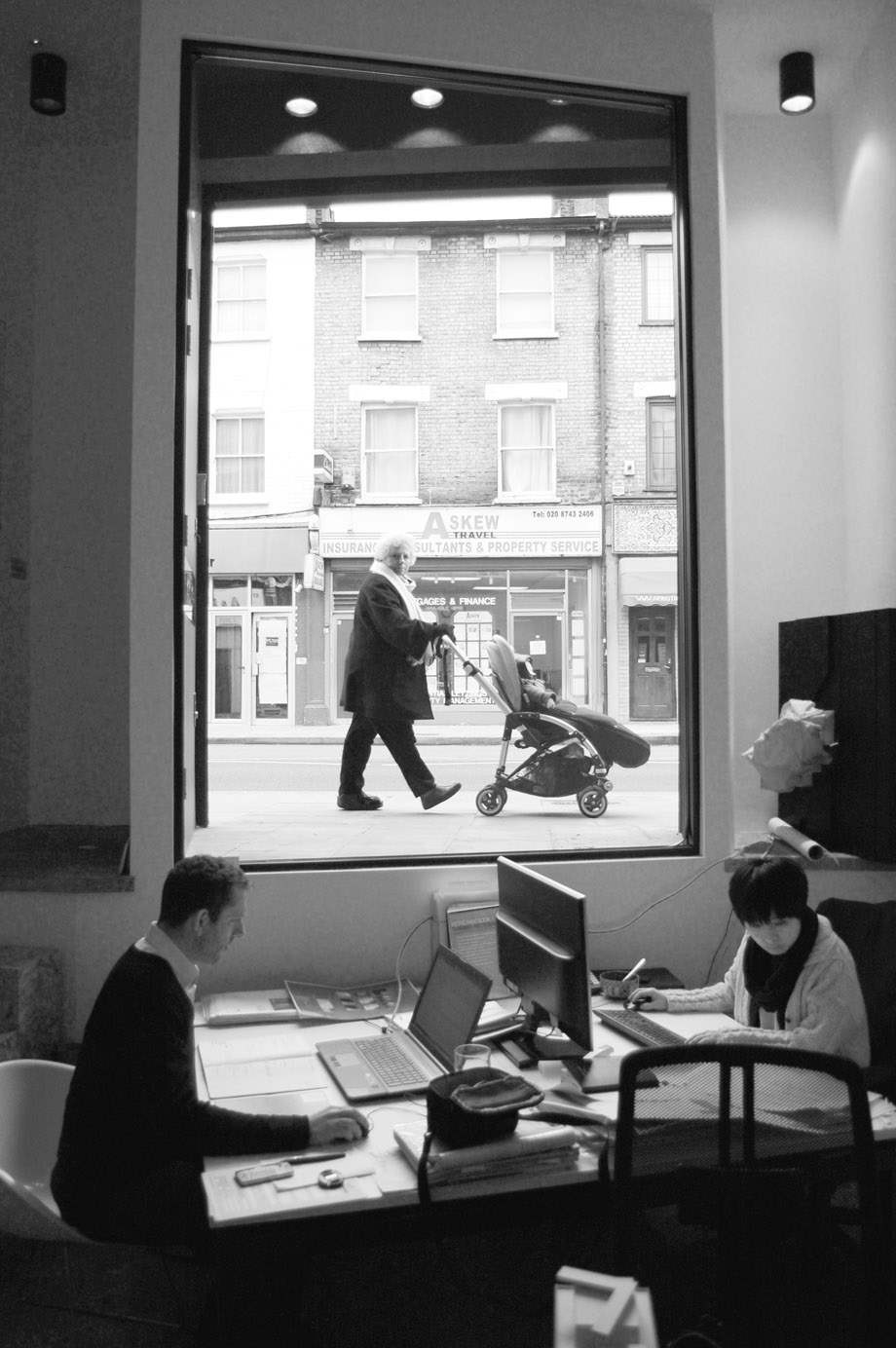
Working in Teatum+Teatum office in London 在伦敦Teatum+Teatum建筑事务所工作中
When:2002 to present
Where:London, UK
Who:Na Li
From:Nanjing, China
How:Graduated from Bartlett School of Architecture, UCL. Now working at Teatum+Teatum in London
Contact:na.li@live.com
www.6uan.com
www.teatumandteatum.com
Why study abroad?
I came to the UK on my own in 2002,the year in which completed my studies at junior high school in China. There was a popular trend at that time for families in my province/China to send their children abroad to be educated. I became one of those children. Ironically, among these families neither the parents nor the kids knew much about what ‘the world out there’ was like and how it would affect our lives. With just a vague understanding of what life would be like and a strong passion for what the west could provide, I decided to come and study in the centre of the Europe, the United Kingdom. The reason I have stayed in London is because in my view, Europe and especially the UK, is a wonderland full of crazy, weird and fantastical opportunities. I wanted to explore these opportunities with the enthusiasm and a passion to learn. I chose the subject of Architecture after I graduated from A-level in Reading and came to the great city of London, where many of the greatest and most influential architects have studied.
In the past ten years of studying and working here in the UK it has changed my views towards architecture, culture, art and design, values. I have gradually become more and more fascinated about the way different people with different cultural backgrounds think about art, and how they connect with their own opinions to the society or politics through creativities. I love the free, inventive, and international environment of the UK, especially London. It provides a great platform for me to fulfill my dream and ambitions.
Is there anything happened impressed you?
There have been lots of things that have impressed and surprised me, both good or bad. The most valuable experience I had was the part-time volunteer job in an elderly care home during the first year I was in the UK. My responsibilities included making lunch and tea for the residents, taking them out for walk, and simply talking to them. Though it sounds simple it was tough job as I needed to learn to be patient and respect and understand the cultural differences. The experience I gained in this period has benefited me greatly.
What do you miss most about China?
My family, friends and all the delicious food
Will you come back? Why?
The answer is yes. I still have a desire to work back in my homeland China at some point in the future, to contribute to local construction developments and architectural education using my experiences and knowledge gained here. Since I started working, I have been impressed by the precise system of planning, building control and health and safety policies in the UK construction industry. I feel it will be very valuable to bring back the knowledge and experiences and apply to the Chinese construction industry, so that we, as architects could ensure a qualified and safe building standards for ordinary people in China and improve their living conditions.
Is it more distinct to view China in a different environment after going aboard? Any thought?
Now that I have been in the UK for 10 years, my memory of my time in China is blurring. However, there certainly have been a lot of changes in my views about China since I left. The most significant change is China’s globalization. It appears there is a greater opportunity for more and more Chinese people to travel aboard to visit, to study or to invest. You can now see advertisements about cities in China on London buses, Chinese movie stars on Leceister square red carpets, and even a mandarin speaking Shakespeare drama was on recently in Shakespeare Globe. Thanks to China’s rapid development and economic growth, it has benefited Chinese nationals working in the UK, especially in the architecture field. Most of the big offices in London have Chinese construction projects, and most of them are of a large scale.
what is your favorite artist(in wider range such as art, music, movie)?What is the influence?
I like Surrealism art. My favorite artists would be Max Earnest, Francis Bacon, Rene Magritte and Frida Kahlo. I like Surrealist works that feature the element of surprise, unexpected juxtapositions and sometimes blur between the real and unreal. Furthermore, they are very architectural. The spaces within Surrealist art are not necessarily physical; they can be philosophical or emotional. They are not literal recorded, but subtle suggested by simple lines, perspectives, lights or reflections. This has influenced me a lot with regard to my design philosophy on architecture. I have always been interested in the idea of spaces being subtle and suggestive by how people experience space, feel space , touch it, and even smell it, rather than purely visual qualities.
What amazing character do your works have?
I wouldn’t say my works are amazing as they still exist on the paper. Personally I think amazing architecture are those built projects that have been transformed from the architect’s ideas into physical forms and with control of the buildings materiality and details. They should innovatively but naturally relate to surrounding context. Nevertheless, the unique character I would say is the ‘narrative’ design approach and presentation language. The idea of ‘telling a story by spaces’ is embedded in every aspect of my design. The main design project I have developed in the two years of the Diploma is ‘Monastery of the Himalayas’. The monastery project was examining a prototype that was proposed to be built under two-phases of construction: one adopting traditional slow craftsmanship and the other using modern fast construction techniques. The thesis emphasized the criticism on the loss of religious symbolism, craftsmanship and honesty to the construction process due to rapid population growth in cities in modern urbanization. The project also reflects my criticism on the fact that religion is used as propaganda, that its purity has been distracted and destroyed. The project has been awarded as Dean’s list for ‘students achieving a Distinction in design’.
When did you start to surf on gooood? Any suggestions?
Thanks : )
I have started to read Gooood for some time. I like the idea of having both English and Chinese version of the latest design news around the world, combined with interviews, forums, and job opportunities. My suggestion would be annual awards holding by the website would be good opportunities for young architects/designers to show their talents!
在海外时间:2002年至今
在海外地点:英国伦敦
姓名:郦娜
籍贯:南京
学校or工作单位:毕业于伦敦大学巴特莱建筑学院(Bartlett School of Architecture, UCL)
现工作于伦敦Teatum+Teatum建筑事务所
联系方式:na.li@live.com
www.6uan.com
www.teatumandteatum.com
为什么出国?
2002年我在南京完成了初中的学习,独自一人来到了英国。那时候身边很多家庭都选择把子女送到国外,然而说起来却有些盲目,因为就连父母对所谓的“外面的世界”都一无所知,从未想过将要面对的是什么,更别说十五岁的孩子。 但也许就是凭借着这点盲目,加上更多的向往与憧憬,我摸索着独自来到了离家千里的英国,而且一下就过了10年。 我非常热爱伦敦这座城市。对于我来说,她是一座迷城,到处都有惊喜,有出其不意的人们做出其不意的事情。尤其是它的文化艺术底蕴,因由历史的沉积以及来自全世界不同国籍不同种人的碰撞与融合,显得格外耐人寻味。穿梭在这座城市的街街巷巷,你常常能在某个角落就看见像电影或舞台剧里的场景,乐此不彼。还有就是它古老和现代的建筑交相呼应,也正因为他们的魅力让我在念A-LEVEL(相当中国的高中)时就决定要在伦敦学习建筑。
在英国的这十年,我对建筑、设计、文化、艺术的认识甚至观念都有了很大的变化。我意识到每个人都会因为他不同的经历,文化、政治以及宗教背景,而对一个作品的表现和完成有全然不同的影响和诠释,而正是这些独一无二的经历和背景让每个设计有了自己的灵魂和语言。作为一个正在摸索属于自己的设计理念和方法的年轻建筑师,我更有兴趣继续欣赏更多的作品,了解更多的人,通过体验来探索对于设计的突破。
在国外遇到了什么让你印象最深刻的事情?
太多事给我留下深刻印象了,有好的有坏的。可能最有意思的是我刚来英国的那一年在一家老人院打工的经历吧,别以为给老奶奶老爷爷们倒倒茶做做蛋糕很容易,要和跟你完全不说一种语言,跨了半个地球和半个世纪代沟的老洋古董们确实还是要花点力气和心思的。不过这半年的打工经历,让我第一次体会了真正的独自在一个陌生的环境里生存并通过自己的价值来换取应得的尊敬和报酬。
最想念祖国的什么?
家人,朋友,各种各样的美食
你会回国吗?为什么?
一定会回的。我依然梦想着学成归国,可以用我在这里学到的知识和经验帮助到中国建筑、城市的发展。在英国工作的最大收获就是看到这里对古建筑的严谨保护已经普及到了每个街区,并不仅仅针对那些重点建筑;伦敦的城市规划建设不管是从水渠、地铁,还是防洪抗震设施,都是以‘100年内无事故’的标准严格把关的;还有把安全的意识具体对每个细节的控制和规范化,以及严格的监管系统和政策制度 也是我认为非常值得中国学习的。我期待回国去了解和学习,以及去对梦想的修正和坚持。
出国后在不同的背景下再看中国是否看得更清晰,有哪些感触?
我离开真正的中国生活已经十年了,加之当时还是十几岁的学生,也许并不能很准确的看中国。然而在英国的这些年身边当地人对中国人印象的改变留给了我很深的印象,有些改变也是我切身体会的。刚来英国的时候,很少有英国人了解中国,连想去了解中国的人都很少。而这几年中国的快速发展和经济的腾飞让有关中国的信息横扫全球,现在我经常会看到伦敦公车上、地铁里各种中国城市旅游的广告,看到中国的影视明星出现在影展、首映式上,前几天还在著名的莎士比亚剧院看了中文的《理查三室》。在建筑业,中国在国际舞台上的重要性也日渐显著,首屈一指的一定是最近第一位拿到普利兹克奖的中国建筑师王澍,他的获奖吸引了我身边许多英国建筑师去了解中国建筑的历史和发展。对于我们这些在英国工作的中国人来说,祖国这几年的快速发展带来的最大优势,莫过于中国拥有的全球最大的建筑市场,尤其是在欧洲经济大萧条的这几年,几乎所有的大型事务所都有中国的项目,而且都是大型项目,所以集聚的增加了对拥有中英背景并掌握双语的人才的需要。
最喜欢的艺术家(绘画音乐电影等广泛范围)是谁?给你创作带来了什么影响?
绘画领域内我最喜欢超现实主义,最欣赏的艺术家包括Max Earnest,Francis Bacon, Rene Magritte 还有 Frida Kahlo。我喜欢他们用极其写实的手法呈现一幅幅非现实的景象。有时你并不知道艺术家是想在记录一个梦境还是在反映自己内心的情绪,抑或用绘画来批判那一个时代,但它们共有的是在那个特有的环境背景下用他们特有的方式记录一个空间,一种想法。画面的视角,笔触,颜色,光影,几何,排列等等,都让我意犹未尽。我认为在建筑设计上也同样要考虑这一切,甚至更有趣的,是去研究如何把想要的效果通过建筑实体来表现,让一个建筑空间不单单可以被使用,更可以被触摸,被感受,被思考。就象超现实主义艺术家运用绘画来表达他们对时代的想法一样,我希望可以通过空间来传达我的想法,这一切只应该是自然流露的,因为我们来自这个时代;真正需要探索的是把想法转达到空间并传送到使用者的设计方法。
觉得自己的作品集有哪些迷人的特质?
我认为建筑的迷人之处是当它从图纸变成了一比一的实体,并且从整体和细节上震撼了它的使用者;目前属于我个人的作品还仅限于学术方面,所以我并不觉得我的作品“迷人”。也许可以说比较独特的是我的作品中“故事性”的设计和表现方法吧,还有刚才提到的,用空间来表达一个想法的转化过程。尤其“故事性”这一点是巴特莱建筑学院Bartlett这所学校最著名的创新,我从大一开始在这里读建筑五年,自然也在作品中秉承了这个特点。研究生的毕业作品也让我荣获了‘校长荣誉卓越奖’。有意思的地方就在于每个学生对 “故事性”的理解都是不一样的,学校注重的也是对每个学生的自我潜力开发的训练,它的教学方式并不是教课或学习软件或做设计课题,每个项目更像是一个‘无命题’课题,要你自己去寻找问题,并找到属于你自己的解决方案。Bartlett学校的强压也是出了命的,在英国学生里有句很流行的话“如果你不想好好活着,就去Bartlett读建筑吧”。因为那个可恶的“无命题”,导师更像是难搞的甲方,同学更像是竞争对手,自己也常常摸不到方向掌握不到方法,但我认为正是这几年在强压下的训练,让我学会了在建筑设计中的探索,适应还有做决定。希望我可以运用到学校里学的这些方法和训练出的能力,把它运用在工作中,尽早设计和建造出属于自己并可以称之“迷人”的作品。
什么时候开始看谷德网的?欢迎你提出建议哦,谢谢。
看谷德网有一阵子了,每天午饭时间都会浏览下最近信息。我很欣赏谷德网的创意,把全球的最近设计信息用中英双语的形式展现给大家,还包括了建筑师访谈、论坛、工作机会等咨询。我认为这尤其给年轻、充满热情的设计师和学生们提供了很全面、很方便的交流平台。希望网站涉及的范围越来越多广泛,可以办一些年度的奖项鼓励大家的设计积极性!
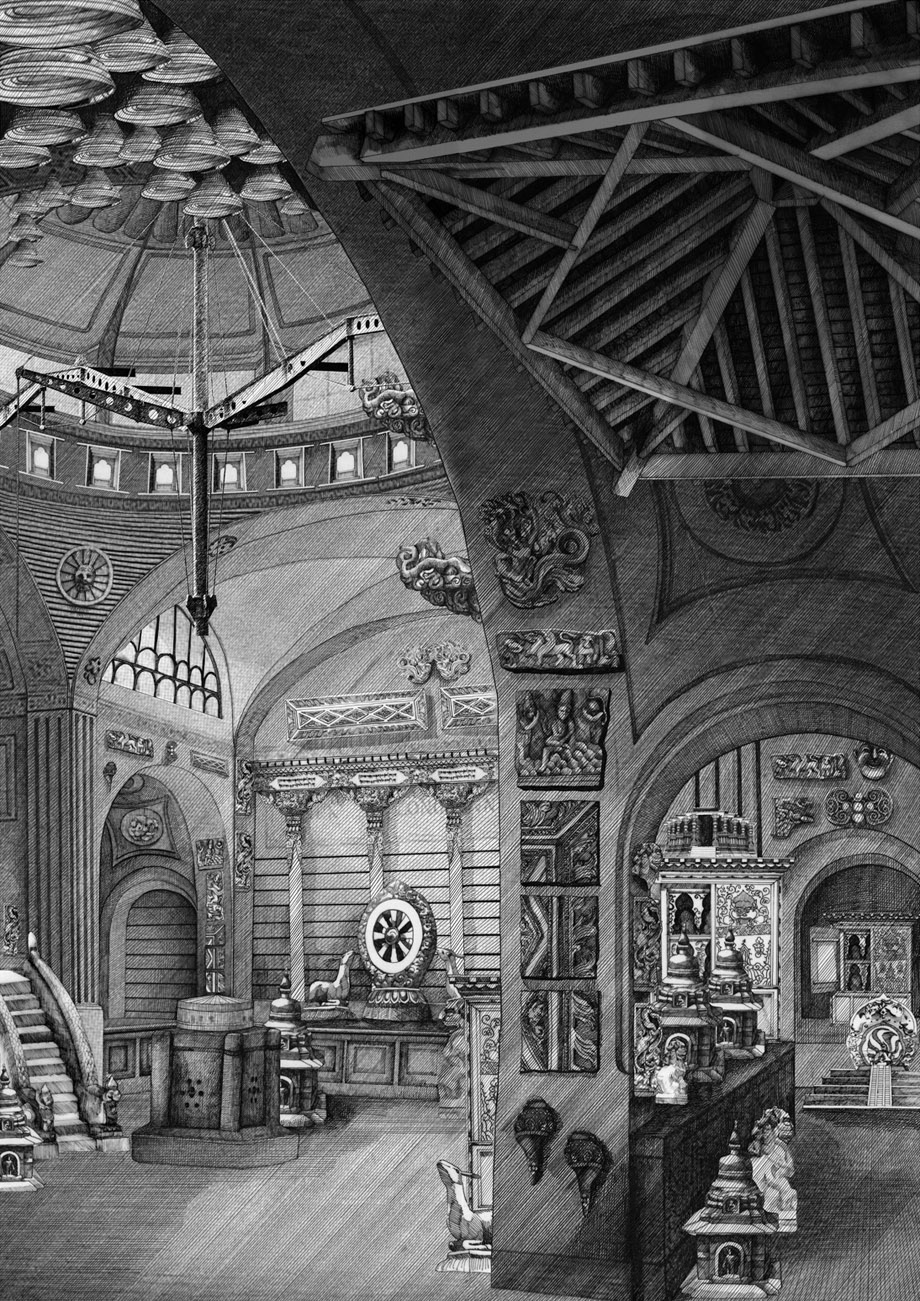
Part I: Academic Work
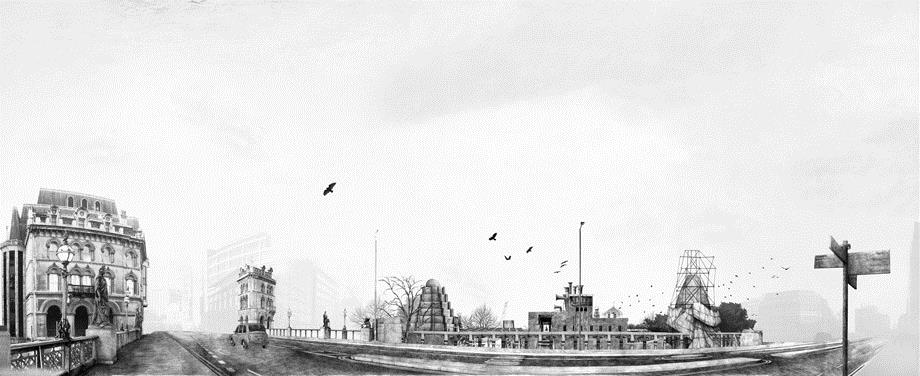
Academic Project 1: Monastery of the Himalayas, City of London
Bartlett School of Architecture
Diploma/MArch Final Project [Distinction Prize Winner]
Tutor: Jonathan Hill
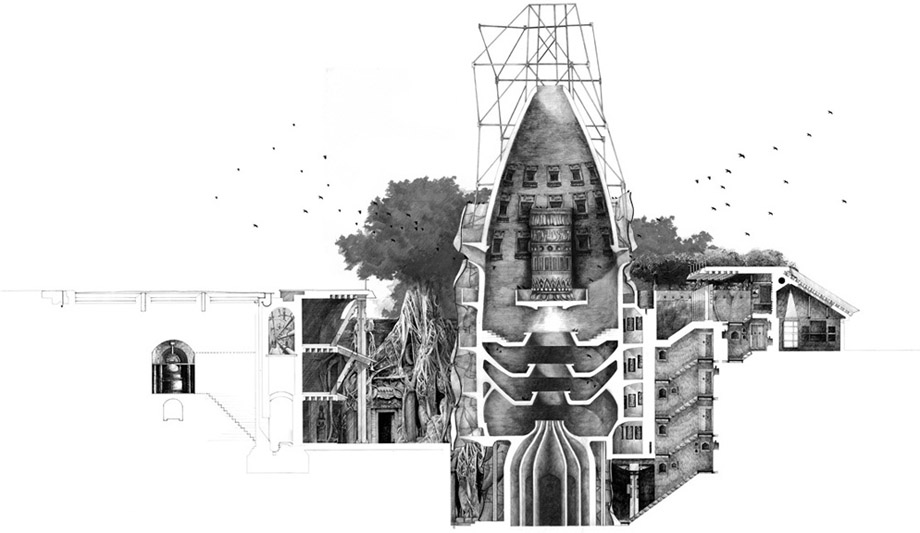
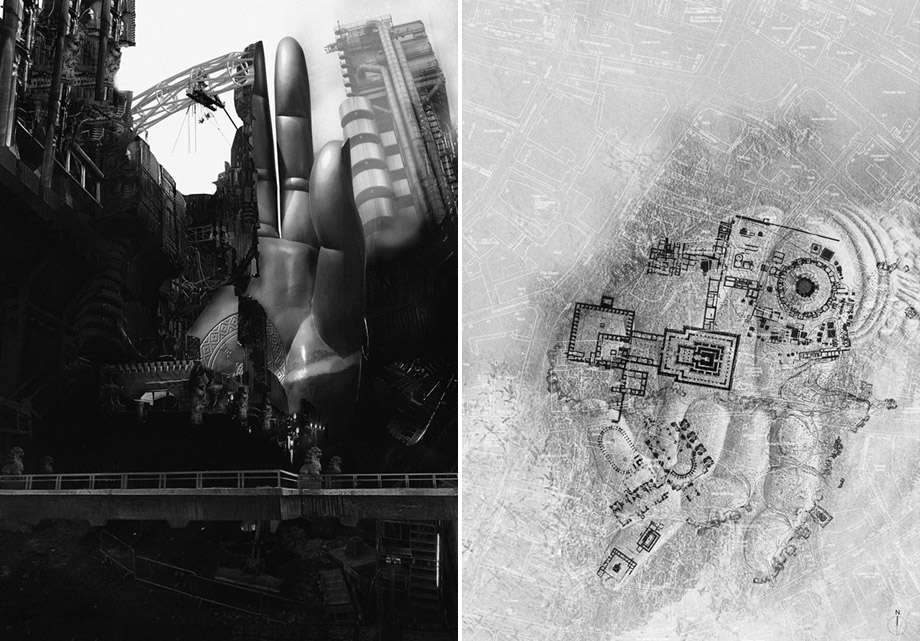
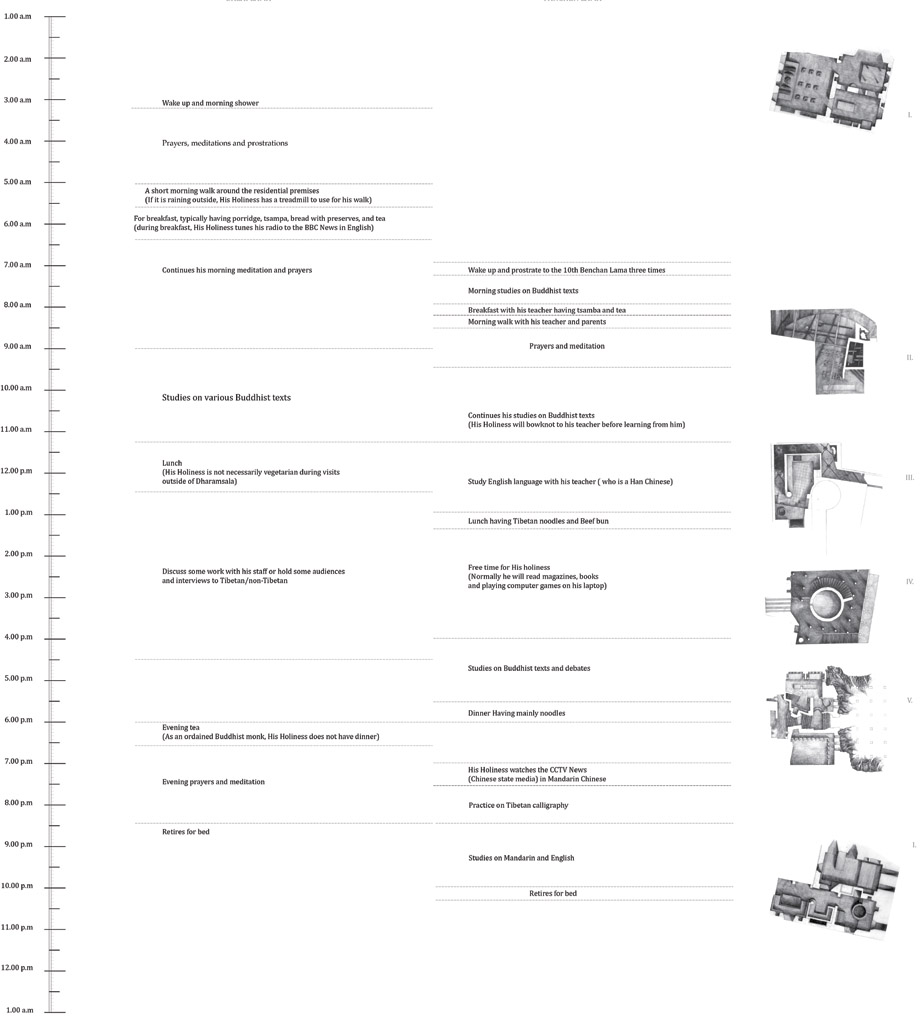
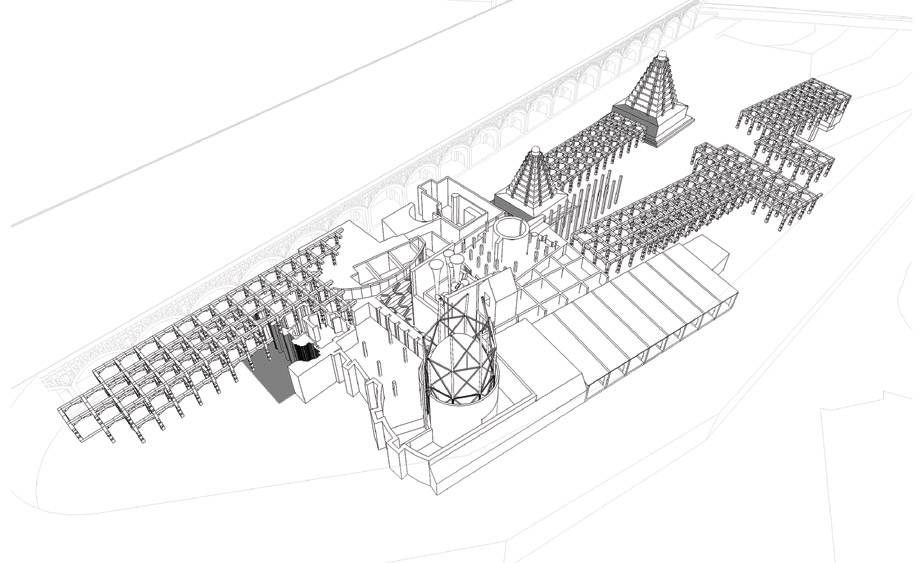
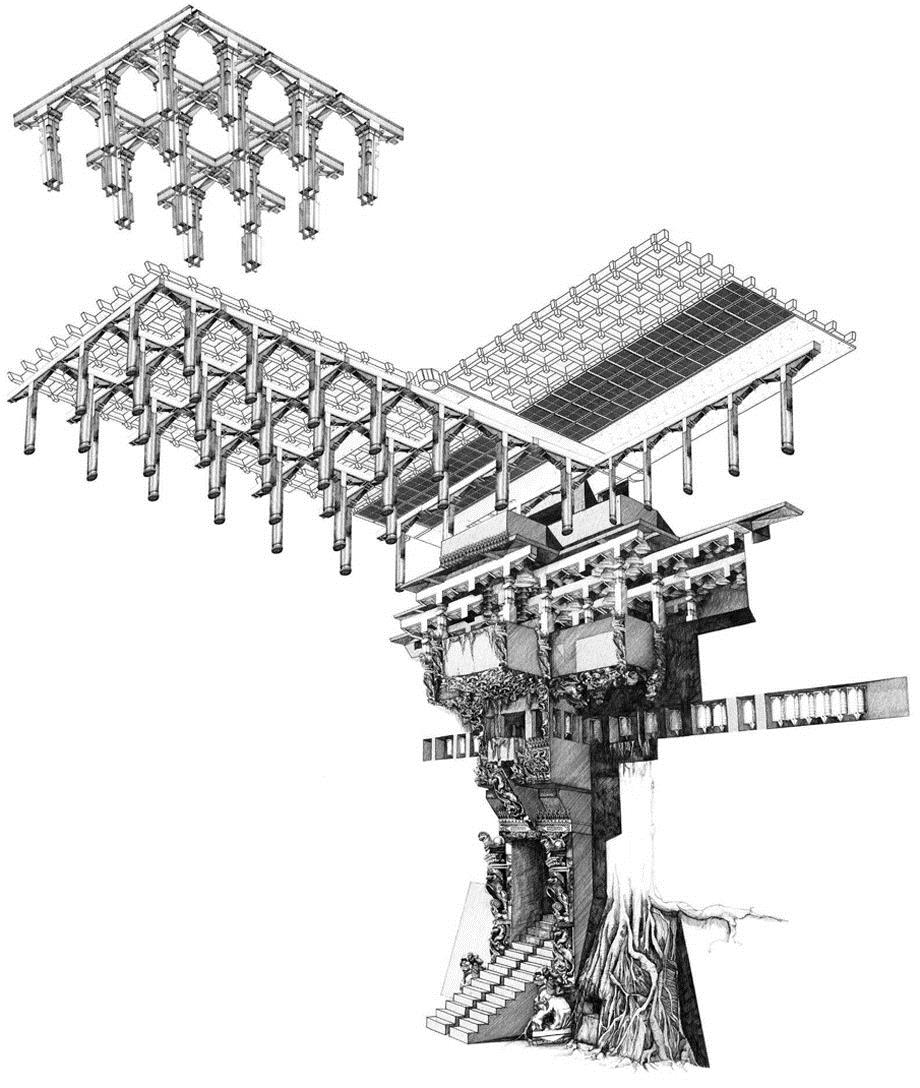
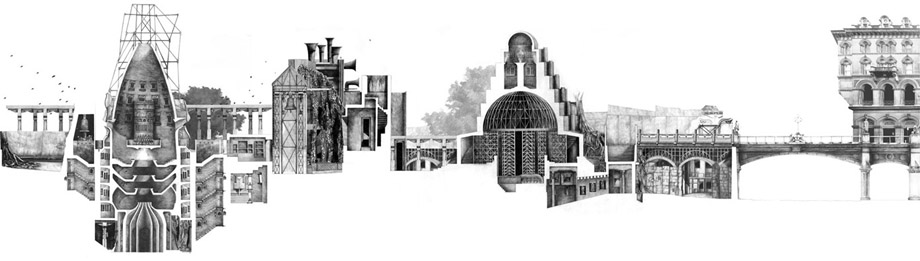
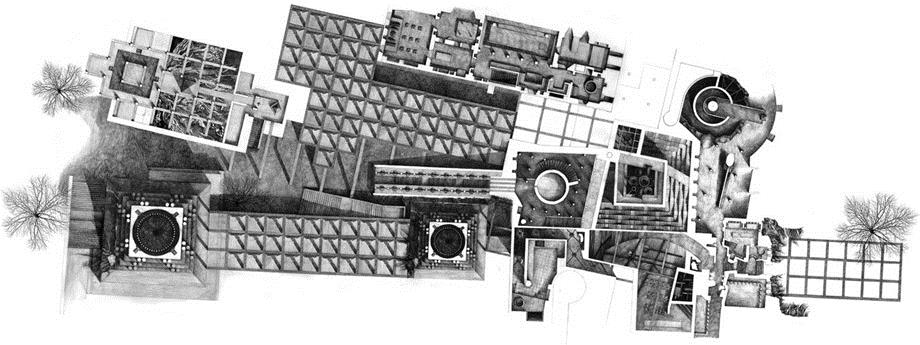
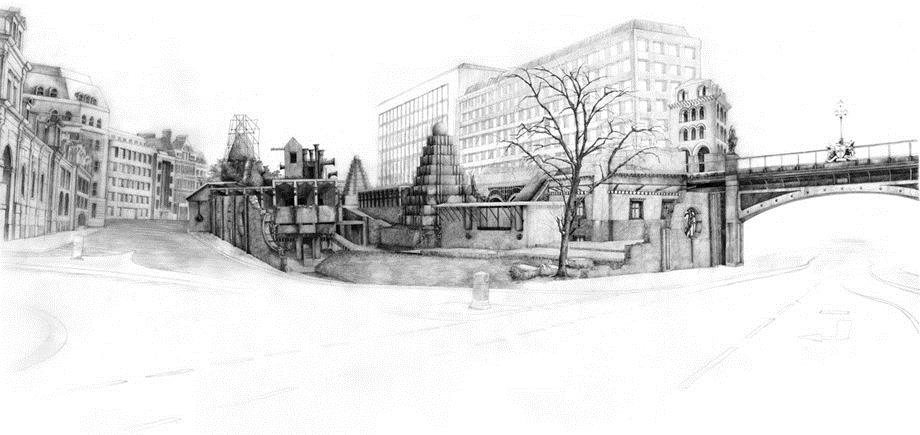
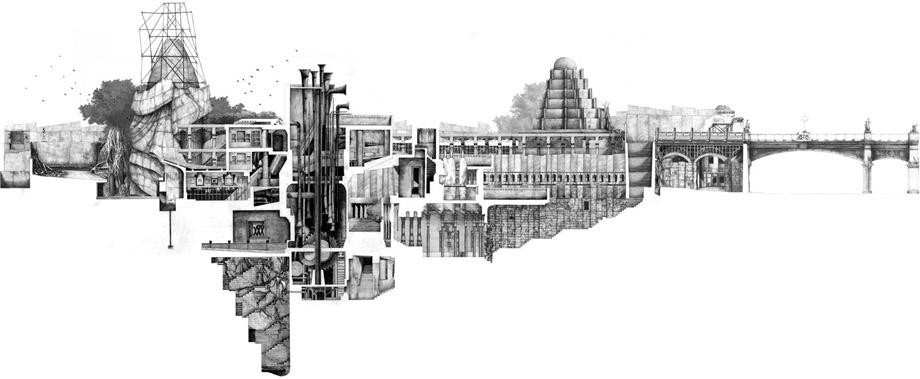
The Monastery of the Himalayas will consist of a monk’s residence and a Buddhist monastery. It also secretly functions as a diplomatic ministry in the city of London. The project criticises the use of religion as political propaganda, corrupting and destroying its purity. The project speaks as a metaphor, and formalises the idea of duality.The building is designed to follow certain Buddhist notions, including the general layout of the Mandala grid, which consists of nine units representing a hierarchy of occupations. Here, however, there are two Mandalas, while certain modules are re-orientated and re-scaled in relation to vulnerable energy spots.
This distortion of the principle of the perfect Mandala represents the duality introduced by the building’s secret role as a diplomatic ministry.In accommodating both the two top monks, the building has been designed with moments where the two meet. Nevertheless, the architecture controls their movements and perceptions so that while physically sharing spaces, they see them essentially differently.
The building will be constructed using both slow and fast techniques in parallel phases, using both Chinese contemporary construction methods and traditional handcraftsmanship.These correspond to two architectural languages: heavily sculpted decoration, and simple bold forms. Hybrids of the two languages happen in building segments including the gate house, Stupa of the Himalayas, the artificial Bodhi tree, the prayer wheel hall, Big Buddha statue and the stepped well.
学术项目一
这所选址在伦敦市金融中心的佛教修道院通过感性的游历和理性的形式分析探索并审视了当今社会宗教被用作政治宣传的课题。我试图通过这个项目思考如何运用建筑的语言作为一种隐喻的手法来传达一个观点,来叙述我对此课题‘两面性’的探究。此项目的重点是感性地联系了宗教与历史和理性的建筑规划与建造的过程,探索一种中立的建筑表现手法,带领读者和使用者来自我领会其中的奥妙。
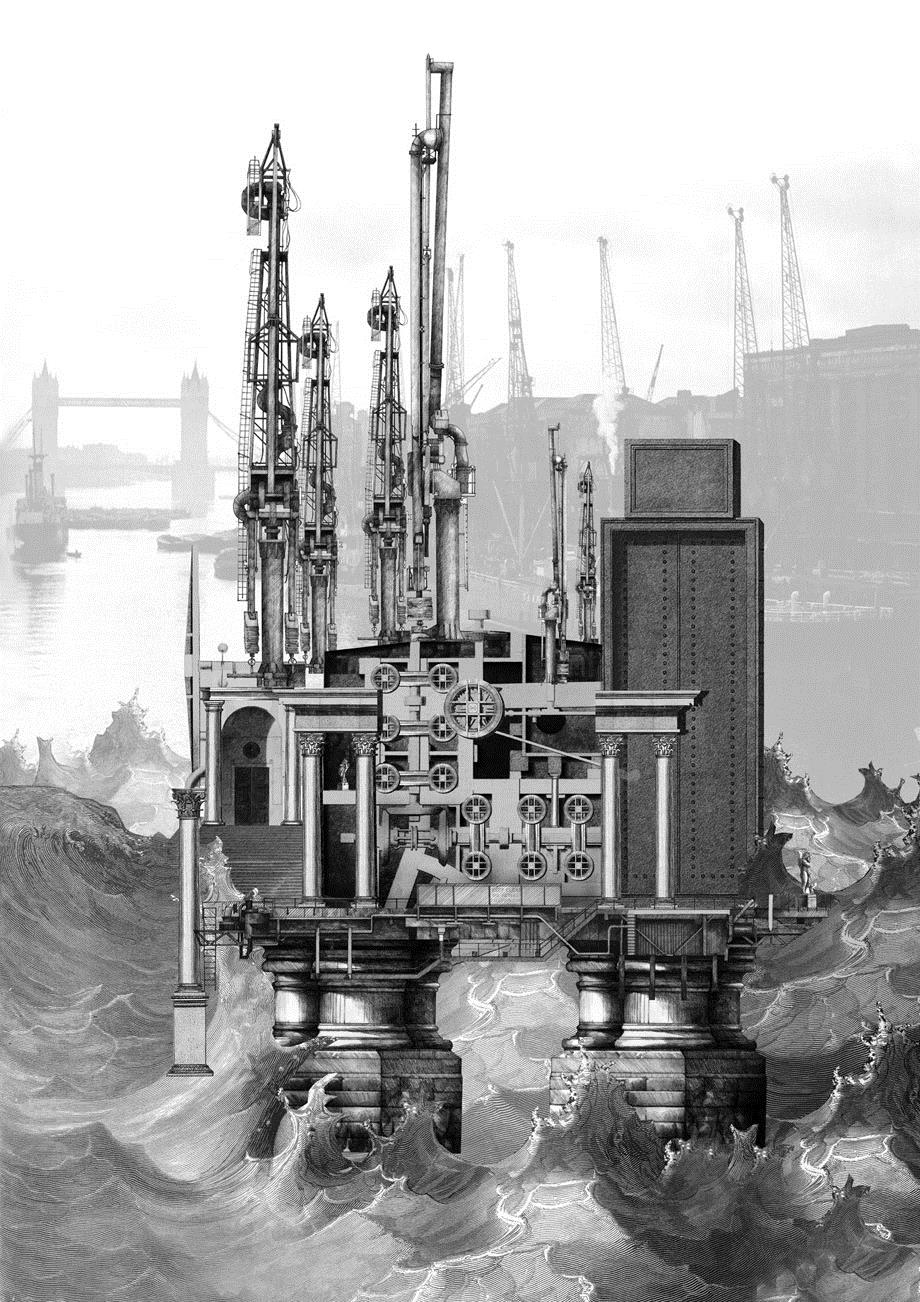
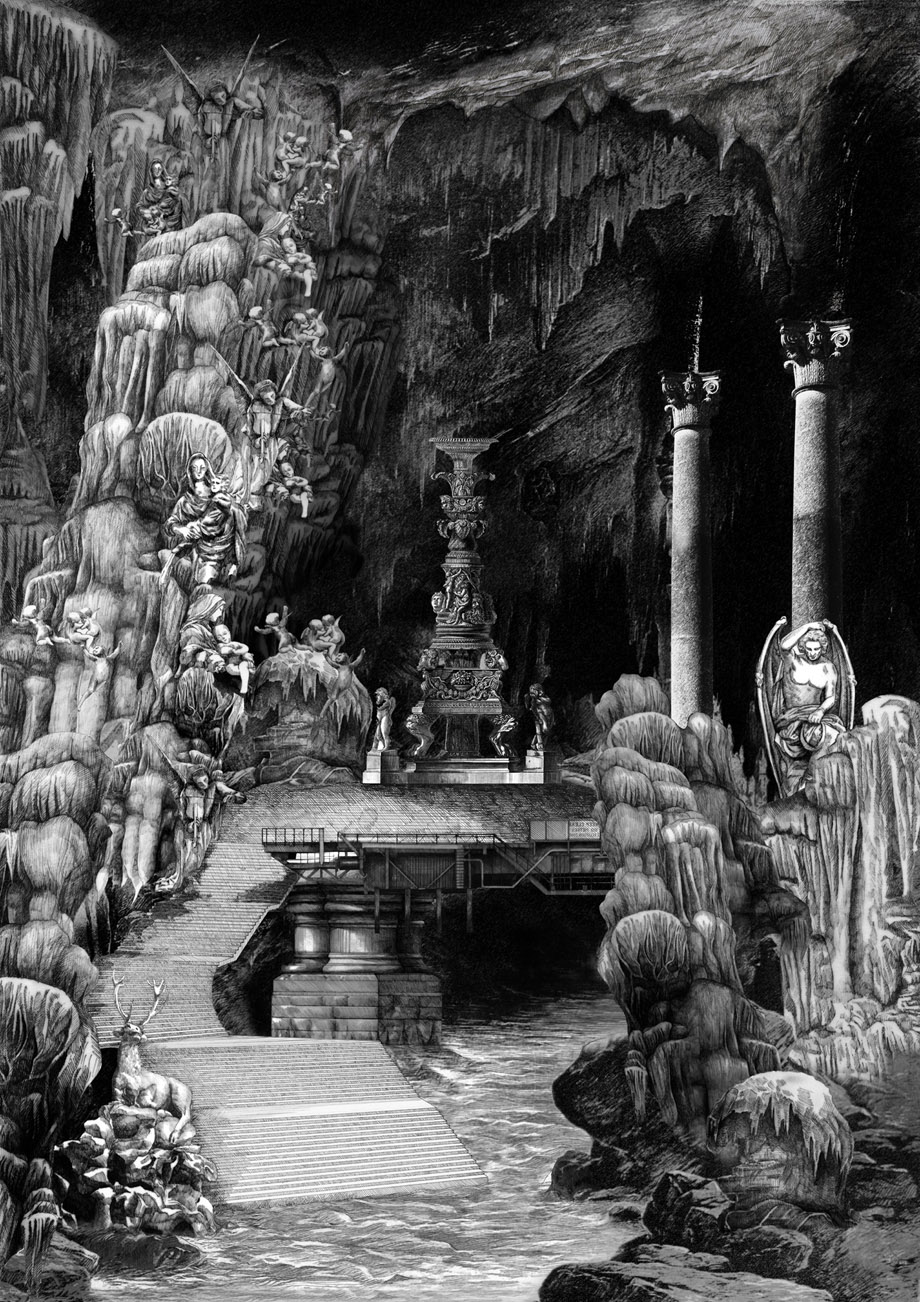
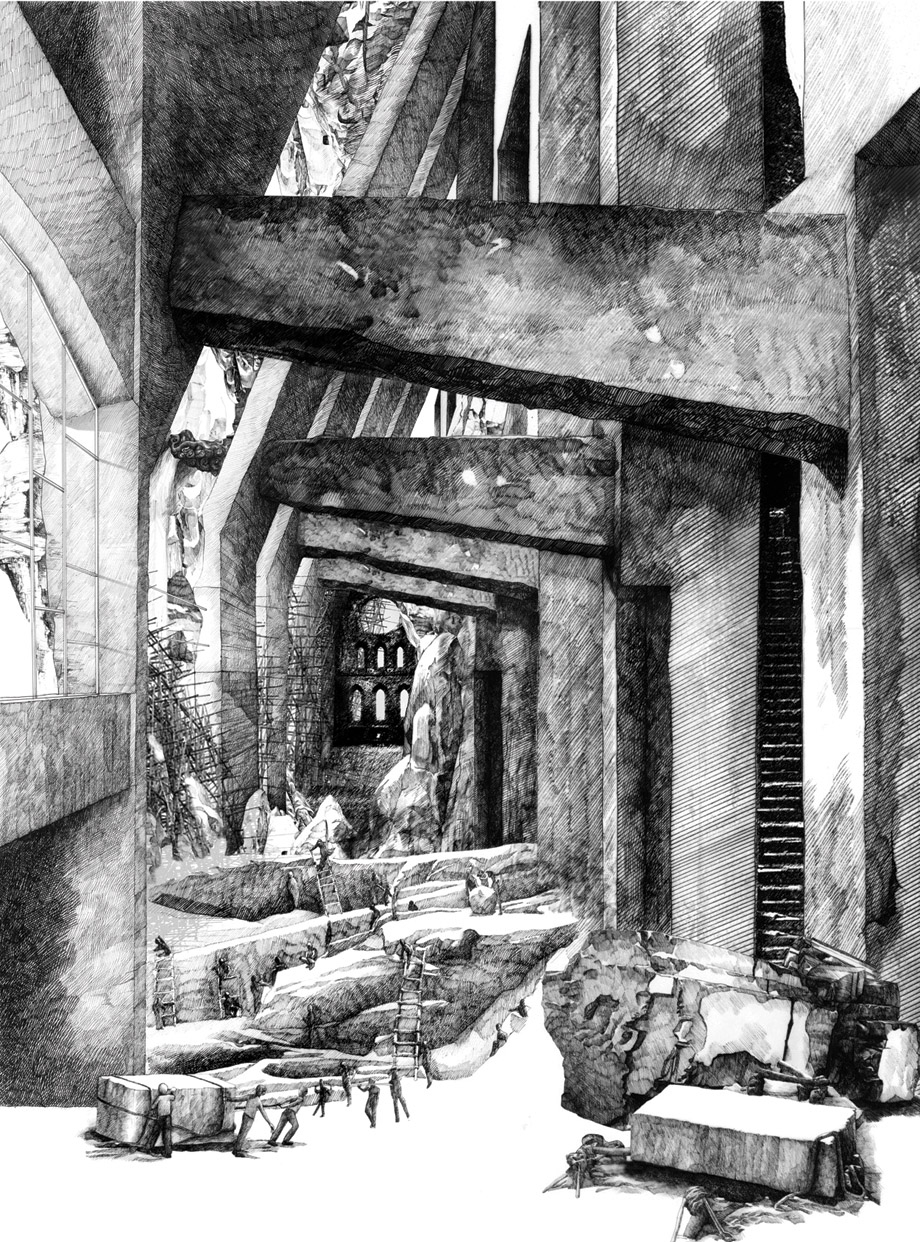
Academic Project 2: Hybrid – The Monument / Ruin of Industry
Bartlett School of Architecture
Diploma/MArch 5th Year Project
Tutor: Jonathan Hill
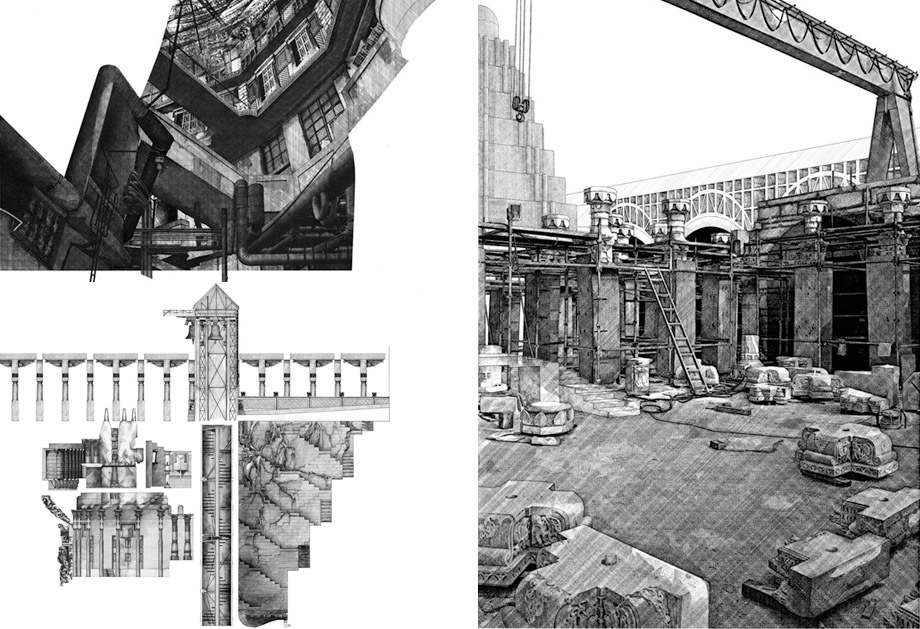
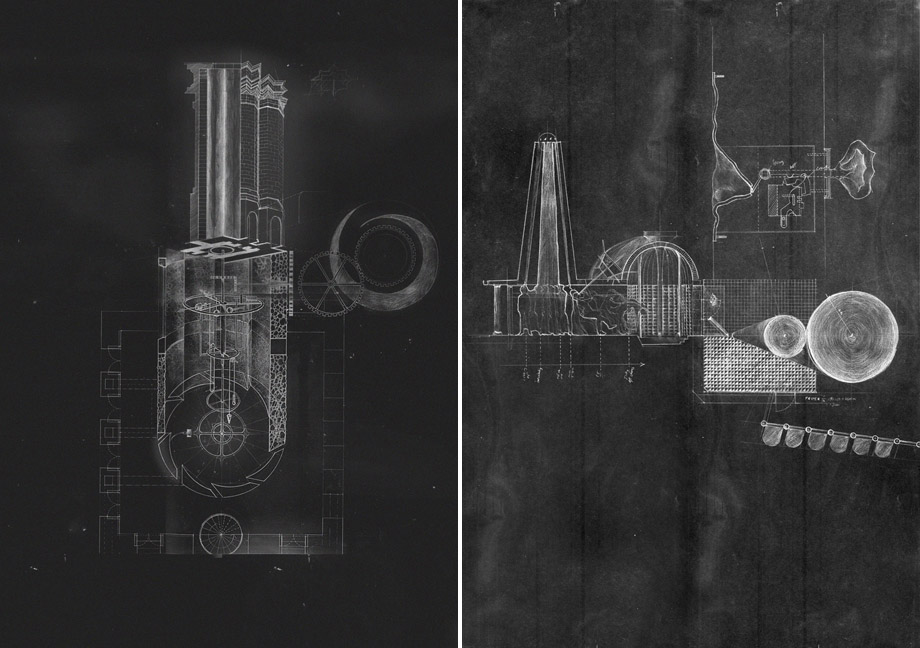
The project looks at the hybrid of the monument/ruin of industry in London, Square Mile and a series of studies/experiments are carried out.Looking back to the past and forward to the future and designing a hybrid of traditional/modern architecture has always been my interest. Since the project ‘Chinese Contemporary Art Museum’ I did in the 3rd year of my Bachelor’s degree in 2008, I have been developing my own architectural understanding of the idea of hybridised architecture.John Soane, Giovanni Battista Piranesi and Joseph Michael Gandy’s work are especially studied and referenced with a focus on hybridising the traditional/modern and also the religious/industrial.
学术项目二
这个项目着眼于伦敦工业时代的遗留问题,进行了一系列的历史研究和建筑实验。分析历史并创造未来;把传统和当代建筑融合,一直是我感兴趣并在研究的课题。在本科时期,我从‘中国当代艺术博物馆’的项目中,开始探索两者结合的可行性。这个项目还包括了对新古典主义建筑师John Soane , Giovanni Battista Piranesi 还有Joseph Michael Gandy的作品研究,着重参考了他们对建筑空间、细节、以及光线的把握和表现手法。
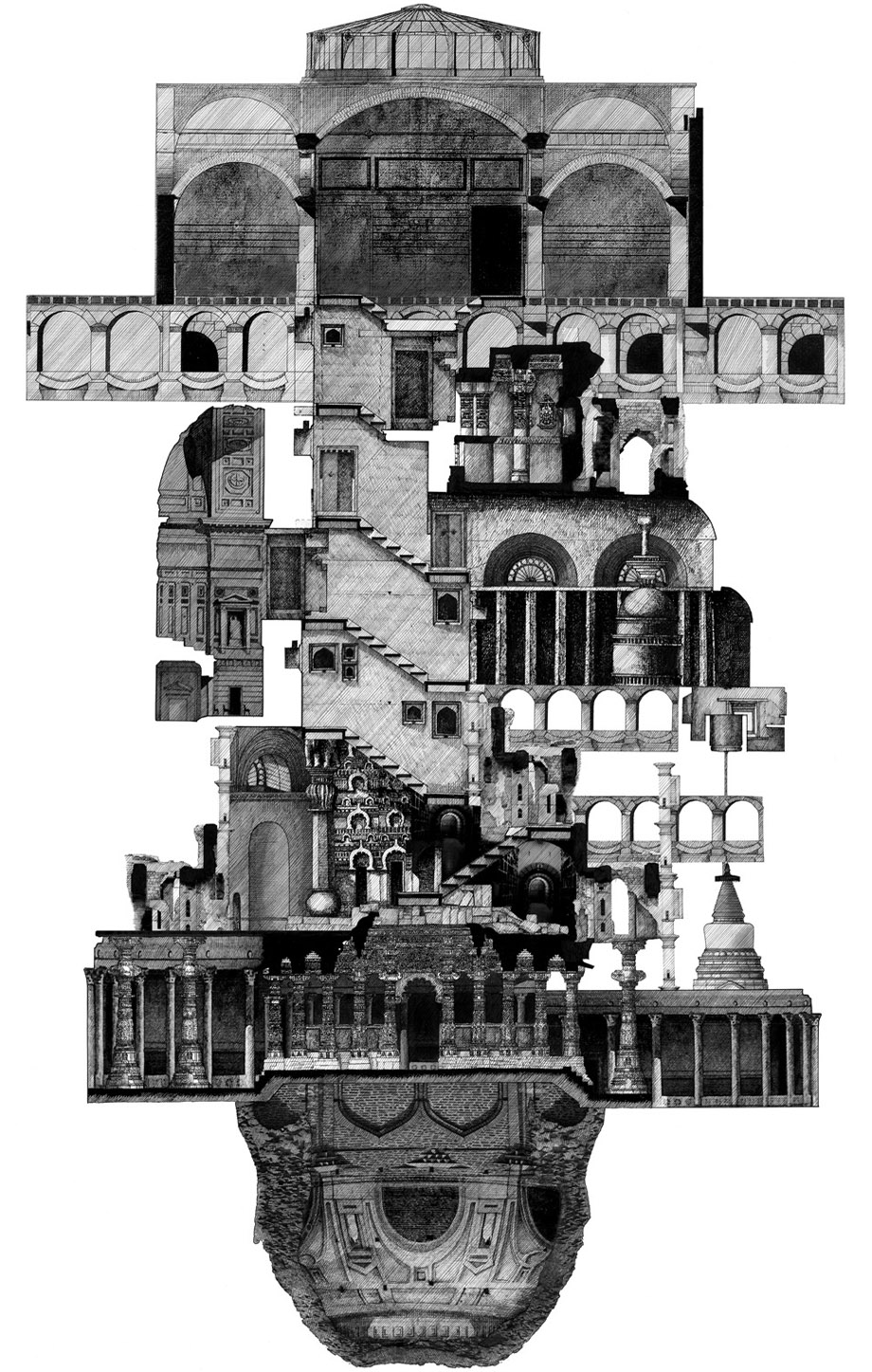
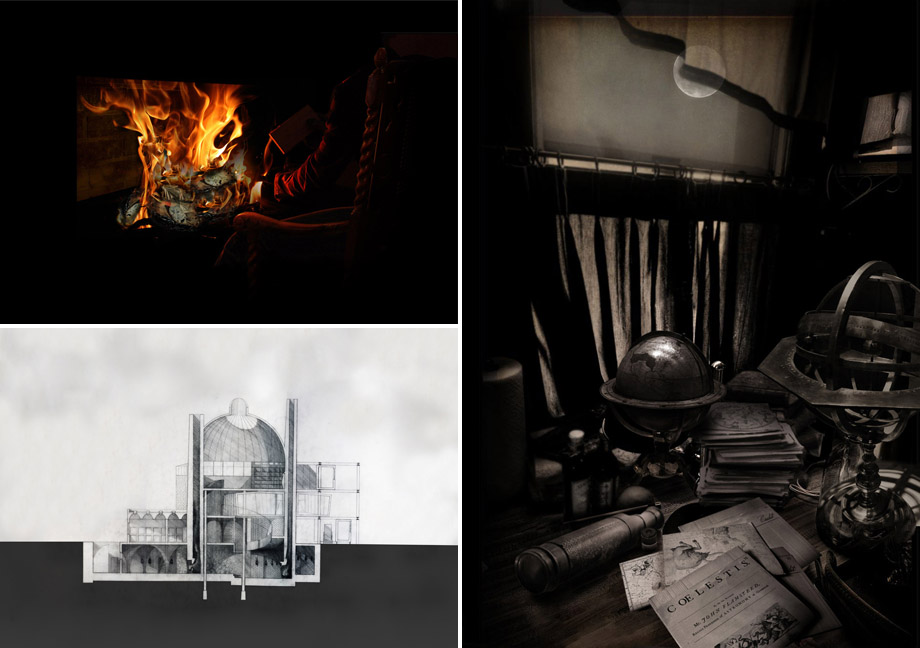
Academic Project 3: Design Realisation – The Estate of the Royal Astronomer
Bartlett School of Architecture
Diploma/MArch 4th Year Project
Tutor: Jonathan Hill
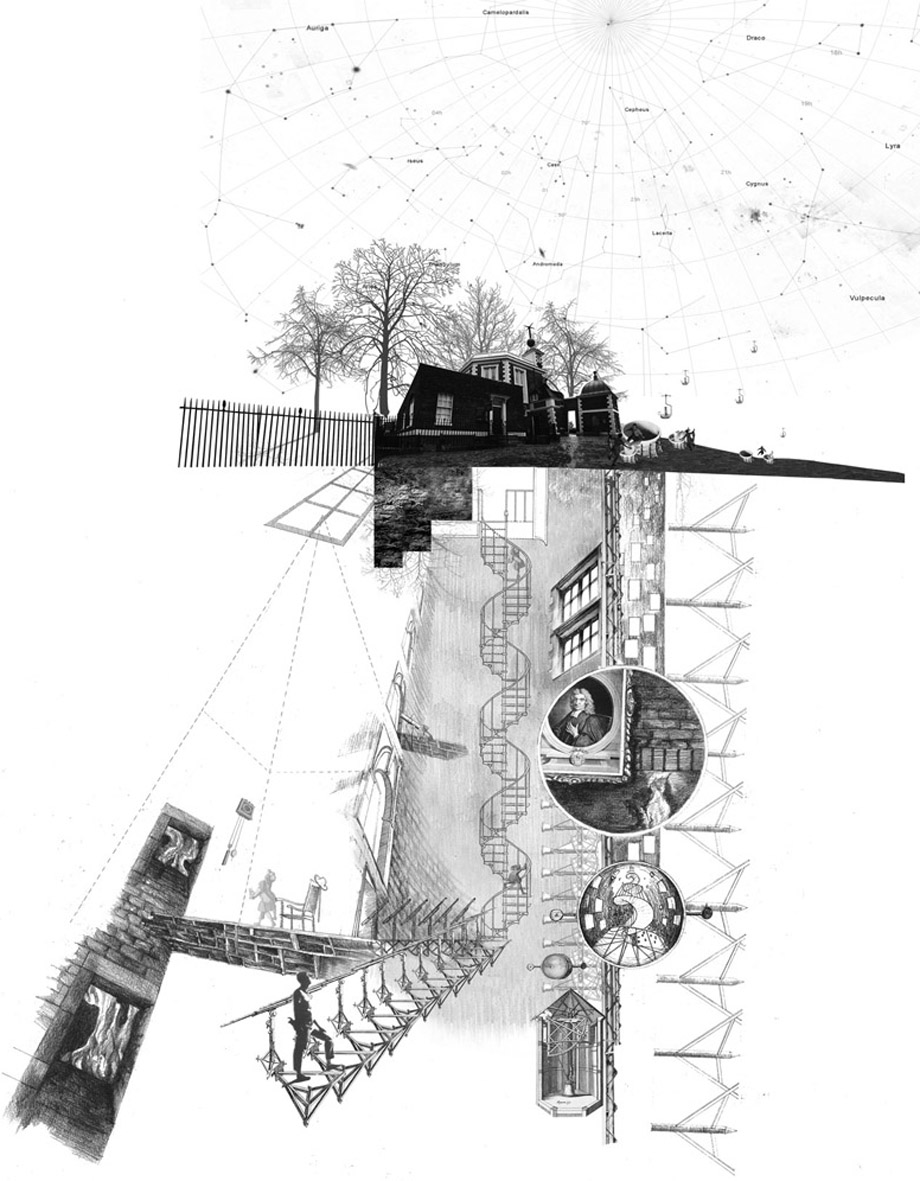
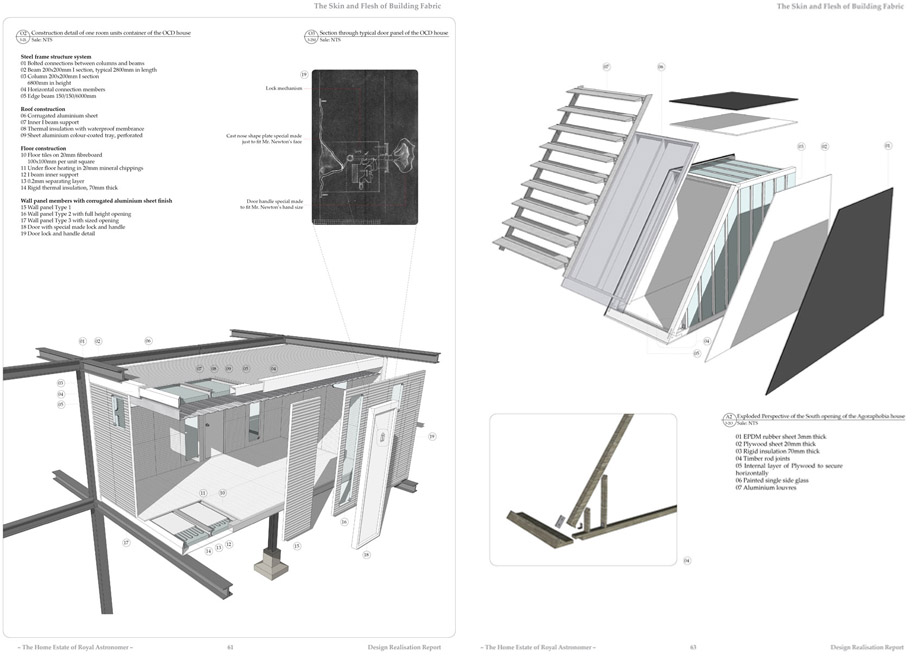
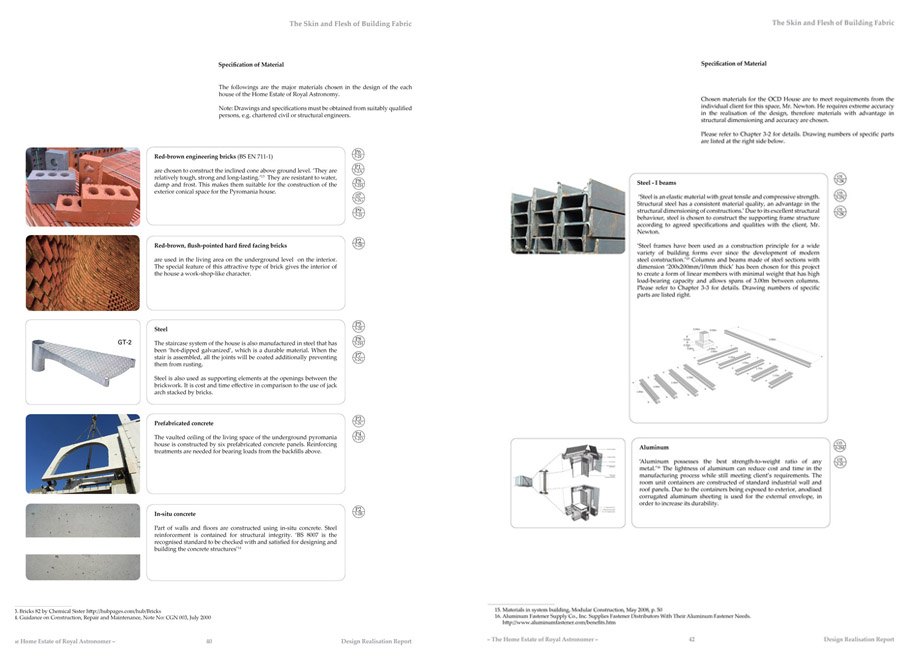
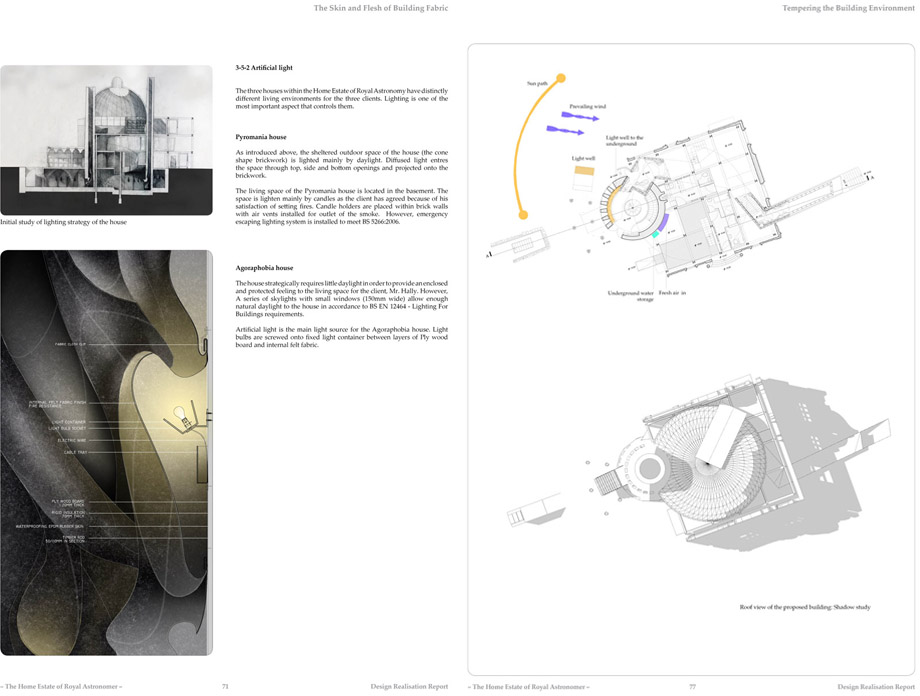
The design strategy of the Home Estate of Royal Astronomer project is to satisfy three psychological obsessions. The characteristics of the obsessions are intrinsic to the house, such as its structure, materiality and function. There are three parts of the house, which are Pyromania House, OCD House and Agoraphobia House. The house is externally a cohesive whole, however inside it is made of three residences which have separate functions. Therefore the three residences will manifest themselves as separate dwellings through their own architectural style, construction methods, and materiality. These architectural expressions interlock with each other; they are interdependent, creating for the house to adapt itself all the time.
学术项目三
此项目针对三种典型心理疾病的探索,研究特殊人群的住宅设计。我例举并着重研究了三种病症:纵火狂、强迫症、幽闭恐惧症。通过分析这些症状对日常生活产生的影响,以及对环境的要求和与他人的交流障碍,我设计出了一所能同时容下该三种病症患者的住宅。其融合了三种建筑形态并选取了三种建筑材料来应对每个特殊人群的需求。
Part II: Practice Work
Background
I joint Teatum+Teatum in 2011 after I have worked in Wilkinson Eyre Architects and graduated from the Bartlett School of Architecture. Teatum+Teatum is a young growing architecture practice based in west London directed by Tom Teatum and James Teatum. The practice is specialized in a range of project comprised of residential, commercial and industrial. We have been creating a collection of spaces across the city that are accessible and offer an opportunity to live and work in unique architecture that inspires a narrative for living and dreaming.
从巴特莱建筑学院毕业后,我在伦敦威尔金森艾尔建筑公司Wilkinson Eyre Architects工作并积累了一定的实践经验。 2011年,我加入了伦敦年轻的建筑团队 – Teatum+Teatum。Teatum+Teatum 建筑事务所涉及的专业领域,无论是住宅、商业还是办公楼,都不断的在探索建筑空间与城市环境共存的机会,并对城市化进程对生活方式带来的变化也有着独特的理解。
Practice Project 1: T+T 001&2 From High Street to Hidden House, London
Architect: Teatum+Teatum
Client: Private
Project Value: £400,000
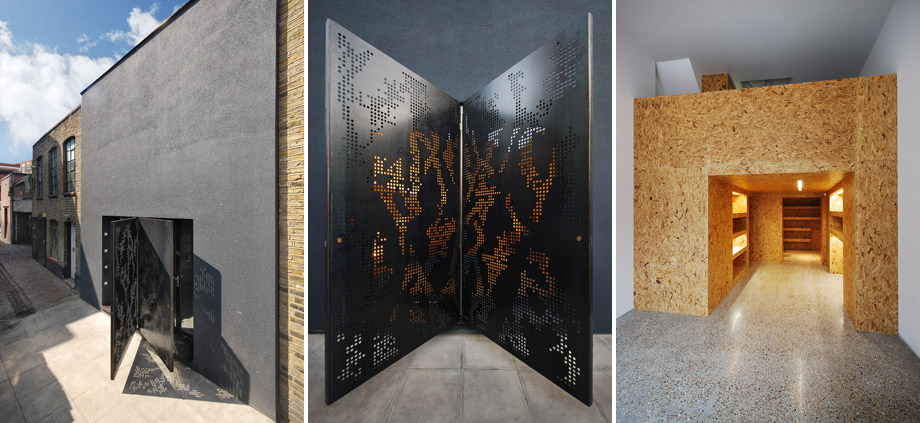
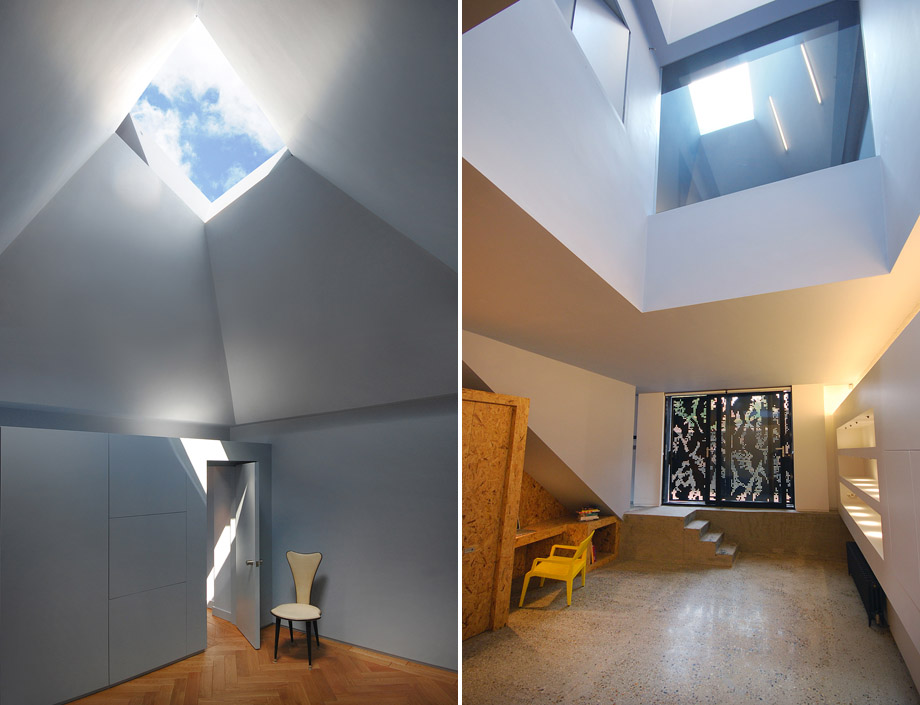
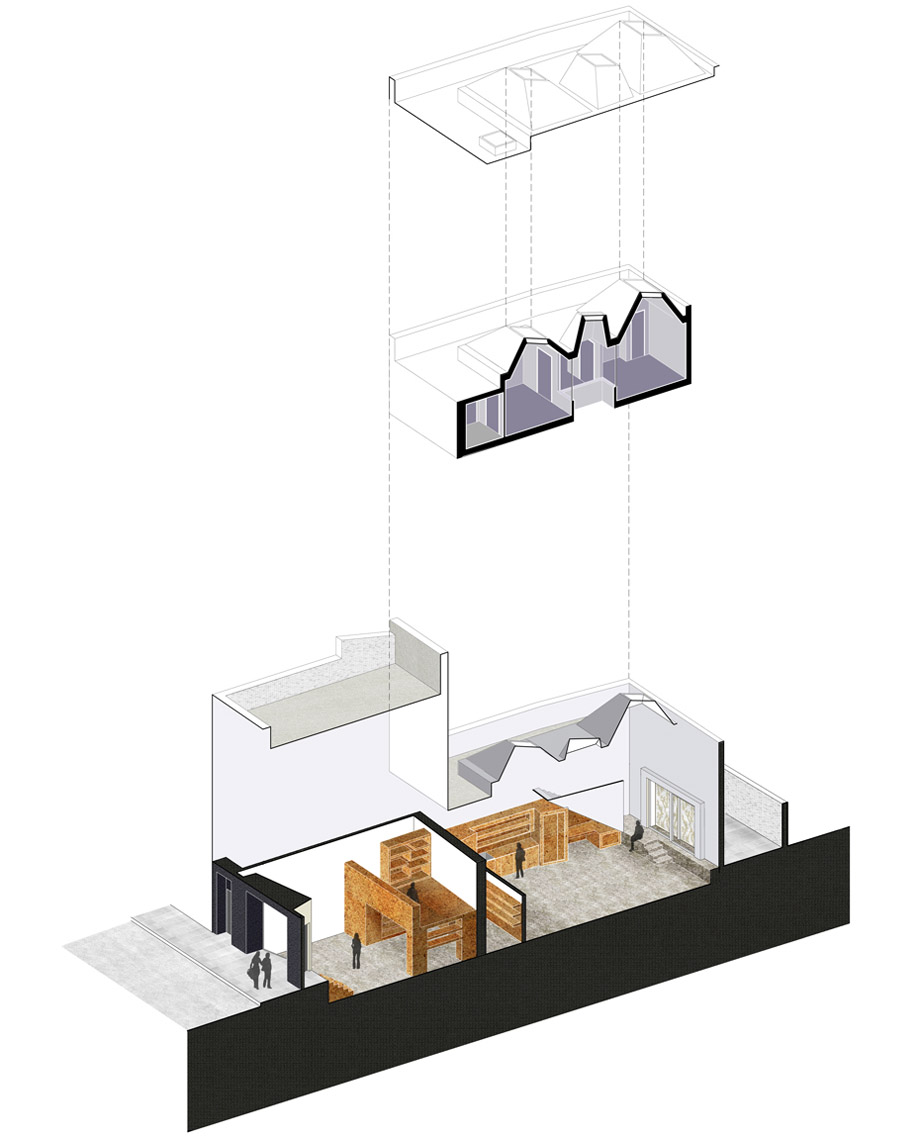
Carved from an existing high street office and yard, the project creates a new house and high street office.
HIGH STREET is a flexible office space that has been spatially intensified and reconnected to its locality. The shop front is defined by a deep cut that encourages pedestrians to engage with the interior, allowing a spatial dialogue between street and office.
HIDDEN HOUSE is formed between existing commercial buildings. It responds to its location by creating an architecture that is internal, intimate and informed by light and materiality. It reinforces the transition between the publicness of the city and the internal intimacy of home. Living spaces interface across a central 7 metre lightwell, allowing bedrooms and living areas to overlap and connect. This interface between spaces allows programmes to infect one another and create a vibrant social experience.
HIGH STREET and HIDDEN HOUSE provide a way for the city to create more housing on existing sites providing unique spaces at low cost.
项目一: T+T一二号楼 从High Street 到Hidden House,伦敦
建筑事务所:Teatum+Teatum
类型:私人别墅及工作室
建造价:400,000英镑
Hidden House坐落在西伦敦一处出其不意的后街角。它巧妙的利用了城市间的间接空间,把被遗忘的角落转变为了一所现代的私人住宅,让使用者在喧哗的城市里可以享受到安逸和宁静。
住宅分为两层,一层是客厅且中部是一个挑高7米的天井,并连接一层和上层的卧室。每间卧室均有天窗,并被玻璃樯隔开在天井两边(参见剖面)。不论位于客厅还是卧室,视野都可以穿过整个住宅看向蓝天。天窗是这所住宅的独特之处,此设计利用了选址的局限性,巧妙的利用顶光源改变了以往人们对窗的习惯理解。我们特意选取了蓝色壁纸和原木地板与天窗相结合,从而创造出不一样的私密空间。建筑外部则是采取机简的设计风格,着重细节和选材。
High Street是连接着Hidden House的临街部分,是一个从伦敦维多利亚时期的老楼改建成的工作室。目的是探索如何把工作环境和城市相结合,让路人透过3米高的巨大窗户直观室内空间并产生互动。室内结构创造了‘盒中盒’的设计架构,其理念是将功能性的空间与办公空间分离:较小的木质盒子聚集了打印间、洗手间、茶室和会议室的功能,外层的白色盒子则是开放式的办公空间。在它将公司内外连接的同时也对其内部的隐私提供了某种保护。整个建筑地面下沉1.2米,这样不仅在局限的空间里容下第二层的会议室,而且创造出一种错落的空间体验。
MORE:
When:2002 to present
Where:London, UK
Who:Na Li 郦娜
From:Nanjing, China
How:Graduated from Bartlett School of Architecture, UCL. Now working at Teatum+Teatum in London
Contact:na.li@live.com
www.6uan.com
www.teatumandteatum.com
手绘太酷了真的 叹为观止的表现细节和图面表达
这手绘,碉堡了
文化差异太大还是教学差异太大~我不能完全的读懂里面的设计~希望回来以后能知道与适应中国现阶段的建筑。
超现实主义,很炫。我很想知道那些看似手绘的图是真的自己画的还是p的?
NB!
woo!劲!
国外的 设计还是比较喜欢线条的应用
很不错的表达,精心的研究,精雕细琢的古建筑。相信你熟知它们的结构,其实建筑除了百年无事故,还可以关注建筑的低碳、绿色,古代的无混凝土建筑,那些穹顶,那些拱桥、斗拱、横梁足够研究一辈子
15..
第一第二俩作品看得我心花怒放啊!【现在喜欢古典主义的不多啊,跟工业风格结合的更是罕见啊!【手绘(那是手绘吧?)的表现力碉堡了!
看不懂
WOW!!! Steam Punk!!!
漂亮
求给一张画,我要挂我卧室里。太美了。。。。。。。。。。。。。。。。[眨眼]