非常感谢Daniel Rozin将项目介绍和项目图片授权gooood发行。更多请至:Daniel Rozin on gooood
Appreciation towards Daniel Rozin for providing the following description:
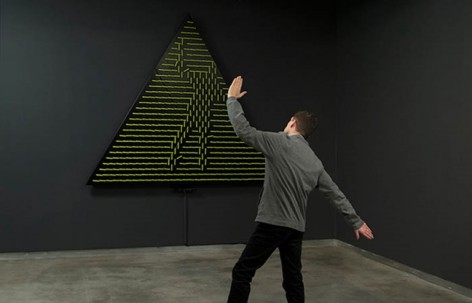
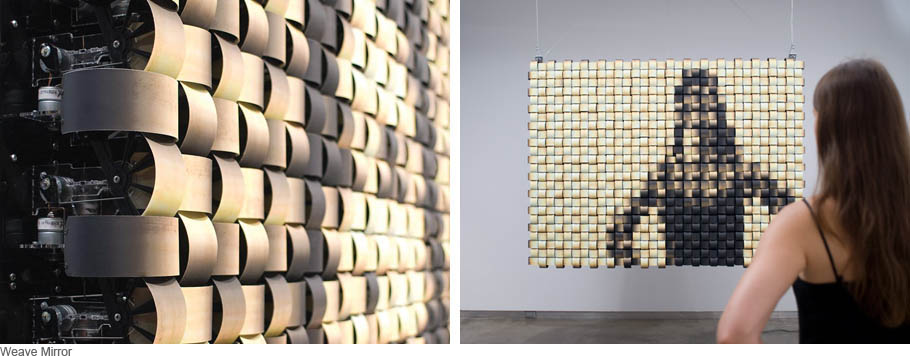
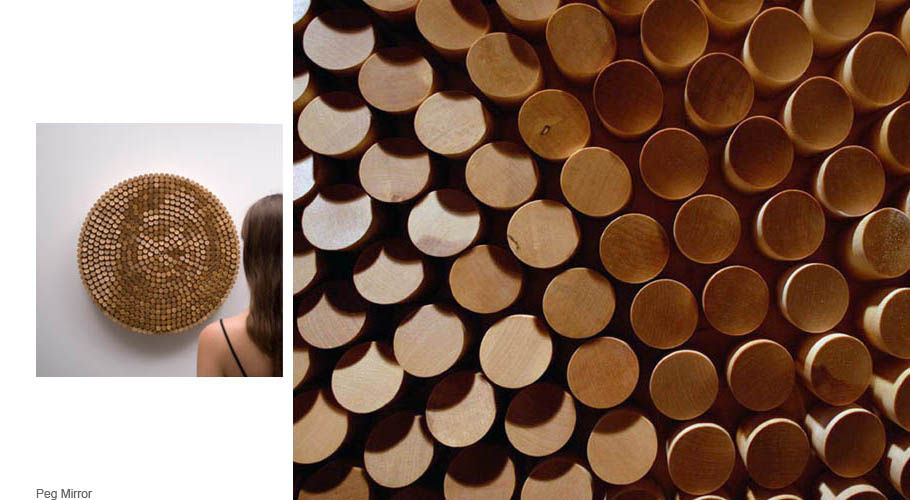
艺术家Daniel Rozin创作的一系列可以和人行为发生互动的雕塑装置,这些雕塑装置就像是机械化镜子,用他们独特的方式映射着人们。这些装置大多是壁挂式的,配有隐藏式摄像头,当人进入8英尺的互动范围,装置就会反映人的行为。
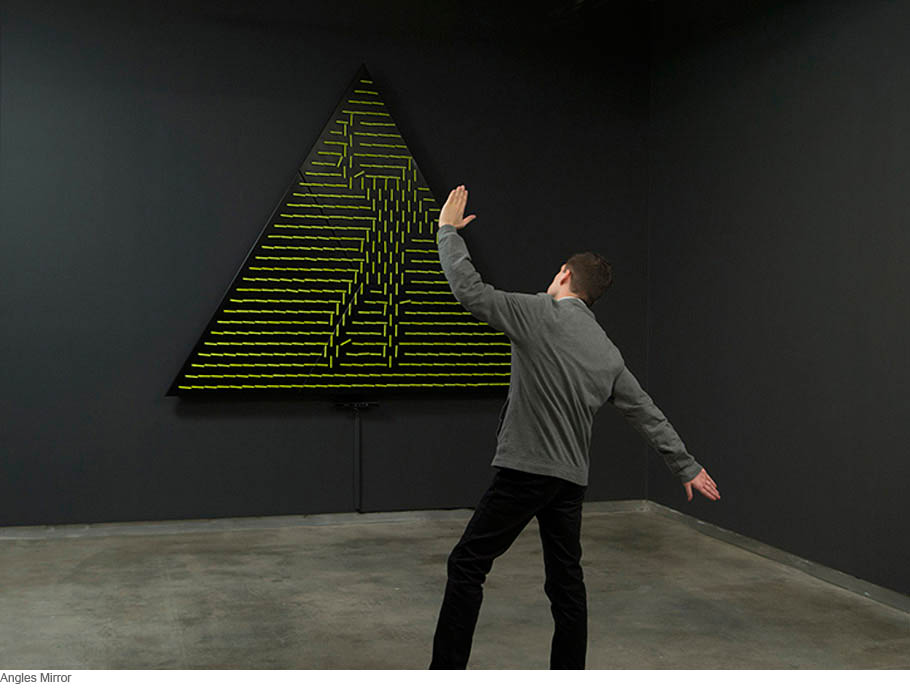
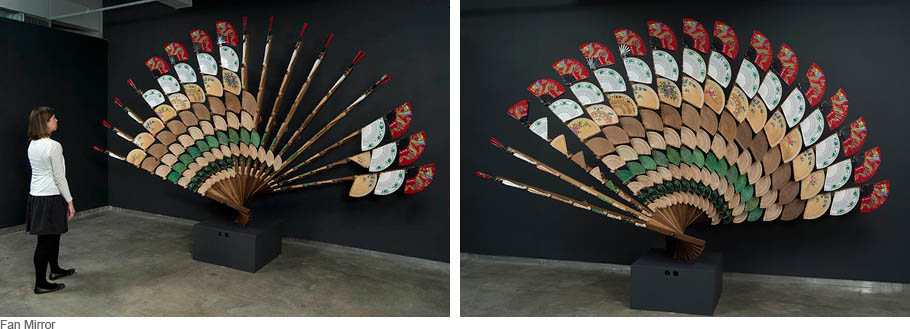
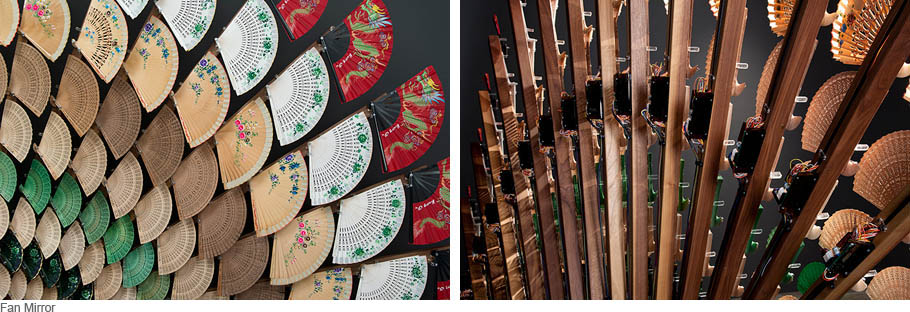
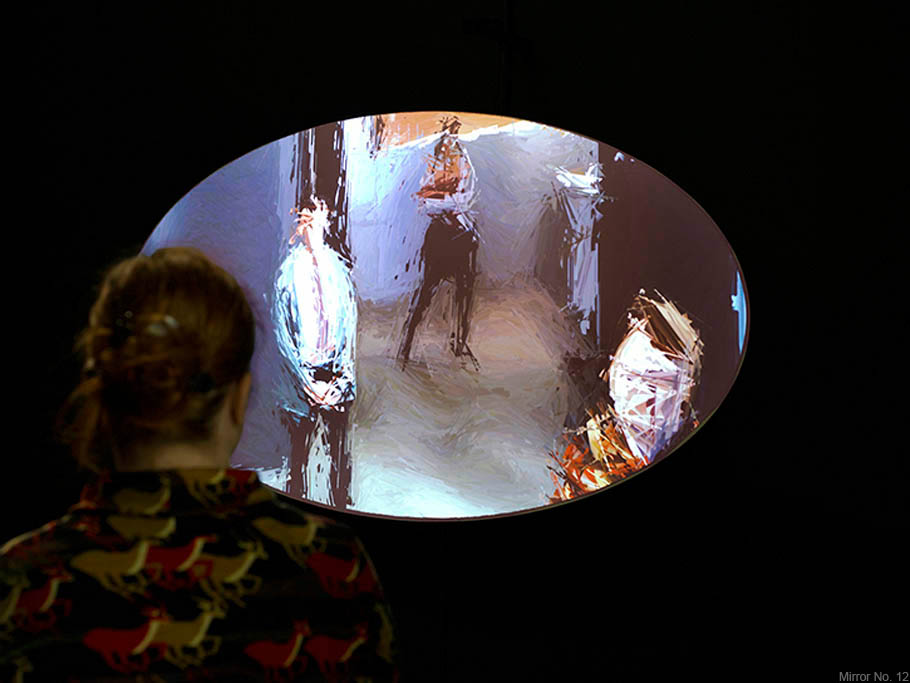
其中一个装置是等边三角形,上面配有黄色的粗线,这些粗线可以旋转,形成相应的图像。还有一个像大折扇的装置,这个装置由许多小折扇构成,当人们走近时,折扇背后的电机就会运作,让折扇形体变换形成观众的剪影。还有一个椭圆形的装置,会把人们的身影以艺术画的方式显示出来。
Here’s some more information from Daniel Rozin :
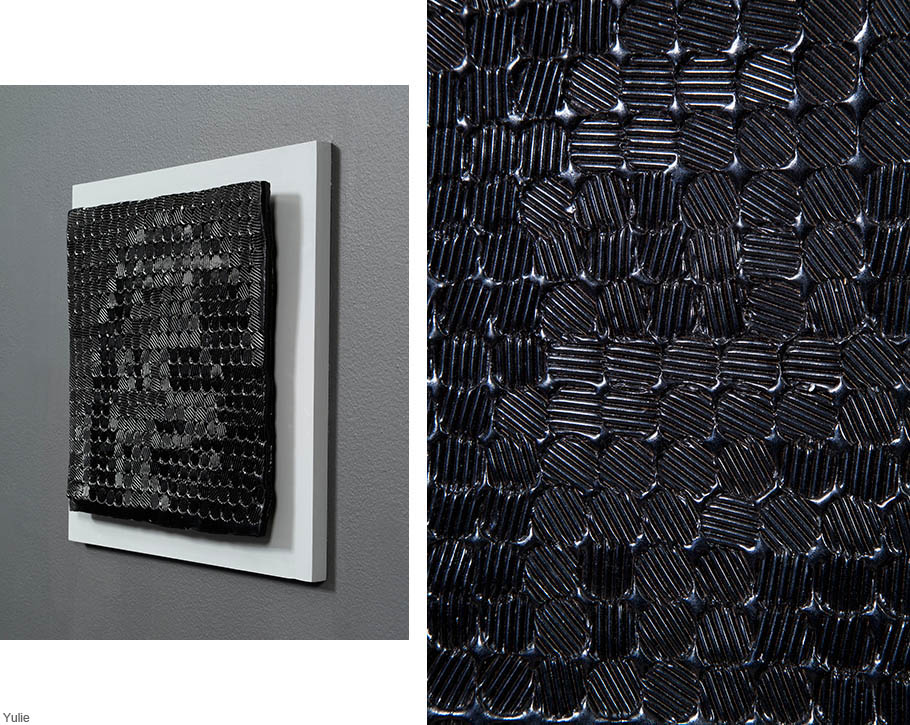
Since the late 1990s, Rozin’s constructions in software and sculpture have investigated the psychological and optical cues inherent to image building, such as pattern and the materiality of the picture plane. In a departure from the traditional rectilinear grid, which was the foundation of his 2010 exhibit X by Y, Rozin’s new series of work proposes another geometric basis of image creation. Focusing on rotational systems of orientation, Angles celebrates the polar, or angular, notations of pictographic information. Using the triangle and sculptural elements that twist their shape, Rozin’s conversation of the grid highlights a new dimensionality of formal representation.
In Rozin’s work, the picture plane’s transformation is a means to explore animated behavior, representation and illusion. Merging the geometric with the participatory, Rozin’s installations have long been celebrated for their kinetic and interactive properties. Grounded in gestures of the body, three pieces in the exhibit Angles are mirrors of various sorts and respond to the presence of viewers in real time by recreating a visual representation of their likeness.
Fan Mirror is a free-standing sculpture that measures fourteen feet across. Its overall shape and rounded frame suggest the folded oriental hand fan, a decorative object that first emerged in the 10th century and gained popularity during the Ming Dynasty. The sculpture is comprised of seventeen ribbed wooden spokes that support a total of 153 hand fans, in an array of sizes and colors, from Korea, China, Taiwan, Spain and Japan. Crafted from materials ranging from sandalwood and synthetic silk to plastic, each fan is actuated by a motor that is computer controlled, causing the bands to spread open and rhythmically close. Sweeping patterns roll across Fan Mirror’s arced surface, blossoming in rings that resemble an onion peel or peacock’s tail. The sequence of movement in this work is directed in part by the viewer’s engagement. When approached at close range, the fans, which are also connected to a camera, move to create a rough silhouette of the viewer within the sculpture. When viewing from a distance, the movement is generated by an algorithm programmed by the artist.
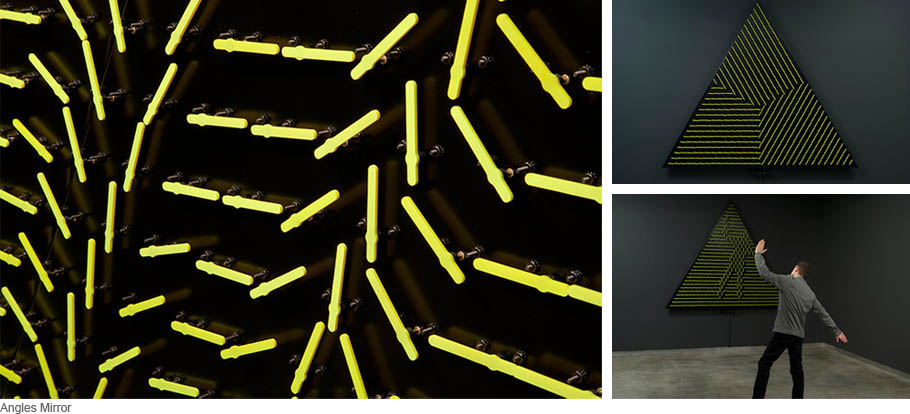
The Angles Mirror rejects the idea of building a picture based on relative lightness and darkness. Instead, it explores a system of linear rotation that indicates the direction of an object’s contour. A wall-mounted sculpture, the Angles Mirror is a sharp triangular block of steel, dotted with yellow indicator arms that pivot. Based on the isometric grid, its structure favors the patterns and angles found in an equilateral triangle. The arms, which do not have the ability to change brightness or luminosity, use input from a camera and reconstruct the view with areas of varying angles. The negative space surrounding a viewer is translated into horizontal lines on the picture plane. Rather than creating a photorealistic image, the three-dimensional movement of a figure is represented, visualizing optical flow as viewer’s proximity to the sculpture changes. A nuanced contour results, as the viewer shifts back and forth, altering how the structure of space is perceived. Similar to Fan Mirror, in the Angles Mirror, the sequence of movement across the picture plane is directed in part by its audience. When the viewer
walks away from the work, or chooses to view the sculpture from a distance, a series of predefined images and transitions cover the object’s surface.
Mirror No.12 is a color video projection that processes live imagery captured from a small camera. Taking upon itself the same image building restrictions as the Angles Mirror, Mirror No.12 uses the rotational transformation of line as the sole means of representation. Resulting in a painterly texture, the artist-authored software manipulates a finite set of straight lines that spin from one position to the next, in an attempt to replicate a visual scene’s angular contours and features. Cropping the camera’s frame and virtually torquing its imagery three-dimensionally, the projection is bounded by an oval, evoking the surveillant effect of an observer gazing through the peephole in a door.
Inspired by Op Art from the 1950s and 60s, Twisted Strips is a kinetic sculpture that explores serial image generation and perceptual illusion. Breaking the picture plane into a black field with twenty-one motorized white vertical strips, the sculpture produces rhythmic waves of movement. The animated pattern shifts in arc and frequency, as the two motors on each strip continually rotate in and out of phase. Using an approach visually analogous to the tape loop structures found in minimal music and phase music, new shapes constantly flow through the composition, which are perceived by the eye as a singular picture in motion.
BIOGRAPHY
New York-based artist Daniel Rozin (b. 1961, Jerusalem, Israel) creates interactive installations and sculptures that have the unique ability to change and respond to the presence of a viewer. His art is part of numerous public and private collections including the Chrysler Museum, Borusan, AT&T, Fidelity Investments, the Fundacion Privada Sorigue, the Perot Museum of Nature and Science, and MUSAC Fundacion, among others.
Past exhibitions of his work include the Reina Sofia National Museum, Madrid; Victoria and Albert Museum, London; The Garage CCC, Moscow; The Israel Museum, Jerusalem; Milwaukee Art Museum; Whitworth Art Gallery, Manchester; Taiwan National Museum of Fine Art, Taipei; ICA Portland, Maine; the Central Academy of Fine Arts Museums, Beijing; the Peabody Essex Museum, Salem; and the Sundance Film Festival. In Fall 2014, he will open a new installation commissioned for the Taiwan Taoyuan international airport.
MORE: Daniel Rozin,更多请至:Daniel Rozin on gooood









好强大好强大好强大!!!!!!!!!!!!!!!!!
想要那个印象派的~ @倒塌斯基
好强大
好强大!
超有意思