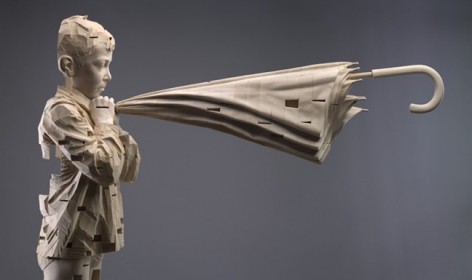
非常感谢设计方Gehard Demetz将英文介绍和项目图片授权gooood发行。更多请至:Gehard Demetz on gooood
Appreciation towards Gehard Demetz for providing the following description:
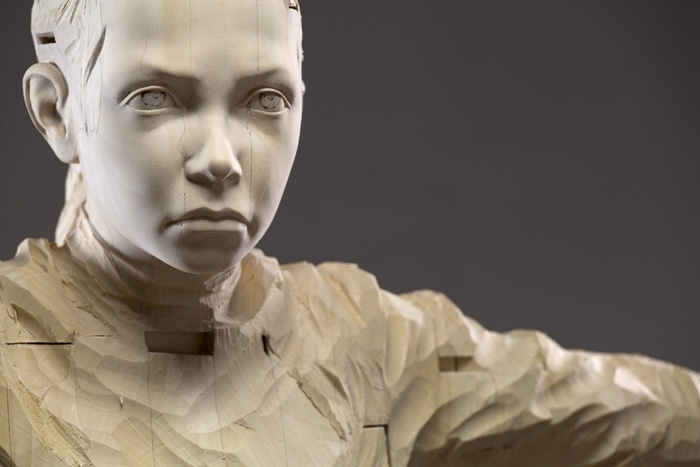
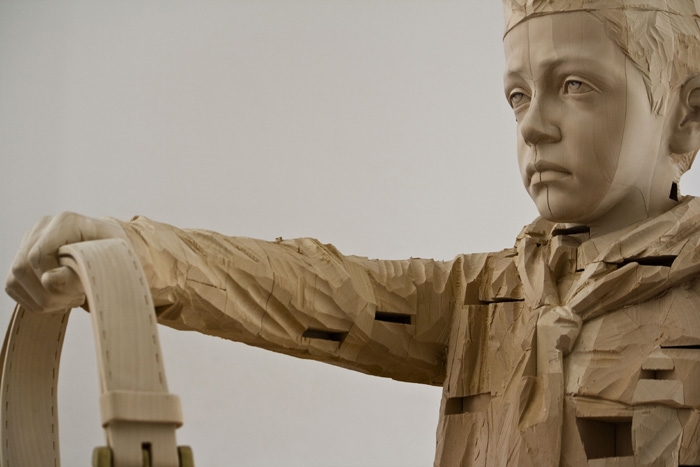
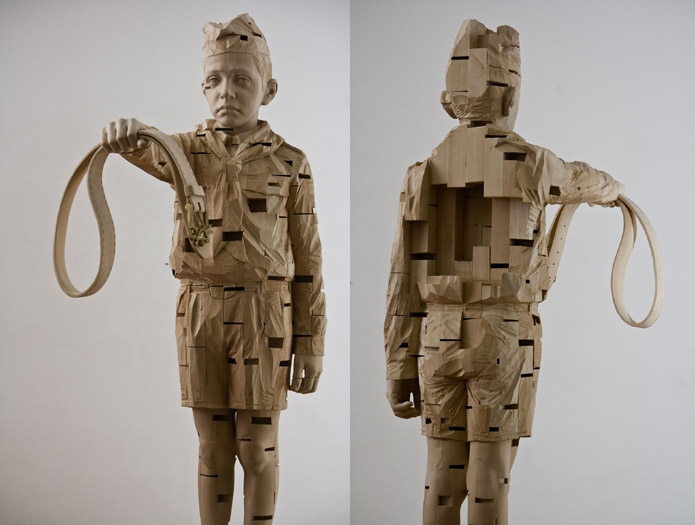
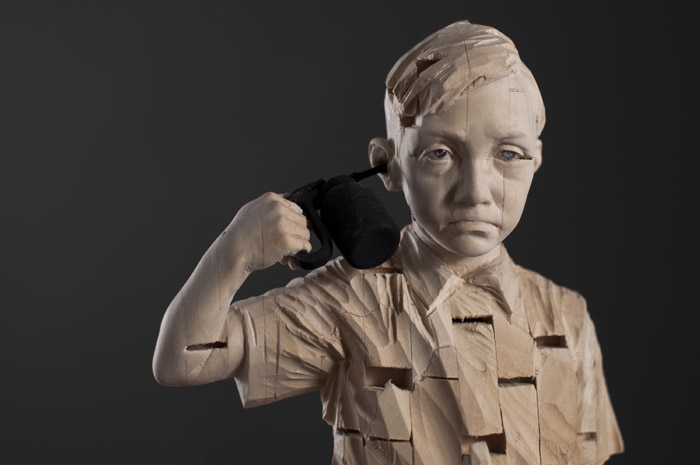
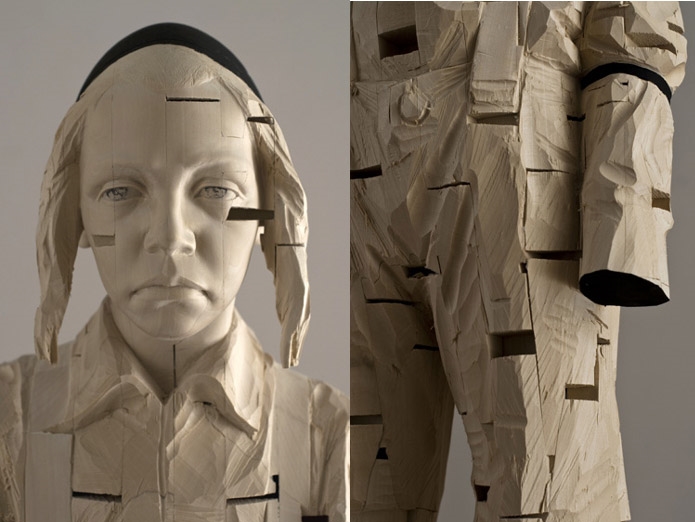
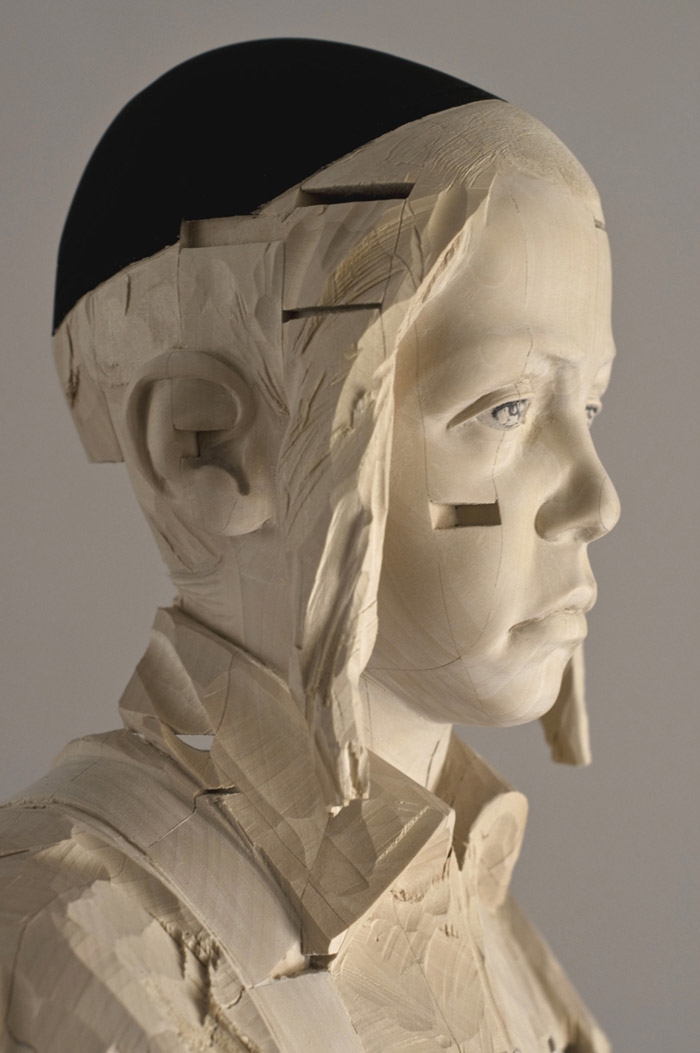
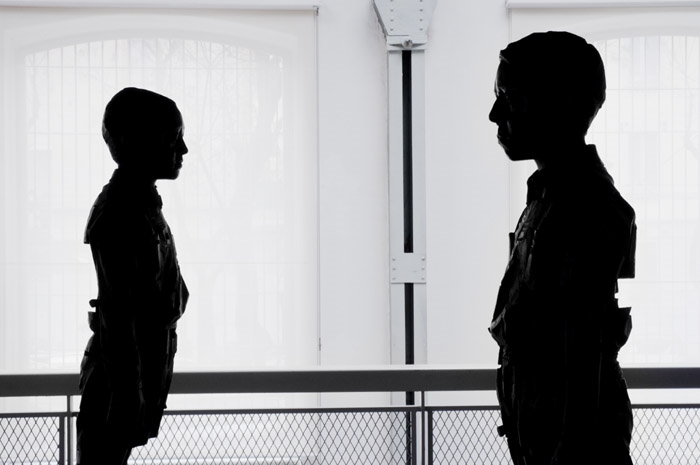
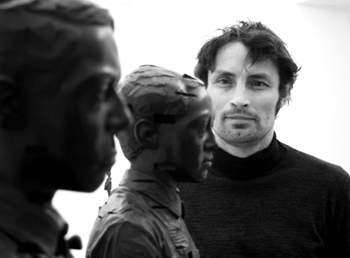
不可思议的悲伤,孤独,冷漠,绝望,抑郁还有独特。你无法离开,你想要对视。他们只是木头,但他们那么真实;他们如此寂静,但他们极具张力;他们沉默,但他们具有很强的传达力;他们是被凝固的一瞬,但他们下一秒蓄势待发。堪称完美的木雕作品,突破禁忌,给人带来更深层次的体会。艺术家Gehard Demetz于1972年生于意大利,现在生活居住在Selva di Val Gardena。他的雕塑具有非常强烈的故事性,就像是文艺复兴时期的故事画,挑选出了全部“动作”里最耐人寻味和想象的那“片刻”。包孕着许多“表情”而只生产出一个“表情。”继往开来,戛然而止,却悠然而长。引发你我的震撼,猜测,还有思考。气场如此强大,每一个都像一个完整的时间体加空间体加叙事体时间体,一旦进入,就会被吸入。
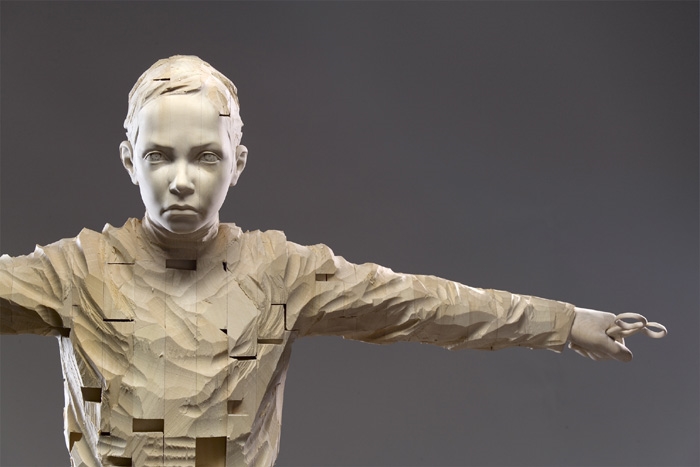
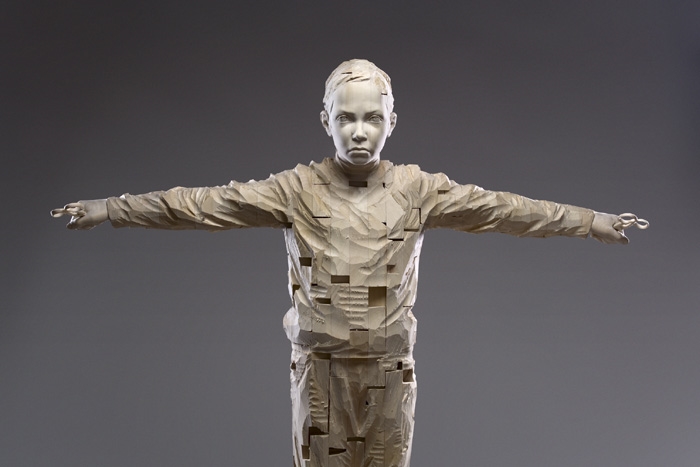
最近Marco Meneguzzo评论认为他的作品非常完美但无关乎年龄。他并不是一个儿童心理学家,只是一个雕塑家,他雕塑的不是孩子们,只是儿童雕塑。
更早时期还有评论认为他的作品就是表达的人,这就是部分儿童和青少年的写照,他们在成人的世界被忽略。这是一个向世界提出质疑的雕塑。同时漂白的木材,防腐木的质感;雕塑上的木块间隙;雕塑使用的道具,还有那封闭,深不可测的孤独眼神,都越发的使得这些作品无敌的冷寂和独特。这是唤醒人心的雕塑,让人们去反思一些问题,具有教育意义。
在访谈中Gehard Demetz说:我从小就被那些巨大的的宗教雕塑所陶醉。并对儿童和成人的行为态度非常着迷。无法理解之处就会引起我的想象。然后我到处画着草图,进行着创作。成长过程其实是蛮艰难的。许多的“恶”都源于自身,但是长大孩子会懂得控制,因此我觉得8岁以前的小孩子就是天才博物馆。婴儿期的小孩则有更多不确定性,什么都有可能发生。我认为我的作品就像是真正的人,具有很大潜质。我个人的童年感觉就非常的敏锐。雕塑有些部分是空的,但是能保证平衡,有时我会插入道具和特别的色彩。我认为这非常迷人。我期望做到可以和雕塑进行对话。
艺术家为gooood提供了三篇文章,选择了一篇:时间最近,2011年Marco Meneguzzo做的评论。
Solo Show:Gehard Demetz, Sala de Exposiciones Palacio de Pimentel, Valladolid
photo © Egon Dejori, Martino Gerosa, Antonio Renda
The artist and Galleria Rubin, Milano
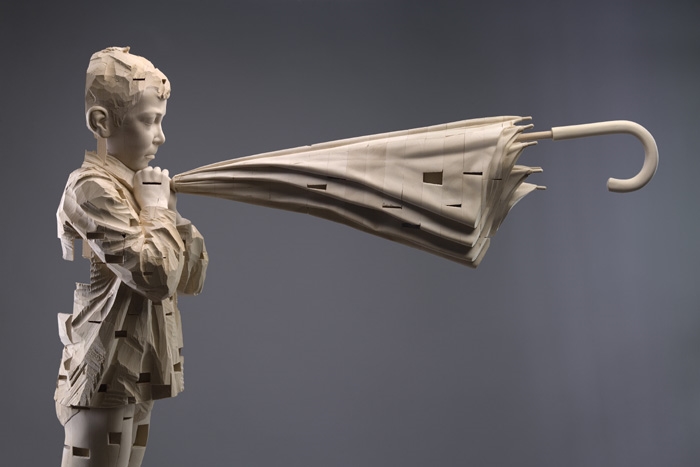
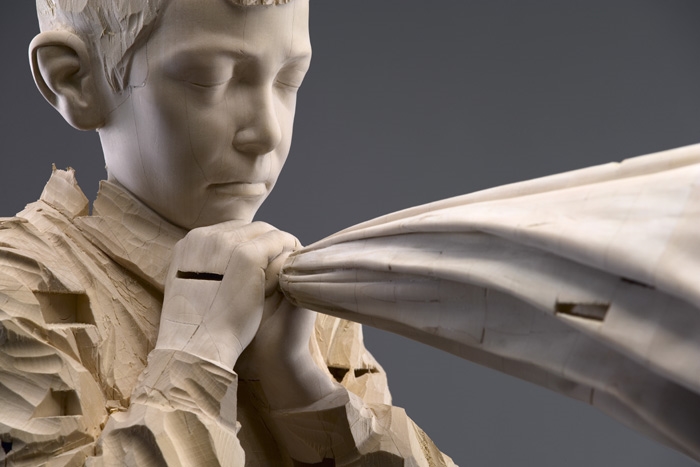
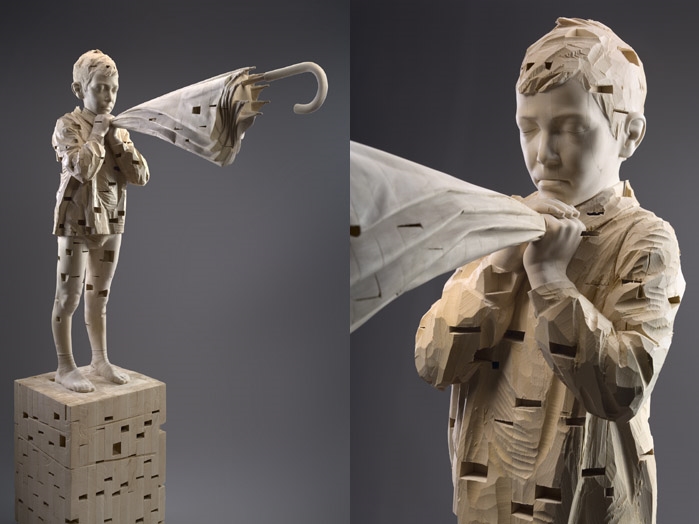
The extraneous age by Marco Meneguzzo
It’s impossible not to talk about children when one is speaking about Gehard Demetz’ art. His art is the perfect proof that speaking about art without speaking about a subject, a story, a reference to what is represented but only about ‘how’ this subject and this story are conceived by the artist, is essentially not possible, to the disdain of theorists of pure visibility. But perhaps it is possible to speak about it differently from the way attempted usually, taking Demetz’ work as a pretext to ‘explain’ the nature of childhood, that is as the formal consequence of a sensation, of thoughts on childhood. In other words, one should not consider the children sculpted by Demetz as the pure and simple explanation of real children, where the cause – his thoughts on childhood – corresponds to the effect – his sculptures of children.
On the contrary, it’s true that Demetz’ sculptures represent, on the one hand, the nature of childhood, and on the other they unveil it, and on another again they construct it and yet they are not the effect of a cause; they are all of these things at the same time. Demetz is not a child psychologist, he is a sculptor. His children are not children; they are sculptures of children.
Why then is the temptation to speak only about childhood so strong, so predominant? Why is the only subject chosen by Demetz so symbolically potent and so rhetorically laden that it tends to make the viewer forget the artifice which has created these works, like a story which is so naturally moving that the way and words in which it is narrated are of secondary importance. Childhood (not adolescence, note), is a taboo which cannot be discussed unless in rhetorical terms: this is why it is a strange, indescribable, ineffable age. It hides behind its own presumed innocence so it is not unveiled, to remain in that state that cannot be tarnished by ordinary words, but only by actions which ‘get round’ these defenses erected by common place rhetoric.
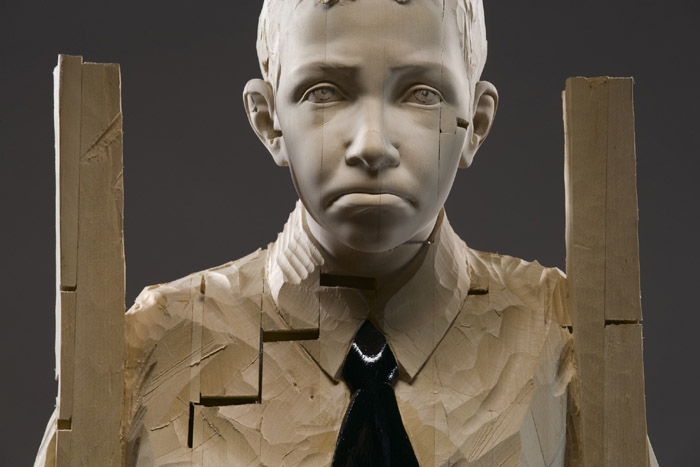
One way is certainly through science, where the authoritativeness of the discipline and its superior purpose allow us to speak of it in crude terms. Another way is that of art, which gets round the rhetoric of childhood with the rhetoric of art. It is of the latter that we must speak when we speak of Demetz because his challenge is to overcome the bastion of rhetoric through an even more potent rhetoric. In other words, to create sculptures of children one must be ready for anything, to devise rhetorical systems – visual, perceptive and narrative, in our case – which succeed in overcoming the common taboo about childhood to narrate something new or simply deeper.
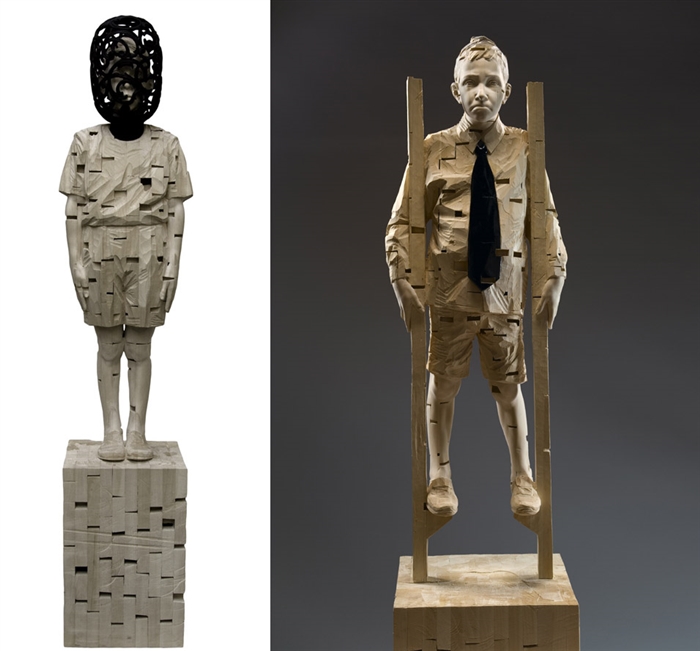
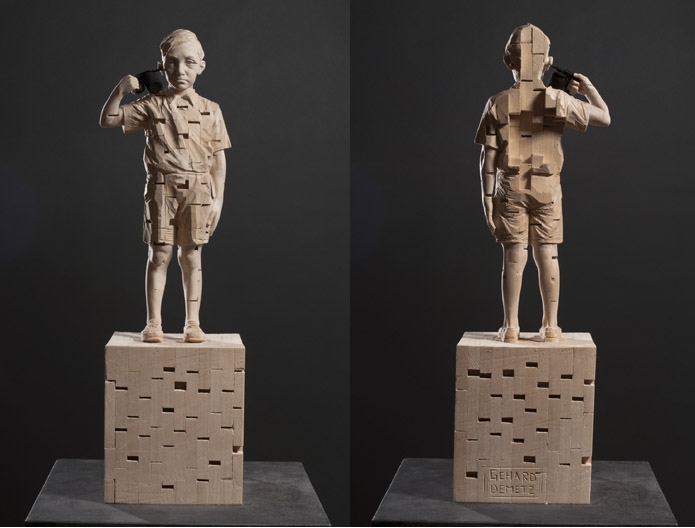
And if the choice of this subject is moved by who knows what impulse, memory, nostalgia, some fear in the artist, it does not concern us, unless as some personal curiosity. Therefore, let’s concentrate on “ Once upon a time there was……. a piece of wood” (Collodi, Pinocchio). One of the most formally and idealistically important elements, and most recognizable in Demetz’ work, is what is missing. Missing links, the space left between one part and the other: the figures are complete, but they are visibly ‘disturbed’ by this imperfect assembly, exactly as what happens on a digital screen when there is an electronic disturbance of the pixels (glossing over the fact that often the back of the sculptures is hollowed out as if blank spaces have been created by removing material, or were waiting to be positioned, in a sort of construction of building blocks, like the children’s game).
This effect reminds us that it is a depiction of a ‘figure’ (the Latin etymology of which has the same root as ‘to shape, to mould’ and where the fictor is the sculptor…), and not from the reality of childhood. When figures appear which represent something that is taboo, we too, even in our hyperdeveloped society of images, tend to identify them with some real object; in this way Demetz, who is perfectly aware of this psychological mechanism, wants to constantly emphasise the gap that exists between art and reality, a gap which, in this case, our vision, clouded by the power of the child subjects, tends to remove.
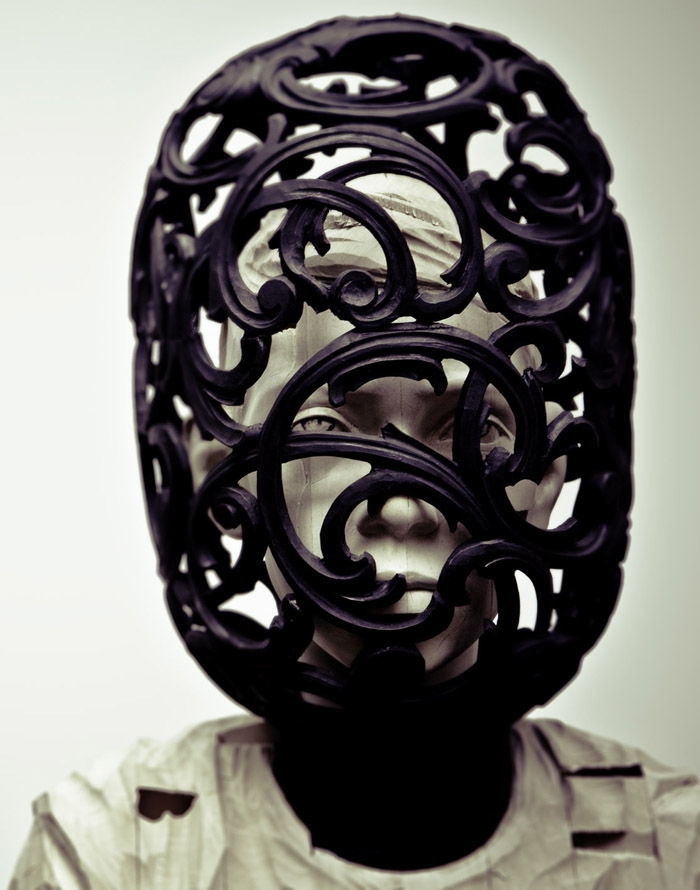
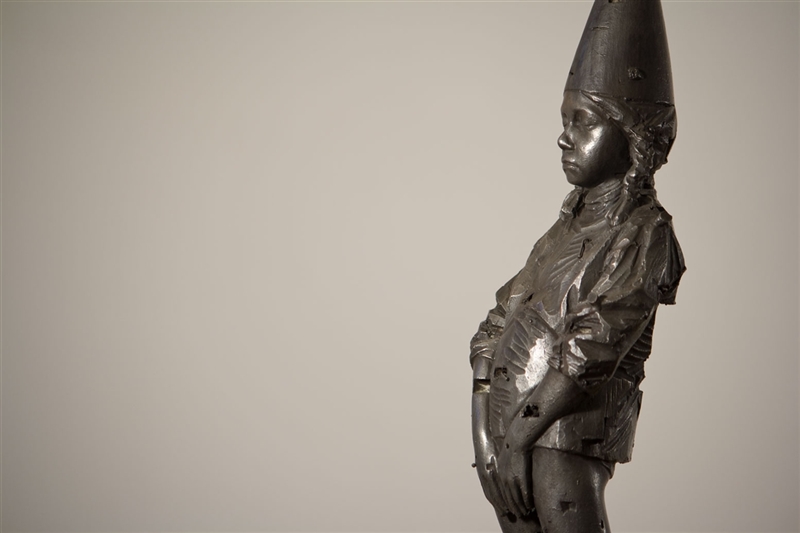
As in classical sculpture or mid European 16th century wooden sculptures, which the author has declared himself to be inspired by and to which tradition he belongs, only the most ‘important’ parts of the body are finished perfectly (in classical sculpture they were in marble and the rest of the body in stone, while in the German Renaissance more attention was lavished on the colours and intonation of the faces and the expressive parts of the figure) while the rest seems to be put together in an ‘almost’ precise way, and it is not by chance that an integral part of the work , the plinth, the base on which the figures stand, reiterates the sense of ‘sculpture’ as oppose to that of imitation or mimesis. Furthermore, a recent variation is one which sees these sculptures in bronze, from the original wooden matrix: another step – concept/ construction in wood) negative form/ plaster/ fusion in bronze – which removes the production, and most probably our glance, from an excessive adherence and nearness to the model.
Thus, once the ‘right distance’ has been established between the work and its subject, one can finally go back to talking of the latter, that means the condition of childhood that is so paradoxically extraneous, even though we have all experienced it. Analysed meticulously by all those who have written about Demetz (from Maurizio Sciaccaluga to Cecilia Antolini, from Rolf Lauter to Luigi Fassi) all the canonical references have been discussed, from Rodolf Steiner’s pedagogy to the childhood memories of Elias Canetti, from analogies with the ruthless children in ‘Lord of the Flies’ by William Golding to Oskar, the protagonist who doesn’t want to grow up of ‘The Tin Drum’ by Gùnter Grass (nobody has, however, cited Peter Pan, who would seem mawkish here…) .
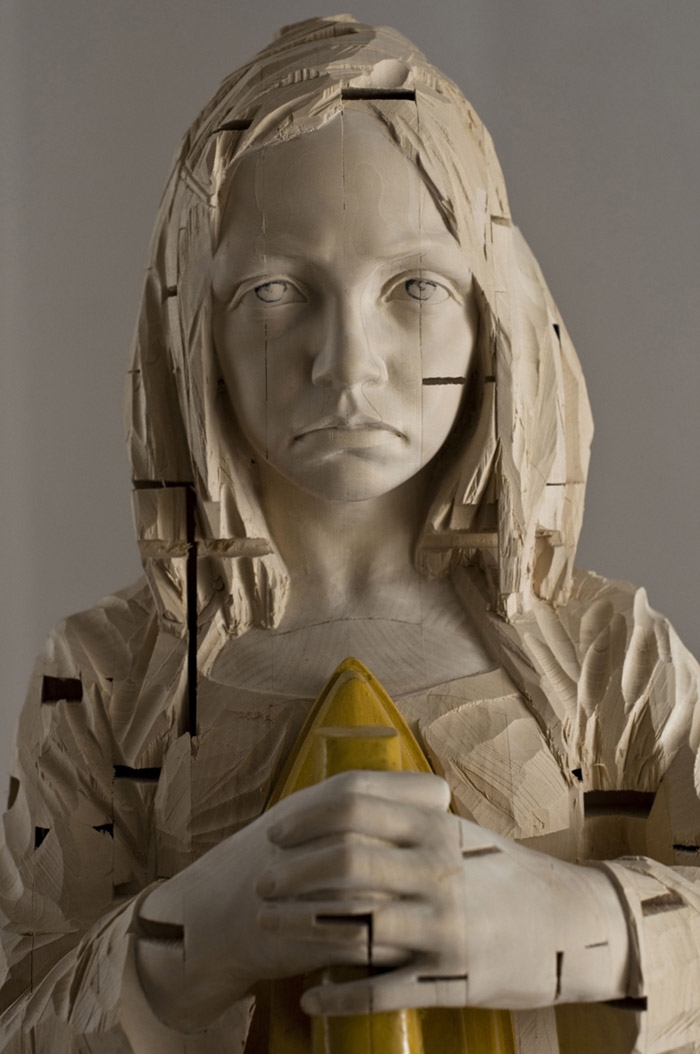
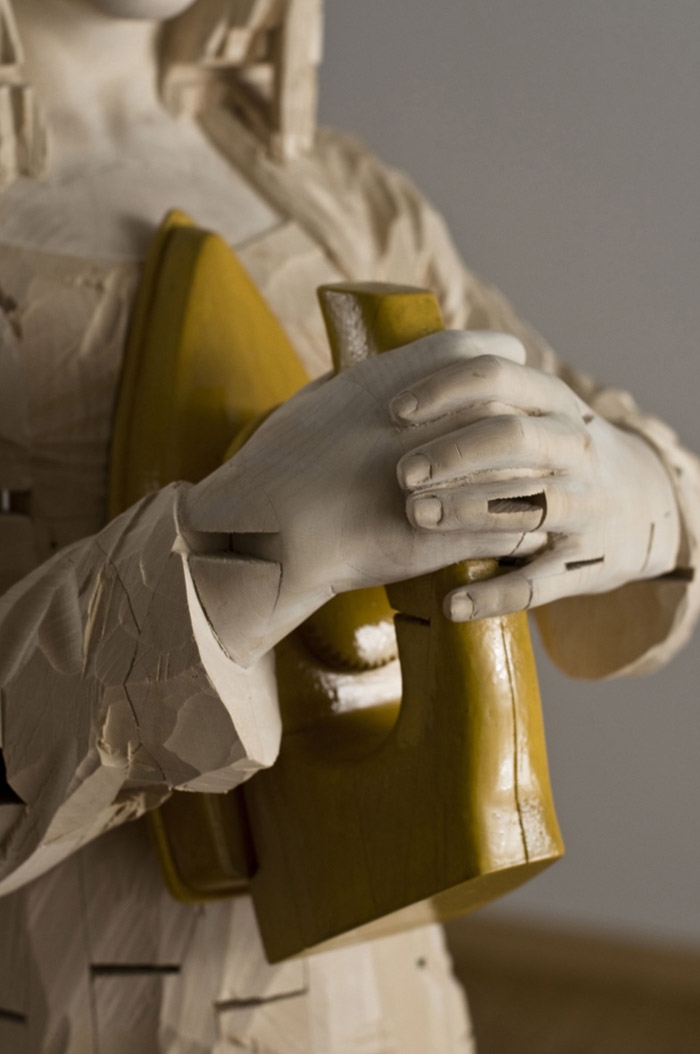
The analogies and references are and can be numerous, and almost all of them correct. Perhaps, however, it would be better not to turn to analogies – ‘as if…’ -, but rather to the evidence of ‘how it is’. Demetz’ characters do not generally look at us, rather they are engaged in an action or thought which does not belong to our relational reality but to an interior world which has its own rules, which we cannot know but only understand as being different from ours; Demetz’ children execute actions which are identified by the objects they are holding in their hands, but which we do not know and which they, instead, know very well and which they are determined to carry out (sculpture in action?…..) Demetz’ children are extraneous from us, and for this reason we are attracted to them; in the end we are not frightened by Demetz’ protagonists, albeit they are deliberately disturbing, because underlying our attraction to them is the awareness that they are figures not individuals. And so, paraphrasing the quote from Pinocchio (and changing it a little….) “ once upon a time there was….. a child, you would say, but no. “Once upon a time there was a piece of wood”.
MORE: Gehard Demetz,更多请至:Gehard Demetz on gooood








厉害
这也太酷了吧
传神!