非常感谢 华中科技大学李保峰教授工作室 予gooood分享以下内容。
Appreciation towards Li Baofeng’s studio of HUST for providing the following description:
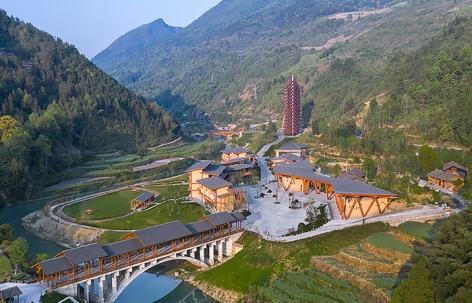
中国湖北省土家族自治区宣恩县藏在深山中,因交通不便,许多优秀的传统建筑以及传统生产方式得以存留,为了宣传土家文化和改善当地村民的贫困状态,当地政府和村民共同开发了中国土家泛博物馆。
▼项目视频,Video
Xuanen County, Tujia Autonomous Region, Hubei Province, China is hidden in the deep mountains. Due to inconvenient transportation, many excellent traditional buildings and traditional production methods have been preserved. In order to promote Tujia culture and improve the poverty of local villagers, the local government and villagers jointly developed Chinese Tujia Pan-Museum.
▼项目概览,Overall view © 赵奕龙
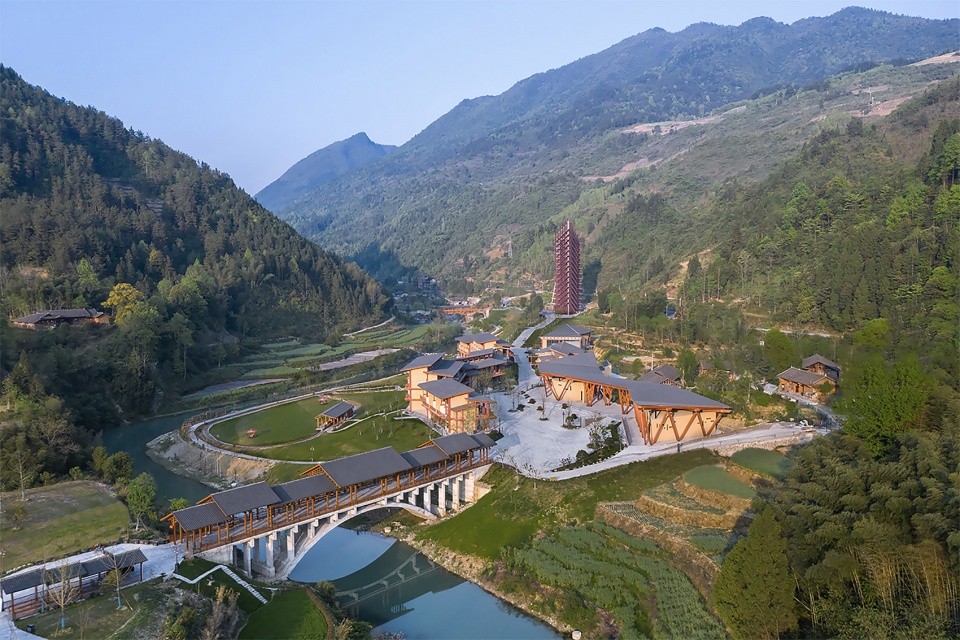
本建项目新建部分包括主游客中心、次游客中心,摩霄楼、墨客桥、地仙桥、土家文化展示中心、研学宿舍及教室等,总建筑面积约为3万平方米。
The new parts of this project include the main tourist center, secondary tourist center, Moxiaolou, Moke Bridge, Dixian Bridge, Tujia Culture Exhibition Center, research dormitories and classrooms, etc., with a total construction area of about 30,000 square meters.
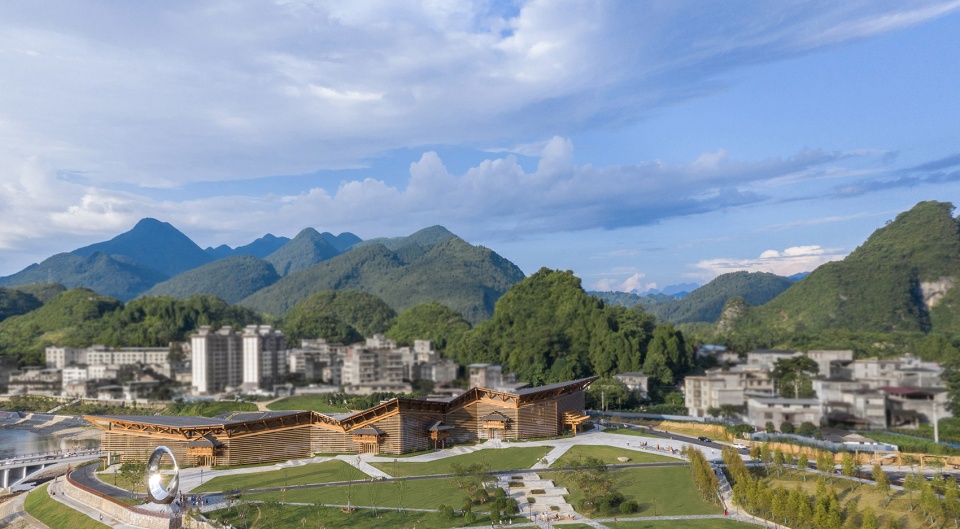
▼俯瞰游客中心,Aerial view to the tourist center © 赵奕龙
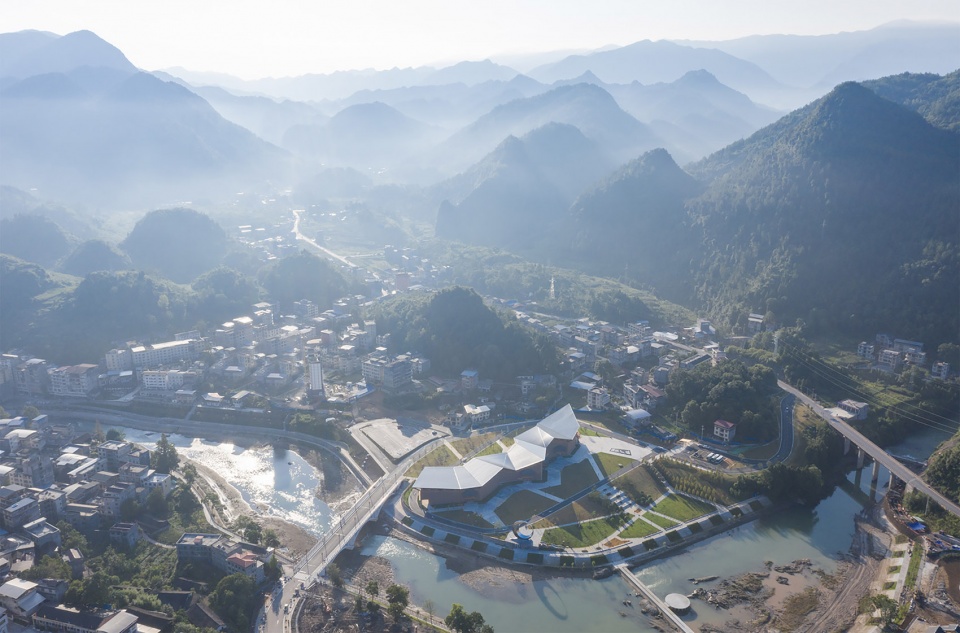
▼远观摩霄楼,Moxiaolou © 赵奕龙
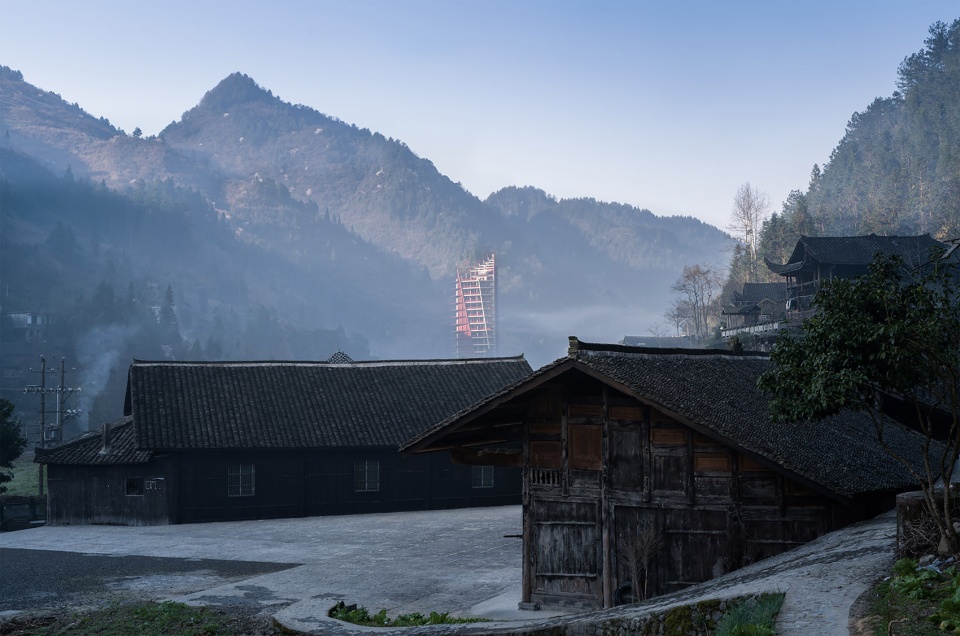
▼远观墨客桥,View to the Moke Bridge © 赵奕龙
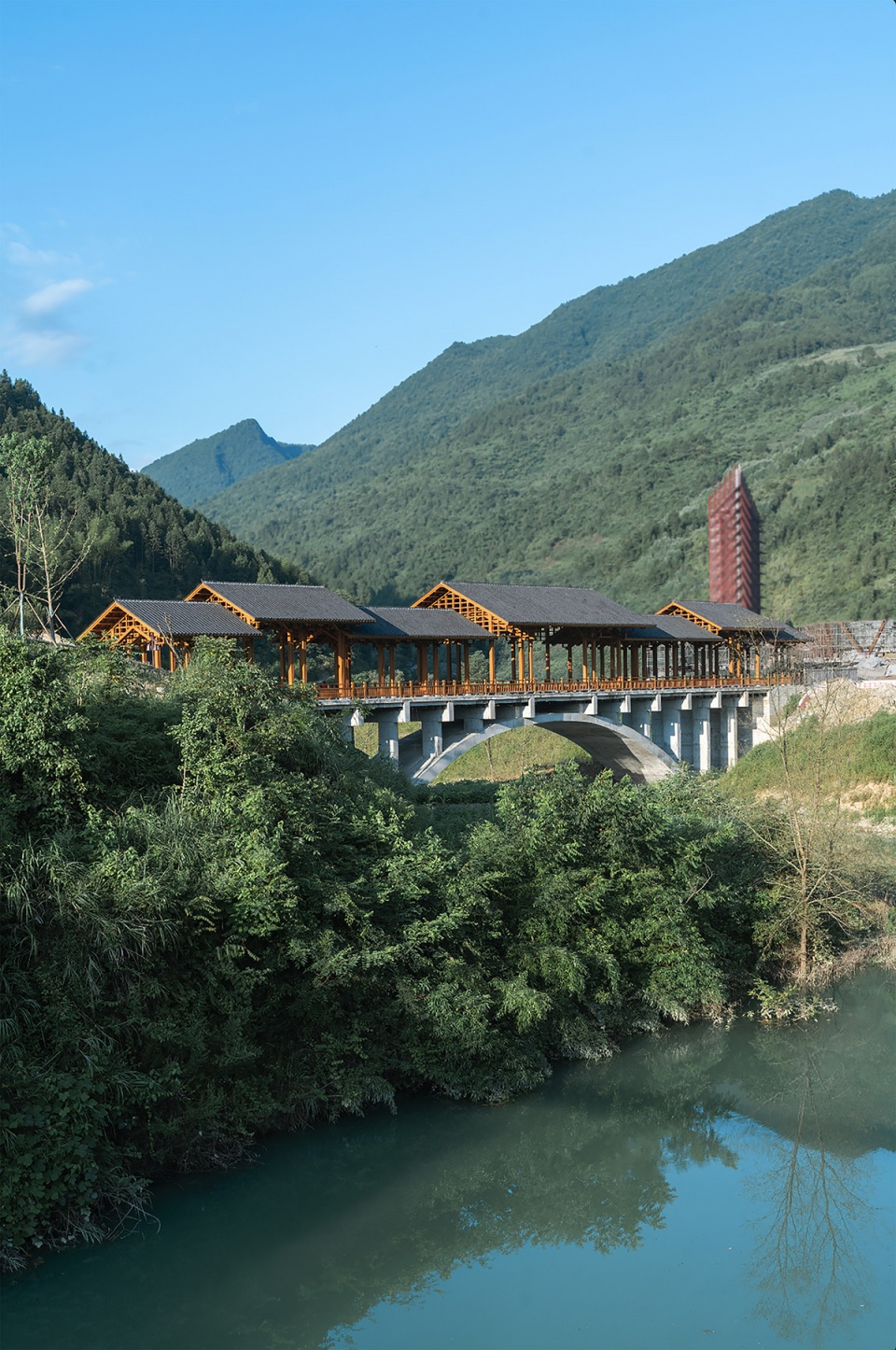
规划和景观设计尊重原有地势地貌,尽量减少对自然的扰动,除了设计了地面标高有变化的主体建筑,还设计了层层叠退、顺应地势的景观。
The planning and landscape design respects the original topography and minimizes disturbance to nature. In addition to designing the main building with changing ground elevations, it also designs a landscape that retreats layer by layer and conforms to the terrain.
▼主游客中心和次游客中心,Main tourist center and secondary tourist center © 赵奕龙
▼研学营,International Research Center © 赵奕龙
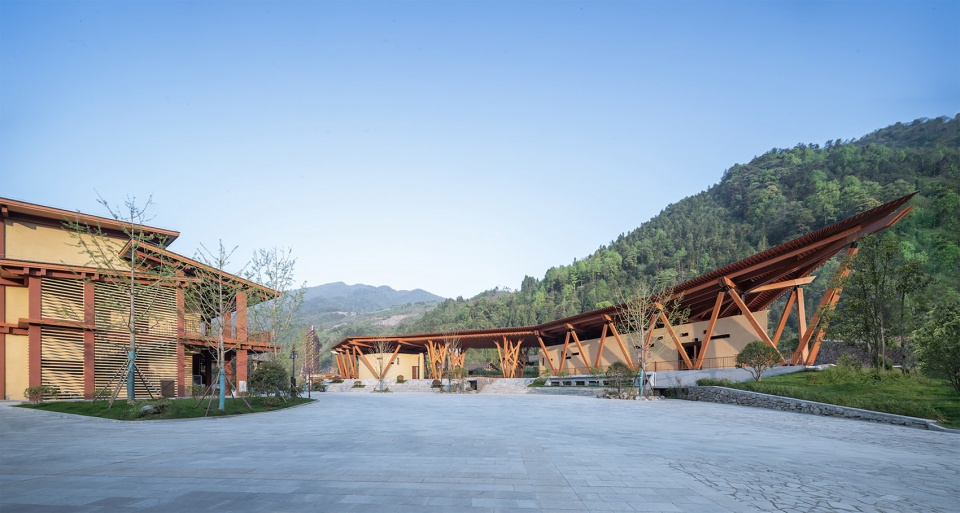
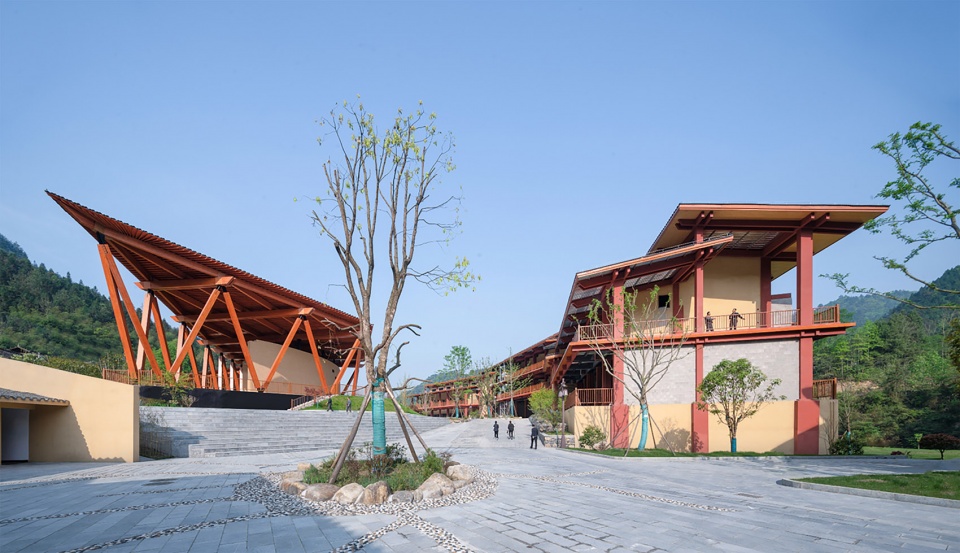
▼主游客中心外观,Main Tourist Center exterior view © 赵奕龙
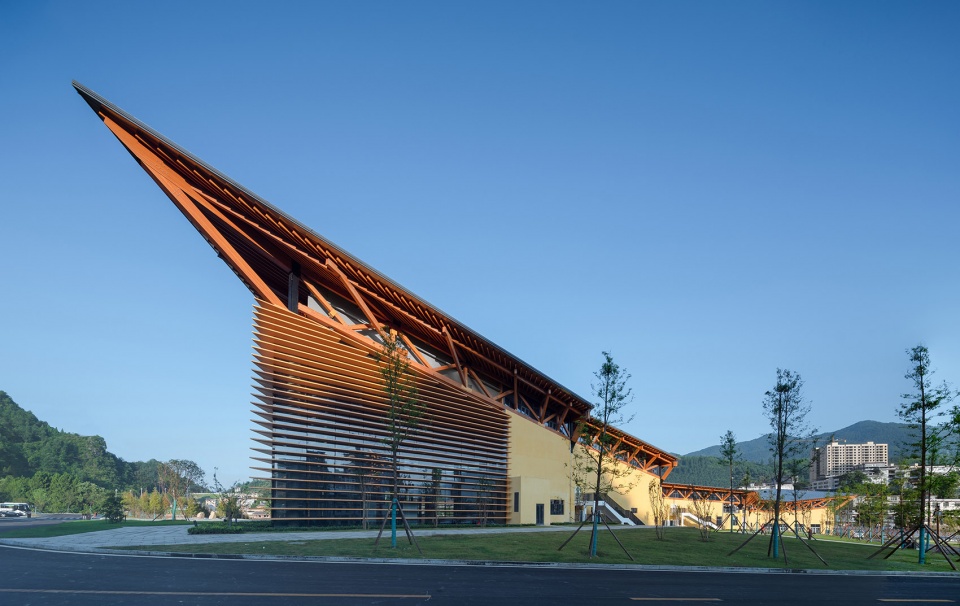
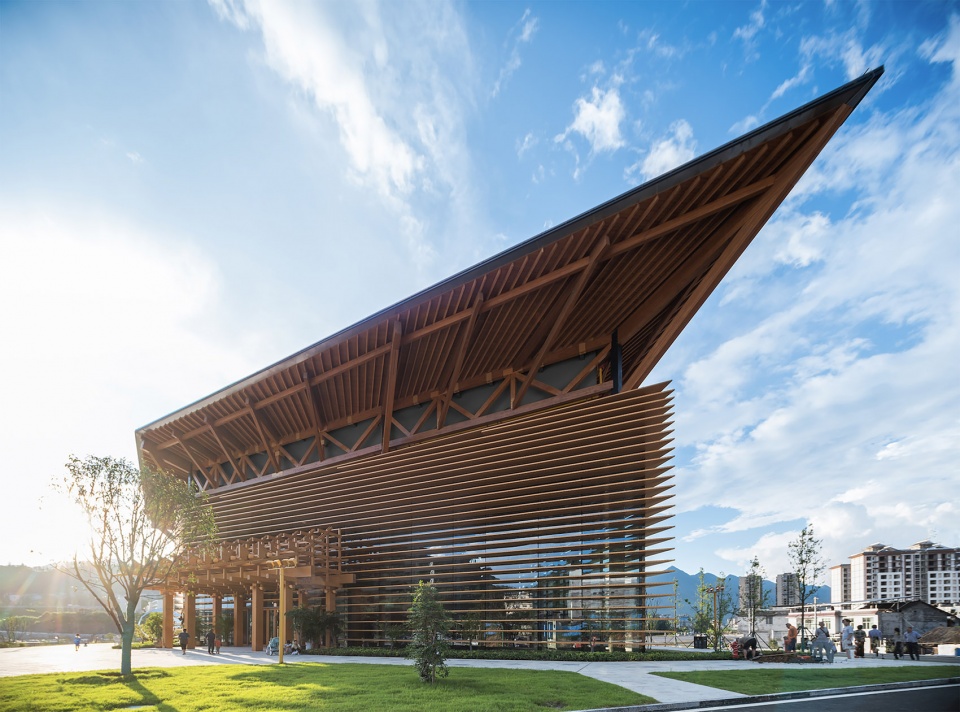
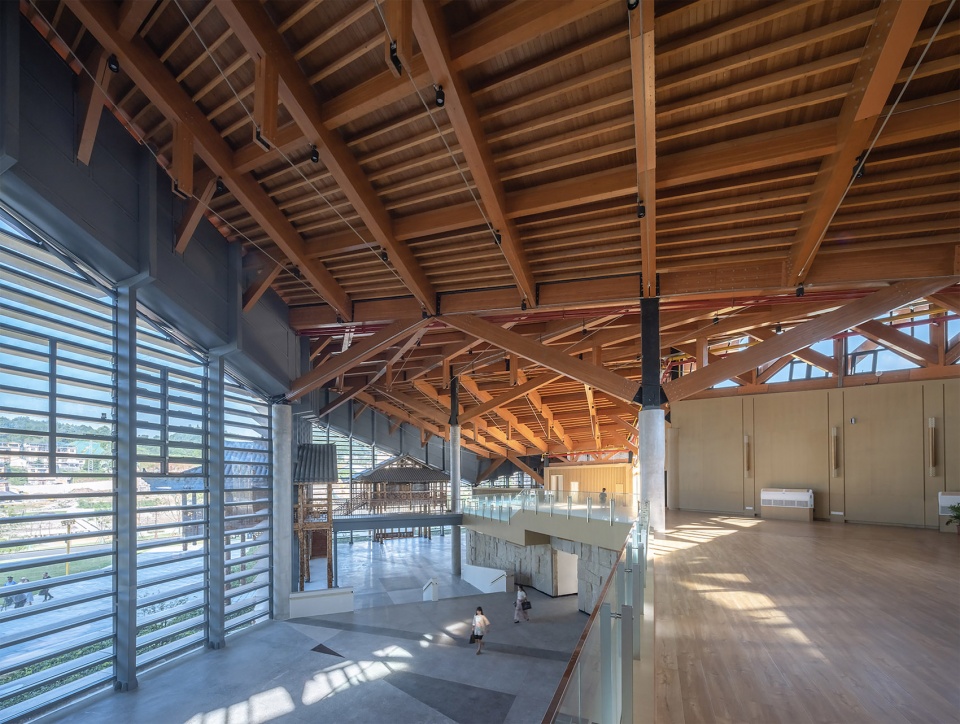
▼主游客中心内景,Main Tourist Center interior view © 赵奕龙
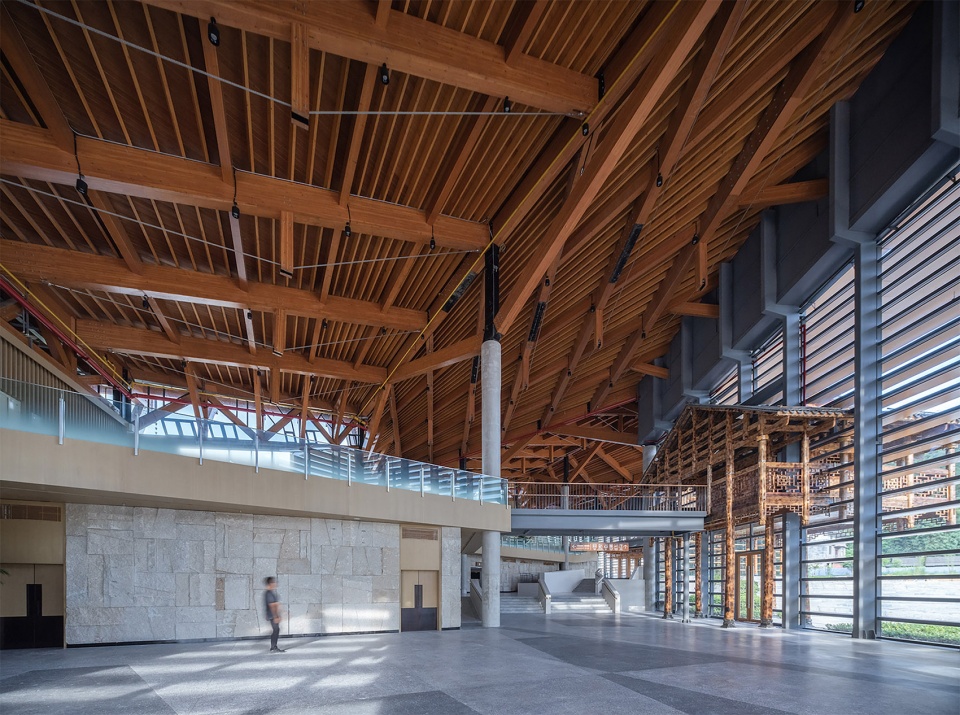
▼建筑入口立面,Entrance facade © 赵奕龙
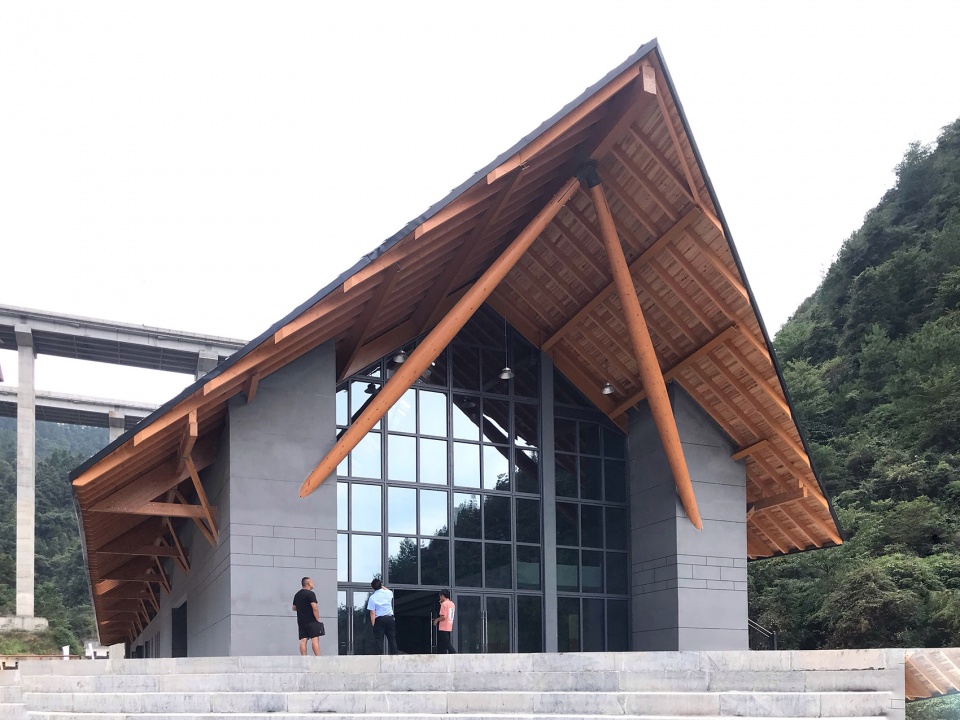
建筑的材料则与当地的传统建筑同构,建筑师借此向当地的少数民族文化传统致意,但中国土家泛博物馆采用当代风格,彰显时代感,并以此创造一种时空的张力。同时,建筑中采用大量被动式技术,减少运行中能源的消耗。建筑设计采用可生长的木材为建筑的主材,以工厂制作的胶合木,现场装配施工,这有助于实现低碳及环保的目标,木材既可以作为结构,又可以形成界面,从而省去了昂贵的室内装修费用,并降低了室内污染的概率。
The materials of the building are the same as the local traditional buildings. The architect pays homage to the local cultural traditions of ethnic minorities. However, Chinese Tujia Pan-Museum adopts a contemporary style to show the sense of the times and create a tension of time and space. At the same time, a large number of passive technologies are used in the building to reduce energy consumption during operation. The architectural design uses growing wood as the main material of the building, and factory-made glulam is used for on-site assembly and construction, which helps to achieve the goal of low carbon and environmental protection. Wood acts both as a structure and as an interface, saving expensive interior renovations and reducing the chance of indoor pollution.
▼摩霄楼外观,Moxiaolou exterior view © 赵奕龙
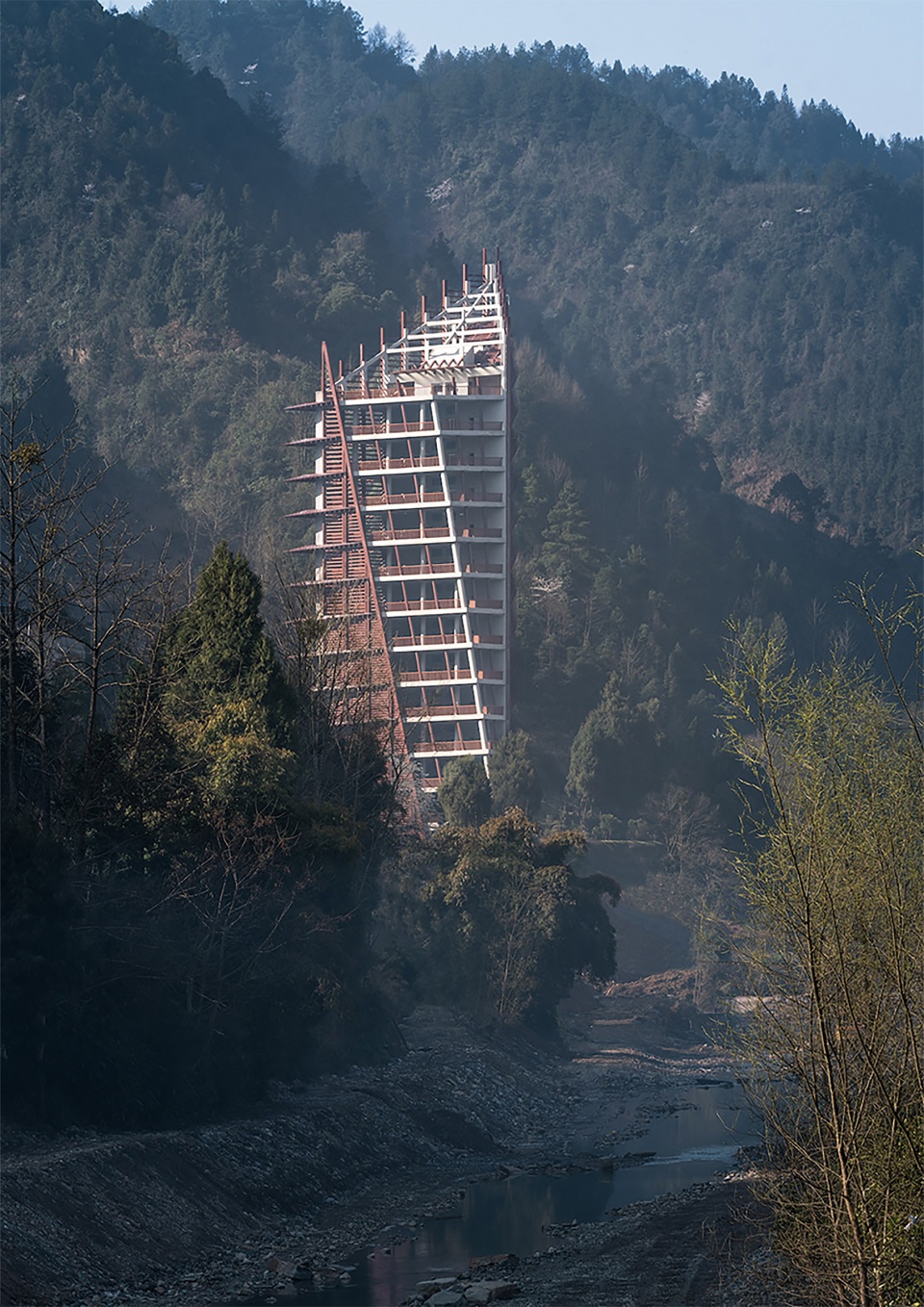
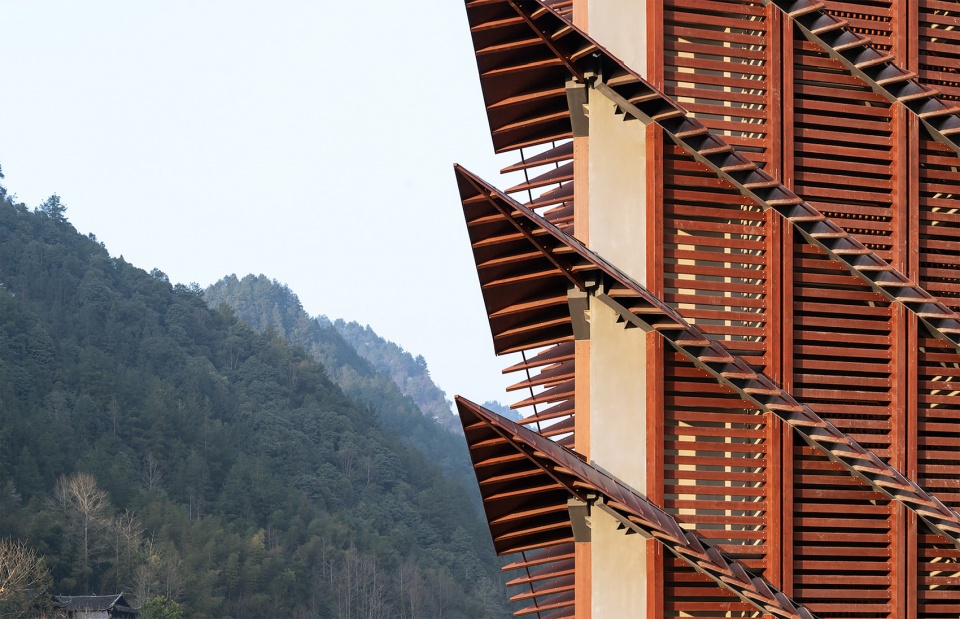
▼摩霄楼近景,Facade view © 赵奕龙
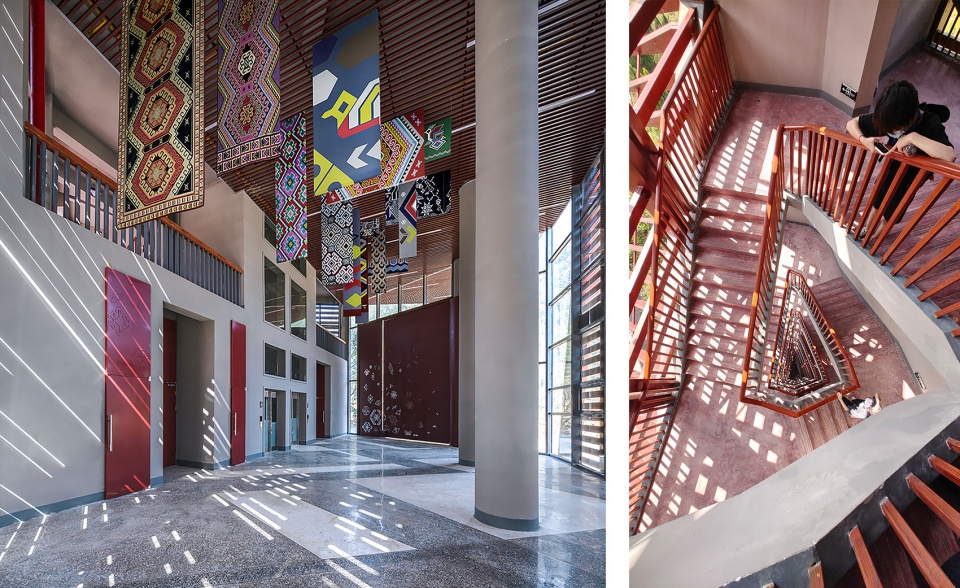
▼摩霄楼内景,Interior view © 赵奕龙
▼摩霄楼分析图,Diagram © 华中科技大学李保峰教授工作室
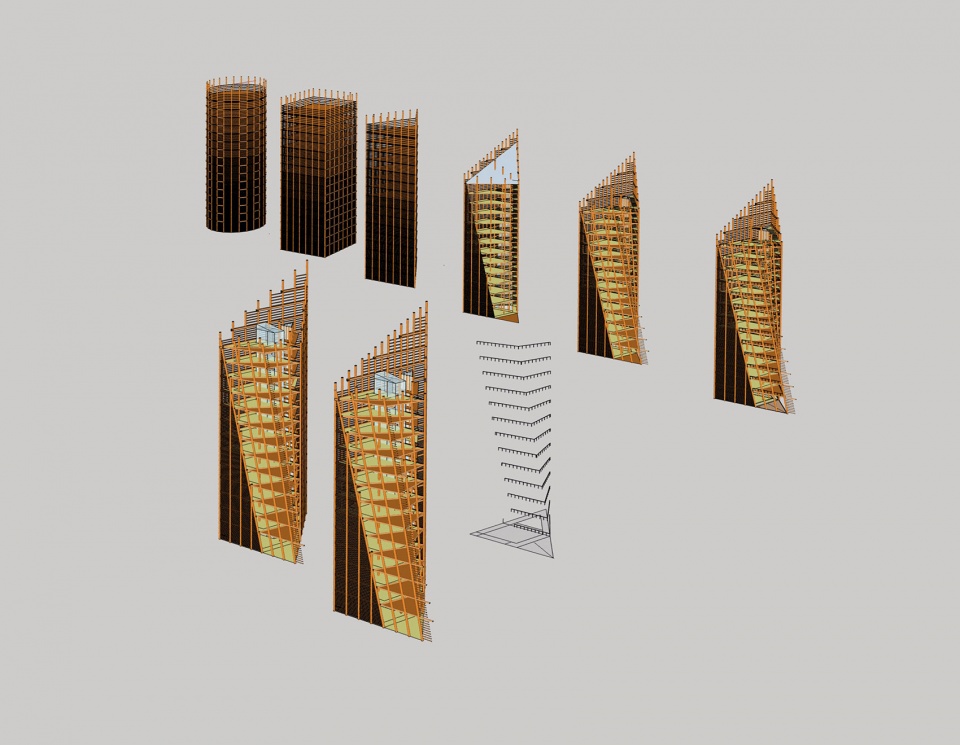
此外,建筑师团队用数字技术解决了“装配式要求标准化但独特性要求定制化”这一矛盾。因为建筑形态复杂,在材料加工和装配时中施工单位遇到很多困难,传统的经验不足以解决这些问题。我们设计团队和机器人团队跨界合作,采用机器人加工构件,大大提高了效率。
In addition, the architect team used digital technology to solve the contradiction of “fabrication requires standardization but uniqueness requires customization”. Due to the complex architectural form, the construction unit encountered many difficulties in material processing and assembly, and traditional experience was not enough to solve these problems. Our design team and robot team cooperate across borders and use robots to process components, which greatly improves efficiency.
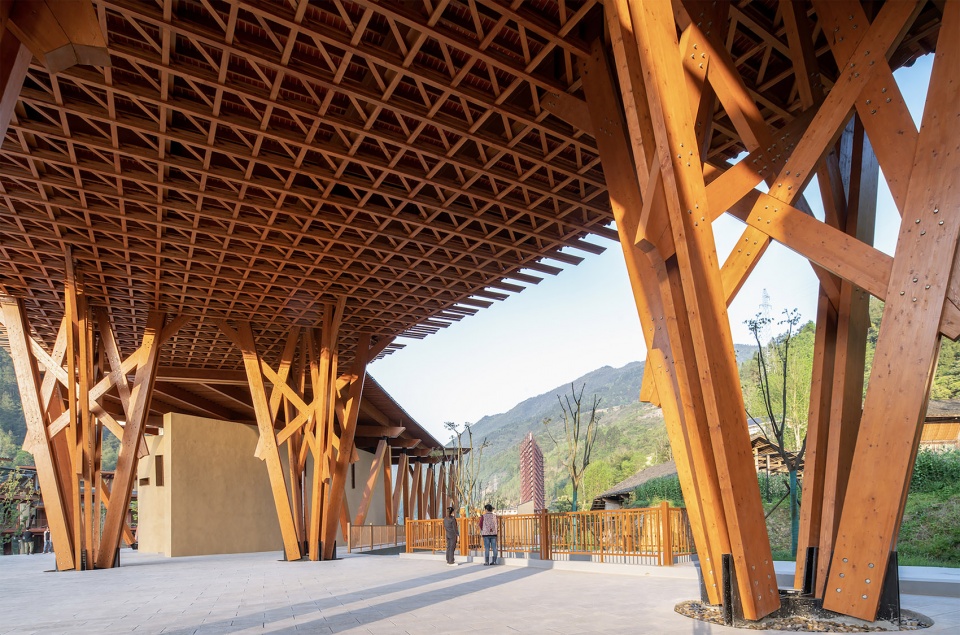
▼研学营架空空间,The sheltered space of International Research Center © 赵奕龙
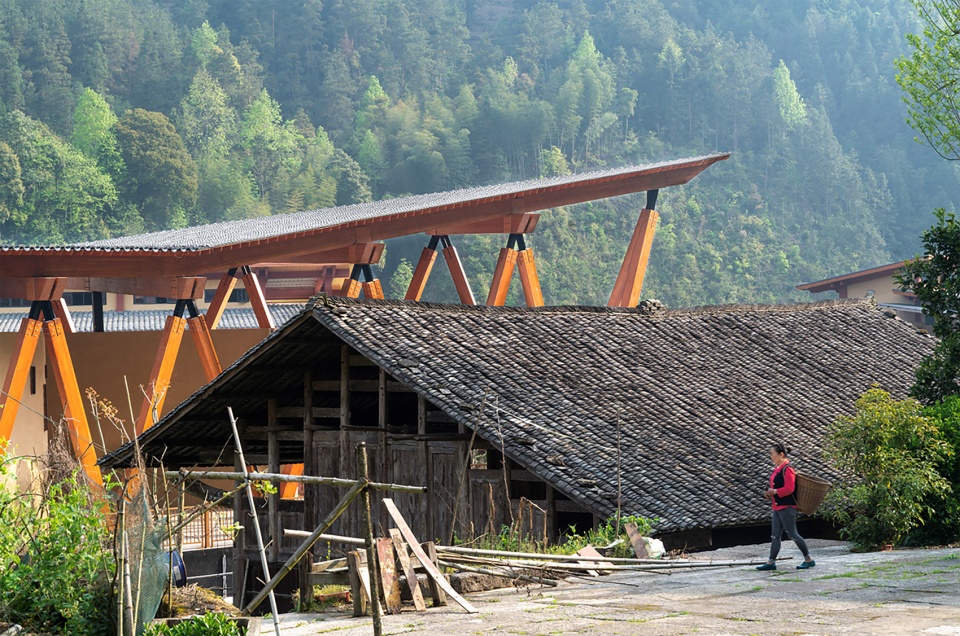
▼新旧建筑的对比,The contrast of old and new buildings © 赵奕龙
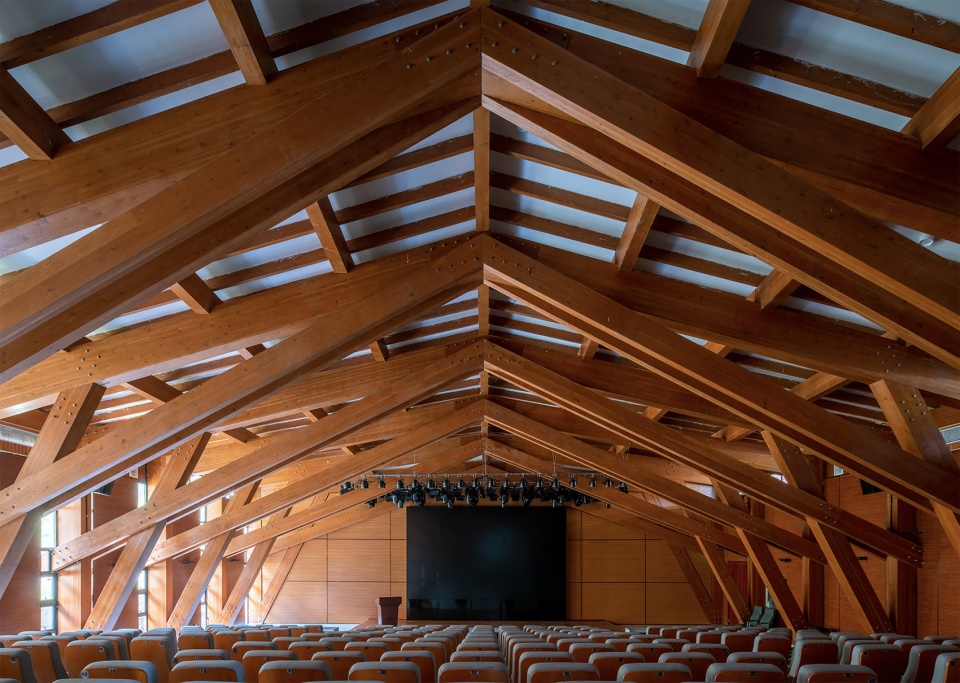
▼礼堂,Auditorium © 赵奕龙
中国土家泛博物馆建成后吸引了大量游客,游客的到来对当地经济的发展起到了积极的作用。同时,泛博物馆内的工作人员大部分都是当地村民,故该项目也为当地村民提供了就业机会。此外,建筑的外部环境也是深受当地居民喜欢的公共空间,每天早晨和黄昏,大量当地居民聚集于此散步和锻炼,使得建筑及其环境充满着活力。
After the completion of the Chinese Tujia Pan-Museum, it has attracted a large number of tourists, and the arrival of tourists has played a positive role in the development of the local economy. At the same time, most of the staff in the pan-museum are local villagers, so the project also provides employment opportunities for local villagers. In addition, the external environment of the building is also a public space favored by local residents. Every morning and evening, a large number of local residents gather here to walk and exercise, making the building and its environment full of vitality.
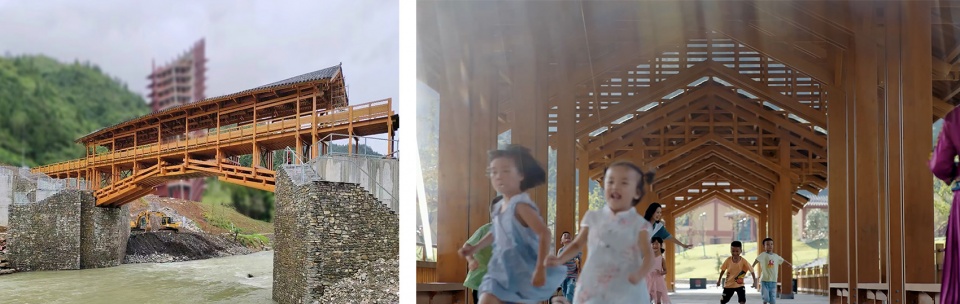
▼地仙桥(左上)和墨客桥,Dixian Bridge (top left) and Moke Bridge © 赵奕龙
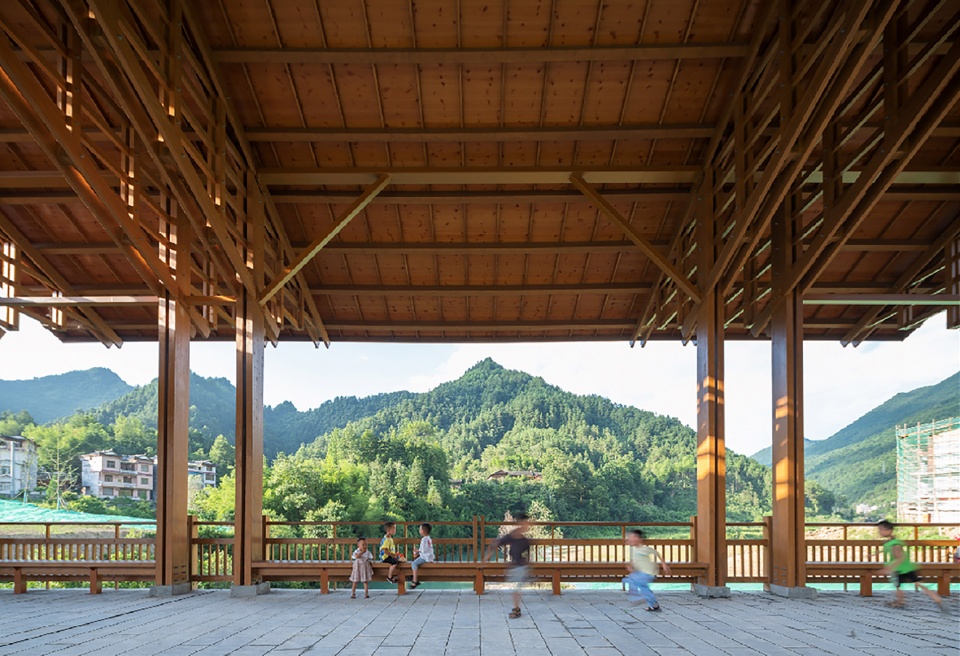
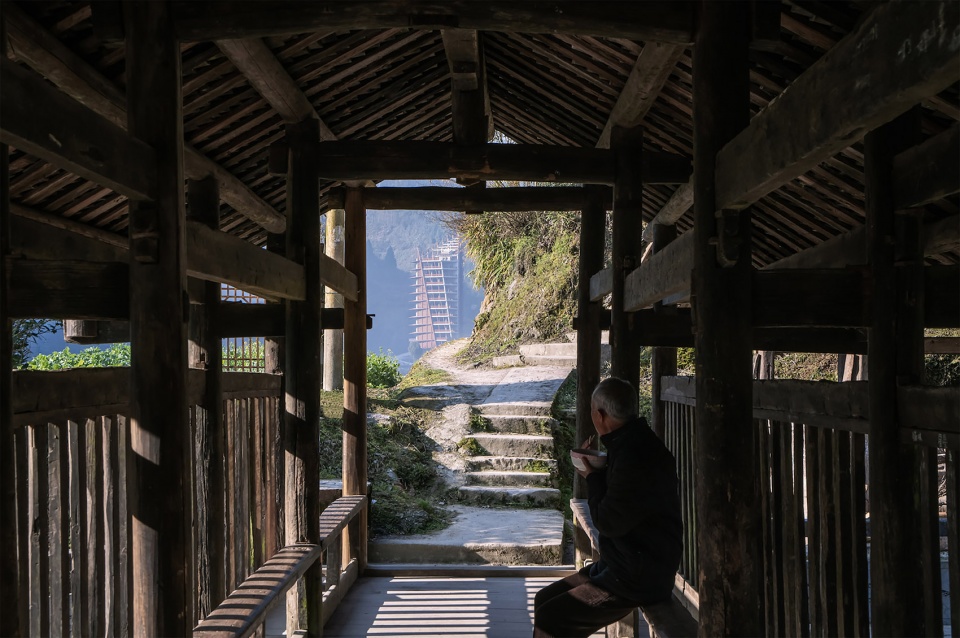
▼休憩的村民,The villager © 赵奕龙
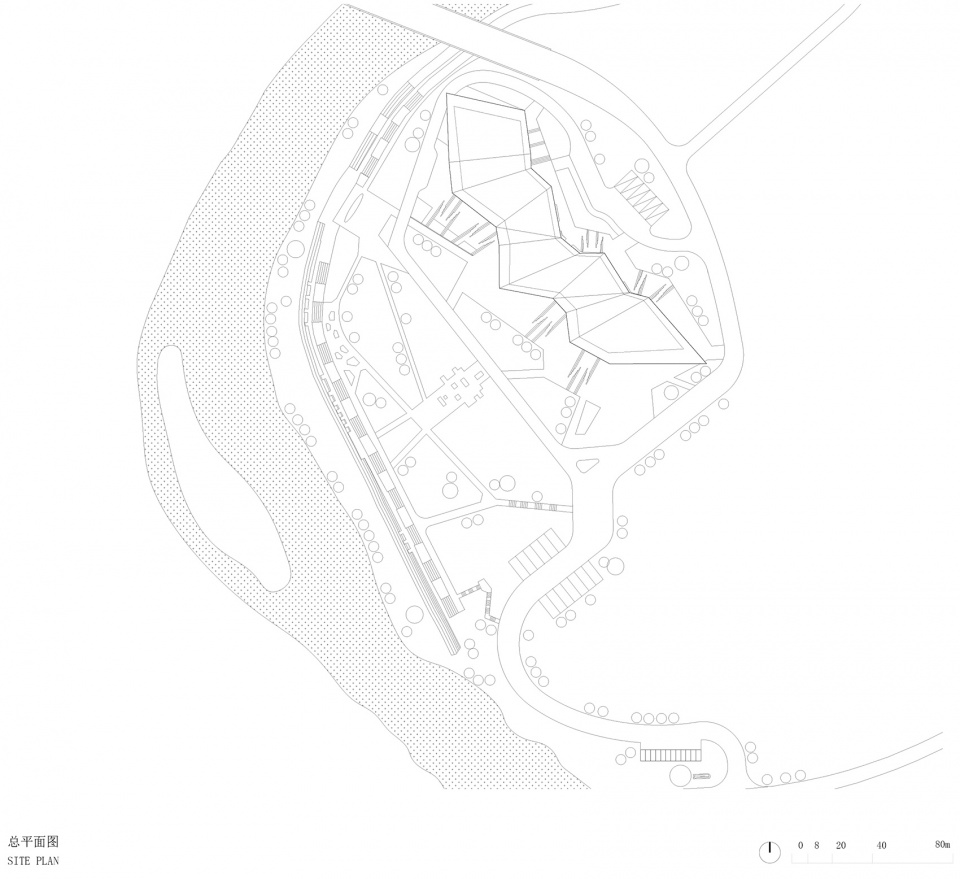
▼主游客中心总平面图,Main visitor center site plan © 华中科技大学李保峰教授工作室
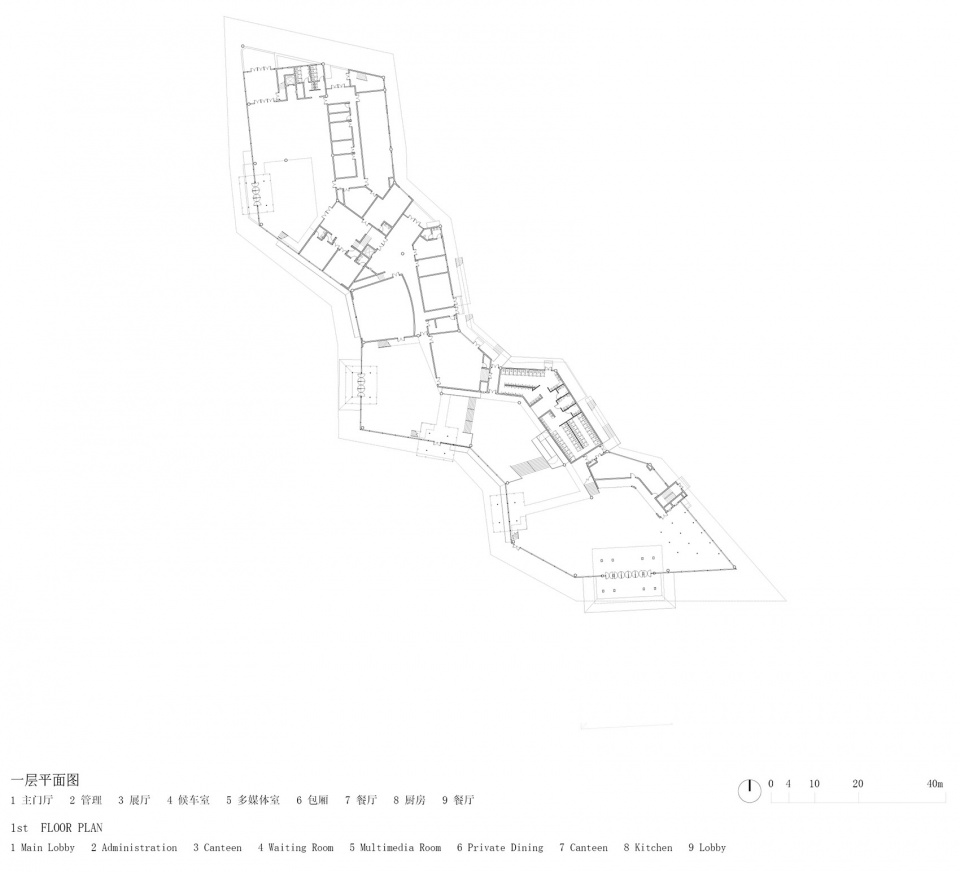
▼主游客中心平面图,Main visitor center plan © 华中科技大学李保峰教授工作室
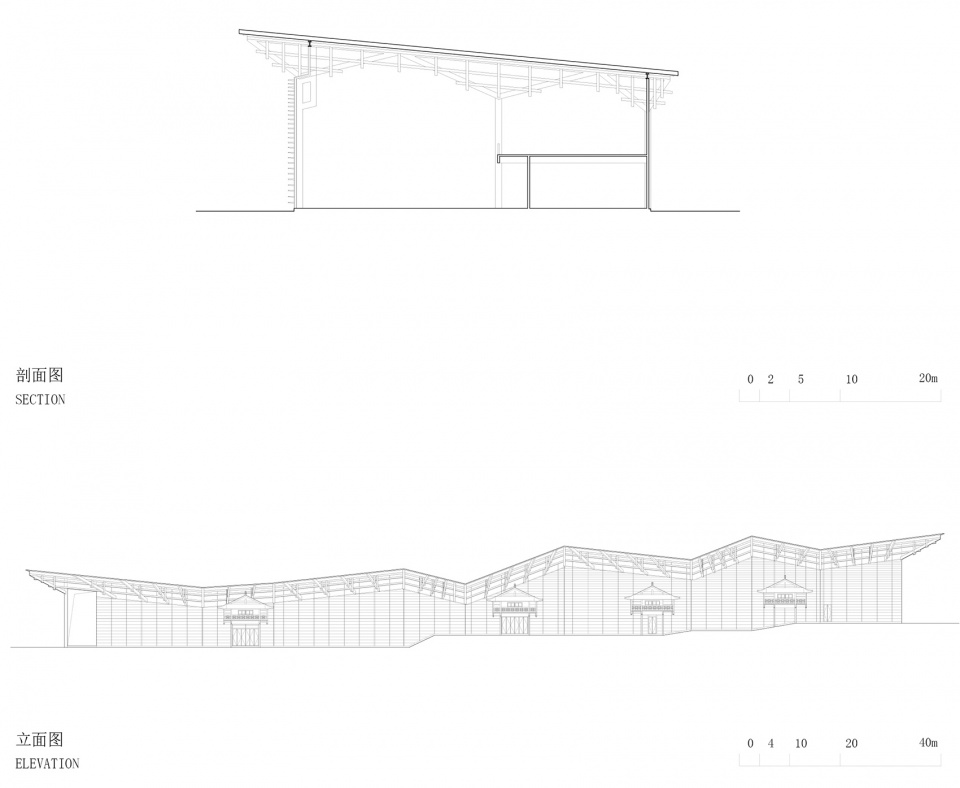
▼主游客中心立面和剖面图,Main visitor center section and elevation © 华中科技大学李保峰教授工作室
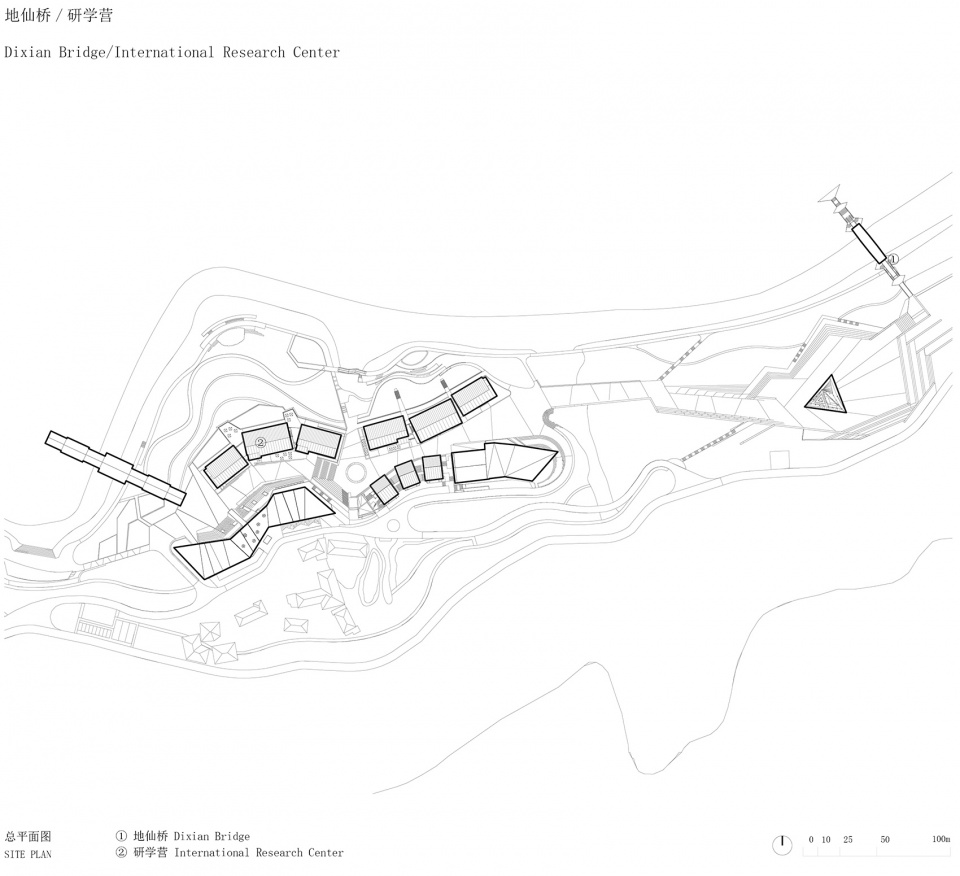
▼地仙桥和研学营总平面图,Dixian Bridge / International Research Center site plan © 华中科技大学李保峰教授工作室
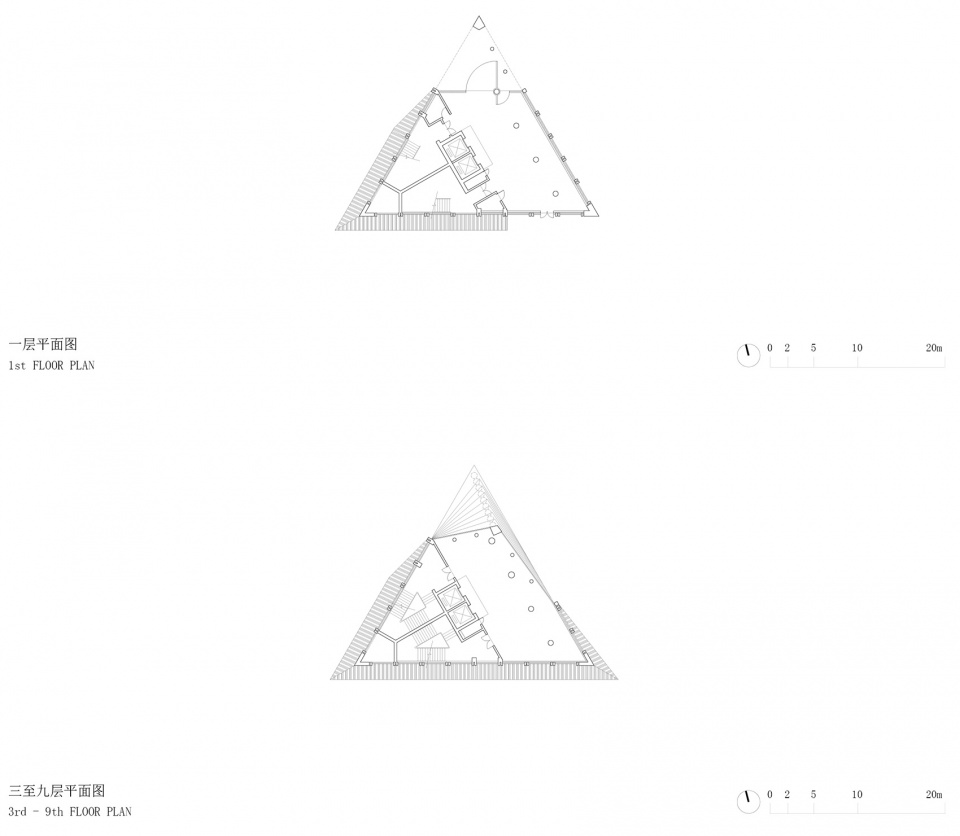
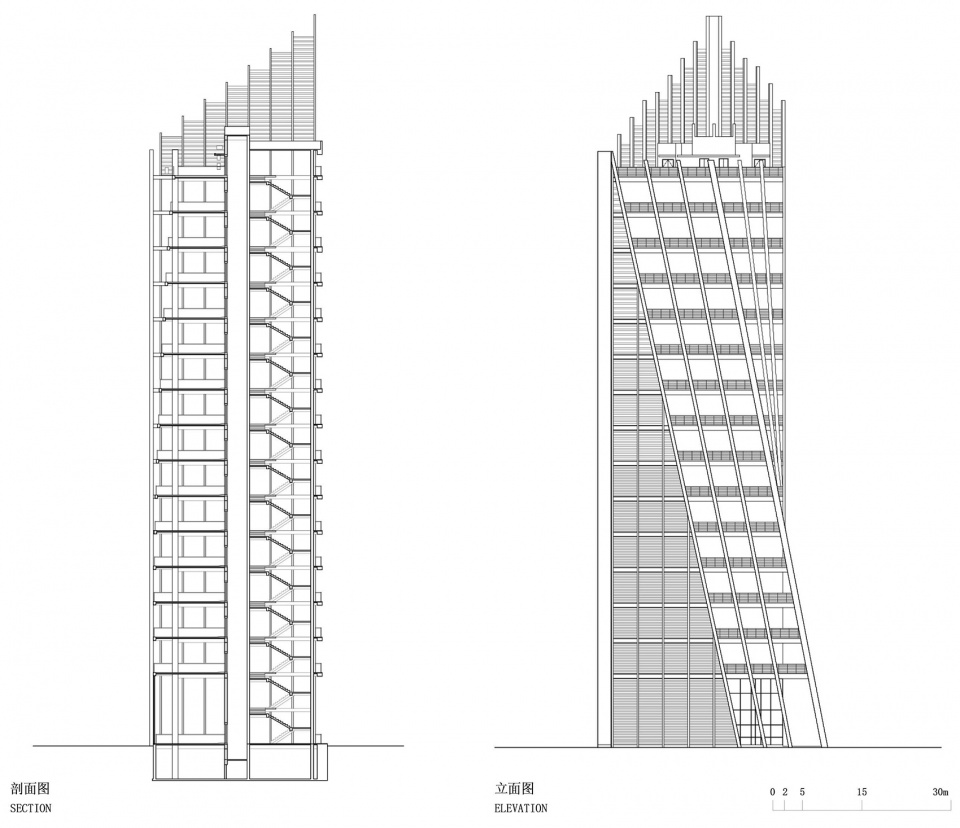
▼摩霄楼平面图,Moxiaolou Plan © 华中科技大学李保峰教授工作室
▼摩霄楼剖面和立面,Moxiaolou section and elevation © 华中科技大学李保峰教授工作室
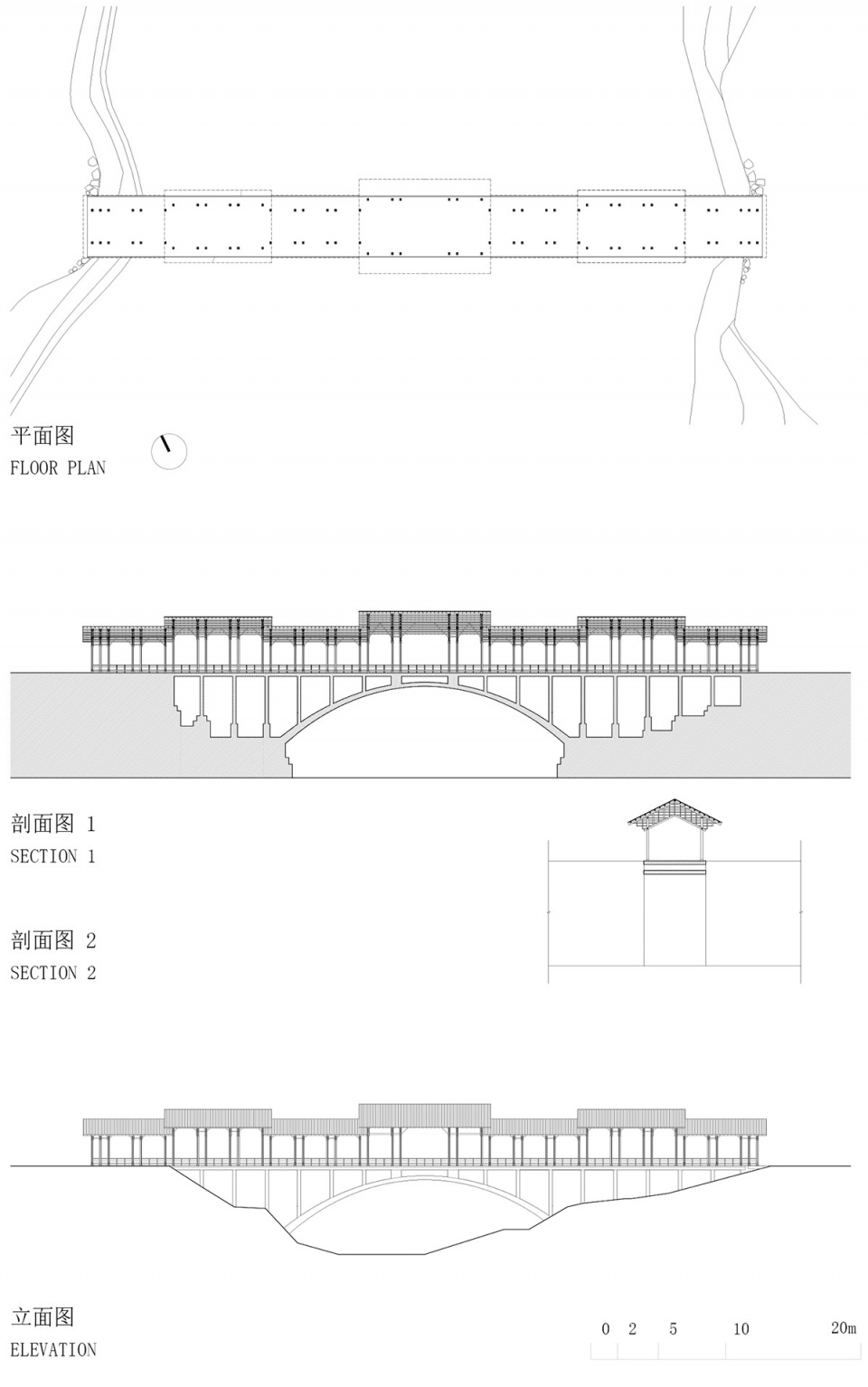
▼墨客廊桥平立剖,Moke Bridge drawings © 华中科技大学李保峰教授工作室
项目名称:中国土家泛博物馆
项目类型:博物馆/混合用途
设计方:华中科技大学李保峰教授工作室
公司网站:http://www.libaofengstudio.com/
联系邮箱:libaofeng_1956@hust.edu.cn
项目设计:2018
完成年份:2021
设计团队:李保峰、朱薛景、羊青园、万顺、袁涵、杨鹏鹏、王鑫琪、杨治宇、朱发文、张瑞芳、曹野、王子令、庞子锐、赵蕊、张师维等
项目地址:中国湖北恩施土家苗族自治州
建筑面积:30000㎡
摄影版权:赵奕龙
合作方:黄晶、蒋涛、于志光、王通、姚崇怀、尹传垠、张贲、徐昌顺、何炼、申发亮、张效房、杨鹏、谢建业、陈挺、殷国婷、卢雪莱、申安付、汪蓉等
客户:王坤
Project name:Chinese Tujia Pan-Museum Complex
Project type:Museum/Mix-Use
Design:Professor Li Baofeng’s studio of HUST
Website: http://www.libaofengstudio.com/
Contact e-mail:libaofeng_1956@hust.edu.cn
Design year:2018
Completion Year:2021
Leader designer & Team:Baofeng Li, Xuejing Zhu, Qingyuan Yang, Shun Wan, Han Yuan, Pengpeng Yang, Xinqi Wang, Zhiyu Yang, Fawen Zhu, Ruifang Zhang, Ye Cao, Ziling Wang, Zirui Pang, Rui Zhao, Shiwei Zhang
Project location:Enshi,China
Gross built area: 30000㎡
Photo credit: Yilong Zhao
Partner:Jing Huang, Tao Jiang,Zhiguang Yu, Tong Wang, Chonghuai Yao,Chuanying Yin, Ben Zhang, Changshun Xu,Lian He, Faliang Shen, Xiaofang Zhang, Peng Yang, Jianye Xie, Ting Chen, Guoting Yin, Xuelai Lu, Anfu Shen, Rong Wang
Clients:Kun Wang
More: 华中科技大学李保峰教授工作室



做大透视尖角、各种木结构外露、过饱和的木色。争奇斗艳太扎眼,透露出设计者的满满自负、野心勃勃。表现这么多,是在做给谁看
铜官窑博物馆
开头视频的意义是什么。。
摩霄楼一言难尽
空洞-无神
这个教授有点蜜汁自信啊,都是不知所云的设计
建议听一下李教授的讲座,你明白他的设计思路与设计理念之后就不会这么想了。
这个摩霄楼杵在这儿是不是太突兀了 后期利用率不会太高吧
去过现场 感觉还是很不错的
除了高楼像烂尾楼以外其他的还好吧
楼不错
大三学生作业~~
那不至于 大三学生能把这木结构搞清楚都不错了。。。
有点拼凑
跟你脑子一样?
跟你妈一样
很不错
看副标题进来的,有这钱改善一下当地民生不好么。
确实 今年干乡村项目 一直在想一个问题 不过有的集体经济建成也确实可以解决一部分就业问题 ,像什么村旅游项目 我估计也吸引不了太多
中国土家泛博物馆建成后吸引了大量游客,游客的到来对当地经济的发展起到了积极的作用。同时,泛博物馆内的工作人员大部分都是当地村民,故该项目也为当地村民提供了就业机会。
这种说法也就是听听而已,当不得真……这样能吸引到多少游客?吸引游客的是后面的彭家寨,这个“泛博物馆”更多只是彭家寨的游客服务中心和配套,真要吸引游客,从一开始就要有经营上的深度考量,植入体验,就目前看到的,这部分应该是比较欠缺