“《Black Landscapes Matter》一书适时地揭示了存在于美国各地的不公正现象,其中不乏有令人痛心的真相。它以一种促进恢复行动的方式直面这些问题并将其引向更公正的结果。这种公正性不仅可以通过单方面的应用使我们与集体的历史和解,同时也为人们提供了设想自身未来的空间。这本书讲述了87个直击人心的故事,使读者听到87种不同的声音。从这些声音中,我们得以了解和体会黑人景观的重要性,以及这些差异本身所蕴含的价值。”
– 2021年评审委员会“Black Landscapes Matter is a timely revelation of sometimes painful truths about places across the United States where injustices have been embedded, confronting them in a way that promotes restorative action toward a more just terrain. That justice can be applied unilaterally, reconciling our collective past, but then also gives people the space to envision themselves in the future. The book elevates and amplifies eighty-seven voices to tell their powerful stories, celebrating the very difference of those voices as it expands understanding and appreciation of how Black landscapes matter.”
– 2021 Awards Jury
来自 ASLA 对gooood的分享。
Black Landscapes Matter | Walter Hood & Grace Mitchell Tada
项目概述
PROJECT STATEMENT
在《Black Landscapes Matter》(UVA Press出版,2020年)一书中,Walter Hood和Grace Mitchell Tada两位编者将景观设计与规划领域的专业人士汇聚在一起,对存在于美国景观中的种族问题、记忆和价值进行了探讨。作者考察了美国的不同地区,证明了当地景观在塑造个人与社区身份方面的巨大作用。通过一系列的辩证思考与深入调查,他们强调这些地区对于全面解读美国景观具有至关重要的意义。本书已经出售超过1000册,目前正在进行第三次再版,由此也说明了当下的建筑环境行业,尤其是景观设计行业对于解决种族、公平和文化记忆问题的迫切需要。《Black Landscapes Matter》是美国各地社区为实现公平公正的公共空间而进行对话的起点,同时也是一次及时且必要的警醒:若不能承认并接纳这些历史与空间,就无法真正地理解美国的过去与未来。
In the volume Black Landscapes Matter (UVA Press, 2020), editors Walter Hood and Grace Mitchell Tada bring together landscape architecture and planning professionals to probe how race, memory, and meaning intersect in the American landscape. The authors examine diverse places across the US and assert these landscapes as canvases that shape individual and communal identities. Through critique, celebration, and examination, they call for the recognition of these places as paramount for enabling a comprehensive reading of the American landscape. Over 1,000 copies of the book have already been sold, and the volume is currently in its third reprinting. The success of the book speaks to the demand within the built environment professions, and specifically landscape architecture, to address issues of race, equity, and truthful cultural memory. Black Landscapes Matter serves as a starting point for conversations in communities across the US working toward equitable and just public spaces, and is a timely and necessary reminder that without recognizing and reconciling these histories and spaces, America’s past and future cannot be understood.
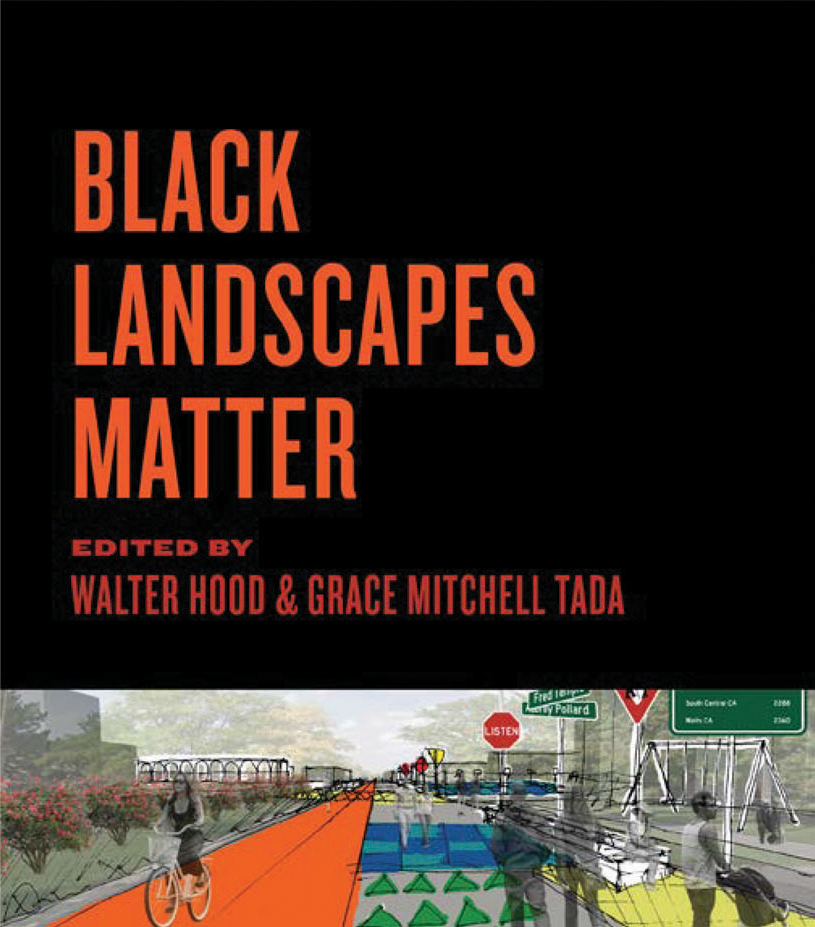
▲《黑人景观同等重要》书籍封面。Black Landscapes Matter, cover © UVA Press
项目说明
PROJECT NARRATIVE
由Walter Hood和Grace Mitchell Tada共同编写的书籍《Black Landscapes Matter》(黑人景观同等重要),提出了“黑人景观是否重要”的问题。从奴隶制度下的种植园到当今相互隔离的城市,从被解放的村落到为追求自由而迁徙的北方居民,美国的景观承载着多种族背景所留下的痕迹。黑人景观之所以重要,是因为它们讲述了真相。为了阐明这些真相,著名景观设计师和公共艺术家Walter Hood召集了众多景观设计和规划领域的专家和学者,意在探讨种族问题、记忆与价值是如何在美国景观中彼此交汇。
在本书中,两位作者对美国多个地区进行了考察——从新奥尔良和夏洛特,到密尔沃基和底特律——揭露了建筑环境中普遍存在的种族主义,并承认了黑人的地域和文化景观被大量抹去的事实。结合案例研究、评论和行动呼吁,作者揭示了对有色人种社区造成伤害的景观缺陷和带有偏见的描述,并质疑了公共设计和保护工作是否真的能够支持这些地方的民众。充斥着历史遗漏和消极叙事的文化环境往往会让少数人种社区丢失投资和发展的机会,若要以新的方式激活这些社区,就更加需要来自设计师、规划师、艺术家乃至居民自己去提出创造性的解决方案。黑人群体以一种无法被充分了解的方式建造并塑造了美国的景观。
章节内容
Walter Hood在卷首发表了对景观设计师和相关学科人员的呼吁,鼓励他们培养一种“先知”的美学语言,在铭记过去的同时,亦能借助其力量去发展新的未来,唯有如此才能将历史修正为真理。
设计师兼教育家Richard Hindle对2016年的总统选举和相关事件提出了清醒的看法,这些事件揭示了持续几个世纪之久、以无数种形式潜藏在美国各地的制度性和具象化的种族主义。他写道:显然,黑人景观对每个人而言都是重要的,它们构成了美国历史的核心——从早期的殖民地和种植园景观,再到中央公园的塞内卡村落(Seneca Village)。然而,从整体的角度,我们对他们的文化知之甚少。我们从很久以前就应当改变这样的认知。
景观历史学家Louise Mozingo回顾了她童年时期从罗马迁往弗吉尼亚州阿林顿市的经历,以及她对于公共领域的认知的相应转变。在美国,Mozingo最初面临着存在于景观中的种族问题:她回忆了自己对于盛行于美国公共领域的这种无意义的、充满种族意味的分隔逐步形成认知的过程。时至今日,局面仍未改变,正是这些物理上的分隔造成了今天存在于全国的各种形式的划分行为。只要这样的划分继续存在,那么公共领域的设计就依然是一项紧迫的工作。
Anna Brand博士记录了卡特里娜飓风前后,新奥尔良坎普大街4800号街区的日常生活。在2003年至2017年间,她见证了黑人群体在灾后背景下的流离失所和迁移过程,区域的贵族化被掩盖在一系列重建政策中。Brand博士认为,虽然这些黑人聚居区是在种族隔离的体系下产生的,但它们并非由种族主义所定义。 她指出,这些景观中固有的特殊性和创造性的模式是其未来发展的关键所在。
来自北卡罗莱纳州的设计师、教育家和环境正义倡导者Kofi Boone在“Black Lives Matter”(黑人的生命同等重要)运动的基础上发出质询:景观设计领域是否可以重新成为社区赋权的载体。在提及围绕BLM进行的创造性生产时,他指出了建筑环境专业被排除在主流之外的现状。当代教育和专业系统的重新配置将为非裔美国人提供参与塑造美国景观的机会,并承认他们在历史中的长期作用——这一点在种植园景观、传统黑人大学(HBCU)校园、政治和经济城市空间以及社区的规划中都得到了证明。Boone还认识到,随着黑人华尔街、创造性的抗议活动和环境正义运动的兴起,公共空间对于黑人领导力的发展产生了重要影响。
作者Walter Hood回忆了他在北卡罗莱纳州度过的童年(1960-70年代),以及自那时起夏洛特市发生的种种改变。在当时,虽然民权运动已经结束,种族隔离的问题依然存在。Hood对人口普查数据和公共艺术进行了研究,并借地理学家David Lowenthal的《彼时此地:景观与记忆》一文阐述了他对城市转型的理解。他写道,在美国城市中,黑人景观的矛盾性体现在它从很大程度上塑造了美国的集体意识,可另一方面又遭到了物理意义上的抹除。Hood认为,留存于其家乡的黑人景观的记忆展现了另一个版本的过去——一种只存在于表面、从未发生过的过去。
时任底特律市规划局长的Maurice Cox在本书中分享了他作为建筑师、政治家和活动家的职业历程,其脚步遍及全美。他认识到美国的景观存在抹去某些特定历史的倾向,尤其是和非裔美国人社区有关的历史。Cox认为,能够保护和主导这些空间的正是这些社区本身,就像维吉尼亚州的Bayview乡村社区,它们保卫了自己的决策权;还有新奥尔良,多元的文化遗产塑造了其独特的景观。当Cox来到密歇根州底特律市,他发出了这样的疑问:城市规划应当如何考虑那些被剥夺发展机会并让黑人失去权利的景观?他给出的答案之一是,承认景观的价值并尊重一个地区的历史和人民。
景观设计师、教育家和电影制片人Austin Allen从个人视角分享了从新奥尔良到俄亥俄州的多样景观叙事,并讲述了非裔美国人在界定和维护景观方面的斗争——即便他们在美国景观的塑造和培育上发挥了核心作用。在某些地方,种族博弈让黑人能够继续占领空间,而在其他情况下,一个地方往往是难以捉摸且充满不确定性的,随之也就产生了黑人景观、社区和身份所特有的意识、规则、阐释与谈判方式。然而,即便是在充满光明和变革的时刻,这些地方也因为其黑暗的历史在动乱的环境中挣扎摇摆。考虑到教育对黑人景观发展的促进作用,Allen主张通过更新社区学院系统来证明黑人景观和黑人群体对建筑环境的贡献,同时在充满不确定性的未来为黑人社区赋予权利。
Hood还在书中讲述了他的景观设计工作是如何在1990年代转变为一种强调新型叙述和表现的语言,并且能够被使用这些空间的人们所理解。他意识到了摄影对其思考的引导作用。由Lewis Watts拍摄的一系列以黑人为主题的作品深深地影响了Hood本人对黑人景观空间的理解。Hood为本书挑选了Watts在新奥尔良拍摄的17张照片,记录了黑人的身体和他们在具有包容性的空间中的重要意义:黑人的身体与寻常的身体并无二致,他们以和其他人一样的方式存在于我们共同的空间。
艺术家和公民参与促进者Sara Daleiden以威斯康星州密尔沃基的Beerline Trail,一个“从铁路到小路”的项目为例,探讨了合作与专门机构在道德文化发展中的作用。该项目围绕小路及其周边空间展开,回应了场地中与种族隔离政策和行为相关的历史留痕。Daleiden借此讨论了黑人景观作为文化载体在消解城市创伤中的作用。小路成为了景观中的特殊事物,它就像是一面透镜,从中可以看到被边缘化的社区困境与愿望。
在本书的结尾,Hood呼吁人们在叙事中更多地呈现潜藏于美国景观中的多样性。他指出,尽管美国将“E Pluribus Unum”(合众为一)作为座右铭,但当我们生活在一个多样性的国家时,就必然难以实现统一性。Hood在此提到了社会学家W. E. B. Du Bois对于双重意识引发共鸣的理解,并表示自己也支持将多样性作为一种理解、接受和赞美差异的手段。黑人景观和他们的叙事,以及其他被历史埋没的重要事物,都要求美国人改变和扩展他们对于本地景观的狭隘而刻板的认知。将更加复杂多样的景观纳入美国人的集体记忆,这将促使我们树立新的意识和观念。
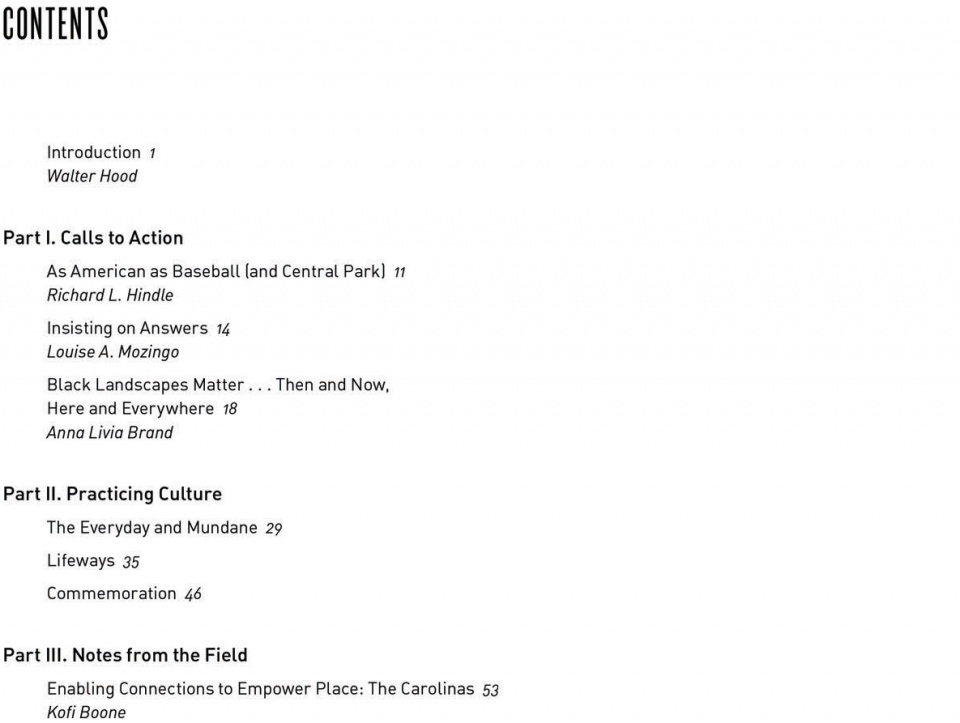
▲《黑人景观同等重要》目录第一页。描述了本书的主要内容。Black Landscapes Matter, Table of Contents, first page. Table of Contents describing contents of book. © UVA Press

▲《黑人景观同等重要》目录第二页。描述了本书的主要内容。Black Landscapes Matter, Table of Contents, second page. Table of Contents describing contents of book. © UVA Press
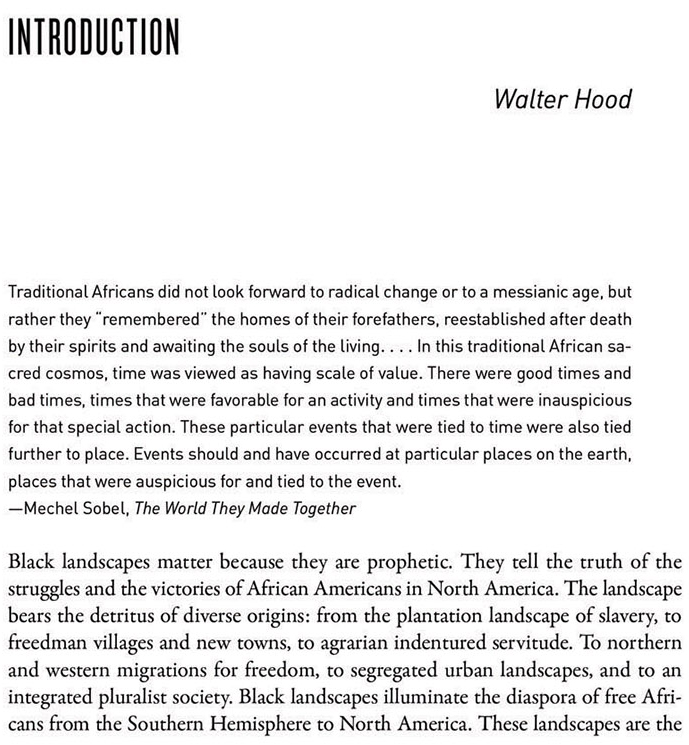
▲《黑人景观同等重要》引言第一页。Walter Hood 呼吁景观设计师和相关学科的从业者培养一种“先知”的美学语言,在铭记过去的同时,亦能借助其力量去发展新的未来。Black Landscapes Matter, Introduction (pg. 1). Walter Hood calls for landscape architects and those in related disciplines to develop a “prophetic” aesthetic language to remember and develop new futures from the power of the past. © UVA Press
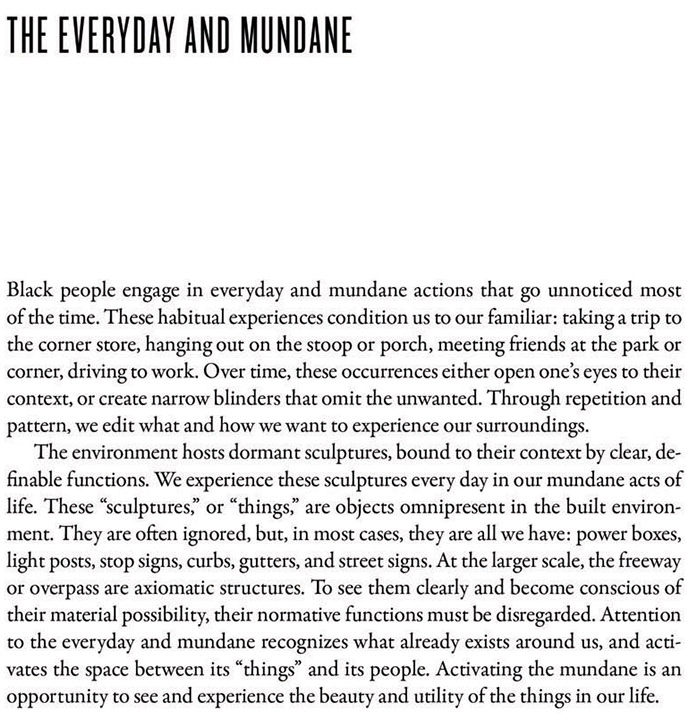
▲《黑人景观同等重要》,“日常与世俗”章节(第29页)。作者是Walter Hood。Black Landscapes Matter, The Everyday and Mundane (pg. 29). Text by Walter Hood. © UVA Press
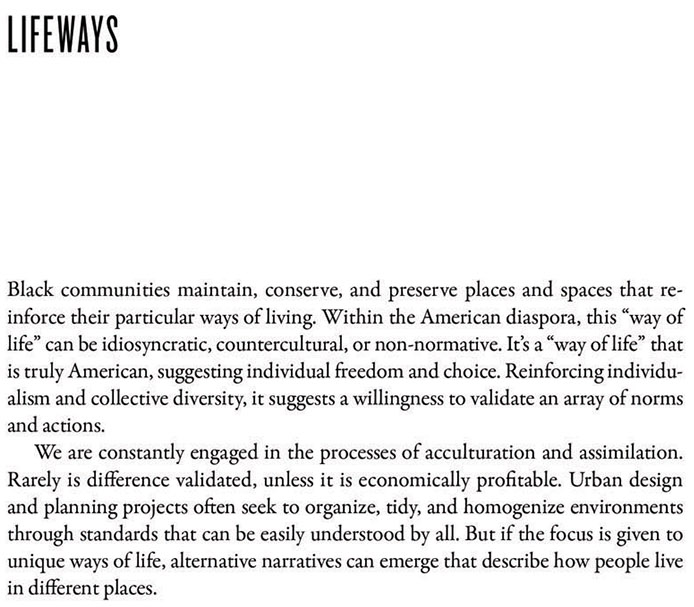
▲《黑人景观同等重要》,“生活方式”章节(第35页)。作者是Walter Hood。Black Landscapes Matter, Lifeways (pg. 35). Text by Walter Hood. © UVA Press
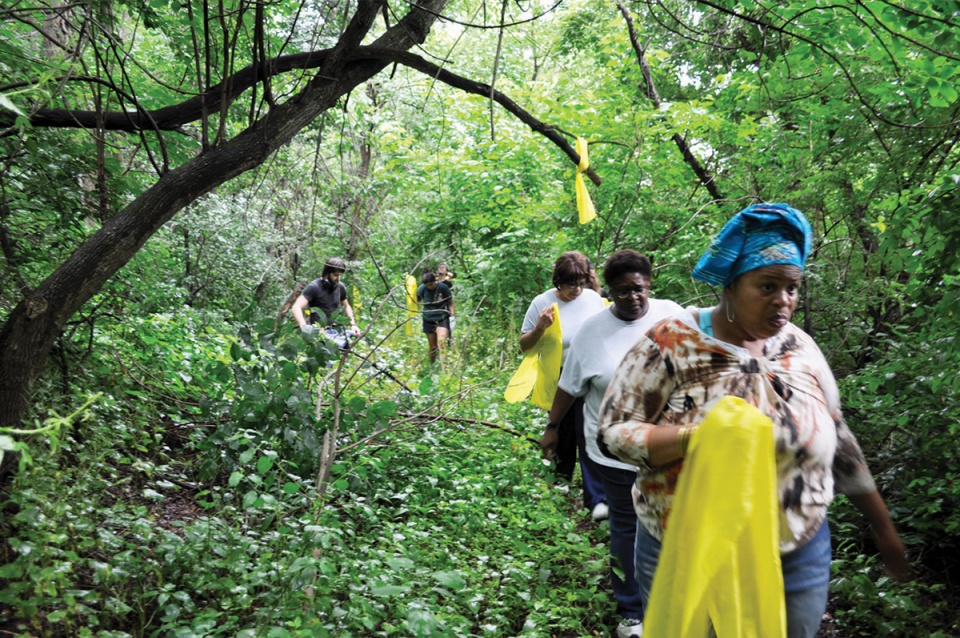
▲《黑人景观同等重要》,“煤层小路”章节(第36页)。匹茨堡山丘区的煤层小路为一个失去发展机会的街区提供了生活的新路径。在山丘区出现的连续的城市景观与小路拥有相同的价值,促进了新生活方式的形成。Black Landscapes Matter, Coal Seam Trail (pg. 36). The Coal Seam Trail in Pittsburgh’s Hill District brought back a lifeway in a neighborhood plagued by disinvestment and abandonment. In the Hill District, the successional urban landscape that emerged had the same value and became a new lifeway. © Hood Design Studio
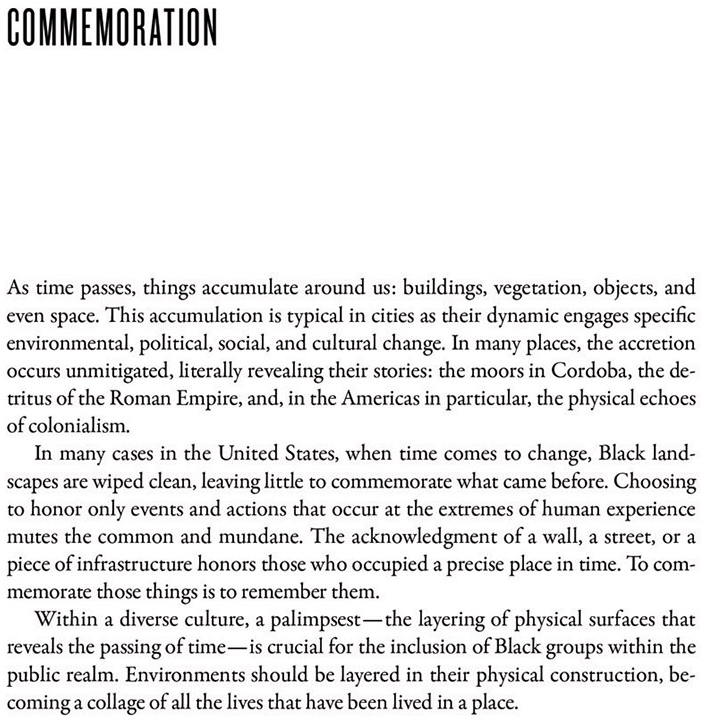
▲《黑人景观同等重要》,“庆典”章节(第46页)。作者Walter Hood。Black Landscapes Matter, Commemoration (pg. 46). Text by Walter Hood. © UVA Press
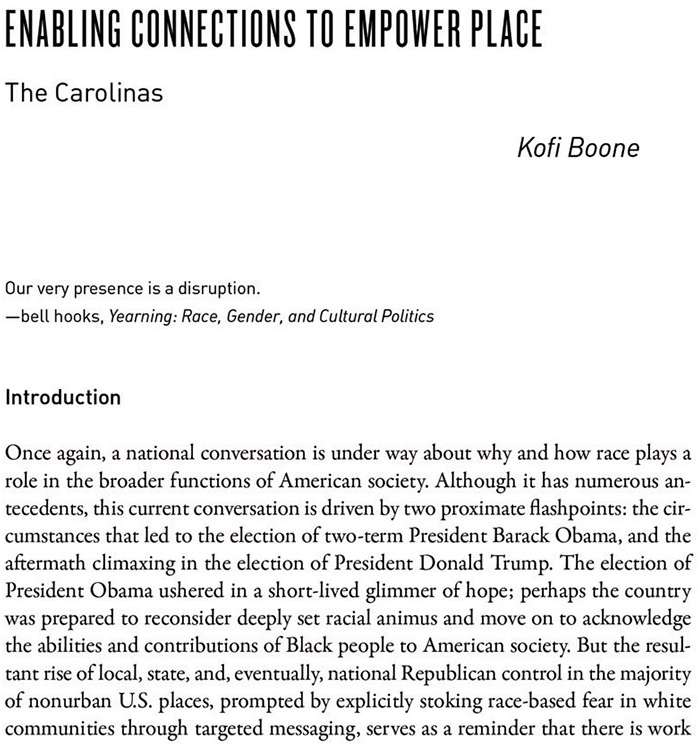
▲《黑人景观同等重要》,“以连接赋权地方:卡罗莱纳州”章节(第53页)。设计师提出了景观设计是否可以重新成为社区赋权的载体的问题。他认识到,随着黑人华尔街、创造性的抗议活动和环境正义运动的兴起,公共空间对于黑人领导力的发展产生了重要影响。Kofi Boone Black Landscapes Matter, Enabling Connections to Empower Place: The Carolinas (pg. 53). Designer Kofi Boone asks if landscape architecture can be reconsidered as a vector of community empowerment. He recognizes the role of public space in developing Black leadership through the rise of Black Wall Streets, creative protest, and the environmental justice movement. © UVA Press
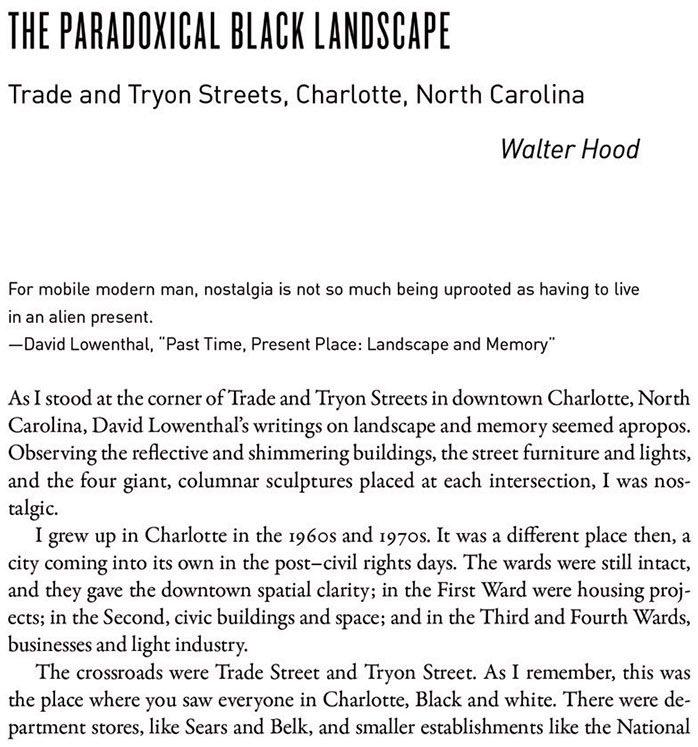
▲《黑人景观同等重要》,“充满矛盾的黑人景观:夏洛特市Trade和Tryon街道”章节(第74页)。黑人景观的矛盾性体现在它从很大程度上塑造了美国的集体意识,可另一方面又遭到了物理意义上的抹除。Hood认为,留存于其家乡的黑人景观的记忆展现的是一种从未发生过的过去。Black Landscapes Matter, The Paradoxical Black Landscape: Trade and Tryon Streets, Charlotte, North Carolina (pg. 74). The Black landscape in the urban United States is paradoxically celebrated in the collective American consciousness despite its physical erasure. Walter Hood posits his hometown’s memory of Black landscapes presents a version of the past that never was. © UVA Press
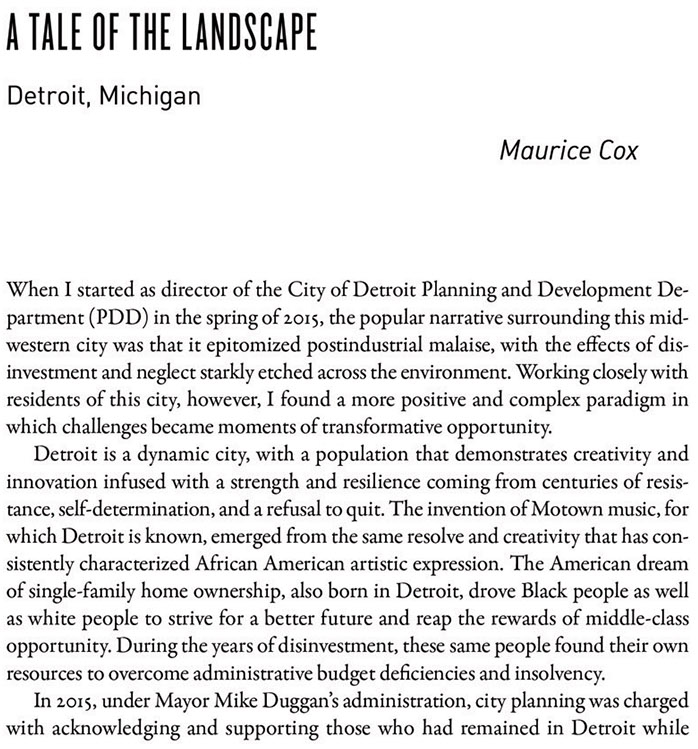
▲《黑人景观同等重要》,“景观的故事:密歇根州底特律”章节(第82页)。通过讲述其在底特律市的经历,城市规划师Maurice Cox提出了如下问题:城市规划应当如何考虑那些被剥夺发展机会并让黑人失去权利的景观?他给出的答案之一是,承认景观的价值并尊重一个地区的历史和人民。Black Landscapes Matter, A Tale of the Landscape: Detroit, Michigan (pg. 82). Harnessing his experience in Detroit, planner Maurice Cox asks how urban planning considers a landscape of disinvestment and Black disenfranchisement. His answers include recognizing value in the landscape, and respecting the history of the place and its people. © UVA Press
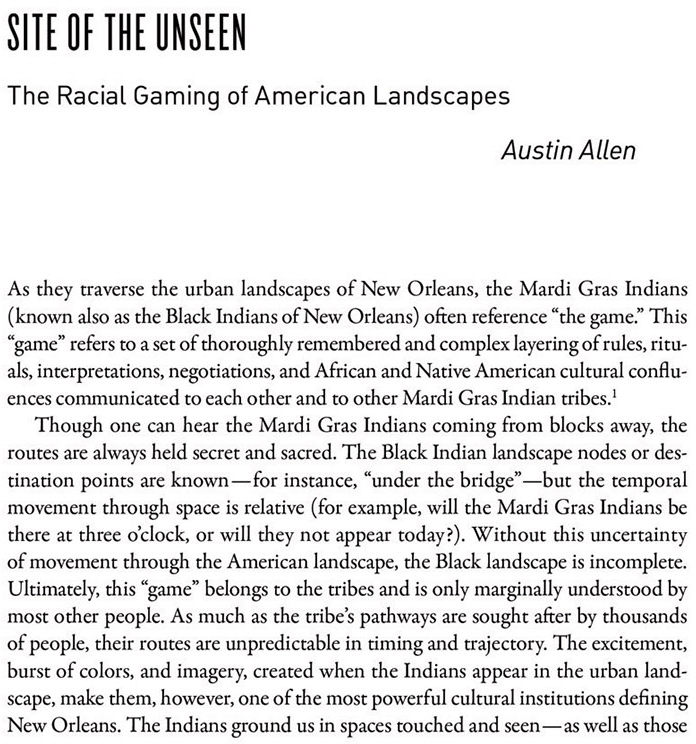
▲《黑人景观同等重要》,“未被看见的场地:美国景观的种族博弈”章节(第97页)。景观设计师、教育家和电影制片人Austin Allen从个人视角分享了从新奥尔良到俄亥俄州的多样景观叙事,并讲述了非裔美国人在界定和维护景观方面的斗争——即便他们在美国景观的塑造和培育上发挥了核心作用。Black Landscapes Matter, Site of the Unseen: The Racial Gaming of American Landscapes (pg. 97). Landscape architect, educator, and filmmaker Austin Allen shares personal narratives across various landscapes, from New Orleans to Ohio, describing African Americans’ struggle to define and maintain space despite their central role in shaping and cultivating the American landscape. © UVA Press
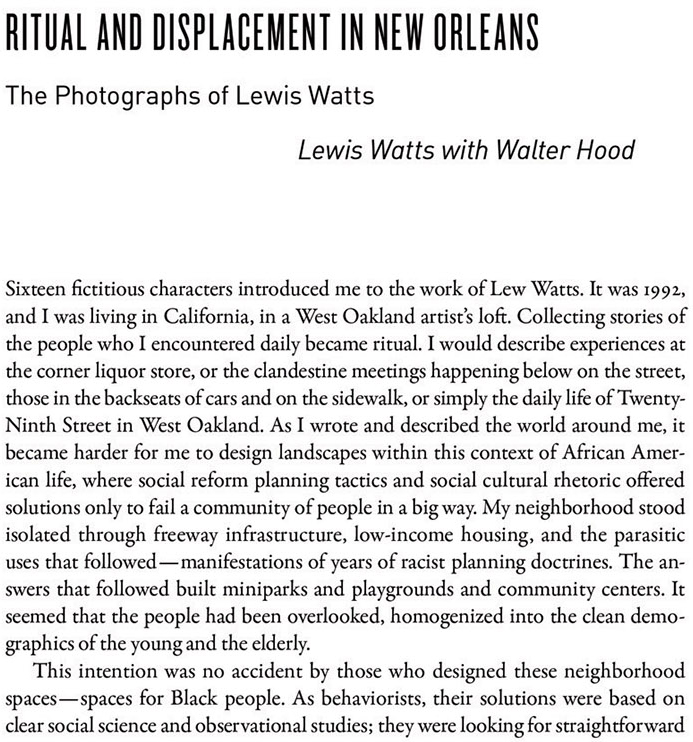
▲《黑人景观同等重要》,“新奥尔良的仪式与流亡:Lewis Watts的摄影作品”章节(第134页)。Hood为本书挑选了Watts在新奥尔良拍摄的17张照片,记录了黑人的身体和他们在具有包容性的空间中的重要意义:黑人的身体与寻常的身体并无二致,他们以和其他人一样的方式存在于我们共同的空间。Black Landscapes Matter, Ritual and Displacement in New Orleans: The Photographs of Lewis Watts (pg. 134). Walter Hood selects seventeen of Lewis Watts’ images from New Orleans that document the Black body and its importance in inclusive space: the Black body as ordinary—not as spectacle—existing in the same space as everyone else. © UVA Press
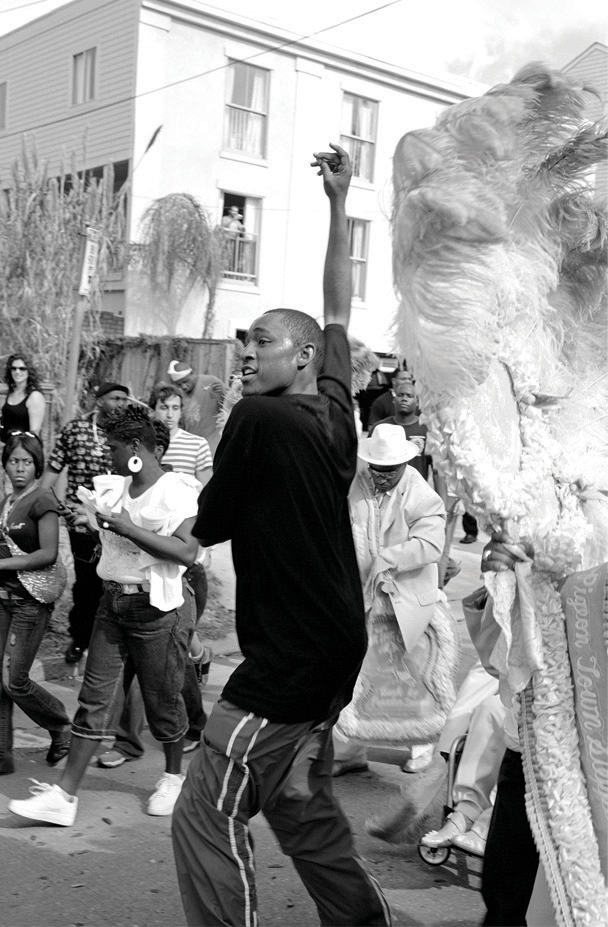
▲《黑人景观同等重要》,“新奥尔良的仪式与流亡:Lewis Watts的摄影作品”章节(第148页)。Lewis Watts拍摄的系列照片之一。Black Landscapes Matter, Arms Up, 2nd Line Parade, Tremé (Lewis Watts, 2008) (pg. 148). One photograph in a series by Lewis Watts. © Lewis Watts
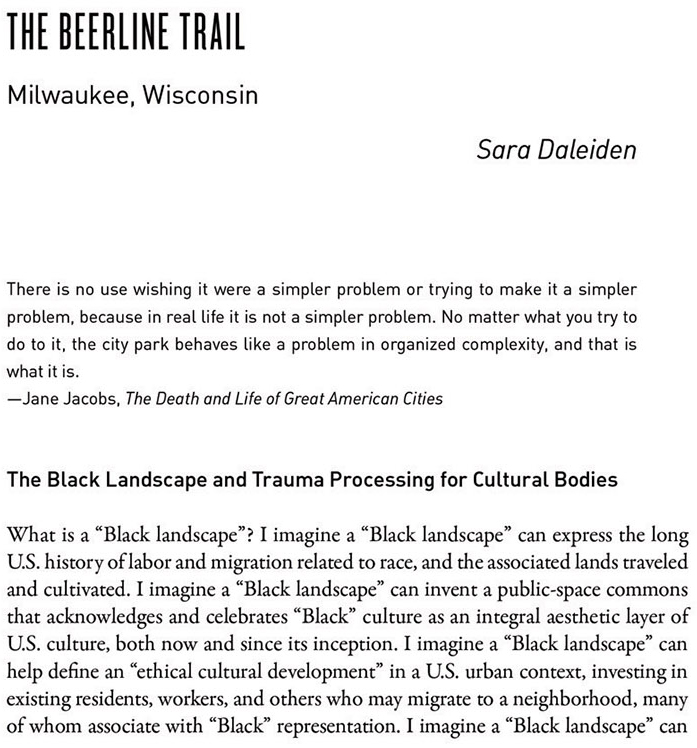
▲《黑人景观同等重要》,“Beerline小路:威斯康星州密尔沃基”章节(第153页)。艺术家和公民参与促进者Sara Daleiden以一个“从铁路到小路”的项目为例,探讨了合作与专门机构在道德文化发展中的作用。Black Landscapes Matter, The Beerline Trail: Milwaukee, Wisconsin (pg. 153). Artist and civic-engagement facilitator Sara Daleiden discusses collaboration and agency as a tool for ethical cultural development within the context of the Beerline Trail, a “rail to trail” project in Milwaukee, Wisconsin. © UVA Press
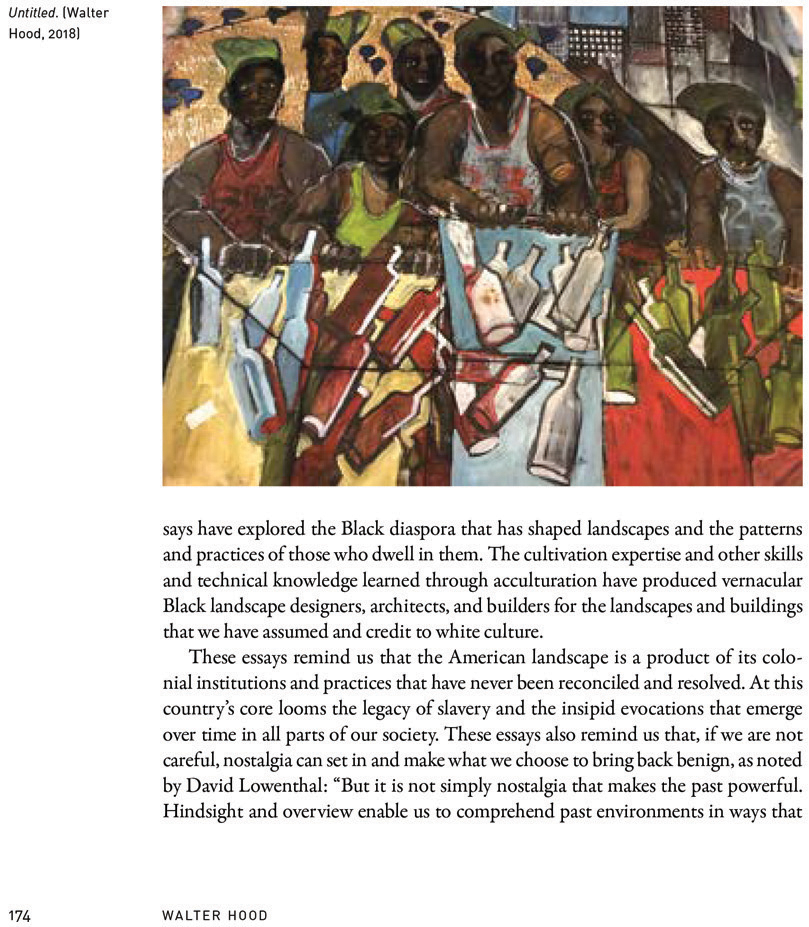
▲《黑人景观同等重要》,后记部分(第174页),文字和插画作者均为Walter Hood。他在此章呼吁人们在叙事中更多地呈现潜藏于美国景观中的多样性。将更加复杂多样的景观纳入美国人的集体记忆,这将促使我们树立新的意识和观念。Black Landscapes Matter, page from Walter Hood’s Afterword (pg. 174), text and Untitled, painting by Walter Hood. Walter Hood calls for narratives that showcase the multiplicities latent in the American landscape. Including more complex landscapes in the collective American memory imbues us all with a new consciousness. © UVA Press and Walter Hood
PROJECT NARRATIVE
The volume Black Landscapes Matter, edited by Walter Hood and Grace Mitchell Tada, poses the question “Do black landscapes matter?” From the plantations of slavery to contemporary segregated cities, from freedman villages to northern migrations for freedom, the nation’s landscape bears the detritus of diverse origins. Black landscapes matter because they tell the truth. To elucidate these truths, acclaimed landscape designer and public artist Walter Hood assembles a group of notable landscape architecture and planning professionals and scholars to probe how race, memory, and meaning intersect in the American landscape.
Essayists examine a variety of U.S. places—ranging from New Orleans and Charlotte to Milwaukee and Detroit—exposing racism endemic in the built environment and acknowledging the widespread erasure of Black geographies and cultural landscapes. Through a combination of case studies, critiques, and calls to action, contributors reveal the deficient, normative portrayals of landscape that affect communities of color and question how public design and preservation efforts can support people in these places. In a culture in which historical omissions and specious narratives routinely provoke disinvestment in minority communities, creative solutions by designers, planners, artists, and residents are necessary to activate them in novel ways. Black people have built and shaped the American landscape in ways that can never be fully known.
The volume is organized by chapter as follows:
Walter Hood opens the volume encouraging landscape architects and those in related disciplines to develop a “prophetic” aesthetic language to remember and develop new futures from the power of the past. Only in doing so can history be corrected as truth.
Designer and educator Richard Hindle offers a sobering view of the 2016 presidential election and surrounding events that have revealed the centuries-long institutional and embodied racism latent in countless forms across the United States. It is evident, he writes, that Black landscapes matter to everyone. They form the core of American history—from early colonial and plantation landscapes, to Seneca Village in Central Park. Yet, as a whole, our culture knows little of them. It is overdue that we shift that understanding.
Landscape historian Louise Mozingo considers her childhood move from Rome, Italy, to Arlington, Virginia, and the corresponding shift in how she experienced the public realm. In the US, Mozingo initially confronted race and Blackness in the landscape: she recalls her slow realization of the nonsensical, racist divisions that governed the American public realm. They still do today, and it is these physical divisions that preserve myriad other divisions throughout the country. As long as these divisions persist, designing the public realm continues to be urgent work.
Dr. Anna Brand documents the everyday and mundane life pre- and post-Hurricane Katrina on the 4800 block of Camp Street, in the Uptown neighborhood of New Orleans. Between 2003 and 2017, she witnessed the shifting and displacement of people within a Black geography in a post-catastrophic context where gentrification was cloaked in the politics of rebuilding. Brand argues that although these Black geographies were created out of apartheid racial systems, they are not defined by racism. She points to the specificities and the creative patterns inherent in these landscapes as keys to establishing their future.
North Carolina–based designer, educator, and environmental-justice advocate Kofi Boone builds from the groundwork of the Black Lives Matter (BLM) movement and asks if the field of landscape architecture can be reconsidered as a vector of community empowerment. Referencing the creative production surrounding BLM, he notes that the built environment professions have been excluded from this wave. A contemporary reconfiguration of the education and professional system would enable African American participation in shaping the American landscape—and recognize their long history of doing so, evidenced in plantation landscapes, HBCU campuses, political and economic urban spaces, and planned communities. Boone also recognizes the role of public space in developing Black leadership through the rise of Black Wall Streets, creative protest, and the environmental justice movement.
Hood recalls with nostalgia his childhood in a post-civil-rights but still-segregated Charlotte, North Carolina, in the 1960s and ’70s, and discusses the evolution of Charlotte since his childhood. He examines census data and public art, and harnesses geographer David Lowenthal’s essay “Past Time, Present Place: Landscape and Memory” to articulate his understanding of the city’s transformation. The paradox of the Black landscape in the urban United States, writes Hood, is its celebrated presence in the collective American consciousness despite its physical erasure. Hood posits that his hometown’s memory of Black landscapes presents a version of the past—an ostensible past—that never was.
Maurice Cox, writing from his post as planning director of the City of Detroit, shares his professional journey as an architect, politician, and activist that has taken him across the United States. He recognizes the tendency of the American landscape to erase certain histories—particularly those of African American communities. It is these communities themselves, Cox argues, who must preserve and steward these spaces, like the Bayview community in rural Virginia that demonstrates self-determination, and like New Orleans, a landscape shaped by multicultural heritage. Arriving in Detroit, Michigan, Cox asks how urban planning considers a landscape of disinvestment and Black disenfranchisement. His answers include recognizing value in the landscape, and respecting the history of the place and its people.
Landscape architect, educator, and filmmaker Austin Allen shares personal narratives across various landscapes, from New Orleans to Ohio, and describes African Americans’ struggle to define and maintain space despite their central role in shaping and cultivating the American landscape. In some places, a racial gaming has allowed Black people’s continued occupation of space. In other instances, place is elusive and improvisational, giving rise to the rituals, rules, interpretations, and negotiations that characterize Black landscapes, communities, and identities. But even in moments of brightness and transgression, these places, because of their dark histories, oscillate between the apocalyptic and post-apocalyptic. Considering the role of education in the celebration of Black landscapes, Allen advocates a renewal of the community college system as a channel by which to validate Black landscapes and Black contributions to the built environment, and empower Black communities in a future laden with uncertainty.
Hood describes the shift in his landscape design work, in the 1990s, toward a language embracing new narratives and representations—and understood by the people whose spaces he designed. He recognizes that photography preceded his thinking. A series of Watts’ photographs portraying Black subjects deeply influenced Hood’s understanding of Black landscape space. Hood selects seventeen of Watts’ images from New Orleans (presented here) that document the Black body and its importance in inclusive space: the Black body as ordinary—not as spectacle—existing in the same space as everyone else.
Artist and civic-engagement facilitator Sara Daleiden discusses collaboration and agency as a tool for ethical cultural development within the context of the Beerline Trail, a “rail to trail” project in Milwaukee, Wisconsin. Working along the trail and its border space that carry a legacy of racial segregation practice and policies, Daleiden discusses the Black landscape as a cultural body that can facilitate working through trauma in a city. The trail becomes the “thing” in the landscape that is a lens by which to navigate the neighborhood’s marginalized predicaments and desires.
Hood concludes the volume calling for narratives that showcase the multiplicities latent in the American landscape. Despite the American motto E Pluribus Unum, Hood asserts that it is impossible to have oneness when we live in a nation of multiplicities. Pointing to W. E. B. Du Bois’ understanding that double-consciousness engenders empathy, Hood, too, espouses multiplicity as a means by which to see, accept, and celebrate difference. Black landscapes and their narratives, as well as others similarly buried, demand Americans expand their narrow, normative understanding of vernacular landscapes. Including more complex landscapes in the collective American memory imbues us all with a new consciousness.
More: ASLA









我们需要对黄种人友好的
景观设计者的初衷应该都是服务于所有人,非要戴上有色眼镜给使用者和使用场地做个划分,专家们是不是吃太饱了
没想到的是景观也能政治正确
不是所有传统都值得焕发第二春,脱离工业文明进步的landscape沾了什么种族也没必要重塑。坐看美国人的口号能不能落实到下一个asla的落地作品
强调Black时,已经是精英阶级用精致的“怜悯”在这个族群里寻找自身优越感的过程。虽然我个人也不喜欢老黑,但对老美的这些ZZZQ操作很作呕……
重要到连照片都没几张。。。(*/ω\*)
这标题~~~~~~~无力吐槽
目前看只有中国类做的比较好
我最讨厌两种人,一种是人种歧视的人,一种是X人
光看书名,我还以为之前的美国景观都是用棉花做绿化的
x人是什么人?
哈哈哈哈哈哈哈哈哈我也刚想来说