海外存知己,天涯若比邻。
在海外专辑分享海外华人的故事。希望这份分享可以让世界更加海阔天空。
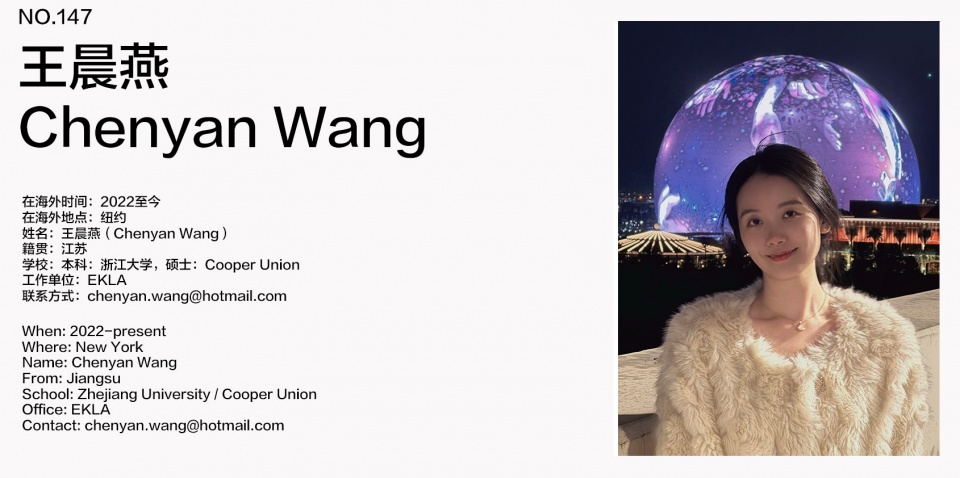
第一百四十七期为您介绍的是毕业于Cooper Union,现工作于EKLA的王晨燕
A bosom friend afar brings distant land near.
The Oversea album shares the lives of Chinese living abroad with all.
The No. 147 episode features Chenyan Wang who graduated from Cooper Union and is now working for EKLA
为什么出国?
Why go abroad?
对挑战和自由的追求,希望把自己放在一个更高密度的思想与现实交汇的场域里。本科期间去过很多国家访学,喜欢在不同的文化氛围中拓宽自己对世界的思考。纽约对我来说是一所“没有围墙的学校”:世界级艺术馆、拥挤的街道、陌生人的对话、以及不断出现的社会议题,都在让你你重新定义设计的边界。
纽约也会以非常真实的方式回应你。有时慷慨,有时残酷而冷血。正如那句老话说的:“If you can make it in New York, you can make it anywhere.” 这座城市聚集了极高密度的文化资源、最有野心与勇气的人,也提供了极其真实的竞争环境。
在这样的城市里,真正的学习并不只发生在课堂。它发生在你如何观察世界、如何面对矛盾,以及如何在理性与浪漫之间找到自己的节奏。纽约,毫无疑问,是最好的练习场。
A desire for challenge and freedom played a big part, but more importantly, I wanted to place myself in a context where ideas and reality intersect at a much higher density. During my undergraduate years, I had the opportunity to study and travel in several countries, and I found that being in different cultural environments constantly expanded the way I think about the world.
For me, New York is a kind of “school without walls.” World-class museums, crowded streets, conversations with strangers, and the constant emergence of social issues all push you to rethink the boundaries of design.
New York also responds to you in very real ways. Sometimes it is generous; other times it can be brutally indifferent. As the old saying goes, “If you can make it in New York, you can make it anywhere.” The city concentrates an extraordinary density of cultural resources and ambitious, courageous people, while also offering one of the most honest competitive environments you can encounter.
In a city like this, real learning doesn’t only happen in classrooms. It happens in how you observe the world, how you navigate contradictions, and how you find your own rhythm between rationality and imagination. In that sense, New York is, without question, the ultimate training ground.
在国外遇到了什么让你印象最深刻的事情?
What impressed you the most when you are abroad?
在纽约的四年让我学会在极度的不安与失控中寻找秩序。你会发现这座城市从未崩溃。因为混乱并非秩序的反面,而是秩序的一种更复杂、更宏大、处于演化过程中的隐性形态。
对我来说,最深刻的影响是一种被反复训练出来的习惯:先观察,再审视自己的观察。在 Cooper Union 的课程里,老师通过大量阅读与讨论逼着你建立良好的研究习惯:如何提出好的问题,如何建立论证,以及如何通过叙事表达思想。设计并不是所谓的“灵感闪现”,而是一种非常理性、非常克制的工作方式。
另一个改变则来自于一种心态。在课堂和工作中,我最常被问到的一句话是:“Do you have fun today?” 重要的并不是一个优异的结果,而是找到自己内心真正的动力以及能乐在其中的精神,即把自己放进时代和学科的洪流之中,持续参与、持续思考的能力。
My four years in New York taught me how to search for order amid extreme uncertainty and loss of control. Over time, you begin to realize that this city has never truly collapsed. Chaos is not the opposite of order; it is a more complex and expansive form of order, one that is still evolving and not yet fully visible.
For me, the most profound influence was a habit that was repeatedly trained into us: first observe, and then examine your own observations. In the seminars at Cooper Union, professors push you through intensive reading and discussion to develop strong research habits: how to formulate meaningful questions, how to construct arguments, and how to express ideas through narrative. Design is not a sudden flash of inspiration, it is a disciplined and deeply rational way of working.
Another transformation came in terms of mindset. In both studio and professional practice, one question I hear most often is: “Do you have fun today?” What matters is not simply achieving an outstanding result, but discovering the inner motivation that sustains you and cultivating a spirit of genuine engagement. It is about placing yourself within the ongoing currents of your discipline and your time, continuing to participate, to observe, and to think.
最想念祖国的什么?
What do you miss the most about China?
最想念的是家人和朋友,那种不用解释就能懂的默契;也会想念杭州的湿润空气、校园里的树影,以及灵隐一带那种能让人慢下来的安静。
What I miss most are my family and friends: the kind of unspoken understanding where nothing really needs to be explained. I also miss the humid air of Hangzhou, the shadows of trees across campus, and the quiet atmosphere around Lingyin, where everything seems to slow down.
你会回国么,为什么?
Will you come back? Why?
会。但思考这个问题不是一个非此即彼的事情,看你所做的事情需要什么样的能量和场域,文化上,我始终觉得自己是非常中国人的,但很多事情的发展并不是线性的。不同的城市会提供不同的能量结构、社会语境和实践机会。有些想法可能在纽约更容易发生,有些则可能在中国拥有更大的现实张力。很多事情都是阶段性的,需要辩证和战略的去看待。
Yes. But I don’t really see it as an either–or decision. It depends on what kind of work you are trying to do and what kind of context it requires. Culturally, I feel deeply Chinese, but intellectual and professional trajectories are rarely linear. Different cities produce different social energies and conditions of practice. Some ideas emerge more naturally in New York, while others may find greater resonance within the realities of China. So for me, these decisions are often provisional and strategic: something to be understood dialectically and in phases, rather than as a fixed position.
出国后在不同的背景下再看中国是否看得更清晰,有哪些感触?
Is it more distinct to view China in a different environment after going abroad? Any thought?
当然更清晰。离开熟悉的语境之后,我反而更能感受到中国的复杂与能量:它既有惊人的效率与规模,也有很多仍在快速迭代、需要被理解与被耐心处理的结构性问题。我在异国他乡的日子让我更清楚自己从哪里来,以及我想用怎样的方式介入这个时代。
Yes, much more clearly. Once you step outside a familiar context, you begin to see it with a different kind of clarity. Living abroad has made me more aware of the complexity and energy of China. It is a place of astonishing scale and efficiency, but also one that is evolving rapidly, with many structural questions that still require careful understanding and patience. Being away has clarified not only where I come from, but also how I hope to position myself,and my work, within the conditions of this era.
你的学校有哪些教育特点?
What are the educational characteristics of your school?
我在两所学校感受到的共同气质是:理性克制,又浪漫自由,只是“自由”的形态不同。前者因为其开放与包容,后者因为其纯粹且深刻。
综合性大学会提供多元全面的发展平台,特别注重跨专业的交流与合作,这对本科生来说是非常好的试错机会,可以极大的开拓眼界。Cooper Union 则是一种“极致”:小规模、研究导向、密集讨论。你会被鼓励把兴趣变成可论证的立场,建立属于自己的叙事与表达体系。
此外,学校所在的城市环境也非常重要。浙大位于杭州,这是一座兼具历史文化与科技创新的城市,校园环境优美,城市资源也十分丰富;而 Cooper Union 坐落于曼哈顿下城,是纽约最核心的文化区域之一,周围有大量艺术机构、画廊和实习机会。对于从事创意行业的学生来说,城市本身就是最好的课堂。
教育是一切的起点。我也希望每个人都能有机会接触到那种可能改变一生的教育,并真正感受到自己与曾经梦想的一切产生连接。
What I felt most strongly at both schools was a shared spirit: rational and disciplined, yet romantic and free. The difference lies in the form that freedom takes. At Zhejiang University, it comes from openness and inclusivity; at Cooper Union, it emerges from a kind of intellectual purity and depth.
A comprehensive university like Zhejiang University offers a broad and multidimensional platform. Interdisciplinary exchange and collaboration are strongly encouraged, which provides undergraduate students with an invaluable space to experiment, explore different interests, and significantly broaden their perspective. Cooper Union, by contrast, represents a kind of intensity. The program is small, research-driven, and built around constant, rigorous discussion. Students are encouraged to turn their curiosities into positions that can be argued and developed, gradually building their own narrative and modes of representation.
The cities in which these schools are located are also deeply influential. Zhejiang University is in Hangzhou, a city that combines rich historical culture with a strong atmosphere of technological innovation. The campus environment is beautiful and the city offers abundant resources. Cooper Union sits in Lower Manhattan, one of the cultural centers of New York City, surrounded by museums, galleries, and countless internship opportunities. For students in creative fields, the city itself becomes an extension of the classroom.
For me, education is where everything begins. I hope everyone has the opportunity to encounter the kind of education that can change the course of a life, and to feel genuinely connected to everything they ever dreamed of.
你现在工作公司的特色和有趣的地方?
What are the distinctive and interesting aspects of the company you are currently working for?
我一直在和不同的女性创始人共事。她们大多是受过高等教育的移民女性,在城市规划、建筑和景观行业中已经实践了三十多年。因为我一直有创业的计划,所以在纽约的工作经历,对我来说更像是一种近距离的观察与学习:如何在充满变数的环境中保持长期主义,如何在商业现实与创作理想之间维持平衡,如何审时度势、如何待人接物。
我也从不把自己局限在“画图”这一件事上。凡是我觉得有意义、有可能性的方向,我都会主动提出,并想办法去尝试。我更感兴趣的,是如何建立一个真正完整的商业闭环,而不仅仅是完成一个漂亮的设计方案。
在这里,我也看到了很多女性创始人不为人知的困境与坚持。工作之余,我们常常会聊世界的政治、经济、文化和哲学,几乎可以讨论任何你真正感兴趣的问题。她们也会尽可能为年轻人提供机会和视角。你会很清晰地感受到一种跨越代际的支持,一种女性之间彼此托举、不断延续的力量。
I have been working with a number of female founders. Most of them are highly educated immigrant women who have spent more than thirty years practicing in urban planning, architecture, and landscape. Because I have always had plans to start something of my own, my work experience in New York has felt less like a conventional job and more like an opportunity to observe and learn at close range: how to maintain a long-term vision in an environment full of uncertainty, how to balance commercial realities with creative ideas, and how to read situations and navigate relationships with care.
I have also never confined myself to simply “drawing.” Whenever I see a direction that feels meaningful or promising, I tend to propose it and find ways to test it. What interests me most is not just producing a beautiful design, but understanding how to build a complete and viable ecosystem around it, like how an idea can eventually form a real and sustainable business model.
Working in these environments has also allowed me to witness the less visible side of leadership. I have seen the difficulties and persistence behind many women founders. Outside of work, our conversations often drift toward politics, economics, culture, and philosophy; almost anything you are genuinely curious about can become part of the discussion. They also make a real effort to create opportunities and perspectives for younger people. In those moments, you can clearly feel a kind of intergenerational support: a quiet but powerful tradition of women lifting one another up and carrying that strength forward.
最喜欢的艺术家(绘画音乐电影等广泛范围)是谁?给你创作带来了什么影响?
Who is your favorite artist (in wider range such as art, music, movie)? What is the influence?
如果一定要选,我最喜欢的是胡安·米罗(Joan Miró)和建筑师约翰·海杜克(John Hejduk)。
米罗对我的影响,深入到了我思考形式本身的方式。他用极其简单的符号:鸟、星星、线条、色块等构建出一套几乎如语言般的视觉系统。那些看似天真的图形背后,是高度凝练的情感与意志的表达:用最少的形式,承载最复杂的情绪与意义,同时将思维从理性的秩序中强行解放出来。
海杜克的建筑更像是诗歌或寓言:通过人物、故事、叙事去构建建筑的意义。他让我真正相信,建筑可以不止于空间与功能,它也可以是一种思想的形态、一种叙事的方式。这种对建筑师身份的理解,也是我来到 Cooper Union 的原因。CU一直继承着海杜克留下的那种气质:拒绝将建筑化约为功能或造型,坚持在理论、历史、批评与设计之间保持张力。
If I had to choose, the two figures who have influenced me the most are Joan Miró and the architect John Hejduk.
Miró shaped the way I think about form itself. With extremely simple symbols like birds, stars, lines, and blocks of color, he constructed a visual system that functions almost like a language. What appears playful or naive on the surface is in fact an extraordinarily condensed articulation of emotion and will: using the fewest forms to carry the most complex feelings and meanings, while simultaneously disrupting the rigid structures of rationality.
Hejduk represents a very different, but equally formative influence. His architecture reads less as an object and more as a narrative construct. Through characters, allegories, and carefully staged spatial situations, he reframed architecture as a medium capable of carrying memory, myth, and philosophical inquiry. In his work, architecture becomes not simply a matter of space or function, but a form of thought. This understanding of what it means to be an architect is also why I came to The Cooper Union. The school continues to carry the intellectual lineage Hejduk established: a refusal to reduce architecture to either technical performance or formal production, and instead an insistence on maintaining a productive tension between theory, history, criticism, and design.
觉得自己的作品集有哪些迷人的特质?
What fascinates viewers the most in your portfolio in your opinion?
我觉得我的作品集最有吸引力的地方,在于它始终从定义问题出发。
对我来说,设计最重要的不是给出一个漂亮的答案,而是重新界定问题本身。很多项目都从具体的社会现实出发,比如城乡关系、生态系统、劳动结构或空间权力,再通过空间语言把复杂现实转译为一种可以被感知和讨论的空间经验。
在我看来,建筑更像是一种先于语言的情感表达。它拥有自己的叙事与立场,并参与到社会结构的共振之中。建筑并不是一个最终完成的状态,而是一种持续社会化的过程,是一种催化剂,可以触发新的行为模式和社会关系。
我一直对生态与城市议题很感兴趣,也很享受在看似无关的系统之间寻找联系:资本、技术、基础设施、气候等等。设计的过程对我来说更像是在解一道复杂的谜题:从混杂的元素中发现结构,并把它转化为一种新的空间表达。
I think the most compelling aspect of my portfolio is that it always begins with defining the problem.
Power often comes from framing the questions. For me, the most important role of design is not to produce a beautiful answer, but to redefine the question itself. Many of my projects start from concrete social realities, such as urban–rural relationships, ecological systems, labor structures, or spatial power, and translate these complex conditions into spatial experiences that can be perceived, discussed, and questioned.
I gradually came to see space as an emotion that precedes language. Built landscapes possess their own standpoint and narrative, participating in the resonance of society. Architecture is not an ultimate state of completion, but a process of continuous socialization. It works more like a catalyst that generates new behaviors and social relations.
I have always been particularly interested in ecological and urban questions, and I enjoy searching for connections between systems that may initially appear unrelated—capital, technology, infrastructure, climate, and so on. For me, the design process often feels like solving a complex puzzle: discovering underlying structures within a mixture of elements and transforming them into a new spatial expression.
什么时候开始看谷德网的?欢迎你提出建议哦,谢谢。
When did you start to follow gooood? Any suggestions?
从本科的时候就关注了。我非常喜欢其中多元的案例,以及“在海外”专栏里不同个体的经验与视角,收获颇丰。祝越办越好!
I’ve been following it since my undergraduate years. I really appreciate the diversity of projects featured on the platform, as well as the Overseas column, which brings together many different personal experiences and perspectives. I’ve learned a lot from it over the years. Wishing the platform continued success!
W O R K
01.
岛屿景观与水域城市主义:发展中岛屿国家的游牧型、两栖型与韧性生态系统
ISLANDSCAPE AND AQUATIC URBANISM
Nomadic, Amphibious, and Resilient Ecosystem for Small Island Developing States
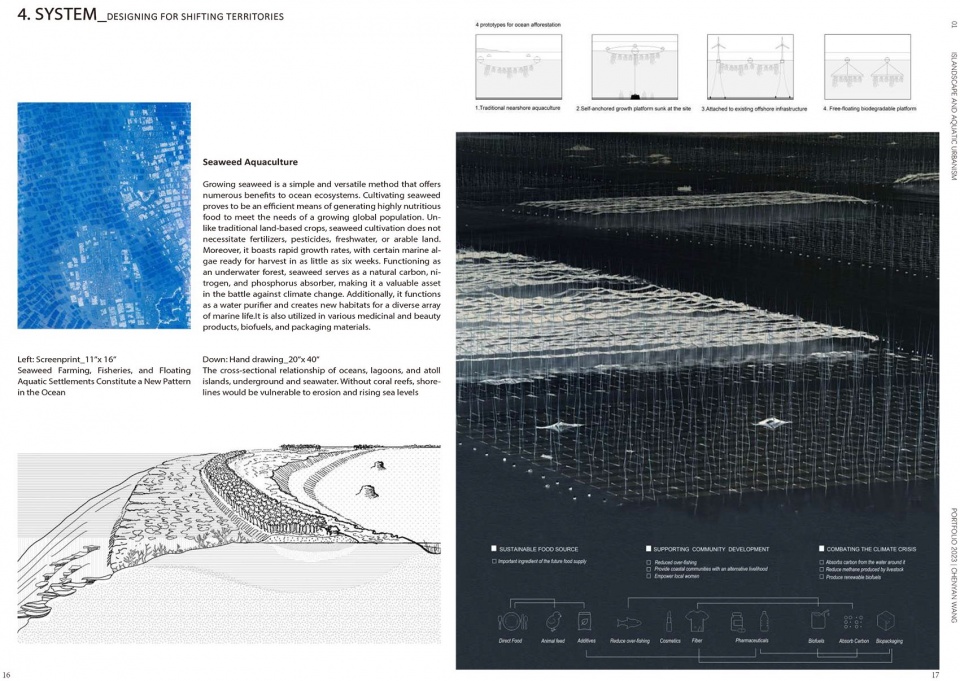
小岛屿发展中国家面临着一系列独特的环境与发展挑战。土地资源有限、生态系统脆弱,同时又高度依赖国际贸易与外部资源。在全球气候变化的背景下,海平面上升、海岸线退缩以及海洋生态变化,正在不断重塑这些岛屿国家的空间边界与生存环境。
Small Island Developing States face a unique set of environmental and developmental challenges. Limited land resources, fragile ecosystems, and strong dependence on external systems make these territories particularly vulnerable to climate change. Rising sea levels, shifting coastlines, and changing marine ecologies are continuously reshaping their spatial boundaries and living environments.
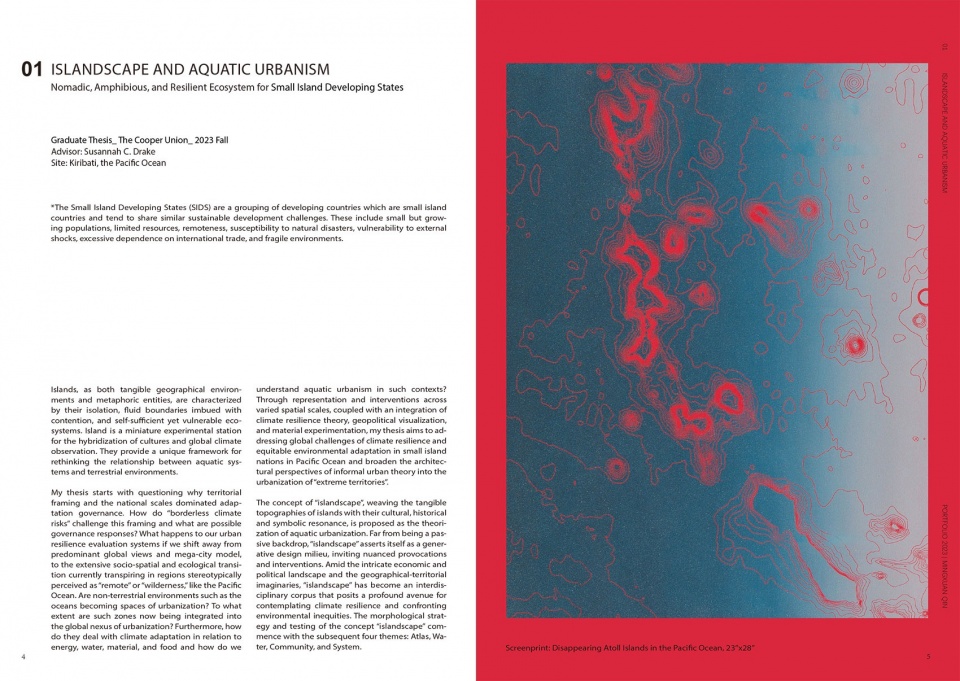
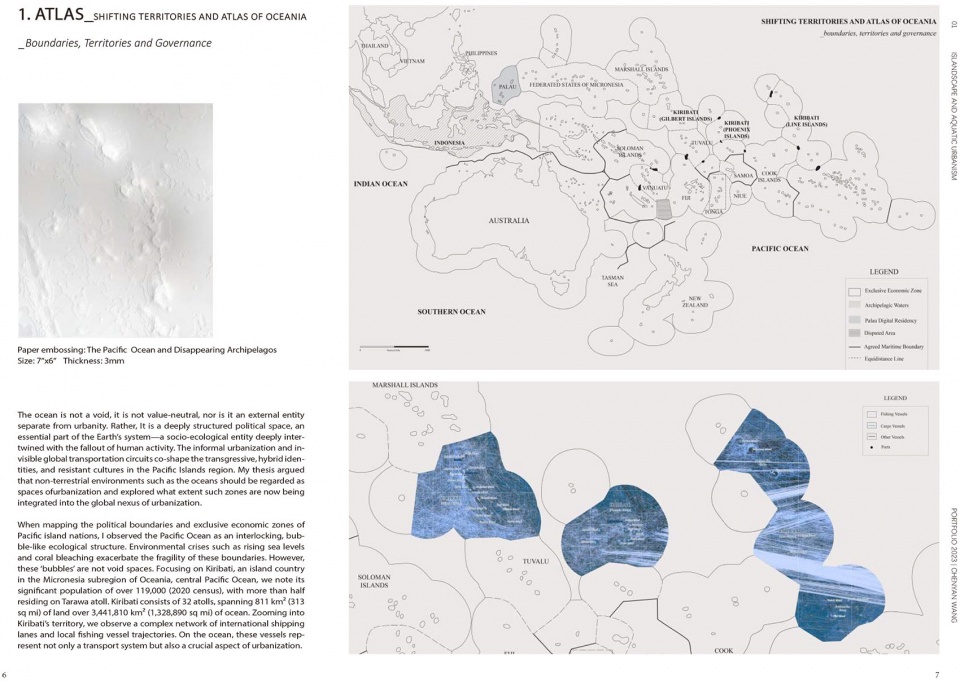
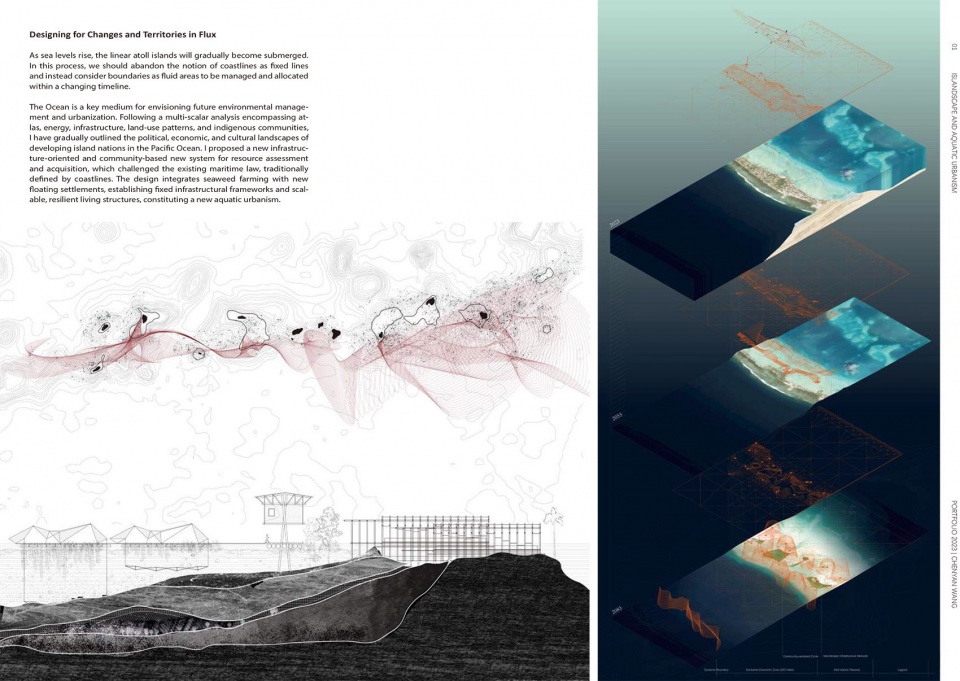
然而,现有的城市治理与气候适应体系大多建立在以陆地为中心的尺度与边界之上。当气候风险跨越国家边界并在海洋系统中扩散时,这种以陆地为基础的空间框架逐渐显现出局限性。因此,一个关键问题随之出现:当海洋本身成为一种城市化空间时,我们应当如何重新理解城市、基础设施与领土边界?
However, most existing frameworks of urban governance and climate adaptation remain land-centered. As climate risks increasingly operate across oceanic systems and national borders, this terrestrial logic reveals its limitations. A critical question therefore emerges: how should we rethink cities, infrastructures, and territorial boundaries when the ocean itself becomes a space of urbanization?
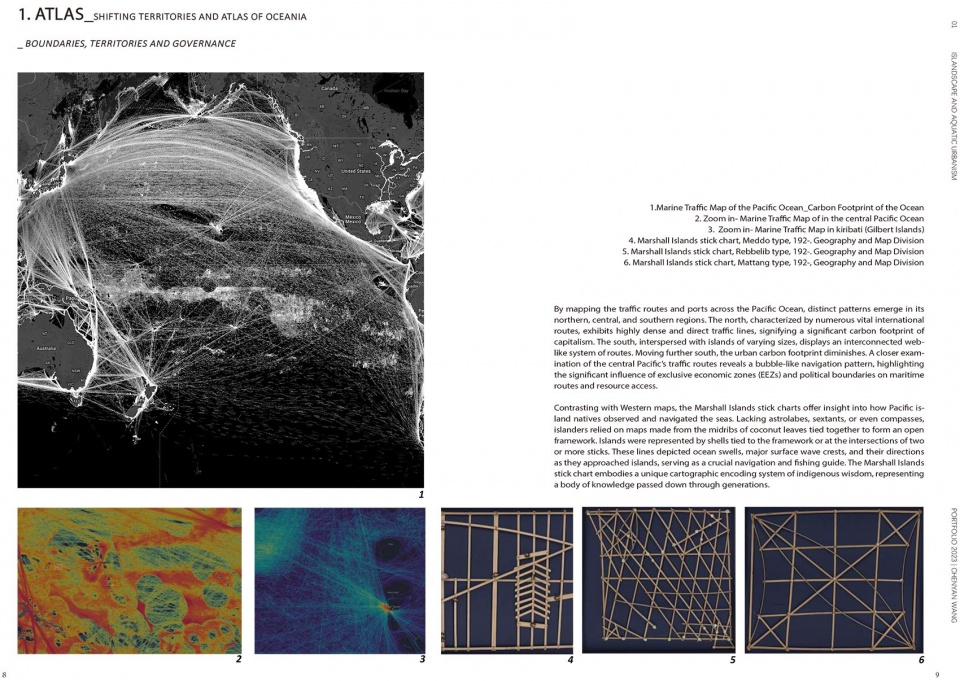
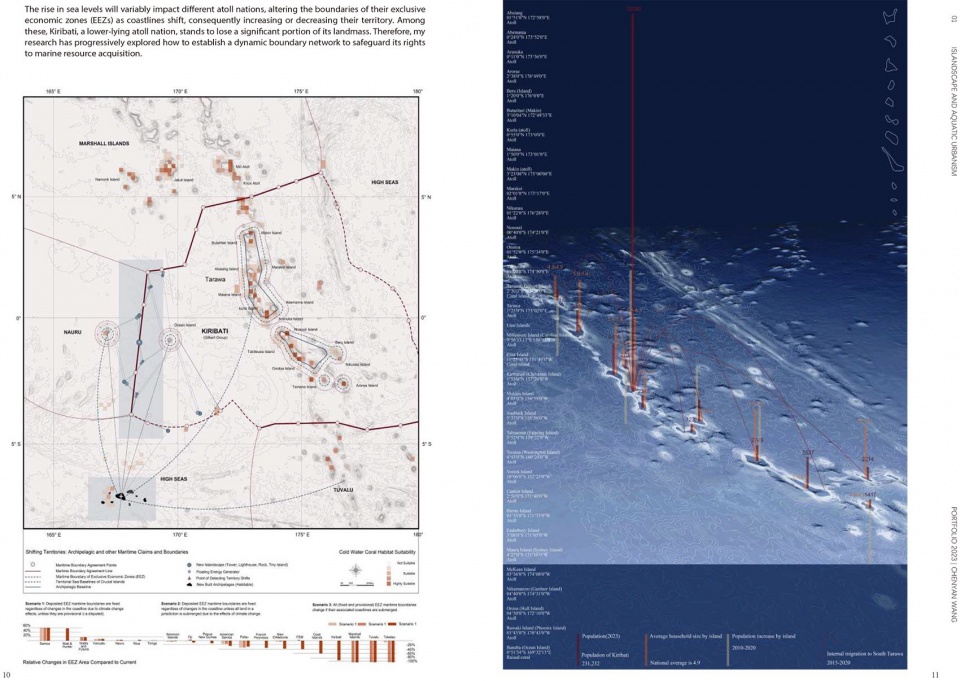
本研究提出岛屿景观这一概念,将岛屿视为嵌入海洋网络中的动态系统。在这一视角下,海洋不再只是陆地之外的背景,而是一种具有政治、生态与经济意义的空间。
This thesis introduces the concept of “Islandscape,” which understands islands as dynamic systems embedded within oceanic networks. In this framework, the ocean is no longer a passive backdrop to land but an active spatial medium shaped by political, ecological, and economic forces.
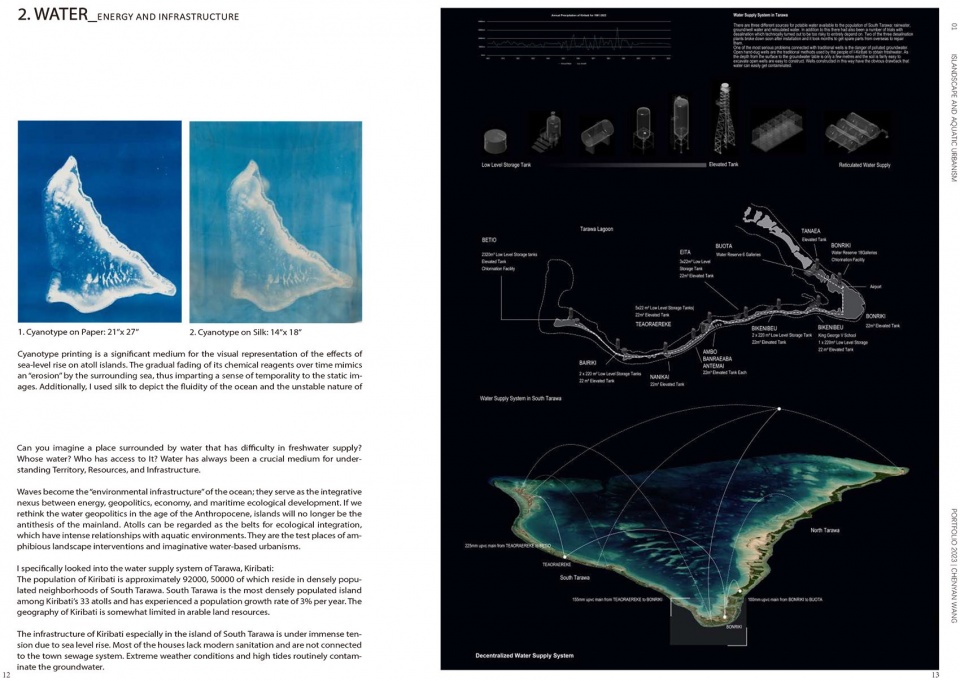
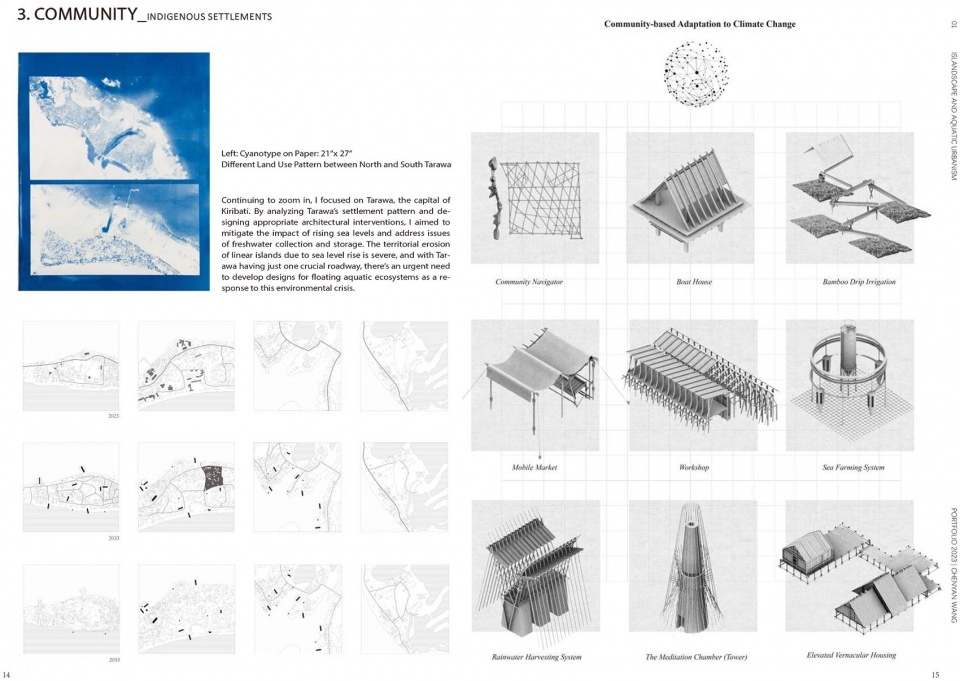
项目以太平洋岛国基里巴斯为研究对象,通过多尺度地图绘制、材料实验以及建筑原型设计等方式,探索在海平面上升背景下新的空间适应策略。研究从Atlas(地图)、Water(水源)、Community(社区)与 System(系统)四个维度展开,试图从空间、生态与社会结构的多个层面重新理解海洋与城市化之间的关系,并为气候变化时代的小岛国家提供新的空间治理方式。
Focusing on Kiribati in the Pacific Ocean, the project employs multi-scalar mapping, material experimentation, and spatial prototyping to explore adaptive strategies for sea-level rise. The research unfolds through four themes: Atlas, Water, Community, and System, reframing the relationship between ocean and urbanization while imagining new forms of spatial governance for island nations in the age of climate change.
02.
菌丝森林:一种城市种植策略
Mycelium Forest as an Urban Planting Strategy
森林通常被理解为一种稳定的自然景观,但在森林地表之下,菌丝网络构成了一种复杂的生态系统,连接着植物、土壤与微生物,并调节着养分循环与能量流动。本项目以菌丝为切入点,重新思考森林作为一种空间系统的组织方式。
Forests are often understood as stable natural landscapes. Yet beneath the forest floor lies a complex mycelial network that connects plants, soil, and microorganisms, regulating the circulation of nutrients and energy. This project takes mycelium as a point of entry to rethink the forest as a spatial system organized through flows and connections.
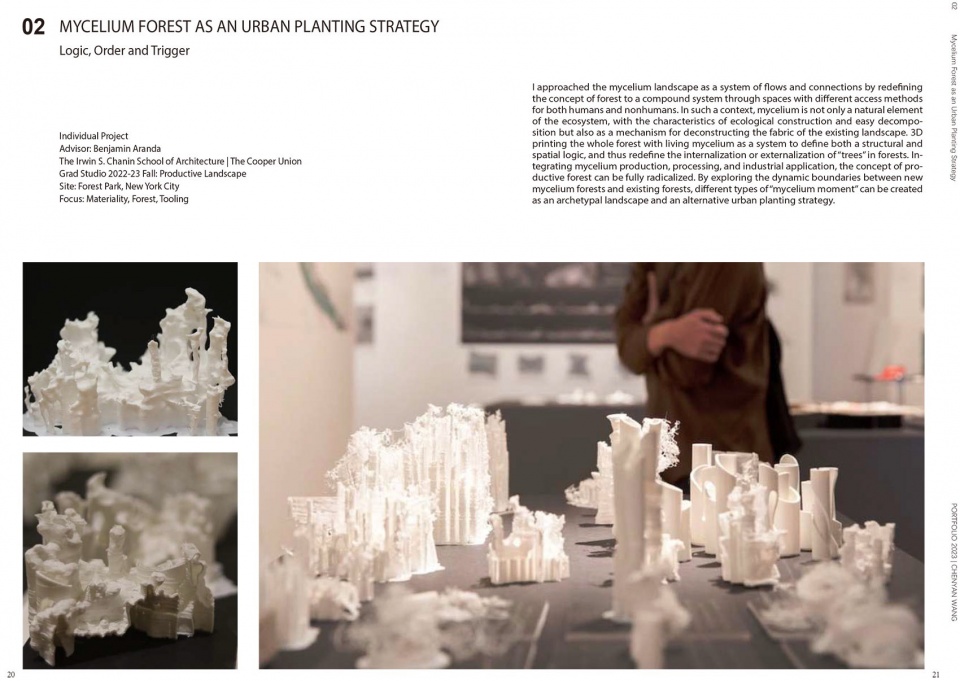
菌丝不仅是一种具有生长与分解能力的生态材料,同时也揭示了一种由连接与流动构成的空间逻辑。通过将菌丝视为一种结构与空间生成机制,森林不再只是由树木构成的自然环境,而成为一种可以被重新组织和生产的生态景观。
Mycelium is not only an ecological material capable of growth and decomposition, but also reveals a spatial logic based on connectivity and exchange. By treating mycelium as a structural and generative mechanism, the forest is no longer understood simply as a collection of trees, but as an ecological landscape that can be reorganized and produced.
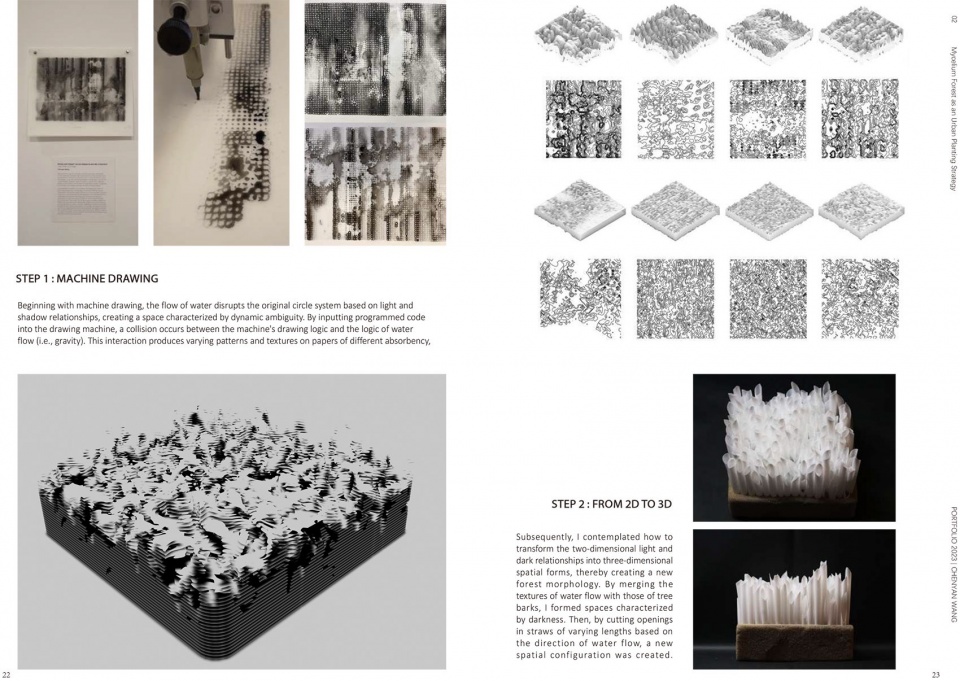
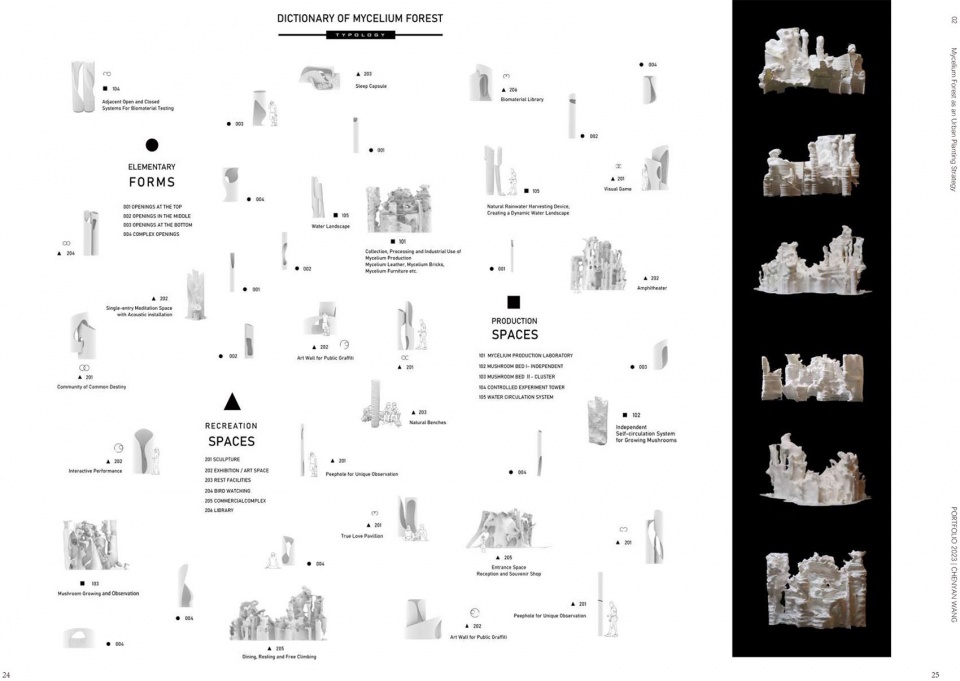
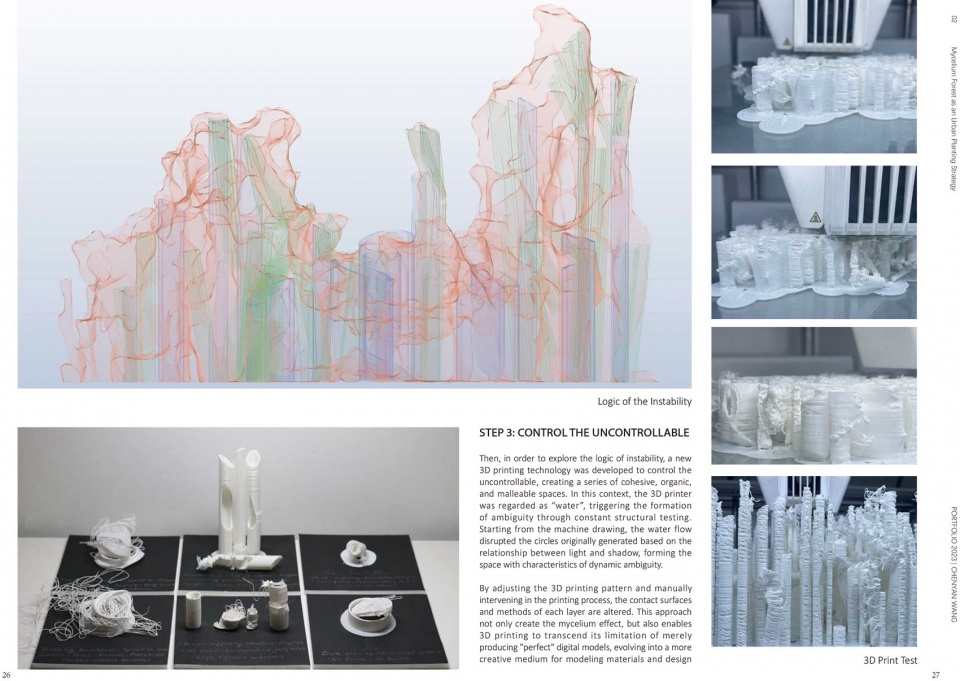
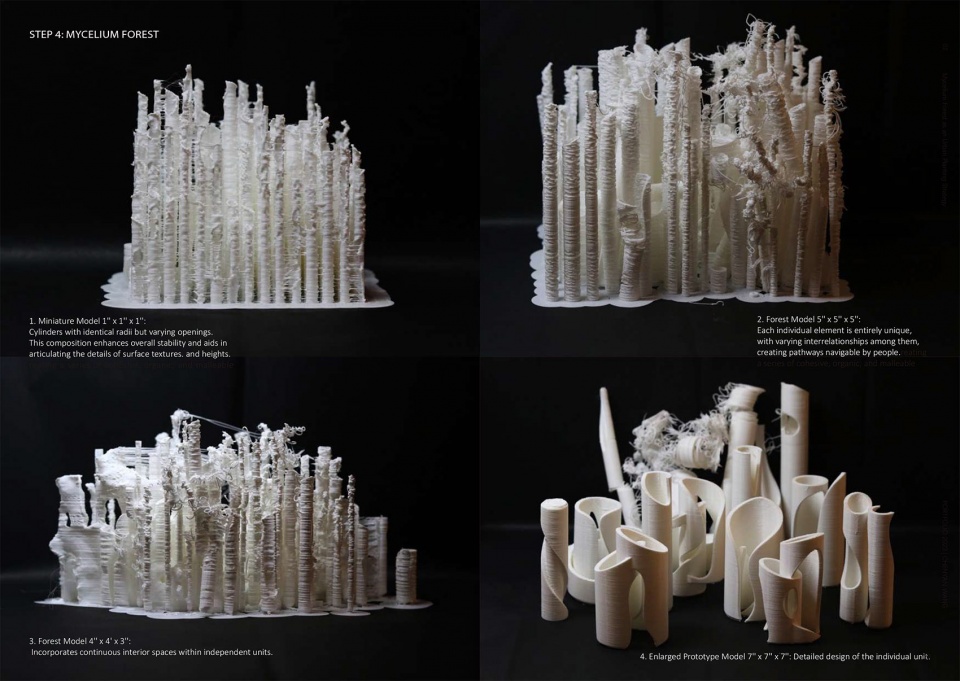
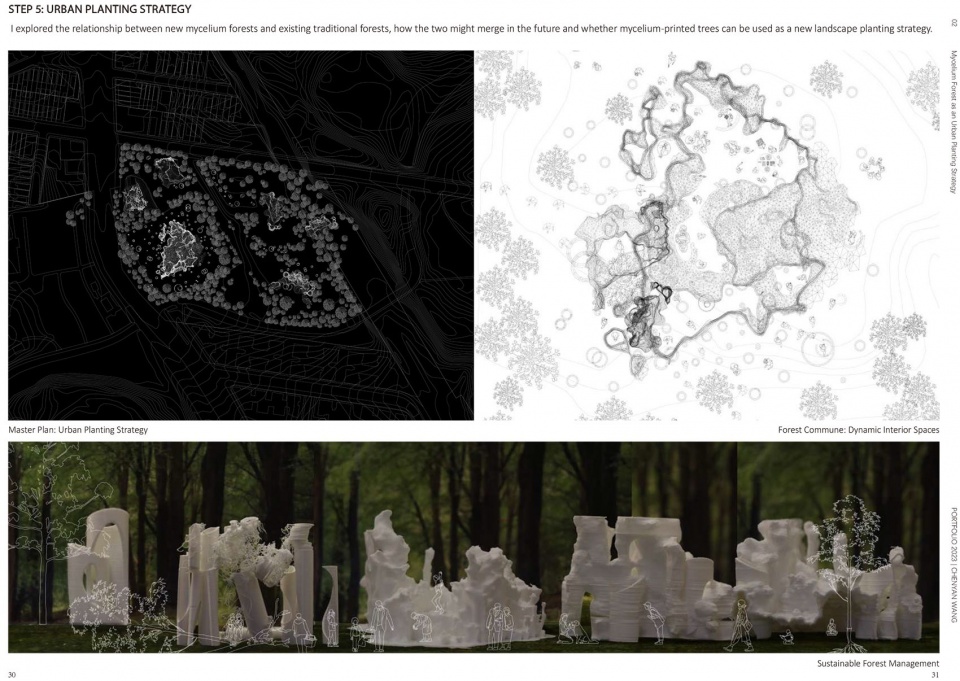
项目通过材料实验与3D打印技术探索活体菌丝在空间生成中的潜力,并将菌丝的培育、加工与生态生产纳入森林系统之中。通过研究新旧森林之间的动态边界,项目提出不同类型的“菌丝时刻(Mycelium Moment)”,作为一种原型景观,探索未来城市中的替代性种植策略。
Through material experimentation and 3D printing techniques, the project explores the potential of living mycelium in spatial formation, integrating its cultivation, processing, and ecological production into the forest system. By examining the dynamic boundaries between new mycelium forests and existing woodlands, the project proposes a series of “mycelium moments” as archetypal landscape conditions and explores alternative planting strategies for future urban environments.
03.
蓝色补丁
Blue Patch
“蓝色补丁” 是一个关于中国乡村空间演变的研究项目。项目基于为期五个月的田野调查,在“乡村振兴”政策背景下,关注那些因缺乏明确经济与生态价值而逐渐被规划体系忽略的村庄。这些处于边缘状态的聚落,逐渐形成了一种混杂、自发且不断演化的空间景观。
“Blue Patch” is a research project that investigates the spatial transformation of rural settlements in China. Based on five months of fieldwork, the project focuses on villages that, under the broader policy framework of rural revitalization, have gradually been overlooked by planning systems due to their lack of clear economic or ecological value. These marginalized settlements have slowly evolved into hybrid, self-organized landscapes shaped by everyday practices and informal adaptations.
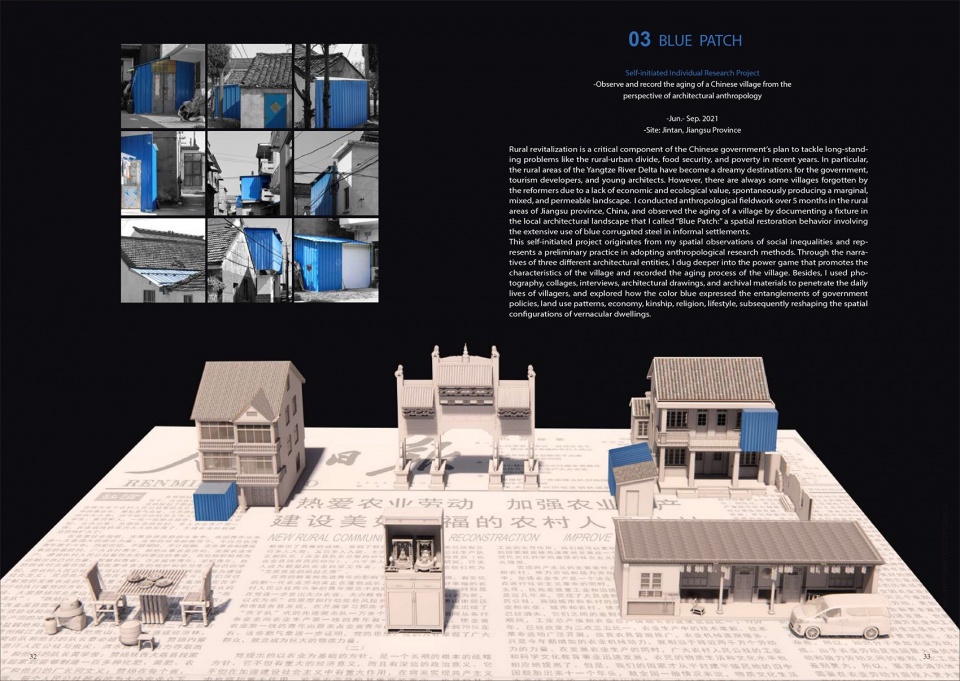
研究从一种看似偶然的视觉现象(蓝色波纹铁皮在乡村建筑中的广泛出现)作为切入点,将其视为一种“色彩的空间入侵”。通过追踪这一材料在村庄中的扩散与叠加,项目试图揭示其背后所隐含的经济结构、政策机制与社会关系的变化,并进一步探讨:当村庄不可避免地走向老龄化与衰退时,空间是否能够以一种更为从容与优雅的方式回应这一过程。
The research begins with what appears to be a minor visual phenomenon—the widespread use of blue corrugated steel sheets in rural buildings. I approach this phenomenon as a form of “spatial color intrusion.” By tracing the proliferation and layering of this material across the village, the project seeks to reveal the shifting economic structures, policy mechanisms, and social relations embedded within these seemingly ordinary constructions. More importantly, it raises a broader question: as many villages inevitably face aging populations and gradual decline, can spatial practices respond to this process in a more gentle and dignified way?
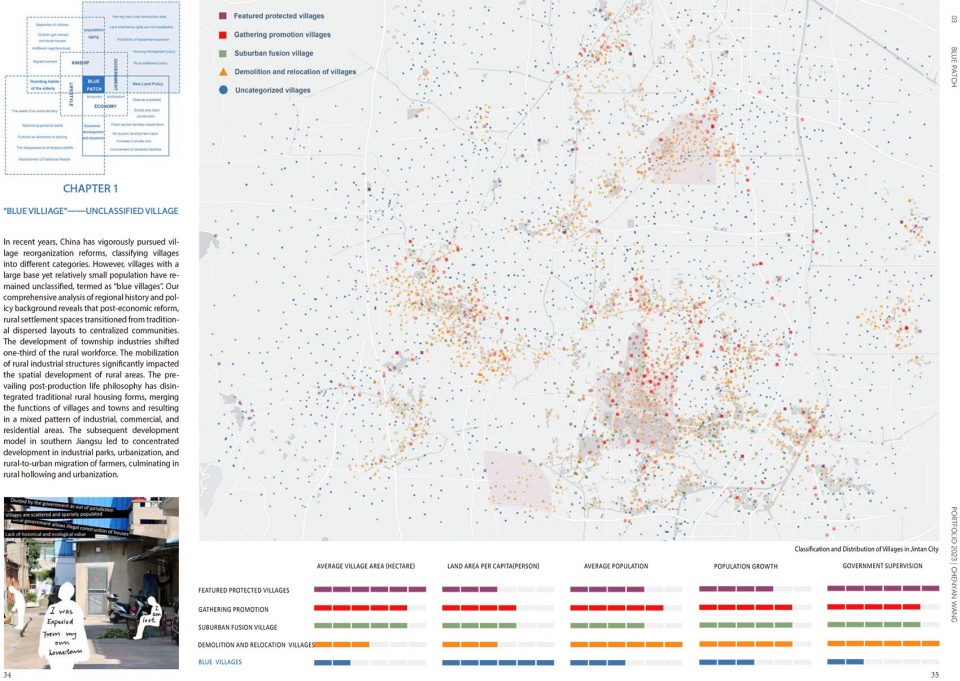
在调研过程中,我注意到村民在房屋修补或扩建时大量使用蓝色波纹铁皮。这些临时性构筑被我称为“蓝色补丁”。这种看似随意的空间修补行为,实际上记录了乡村人口流动、家庭结构变化、土地制度以及日常生活方式的转变。
During the fieldwork, I observed that villagers frequently used blue corrugated steel sheets when repairing or extending their houses. I refer to these temporary constructions as “Blue Patch.” What appears to be a casual act of spatial repair actually records deeper transformations in rural society, including patterns of migration, changes in family structures, land-use systems, and everyday lifestyles.
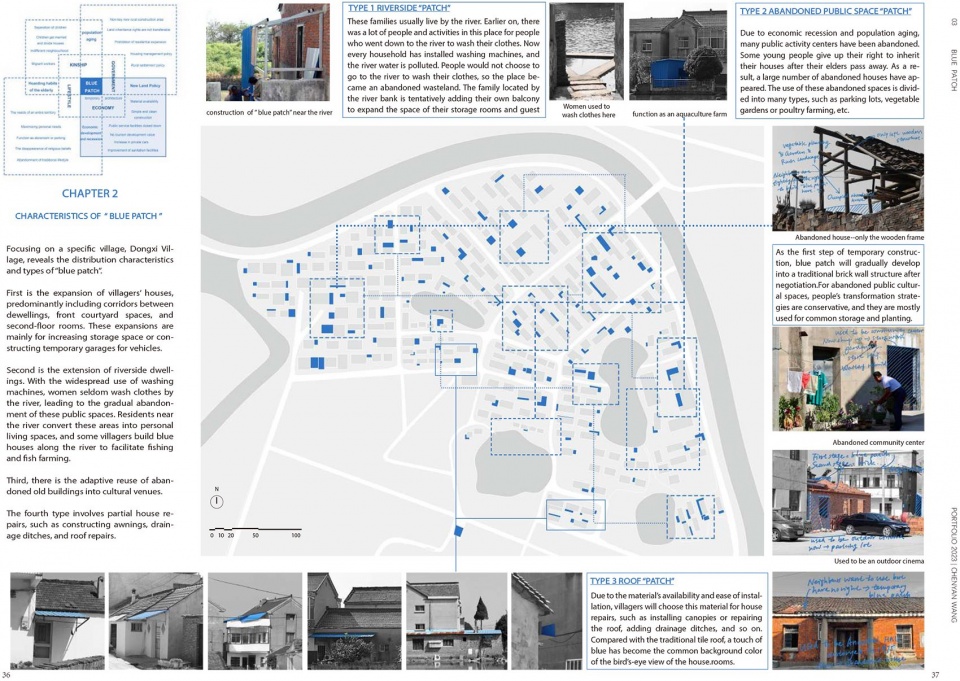
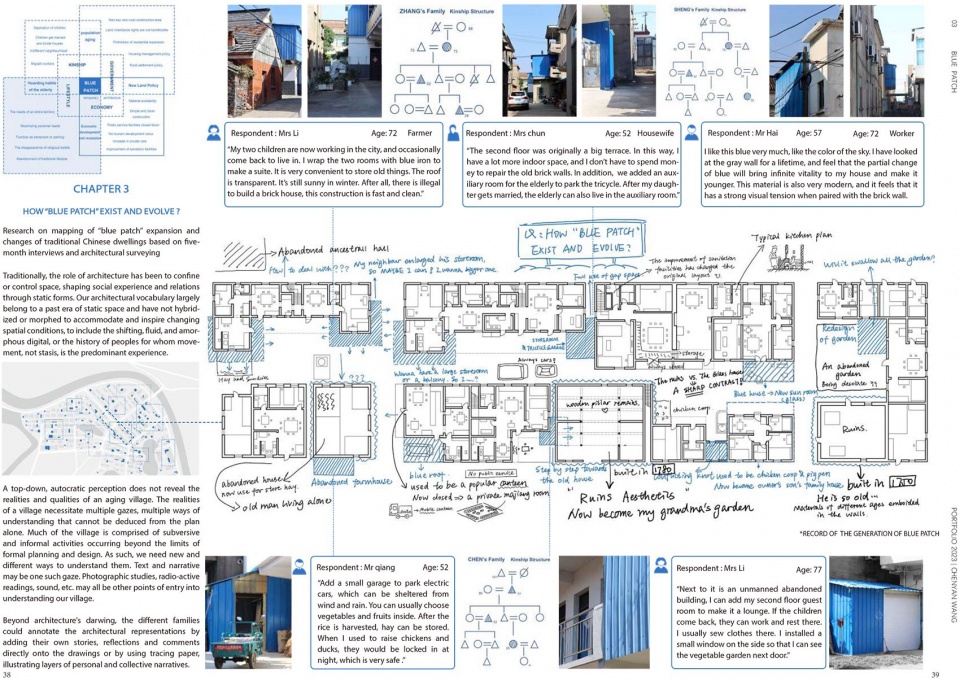
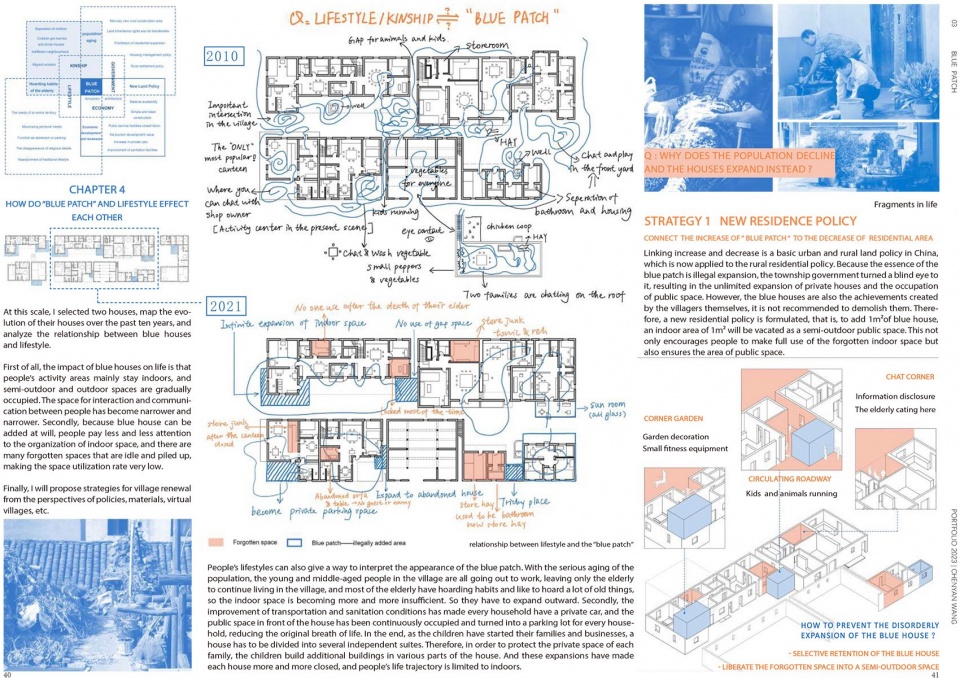
项目通过摄影、拼贴、访谈、建筑测绘和档案资料等多种方法,记录并分析这种“蓝色补丁”在村庄中的分布、演化和空间类型。从河岸扩建、屋顶修补到废弃公共空间的再利用,这些细小的空间行为构成了村庄缓慢变化的真实轨迹。
Through photography, collage, interviews, architectural surveys, and archival research, the project documents and analyzes the distribution, evolution, and spatial typologies of these “blue patches” across the village. From riverside extensions and roof repairs to the adaptive reuse of abandoned public spaces, these small spatial interventions together map the slow and often unnoticed transformations of rural life.
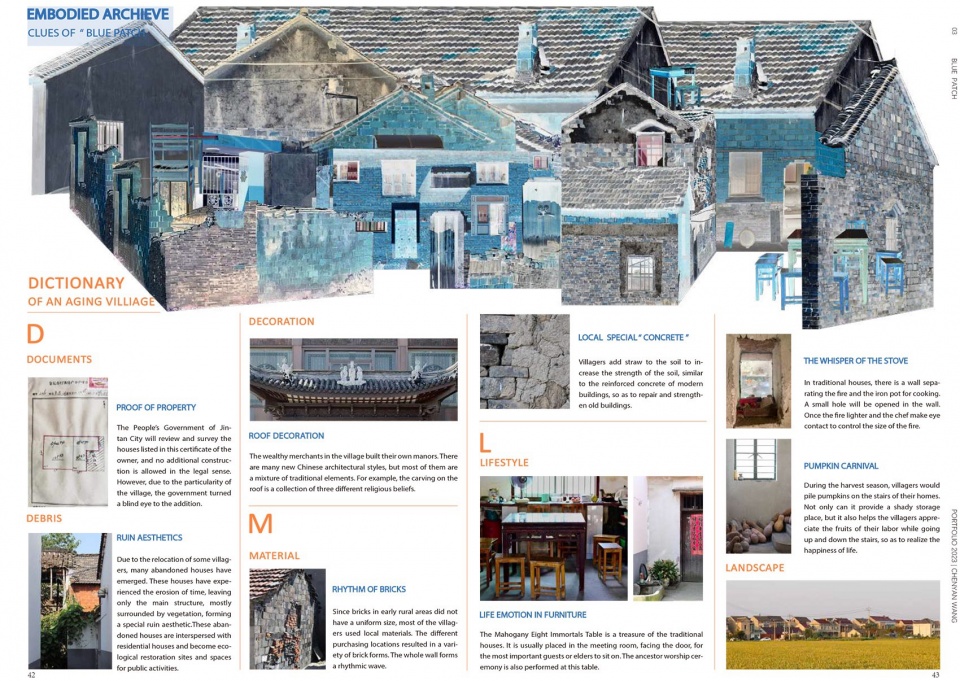
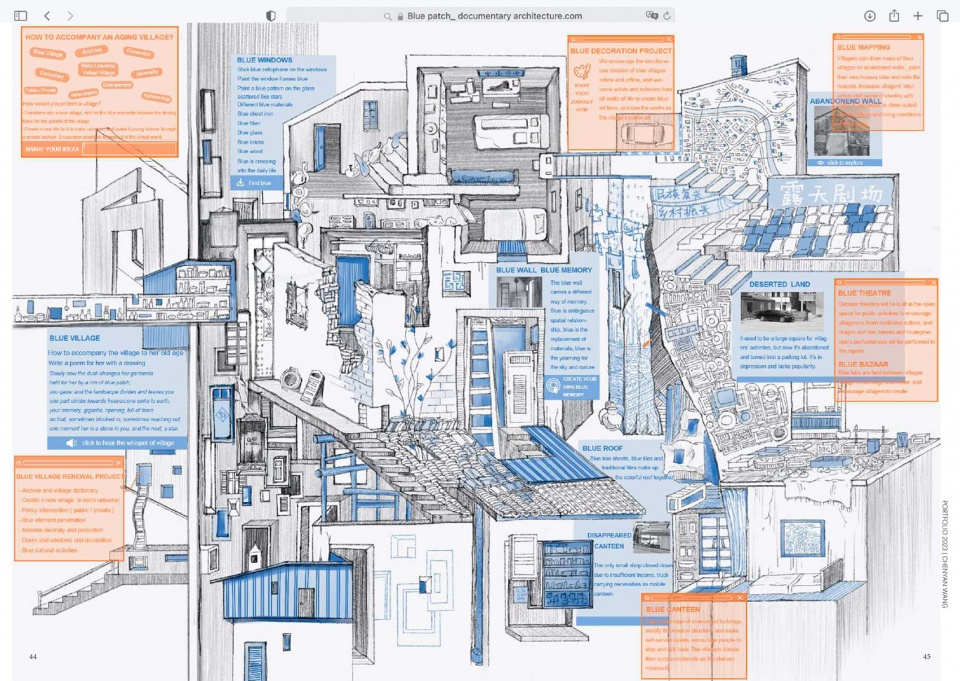
相比传统自上而下的规划视角,这个研究更关注日常生活中的微观实践:建筑并不是一个静态完成的对象,而是不断被居民重新使用、修补和改写的过程。通过这些“蓝色补丁”,我们可以看到政策、经济、家庭关系与生活方式如何共同塑造乡村空间,并在时间中留下痕迹。最后我通过手绘和互动网站的方式帮助乡村完成了第二次新生。
Rather than adopting a conventional top-down planning perspective, the research pays closer attention to the micro-practices of everyday life. Architecture here is not a static object but an ongoing process—constantly reused, repaired, and rewritten by its inhabitants. Through the lens of the “blue patch,” the project reveals how policies, economic conditions, kinship structures, and daily routines collectively shape rural space over time. Finally, through aseries of hand drawings and an interactive website, the project attempts to reassemble these fragmented narratives and imagine a renewed spatial future for the village.
在海外时间:2022至今
在海外地点:纽约
姓名:王晨燕(Chenyan Wang)
籍贯:江苏
学校:本科:浙江大学,硕士:Cooper Union
工作单位:EKLA
联系方式:chenyan.wang@hotmail.com
When: 2022-present
Where: New York
Name: Chenyan Wang
From: Jiangsu
School: Zhejiang University / Cooper Union
Office: EKLA
Contact: chenyan.wang@hotmail.com
喜欢蓝色补丁
DK
家门儿很优秀